• Nenhum resultado encontrado

Stimulatory sub-lethal response of a generalist predator to permethrin: hormesis, hormoligosis or homeostatic regulation?

N/A
N/A
Protected

Academic year: 2017

Share "Stimulatory sub-lethal response of a generalist predator to permethrin: hormesis, hormoligosis or homeostatic regulation?"

Copied!
27
0
0

Texto

(1)

LUCIANO VEIGA COSME

STIMULATORY SUB-LETHAL RESPONSE OF A GENERALIST

PREDATOR TO PERMETHRIN: HORMESIS, HORMOLIGOSIS OR

HOMEOSTATIC REGULATION?

Dissertação apresentada à Universidade

Federal de Viçosa, como parte das exigências

do

Programa

de

Pós-Graduação

em

Entomologia, para obtenção do título de

Magister Scientiae.

VIÇOSA

(2)

LUCIANO VEIGA COSME

STIMULATORY SUB-LETHAL RESPONSE OF A GENERALIST

PREDATOR TO PERMETHRIN: HORMESIS, HORMOLIGOSIS OR

HOMEOSTATIC REGULATION?

Dissertação apresentada à Universidade

Federal de Viçosa, como parte das exigências

do

Programa

de

Pós-Graduação

em

Entomologia, para obtenção do título de

Magister Scientiae.

APROVADA: 30 de abril de 2008.

Prof. Eliseu José Guedes Pereira

Dr. João Alfredo Marinho Ferreira

Dr. Reinildes Silva Filho

Prof. Angelo Pallini Filho

(3)

AGRADECIMENTOS

À Universidade Federal de Viçosa e ao Departamento de Biologia Animal, pela

oportunidade de realização deste curso.

Ao Conselho Nacional de Desenvolvimento Científico e Tecnológico (CNPQ),

pela concessão da bolsa de estudo.

Ao Professor, Orientador Raul Narciso C. Guedes, pela orientação e amizade

ao longo desses anos de convívio. O conhecimento adquirido por mim durante estes sete

anos de graduação e mestrado se deve especialmente a ele que contribuiu para minha

formação profissional e moral.

Aos amigos da pós-graduação Marla Maria Marquete e Leandro Gomide Neves

pela grande amizade, convívio e companheirismo ao longo da minha vida acadêmica em

Viçosa.

Aos demais professores do curso de Entomologia da UFV e também aos do

curso Agronomia da UFLA, os quais foram importantes na transmissão de suas

experiências e responsáveis por parte dos conhecimentos adquiridos durante a minha

formação.

À secretária do Programa de Pós-graduação em Entomologia Sra. Maria Paula

da Costa e à Míriam, pela ajuda.

Aos membros do laboratório do Prof. Ângelo Pallini, pelo convivio e ajuda.

A todos os meus familiares, que diretamente ou indiretamente ofereceram

condições de progredir na realização de vários sonhos e projetos.

A todos colegas dos cursos de Entomologia pelo agradável convívio durante as

disciplinas cursadas e pela relação de amizade.

(4)

BIOGRAFIA

LUCIANO VEIGA COSME, filho de Luiz Cosme e Maria da Fátima Veiga,

nasceu em Três Pontas, Minas Gerais, em 09 de Junho de 1979.

Em dezembro de 1996, concluiu o concluiu o curso técnico profissionalizante

em Agropecuária na Escola Agrotécnica Federal de Inconfidentes, Inconfidentes, MG.

Entre janeiro de 1997 e dezembro de 1999 trabalhor como assistente técnico na estação

experimental da Bayer Crop Science em Paulínea, SP. Em março de 2000 engressou no

curso de Agronomia pela Universidade Federal de Lavras. Durante a graduação,

recebeu bolsa de iniciação científica do CNPq e bolsa da Bayer Crop Science. Em 2003

e 2004 foi premiado pela Sociedade Mineira de Engenharia pelos projetos realizados

sob a orientaçao do prof. Geraldo Andrade Carvalho, do departamento de entomologia

da UFLA. Em 2003 foi selecionado para participar do programa de intercâmbio

internacional CAEP, tendo residido nos Estados Unidos por um ano e aperfeiçoamento

em técnicas de produção de plantas ornamentais.

(5)

ÍNDICE

RESUMO ... v

ABSTRACT ... vi

1. INTRODUCTION ... 1

2.MATERIALS AND METHODS ... 5

2.1 Insects and Insecticide ... 5

2.2 Life Table Experiments and Estimated Parameters ... 6

2.3 Statistical Analysis ... 7

3 RESULTS ... 8

3.1 Survival Analysis ... 8

3.2 Fitness parameters ... 9

3.3 Reproductive Value ... 12

4. DISCUSSION ... 13

(6)

RESUMO

COSME, Luciano Veiga. M.Sc., Universidade Federal de Viçosa, abril de 2008.

Resposta sub-letal estimultória de um predador generalista à permetrina:

hormese, hormoligose ou regulação homeostática? Orientador: Raul Narciso

Carvalho Guedes. Co-orientadores: Kun Yun Zhu, José Lino Neto e Marcelo

Coutinho Picanço.

(7)

ABSTRACT

COSME, Luciano Veiga. M.Sc., Universidade Federal de Viçosa, april of 2008.

Stimulatory sub-lethal response of a generalist predator to permethrin:

hormesis, hormoligosis or homeostatic regulation? Advisor: Raul Narciso

Carvalho Guedes. Co-Advisors: Kun Yun Zhu, José Lino Neto and Marcelo

Coutinho Picanço.

The assessment of pesticide effects in arthropods historically have relied heavily

on acute lethal effects and the sub-lethal responses to such compounds are frequently

neglected. However, stimulatory effects associated with low doses of compounds toxic

at higher doses, such as pesticides, have been widely reported in recent years and

recognized as a general toxicological phenomenon. Evidence of such stimulatory

response has also been reported among mites and a few insect pest-species exposed to

pesticides and recognized as a one of the potential causes underlying pest resurgence

and secondary pest outbreaks. However, fitness parameters and its implications were

seldom considered in these studies and natural enemies are not usually target of

attention. Here we reported the stimulatory effect of sub-lethal doses (ranging from 0.02

to 172.00 ppb in addition to the control) of the pyrethroid permethrin topically applied

to 3

rd

instar nymphs of the spined soldier bug Podisus distinctus (Stål) (Heteroptera:

Pentatomidae). The parameters estimated from the fertility tables of insects exposed to

the increasing doses of insecticide indicated a slight increase in the mean survival time

for doses ≥ 0.20 ppb and a peak in the net reproductive rate at 1.72 ppb. This trend is

coincident and correlated with the intrinsic rate of population growth (n = 18, r = 0.78,

P = 0.0001), which also shows a peak at 1.72 ppb leading to higher reproductive values

(8)

1. INTRODUCTION

The assessment of pesticide effects in arthropods historically has relied heavily

on acute lethal effects of these toxic compounds. Pesticide bioassays with arthropods

are usually designed to evaluate acute toxicity by testing individuals of a specific life

stage, age and size with the primary objective of estimating their lethality through

dose-response estimates employing binary scoring (i.e., dead vs. alive). The importance of

such tests largely used for pest management and regulatory objectives is undeniable.

However, the sub-lethal responses to pesticides are frequently neglected, as are more

demographically-oriented studies despite their recognition as a more reliable approach

to toxicity assessment (Forbes and Calow 1999, Stark and Bank 2003).

(9)

Calabrese and Baldwin 2001b, 2003ab; Calabrese 2004). Evidence of such stimulatory

response has also been reported among arthropod pest-species exposed to pesticides,

and has been recognized as one of the potential causes underlying pest resurgence and

secondary pest outbreaks (Dittrich et al. 1974, Gerson and Cohen 1989; Hardin et al.

1995, Morse 1998, Cohen 2006). Mite pest-species, particularly the two-spotted spider

mite Tetranychus urticae, have been the main object of attention in addition to a few

other mite and insect-pest species (Dittrich et al. 1974, Carey 1982, Trichilo and Wilson

1993, James and Price 2002, Cuthbertson et al. 2003, Marcic 2003, Cutler et al. 2005).

However, fitness parameters and its implications were seldom considered in these

studies and natural enemies are not usually target of attention.

The recognition that the dose-response relationship of toxic compounds may be

biphasic with a stimulatory response at low doses is credited to Schulz (1887), although

the term hormesis was coined much later by Southam and Ehrlich (1947). The low-dose

stimulation of subinhibitory doses was referred to as “hormesis” derived from the Greek

“to excite” and has become widespread when describing a d

ose-response continuum

involving a low-dose stimulation/high-dose inhibition (Calabrese and Baldwin 2001b,

2003a, Calabrese 2004). Insecticide hormoligosis is frequently used in entomology and

acarology as a synonym of hormesis (Morse 1998). However, Luckey (1968) coined the

term from the Greek “hormo”(“to excite”, as in hormesis) and oligo (“minute”) to

(10)

hormoligosis was earlier described in house crickets (Acheta domesticus), under

suboptimal conditions of diet and temperature, when exposed to sub-lethal doses of

insecticides (Luckey 1968).

Pesticide-mediated homeostatic modulation in arthropods was a term recently

coined by Cohen (2006) to describe both true hormesis and hormesis-like (e.g.,

hormoligosis) phenomena establishing their hierarchy and allowing their proper

recognition within related studies with insects and mites exposed to sub-lethal doses of

pesticides, which has been faulty. Stimulatory effects observed with pesticides that are

non-toxic to arthropods at high doses do not fall within the scope of hormesis and

therefore cannot be considered hormetic, although the underlying mechanisms may be

identical. Hence, as homeostasis in arthropods is affected and modulated by pesticides

to produce stimulatory effects, the term pesticide-induce homeostatic modulation

(PIHM) was suggested (Cohen 2006). Alleged hormetic effects on mites and natural

enemies were the main concern in coining the PIHM definition, mainly because they are

frequently non-targeted by the insecticide applications and the toxicity of the applied

insecticide is not known or reported for the non-target species, compromising the

recognition of hormesis as the phenomenon in place. Parallel difficulties were also

reported in early surveys of the general occurrence of hormesis as a toxicological

phenomenon (Calabrese 1997, 2001ab, 2003a).

(11)

tolerant to pyrethroid insecticides used against this pest species (Picanço et al. 1996,

Magalhães et al. 2002, Zanuncio et al. 2002). In addition, preliminary evidence of

hormesis have been reported in this species as well as in the related predator of relative

minor importance Supputius cinctipes (Stål) (Heteroptera: Pentatomidae) (Magalhães et

al. 2002, Zanuncio et al. 2003). These earlier studies did not considered overall fitness

assessment in demographic studies, but rather focused on isolated fitness components.

(12)

2. MATERIALS AND METHODS

2.1 Insects and Insecticide

(13)

solution applied with a calibrated microsyringe in a microapplicator (Burkward,

Rickmansworth, UK) targeting the insect scutelum.

2.2 Life Table Experiments and Estimated Parameters

The fitness parameters were estimated for three batches of insects exposed to

each dose of permethrin, in addition to a control (acetone only). One hundred eggs (24 h

old) were used to establish the insect cohorts to be exposed to each insecticide dose.

The eggs were collected from the laboratory colony using cotton wads and place in Petri

dishes (9 cm diameter x 1.5 cm high), where they were maintained with a wet cotton

wad to secure high humidity and water availability to the nymphs. The emerged nymphs

were transferred in groups of 20 individuals to 200 ml plastic containers with water

provided in wet cotton wads. Upon reaching the 3

rd

instar, the nymphs were isolated in

500 ml plastic containers, where water was again provided through a wet cotton wad

and pupae of yellow mealworm were daily provided ad libitum following Magalhães et

al. (2002) and Zanuncio et al. (2003). After 24 h, the 3

rd

instar nymphs were

individually subjected to permethrin application as previously described and

subsequently placed back in their individual containers. Three groups of 20

individualized nymphs (3

rd

instar) were daily followed and upon reaching the adult

stage, the females were paired with males subjected to the same permethrin exposure.

The females were daily observed throughout their lives recording their survival,

fecundity (eggs laid daily) and fertility (hatched nymphs) until eventual death.

(14)

2.3 Statistical Analysis

The daily survivorship data was subjected to survival analysis using the

procedure LIFETEST from SAS and the log-rank

χ

2

to test the equality of the survival

curves between doses of permethrin (SAS Institute 2002). The estimated mean survival

time (days) obtained in the survival analysis, as well as the life table estimates of

generation time (G), net reproductive rate (Ro), intrinsic rate of population growth (r

m

)

were subjected to regression analysis using dose of permethrin as independent variable

in the curve-fitting procedure from TableCurve 2D (SPSS 2000). The reproductive

value of each cohort exposed to each insecticide dose was also subjected to regression

analysis, but using insect age (days) as independent variable also in the curve-fitting

procedure from TableCurve 2D (SPSS 2000). The models were tested from the simplest

(linear and quadratic) to the alternative models of increasing complexity (non-linear

peak models). The model selection was carried out based on simplicity, high F-values

(and mean squares) and steep increase of R

2

with model complexity. Residue

distribution was also checked for each analysis on TableCurve 2D to ascertain of

parametric assumptions. Punctual contrasts between the control treatment (without

permethrin exposure) and the permethrin dose showing the highest response were tested

(15)

3. RESULTS

3.1 Survival Analysis

The survival analysis of the daily survivorship data indicated significant

differences between the insects exposed to increasing doses of permethrin (log-rank

χ

2

=

66.87, df = 5, P < 0.0001). Therefore, the mean survival times estimated for each

replicate of permethrin dose were subjected to regression analysis using the dose of

permethrin as independent variable. The control treatment (0.0 ppb permethrin) was not

included in the analysis to allow more flexibility in selecting the best model, since the

zero value will prevent use of ratio and log-based models. The best descriptive model

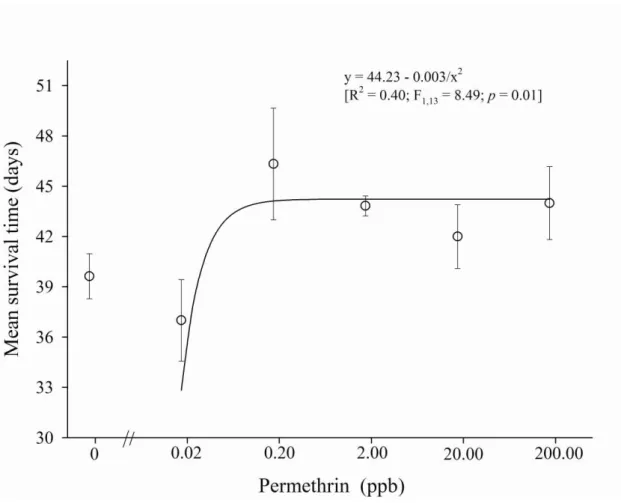
obtained indicated an increase in mean survival time with permethrin dose until

reaching a plateau at 45 days (Fig. 1). The mean survival time of insects without

permethrin exposure was significantly lower than for insets exposed to 0.2 ppb (t

1,4

=

(16)

Figure 1. Effect of sub-lethal doses of permethrin in the mean survival time of the

predator Podisus distinctus. Each symbol represents the mean of three replicates and the

vertical bars indicate the standard error of the means.

3.2 Fitness parameters

The fitness parameters generation time (G), net reproductive rate (Ro) and

intrinsic rate of population growth (r

m

) were estimated through fertility tables of females

(17)

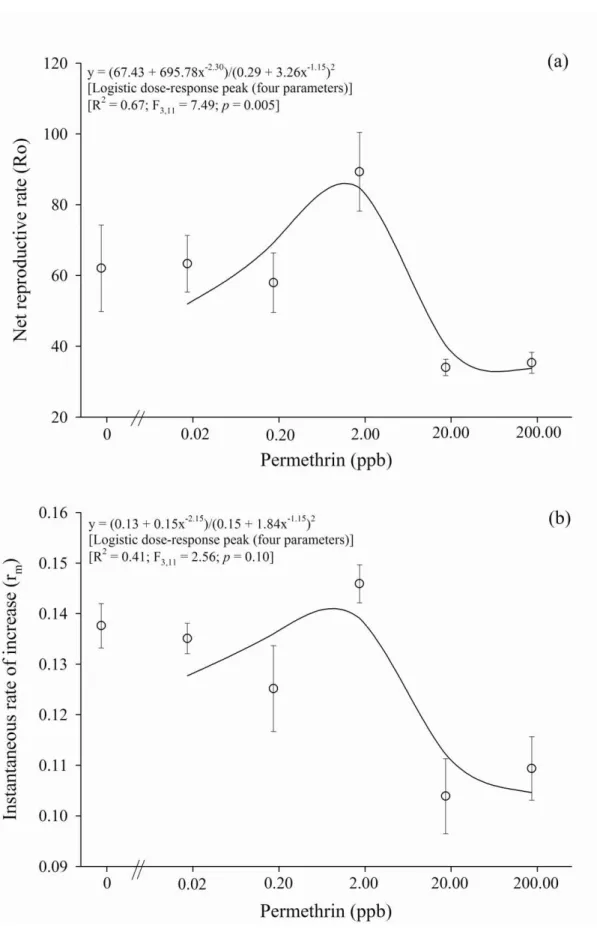
reproductive rate, which showed a peak at 1.7 ppb permethrin (89.33 ± 11.11; Fig. 2a).

This peak in net reproductive rate was significantly different from the net reproductive

rate without permethrin exposure (62.06 ± 9.02) (t

1,4

= 2.73; P = 0.05). The intrinsic rate

of population growth was significantly correlated with the net reproductive rate (n = 18,

r = 0.78, P < 0.0001) and showed a trend similar to this parameter, although significant

only at P = 0.10 (Fig. 2b). This was due to the opposite action of generation time

reducing the impact of the reproductive rate in the intrinsic rate of population growth,

whose peak also at 1.7 ppb permethrin (0.146 ± 0.004) did not differ significantly from

the rate of population growth of insects not exposed to permethrin (0.138 ± 0.004) (t

1,4

=

(18)
(19)

3.3 Reproductive Value

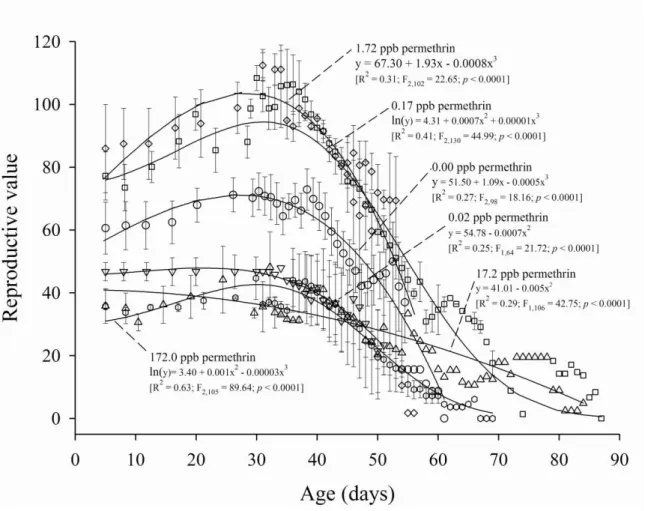
The regressions carried out with the estimated reproductive values of insects

exposed to increased doses of permethrin indicated a peak around 30 days of age and

again the females exposed to sub-lethal doses of the insecticide in the range of 0.2 and

1.7 ppb exhibited higher reproductive values, followed by the non-exposed insects and

then the females exposed to the remaining doses (Fig. 3).

(20)

4. DISCUSSION

(21)

Hormoligosis, together with hormesis and other hormesis-related phenomena,

are examples of pesticide-mediated homeostatic modulation (Cohen 2006).

Hormoligosis was first reported by Luckey (1968) in house crickets (Acheta domesticus

(L.)) exposed to sub-lethal doses of a range of different insecticides (mainly

organochlorines, but also organophosphates), which were the different stressors used,

under suboptimal conditions of temperature and nutrition. The conditions of this

experiment satisfy the hormesis criteria

a sub-lethal dose of a toxic compound and

assessment of a parameter (weight gain in the case) able to display either stimulatory or

inhibitory responses (Calabrese and Baldwin 2001ab, 2003a)

were satisfied and this is

a likely reason for its frequent confusion with hormesis within entomology and

acarology (see Morse 1998, Cohen 2006). However, hormoligosis was defined based on

the use of a stressor (which is not necessarily a toxic compound within an applied

framework) under suboptimal conditions for the targeted species (Luckey 1968). The

suboptimal conditions are systematically neglected in the studies reporting pesticide

hormoligosis, and sometimes toxicity of the pesticide under investigation to the species

is not considered as pointed by Cohen (2006). The hormesis criteria is not met if the

pesticide considered is selective in favor of a non-target species (e.g. a natural enemy or

another non-target species) and if its toxicity to the studied species in not indicated

somehow, but the hormoligosis concept is satisfied since the pesticide is still a stressor.

(22)

the experimental conditions and results obtained clearly indicate that the hormesis

phenomenon takes place in P. distinctus. Furthermore, the insecticide-induced hormesis

in P. distinctus was detected using demographic parameters (net reproductive rate and

consequently reproductive value), which we are not aware of for any other insect

predator species.

The use of fitness parameters as the toxicological endpoint in our study allows

us to test the prediction of Forbes (2000). Based on earlier surveyed studies on

hormesis, Forbes (2000) suggested that the overall fitness of an organism is unlikely to

enhance at low levels of exposure to toxic agents because life-history traits are not

likely to exhibit hormesis simultaneously as a result of energetic trade-offs among them.

Some evidence to the contrary exists concerning pesticide-mediated homeostatic

modulation in two-spotted spider mites (not hormesis) (Dittrich et al. 1974, Carey

1982), but such evolutionary expectation has yet to be tested for pesticide-induced

hormesis in arthropods. Podisus distinctus exhibits increased reproductive output under

sub-lethal doses of permethrin and such increase was within the 30-60% range of

increase commonly reported for hormesis (Calabrese 2003a). However, when the

intrinsic rate of population growth (r

m

) was considered in our study, the increase

observed under sub-lethal doses of permethrin was barely significant and certainly

undistinguishable from the control without permethrin exposure. Such finding lay

credence to the prediction by Forbes (2000) and the suggestion that reproduction may

be favored under sub-lethal doses of toxic compounds at the expense of other

physiological process (e.g., maintenance), as predicted by the principle of resource

allocation put forward by Sibly and Calow (1986). However, the same may not take

place with other organisms and conditions, what deserves attention.

(23)
(24)

5. REFERENCES CITED

Calabrese, E. J. 2004. Hormesis: from marginalization to mainstream. A case for

hormesis as the default dose-response model in risk assessment. Toxicol. Appl.

Pharmacol. 197: 125-136.

Calabrese, E. J., and L. A. Baldwin. 1997. A quantitatively based methodology for the

evaluation of hormesis. Hum. Ecol. Risk Assess. 3: 545-554.

Calabrese, E. J., and L. A. Baldwin. 2001a. The frequency of U-shaped dose

responses in the toxicological literature. Toxicol. Sci. 62: 330-338.

Calabrese, E. J., and L. A. Baldwin. 2001b. U-shaped dose-response in biology,

toxicology, and public health. Annu. Rev. Public Health 22: 15-33.

Calabrese, E. J., and L. A. Baldwin. 2003a. Hormesis: the dose-response revolution.

Annu. Rev. Pharmacol. Toxicol. 43: 175-197.

Calabrese, E. J., and L. A. Baldwin. 2003b. Toxicology rethinks its central belief.

Nature 421: 691-692.

(25)

Chapman, P. M. 2001. Reflections on the future of hormesis. Crit. Rev. Toxicol. 31:

649-651.

Cohen, E. 2006. Pesticide-mediated homeostatic modulation in arthropods. Pestic.

Biochem. Physiol. 85: 21-27.

Cook, R. R., and E. J. Calabrese. 2006. The importance of hormesis to public health.

Environ. Health Perspect. 114: 1631-1635.

Cuthbertson, A. G. S., A. C. Bell, and A. K. Murchie. 2003. Impact of the predatory

mite Anystis baccarum (Prostigmata: Anystidae) on apple rust mite Aculus

schlechtendali (Prostigmata: Eriophyidae) populations in Northern Ireland Bramley

orchards. Ann. Appl. Biol. 142: 107-114.

Cutler, G. C., C. D. Scott-Dupree, J. H. Tolman, and C. R. Harris. 2005. Acute and

sublethal toxicity of novaluron, a novel chitin synthesis inhibitor, to Leptinotarsa

decemlineata (Coleoptera: Chrysomelidae). Pest Manag. Sci. 61: 1060-1068.

Dittrich, V., P. Streitbert, and P. A. Bathe. 1974. An old case reopened: mite

stimulation by insecticide residues. Environ. Entomol. 3: 534-540.

Ferguson, J. S., and R. K. Chapman. 1993. Factors involved in carbaryl-induced

population build-ups of Myzus persicae (Sulzer) (Homoptera, Aphididae) on potato.

J. Agric. Entomol. 10: 51-64.

Forbes, V. E. 2000. Is hormesis an evolutionary expectation? Funct. Ecol. 14: 12-24.

Forbes, V. E., and P. Calow. 1999. Is the per capita rate of increase a good measure of

population-level effects in ecotoxicology? Environ. Toxicol. Chem. 18: 1544-1556.

Gerson, U., and E. Cohen. 1989. Resurgences of spider mites (Acari: Tetranychidae)

induced by synthetic pyrethroids. Exp. Appl. Acarol. 6: 29-46.

(26)

James, D. G., and T. S. Price. 2002. Fecundity in twospotted spider mite (Acari:

Tetranychidae) is increased by direct and systemic exposure to imidacloprid. J. Econ.

Entomol. 95: 729-732.

Luckey, T. D. 1968. Insecticide hormoligosis. J. Econ. Entomol. 61: 7-12.

Magalhães, L. C., R. N. C. Guedes, E. E. Oliveira, and E. S. Tuelher. 2002.

Desenvolvimento e reprodução do predador Podisus distinctus (Stål) (Heteroptera:

Pentatomidae) frente a doses subletais de permetrina. Neotrop. Entomol. 31: 445-448.

Maia, A. H. N., A. J. B. Luiz, and C. Campanhola. 2000. Statistical inference on

associated fertility life table parameters using jackknife technique: computational

aspects. J. Econ. Entomol. 93: 511-518.

Marcic, D. 2003. The effects of clofentezine on life-table parameters in two-spotted

spider mite Tetranychus urticae. Exp. Appl. Acarol. 30: 249-263.

Morse, J. G. 1998. Agricultural implications of pesticide-induced hormesis of insects

and mites. Hum. Exp. Toxicol. 17: 266-269.

Morse, J. G., and N. Zareh. 1991. Pesticide-induced hormoligosis of citrus thrips

(Thysanoptera, Thripidae). J. Econ. Entomol. 84: 1169-1174.

Murado, M. A., and J. A. Vázquez. 2007. The notion of hormesis and the

dose-response theory: a unified approach. J. Theor. Biol. 244: 489-499.

Penman, D. R., and R. B. Chapman. 1980. Woolly apple aphid outbreak following

use of fenvalerate in apples in Canterbury, New Zealand. J. Econ. Entomol. 73: 49-51.

Picanço, M. C., R. N. C. Guedes, V. C. Batalha, and R. P. Campos. 1996. Toxicity

of insecticides to Dione juno juno (Lepidoptera: Heliconidae) and selectivity to two

of its predaceous bugs. Trop. Sci. 36: 51-53.

SAS Institute. 2002.

SAS/STAT user’s guide, vol

. 8. SAS Institute, Cary, NC, USA.

Schulz, H. 1887. Zur Lehre von der Arzneiwirdung. Arch. Pathol. Anat. Physiol. Klin.

(27)

Sibly, R. M., and P. Calow. 1986. Physiological ecology of animals

an evolutionary

approach. Blackwell, Oxford, UK.

Southam, C. M., and J. Ehrlich. 1943. Effects of extracts of western red-cedar

heartwood on certain wood-decaying fungi in culture. Phytopathology 33:

517-524.

Southwood, T. R. E. 1978. Ecological methods with particular reference to the study of

insect populations, 2

nd

ed. Chapman and Hall, London, UK.

Stark, J. D., and Banks, J. E. 2003. Population-level effects of pesticides and other

toxicants on arthropods. Annu. Rev. Entomol. 48: 505-519.

SPSS. 2000. TableCurve 2D

user’s guide. SPSS,

Chicago, IL, USA.

Toft, S., and A. P. Jensen. 1998. No negative sublethal effects of two insecticides on

prey capture and development of a spider. Pestic. Sci. 52: 223-228.

Trichilo, P. J., and L. T. Wilson. 1993. An ecosystem analysis of spider mite

outbreaks: physiological stimulation or natural enemy suppression. Exp. Appl.

Acarol. 17: 291-314.

Zanuncio, J. C., R. N. C. Guedes, H. N. Oliveira, and T. V. Zanuncio. 2002. Uma

década de estudos com percevejos predadores: conquistas e desafios, PP. 495-509.

In J. R. P. Parra, P. S. M. Botelho, B. S. Corrêa-Ferreira and J. M. S. Bento (Eds.),

Controle biológico no Brasil: parasitóides e predadores. Manole, Barueri, SP,

Brazil.

Zanuncio, T. V., J. E. Serrão, J. C. Zanuncio, and R. N. C. Guedes. 2003.

Permethrin-induced hormesis on the predator Supputius cincticeps (Stål, 1860)

(Heteroptera: Pentatomidae). Crop Prot. 22: 941-947.

Imagem

Figure  1.  Effect  of  sub-lethal  doses  of  permethrin  in  the  mean  survival  time  of  the  predator Podisus distinctus
Figure 2. Effect of sub-lethal doses of permethrin in the net reproductive rate (a) and  intrinsic rate of population growth (b) of the predator Podisus distinctus
Fig. 3. Age-dependent reproductive value of the predator Podisus distinctus exposed to  increasing doses of permethrin

Referências

Documentos relacionados

In short, the drug industry clearly had negative implications over Colombia both internally and externally: internally, the cartels promoted violence, fomented

Sempre inquieta, realizando leituras principalmente sobre Física Moderna Contemporânea (FMC), por se tratar de um assunto que faz parte de nosso cotidiano e estar prevista

Este estudo teve como principal objetivo, investigar em que medida a relação entre o foco regulatório coletivo, enquanto estado emergente motivacional, e a eficácia do trabalho

Entre as atividades agroindustriais praticadas nos assentamentos, chamam a atenção as experiências com moinhos coloniais por envolver aspectos como: a) a amplitude de sua

Modelagem numérica e computacional com similitude e elementos finitos : equação preditiva geral para o cálculo da força de retenção em freios de estampagem [livro eletrônico]

Os objetivos deste trabalho são conhecer os problemas orais resultantes da radioterapia feita para o tratamento de neoplasias na área da cabeça e pescoço assim

Deve-se acrescentar, ainda, os jornais vinculados aos novos grupos étnicos presentes na província, como os alemães, com o jornal católico Deutsches Volksblatt, de 1871;

Baixas doses de glyphosate pode estimular o crescimento de uma variedade de espécies de plantas o efeito de hormesis provavelmente esteja relacionado com o sítio de