Partner Choice Drives the Evolution of
Cooperation via Indirect Reciprocity
Gilbert Roberts*
Centre for Behaviour and Evolution, Institute of Neuroscience, Newcastle University, Newcastle upon Tyne, United Kingdom
Abstract
Indirect reciprocity potentially provides an important means for generating cooperation based on helping those who help others. However, the use of‘image scores’to summarize individuals’past behaviour presents a dilemma: individuals withholding help from those of low image score harm their own reputation, yet giving to defectors erodes cooperation. Ex-plaining how indirect reciprocity could evolve has therefore remained problematic. In all pre-vious treatments of indirect reciprocity, individuals are assigned potential recipients and decide whether to cooperate or defect based on their reputation. A second way of achieving discrimination is through partner choice, which should enable individuals to avoid defectors. Here, I develop a model in which individuals choose to donate to anyone within their group, or to none. Whereas image scoring with random pairing produces cycles of cooperation and defection, with partner choice there is almost maximal cooperation. In contrast to image scoring with random pairing, partner choice results in almost perfect contingency, producing the correlation between giving and receiving required for cooperation. In this way, partner choice facilitates much higher and more stable levels of cooperation through image scoring than previously reported and provides a simple mechanism through which systems of help-ing those who help others can work.
Introduction
If an individual helps someone on the basis that they have helped others, indirect reciprocity can be said to be in action [1]. Indirect reciprocity is an important concept because it is integral to the notion that we may benefit from being seen to be cooperative. Furthermore, it is not de-pendent upon repeated meeting between the same pair of individuals [2]. These factors suggest that indirect reciprocity may have been important in the development of human sociality, and may have co-evolved with morality and language [3].
Models of indirect reciprocity show that cooperation (sensupaying a cost to benefit another, e.g. [4]) is possible, but that it is cyclically unstable, with defection being as likely as cooperation [2]. Image scoring, which represents cooperating and defecting histories positively and nega-tively, has an Achilles heel because withholding help from defectors harms ego’s reputation, yet providing help erodes the discrimination required for cooperation. Experiments show that a11111
OPEN ACCESS
Citation:Roberts G (2015) Partner Choice Drives the Evolution of Cooperation via Indirect Reciprocity. PLoS ONE 10(6): e0129442. doi:10.1371/journal. pone.0129442
Received:January 24, 2014
Accepted:May 10, 2015
Published:June 9, 2015
Copyright:© 2015 Gilbert Roberts. This is an open access article distributed under the terms of the
Creative Commons Attribution License, which permits unrestricted use, distribution, and reproduction in any medium, provided the original author and source are credited.
Funding:This author has no support or funding to report.
people do reward those who are generous to others [5–8] and that this may contribute to solv-ing social dilemmas [9,10]. Thus, despite image scoring being unstable in theory, a tendency to base behaviour on reputations is evident in practice. One possibility is that people use the
‘standing’[11] construct, which differs in that individuals can justifiably defect on a defector without their reputations being harmed [12]. Such a strategy resolves the issues with evolution-ary stability [13] but the requirement for second order reputational assessment increases the information gathering and processing demands, restricting its use in practice [5]. There there-fore remain fundamental difficulties in understanding both theoretically how indirect reciproc-ity might have evolved [14], and empirically why people give more to co-operators.
There are two ways in which discrimination of cooperators may be effected. In all previous treatments of indirect reciprocity, individuals have been presented with potential recipients and have had to decide how they would play, contingent upon their own strategy and the part-ner’s reputation [3]. This question of how to respond to a partner’s previous moves has been referred to as‘partner control’[15] and in the context of direct reciprocity, strategies related to Tit-for-Tat [16] have received considerable attention. The second way to achieve discrimina-tion is through partner choice. This is an important driver of social behaviour and a powerful means by which direct reciprocity can be stabilized [17–20]. Here I introduce for the first time the possibility of partner choice (strictly speaking recipient choice since interactions are one-off and unidirectional) into a model of indirect reciprocity (see ref. [21] re the importance of making this advance). I consider social groups in which individuals know the reputations of others and can choose to whom to donate. My hypothesis is that provided there is at least one other cooperator in a group, then individuals shouldn’t need to interact with defectors at all, so a key issue with image scoring can be avoided and indirect reciprocity should lead to coopera-tion at a stable, high level (see ref. [22] for similar reasoning and refs. [19,23–25] for examples of the importance of opt-outs).
Methods
I modelled indirect reciprocity using a form of first-order reputation indexing related to image scoring [2]. Scores were initialised at 0 for each individual in each generation (as in [2,13]), re-flecting the fact that individuals begin their lives without experience. Scores then became -1 fol-lowing defection and 1 folfol-lowing cooperation [26]. Strategies were defined by their thresholds
k, wherek= -1 denotes individuals that cooperated unconditionally;k= 0 strategists cooper-ated provided their partner had never played or had coopercooper-ated;k= 1 strategists cooperated provided the partner had cooperated; andk= 2 strategists never cooperated. Individuals inter-acted in groups of sizegwith defaultg= 100.
Interactions proceeded by the program randomly choosing a focal individual (i.e. an indi-vidual upon whom operations are performed by the program) which then had an opportunity to donate to a partner from the same group, conditional upon its own strategy and the partner’s image score. Depending on the focal’s strategy, partners were either assigned randomly or were selected as having positive image scores. Partner choice was implemented by presenting indi-viduals with a randomly chosen partner from their group, and allowing the focal to reject the partner until either (1) the partner had a positive image score, in which case partner choice was successful; or (2) the program reached a giving up time that was set so that approximately all group members were sampled in the search for one with a positive image score. In this case, the focal had to settle for the last partner randomly assigned by the program [19].
as they never give. They are therefore simply assigned partners at random. There are no conse-quences for the randomly assigned individual: they don’t receive anything, nor do they take any action. The only consequence is that thek= 2 individual gains a negative image score, which would be the same result regardless of the partner.
This interaction process was repeated such that every group member had on averagem
meetings with every other, either as donor or recipient, where by defaultm= 1. If the focal do-nated, it incurred costc= -1 and the partner received benefitb= 2. The donation cost-benefit ratio was set to 1:2 rather than the 1:10 employed in some earlier studies [2] in order to be con-servative regarding the evolution of cooperation. To avoid negative payoffs (which should not occur in reality provided cooperating costs a small proportion of available resources), all focals had their payoffs incremented by 1 each time they played.
A meta-population structure was used in whichp= 10,000 individuals were distributed evenly overi = 100islands, where islands are units in which reproduction is structured. Note that the default island size was equal to one group, but the parameters were distinct so that in-teraction group size could be varied without affecting reproduction and drift. Simulations started with equal proportions of all strategies and neutral image scores. This practice follows previous authors e.g. [2], but it can be noted that the results reported were effectively identical when starting from a population of all unconditional defectors. Simulations were evolutionary in that those strategies accumulating the highest payoff produced most offspring. Reproduction was based on the success of a strategy both within and between islands. The payoffs of all strat-egies were summed, then individuals were assigned stratstrat-egies in the next discrete generation in proportion to the relative payoff of each strategy. An individual for the next generation was de-rived locally with probability 0.9 and globally with probability 0.1. This reduced the potential for genetic drift and allowed migration of successful strategies to other islands [13,26]. Popula-tion size was therefore kept constant, with each generaPopula-tion being fully replaced by the next. Re-production was accompanied by mutation: with probabilityμ= 0.01 an individual’s strategy
was replaced at random (any strategy could change to any other strategy without having to track through an imposed sequence). Simulations were run for 10,000 generations.
Phenotypic defectors are individuals carrying a cooperative strategy yet defecting (which is postulated to occur due to e.g. lack of resources) [27,28]. Phenotypic defectors were included in selected simulations in order to allow comparison with earlier work that has shown they may play a role in stabilizing cooperation. In simulations with phenotypic defectors, these were in-troduced by constraining 10% of agents in each generation from cooperating, regardless of their genetic strategy. The payoffs of those assigned to be phenotypic defectors within any one generation nevertheless contributed to the relative payoff of the genetic strategy they carried.
In the model, as in most models of cooperation, image scores depend only upon the last move. In a few models of indirect reciprocity (e.g. [13]), strategy thresholds are constant for each player across rounds yet image scores are cumulative. This results in a situation whereby it can pay to attend to one’s own image score and cooperate when in poor standing but not when in good standing as there may be little to be gained because one’s image score already ex-ceeds the population threshold for cooperating. The model presented here avoids such unreal-istic internal inconsistencies and thereby avoids the artefactual complexities reported in [13].
Results
Evolution of cooperative strategies
emerge (Fig 1), the inclusion of phenotypic defectors does lead to an increase [26]. However, introducing partner choice (without phenotypic defectors) produces a much greater effect, al-most doubling cooperation from 52.46 ± 1.54 with random assignment to 96.07 ± 0.11 with choosiness (unless otherwise stated, means ± SEM are calculated across 10 simulations, where within simulation means are calculated over 10,000 generations with the default parameters). Thus, although introducing phenotypic defectors has some appeal in theory, partner choice is much more effective in increasing cooperation.
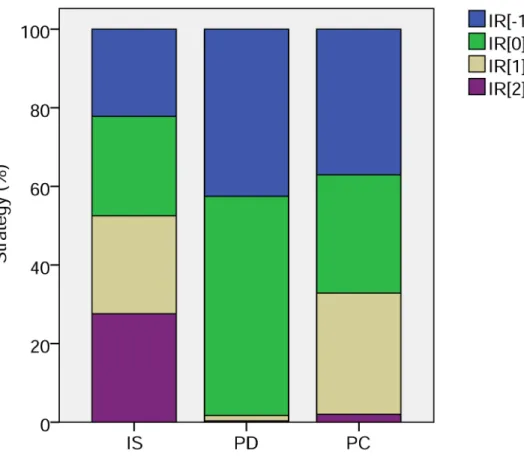
Examining the proportions of each strategy (Fig 2) reveals that with pure image scoring there is an almost even mix of all strategies. With phenotypic defectors, there is a balance be-tween unconditionally cooperative strategies and those which cooperate with those with at least neutral image scores. With partner choice, again almost all strategies are cooperative, these now being divided between the cooperative thresholds (i.e. all except unconditional de-fectors). This reflects the fact that all can now discriminate through choice of partner, so the threshold becomes less important. So both processes lead to the dominance of potentially co-operative strategies, though in practice, the presence of phenotypic defectors constrains the number of actual cooperative acts (as reported in the discussion ofFig 1).
Fig 1. Cooperation with image scoring and partner choice.Percentage cooperation in simulations with pure image scoring with random assignment (IS); incorporating phenotypic defectors (PD); and with partner choice (PC). Cooperation is plotted as the mean±SEM across 10 simulations of within simulation means each calculated across all 10,000 generations. One way ANOVA, F2,27= 422.42; p<0.0005; post-hoc Scheffe comparisons all significant at 0.0005 level.
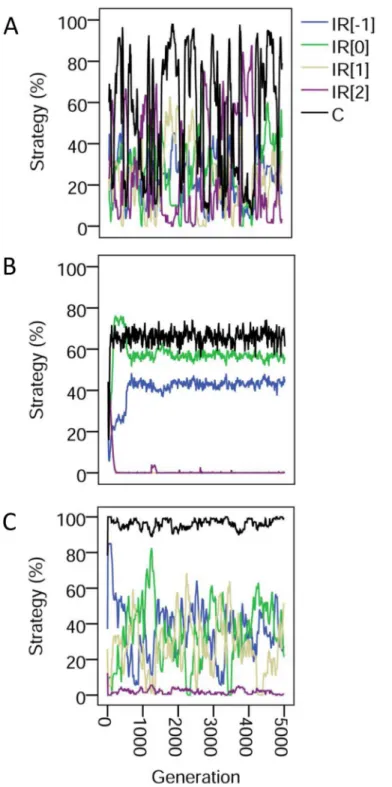
Examining the evolutionary dynamics further helps us to understand this mix of strategies (Fig 3). With pure image scoring, the dynamics of all strategies are highly unstable with cycles of cooperation and defection. These cycles are stabilized by the addition of phenotypic defec-tors, however cooperation asymptotes at a moderately high level. In contrast, partner choice al-lows total cooperation to reach a stable, almost maximal level. Note that the strategy thresholds actually wander below the always-defect level: once a rule of choosing a partner with a positive image score becomes established then the strategy threshold is released from selection (provid-ed it is below the unconditional defection level).
The simulations reported here were initialized with an even mix of strategies, however ini-tializing with 100% unconditional defectors results in indistinguishable average levels of coop-eration and frequencies of strategies, confirming that partner choice can allow coopcoop-eration to invade.
Discrimination
Partner choice is clearly effective at increasing cooperation via indirect reciprocity, but can we show that individuals are expressing a partner preference? The mean image score of those de-fected upon (on the scale from -1 to 1) was -0.83 ± 0.00 with pure image scoring versus -0.93 ± 0.00 with partner choice (the difference from -1 reflecting defection when no individual
Fig 2. Strategies of image scoring and partner choice.Strategy mixes with pure image scoring with random assignment (IS); incorporating phenotypic defectors (PD); and with partner choice (PC). Strategies are labelled as IR[k] wherekis the strategy threshold. Thusk= -1 denoted individuals that cooperated unconditionally;k= 0 strategists cooperated provided their partner had never played or had cooperated;k= 1 strategists cooperated provided the partner had cooperated; andk= 2 strategists never cooperated. Proportions are shown as means over 10 simulations of within simulation means calculated across 10,000 generations.
Fig 3. Dynamics of image scoring and partner choice.The evolutionary dynamics of indirect reciprocity strategies for (A) pure image scoring with random assignment; (B) with phenotypic defectors; (C) with partner choice. The first of 10 simulations is shown in each case. Strategies are labelled as IR[k] where k is the strategy threshold. Thusk= -1 denoted individuals that cooperated unconditionally;k= 0 strategists cooperated provided their partner had never played or had cooperated;k= 1 strategists cooperated provided the partner had cooperated; andk= 2 strategists never cooperated. C is cooperation, plotted as the proportion of cooperative moves.
with positive image score was available;Fig 4), so choice did bring some degree of increased se-lection against defectors (t18= 25.66,p<0.0005). A more marked difference is apparent when looking at those donated to. Here the mean image score was -0.13 ± 0.03 under partner assign-ment but 0.92 ± 0.00 under partner choice (the difference from 1 reflecting the fact that where recipients with positive image score are unavailable, focals will cooperate according to their threshold;t18= -31.87,p<0.0005). Thus, with pure image scoring there is on average close to no discrimination by image score of who is given to, while under partner choice, there is almost pure preference for co-operators.
Evolution of choice
I have shown that choosiness does support cooperation through indirect reciprocity, but would a strategy of being choosy invade a non-choosy population? I ran simulations in which each in-dividual’s strategy was a combination of two independent elements: an indirect reciprocity threshold determining whether individuals would donate to partners (the thresholds being as described in the Methods), and a choosiness element which determined whether the individual would accept a random partner as a recipient or would express a preference for individuals with positive image score (the implementation of the partner choice routine being as previously de-scribed in the Methods). The result was that partner choice and random pairing were both maintained in the population: those individuals using partner choice accounted for approxi-mately half (49.73 +/- 0.76%) of strategies. A high level of cooperation was found, with occasion-al invasion by defection lowering the mean to 87.68 ± 0.74%. Cooperation was associated with the spread of those choosy strategies that are potentially cooperative (the sum of the frequencies of strategies withk<2) correlated with cooperation (r= 0.71,p= 0.021,n= 10 simulations); whereas the potentially cooperative non-choosy strategies did not (r= 0.02,p= 0.95,n= 10).
Direct reciprocity
When modelling indirect reciprocity it is instructive to limit the possibility for direct reciproc-ity so that we can be sure any reciprocation is from third parties. The simplest way to do this is
Fig 4. Discrimination in image scoring and partner choice.Discrimination between recipients as shown by the image scores of those with whom focal individuals cooperated (C) or defected (D), plotted as means±SEM for pure image scoring with random assignment (IS) and partner choice (PC).
to restrict the number of interactions so that the probability of any agent having the opportuni-ty to receive back from an agent it has donated to is too small to determine the outcome [2]. In the simulations presented, every agent had on average one interaction either as donor or recipi-ent with every other individual (m= 1). To determine the effect of reducing the possibility of direct reciprocation still further, I repeated the simulations with 1/50 the number of dyads (m= 0.02), so each agent had on average approximately only one interaction as donor and one as recipient in total in each generation. Mean cooperation over the 10,000 generations was 95.95 ± 0.14%, so the result is unchanged from the 96.07 ± 0.11 found under the default condi-tions ofm= 1. We can therefore conclude that direct reciprocation is not a factor in explaining the high levels of cooperation found with indirect reciprocity and partner choice.
Phenotypic defectors and partner choice
I have considered the introduction of phenotypic defectors and of partner choice separately. For completeness, I also investigated introducing both simultaneously. This actually lowers co-operation from the level of 96.07 ± 0.11 with partner choice and default parameters to
81.36 ± 0.00. This can be understood as being an inevitable consequence of introducing indi-viduals that do not cooperate into an almost fully cooperative environment and so is not ex-plored further here.
Group size
As group size decreases, there may be less opportunity to find a co-operator from within the group and so it may be harder for cooperation to get established. I therefore investigated reduc-ing the group size from the default of 100 to 10 while retainreduc-ingm= 1. Results were very similar, with a marginal reduction from 96.07 ± 0.11 to 94.91± 0.18% cooperation (Fig 5). Even with a group size as low as 4, cooperation remains at a high level of 70.66 ± 1.91%. This reduced mean at the lowest group sizes results from cycles of invading defection, as happens without partner choice. This is consistent with the fact that at these group sizes there is effectively very little choice available. Very small group sizes are not of interest for indirect reciprocity since the point is to explain cooperation in large groups with few meetings per individual. In groups of 2,
Fig 5. Cooperation and group size.The mean level of cooperation across 10 simulations, each of 10,000 generations is shown in relation to the group size in which individuals interacted using image scoring with partner choice, maintainingm= 1 and island size = 100. Standard errors are too small to be visible.
maintaining the parameterm= 1 to eliminate potential for direct reciprocity means that each is on average a donor or recipient only once so reciprocity cannot produce a profit.
Standing
The reputation assignment mechanism of standing [11,13] provides an alternative to image scor-ing, with the benefit of greater evolutionary stability but the drawback of requiring second order information on prior behaviour in order to distinguish those defections which are‘justifiable’ be-cause they are with others who have themselves defected [12]. A version of the standing mecha-nism was implemented as in [26] by modifying the reputation scoring routine such that defection only produced a bad reputation when it was with an agent that had previously either cooperated or not moved, otherwise the focal agent’s reputation remained unchanged. Based on previous re-sults showing that standing can engender high levels of cooperation under indirect reciprocity [26], I predicted that partner choice would have little additional impact on the evolutionary dy-namics. This was upheld, with standing in a partner assignment regime giving 84.71 ± 0.47% co-operation (with default parameters) and partner choice increasing this to 96.22 ± 0.09%, a figure almost identical to that with image scoring and partner choice (96.07 ± 0.11). Thus, when indi-viduals can choose partners, the benefits of having second order information disappear: partner choice can produce very high levels of cooperation even without the complexity of knowing the context in which players gained their reputations.
Costs of choice
I have assumed that individuals in groups have information on their group-mates and can se-lect with whom they interact in a cost-free way. However, it is also possible that if potential partners are presented one at a time, there may be some cost in rejecting one and holding out for a better partner. This may take the form of an opportunity cost such that with a given probability, the focal then fails to find a further partner. This was implemented such that a focal could only proceed with the interaction with probabilitypraised to the power of the number of partners it had rejected before finding one that was acceptable. If this condition was not satisfied then a new focal was chosen. This procedure meant that the total number of interactions was retained, but that non-choosy individuals had a greater proportion of the in-teractions. I found that, as one might predict, costs of choice did reduce both cooperation and choosinesss, but that both were remarkably robust. Withp= 0.5 (i.e. each time a partner was rejected it halved the chance of that focal being able to play) cooperation was retained at 80.38 ± 1.26% with 42.98 ± 0.86% of individuals being choosy. Even withp= 0.1, cooperation was 72.34 ± 1.31% and choosy strategies accounted for 36.61 ± 0.88%. Thus the cost of choice is an important factor to consider but it does little to impede the evolution of cooperation through partner choice.
Discussion
under pure image scoring there is no temptation to cooperate with defectors just to preserve one’s own reputation—instead they can simply be avoided.
The impact of partner choice can be understood within the existing analytical framework for understanding image scoring. If cooperation depends upon the level of“acquaintanceship”
orq[30] then rather than being limited by the average ofqacross all those an individual might meet, individuals can choose to interact with those for which their knowledge of cooperative-ness is maximal. Thus the condition for cooperation to work under indirect reciprocity is much more readily satisfied.
The model presented here should be tested using an experiment in which people are able to choose who (if any) in their group to donate to. The prediction is that people should demon-strate strong discrimination between recipients, resulting in a high level of cooperation through indirect reciprocity. One study of cleaner fish presented individuals with a choice of cooperat-ing and defectcooperat-ing partners and did find evidence of image scorcooperat-ing [31].
The results here provide further support for the role of partner choice in driving reputation-based cooperation. A number of studies have shown how those individuals who are seen to be the most cooperative are the most sought after partners for alliances, or repeated mutually-ben-eficial relationships, and that this can drive strategic investment in cooperation [32,33]. This study provides evidence that partner choice can also stabilize cooperation in the context of one-off, one-way donations without re-meeting.
Author Contributions
Conceived and designed the experiments: GR. Performed the experiments: GR. Analyzed the data: GR. Contributed reagents/materials/analysis tools: GR. Wrote the paper: GR.
References
1. Alexander RD (1987) The Biology of Moral Systems. New York: Aldine de Gruyter.
2. Nowak MA, Sigmund K (1998) Evolution of indirect reciprocity by image scoring. Nature 393: 573–577. PMID:9634232
3. Nowak MA, Sigmund K (2005) Evolution of indirect reciprocity. Nature 437: 1291–1297. PMID:
16251955
4. Nowak MA (2006) Five rules for the evolution of cooperation. Science 314: 1560–1563. PMID:
17158317
5. Milinski M, Semmann D, Bakker TCM, Krambeck HJ (2001) Cooperation through indirect reciprocity: image scoring or standing strategy? Proceedings of the Royal Society of London Series B-Biological Sciences 268: 2495–2501. PMID:11747570
6. Semmann D, Krambeck HJ, Milinski M (2004) Strategic investment in reputation. Behavioral Ecology and Sociobiology 56: 248–252.
7. Wedekind C, Milinski M (2000) Cooperation through image scoring in humans. Science 288: 850–852. PMID:10797005
8. Seinen I, Schram A (2006) Social status and group norms: Indirect reciprocity in a repeated helping ex-periment. European Economic Review 50: 581–602.
9. Panchanathan K, Boyd R (2004) Indirect reciprocity can stabilize cooperation without the second-order free rider problem. Nature 432: 499–502. PMID:15565153
10. Milinski M, Semmann D, Krambeck HJ (2002) Reputation helps solve the 'tragedy of the commons'. Na-ture 415: 424–426. PMID:11807552
11. Sugden R (1986) The Economics of Rights, Cooperation and Welfare. Oxford: Blackwell.
12. Panchanathan K, Boyd R (2003) A tale of two defectors: the importance of standing for evolution of indi-rect reciprocity. Journal of Theoretical Biology 224: 115–126. PMID:12900209
13. Leimar O, Hammerstein P (2001) Evolution of cooperation through indirect reciprocity. Proceedings of the Royal Society of London Series B-Biological Sciences 268: 745–753. PMID:11321064
15. Noë R (2006) Cooperation experiments: coordination through communication versus acting apart to-gether. Animal Behaviour 71: 1–18. PMID:18846249
16. Axelrod R, Hamilton WD (1981) The evolution of cooperation. Science 211: 1390–1396. PMID:
7466396
17. Bull JJ, Rice WR (1991) Distinguishing mechanisms for the evolution of co-operation. Journal of Theo-retical Biology 149: 63–74. PMID:1881147
18. Noë R, Hammerstein P (1994) Biological Markets: Supply and Demand Determine the Effect of Partner Choice in Cooperation, Mutualism and Mating. Behavioral Ecology and Sociobiology 35: 1–11.
19. Sherratt TN, Roberts G (1998) The evolution of generosity and choosiness in cooperative exchanges. Journal of Theoretical Biology 193: 167–177. PMID:9689952
20. Barclay P (2013) Strategies for cooperation in biological markets, especially for humans. Evolution and Human Behavior 34: 164–175.
21. Nowak MA (2012) Evolving cooperation. Journal of Theoretical Biology 299: 1–8. doi:10.1016/j.jtbi. 2012.01.014PMID:22281519
22. Rand DG, Nowak MA (2013) Human cooperation. Trends in cognitive sciences 17: 413–425. doi:10. 1016/j.tics.2013.06.003PMID:23856025
23. Aktipis CA (2004) Know when to walk away: contingent movement and the evolution of cooperation. Journal of Theoretical Biology 231: 249–260. PMID:15380389
24. Hauert C, De Monte S, Hofbauer J, Sigmund K (2002) Volunteering as Red Queen Mechanism for Co-operation in Public Goods Games. Science 296: 1129–1132. PMID:12004134
25. Peck JR (1993) Friendship and the Evolution of Co-operation. Journal of Theoretical Biology 162: 195–228. PMID:8412224
26. Roberts G (2008) Evolution of direct and indirect reciprocity. Proceedings of the Royal Society B-Biological Sciences 275: 173–179. PMID:17971326
27. Lotem A, Fishman MA, Stone L (1999) Evolution of cooperation between individuals. Nature 400: 226– 227. PMID:10421362
28. Sherratt TN, Roberts G (2001) The role of phenotypic defectors in stabilizing reciprocal altruism. Behav-ioral Ecology 12: 313–317.
29. Berger U (2011) Learning to cooperate via indirect reciprocity. Games and Economic Behavior 72: 30– 37.
30. Nowak MA, Sigmund K (1998) The dynamics of indirect reciprocity. Journal of Theoretical Biology 194: 561–574. PMID:9790830
31. Bshary R, Grutter AS (2006) Image scoring and cooperation in a cleaner fish mutualism. Nature 441: 975–978. PMID:16791194
32. Roberts G (1998) Competitive altruism: from reciprocity to the handicap principle. Proceedings of the Royal Society of London Series B-Biological Sciences 265: 427–431.