ACTA ORTOP BRAS 13(1) - 2005
20
O
RIGINALA
RTICLEW
ILSONA
BOUR
EJAILI1,
A
LCEUG
OMESC
HUEIRE2,
J
OSÉA
NTONIOC
ORDEIRO3,
F
LAVIOC
ALILP
ETEAN4,
G
UARACYDEC
ARVALHOF
ILHO5144
1 - Master’s Degree Student at the FAMERP
2 - Head of the Department of Orthopedics and Traumathology
3 - Professor at the UNESP - Teaching-I Coordinator at the Epidemiology and Public Health Department
4 - Assistant Doctor at the Clinical Immunology Division of the Clinical Medicine Department
5 - Head of the Orthopedics and Traumatology Division of the FAMERP-FUNFARME Study Center: Orthopedics and Traumatology Department of the FAMERP-FUNFARME
Mail Address: Rua Campos Sales 1767 ZIP Code: 15025-600
SÃO JOSÉ DO RIO PRETO-SP - Brasil. E-mail: [email protected]
INTRODUCTION
Osteoarthrosis is the most prevailing degenerative joint di-sease, resulting in significant morbidity and one of the highest treatment costs for the health systems worldwide(1,7,12,13). The
pro-cess of the disease is characterized by progressive erosion of joint cartilage, resulting in a decrease of joint space, subchon-dral sclerosis, formation of marginal osteophytes, subchonsubchon-dral cysts, and synovial inflammation resulting in pain and decrea-sed function, leading these patients to search for medical care(1, 2,12).
The normal cartilage is an avascular tissue formed by a gre-at extracellular mgre-atrix and sparse cells. Wgre-ater amounts to 66 to 80% of its structure and the organic material consists of 48 to 62% of type-II collagen and 22 to 38% of proteoglycans. These groups of liquids of variable density, fibers with several directi-ons, and cells distributed within are nurtured by soak, and its anabolic and catabolic process is governed by several factors, especially the growth factor. The homogeneity and the balance of that complex structure are maintained by several enzymes, in their majority secreted by chondrocytes and synovial cells. Ar-throsis leads to balance disturbance and cartilage disorder due to its fragmentation, thus resulting in the release of degrading enzymes from the matrix by chondrocytes and, therefore, in the fibrillation and fragmentation and subsequently lesions of joint surface, such as cambers (arching) and ulceration of the cartilage(2, 9).
Knee arthrosis can be classified as primary (idiopathic) or secondary to inflammatory, infectious, or traumatic diseases that destroy the structure of the cartilage(2,9). The initial classic
treat-ment of the knee osteoarthrosis is conservative in general with the use of analgesic and antiinflammatory drugs, intraarticular injections of corticosteroids associated to physiotherapy and
weight loss. However, with better, although partial, knowledge of ethiopathogeny, new drugs have been studied and recently used with relative success, aiming at the protection of the cartilage structure, as is the case with diacirein, glucosamine sulfate and chondroitin, and the unsaponifiable oils that seem to reduce the action of the degrading enzymes and protect the joint cartilage. Loss of the elastoviscosity properties of the sinovial liquid plays an important role in the pathophysiology of osteoarthro-sis. Therefore, hyaluronates have been developed for intraarti-cular infiltration and shown to be effective as a conservative tre-atment for arthrosis(2,7,9,12,13).
When conservative therapy fails, several surgical therapies are available, such as arthroscopy for lavage and joint debride-ment , corrective osteotomies, and partial or total arthroplasty of the knee, depending on the degree of the arthrosis(1, 2, 12). The
most controversial treatment mentioned in literature is lavage associated to joint debridement. Irrigation of the knee joint reduces the concentration of the lytic enzymes, removes debris from joint cartilage and free bodies, a theoretical source of persistent sy-novitis, which includes the adequate performance of meniscec-tomies leading to blockage and pain. Historically, debridements were first described by Pridie(10) and Magnunson(8) and were
analyzed later by Insall(10). Pridie10 found 64% of success and
Magnunson10 described a fibrocartilaginous response following
light debridement of the cartilage lesions. In addition, satisfac-tory results were found by Rand(10) (74%), Sprague(10) (75%), Bert
and Macshka(10) (77%) and associated with the almost 500
ca-ses of Insall(10); folowing a retrospective review, conclusion was
that lavage and debridement would be suitable in patients with symptoms of mechanical blockage. Hylan GF-20 (hyaluronate of high molecular weight) has been routinely used by orthopedic
SUMMARY
This study evaluated the benefits of the Hylano GF-20 use in the postoperative period of knee arthroscopies for irrigation and debridement due to arthrosis. Twenty knees of twenty patients underwent arthroscopy. They presented arthrosis up to 3rd
classi-fication degree, pain and had their knees blocked. The segmen-tal treatment showed no improvement ,consequently irrigation associated with mild condral and meniscus debridement was performed according to each case.
The patients were divided into two groups: arhtroscopy was performed in one; in the other, arthroscopy associated with the
The evaluation of Hilan GF-20 in the postoperative knee
arthroscopies for arthrosis
use of three weekly infiltrations of Hylano GF-20. The patients were evaluated according to the following variables: pain during night sleep; pain during movements with loads of 10% of the body weight; pain during more severe movements of the injured knee with visual scale and the daily amount of potassium diclofenac ingested to relieve the pain of the injured knee.The statistical re-sults showed a significant improvement in relation to all studied variables of patients from the group submitted to the use of Hyla-no GF-20 infiltration in the postoperative period of knee arthros-copy due to arthrosis.
Received on August 28, 2003 and approved on November 18, 2004.
ACTA ORTOP BRAS 13(1) - 2005
21
surgeons and given by intraarticular infiltration followingar-throscopy for knee arthrosis. This procedure is carried out ba-sed on the fact that the sinovial liquid, in arthrosis of the knee, presents decreased viscosity and elasticity properties, as well as on the efficacy demonstrated by previous studies for the use of this drug in the conservative treatment of arthrosis(2,7,9,12,13).
The objective of this research was to evaluate benefits, if any, in the use of this drug for lavage and debridement in the posto-perative arthroscopies.
CASUISTICS AND METHOD
Twenty patients presenting knee arthrosis refractory to con-servative treatment with blockage and pain symptoms were stu-died. They were from the Clinic of Orthopedics from the Irman-dade da Santa Casa de Misericordia de Sao Jose do Rio Preto, in the State of Sao Paulo, and they were submitted to arthrosco-pic treatment for articular lavage and debridement to articulate. The study was performed from September 2002 to March 2003 and randomized patients into 2 groups.
In group I (10 patients), the behavior of treatment with ar-throscopy (articular lavage and debridement) associated to the weekly postoperative infiltration, totaling three infiltrations, of Hylan GF-20 was studied. Nine patients were female and 1 male, with age range from 44 to 57 years (mean age: 52.80 years). Out of this total, seven presented an injury on the right side and three on the left side, and all the patients had arthrosis grade 3 of Kellgren and Lawrence(5) upon radiography examination.
In group II (10 patients), the behavior of treatment with ar-throscopy (articular lavage and debridement) without the posto-perative use of any condral protecting medication was studied in seven female patients and 3 male patients aged from 39 to 73 years (mean age: 56.10 years). Out of the total of 10 treated knees, six had an injury on the right side and four on the left side, and all the patients had arthrosis grade 3 Kellgren and Lawren-ce7 upon radiographic examination.
Com-puterized tomography showed chondral and meniscus injuries in all patients.
Patients from both groups were sub-mitted to a previous evaluation of the knee to be operated. Clinical history, physical and radiographic data were assessed. The grade of pain reported during the rest at night, pain during movement with a 10% overload of the corporal weight and reduc-tion of the pain during the most painful mo-vements of the knee with visual analogical scale. In addition to these parameters, the number of potassium diclophenac tablets ingested daily for pain relief in the affec-ted knee was also studied.
The Informed Consent form was sup-plied and explained by the Committee of Ethics in Research from FAMERP (Proto-col no. 4119/2002) at the pre-treatment examination.
Only the patients classified as grade 3 Kellgren and Lawren-ce(5) were studied, due to the previous observation in the
literatu-re that the drug doesn’t bring proven benefits to patients classi-fied as grade 4 or 5(1,18). Please find below the description of the
Kellgren and Lawrence(5) classification of in its 5 degrees:
Grade 0 – No radiological alteration characteristic of osteo-arthrosis.
Grade 1 - Presence of a minimum osteophyte without reduc-tion of the articular space.
Grade 2 - Presence of a minimum osteophyte with low re-duction of the articular space.
Grade 3 - Presence of moderate osteophyte with moderate reduction of the articular space.
Grade 4 – Articular space almost or totally reduced with scle-rosis of the subchondral bone.
Patients with grade 3 upon Kellgren and Lawrence(5)
radiolo-gical classification with blockage symptoms that did not impro-ve with previous conservatiimpro-ve treatment were then submitted to arthroscopic surgery for the necessary chondral lavage, debri-dement, and the partial or total meniscus stabilization. The tech-nique used was the three portals (superomedial, inferomedial and inferolateral). Saline solution was used and the meniscus cartilage stabilization was softly made without abrasion, expo-sure or perforation of the subchondral bone. Patients were sti-mulated to stroll in the first postoperative day and stitches were removed at the first visit after two weeks. Patients from group I were submitted to 3 weekly infiltrations of Hylan GF-20 starting from the first follow-up consultation on; it was carried out with an anesthetic button (2 ml of Xylocaine at 2% without vasoconstric-tor) on the skin, with a rigorous asepsis in the superolateral area of the operated knee. Patients from group II were not submitted to infiltration with Hylan GF-20. All patients were assessed at 2,4,8,16, and 24 weeks following surgery with the use of a visual analogical pain scale (ruler) where the side shown to the patient presented pain “faces” and colors ranging from blue to red as pain increased, and the observer’s side showed the value assig-ned by the patient in absolute numbers (pain during the night rest, pain during movement with a 10% overload of weight on the affected knee and pain reduction during the most painful movements of the knee). The degenerative chondral lesions were classified at the moment of arthroscopy by Noyes and Stabler appud Lemark(6) as
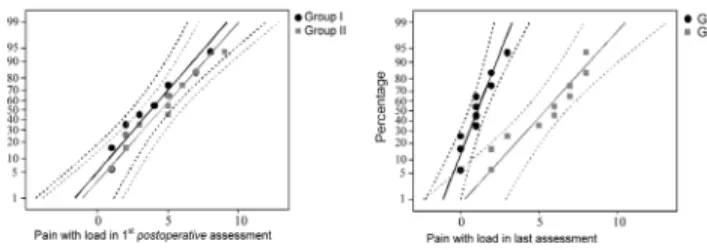
grade I: chondromalacia-type lesion, gra-de II: cartilage lesion without subchondral bone view, and grade III: osseous exposi-tion. Statistical analysis was made at the Laboratory for Study Design and Data Analyses of the Department of Epidemio-logy and Public Health of the Medical School of Sao Jose do Rio Preto. Normal distribution of data was found, as shown by the graphs below. This was checked by the Anderson-Darling test, according Figure 1:
In order to compare 2 averages, the Welch t-test was used. The variance analy-sis for repetitive measurements was used for the comparison of the group and the effect, and group interaction x time. The use of this test was only possible due to the normal distribution followed by the groups. Significance level α = 0. 05, was adopted as usually seen in health sciences studies.
RESULTS
A larger number of female patients were found both in group I (9) and group II (7), with a p value of 0.58. Therefore, there was no evidence of proportion difference for women among the study groups.
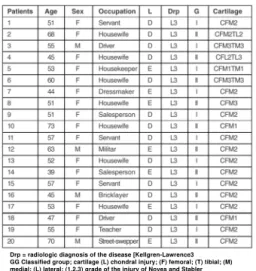
Table 1 - Data of the 20 patients who were operated
ACTA ORTOP BRAS 13(1) - 2005
22
Figure 1- Graphs of pain evaluation upon movement with 10% overload on corporal weight at the first and the last postoperative evaluation (Anderson-Darling method), showing a normal pattern. Welch t-test was used for comparison of 2 means.
Table 1- Mean values, standard deviation (sd) and p-value for all study variables in the preoperative assessment:
Table 2 - Mean values, standard deviation (sd) and p-value of all study variables at the first postoperative assessment. Mean age was 52.80 years for group I and 56.10 for group II.
Therefore, there was no evidence of average age difference among the study groups (p value=0.43).
By evaluating the results found for all variables in the preopera-tive assessment, it was observed that there was no evidence of mean difference during the preoperative period, as shown by Table 1:
By evaluating the results for all study variables at the first evaluation, no evidence of mean difference was found at the first evaluation, as show by Table 2:
By evaluating the results for all study variables at the first evaluation, it was
obser-ved that no evidences of mean reduction differences were found from the preoperative evaluation up to the first posto-perative evaluation, as shown by Table 3:
By evaluating the results for all study variables from the first to the fifth evaluation, it was observed that there was eviden-ce of reduction in the group I and of stability in the variables: pain in rest, pain with load and
pain to the most painful movement, and an increase in the varia-ble diclofenac in the group II from the first to the fifth postoperative evaluation, as shown by Table 4:
The degree of cartilage lesion found on the arthroscopies compared to the averages was assessed; it was noted that this should not be a limiting factor for the improvement found in group I (Figures 2 – 5)):
DISCUSSION
Articular cartilage lesions are the greatest challenges of Or-thopedics today. As for knee arthrosis, the best treatment follo-wing conservative therapy failure has not yet been established, especially in mild to moderate arthrosis where osteotomy or arthroplasty would be indicated. The great problem with these treatments, in addition to the costs, are the serious risks invol-ved, from clinical risks to those associated with implants, resul-ting in complications for the patients. Great divergence exists in literature, but the arthroscopy associated to the lavage and light debridement has still been used with great frequency and with good results all over the world(10).
The upcoming of chondroprotection drugs (diacirein, gluco-samine sulfate and chondroitin, unsaponifiable oils and hyalu-ronates) bring new improvement possibilities in the final result of the arthroscopic treatment. Inhibition of interleukin-1 producti-on, thus preventing that metalloproteases destroy the cartilagi-nous matrix would avoid, for some time, the need for correction of instabilities or deviations from the mechanical axles and would
result in less aggressive treatments, with substantially reduced surgical risks.
As already known, an important element in the pathophysio-logy of osteoarthrosis is the loss of the elastoviscosity properties of the sinovial liquid due to decreased concentration and mole-cular size of hyaluronic acid. This considerably increases the sus-ceptibility of cartilage to lesions due to overload; the use of hya-luronates in the postoperative arthroscopy for lavage and light debridement has become a possibility of improved results, due to the capacity of hyaluronates to reduce the pressure vector caused by the weight; to pro-tect the integrity of the articu-lar cartilage; to stabilize the cartilaginous matrix for the inhibition of proteoglycans loss and, as such, to interve-ne in the evolution of the tis-sue destruction process, im-proving the postoperative re-sult of the referred chirurgical treatment(1, 2,9,12).
A certain tendency was observed in the world literatu-re towards the use of Hylan GF-20, due to its largest mo-lecular weight, because it would have an absorption power for larger weights than the one with low molecular weight, with better results in relation to the impro-vement of the pain and functional capacity of the knee(1,9,12,13).
Besides this physical property, it is believed that Hylan GF-20 also presents other theoretical properties that would aid in the improve-ment of the pain and of the functional capacity of the knee with arthrosis as described by Watterson and Esdaile(12) in their article:
- Antiinflammatory property: The hyaluronic acid is invol-ved in the transduction of the surface receptors’ signals of the leukocyte cells and that are dependent of the size of the hyaluro-nic acid molecule and, then, the administration of the same in the intra-articulation form would reduce the levels of the inflam-matory mediators.
- Analgesic activity: Studies in experimental models using mice and cats, showed a reduction of the nociceptive activity in inflamed articulations, maybe due to the direct action in the sy-novia or indirectly through the substance P.
The idea of studying the behavior of the use of Hylan GF-20 in the postoperative knee arthroscopies for lavage and debride-ment was due to the continuous use by knee surgeons in an empiric way, and without scientific corroboration. In the attempt of finding support in the literature, only two studies to support that the use of hyaluronates of low or high molecular weight could be important in the postoperative knee arthroscopies, improving the postoperative results for these, were found.
Vad et al(11) tested the lavage of the knee with saline solution
GF-ACTA ORTOP BRAS 13(1) - 2005
23
Figure 3 -Pain during movement of 10% of body weight in group II for different grades of cartilage injury
shown by arthroscopy
Figure 4 -Pain at rest at night in group I for different grades of
cartilage injury shown by arthroscopy
Figure 5 -Pain at rest at night in group II for different grades of
cartilage injury shown by arthroscopy
20, with a control group just with Hylan GF-20 infiltrations sepa-rately for patients with knee arthrosis, and better results were observed in relation to the pain and functional capacity for the patients submitted to the previous lavage, in relation to the group in which Hylan GF-20 was used alone.
Daí et al(3) performed several weekly infiltrations of sodium
hyaluronate in the postoperative surgical knee arthroscopies and found that the use of hyaluronate in the postoperative knee sur-gery seemed effective in the relief of the postoperative pain cau-sed by the referred to surgeries.
In relation to the results found in our study, it was observed that there was no difference among the two groups in relation to sex and in relation to age average, which was in agreement with the world literature(2,9).
The statistical results found in the preoperative period evalu-ation showed that the groups didn’t have a statistical difference in relation to the four studied variables, what demonstrated the homogeneity of the two groups studied.
In relation to the arthroscopic treatment, there were no intra or postoperative complications in the patients studied.
In relation to postinfiltration synovitis, the most common compli-cation found in the literature with the use of Hylan GF-20, varying from 11% found by Puttick et al(8) and up to 47% by Henderson et
al(4), this complication was not observed in the study performed.
In relation to the individual analysis of the first postoperative evaluation, a decrease of all the variables studied was observed
in both groups, demonstrating that the surgical treatment was probably the differential factor in the improvement of the studied variables. Therefore, until that moment the infiltrations with Hylan GF-20 had not been made. This analysis is similar to the literatu-re, and reports that there is improvement with the lavage and light debridement through arthroscopy.
In the statistical analysis, where the variables behaviors after or during the use of Hylan GF-20 were studied, an overall im-provement or averages decrease trend was seen in group I com-pared to group II.
Data found here suggest that the degree of cartilage lesion (I - III by Noyes and Stabler) would not be a limiting factor for the improvement noticed, since an improvement or a decrease trend has always been observed in group I compared to group II.
Taking the statistical data into account, it was noticed that Hylan GF-20 was the differential of the improvement on study variables for both groups, and its routine use at the arthroscopy postoperative period for arthrosis treatment can improve its final outcome within the period of 6 months.
CONCLUSION
Taking into account the statistical data, Hylan GF-20 was res-ponsible for the improvement seen in the study variables for both groups. The routine use following arthroscopy in the treatment of arthrosis can also lead to an improved outcome.
REFERENCES
1. Adams ME,Atkinson MH,Lussier AJ,Schulz JI,Siminovitch KA,Wade JP et al. The role of viscosupplementation with hylan G-F 20 in the treatment of osteoarthritis of the knee: a Canadian multicenter trial comparing hylan G-F 20 alone, hylan G-F 20 with non-steroidal anti-inflammatory drugs(NSAIDs) and NSAIDs alone.Osteoarthritis and Cartilage 3:213-225,1995. 2. Camanho GL. Tratamento da osteoartrose do joelho.Rev Bras Ortop 36: 135-140,2001. 3. Dai GF, Tang JW, Wang SJ, Liu Q, Shi DP. Zhongguo Xiu Fu Chong Jian Ke Za Zhi 16: 8-16,2002. 4. Henderson EB, Grootveld M, Smith EC, Thompson PW, Blake DR.Ann Rheum Dis 50: 196-200, 1991.
5. Kellgren JH, Lawrence JS.Radiological assessment of osteoarthrosis.Ann Rheum Dis 16:494-501, 1957.
6. Lemark LJ,Marushack MM.Tratamento da Cartilagem Articular.In:Andrews JR,Timmerman LA,Editores.Artroscopia:Diagnóstico e Cirurgia.1a ed.londres:Chapman and Hall/ CRC;1999.p.189-97.
7. Pelletier JP, Pelletier JM. The Pathophysiology of Osteoarthritis and the Implication of the Use of Hyaluronan and Hylan as Therapeutic Agents in Viscosupplementation. J Rheu-matol 20:19-24,1993.
8. Puttick MPE, Wade JP, Chalners A,Connell DG,Rangno KK.Acute Local Reactions after Intraarticular Hylan for Osteoarthritis of the Knee.J Rheumatol 22:1311-1314,1995. 9. Rezende MU. Efeito do Ácido Hialurônico e da Diacíreina na Artrose: Modelo
Experimen-tal em Ratos [dissertação].São Paulo (SP): Faculdade de Medicina da Universidade de São Paulo, 2000.
10. Scott WN, Insall JN, Kelly MA.Artroscopia Y meniscectomía: abordaje, anatomia y técni-cas quirúrgitécni-cas.In: Insall JN.Cirugía de la Rodilla.2a edição.Buenos Aires: Editora Medica Panamericana,1994. p 165-225.
11. Vad VB,Bhat AL, Sculco TP,Wickiewicz TL. Management fo the Knee Osteoarthritis : Knee Lavage Combined With Hylan Versus Hylan. Alone.Arch Phys Rehabil 84:634-637,2003. 12. Watterson JR, Esdaile JM. Viscosupplementation: Therapeutic Mechanisms and clinical
Potential in Osteoarthritis of the Knee. J Am Acad Orthop Surg 8: 277-284,2000. 13. Wobig M, Bach G, Beks P, Dickhut A, Runzheimer J,Schwieger G et al. The Role of
Elas-toviscosity in the Efficacy of Viscosupplementation for Osteoarthritis of the Knee: A Comparison of Hylan G-F 20 and Lower-Molecular-Weight Hyaluronan.Clin Ther 21: 1549-1562,1999.
Figure 2 -Pain during movement of 10% of body weight in group I for different grades of cartilage injury
shown by arthroscopy
Table 3 - Mean values, standard deviation (sd) and p-value for all study variables from the preoperative evaluation up to the first
postoperative evaluation.