Submitted18 May 2016
Accepted 5 October 2016
Published9 November 2016
Corresponding author
Marius Somveille,
Academic editor
Scott Edwards
Additional Information and Declarations can be found on page 15
DOI10.7717/peerj.2658
Copyright
2016 Somveille et al.
Distributed under
Creative Commons CC-BY 4.0
OPEN ACCESS
A global analysis of bird plumage
patterns reveals no association between
habitat and camouflage
Marius Somveille1,2, Kate L.A. Marshall1and Thanh-Lan Gluckman1,3,4
1Department of Zoology, University of Cambridge, Cambridge, United Kingdom
2The Edward Grey Institute, Department of Zoology, University of Oxford, Oxford, United Kingdom 3Department of Animal and Plant Sciences, University of Sheffield, Sheffield, United Kingdom 4Center for Interdisciplinary Research in Biology, College de France, Paris, France
ABSTRACT
Evidence suggests that animal patterns (motifs) function in camouflage. Irregular mottled patterns can facilitate concealment when stationary in cluttered habitats, whereas regular patterns typically prevent capture during movement in open habitats. Bird plumage patterns have predominantly converged on just four types—mottled (irregular), scales, bars and spots (regular)—and habitat could be driving convergent evolution in avian patterning. Based on sensory ecology, we therefore predict that irregular patterns would be associated with visually noisy closed habitats and that regular patterns would be associated with open habitats. Regular patterns have also been shown to function in communication for sexually competing males to stand-out and attract females, so we predict that male breeding plumage patterns evolved in both open and closed habitats. Here, taking phylogenetic relatedness into account, we investigate ecological selection for bird plumage patterns across the class Aves. We surveyed plumage patterns in 80% of all avian species worldwide. Of these, 2,756 bird species have regular and irregular plumage patterns as well as habitat information. In this subset, we tested whether adult breeding/non-breeding plumages in each sex, and juvenile plumages, were associated with the habitat types found within the species’ geographical distributions. We found no evidence for an association between habitat and plumage patterns across the world’s birds and little phylogenetic signal. We also found that species with regular and irregular plumage patterns were distributed randomly across the world’s eco-regions without being affected by habitat type. These results indicate that at the global spatial and taxonomic scale, habitat does not predict convergent evolution in bird plumage patterns, contrary to the camouflage hypothesis.
SubjectsBiodiversity, Ecology, Evolutionary Studies, Zoology
Keywords Ecological selection, Camouflage, Plumage patterns, Signalling, Macroevolution, Natural selection
INTRODUCTION
to function in camouflage, such as by generally matching the background or by breaking up (disrupting) the prey outline and creating false edges to prevent detection by predators (Thayer, 1909;Cott, 1940;Pough, 1976;Stevens & Merilaita, 2009). Under sensory ecology theory, the likelihood of a predator being able to detect its prey depends on how effectively the visual cue is transmitted to the predator’s eye, and on how well the predator’s specific visual system can detect/recognise its prey against the background on which it is viewed (e.g.,Endler, 1992). Past studies have shown that genetic adaptation of camouflage appears to enhance background matching in local environments and increase survival against visual predators (e.g., Hoekstra, Krenz & Nashman, 2005;Vignieri, Larson & Hoekstra, 2010). Crucially, visual modelling studies have shown that such local adaptation can prevent detection by the actual visual systems of predators, such as hunting birds (e.g.,Stuart-Fox et al., 2004;Marshall et al., 2015a;Marshall, Philpot & Stevens, 2015b), thus indicating that camouflage tends to be optimised to local habitats under natural selection.
Across animals, different types of visual patterns made up of different patches of pigmentation to make up an overall pattern or ‘motif’ have been linked to different functions in camouflage. Specifically, irregular patterns (mottled) tend to function in stationary camouflage while those that regularly repeat a pattern or motif (bars, spots) function in motion camouflage, which are in turn predicted to be more effective in closed and open habitats, respectively (Marshall & Gluckman, 2015). Birds are the most well described taxonomic group of animal and can be found in all types of habitats on all major landmasses (Gluckman & Cardoso, 2010;Jetz et al., 2012), making them particularly well suited for investigating sensory ecology hypotheses. Recent studies on bird colouration across a large number of species and at large spatial scale revealed that islands are associated with reduced signal intensity (Doutrelant et al., 2016) and that colour heterogeneity decreases with body size (Galvan et al., 2013), but also showed distinct effects of habitat, life history and sexual selection on the evolution of colouration that lacks patterning (an absence of patterns or uniform colouration), such as bright red carotenoid and dull brown melanins (Dale et al., 2015;Dunn, Armenta & Whittingham, 2015). However, no study has yet explicitly examined the role of habitat and camouflage on avian feather patterns type at the global scale (but see Riegner, 2008;Gluckman & Cardoso, 2010).
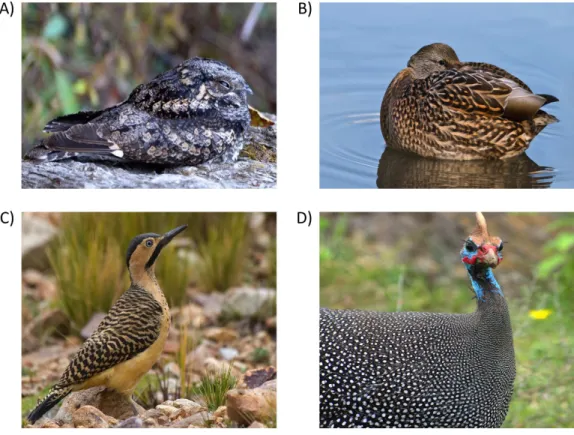
In spite of the spectacular diversity in phenotypes across the class Aves, bird plumage patterns have predominantly converged on just four types: mottled, scales, bars and spots (Fig. 1;Gluckman, 2014;Marshall & Gluckman, 2015;Gluckman & Mundy, 2016). Most studies of camouflage focus on single or few species (Marshall & Gluckman, 2015) that may not be representative of broad scale selection pressures. Here, we investigated whether sensory ecology theory could explain convergent evolution in the camouflage plumage patterns of birds at the global spatial and taxonomic scale, i.e., with a global spatial extent, using large spatial units, and data on most land bird species.
Figure 1 The predominant types of plumage patterns in birds.(A) Irregular mottled plumage con-sists of feathers that are heterogeneously pigmented (Jungle Nightjar–Caprimulgus indicus indicus). Reg-ular plumage patterns can be comprised of (B) scales where pigmentation follows the edge of the vane (Mallard–Anas platyrhynchos), (C) bars that are made of alternating dark and light pigmentation transver-sal to the feathers axis (Andean flicker–Colaptes rupicola), and (D) spots where one or more spots pigment each feather (Guineafowl–Numida meleagris). Photos: Grey Nightjar.jpg by Koshy Koshy (retrieved from https://commons.wikimedia.org/wiki/File:Grey_Nightjar.jpgCC BY 2.0 license); Female Mallard Duck Rest.jpg by Alain Carpentier (retrieved fromhttps://commons.wikimedia.org/wiki/File:Female_Mallard_ Duck_Rest.jpgunder a CC-BY-SA 3.0 license); Colaptes rupicola 20070123.jpg by Adam Kumiszcza (re-trieved fromhttps://en.wikipedia.org/wiki/Andean_flicker#/media/File:Colaptes_rupicola_20070123. jpgunder a CC-BY-SA 3.0 license) and Pintade de Numidie.jpg by JP Hamon (retrieved fromhttps:// commons.wikimedia.org/wiki/File:Pintade_de_Numidie.jpgunder a CC BY-SA 3.0 license), respectively.
Therefore, irregular patterns should be favoured in visually complex closed environments that provide backgrounds where a prey animal can easily blend in. Irregular mottled patterns are common in avian species, and are more frequently found in females and juveniles in comparison to regular barred plumage patterns (Gluckman & Cardoso, 2010).
to the predator’s vision so that it appears to match the background against which it is moving (e.g., Brodie, 1989;Brodie, 1992;Brodie, 1993;Lindell & Forsman, 1996). Given that escape by flight requires space and that motion camouflage is dependent on effective transmission to the predator’s eye, regular patterns in birds should be more common in open habitats where patterns are easily visible and escape by flight is unencumbered. Additionally, regular patterns may have a dual function in both camouflage and visual communication with conspecifics (Marshall, 2000;Gluckman & Cardoso, 2010) and, due to multiple functions, may evolve independently of habitat in adult males (Bradbury & Vehrencamp, 1998;Endler, 1992;Kenward et al., 2004;Leal & Fleishman, 2004;Seehausen et al., 2008;McLean, Moussalli & Stuart-Fox, 2014).
Across the world, habitats differ in their structural composition, e.g., forested habitats are cluttered and visually noisy, while desert habitats are not. The dorsal plumage patterns of birds are likely to function in camouflage in adults of both sexes, as well as juveniles, whereas a communication function is likely to evolve on the ventral surface of sexually competing males (Stuart-Fox & Ord, 2004;Gluckman & Cardoso, 2010;Garcia, Rohr & Dyer, 2013).
In this study, we investigated whether habitat selects for convergent evolution in the plumage patterns of terrestrial birds at the global scale, using the geographical distribution of all known avian species (excluding sea birds). Firstly, we looked for an association between plumage patterns type and habitat type across avian species; and secondly, we investigated whether patterned species were distributed at random across the world. We expected to find a significant association between closed and open habitats with irregular and regular patterns, respectively, in the plumage of adults as well as juveniles. In the sexually selected ventral plumage of breeding males, we expected that plumage pattern evolution would be independent of habitat due to its function in communication. In addition, we expected the distribution of irregularly and regularly patterned species across geographical space to differ from random and be affected by habitat.
MATERIAL AND METHODS
Data collection
We focused on the most prominent aspect of patterning: the four different types of spatial arrangement of pigmentation (Fig. 1). To collect plumage pattern information we referred to field guides covering all major landmasses: North and Central America (Sibley, 2000;Van Perlo, 2006), South America and Antarctica (De La Pena & Rumboll, 1998;Restall, Rodner & Lentino, 2007), sub-Saharan Africa and Madagascar (Langrand, 1990;Sinclair & Ryan, 2003), Europe, North Africa and Central Asia (Heinzel, Fitter & Parslow, 1995;Grimmett, Inskipp & Inskipp, 1999;Arlott, 2007;Arlott, 2009;Brazil, 2009), East and South-East Asia (MacKinnon & Phillips, 1993;Coates & Bishop, 1997;Robson, 2005), and Oceania (Beehler, Pratt & Zimmerman, 1986;Pratt, Bruner & Berrett, 1987;Simpson & Day, 2004;Robertson
& Heather, 2005). Where multiple subspecies were present, we collected information on
Aves). Species that were unpatterned and/or without habitat information were excluded from further statistical analyses, giving an overall sample size of 2,756 avian species (34% of the species considered), providing information for 2,593 adult and 2,104 juvenile avian species (see the list of species inAppendix S1).
We scored the plumage of both sexes as well as juveniles of each species for: an absence of patterns, mottled, scaled, barred and spotted patterns, both on the ventral and dorsal surface, separately (Fig. 1). Irregular mottled patterns were defined as pigmentation that did not have a clearly discernible motif or the putative motif had irregular borders, as frequently found on the dorsum of sparrows (in contrast with the stripes of species from the genusGaviathat have clear and neat boundaries in the stripes on the neck). Regular patterns had a motif with regular borders and were repeated across a patch of patterning (Fig. 1). Some species have multiple patterns on either the ventral or dorsal surface (e.g., the male zebra finch,Taeniopygia guttata, has barred patterns on the breast and spotted flanks): on the ventral surface, 62 and 64 species for males during the non-breeding and breeding seasons respectively, 70 and 72 species for females during the non-breeding and breeding seasons respectively, and 63 species for juveniles; and on the dorsal surface, 229 and 222 species for males during the non-breeding and breeding seasons respectively, 231 and 233 species for females during the non-breeding and breeding seasons respectively, and 102 species for juveniles. In these types of species, all of the different types of plumage patterns on each surface were scored and each pattern type was analysed separately. Where species exhibited variable patterns between moults, we collected the breeding and non-breeding plumage given that there may be variation in selection pressure on the different types of patterns exhibited. Squares, triangles and stripes also occur within the plumage of birds, but are comparatively rare (e.g., out of these three rare patterns stripes are the most common: 43 species). Stripes are comprised of regular longitudinal lines (unlike bars, which are pigmented transversal to the feathers axis). These rare types of patterns were excluded from the analysis due to low statistical power.
We examined all of the combinations of gender/age (male/female/juvenile), season (breeding/non-breeding), and body part (ventral/dorsal), individually. Herein we refer to each asbiological combinations.
Species geographical distributions
distribution of marine species is not well known and represents less than 3% of avian species. We statistically examined our data for an association between habitat and plumage patterns for eachbiological combination. For adult breeding and non-breeding plumages, we used the breeding and non-breeding geographical distributions of bird species, respectively. For juvenile plumages, we used the breeding geographical distributions as this life stage occurs predominantly during the adult breeding season. Note that for resident species (i.e., non-migrants; 85% of avian species), the breeding and non-breeding geographical distributions are the same. Irregular patterning is found in 24% of the 8,006 avian species analysed (1,887 species) whereas regular patterning is found in 23% (1,858 species). Of the regular patterns (scaled, barred and spotted), scaled and spotted patterns are prevalent in 25% (470 species) and 30% (549 species) of avian species (acrossbiological combinations) respectively, whereas barring is observed in 66% (1,220 species) of avian species (across biological combinations)–percentages are relative to the number of species with regular plumage patterns in at least onebiological combination.
To avoid an underestimation or overestimation of ecological signal for regular patterns, we categorized regular patterns in two ways for our analyses: (1) all regular patterns grouped together as a single category, and (2) just barred plumage patterns due to these being the most frequent type of regular pattern occurring in bird plumage patterns (Gluckman & Cardoso, 2009;Gluckman & Cardoso, 2010). The results were qualitatively the same for the analyses of regular patterns together and barred plumage patterns alone, and we present the results for the category of all regular patterns together (a comparison of mottled versus barred patterns for all analyses are available in theSupplemental Information 1).
Phylogenetic comparative analysis
To examine the habitat in which species live, we analysed the habitat types found within their geographical distributions. For each species with irregular or regular plumage patterns, we quantified how open or closed is the habitat in which they live, a measure herein called habitat coverage.Information on habitat was obtained from the global MODIS land cover dataset (Channan, Collins & Emanuel, 2014). We coded forests pixels as closed habitat with a value of 1; savannas, grasslands, wetlands, croplands, snow and ice and barren or sparsely vegetated pixels as open habitat with a value of 0; and shrublands, woody savannas and cropland/natural vegetation mosaic pixels as partially closed habitat with a value of 0.5. For each species, we then quantifiedhabitat coverage as the average habitat value across the pixels found within the species’ geographical distribution. This allowed us to obtain a continuous measure of habitat for each species during both its breeding and non-breeding seasons–which can be very different for migrants, representing ∼16% of avian species
(Somveille et al., 2013). We then removed species for which no habitat information were
available and no plumage patterns were present.
Plumage patterns may be phylogenetically conserved, resulting in similar plumage patterns occurring in closely related species due to phylogenetic inertia (Felsenstein, 1985;
2010). We therefore examined the association between plumage patterns and habitat by performing comparative analyses that take phylogenetic relatedness into account.
For eachbiological combination,we computed a phylogenetic logistic regression model (Ives & Garland Jr, 2010) with plumage pattern type (regular vs irregular; regular pattern
= 0 and irregular pattern=1) as the dependent variable andhabitat coverage as the
explanatory variable (R code: phyloglm(plumage pattern type ∼habitat coverage, phy
=tree, method =‘‘logistic_IG10’’)). For eachbiological combination, the analysis was
performed only using species with plumage patterns (regular or irregular). As no phylogenetic signal was detected in the models, we also employed standard generalized linear models (GLMs) for comparison (R code: glm(plumage pattern type∼ habitat
coverage, family=‘‘binomial’’)). At large sample sizes, trivially small effects can be detected.
Therefore, to examine the statistical significance of the relationship for the GLMs, we evaluated this significance by assessing the goodness-of-fit using the McFadden’s
pseudo-R2(McFadden, 1974). All statistical analyses were performed in R (R Development Core
Team, 2012); phylogenetic logistic regressions were performed using thephylolmR package.
Phylogenetic information for bird species was obtained fromhttp://BirdTree.org(Jetz et
al., 2012). This phylogeny randomly resolves species with missing data by assuming
mono-phyletic genera. To account for phylogenetic uncertainties, we performed our statistical analyses (i.e., phylogenetic logistic regression models) on 100 randomly selected trees and reported the observed variation in the parameter estimates. Branch lengths were computed using the Grafen method (Grafen, 1989; R function: compute.brlen). In phylogenetic logistic regressions, acaptures the phylogenetic signal in the data and can vary between
−4 (no phylogenetic signal) and 4 (strong phylogenetic signal;Ives & Garland Jr, 2010).
Eco-region avian assemblage analysis
To investigate whether species with regular and irregular plumage patterns were distributed randomly across the world, we examined avian assemblages at the scale of the eco-region (Olson et al., 2001), using a global map of the world’s terrestrial eco-regions made available
byThe Nature Conservancy (2009)(Fig. S1B). The physical component that defines habitat
type are the individual units of land (eco-regions) containing habitat type specific plant communities and species, nested within biomes (Olson et al., 2001). We categorized habitat into two main types: closed and open. Closed habitat was defined as broadleaf and coniferous forests as well as Mediterranean forests and the Taiga; and open habitat comprised the various types of grasslands, deserts and tundra as well as the scarce habitats of Inland water, Rock and ice. Mangrove habitat was not considered in our analysis, as it is not clearly composed of solely closed or open habitat.
To examine whether the composition of plumage patterns in avian assemblages across the world’s eco-regions was random or affected by habitat type, we quantified the ratio of regular to irregular patterns in each eco-region and compared it to a null expectation based on random distribution of the species. The ratio was calculated as the number of species with regular patterns divided by the number of species with irregular patterns (herein referred to as ratio regular-irregular). For the analysis comparing barred and mottled patterns, the ratio was calculated as the number of barred species divided by the number of mottled species (results are presented inSupplemental Information 1). To avoid a skew in the distribution, we log transformed this ratio for all of the analyses. Eco-regions without any species with an irregular plumage pattern (2.6% of the eco-regions on average across thebiological combinations) were excluded from this analysis because the ratio could not be calculated.
The null distribution of plumage pattern ratios across the world’s eco-regions was generated by drawing species without replacement 100 times from the hemispherical species pool (i.e., treating Western and Eastern Hemispheres separately). In each eco-region, we drew a number of species corresponding to the observed species richness of the local assemblage, and identified eco-regions with significantly high or low values to the null expectation.
To take spatial autocorrelation into account –whereby species occurring in the local pool of species (i.e., in the neighbouring eco-regions) are more likely to occur in the focal eco-region –we weighted the probability of sampling species based on their degree of occurrence in the local pool. In each avian assemblage (i.e., eco-region), for each species in the hemispherical pool, we determined the proportion of neighbouring eco-regions in which it occurs. Then, for each discrete proportion (i.e., because each eco-region has a discrete number of direct neighbours), we calculated the proportion of species occurring in the focal eco-region. For example, for a given focal eco-region, among all of the species occurring in 50% of the adjoining neighbours, 30% of these species also occur in the focal eco-region. We then fitted a non-linear model (using the nls function in R) to estimate the parameters of this relationship across all the eco-regions (treating the western and eastern hemispheres separately). The fitted curve was then used to determine the probability of a species to occur in a focal eco-region given its occurrence in the neighbouring eco-regions (i.e., the local pool).
We examined the species of the Western hemisphere (the Americas; defined as longitude <−30◦W) separately from the Eastern hemisphere (the Old World; defined as longitude
>−30◦W) as they have distinctive avian species pools. For example, the total ratio
regular–irregular (as well as the total ratio barred–mottled) is different between these two hemispheres (seeTable S2andFig. S3). The global species pool from which species were drawn was therefore separated into two species pools representing each hemisphere.
1 minus the cumulative probability because we expect the ratio regular-irregular to be higher than the null expectation. To account for multiple testing (i.e., one test for each eco-region) we controlled the false discovery rate using the method developed by
Benjamini & Hochberg (1995).
RESULTS
All types of plumage patterns are found in all biological combinations of females, males and juveniles, for non-breeding and breeding plumage on both the ventral and dorsal surface (Table S1). Mottled plumage is the most prevalent plumage pattern and is found on the dorsal surface more frequently than on the ventral surface in all sex/age classes, and is least frequent in males. Barred patterns are also common and are frequently found on the ventral surface of breeding adult males, but also in juveniles. Scaled and spotted patterns are less prevalent and are frequently biased towards the dorsal surface of adults and the ventral surface of juveniles. However, spotted patterns are also frequently found on the ventral surface of breeding males and females.
Phylogenetic comparative analysis
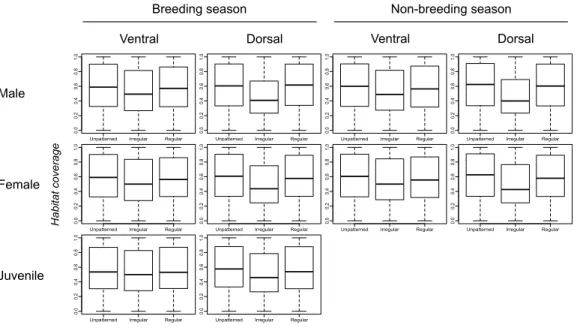
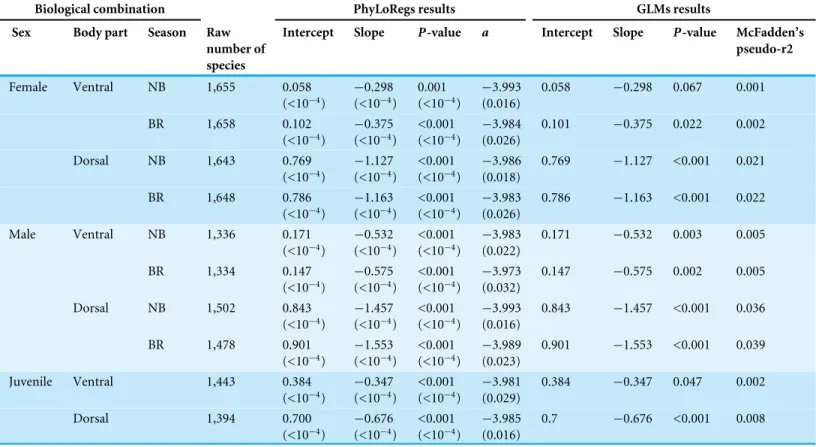
Figure 2shows very little difference in habitat coverage between species with regular versus irregular plumage patterns for all biological combinations, which was confirmed by the statistical models (Table 1). Phylogenetic uncertainty due to randomly resolving species with missing data by assuming monophyletic genera did not meaningfully affect the results (Table 1). For all biological combinations of plumage patterns, awas very nearly−4
indicating that almost no phylogenetic signal could be detected in the data for plumage patterns. Due to the lack of phylogenetic signal, estimates of intercepts and slopes were almost identical between phylogenetic logistic regressions and GLMs (Table 1). Although most slopes were significantly different from the null hypothesis for both phylogenetic logistic regressions and GLMs, the association between plumage pattern type andhabitat coverage using GLMs yielded extremely low R2 values (0.001–0.039) with a median R2 of 0.0065 (Table 1). In addition to the low explanatory power, all the models showed a negative relationship between plumage patterns andhabitat coverage, indicating that regular patterns are more associated with closed environments relatively to irregular patterns that are more associated with open environments, contrary to the camouflage hypothesis.
Eco-region avian assemblage analysis
Across the world’s eco-regions, and age, sex and breeding combinations, avian assemblages had similar proportions of species with regular and irregular plumage patterns, regardless of habitat type (Fig. 3;Fig. S2). In addition, all eco-regions contained qualitatively the same ratio of species with and without plumage patterns for each biological combination, regardless of habitat type (Fig. 3;Fig. S3).
Breeding season Non-breeding season
Ventral Dorsal Ventral Dorsal
H a b it a t co ve ra g e Male Female Juvenile 0.0 0.2 0.4 0.6 0.8 1.0
Unpatterned Irregular Regular
0.0 0.2 0.4 0.6 0.8 1.0
Unpatterned Irregular Regular
0.0 0.2 0.4 0.6 0.8 1.0
Unpatterned Irregular Regular
0.0 0.2 0.4 0.6 0.8 1.0
Unpatterned Irregular Regular
0.0 0.2 0.4 0.6 0.8 1.0
Unpatterned Irregular Regular
0.0 0.2 0.4 0.6 0.8 1.0
Unpatterned Irregular Regular
0.0 0.2 0.4 0.6 0.8 1.0
Unpatterned Irregular Regular
0.0 0.2 0.4 0.6 0.8 1.0
Unpatterned Irregular Regular
0.0 0.2 0.4 0.6 0.8 1.0
Unpatterned Irregular Regular
0.0 0.2 0.4 0.6 0.8 1.0
Unpatterned Irregular Regular
Figure 2 Comparison ofhabitat coveragevalues for species without plumage patterns, species with ir-regular plumage patterns and species with ir-regular plumage patterns across the class Aves.The compar-ison was plotted for allbiological combinations.
Proportion of species
Dorsal V entral
Male Female Juvenile
Patterned
Closed habitat
Open habitat Irregular
vs regular
Patterned Irregular
vs regular
Patterned Irregular
vs regular
1 2 3 4
0.0 0.2 0.4 0.6 0.8 1.0
1 2 3 4
0.0 0.2 0.4 0.6 0.8 1.0
1 2 3 4
0.0 0.2 0.4 0.6 0.8 1.0 0.0 0.2 0.4 0.6 0.8 1.0 0.0 0.2 0.4 0.6 0.8 1.0 0.0 0.2 0.4 0.6 0.8 1.0
Table 1 Relationship between plumage pattern type (regular versus irregular) and habitat (using ourhabitat coveragemeasure) across the class Aves using Phylogenetic Logistic Regressions (PhyLoRegs) and Generalized Linear Models (GLMs).We present the estimate of the intersect as well as the slope and its associatedp-value for both PhyLoRegs and GLMs. For PhyLoRegs, values correspond to the mean of 100 runs using ran-domly sampled phylogenetic trees fromJetz et al. (2012), and values in brackets correspond to the standard deviation. Positive slopes indicate that regular patterns are more associated with open habitat while irregular patterns are more associated with closed habitat, and negative slopes indicate the opposite.ais the phylogenetic correlation parameter calculated from the PhyLoRegs.R2values were computed for the GLMs and correspond to
the McFadden’s pseudo-R2.
Biological combination PhyLoRegs results GLMs results Sex Body part Season Raw
number of species
Intercept Slope P-value a Intercept Slope P-value McFadden’s pseudo-r2
Female Ventral NB 1,655 0.058 (<10−4)
−0.298
(<10−4)
0.001 (<10−4)
−3.993
(0.016)
0.058 −0.298 0.067 0.001
BR 1,658 0.102 (<10−4)
−0.375
(<10−4)
<0.001 (<10−4)
−3.984
(0.026)
0.101 −0.375 0.022 0.002
Dorsal NB 1,643 0.769 (<10−4)
−1.127
(<10−4)
<0.001 (<10−4)
−3.986
(0.018)
0.769 −1.127 <0.001 0.021
BR 1,648 0.786 (<10−4)
−1.163
(<10−4)
<0.001 (<10−4)
−3.983
(0.026)
0.786 −1.163 <0.001 0.022
Male Ventral NB 1,336 0.171 (<10−4)
−0.532
(<10−4)
<0.001 (<10−4)
−3.983
(0.022)
0.171 −0.532 0.003 0.005
BR 1,334 0.147 (<10−4)
−0.575
(<10−4)
<0.001 (<10−4)
−3.973
(0.032)
0.147 −0.575 0.002 0.005
Dorsal NB 1,502 0.843 (<10−4)
−1.457
(<10−4)
<0.001 (<10−4)
−3.993
(0.016)
0.843 −1.457 <0.001 0.036
BR 1,478 0.901 (<10−4)
−1.553
(<10−4)
<0.001 (<10−4)
−3.989
(0.023)
0.901 −1.553 <0.001 0.039
Juvenile Ventral 1,443 0.384 (<10−4)
−0.347
(<10−4)
<0.001 (<10−4)
−3.981
(0.029)
0.384 −0.347 0.047 0.002
Dorsal 1,394 0.700 (<10−4)
−0.676
(<10−4)
<0.001 (<10−4)
−3.985
(0.016)
0.7 −0.676 <0.001 0.008
Notes. Season
NB, Non-breeding; BR, Breeding.
DISCUSSION
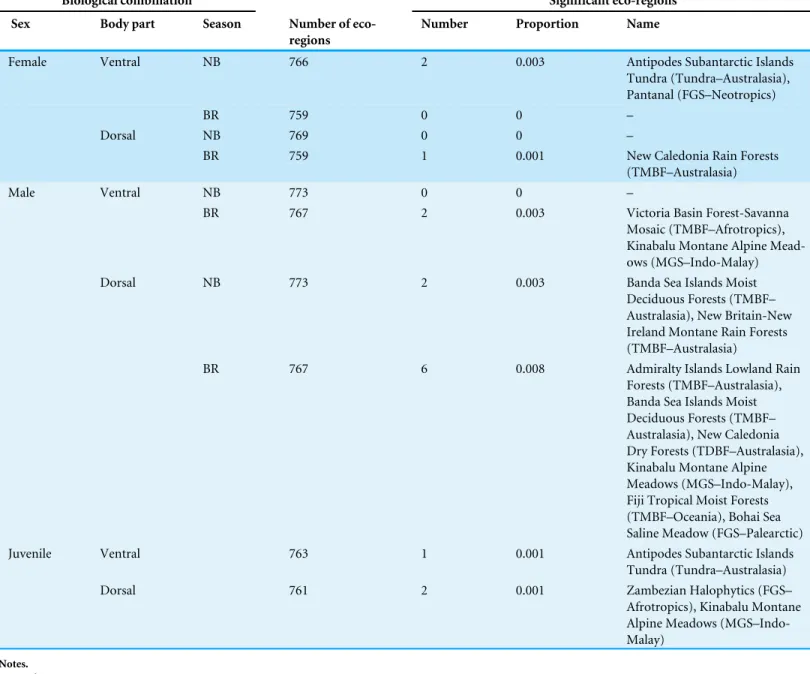
All types of plumage patterns have evolved in juveniles, females and males in non-breeding and breeding plumage, on both the ventral and dorsal surface (Table S1), and species with regular plumage patterns did not differ on average in the type of habitat in which they occur from species with irregular plumage patterns (Table 1;Fig. 2). In fact, contrary to prevailing sensory ecology based hypotheses of the function of patterns in camouflage, we did not find convincing evidence of an association between habitat type and bird plumage patterns at the global spatial and taxonomic scale (Table 1;Table S2). In addition, we found that species with regular and irregular plumage patterns are distributed at random across the world’s eco-regions with respect to one another without any significant effect of the eco-regions’ habitat type.
Table 2 Assemblage-level test of an association with habitat type for the ratioregular-irregular.For eachbiological combination, we present the total number of eco-regions that have avian species with plumage patterns, and the number, proportion and habitat type of eco-regions that have an observed ratioregular-irregularsignificantly different from the null expectation.
Biological combination Significant eco-regions Sex Body part Season Number of
eco-regions
Number Proportion Name
Female Ventral NB 766 2 0.003 Antipodes Subantarctic Islands Tundra (Tundra–Australasia), Pantanal (FGS–Neotropics)
BR 759 0 0 –
Dorsal NB 769 0 0 –
BR 759 1 0.001 New Caledonia Rain Forests
(TMBF–Australasia)
Male Ventral NB 773 0 0 –
BR 767 2 0.003 Victoria Basin Forest-Savanna Mosaic (TMBF–Afrotropics), Kinabalu Montane Alpine Mead-ows (MGS–Indo-Malay)
Dorsal NB 773 2 0.003 Banda Sea Islands Moist
Deciduous Forests (TMBF– Australasia), New Britain-New Ireland Montane Rain Forests (TMBF–Australasia)
BR 767 6 0.008 Admiralty Islands Lowland Rain Forests (TMBF–Australasia), Banda Sea Islands Moist Deciduous Forests (TMBF– Australasia), New Caledonia Dry Forests (TDBF–Australasia), Kinabalu Montane Alpine Meadows (MGS–Indo-Malay), Fiji Tropical Moist Forests (TMBF–Oceania), Bohai Sea Saline Meadow (FGS–Palearctic) Juvenile Ventral 763 1 0.001 Antipodes Subantarctic Islands
Tundra (Tundra–Australasia)
Dorsal 761 2 0.001 Zambezian Halophytics (FGS–
Afrotropics), Kinabalu Montane Alpine Meadows (MGS–Indo-Malay)
Notes. Habitat type
TMBF, Tropical and Subtropical Moist Broadleaf Forests; TDBF, Tropical and Subtropical Dry Broadleaf Forests; MGS, Montane Grasslands and Shrublands; MFWS, Mediterranean Forests, Woodlands and Scrub; FGS, Flooded Grasslands and Savannas; DXS, Deserts and Xeric Shrublands.
Season
NB, Non-breeding; BR, Breeding.
backgrounds (e.g., deserts) where irregular patterns would probably be easier to detect (e.g.,
1992;Brodie, 1993;Lindell & Forsman, 1996;Stevens, Yule & Ruxton, 2008;Scott-Samuel et al., 2011;Von Helversen, Schooler & Czienskowski, 2013;How & Zanker, 2014).
The finding that habitat had no effect on the presence of regular patterns on the ventral (breeding) surface of males (in particular barred patterns;Gluckman & Cardoso, 2010) would be expected under sexual selection, if regular patterns function solely to maximise conspicuousness to conspecifics. However, visual signals should diverge in biological hotspots due to species recognition/sexual selection (Bradbury & Vehrencamp, 1998). Habitat may influence whether the pattern stands out against its background, for example by being conspicuous against a uniform background or opposing the geometric pattern of the background. Indeed, signalling traits can be correlated with ecological characteristics to drive signal divergence, such as in African cichlid fish andAnolislizards (Leal & Fleishman, 2004;Seehausen et al., 2008) as well as in birds (Doutrelant et al., 2016). Other factors, such as whether the pattern is able to convey aspects of individual quality, would influence their evolution independent of the viewing background. This perhaps may explain why barred patterns have repeatedly evolved independently on the ventral surface of males (Gluckman & Cardoso, 2010). Conceivably, the same forces of sexual selection/species recognition may have shaped the evolution of the other types of patterns in males, such as spotted patterns (Roulin et al., 2000; b;Petrie & Halliday, 2008;Muck & Goymann, 2011;Pérez-Rodríguez, Jovani & Mougeot, 2013).
Several factors could explain the seemingly random distribution of regular and irregular plumage patterns from deserts to tropical forests. First, it could be due to the coarse scale at which we investigated the association between habitat and plumage patterns. Many of the empirical studies that demonstrate a camouflage function of patterns in non-colour changing animals show an association in one or a limited number of species (e.g.,Lovell et al., 2013;Kang et al., 2014;Marshall, Philpot & Stevens, 2015b.;Wilson-Aggarwal et al., 2016) or were found via predator–prey computer simulations (e.g.,Stevens, Yule & Ruxton, 2008;Stevens et al., 2011;Scott-Samuel et al., 2011;Troscianko et al., 2013;How & Zanker, 2014;Hughes, Troscianko & Stevens, 2014;reviewed in Marshall & Gluckman, 2015). At the level of microhabitats, some studies demonstrate that individual behaviours may facilitate camouflage, such as a behavioural choice to rest on backgrounds that enhance camouflage (Tsurui, Honma & Nishida, 2010;Lovell et al., 2013;Kang et al., 2014;Marshall, Philpot & Stevens, 2015b.;Troscianko et al., 2016; Wilson-Aggarwal et al., 2016). Under current camouflage theory, microhabitat usage in closed and open habitats should result in irregular patterning being associated with all habitats, as it is typically invoked in static camouflage. However, as regular patterns in camouflage are activated by motion, they would very likely need to be associated with only open habitats. Yet, no association was found at the scale we investigated and both irregular and regular patterns were randomly distributed and showed no difference in their geographic distribution with uniformly coloured avian species and no difference between any biological combination (Figs. 2and3;Table 1).
visual systems and may be highly visible to others in certain environments (e.g.,Cummings, Rosenthal & Ryan, 2003;Siebeck et al., 2010). Thus, avian camouflage patterns may be tuned to deceive predators’ visual systems in certain environments by distance-dependent effects and by exhibiting signals that predator visual systems cannot detect (private communication channels). However, to create a distance-dependent effect, regular patterns would require space to blur the pattern and should therefore have been associated with more open habitats, especially on the dorsal surface of females and juveniles, which was not what we found.
Perhaps the use of different strata in the vegetation, e.g., ground-dwelling vs. arboreal, may present different visual microhabitat backgrounds that alter the selection for pattern type. The tops of trees are more open and may allow for more movement required for motion-dazzle/flicker-fusion regular patterns whereas ground-dwelling species may benefit from background matching irregular patterning. Similarly, open habitat such as savannahs and grasslands contain patches of closed environment such as bushes and isolated trees in which static camouflage via irregular plumage patterning might be favoured. Moreover, more closed habitats will be darker due to shade, and predator risk might be lower due to reduced visual perception and increased clutter, so perhaps camouflage in highly cluttered environments is less likely to be favoured by selection. Conversely, in open environments, both regular and irregular patterns are likely to be found for dual functions in camouflage and communication.
Developmental constraint may also explain repeated convergence of the four types of plumage patterns independent of function. For example, white patches of plumage can be attributed to morphogen production (Price & Pavelka, 1996) and body size may be negatively related to plumage colour heterogeneity in birds (Galvan et al., 2013).Riegner
(2008)was the first to study the recurrence of plumage pattern elements across the class
Aves and emphasised developmental constraint as a mechanism of parallelism rather than convergence. However, patches of pigmentation over the body (e.g., counter shading) were the major focus of this study, and so scales were not included and spots were largely grouped with drab/blended plumage. The results of Riegner’s study demonstrated that some plumage patterns shift along a trajectory correlated with body size and that neither habitat nor common descent adequately predicted the evolution of patches of bold pigmentation over the body in aquatic or marine habitats. Also, striped (mottled) patterns appeared to be more frequent in Passerines whereas bars are more prevalent in large bodied species, e.g., Galliformes, raptors, etc. However,Riegner’s (2008) analysis did not control for phylogeny. Based on a theoretical model of reaction–diffusion based plumage pattern formation (Prum & Williamson, 2002), the evolutionary trajectory of plumage in Anseriformes and Galliformes followed the same pathways within and between patches of plumage over the body (Gluckman & Mundy, 2016). Given that Anseriformes and Galliformes are diverse in life history attributes, this result warrants further investigation at the macroevolutionary scale. Nevertheless, these studies indicate that there may be developmental constraint in plumage pattern evolution that may have implications for natural selection.
where each morph has varying amounts of mottled patterns in varying colours. However, when all morphs are present in a population, all morphs benefit by providing variation in the search image of predators (Karpestam, Merilaita & Forsman, 2014). In the case of birds, perhaps the four different types of patterns, in the context of a community of avian species that may also comprise uniform coloration without patterns, may benefit all member species. Although intraspecific polymorphism is quite different to interspecific variation, intraspecific polymorphism via adaptation to different habitats may be the first step to speciation leading to interspecific variation (reviewed inBoughman, 2002;Stevens, 2013;
McLean & Fox, 2014).
In summary, we found no convincing evidence for an association between habitat type and plumage pattern in land birds worldwide, and the distribution of plumage patterns across the world appears to be random rather than affected by habitat type. These results opposes the hypothesis that closed habitat should contain more species with irregular plumage pattern and open habitat more species with regular plumage pattern, as a result of habitat selection for camouflage. This is an intriguing result that implies that plumage pattern evolution does not conform to the prevailing views of selection for camouflage at the global spatial and taxonomic scale.
ACKNOWLEDGEMENTS
We would like to thank Trevor Price and two anonymous reviewers for insightful comments as well as John A. Endler Nicholas I. Mundy, Fabien Laroche and Andrea Manica for thoughtful feedback as well as Dieter Lukas for technical advice on comparative approaches.
ADDITIONAL INFORMATION AND DECLARATIONS
Funding
This research was funded by an Entente Cordiale Scholarship to M.S., a Biotechnology and Biological Sciences Research Council studentship to K.L.A.M. and the Cambridge Overseas Trust to T-L.G. The funders had no role in study design, data collection and analysis, decision to publish, or preparation of the manuscript.
Grant Disclosures
The following grant information was disclosed by the authors: Entente Cordiale Scholarship.
Biotechnology and Biological Sciences Research Council studentship. Cambridge Overseas Trust.
Competing Interests
The authors declare there are no competing interests.
Author Contributions
• Marius Somveille conceived and designed the experiments, performed the experiments,
• Kate L.A. Marshall conceived and designed the experiments, wrote the paper, reviewed
drafts of the paper.
• Thanh-Lan Gluckman conceived and designed the experiments, performed the
experiments, wrote the paper, prepared figures and/or tables, reviewed drafts of the paper.
Data Availability
The following information was supplied regarding data availability:
We have supplied the raw data used in this analysis for the review process. Please do not publish the raw data alongside this article if accepted as a third-party, who is not a co-author on this paper, partly owns the dataset with T-LG.
Supplemental Information
Supplemental information for this article can be found online athttp://dx.doi.org/10.7717/ peerj.2658#supplemental-information.
REFERENCES
Arlott N. 2007.Birds of Europe, Russia, China, and Japan, Passerines. Princeton: Prince-ton University Press.
Arlott N. 2009.Birds of Europe, Russia, China and Japan, Non- Passerines. Princeton: Princeton University Press.
Beehler BM, Pratt TK, Zimmerman DA. 1986.Birds of New Guinea. Princeton: Princeton University Press.
Benjamini Y, Hochberg Y. 1995.Controlling the false discovery rate: a practical and powerful approach to multiple testing.Journal of the Royal Statistical Society: B 57:289–300.
Birdlife International, NatureServe. 2012.Bird species distribution maps of the world. Cambridge: BirdLife International & Arlington: NatureServe.Available athttp: // www.birdlife.org/ datazone/ info/ spcdownload(accessed on 4 July 2013).
Boughman JW. 2002.How sensory drive can promote speciation.Trends in Ecology and Evolution17(12):571–577DOI 10.1016/S0169-5347(02)02595-8.
Bradbury JW, Vehrencamp SL. 1998.Principles of animal communication. Sunderland: Sinauer Associates.
Brazil M. 2009.Birds of East Asia, China, Taiwan, Korea, Japan, and Russia. Princeton: Princeton University Press.
Brodie ED. 1989.Genetic correlations between morphology and antipredator be-haviour in natural populations of the garter snakeThamnophis ordinoides.Nature 342:542–543DOI 10.1038/342542a0.
Brodie ED. 1992.Correlational selection for color pattern and antipredator be-havior in the garter snakeThamnophis ordinoides.Evolution46:1284–1298 DOI 10.2307/2409937.
Channan S, Collins K, Emanuel WR. 2014.Global mosaics of the standard MODIS land cover type data. University of Maryland and the Pacific Northwest National Laboratory, College Park, Maryland, USA.Available athttp:// glcf.umd.edu/ data/ lc/ (accessed on 1 October 2015).
Coates BJ, Bishop DK. 1997.A Guide to the birds of wallacea. Alderley: Dove Publica-tions.
Cott HB. 1940.Adaptive coloration in animals. Oxford: Oxford University Press. Cummings ME, Rosenthal GG, Ryan MJ. 2003.A private ultraviolet channel in visual
communication.Proceedings of the Royal Society B: Biological Sciences270:897–904 DOI 10.1098/rspb.2003.2334.
Dale J, Dey CJ, Delhey K, Kempenaers B, Valcu M. 2015.The effect of life history and sexual selection on male and female plumage colouration.Nature527:367–370 DOI 10.1038/nature15509.
De La Pena MR, Rumboll M. 1998.Birds of Southern South America and Antarctica. Princeton: Princeton University Press.
Dimitrova M, Merilaita S. 2009.Prey concealment: visual background complexity and prey contrast distribution.Behavioral Ecology21:176–181
DOI 10.1093/beheco/arp174.
Doutrelant C, Paquet M, Renoult JP, Grégoire A, Crochet P-A, Covas R. 2016. World wide patterns of bird colouration on islands.Ecology Letters19(5):537–545 DOI 10.1111/ele.12588.
Dunn PO, Armenta JK, Whittingham LA. 2015.Natural and sexual selection act on different axes of variation in avian plumage color.Science Advances1:e1400155 DOI 10.1126/sciadv.1400155.
Endler JA. 1978.Hecht MK, Steere WC, Wallace B, eds.Evolutionary biology. Boston: Springer.
Endler JA. 1992.Signals, signal conditions, and the direction of evolution.American Naturalist 139:125–153DOI 10.1086/285308.
Felsenstein J. 1985.Phylogenies and the comparative method.American Naturalist 125:1–15DOI 10.1086/284325.
Galvan I, Negro JJ, Rodriguez A, Carrascal LM. 2013.On showy dwarfs and sober giants: body size as a constraint for the evolution of bird plumage colouration.Acta Ornithologica48:65–80DOI 10.3161/000164513X670007.
Garcia JE, Rohr D, Dyer AG. 2013.Trade-off between camouflage and sexual di-morphism revealed by UV digital imaging: the case of Australian Mallee dragons (Ctenophorus fordi).Journal of Experimental Biology216:4290–4298
DOI 10.1242/jeb.094045.
Gluckman T-L. 2014.Pathways to elaboration of sexual dimorphism in bird plumage patterns.Biological Journal of the Linnean Society111:262–273 DOI 10.1111/bij.12211.
Gluckman T-L, Cardoso GC. 2009.A method to quantify the regularity of barred plumage patterns.Behavioral Ecology and Sociobiology63:1837–1844
Gluckman T-L, Cardoso GC. 2010.The dual function of barred plumage in birds: camouflage and communication.Journal of Evolutionary Biology23:2501–2506 DOI 10.1111/j.1420-9101.2010.02109.x.
Gluckman T-L, Mundy NI. 2016.Evolutionary pathways to convergence in plumage patterns.BMC Evolutionary Biology 16:172DOI 10.1186/s12862-016-0741-x. Grafen A. 1989.The phylogenetic regression.Philosophical Transactions of the Royal
Society of London B: Biological Sciences326:119–157DOI 10.1098/rstb.1989.0106. Grimmett R, Inskipp C, Inskipp T. 1999.Birds of India, Pakistan, Nepal, Bangladesh,
Bhutan, Sri Lanka and the Maldives. Princeton: Princeton University Press. Hall JR, Cuthill IC, Baddeley R, Shohet AJ, Scott-Samuel NE. 2013.Camouflage,
detection and identification of moving targets.Proceedings of the Royal Society B: Biological Sciences280:Article 20130064DOI 10.1098/rspb.2013.0064.
Heinzel H, Fitter R, Parslow J. 1995.Birds of britain and europe. London: Harper Collins Publishers.
Hoekstra HE, Hirschmann RJ, Bundey RA, Insel PA, Crossland JP. 2006.A single amino acid mutation contributes to adaptive beach mouse color pattern.Science 313:101–104DOI 10.1126/science.1126121.
Hoekstra HE, Krenz JG, Nashman NW. 2005.Local adaptation in the rock pocket mouse (Chaetodipus intermedius): natural selection and phylogenetic history of populations. Heredity94:217–228 DOI 10.1038/sj.hdy.6800600.
How MJ, Zanker JM. 2014.Motion camouflage induced by zebra stripes.Zoology 117:163–170DOI 10.1016/j.zool.2013.10.004.
Hughes AE, Troscianko J, Stevens M. 2014.Motion dazzle and the effects of tar-get patterning on capture success.BMC Evolutionary Biology 14:201–201 DOI 10.1186/s12862-014-0201-4.
Hurlbert AH, Jetz W. 2007.Species richness, hotspots, and the scale dependence of range maps in ecology and conservation.Proceedings of the National Academy of Sciences of the United States of America104:13384–13389DOI 10.1073/pnas.0704469104. Ives AR, Garland Jr T. 2010.Phylogenetic logistic regression for binary dependent
variables.Systematic Biology 59:9–26DOI 10.1093/sysbio/syp074.
Jetz W, Thomas GH, Joy JB, Hartmann K, Mooers AO. 2012.The global diversity of birds in space and time.Nature491:444–448DOI 10.1038/nature11631.
Kang C, Stevens M, Moon J, Lee S, Jablonski PG. 2014.Camouflage through behavior in moths: the role of background matching and disruptive coloration.Behavioral Ecology 26:45–54DOI 10.1093/beheco/aru150.
Karpestam E, Merilaita S, Forsman A. 2014.Natural levels of colour polymorphism reduce performance of visual predators searching for camouflaged prey.Biological Journal of the Linnean Society112(3):546–555DOI 10.1111/bij.12276.
Kenward B, Wachtmeister C-A, Ghirlanda S, Enquist M. 2004.Spots and stripes: the evolution of repetition in visual signal form.Journal of Theoretical Biology 230:407–419DOI 10.1016/j.jtbi.2004.06.008.
Leal M, Fleishman LJ. 2004.Differences in visual signal design and detectability between allopatric populations ofAnolislizards.American Naturalist 163:26–39 DOI 10.1086/379794.
Lindell LE, Forsman A. 1996.Density effects and snake predation: prey limitation and reduced growth rate of adders at high density of conspecifics.Canadian Journal of Zoology74:1000–1007DOI 10.1139/z96-113.
Lovell PG, Ruxton GD, Langridge KV, Spencer KA. 2013.Egg-laying substrate selection for optimal camouflage by quail.Current Biology23(3):260–264 DOI 10.1016/j.cub.2012.12.031.
MacKinnon J, Phillips K. 1993.A field guide to the birds of Borneo, Sumatra, Java and Bali (The greater Sunda islands). New York: Oxford University Press.
Marshall JN. 2000.Communication and camouflage with the same ‘‘Bright’’ colours in reef fishes.Philosophical Transactions of the Royal Society of London B: Biological Sciences355:1243–1248DOI 10.1098/rstb.2000.0676.
Marshall KLA, Gluckman T-L. 2015.The evolution of pattern camouflage strategies in waterfowl and game birds.Ecology and Evolution5(10):1981–1991
DOI 10.1002/ece3.1482.
Marshall KLA, Philpot KE, Damas-Moreira I, Stevens M. 2015a.Conspicuous male coloration impairs survival against avian predators in Aegean wall lizards,Podarcis erhardii.Ecology and Evolution5(18):4115–4131DOI 10.1002/ece3.1650.
Marshall KLA, Philpot KE, Stevens M. 2015b.Intraspecific colour variation among lizards in distinct island environments enhances local camouflage.PLoS ONE 10:e0135241DOI 10.1371/journal.pone.0135241.
McFadden D. 1974. Conditional logit analysis of qualitative choice behavior. In: Zarembka P, ed.Frontiers in econometrics. New York: Academic Press, 105–142. McLean CA, Stuart Fox D. 2014.Geographic variation in animal colour polymorphisms
and its role in speciation.Biological Reviews89:860–873DOI 10.1111/brv.12083. McLean CA, Moussalli A, Stuart-Fox D. 2014.Local adaptation and divergence in colour
signal conspicuousness between monomorphic and polymorphic lineages in a lizard. Journal of Evolutionary Biology27:2654–2664DOI 10.1111/jeb.12521.
Muck C, Goymann W. 2011.Throat patch size and darkness covaries with testosterone in females of a sex-role reversed species.Behavioral Ecology22:1312–1319
DOI 10.1093/beheco/arr133.
Olson DM, Dinerstein E, Wikramanayake ED, Burgess ND, Powell GVN, Underwood EC, D’amico JA, Itoua I, Strand HE, Morrison JC, Loucks CJ, Allnutt TF, Ricketts TH, Kura Y, Lamoreux JF, Wettengel WW, Hedao P, Kassem KR. 2001.Terrestrial ecoregions of the world: a new map of life on earth: a new global map of terrestrial ecoregions provides an innovative tool for conserving biodiversity.BioScience 51:933–938DOI 10.1641/0006-3568(2001)051[0933:TEOTWA]2.0.CO;2.
Petrie M, Halliday T. 2008.Experimental and natural changes in the peacocks (Pavo cristatus) train can affect mating success.Behavioral Ecology and Sociobiology 35:213–217DOI 10.1007/BF00167962.
Pough FH. 1976.Multiple cryptic effects of crossbanded and ringed patterns of snakes. Copeia1976:834–836DOI 10.2307/1443481.
Pratt HD, Bruner PL, Berrett DG. 1987.The birds of hawaii and the tropical pacific. Princeton: Princeton University Press.
Price T, Pavelka M. 1996.Evolution of a colour pattern: history, development and selec-tion.Journal of Evolutionary Biology9:451–470
DOI 10.1046/j.1420-9101.1996.9040451.x.
Prum RO, Williamson S. 2002.Reaction–diffusion models of within-feather pigmenta-tion patterning.Proceedings of the Royal Society B: Biological Sciences269:781–792 DOI 10.1098/rspb.2001.1896.
R Development Core Team. 2012.R: a language and environment for statistical comput-ing. Vienna: R Foundation for Statistical Computcomput-ing.Available athttp:// www.R-project.org.
Restall R, Rodner C, Lentino M. 2007.Birds of Northern South America. New Haven: Yale University Press.
Revell LJ. 2010.Phylogenetic signal and linear regression on species data.Methods in Ecology and Evolution1:319–329DOI 10.1111/j.2041-210X.2010.00044.x.
Revell LJ, Harmon LJ, Collar DC. 2008.Phylogenetic signal, evolutionary process, and rate.Systematic Biology57:591–601DOI 10.1080/10635150802302427.
Riegner MF. 2008.Parallel evolution of plumage pattern and coloration in birds: implications for defining avian morphospace.The Condor110:599–614 DOI 10.1525/cond.2008.8503.
Robertson H, Heather B. 2005.The hand guide to the birds of New Zealand. Auckland: Penguin Books.
Robson C. 2005.Birds of Southeast Asia. Princeton: Princeton University Press.
Rosenblum EB. 2006.Convergent evolution and divergent selection: lizards at the white sands ecotone.American Naturalist 167:1–15DOI 10.1086/498397.
Roulin A, Jungi TW, Pfister H, Dijkstra C. 2000.Female barn owls (Tyto alba) advertise good genes.Proceedings of the Royal Society B: Biological Sciences267:937–941 DOI 10.1098/rspb.2000.1093.
Scott-Samuel NE, Baddeley R, Palmer CE, Cuthill IC. 2011.Dazzle camouflage affects speed perception.PLoS ONE6:e20233DOI 10.1371/journal.pone.0020233. Seehausen O, Terai Y, Magalhaes IS, Carleton KL, Mrosso HDJ, Miyagi R, Van der
Sluijs I, Schneider MV, Maan ME, Tachida H, Imai H, Okada N. 2008.Speciation through sensory drive in cichlid fish.Nature455:620–626 DOI 10.1038/nature07285. Sibley DA. 2000.The sibley guide to birds. New York: Alfred Knopf.
Simpson K, Day N. 2004.Birds of Australia. 7th edition. Princeton: Princeton University Press.
Sinclair I, Ryan P. 2003.Birds of Africa south of the Sahara. Johannesburg: Struik Publishers.
Somveille M, Manica A, Butchart SHM, Rodrigues ASL. 2013.Mapping global diversity patterns for migratory birds.PLoS ONE 8:e70907DOI 10.1371/journal.pone.0070907. Stevens M. 2013.Sensory ecology, behaviour, and evolution. Oxford: Oxford University
Press.
Stevens M, Merilaita S. 2009.Defining disruptive coloration and distinguishing its functions.Philosophical Transactions of the Royal Society of London B: Biological Sciences364:481–488 DOI 10.1098/rstb.2008.0216.
Stevens M, Searle WTL, Seymour JE, Marshall KL, Ruxton GD. 2011.Motion dazzle and camouflage as distinct anti-predator defenses.BMC Biology9:81
DOI 10.1186/1741-7007-9-81.
Stevens M, Yule DH, Ruxton GD. 2008.Dazzle coloration and prey movement. Proceed-ings of the Royal Society B: Biological Sciences275:2639–2643
DOI 10.1098/rspb.2008.0877.
Stuart-Fox DM, Moussalli A, Johnston GR, Owens IPF. 2004.Evolution of colour vari-ation in dragon lizards: quantitative tests of the role of crypsis and local adaptvari-ation. Evolution58:1549–1559DOI 10.1111/j.0014-3820.2004.tb01735.x.
Stuart-Fox DM, Ord TJ. 2004.Sexual selection, natural selection and the evolution of dimorphic coloration and ornamentation in agamid lizards.Proceedings of the Royal Society B: Biological Sciences271:2249–2255DOI 10.1098/rspb.2004.2802.
Thayer GH. 1909.Concealing-coloration in the animal kingdom; an exposition of the laws of disguise through color and pattern. London: Macmillan.
The Nature Conservancy. 2009.Terrestrial ecoregions of the world. Arlington: The Nature Conservancy.Available athttp:// maps.tnc.org/ gis_data.html(accessed on 24 April 2015).
Troscianko J, Lown AE, Hughes AE, Stevens M. 2013.Defeating crypsis: detection and learning of camouflage strategies.PLoS ONE8:e73733.
Troscianko J, Wilson-Aggarwal J, Stevens M, Spottiswoode CN. 2016.Camouflage predicts survival in ground-nesting birds.Scientific Reports6:Article 19966 DOI 10.1038/srep19966.
Tsurui K, Honma A, Nishida T. 2010.Camouflage effects of various colour-marking morphs against different microhabitat backgrounds in a polymorphic pygmy grasshopperTetrix japonica.PLoS ONE5(7):e11446
DOI 10.1371/journal.pone.0011446.
Van Perlo B. 2006.Birds of Mexico and Central America. Princeton: Princeton University Press.
Von Helversen B, Schooler LJ, Czienskowski U. 2013.Are stripes beneficial? dazzle camouflage influences perceived speed and hit rates.PLoS ONE8:e61173 DOI 10.1371/journal.pone.0061173.