TNF-
a
-308G/A Polymorphism Contributes to Obstructive
Sleep Apnea Syndrome Risk: Evidence Based on 10
Case-Control Studies
Yanping Wu1", Chao Cao1,2", Yinfang Wu1
, Chao Zhang1, Chen Zhu1, Songmin Ying1, Zhihua Chen1,
Huahao Shen1, Wen Li1*
1Department of Respiratory and Critical Care Medicine, Second Affiliated Hospital, School of Medicine, Zhejiang University, Hangzhou, China,2Department of Respiratory Medicine, Affiliated Hospital of School of Medicine, Ningbo University, Ningbo, China
Abstract
Objective: The aim of our study was to investigate the association between the TNF-a-308G/A polymorphism and
obstructive sleep apnea syndrome (OSAS).
Method:The Medline, Web of Science, EMBASE, Chinese National Knowledge Infrastructure (CNKI), and Cochrane Central
Register of Controlled Trials were searched. Pooled odds ratios (ORs) and 95% confidence intervals (CIs) were calculated to studyTNF-a-308G/Apolymorphism and risk of OSAS.
Result:10 case-control studies were included in our meta-analysis. The results from our study showed that theTNF-a-308G/ Apolymorphism was significantly associated with risk of OSAS (Avs. G: OR = 1.67, 95% CI = 1.43–1.95). In the subgroup analysis by ethnicity, the statistical similar results were observed both in European (Avs.G: OR = 1.68, 95% CI = 1.35–2.08) and Asian population (Avs. G: OR = 2.02, 95% CI = 1.50–2.71). When stratified by age, a significantly increased risk was observed in adult carries A allele compared with G allele (OR = 1.79, 95% CI = 1.50–2.13), whereas no association was found in children (OR = 1.09, 95% CI = 0.70–1.69).
Conclusion:Our study suggested that theTNF-a- 308G/Apolymorphism contributed to the susceptibility to the risk of
OSAS. Additional well-designed large studies are needed to validate our findings.
Citation:Wu Y, Cao C, Wu Y, Zhang C, Zhu C, et al. (2014) TNF-a-308G/A Polymorphism Contributes to Obstructive Sleep Apnea Syndrome Risk: Evidence Based on 10 Case-Control Studies. PLoS ONE 9(9): e106183. doi:10.1371/journal.pone.0106183
Editor:Junwen Wang, The University of Hong Kong, Hong Kong
ReceivedJune 5, 2014;AcceptedJuly 28, 2014;PublishedSeptember 5, 2014
Copyright:ß2014 Wu et al. This is an open-access article distributed under the terms of the Creative Commons Attribution License, which permits unrestricted use, distribution, and reproduction in any medium, provided the original author and source are credited.
Data Availability:The authors confirm that all data underlying the findings are fully available without restriction. All relevant data are within the paper and its Supporting Information files.
Funding:This work was supported by grant of National Natural Science Foundation of China (No. 81170037 and No. 81370126) and Natural Science Foundation of Ningbo (No. 2012A610257). The funders had no role in study design, data collection and analysis, decision to publish, or preparation of the manuscript.
Competing Interests:The authors have declared that no competing interests exist.
* Email: [email protected]
"Yanping Wu and CC are co-first authors on this work.
Introduction
Obstructive sleep apnea syndrome (OSAS) is a common sleep disorder characterized by repetitive partial or complete obstruc-tion of the upper respiratory tract during sleep, resulting in apnea or hypopnea [1]. Due to obesity and aging population, the OSAS has undergone an increasing prevalence all over the world. It was reported that more than 5% of the general population has been affected [2]. According to the National Sleep Foundation (NSF) Sleep in America, there were 1/4 Americans at high risk of suffering sleep apnea on the basis of the Berlin Questionnaire [3]. OSAS has been reported to be associated with various health related consequences, including cardiovascular disease, hyperten-sion, stroke, insulin resistance and all-cause mortality [4]. OSAS represents a vital public health concern and should be given much more attention because of the high prevalence and its enormous negative consequences. In consequence, improving our
under-standing of the pathogenesis of OSAS is essential for the development of effective and safe therapies.
Tumor necrosis factor (TNF)-a, a member of the TNF/TNFR cytokine family, is an intercellular communicating molecule involved in a wide variety of human diseases. Krueger et al. [5] has pointed out that TNF-a is one of the most important pleiotropic proinflammatory cytokines involved in sleep regula-tion. Raised levels of circulating TNF-a in patients with OSAS have been reported in previous studies [6–8]. The synthesis of TNF-a has been suggested to be mostly regulated at the transcriptional level [9]. The DNA variations in the promoter region of theTNF-agene may directly influence the transcription
of theTNFgene. The TNF-agene is located within the highly
polymorphic major histocompatibility complex (MHC) region on the short arm of chromosome 6p21.3 [10]. Several polymorphisms in the promoter region of theTNF-agene have been identified.
region, consisting of a guanine (G) to adenine (A) substitution, has been reported to be associated with increased production of
TNF-alevels bothin vitroandin vivo[11,12]. There is evidence that A
allele is associated with increased level of TNF-a in plasma
compared with G allele [13]. As the TNF-a-308G/A
polymor-phism is strongly associated with circulating TNF-a concentra-tions, it is assumed that it might be closely related to the OSAS risk. To investigate a possible association between TNF-a
polymorphism and risk of OSAS, we conducted a meta-analysis from all available relevant studies.
Materials and Methods
Literature search strategy and eligibility criteria
The Medline, Web of Science, EMBASE, Chinese National Knowledge Infrastructure (CNKI) and Cochrane Central Register of Controlled Trials were searched. A broad search strategy was used for optimum sensitivity. Using Medical Subject Headings (MeSH) and text words, we adopted the following terms to search the databases: (‘‘obstructive sleep apnea–hypopnea syndrome’’ OR ‘‘obstructive sleep apnea’’ OR ‘‘sleep apnea’’ OR ‘‘apnea’’ OR ‘‘OSAS’’ OR ‘‘OSA’’) AND (‘‘single nucleotide polymor-phisms’’ OR ‘‘SNP’’ OR ‘‘polymorphism’’ OR ‘‘gene variant’’ OR ‘‘mutation’’) AND (‘‘tumor necrosis factor a’’ OR ‘‘tumor necrosis factor-a’’ OR ‘‘tumor necrosis factor’’ OR ‘‘TNF-a’’ OR
‘‘TNF’’). The search was restricted to humans. Titles and abstracts were screened up to 31 March 2014 were retrieved. Articles were screened at the title and abstract phase by two authors (Yanping Wu and Chao Cao).
Inclusion and exclusion criteria
Inclusion criteria for studies included: (a) evaluation of the relationship betweenTNF-a- 308G/Apolymorphism and OSAS
susceptibility; (b) case–control study; (c) validated genotyping methods were used; (d) detailed genotype frequencies in cases and controls for the calculation. Major reasons for exclusion of studies were: (a) no control group, case reports or review articles; (b) duplicate data; (c) enrolled patients were using TNF inhibitors.
Data extraction and quality assessment
Information was carefully extracted from all eligible studies independently by two of the authors, according to the inclusion criteria listed above. From each study, data on general study characteristics was extracted: first author’s surname, year of publication, ethnic descent of the study population (European, Asian or mixed), genotyping methods, numbers of eligible cases and controls, genotype distributions in cases and controls and available subgroups. Disagreements were resolved by discussion and consensus.
The Newcastle-Ottawa Scale (NOS), which was developed to assess the quality of non-randomised studies, was performed to assess the quality of included studies [14]. The system included three broad perspectives: the selection of the study groups; the comparability of the groups; and the ascertainment of the outcome. And the scores of 0–3, 4–6, and 7–9 indicated low, moderate, and high quality of studies, respectively.
Statistical analysis
All analyses were performed on Review Manager version 5.0.16 and Stata version 12.0. The Hardy-Weinberg equilibrium (HWE) was utilized to compare the observed genotype frequencies with expected genotype frequencies in controls. The association between risk of OSAS and TNF-a-308G/A polymorphism was
estimated for each study using the odds ratio (OR) and 95% confidence interval (CI). Between-study heterogeneity was assessed with thex2-based Q statistical test [15]. We also used the statistic
ofI2to efficiently test for the heterogeneity, with I2,25%, 25– 75% and.75% to represent low, moderate and high degree of inconsistency, respectively [16,17]. When P.0.1 or I2,50%, indicating a lack of heterogeneity, and for these analyses, the fixed-effect model was used; otherwise, the random-fixed-effect model was applied [16–19]. The significance of the combined OR was determined by the Z-test, in which P,0.05 was considered significant. Effects were tested in models as follows: allele comparison (A vs. G), homozygote comparison (GG vs. AA), heterozygote comparison (AG vs. AA), dominant model (AG+GG vs. AA), and recessive model (GG vs. AA+AG). Stratified analysis Figure 1. Flow chart of literature search and study selection.
doi:10.1371/journal.pone.0106183.g001
TNF-a-308G/A Polymorphism and Obstructive Sleep Apnea Syndrome
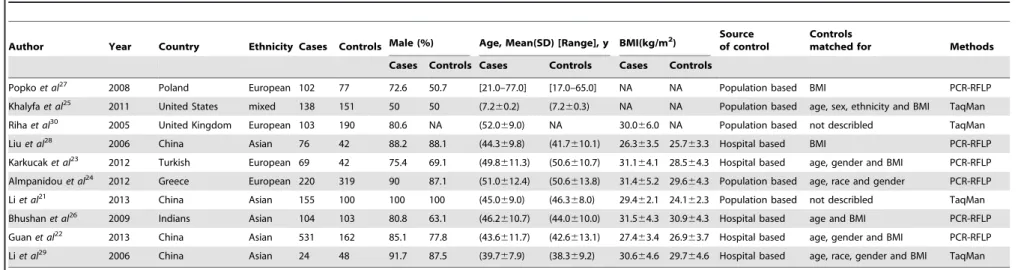
Table 1.Study characteristics from published studies on the relation of the TNF-a-308G/A polymorphism to OSAS risk in this meta-analysis.
Author Year Country Ethnicity Cases Controls Male (%) Age, Mean(SD) [Range], y BMI(kg/m2)
Source of control
Controls
matched for Methods
Cases Controls Cases Controls Cases Controls
Popkoet al27 2008 Poland European 102 77 72.6 50.7 [21.0–77.0] [17.0–65.0] NA NA Population based BMI PCR-RFLP
Khalyfaet al25 2011 United States mixed 138 151 50 50 (7.260.2) (7.260.3) NA NA Population based age, sex, ethnicity and BMI TaqMan
Rihaet al30 2005 United Kingdom European 103 190 80.6 NA (52.069.0) NA 30.066.0 NA Population based not describled TaqMan
Liuet al28 2006 China Asian 76 42 88.2 88.1 (44.369.8) (41.7610.1) 26.363.5 25.763.3 Hospital based BMI PCR-RFLP
Karkucaket al23 2012 Turkish European 69 42 75.4 69.1 (49.8611.3) (50.6610.7) 31.164.1 28.564.3 Hospital based age, gender and BMI PCR-RFLP
Almpanidouet al24 2012 Greece European 220 319 90 87.1 (51.0612.4) (50.6613.8) 31.465.2 29.664.3 Population based age, race and gender PCR-RFLP
Liet al21 2013 China Asian 155 100 100 100 (45.069.0) (46.368.0) 29.462.1 24.162.3 Population based not describled TaqMan
Bhushanet al26 2009 Indians Asian 104 103 80.8 63.1 (46.2610.7) (44.0610.0) 31.564.3 30.964.3 Hospital based age and BMI PCR-RFLP
Guanet al22 2013 China Asian 531 162 85.1 77.8 (43.6611.7) (42.6613.1) 27.463.4 26.963.7 Hospital based age, gender and BMI PCR-RFLP
Liet al29 2006 China Asian 24 48 91.7 87.5 (39.767.9) (38.369.2) 30.664.6 29.764.6 Hospital based age, race, gender and BMI TaqMan
NA: Not applicable; BMI: Body mass index; PCR-RFLP: Polymerase chain reaction–restriction fragment length polymorphism. doi:10.1371/journal.pone.0106183.t001
Table 2.Genotype distribution in included studies.
Author Case Control G allele frequency (%) HWE(P)
AA AG GG AA AG GG
Popkoet al27 0 29 73 0 18 59 88.3 0.25
Khalyfaet al25 7 33 98 5 38 108 84.1 0.47
Rihaet al30 7 44 52 8 52 130 82.1 0.34
Liuet al28 8 23 45 1 6 35 90.5 0.27
Karkucaket al23 0 18 51 0 9 33 89.3 0.44
Almpanidouet al24 19 83 118 14 84 221 82.4 0.11
Liet al21 0 18 137 0 12 88 94.0 0.52
Bhushanet al26 8 22 74 3 10 90 92.2 ,0.01
Guanet al22 6 95 430 1 18 143 93.8 0.60
Liet al29 3 10 11 1 12 35 85.4 0.98
TNF-a
-308G/A
Polymorp
hism
and
Obstructive
Sleep
Apnea
PLOS
ONE
|
www.ploson
e.org
3
September
2014
|
Volume
9
|
Issue
was performed by ethnicity and age. Sensitivity analysis was performed to evaluate the effect of each individual study on the pooled ORs. Funnel plots and Egger’s linear regression test were used to evaluate the potential publication bias [20].
Results
Characteristics of studies
The search strategy retrieved 88 potentially relevant studies. After initial search by the titles and abstracts, 74 studies were excluded. Among the excluded studies, 4 were reviews or meta-analysis and 70 were not relevant to TNF-a-308G/A
polymor-phism and OSAS. By further full text screening, 2 studies were
duplicate publications and 2 had no interested outcomes. Finally, 10 full-text articles, with a total of 1522 OSAS cases and 1234 controls, which definitely addressed the association between TNF-a-308G/A polymorphism and OSAS risk were enrolled in our
study [21-30] (Figure 1). According to the NOS quality assess-ment, all included studies achieved a score of moderate to high quality (table S1). The genotype distribution in each study was extracted and detailed information in one study was referred to published data. Of all eligible studies for TNF-a-308G/A
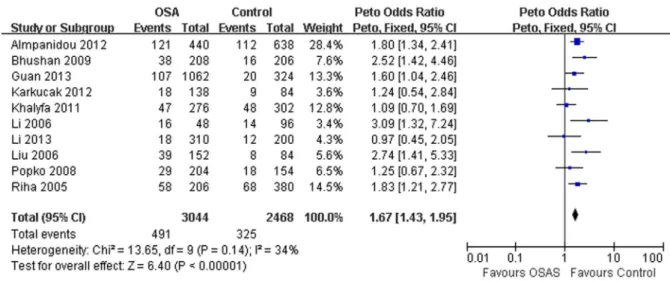
polymorphism, four were performed in European population [23,24,27,30], five in Asian descent [21,22,26,28,29] and one in mixed populations (European and Asian descents) [25]. In terms of Figure 2. Meta-analysis with a fixed model for the ORs of OSAS risk associated withTNF-a-308G/Apolymorphism (A vs. G).
doi:10.1371/journal.pone.0106183.g002
Figure 3. Meta-analysis with a fixed model for the ORs of OSAS risk in subgroup analysis by ethnicity (A vs. G). doi:10.1371/journal.pone.0106183.g003
TNF-a-308G/A Polymorphism and Obstructive Sleep Apnea Syndrome
age, nine studies were conducted in adults [21–24,26–30] and one in children [25]. Polymerase chain reaction-restriction fragment length polymorphism (PCR-RFLP) [22–24,26–28] and TaqMan assay [21,25,29,30] were used to analyze the genotyping. The genotype distributions of all control samples except one study were in HWE [26]. The general characteristics and genotype informa-tion of each study were summarized in Table 1 and Table 2.
Quantitative synthesis
Our study suggested a significant association of the TNFa -308G/Apolymorphism with OSAS risk (Avs.G: OR = 1.67, 95% CI = 1.43–1.95, P,0.00001; homozygote comparison: OR = 2.62, 95% CI = 1.68–4.09, P,0.0001; dominant model: OR = 1.74, 95% CI = 1.36–2.22, P,0.00001; recessive model: OR = 2.15, 95% CI = 1.39–3.32, P=0.0006, Table 3; Figure 2). However, no significant association between this polymorphism and OSAS risk was observed in heterozygote comparison (OR = 1.38, 95% CI = 0.86–2.21, P = 0.18). In the subgroup analysis by ethnicity, similar results were observed in European (Avs.G: OR = 1.68, 95% CI = 1.35–2.08, P,0.00001) and Asian population (Avs.G: OR = 2.02, 95% CI = 1.50–2.71, P,0.00001; Figure 3). When stratified according to age, significant association between the
TNFa-308G/Apolymorphism and risk of OSAS was observed in
adults (Avs.G: OR = 1.79, 95% CI = 1.50–2.13, P,0.00001), but not for children (A vs.G: OR = 1.09, 95% CI = 0.70–1.69, P = 0.71).
Sensitivity analysis
Sensitivity analysis was carried out to assess the influence of each individual study on the pooled ORs. By removing each study, the pooled ORs were not altered significantly, which indicated that no individual study significantly affected the pooled results. When one HWE-violating study was excluded, the corresponding pooled ORs were still meaningful, showing the results were robust (OR = 1.62, 95% CI = 1.37–1.91, P,0.00001).
Publication bias
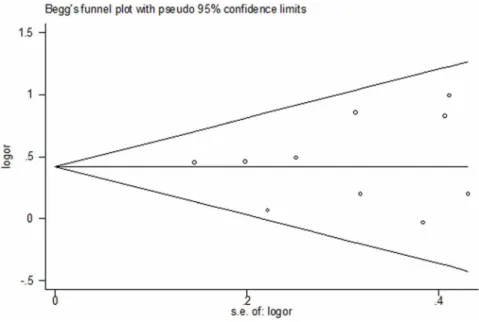
Begg’s test and funnel plot were performed to verify the publication bias of the literature. The shapes of the funnel plots did not show obvious asymmetry (Figure 4). The asymmetry of the funnel plot was further tested by Egger’s regression (t = 0.37, P = 0.724), which showed no significant publication bias.
Discussion
In this meta-analysis, we concluded the existing data on the association ofTNFa-308G/Apolymorphism and OSAS risk. 10
studies involving 1,522 cases and 1,234 controls met the eligibility criteria. Our results demonstrated that the TNF-a-308G/A
polymorphism was associated with OSAS risk (A vs. G: OR = 1.67, 95% CI = 1.43–1.95, P,0.00001). The A allele, compared with the G allele, was more likely to promote the risk of OSAS.
In stratified analyses, we observed that the association between
TNFa-308G/A polymorphism and OSAS risk remained
signifi-cant in Europeans (Avs.G: OR = 1.68, 95% CI = 1.35–2.08) and Asians (A vs. G: OR = 2.02, 95% CI = 1.50–2.71). Genetic background might have significant influence on the susceptibility of OSAS. However, up to date, no studies were performed in Africans, which limited our further analysis in those populations. At the same time, it was worth emphasizing thatTNFa-308G/A
polymorphism was contributed to the increase of OSAS suscep-tibility in adults (Avs.G: OR = 1.79, 95% CI = 1.50–2.13), but not for children (Avs.G: OR = 1.09, 95% CI = 0.70–1.69). This
Table 3. Stratified analysis of the TNF-a -308G/A polymorphism on OSAS risk. Variables No. a Cases/Controls A vs G AA vs GG AA vs AG AA vs AG + GG AA + AG vs GG OR(95%CI) P b P OR(95%CI) P b P OR(95%CI) P b P OR(95%CI) P b P OR(95%CI) P b P Total 10 1522/1234 1.67[1.43,1.95] 0.14 0 .00 2.62[1.68,4.09] 0.79 0.00 1.38[0.86,2.21] 0.98 0.18 2.15[1.39,3.32] 0.91 0.00 1.74[1.36,2.22] 0.14 0.00 Ethnicities European 4 494/628 1.68[1.35,2.08] 0.67 0 .00 2.42[1.33,4.41] 0.82 0.00 1.25[0.67,2.33] 0.67 0.48 1.92[1.07,3.46] 0.74 0.03 1.83[1.41,2.36] 0.57 0.00 Asian 5 8 90/455 2.02[1.50,2.71] 0.13 0 .00 3.95[1.56,10.00] 0.76 0.00 1.60[0.59,4.33] 0.87 0.36 3.28[1.30,8.26] 0.84 0.01 2.01[1.45,2.80] 0.16 0. 00 mixed 1 1 38/151 1.09[0.70,1.69] NA 0.71 1.54[0.47,5.02] N A 0 .47 1.61[0.47,5.56] N A 0 .45 1 .56[0.48,5.04] N A 0 .46 1.03[0.62,1.71] NA 0.92 Age Adults 9 1 384/1083 1.79[1.50,2.13] 0.30 0 .00 2.80[1.69,4.63] 0.85 0.00 1.34[0.79,2.27] 0.96 0.27 2.24[1.37,3.69] 0.87 0.00 1.89[1.55,2.32] 0.36 0.00 Children 1 1 38/151 1.09[0.70,1.69] NA 0.71 1.54[0.47,5.02] N A 0 .47 1.61[0.47,5.56] N A 0 .45 1 .56[0.48,5.04] N A 0 .46 1.03[0.62,1.71] NA 0.92 anumber o f studies. bP value of Q -test for heterogeneity test. 0.00 means value , 0.01. doi:10.1371/journal.pone. 0106183.t003
might reflect the fact that increased age modified the associations and might helpful to understand the pathogenesis of adults’ OSAS. The results from our study showed that TNFa-308G/A
polymorphism associated with risk of OSAS. Compared with G allele, A allele was closely related to increased susceptibility to OSAS. The significance of this polymorphism could be explained by its possible influence on the expression of TNF-aprotein. It was reported that the A allele of TNF-a gene increased TNF-a
expression and resulted in higher TNF-aproduction by means of regulating adipose tissue metabolism [31,32]. Moreover, TNF-a
played an important role in regulating the pro-inflammatory cytokines during sleep and closely related to the level of high sensitivity C-reactive protein (hsCRP) [33]. Shamsuzzaman et al. demonstrated that the plasma C-reactive protein was elevated in OSAS patients and the magnitude of CRP elevation was remarkably related to the severity of OSAS [34].
Compared with the previous meta-analysis performed by Huang et al [35], our study had several superiorities. Firstly, the previous study identified less than half the number of studies as compared with the present study. More subjects were included in our study to provide a more comprehensive result. Secondly, in the previous meta-analysis, the authors did not evaluate some clinically significant outcomes and clinically relevant subgroups. This is first meta-analysis showedTNF-a-308polymorphism increased
suscep-tibility to the OSAS in both in European and Asian population. In addition, we firstly observedTNF-a-308polymorphism increased
the risk of OSAS in Adults, but not for children. Thirdly, no significant between-study heterogeneity and publication bias were observed in our study. Moreover, we carried out sensitivity analyses to evaluate the effect of each individual study on the pooled ORs.
Some limitations of this meta-analysis should be addressed. First, the number of published studies, especially for African population and children, was not large enough. Second, one study did not agreed with HWE in our analysis [26]. However, pooled
ORs were not significant affect when the study was excluded. Third, in most studies detail information such as the co-morbidities were not available, which limited our further performed a risk-adjusted analysis.
Conclusion
In summary, this meta-analysis suggested that the A allele of the
TNF-a-308 polymorphism increased susceptibility to the OSAS.
These results provided the important role of theTNF-a-308G/A
polymorphisms in the development of OSAS. Additional well-designed large studies were needed to validate our findings.
Supporting Information Checklist S1 (DOCX)
Table S1 Quality assessment of case-control studies.
(DOC)
Acknowledgments
This work was supported by grant of National Natural Science Foundation of China (No. 81170037 and No. 81370126) and Natural Science Foundation of Ningbo (No. 2012A610257). The funders had no role in study design, data collection and analysis, decision to publish, or preparation of the manuscript.
Author Contributions
Conceived and designed the experiments: WL CC Yanping Wu Yinfang Wu HS ZC SY. Performed the experiments: CC WL Yanping Wu Yinfang Wu C. Zhang. Analyzed the data: CC Yanping Wu C. Zhu Yinfang Wu WL. Contributed reagents/materials/analysis tools: Yanping Wu CC WL ZC SY. Contributed to the writing of the manuscript: Yanping Wu CC WL.
References
1. Eckert DJ, Malhotra A (2008) Pathophysiology of adult obstructive sleep apnea. Proc Am Thorac Soc 5: 144–153.
2. Young T, Peppard PE, Gottlieb DJ (2002) Epidemiology of obstructive sleep apnea: a population health perspective. Am J Respir Crit Care Med 165: 1217– 1239.
Figure 4. Funnel plot for publication bias of the meta-analysis of OSAS risk andTNF-a-308G/Apolymorphism (A vs. G).
doi:10.1371/journal.pone.0106183.g004
TNF-a-308G/A Polymorphism and Obstructive Sleep Apnea Syndrome
3. Hiestand DM, Britz P, Goldman M, Phillips B (2006) Prevalence of symptoms and risk of sleep apnea in the US population: Results from the national sleep foundation sleep in America 2005 poll. Chest 130: 780–786.
4. Kielb SA, Ancoli-Israel S, Rebok GW, Spira AP (2012) Cognition in obstructive sleep apnea-hypopnea syndrome (OSAS): current clinical knowledge and the impact of treatment. Neuromolecular Med 14: 180–193.
5. Krueger JM (2008) The role of cytokines in sleep regulation. Curr Pharm Des 14: 3408–3416.
6. Ciftci TU, Kokturk O, Bukan N, Bilgihan A (2004) The relationship between serum cytokine levels with obesity and obstructive sleep apnea syndrome. Cytokine 28: 87–91.
7. Li NF, Yao XG, Zhu J, Yang J, Liu KJ, et al. (2010) Higher levels of plasma TNF-alpha and neuropeptide Y in hypertensive patients with obstructive sleep apnea syndrome. Clin Exp Hypertens 32: 54–60.
8. Zamarron C, Garcia Paz V, Riveiro A (2008) Obstructive sleep apnea syndrome is a systemic disease. Current evidence. Eur J Intern Med 19: 390–398. 9. Raabe T, Bukrinsky M, Currie RA (1998) Relative contribution of transcription
and translation to the induction of tumor necrosis factor-alpha by lipopolysac-charide. J Biol Chem 273: 974–980.
10. Wilson AG, Symons JA, McDowell TL, McDevitt HO, Duff GW (1997) Effects of a polymorphism in the human tumor necrosis factor alpha promoter on transcriptional activation. Proc Natl Acad Sci U S A 94: 3195–3199. 11. Louis E, Franchimont D, Piron A, Gevaert Y, Schaaf-Lafontaine N, et al. (1998)
Tumour necrosis factor (TNF) gene polymorphism influences TNF-alpha production in lipopolysaccharide (LPS)-stimulated whole blood cell culture in healthy humans. Clin Exp Immunol 113: 401–406.
12. Kroeger KM, Steer JH, Joyce DA, Abraham LJ (2000) Effects of stimulus and cell type on the expression of the2308 tumour necrosis factor promoter polymorphism. Cytokine 12: 110–119.
13. Wilson AG, di Giovine FS, Blakemore AI, Duff GW (1992) Single base polymorphism in the human tumour necrosis factor alpha (TNF alpha) gene detectable by NcoI restriction of PCR product. Hum Mol Genet 1: 353. 14. Wells GA, Shea B, O’Connell D, Peterson J, Welch V, et al. (2010) The
Newcastle-Ottawa Scale (NOS) for assessing the quality of nonrandomised studies in meta-analyses.
15. Lau J, Ioannidis JP, Schmid CH (1997) Quantitative synthesis in systematic reviews. Ann Intern Med 127: 820–826.
16. Higgins JP, Thompson SG, Deeks JJ, Altman DG (2003) Measuring inconsistency in meta-analyses. BMJ 327: 557–560.
17. Higgins JP, Thompson SG (2002) Quantifying heterogeneity in a meta-analysis. Stat Med 21: 1539–1558.
18. Mantel N, Haenszel W (1959) Statistical aspects of the analysis of data from retrospective studies of disease. J Natl Cancer Inst 22: 719–748.
19. DerSimonian R, Laird N (1986) Meta-analysis in clinical trials. Control Clin Trials 7: 177–188.
20. Egger M, Davey Smith G, Schneider M, Minder C (1997) Bias in meta-analysis detected by a simple, graphical test. BMJ 315: 629–634.
21. Li T, Qian X, Guo R, Sun B, Liu C (2013) Relation between TNF-a
polymorphism and obstructive sleep apnea syndrome accompanying hyperten-sion. Acad J Chinese PLA Med Sch 34.
22. Guan Jian YH, Meng L, Su K, Yin S (2013) Study of association of TNF-alpha gene Polymorphism with OSAHS and metabolic syndrome CHlN ARCH OTOLARYNGOL HEAD NECK SURG 20.
23. Karkucak M, Ursavas A, Ocakoglu G, Go¨ru¨kmez O, Yakut T, et al. (2012) Analysis of TNF-alpha G308A and C857T gene polymorphisms in Turkish patients with obstructive sleep apnea syndrome. Turkiye Klinikleri Journal of Medical Sciences 32: 1368–1373.
24. Almpanidou P, Hadjigeorgiou G, Gourgoulianis K, Papadimitriou A (2012) Association of tumor necrosis factor-alpha gene polymorphism (2308) and obstructive sleep apnea-hypopnea syndrome. Hippokratia 16: 217–220. 25. Khalyfa A, Serpero LD, Kheirandish-Gozal L, Capdevila OS, Gozal D (2011)
TNF-alpha gene polymorphisms and excessive daytime sleepiness in pediatric obstructive sleep apnea. J Pediatr 158: 77–82.
26. Bhushan B, Guleria R, Misra A, Luthra K, Vikram NK (2009) TNF-alpha gene polymorphism and TNF-alpha levels in obese Asian Indians with obstructive sleep apnea. Respir Med 103: 386–392.
27. Popko K, Gorska E, Potapinska O, Wasik M, Stoklosa A, et al. (2008) Frequency of distribution of inflammatory cytokines IL-1, IL-6 and TNF-alpha gene polymorphism in patients with obstructive sleep apnea. J Physiol Pharmacol 59 Suppl 6: 607–614.
28. Liu HG, Guan P, Lin M, Xu YJ, Zhang ZX (2006) The relationship between tumor necrosis factor-alpha gene promoter polymorphism and obstructive sleep apnea-hypopnea syndrome. Zhonghua Jie He He Hu Xi Za Zhi 29: 596–599. 29. Li F, Xue Y (2006) TUMOR NECROSIS FACTOR-a(2308)GENE AND SEROTONIN TRANSPORIER GENE POLYMORPHISM WITH OB-STRUCTIVE APNEA SYNDROME.
30. Riha RL, Brander P, Vennelle M, McArdle N, Kerr SM, et al. (2005) Tumour necrosis factor-alpha (2308) gene polymorphism in obstructive sleep apnoea-hypopnoea syndrome. Eur Respir J 26: 673–678.
31. Hoffstedt J, Eriksson P, Hellstrom L, Rossner S, Ryden M, et al. (2000) Excessive fat accumulation is associated with the TNF alpha-308 G/A promoter polymorphism in women but not in men. Diabetologia 43: 117–120. 32. Brand E, Schorr U, Kunz I, Kertmen E, Ringel J, et al. (2001) Tumor necrosis
factor-alpha-2308 G/A polymorphism in obese Caucasians. Int J Obes Relat Metab Disord 25: 581–585.
33. Teramoto S, Yamamoto H, Ouchi Y (2003) Increased C-reactive protein and increased plasma interleukin-6 may synergistically affect the progression of coronary atherosclerosis in obstructive sleep apnea syndrome. Circulation 107: E40–40.
34. Shamsuzzaman AS, Winnicki M, Lanfranchi P, Wolk R, Kara T, et al. (2002) Elevated C-reactive protein in patients with obstructive sleep apnea. Circulation 105: 2462–2464.
35. Huang J, Liao N, Huang QP, Xie ZF (2012) Association between tumor necrosis factor-alpha-308G/A polymorphism and obstructive sleep apnea: a meta-analysis. Genet Test Mol Biomarkers 16: 246–251.