Genetic Variations in Pattern Recognition
Receptor Loci Are Associated with Anti-TNF
Response in Patients with Rheumatoid
Arthritis
Jacob Sode1,2,3,13*, Ulla Vogel4, Steffen Bank5,6, Paal Skytt Andersen7,8, Merete Lund Hetland9,10, Henning Locht2, Niels H. H. Heegaard1,11, Vibeke Andersen3,5,12,13
1Department of Autoimmunology and Biomarkers, Statens Serum Institut, Copenhagen, Denmark,
2Department of Rheumatology, Frederiksberg Hospital, Frederiksberg, Denmark,3Institute of Regional Health Research-Center Sønderjylland, University of Southern Denmark, Odense, Denmark,4National Research Centre for the Working Environment, Copenhagen, Denmark,5Department of Medicine, Viborg Regional Hospital, Viborg, Denmark,6Biomedicine, University of Aarhus, Aarhus, Denmark,7Department of Microbiology and Infection Control, Statens Serum Institut, Copenhagen, Denmark,8Veterinary Disease Biology, University of Copenhagen, Copenhagen, Denmark,9The DANBIO Registry, Copenhagen Center for Arthritis Research, Center for Rheumatology and Spine Diseases, Rigshospitalet, Glostrup, Denmark,
10Department of Clinical Medicine, Faculty of Health and Medical Sciences, University of Copenhagen, Copenhagen, Denmark,11Clinical Biochemistry, Clinical Institute, University of Southern Denmark, Odense, Denmark,12 Molecular Diagnostic and Clinical Research Unit, Hospital of Southern Jutland, Aabenraa, Denmark,13 OPEN (Odense Patient data Explorative Network), Odense University Hospital, Odense, Denmark
Abstract
Objectives
To determine whether genetic variation within genes related to the Toll-like receptor, inflam-masome and interferon-γpathways contributes to the differences in treatment response to tumour necrosis factor inhibitors (anti-TNF) in patients with rheumatoid arthritis (RA).
Methods
In a retrospective case-case study, we assessed 23 functional single nucleotide polymor-phisms (SNPs) in 15 genes. We included 538 anti-TNF naïve Danish RA patients from the nationwide DANBIO database. Multivariable logistic regression analyses were performed to detect associations (p-value<0.05) between genotypes and European League Against Rheumatism (EULAR) treatment responses. False Discovery Rate corrections for multiple testing (q-value) and stratified analyses were performed to investigate association with indi-vidual therapies and IgM-rheumatoid factor (RF) status.
Results
Six of twenty successfully genotyped polymorphisms were nominally associated with EULAR treatment response. Three of these were in weak to moderate linkage OPEN ACCESS
Citation:Sode J, Vogel U, Bank S, Andersen PS, Hetland ML, Locht H, et al. (2015) Genetic Variations in Pattern Recognition Receptor Loci Are Associated with Anti-TNF Response in Patients with Rheumatoid Arthritis. PLoS ONE 10(10): e0139781. doi:10.1371/ journal.pone.0139781
Editor:Masataka Kuwana, Nippon Medical School Graduate School of Medicine, JAPAN
Received:March 5, 2015
Accepted:September 17, 2015
Published:October 6, 2015
Copyright:© 2015 Sode et al. This is an open access article distributed under the terms of the Creative Commons Attribution License, which permits unrestricted use, distribution, and reproduction in any medium, provided the original author and source are credited.
Data Availability Statement:All relevant data are within the paper and its Supporting Information files.
Funding:This study was supported by the Danish Rheumatism Association, R95-A1913/R99-A1923 (www.gigtforeningen.dk), Region of Southern
Denmark’s PhD Fund, 12/7725 (www.
disequilibrium with polymorphisms previously reported associated with anti-TNF treatment response.TLR5(rs5744174) variant allele carriers (odds ratio(OR) = 1.7(1.1–2.5),p = 0.010, q = 0.46) andTLR1(rs4833095) homozygous variant carriers (OR = 2.8(1.1–7.4),p = 0.037, q = 0.46) had higher odds for a positive treatment response.NLRP3(rs10754558) variant allele carriers (odds ratio(OR) = 0.6(0.4–1.0),p = 0.045,q = 0.46) were more likely to have a negative treatment response.
The association inTLR5(rs5744174) remained significant after correction for multiple comparisons among patients negative for RF (OR = 6.2(2.4–16.3),p = 0.0002,q = 0.024). No other association withstood correction for multiple testing. Post hoc analyses showed that change in Patient Global score on a visual analogue scale (VAS) and change in pain VAS were the main factors responsible for the association.
Conclusions
We reproduced previously reported associations between genetic variation in theTLR10/1/ 6gene cluster,TLR5, andNLRP3loci and response to anti-TNF treatment in RA. Changes
in VAS pain and patient global scores were the main contributors to the association found forTLR5. Furthermore, we identified other candidate genes that require replication in inde-pendent cohorts.
Introduction
Predictive biomarkers capable of stratifying patients into responders and non-responders to treatment with tumour necrosis factor inhibitors (anti-TNF) will enable selection of the opti-mal treatment for the individual patients and thereby improve patient care. Such biomarkers, however, are scarce and none are applicable in a clinical setting. Some single nucleotide poly-morphisms (SNPs) may show associations with anti-TNF response and might be useful for prediction but despite several studies addressing this issue, only few associations have been rep-licated (e.g. thePTPRC[1] andPDE3A–SLCO1C1loci [2]). Overall, associations between
genetic polymorphisms and anti-TNF response are characterized by small effect sizes. However, together with e.g. expression profiling, epigenetic, para-clinical, or clinical mark-ers the growing number of polymorphisms associated with anti-TNF treatment response may be potentially useful for prediction [3]. Furthermore, associations between genetic variation and treatment outcome may provide insight into aberrant molecular pathways and thus form the basis for developing new treatment strategies.
We recently published a candidate gene study [4] focussing on genes involved in the NF-κB mediated signalling pathway. Polymorphisms associated with anti-TNF response were found in the genes encoding NACHT, LRR and PYD domains-containing protein 3 (NLRP3/NALP3) (rs4612666) and interferon-γ(IFN-γ) (rs2430561). The association withNLRP3is supported by a recent study of British patients [5].
The NLRP3 inflammasome belongs to a group of intracellular innate immune sensors, which generally sense stimuli associated with infection and stressed tissue [6]. Caspase recruit-ment domain-containing protein 8 (CARD8) is involved in NLRP3-inflammasome formation [6] and polymorphisms in this gene have been associated with response to anti-TNF drugs [5]. Upon inflammasome activation, caspase–1 proteolytically activates the pro-inflammatory cyto-kines interleukin (IL)-1βand IL–18.
Competing Interests:The authors of this manuscript have read the journal's policy and have the following competing interests: Vibeke Andersen received compensation as a consultant for MSD (Merck) and Janssen, and as a member of the advisory board for MSD (Merck). The other authors have declared that no competing interests exist. This did not alter the authors’adherence to PLOS ONE policies on sharing data and materials.
Like the NLRP3-inflammasome, Toll-like receptors (TLRs) are innate immune sensors. They sense exogenous and endogenous antigens and activate pathways (e.g. NF-κB, AP–1) that increase production of pro-inflammatory cytokines. A recent well-powered study found polymorphisms in the TLR signalling pathways (TLR2,TLR4,MyD88,CHUK) associated with response to anti-TNF treatment [7]. Also, polymorphisms in the genes encoding TLR–1 and TLR–5 (rs5744174) have been shown to be associated with increased IFN-γsecretion [8,9], and, for the latter, with reduced expression of IL–6 and IL–1β[10].
Interferon-γ(IFN-γ) is a central cytokine for both adaptive and innate immunity that medi-ates downstream signalling through binding to the heterodimeric IFN-γreceptor (IFNGR1 and IFNGR2), which in turn activates the JAK-STAT (Janus kinase Signal Transducers and Activator of Transcription) pathway [11]. STAT4 regulates proliferation, survival, and differ-entiation of lymphocytes and genetic variation in the corresponding gene has been associated with RA [12].
Thus, our aim in this study was to assess additional functional polymorphisms related to the TLR, inflammasome and interferon-γpathways and thereby extend the analysis of associations found in our previous study [4]. We analysed 23 functional polymorphisms inCARD8,
IFNGR1,IFNGR2,IL12B,IL12RB1,IL12RB2,IL17A,IL18,JAK2,NLRP1,NLRP3,TBX21,
TIRAP,TLR1andTLR5in a Danish cohort of 538 RA patients treated with anti-TNF and pro-spectively monitored for treatment effect using validated clinical scoring methods.
Materials and Methods
Ethics statement
The study was conducted in accordance with the Declaration of Helsinki and was approved by the Regional Ethics Committee of Central Denmark Region (M–20100153 and S–20120113) and the Danish Data Protection Agency (J. 2010-41-4719). The Regional Ethics Committee of Central Denmark Region gave exemption from obtaining informed consent because samples were taken for other reasons and data were analysed anonymously.
Patients and Samples
We included 538 anti-TNF naïve RA patients. All patients initiated their first anti-TNF treat-ment, had clinical variables registered at baseline and follow-up in DANBIO (The National Danish Registry for Biological Treatment of Rheumatic Diseases), and had available blood samples. The baseline (pre-treatment) visit was defined as a visit 0–30 days before onset of anti-TNF treatment and follow-up as a visit within 60–180 days after treatment onset (at the contact closest to 120 days if more than one visit was registered). A detailed description of the DANBIO registry and the additional patient data were published previously [4,13].
Candidate gene analysis
PubMed was searched for functional polymorphisms in genes closely related to the up- and down-stream signalling molecules of the NLRP3 inflammasome and interferon-γ[4]. A total of 23 SNPs were ultimately chosen primarily based on evidence of biological effect and sec-ondly based on documented association with autoimmune disease (S1 Table). Expected minor allele frequencies (MAFs) ranged from 14% to 44% except for one polymorphism (rs11810249, MAF: 4.4%).
et al. [14]. Genotyping failed for rs8134145 (IFNGR2) and rs2072493 (TLR5) due to their close proximity to neighbouring genotyped SNPs, and forIL17Afor unknown reasons. All other chosen assays had a call rate exceeding 95%. Repeated genotyping of 94 randomly selected samples in an inflammatory bowel disease cohort yielded>99% identical calls.
Statistical methods
Primary outcome (good, moderate or none) was defined by the European League Against Rheumatism (EULAR) response criteria [15] at follow-up. We performed the analyses by com-paring either EULAR good/moderate vs. none (G/M vs. N) response or EULAR good vs. mod-erate/none (G vs. M/N) response. We also analysed treatment response defined by the American College of Rheumatology outcome measure, ACR50 response [16] and relative change in disease activity score for 28 joints (DAS28) (relDAS28 = (baseline DAS28−follow-up DAS28)/baseline DAS28) to enable comparison with other studies.
Multivariate logistic regression analyses were performed to assess association between geno-type and anti-TNF treatment response at the 5% significance level. Adjustments were made in the multivariate analyses for sex, baseline health assessment questionnaire (HAQ) score, DAS28 and concomitant treatment with disease modifying anti-rheumatic drug (DMARD). We have also performed stratified analyses for patients positive for IgM-RF (seropositive RA patients), for the specific type of anti-TNF drug (not certolizumab and golimumab due to insufficient power) and for a combined group of patients treated with monoclonal antibodies (infliximab, adalimumab, and golimumab).
We performed correction for multiple testing using False Discovery Rate classical one-stage method set at 0.05 (q-value) [17]. Values were based on the number of test performed in each of the primary, secondary and stratified analyses, respectively (seeS1–S6tables). Values can be interpreted as the expected proportion of false positive results at least as extreme as the observed result.
Results
Study population
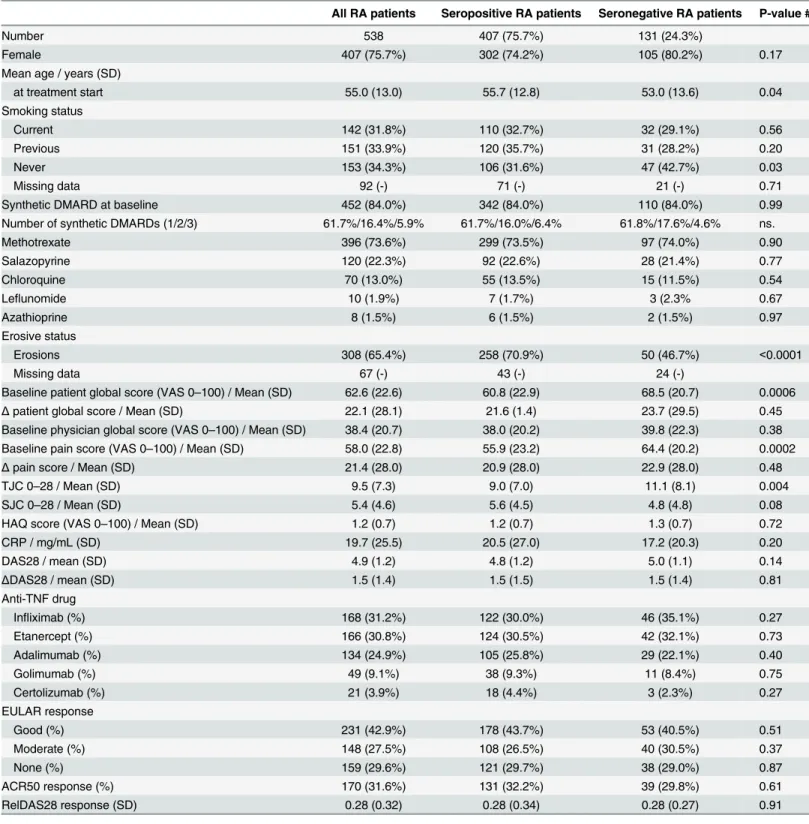
Baseline characteristics and treatment response of the study population are presented in
Table 1. Seronegative RA patients were significantly younger and had higher pain and global
scores as well as higher tender joint count compared with the seropositive patients. No differ-ence in response rates to anti-TNF was observed between the two groups. Both had 29–30% non-responders. Patients with RA receiving concomitant synthetic DMARDs (sDMARD) comprised 84%.
Clinical data were collected at variable time-points due to the study design. Eighty-seven per cent of the patients had baseline data collected 7 days or less before treatment onset, and 74% of the follow-up data were registered 16±4 weeks after treatment onset (S1 Fig).
Genotype associations with anti-TNF response
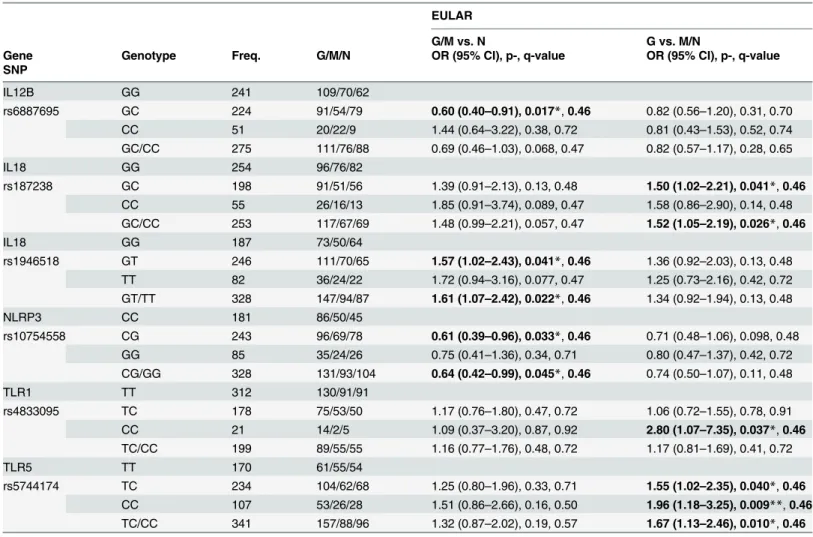
We assessed the association with EULAR anti-TNF response regardless of RF status among all patients. We found that variant allele carriers of theTLR5rs5744174 (OR = 1.7, p = 0.010),
Table 1. Baseline clinical characteristics and treatment response of the study population.
All RA patients Seropositive RA patients Seronegative RA patients P-value #
Number 538 407 (75.7%) 131 (24.3%)
Female 407 (75.7%) 302 (74.2%) 105 (80.2%) 0.17
Mean age / years (SD)
at treatment start 55.0 (13.0) 55.7 (12.8) 53.0 (13.6) 0.04
Smoking status
Current 142 (31.8%) 110 (32.7%) 32 (29.1%) 0.56
Previous 151 (33.9%) 120 (35.7%) 31 (28.2%) 0.20
Never 153 (34.3%) 106 (31.6%) 47 (42.7%) 0.03
Missing data 92 (-) 71 (-) 21 (-) 0.71
Synthetic DMARD at baseline 452 (84.0%) 342 (84.0%) 110 (84.0%) 0.99
Number of synthetic DMARDs (1/2/3) 61.7%/16.4%/5.9% 61.7%/16.0%/6.4% 61.8%/17.6%/4.6% ns.
Methotrexate 396 (73.6%) 299 (73.5%) 97 (74.0%) 0.90
Salazopyrine 120 (22.3%) 92 (22.6%) 28 (21.4%) 0.77
Chloroquine 70 (13.0%) 55 (13.5%) 15 (11.5%) 0.54
Leflunomide 10 (1.9%) 7 (1.7%) 3 (2.3% 0.67
Azathioprine 8 (1.5%) 6 (1.5%) 2 (1.5%) 0.97
Erosive status
Erosions 308 (65.4%) 258 (70.9%) 50 (46.7%) <0.0001
Missing data 67 (-) 43 (-) 24 (-)
Baseline patient global score (VAS 0–100) / Mean (SD) 62.6 (22.6) 60.8 (22.9) 68.5 (20.7) 0.0006
Δpatient global score / Mean (SD) 22.1 (28.1) 21.6 (1.4) 23.7 (29.5) 0.45
Baseline physician global score (VAS 0–100) / Mean (SD) 38.4 (20.7) 38.0 (20.2) 39.8 (22.3) 0.38
Baseline pain score (VAS 0–100) / Mean (SD) 58.0 (22.8) 55.9 (23.2) 64.4 (20.2) 0.0002
Δpain score / Mean (SD) 21.4 (28.0) 20.9 (28.0) 22.9 (28.0) 0.48
TJC 0–28 / Mean (SD) 9.5 (7.3) 9.0 (7.0) 11.1 (8.1) 0.004
SJC 0–28 / Mean (SD) 5.4 (4.6) 5.6 (4.5) 4.8 (4.8) 0.08
HAQ score (VAS 0–100) / Mean (SD) 1.2 (0.7) 1.2 (0.7) 1.3 (0.7) 0.72
CRP / mg/mL (SD) 19.7 (25.5) 20.5 (27.0) 17.2 (20.3) 0.20
DAS28 / mean (SD) 4.9 (1.2) 4.8 (1.2) 5.0 (1.1) 0.14
ΔDAS28 / mean (SD) 1.5 (1.4) 1.5 (1.5) 1.5 (1.4) 0.81
Anti-TNF drug
Infliximab (%) 168 (31.2%) 122 (30.0%) 46 (35.1%) 0.27
Etanercept (%) 166 (30.8%) 124 (30.5%) 42 (32.1%) 0.73
Adalimumab (%) 134 (24.9%) 105 (25.8%) 29 (22.1%) 0.40
Golimumab (%) 49 (9.1%) 38 (9.3%) 11 (8.4%) 0.75
Certolizumab (%) 21 (3.9%) 18 (4.4%) 3 (2.3%) 0.27
EULAR response
Good (%) 231 (42.9%) 178 (43.7%) 53 (40.5%) 0.51
Moderate (%) 148 (27.5%) 108 (26.5%) 40 (30.5%) 0.37
None (%) 159 (29.6%) 121 (29.7%) 38 (29.0%) 0.87
ACR50 response (%) 170 (31.6%) 131 (32.2%) 39 (29.8%) 0.61
RelDAS28 response (SD) 0.28 (0.32) 0.28 (0.34) 0.28 (0.27) 0.91
SD: standard deviation; DMARD: disease modifying anti-rheumatic drugs; VAS: visual analogue scale;ΔVAS: baseline VAS minus follow-up VAS; TJC: tender joint count; SJC: swollen joint count; HAQ: health assessment questionnaire; CRP: C-reactive protein; DAS28: disease activity score (28-joints); EULAR: European League Against Rheumatism; ACR50: American College of Rheumatology, 50% improvement; RelDAS28: relative change in DAS28;
#: Two-sided t-test p-value of difference in means/proportions between seropositive and seronegative patients; Seropositive: Positive for IgM-RF
ofNLRP3rs10754558 (OR = 0.6, p = 0.017) seemed to have a less favourable treatment response (EULAR G/M vs. N).
Analyses of associations with treatment response outcome defined by ACR50 and relDAS28 are shown inS2 Table. Association with altered ACR50 treatment response was found for
TLR1rs4833095 and with altered relDAS28 treatment responses forNLRP3rs10754558 and
TLR5rs5744174.
We also assessed the functionally relevant haplotypes inIFNGR2andIL12B(S1 Table) for association with EULAR anti-TNF response (G/M vs. N and G vs. M/N) under the same multi-variate model. No associations between risk-haplotypes and anti-TNF response and no interac-tion with smoking were found.
Stratified analyses. Next, we performed stratified analyses of polymorphisms for associa-tions with treatment response.
Table 2. Adjusted odds ratios for associations between genotypes and EULAR anti-TNF treatment response.
EULAR
G/M vs. N G vs. M/N
Gene Genotype Freq. G/M/N OR (95% CI), p-, q-value OR (95% CI), p-, q-value
SNP
IL12B GG 241 109/70/62
rs6887695 GC 224 91/54/79 0.60 (0.40–0.91), 0.017*,0.46 0.82 (0.56–1.20), 0.31, 0.70
CC 51 20/22/9 1.44 (0.64–3.22), 0.38, 0.72 0.81 (0.43–1.53), 0.52, 0.74
GC/CC 275 111/76/88 0.69 (0.46–1.03), 0.068, 0.47 0.82 (0.57–1.17), 0.28, 0.65
IL18 GG 254 96/76/82
rs187238 GC 198 91/51/56 1.39 (0.91–2.13), 0.13, 0.48 1.50 (1.02–2.21), 0.041*,0.46 CC 55 26/16/13 1.85 (0.91–3.74), 0.089, 0.47 1.58 (0.86–2.90), 0.14, 0.48
GC/CC 253 117/67/69 1.48 (0.99–2.21), 0.057, 0.47 1.52 (1.05–2.19), 0.026*,0.46
IL18 GG 187 73/50/64
rs1946518 GT 246 111/70/65 1.57 (1.02–2.43), 0.041*,0.46 1.36 (0.92–2.03), 0.13, 0.48
TT 82 36/24/22 1.72 (0.94–3.16), 0.077, 0.47 1.25 (0.73–2.16), 0.42, 0.72
GT/TT 328 147/94/87 1.61 (1.07–2.42), 0.022*,0.46 1.34 (0.92–1.94), 0.13, 0.48
NLRP3 CC 181 86/50/45
rs10754558 CG 243 96/69/78 0.61 (0.39–0.96), 0.033*,0.46 0.71 (0.48–1.06), 0.098, 0.48
GG 85 35/24/26 0.75 (0.41–1.36), 0.34, 0.71 0.80 (0.47–1.37), 0.42, 0.72
CG/GG 328 131/93/104 0.64 (0.42–0.99), 0.045*,0.46 0.74 (0.50–1.07), 0.11, 0.48
TLR1 TT 312 130/91/91
rs4833095 TC 178 75/53/50 1.17 (0.76–1.80), 0.47, 0.72 1.06 (0.72–1.55), 0.78, 0.91
CC 21 14/2/5 1.09 (0.37–3.20), 0.87, 0.92 2.80 (1.07–7.35), 0.037*,0.46 TC/CC 199 89/55/55 1.16 (0.77–1.76), 0.48, 0.72 1.17 (0.81–1.69), 0.41, 0.72
TLR5 TT 170 61/55/54
rs5744174 TC 234 104/62/68 1.25 (0.80–1.96), 0.33, 0.71 1.55 (1.02–2.35), 0.040*,0.46 CC 107 53/26/28 1.51 (0.86–2.66), 0.16, 0.50 1.96 (1.18–3.25), 0.009**,0.46 TC/CC 341 157/88/96 1.32 (0.87–2.02), 0.19, 0.57 1.67 (1.13–2.46), 0.010*,0.46
Logistic regression, adjusted for gender, HAQ, DMARD, and disease activity score (28-joints) at baseline; CI: confidence interval; Freq.: Frequency; OR: odds ratio; EULAR, G/M/N: European League Against Rheumatism response criteria, good/moderate/none; P-value:
*<0.05, **<0.01;
q-value: False Discovery Rate classical one-stage method set at 0.05.
For seropositive RA patients (n = 407),IL12Brs6887695,IL18rs187238 andNLRP3
rs10754558 were associated with similar effect estimates and significance levels (S3 Table) as the total cohort. ForIL18rs1946518 andTLR1rs4833095 effect estimates were similar (p-value <0.1) and forTLR5rs5744174 effect estimates were substantially lower and non-significant compared to the overall cohort (S3 Table).
Stratified analyses by type of anti-TNF drug (infliximab (n = 168), etanercept (n = 166), ada-limumab (n = 134) and the combined group of monoclonal antibodies (infliximab, adaada-limumab, and golimumab) (n = 372)) are shown inS4 Table. Variant allele carriers ofTLR5rs5744174 treated with infliximab (OR = 2.7, p = 0.018) and etanercept (OR = 2.3, p = 0.022) were more likely to have a good treatment response (EULAR G vs. MN) (S4 Table) and a clear allele-dosage effect was observed. Altered treatment responses were also seen among variant allele carriers of
NLRP1(rs878329) andNLRP3rs10754558 treated with infliximab and among variant allele car-riers ofIL12Brs6887695 treated with the monoclonal anti-TNF drugs (S4 Table).
Post hoc analyses. Since there was some discrepancy between associations found in the primary analyses and stratified analyses of seropositive patients, we also assessed the associa-tion in the seronegative subgroup of RA patients forTLR5rs5744174 (S3 Table). Seronegative carriers of the variant allele ofTLR5rs5744174 had a greater chance of good treatment response (EULAR G vs. M/N) (OR = 6.2 (2.4–16.3), p = 0.0002, q = 0.024) (Fig 1).
Due to lack of association among seropositive RA patients with theTLR5polymorphism, we explored other clinical variables of importance for this association using linear regression analyses of the association between theTLR5polymorphism and the components of DAS28 (change (Δ) between baseline and follow-up of swollen and tender joint counts (SJC and TJC), CRP and patient global score).
Interestingly,TLR5rs5744174 was strongly associated withΔpatient global score but nei-ther withΔSJC (p = 0.66),ΔTJC (p = 0.20) nor withΔCRP (p = 0.22). Using linear regression the association remained stable both in a crude analysis (regression coefficient (RC) = 7.8 (2.7–
12.8), p-value = 0.003) and in a multivariate model adjusting for baseline patient global score plus the same variables as in the primary analyses (RC = 7.4 (2.6–12.1), p = 0.002). Almost identical results were found when we substitutedΔpatient global score withΔpain score in a similar analysis (RC = 6.8 (95% CI: 2.2–11.4), p = 0.004).
In this cohort of RA patients, there were marked clinical differences between the seroposi-tive and seronegaseroposi-tive subgroups (fraction of smokers, erosive status, age, baseline tender joint count, pain and patient global score), and this could potentially cause confounding. However, additional multivariate regression analysis adjusting for these potential confounders did not markedly change the significance levels or effect sizes for the RF status-stratified analyses of
CARD8(rs2043211),IFNGR2(rs17882748),IL12B(rs6887695),IL18(rs187238, rs360719),
TLR5(rs5744174) orTLR1(rs4833095) (S6 Table).
Discussion
In this study, we extended the analyses of polymorphisms in genes related to inflammasome-and interferon-γpathways. Overall, we successfully genotyped 20 of 23 functional polymor-phisms, and six SNPs inIL12B,IL18,NLRP3,TLR1andTLR5(Table 2) were nominally associ-ated with EULAR treatment response in RA patients treassoci-ated with anti-TNF. Furthermore, the
TLR5polymorphism lacked association among the seropositive patients but was strongly asso-ciated with response among the seronegative patients.
increases the risk of false positive associations, we have also presented associations corrected for multiple testing (False Discovery Rate, q-value). The association found forTLR5among seronegative RA patients was the only that withstood correction for multiple testing.
Since the present study is exploratory, replication in independent cohorts is needed, in par-ticular, for those found in the stratified analyses. However, the selection of functional polymor-phisms in genes with a biologically plausible role in RA pathogenesis increases the prior probability of true associations. The presented work does not provide evidence for causal rela-tionships between the studied polymorphisms and the altered anti-TNF response because the associated polymorphisms could also be proxies for other genetic markers.
It should be noted that, due to the design of the study, the time-points of collected response data vary between 60 and 180 days from treatment onset. When we analysed the subset of patients with response data at 16±4 weeks (comprising 74% of the patients) in the overall cohort, associations found forIL12Brs6887695,IL18rs1946518, and the SNPs inTLR1and
TLR5remained nominally associated with similar or higher odds ratios (S5 Table). The contrasting odds ratios forIL12Brs6887695 heterozygous and homozygous variant genotypes substantially lower the likelihood of a true association for this polymorphism.
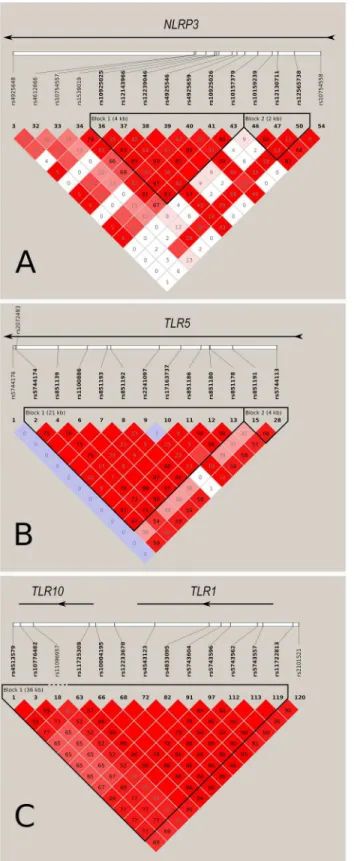
The present study reproduces associations between three gene loci (TLR10/1/6gene cluster,
NLRP3andTLR5) (Fig 2) and RA anti-TNF response previously found in independent studies [4,5,7,18].TLR1rs4833095 is located within a cluster of genes encoding TLR–1, TLR–6 and
Fig 1. Odds ratio for association between polymorphisms inIL18,NLRP3,TLR1andTLR5and EULAR good/moderate vs. none and good vs. moderate/non-response, respectively.ForTLR5rs5744174, patients were also stratified on diagnosis based on IgM-RF (seropositive-/seronegative RA). Log scale, 95% confidence interval.
TLR–10 in a 54-kb region on chromosome 4.TLR1rs4833095 is in modest linkage disequilib-rium withTLR10rs11096957 (R2= 0.52, D’= 0.94), which was found associated with EULAR GM vs. N response to anti-TNF treatment in a UK cohort (N = 909) [7].TLR1rs4833095 has been associated with a high peripheral blood mononuclear cell (PBMC) TLR–1 cell surface expression [19]. Here, we found the homozygous variant genotype associated with a greater chance of good treatment response to anti-TNF. However, this finding relies on small patient groups and needs confirmation in an independent and preferably larger cohort.
To our knowledge, this study is the third to show an association between genetic variation inNLRP3and anti-TNF treatment response. Mathews et al. found three polymorphisms in
NLRP3with nominal association with EULAR response with rs4925659 as the most tightly linked with rs10754558 (D’= 0.93; r2= 0.40) [5]. In the same cohort as used in the present study, we have previously reported the rs4612666 T allele to be associated with a lesser chance of EULAR GM vs. N response [4]. The two SNPs are not in linkage disequilibrium (D’= 0.15; r2= 0.06), thus not allowing haplotype analysis.
Both rs4612666 and rs10754558 inNLRP3have been functionally investigated by Hitomi et al. [20]. In THP–1 cells they found minor alleles of these two polymorphisms to decrease and increaseNLRP3expression, respectively. Based on this, our results for these two polymor-phisms seem contradictory since the high expression alleles of the two polymorpolymor-phisms are associated with positive and negative treatment response, respectively. However, the in vitro experiments performed on THP–1 cells may not reflect in vivo conditions in RA patients.
We found two polymorphisms inIL18associated with anti-TNF treatment response. IL–18 is an interleukin that is activated by the NLRP3 inflammasome, and these results therefore fur-ther support a role of this pathway for anti-TNF treatment outcome in RA.
The association found forTLR5confirms the association between aTLR5gene locus and EULAR anti-TNF response previously found in a Dutch cohort (n = 182) [18]. In that study, both rs5744174 and anotherTLR5polymorphism (rs2072493) in linkage disequilibrium (genetic distance: 71bp; D’= 1; r2= 0.08) were genotyped (Fig 2). Only rs2072493 was associ-ated with anti-TNF response. In a Swedish validation cohort (n = 269), these findings could not be confirmed. Due to different MAFs of these two polymorphisms, they have low tagging capabilities of each other (r2= 0.08). The lack of associations for rs5744174 in the Dutch cohort and for rs2072493 in the Swedish cohort could be caused by the low statistical power, causing false negative results. Differences in statistical methods may also play a role. Coenen et al. per-formed unadjusted Fisher’s exact or Chi-square test for analyses of 3x3 tables (EULAR response groups / genotype counts), and analyses of our data are non-significant when ana-lysed this way (data not shown). Further, differences in anti-TNF drugs received in the two cohorts may also be of importance. As an example, the fraction of adalimumab-treated patients is larger in the Dutch cohort (34% vs. 25%). Our data do suggest a trend for a negative adalimu-mab response for carriers of theTLR5variant allele compared to a positive treatment response found in the overall cohort and among infliximab and etanercept treated patients (S4 Table).
Functional studies ofTLR5rs5744174 have shown that flagellin (a TLR5 ligand) stimulation results in lower chemokine (C-C motif) ligand (CCL20) production in HEK 293T cells [21] and reduced IL–6 and IL–1βexpression in primary immune cells from healthy homozygous carriers of the variant allele [10]. Another study reported that anti-TNF treatment decreases TLR5 (and TLR4) expression among ankylosing spondylitis patients [22], which supports the hypothesis of TLR5 having a role in the differential anti-TNF response.
TLR5: MAF>0.1, HW p-value>0.01, genotype>50%, force include rs5744176, force exclude # 17–25; TLR10/ 1: MAF>0.1, HW p-value>0.01, genotype>50%, force include rs11096957, force exclude #4–58, 98–111.
Interestingly, post hoc analyses showed that change in patients’subjective general health assessment (Δpatient global score) and probably also change in pain score could explain most of the correlation with the multi-component EULAR response. A recent paper by Coenen et al. showed that separate components of DAS28, such as tender and swollen joint counts, have a stronger heritability in pharmacogenetic studies of anti-TNF response than DAS28 itself [23]. Although they did not show this for patient global score assessment, it may be the case for
TLR5rs5744174. In fact, it is well established that TLRs are central in chronic pain pathogene-sis [24] and TLR2/3/4/5 deficient mice have reduced neuropathic pain [25]. In a future valida-tion study of the predictive value of this polymorphism, it will therefore be very relevant to include analyses adjusting for patient global score and RF status.
Overall, the effects of the associated polymorphisms were too weak to be used as indepen-dent biomarkers for treatment response but they have a potential use as part of a larger panel of predictive biomarkers if validated in independent cohorts.
Based on the results from this study, we hypothesize that so far undefined RA sub-pheno-type(s) not responding to anti-TNF treatment are characterized by increased NLRP3-inflam-masome activation and increased IL–1β/IL–18 production.
In conclusion, we have reproduced previously published associations between genetic varia-tion in theTLR10/1/6gene cluster,TLR5, andNLRP3loci and response to anti-TNF treatment in RA. Changes in VAS pain and patient global scores were main factors in the association found forTLR5. SNPs inIL18were associated with anti-TNF treatment response, but these associations need validation in an independent cohort.
Supporting Information
S1 Fig. Registered response data.Quantile-plot of distribution of treatment duration at time of response classification.
(TIF)
S1 Table. Chosen polymorphisms and corresponding gene.Associated effect of polymor-phism.
(DOCX)
S2 Table. ACR50 and relDAS28 anti-TNF treatment response.Adjusted odds ratio (OR)/ coefficient for associations between genotypes and ACR50 and relDAS28 response to anti-TNF treatment. (a. All RA patients, b. Seropositive RA patients, c. Seronegative RA patient forTLR5
rs5744174). (DOCX)
S3 Table. EULAR anti-TNF treatment response.Adjusted odds ratios for associations between genotypes and EULAR anti-TNF treatment response. (a. All RA patients, b. Seroposi-tive RA patients, c. SeronegaSeroposi-tive RA patient forTLR5rs5744174).
(DOCX)
S4 Table. Anti-tumour necrosis factor (TNF) drug stratified analyses.Odds ratio for variant allele carriers association with EULAR good vs. moderate/none response. (a. EULAR good/ moderate vs. non-response. b. EULAR good vs. moderate/non-response).
(DOCX)
S5 Table. EULAR anti-TNF treatment response at 16 weeks.All RA patients. Adjusted odds ratios for associations between genotypes and EULAR anti-TNF treatment response.
S6 Table. IgM-Rheumatoid factor stratified analyses adjusted for potential confounders.
Multivariate logistic regression. Odds ratio (OR) per variable in model for European League Against Rheumatism response criteria, good/moderate/none (EULAR, G/M/N). Seropositive/-negative RA: rheumatoid arthritis positive/Seropositive/-negative for IgM-rheumatoid factor. DAS28: disease activity score across 28-joints. HAQ: health assessment questionnaire score. DMARD: disease-modifying anti-rheumatic drugs (dichotome). Smoking: previous/current smoking (dichot-ome). Erosions: erosions on x-ray (dichot(dichot-ome). TJC: tender joint count. VAS: visual analogue scale. P-value:<
0.05.<
0.01.< 0.001. (DOCX)
Acknowledgments
We thank Vibeke Østergaard Thomsen, International Reference Laboratory of Mycobacteriol-ogy, Statens Serum Institut; Marianne Kragh Thomsen, Department of Clinical MicrobiolMycobacteriol-ogy, Aarhus University Hospital, Aarhus, Denmark and Hans Jürgen Hoffmann, Department of Respiratory Diseases, Aarhus University Hospital, Aarhus, Denmark for collecting samples; Elvira Chapka, Statens Serum Institut for laboratory support; and Niels Steen Krogh, Zitelab Aps, Copenhagen, Denmark for database management.
Author Contributions
Conceived and designed the experiments: JS UV SB PSA MLH HL NHHH VA. Performed the experiments: JS SB PSA. Analyzed the data: JS UV NHHH VA. Contributed reagents/materi-als/analysis tools: JS PSA UV NHHH VA. Wrote the paper: JS UV SB PSA MLH HL NHHH VA. Contributed with collection of patient samples and clinical data: JS UV SB PSA MLH HL VA.
References
1. Plant D, Prajapati R, Hyrich KL, Morgan AW, Wilson AG, Isaacs JD, et al. Replication of association of the PTPRC gene with response to anti-tumor necrosis factor therapy in a large UK cohort. Arthritis Rheum. 2012 Mar; 64: 665–670. doi:10.1002/art.33381PMID:21952740
2. Acosta-Colman I, Palau NF, Tornero JF, Fernandez-Nebro AF, Blanco FF, Gonzalez-Alvaro IF, et al. GWAS replication study confirms the association of PDE3A-SLCO1C1 with anti-TNF therapy response in rheumatoid arthritis. Pharmacogenomics. 2013; 14: 727–734. doi:10.2217/pgs.13.60PMID:
23651021
3. van den Broek M, Visser K, Allaart CF, Huizinga TW. Personalized medicine: predicting responses to therapy in patients with RA. Current Opinion in Pharmacology. 2013 Jun; 13: 463–469. doi:10.1016/j.
coph.2013.03.006PMID:23578763
4. Sode J, Vogel U, Bank S, Andersen PS, Thomsen MK, Hetland ML, et al. Anti-TNF treatment response in rheumatoid arthritis patients is associated with genetic variation in the NLRP3-inflammasome. PLoS One. 2014; 9: e100361. doi:10.1371/journal.pone.0100361PMID:24967817
5. Mathews RJ, Robinson JI, Battellino M, Wong C, Taylor JC, Eyre S, et al. Evidence of NLRP3-inflam-masome activation in rheumatoid arthritis (RA); genetic variants within the NLRP3-inflamNLRP3-inflam-masome com-plex in relation to susceptibility to RA and response to anti-TNF treatment. Ann Rheum Dis. 2013 May 17; 0: 1–9. annrheumdis-2013-203276 [pii]; doi:10.1136/annrheumdis-2013-203276
6. Strowig T, Henao-Mejia J, Elinav E, Flavell R. Inflammasomes in health and disease. Nature. 2012 Jan 19; 481: 278–286. doi:10.1038/nature10759PMID:22258606
7. Potter C, Cordell HJ, Barton A, Daly AK, Hyrich KL, Mann DA, et al. Association between anti-tumour necrosis factor treatment response and genetic variants within the TLR and NFκB signalling pathways. Ann Rheum Dis. 2010 Jul; 69: 1315–1320. ard.2009.117309 [pii]; doi:10.1136/ard.2009.117309PMID:
20448286
8. Yang CA, Scheibenbogen C, Bauer S, Kleinle C, Wex T, Bornschein J, et al. A frequent Toll-like recep-tor 1 gene polymorphism affects NK- and T-cell IFN-gamma production and is associated with Helico-bacter pylori-induced gastric disease. HelicoHelico-bacter. 2013 Feb; 18: 13–21. doi:10.1111/hel.12001
9. Dhiman N, Ovsyannikova IG, Vierkant RA, Ryan JE, Shane Pankratz V, Jacobson RM, et al. Associa-tions between SNPs in toll-like receptors and related intracellular signaling molecules and immune responses to measles vaccine: Preliminary results. Vaccine. 2008 Mar 25; 26: 1731–1736. doi:10.
1016/j.vaccine.2008.01.017PMID:18325643
10. Klimosch SN, Forsti A, Eckert J, Knezevic J, Bevier M, von SW, et al. Functional TLR5 genetic variants affect human colorectal cancer survival. Cancer Res. 2013 Dec 15; 73: 7232–7242.
0008-5472.CAN-13-1746 [pii]; doi:10.1158/0008-5472.CAN-13-1746PMID:24154872
11. Schroder K, Hertzog PJ, Ravasi TF, Hume DA. Interferon-gamma: an overview of signals, mechanisms and functions. J Leukoc Biol. 2004; 75: 163–189. PMID:14525967
12. McInnes IB, Schett G. The Pathogenesis of Rheumatoid Arthritis. N Engl J Med. 2011 Dec 7; 365: 2205–2219. doi:10.1056/NEJMra1004965PMID:22150039
13. Hetland ML. DANBIO—powerful research database and electronic patient record. Rheumatology
(Oxford). 2011 Jan; 50: 69–77. keq309 [pii]; doi:10.1093/rheumatology/keq309
14. Bank S, Nexo BA, Andersen V, Vogel U, Andersen PS. High-Quality and -Quantity DNA Extraction from Frozen Archival Blood Clots for Genotyping of Single-Nucleotide Polymorphisms. Genet Test Mol Biomarkers. 2013 Apr 10; 17: 501–503. doi:10.1089/gtmb.2012.0429PMID:23574531
15. Fransen J, van Riel PL. The Disease Activity Score and the EULAR response criteria. Clin Exp Rheu-matol. 2005 Sep; 23: S93–S99. PMID:16273792
16. Felson DT, Anderson JJ, Boers M, Bombardier C, Chernoff M, Fried B, et al. The American College of Rheumatology preliminary core set of disease activity measures for rheumatoid arthritis clinical trials. The Committee on Outcome Measures in Rheumatoid Arthritis Clinical Trials. Arthritis Rheum. 1993 Jun; 36: 729–740. PMID:8507213
17. Benjamini Y, Hochberg Y. Controlling the false discovery rate: a practical and powerful approach to multiple testing. J R Stat Soc Series B. 1995; 57: 289–300.
18. Coenen MJ, Enevold C, Barrera P, Schijvenaars MM, Toonen EJ, Scheffer H, et al. Genetic variants in toll-like receptors are not associated with rheumatoid arthritis susceptibility or anti-tumour necrosis fac-tor treatment outcome. PLoS One. 2010; 5: e14326. doi:10.1371/journal.pone.0014326PMID: 21179534
19. Uciechowski P, Imhoff H, Lange C, Meyer CG, Browne EN, Kirsten DK, et al. Susceptibility to tuberculo-sis is associated with TLR1 polymorphisms resulting in a lack of TLR1 cell surface expression. J Leu-koc Biol. 2011 Aug; 90: 377–388. jlb.0409233 [pii]; doi:10.1189/jlb.0409233PMID:21642391 20. Hitomi Y, Ebisawa M, Tomikawa M, Imai T, Komata T, Hirota T, et al. Associations of functional NLRP3
polymorphisms with susceptibility to food-induced anaphylaxis and aspirin-induced asthma. J Allergy Clin Immunol. 2009 Oct; 124: 779–785. doi:10.1016/j.jaci.2009.07.044PMID:19767079
21. Sheridan J, Mack DR, Amre DK, Israel DM, Cherkasov A, Li H, et al. A Non-Synonymous Coding Vari-ant (L616F) in the TLR5 Gene Is Potentially Associated with Crohn's Disease and Influences Responses to Bacterial Flagellin. PLoS ONE. 2013 Apr 11; 8: e61326. doi:10.1371/journal.pone. 0061326PMID:23593463
22. Assassi S, Reveille JD, Arnett FC, Weisman MH, Ward MM, Agarwal SK, et al. Whole-blood gene expression profiling in ankylosing spondylitis shows upregulation of toll-like receptor 4 and 5. J Rheu-matol. 2011 Jan; 38: 87–98. jrheum.100469 [pii]; doi:10.3899/jrheum.100469PMID:20952467 23. Umicevic MM, Janss L, Vermeulen SH, van de Laar MAFJ, van Riel PLCM, Guchelaar HJ, et al.
Esti-mation of heritability of different outcomes for genetic studies of TNFi response in patients with rheuma-toid arthritis. Annals of the Rheumatic Diseases. 2014 Aug 11.
24. Nicotra L, Loram LC, Watkins LR, Hutchinson MR. Toll-like receptors in chronic pain. Exp Neurol. 2012 Apr; 234: 316–329. S0014-4886(11)00358-X [pii]; doi:10.1016/j.expneurol.2011.09.038PMID:
22001158