Domain Information Based Blacklisting Method For The Detection Of Malicious
Webpages
Ralph Edem Agbefu¹, Yoshiaki Hori¹²and Kouichi Sakurai¹² Department of Informatics, Kyushu University¹²,
Room 712, Ito Campus, West Bldg. No.2, 744 Motooka, Nishi-ku, Fukuoka, 819-0395, Japan
Institute of Systems and Information Technologies and Nanotechnologies (ISIT)² Fukuoka SRP Center Building 7F,
2-1-22, Momochihama, Sawara-ku, Fukuoka, 814-0001, Japan
[email protected],[email protected]
ABSTRACT
Malicious web pages that host drive by download exploits have become a popular means by which an attacker delivers malicious contents to computers across the internet. The popularity of the attack has led to researchers developing systems to detect and stop such attacks. These methods include dynamic solutions, static solutions and the use of blacklisting and whitelisting methods. Blacklisting and in particular URL blacklisting is one of such detection methods. URL blacklisting analyzes the structure of a web page URL. URL blacklisting are however prone to evasion attacks when the lexical structure of the URL changes. In this paper, we propose the usage of domain related information for the detection of drive by download web pages. These domain features are used to model a scoring mechanism classification system. We show the effectiveness of detecting malicious web pages using domain based by obtaining a high detection rate and a relatively low false negative.
KEYWORDS
Drive by download, Blacklist, domain information, registrar, domain duration, domain freshness.
1 INTRODUCTION
Technological advances have led to the internet
playing a major factor in our daily activities. We
depend greatly on the internet for a variety of
activities including industrial activities, medical
activities, banking activities and many more. In
order to keep with these technological advances, a
wide variety of functionalities have been added to
the modern day web browsers and these
advancements, have come with a number of
vulnerabilities. The presence of these
vulnerabilities require the high standard of security
practices to be implemented in a browser. In addition to this, a user’s computer usually contains a number of applications that are rarely updated or
in some case never updated. According to a report
[1], as much as 80% of web users are using
outdated versions of Adobe Flash and Acrobat
Reader and popular web browser plugins.
These outdated application introduce a number of
vulnerabilities and these together with web browser
vulnerabilities are very much exploited by
adversaries. An effective way of performing this
exploitation of computer vulnerabilities is through
the use of the so called drive by download attack.
just visiting a compromised website without
necessarily having any other sort of interaction.
The successful exploitation of vulnerabilities will
lead to the downloading and installation of
malicious software. The installed malicious
software connect to a command and control
infrastructure to form a botnet.
1.1Background
Drive-by downloads attacks have been around for
a number of years. A drive by download attack
occurs when on visiting a web page, a user is
redirected to a malicious web page that leads to the
downloading of malware to the user’s computer
without his consent. These attacks exploit multiple unpatched vulnerabilities in the user’s browser, browser plugin, application or operating system.
Hackers can either lure users to malicious sites they
have initially injected with malicious code or hack
legitimate sites to host the malware. Because
legitimate sites are generally trusted and may be
popular high-traffic venues, they can be very
successful for distributing malware to unsuspecting
visitors through the browser. Also, due to the fact
that certain landing pages are originally benign web
sites, a number of users could access these sites
thus attackers can effectively infect the users’
machine with malware.
Moreover, the injected malicious codes are usually
obfuscated Java codes [19]. The obfuscation of
Java Codes makes analysis difficult and increases
the success rate of drive by download attacks. A
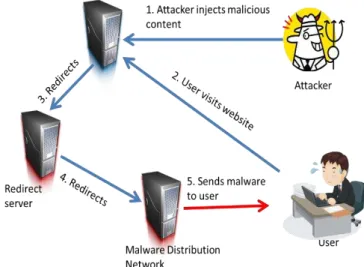
typical attack is illustrated in the Fig.1 and it
usually involves the following steps:
(1) Initially an attacker injects malicious code into
web server, which compromises the site.
(2) User visits compromised website.
(3) Injected malicious script causes redirection
from one web server to another.
(4) After a number of redirects, the user is directed
to the exploit server, which sends the exploit codes to the user’s computer.
(5) On execution of such exploit codes, the attacker gains control of the victim’s browser. Malwares are downloaded and executed on the user’s computer.
Fig 1: Drive by download attack
1.2 Injecting malicious contents
The starting point for an attacker is to obtain control
of a legitimate web server and inserts malicious
code into such web servers. These malicious codes
are very much obfuscated contents. In order for this
to be successful, an attacker usually takes
advantage of certain conditions. A non-secure web
server, user contributed content, advertisements
and third party widgets are examples of such
situations.
Keeping the web server security and applications
regularly up-dated with the most recent security
patches ensures the web server is secure.
Malicious content can be injected as an entry in
databases using SQL injection techniques.
A number of websites allows users to contribute to
their page in the form of blogs, comments, reviews
etc. However, most of the pages lack proper input
validations and allows users to input virtually
expose other users to the dangers of a drive by
download attack.
Ad syndication is one of the ways through which
an attacker can insert malicious content into a web
page. Ad syndication allows an advertiser to sell or
lease out the advertising space to another company
which in turn can sell it out to another company.
This implies that the advertising script is not directly under the control of the web page’s administrator and if the controller happens to be an
adversary, he can easily inserts malicious code into
the web page.
Third party widgets are tools provided by third
parties used commonly to provide extra
functionality to a web site. If the third party in
question happens to be an attacker he can easily
inserts malicious script code into the provided
widget.
1.3 Exploiting strategies
A popular way of exploiting the user’s computer in
the past was by exploitation of network services.
However, due to the abundance of technologies
such as Network Address Translation and Firewalls,
these exploitation techniques have become less
successful. As a result, attackers are forced to find
other means of exploiting vulnerabilities in a user’s
computer.
Attackers look to lure users to connect to malicious
servers on the internet through the use of a
combination of exploit software and social
engineering techniques. Scripting support allows a
web page to collect information about the browser’s computing environment. While these capabilities can be employed for legitimate
purposes, it also offers for adversaries the
opportunity to learn of the vulnerabilities on a user’s computer.
Tricking of users usually happen in cases where the
attacker was not able to find a vulnerability on the
user’s computer. Users are asked to download a certain program in order to play certain media files.
These programs may in fact look like the normal “codec” or “plug-ins”, however they are malicious software. Once installed, they compromise the user’s computer and finally lead to the downloading and installation of malware.
Exploiting software may either look to exploit
vulnerabilities in the browser or automatically
launch external programs and extensions. Less
number of users pay much attention to upgrading
of applications and software on their computers, as
evidenced by Secunia PSI Report [17].
1.4 Motivation
Web pages are very common and web browsers that
are used to retrieve web pages have existed for a
long time. In the creation of the web browser, the
possibility of an attack being mounted through the
web browser wasn’t envisaged. As such, web
browser security became an afterthought.
The danger of the drive by download attack stems
from the fact that very little or no user interaction is required for a user’s computer to be compromised. A simple click on a URL that points
to a malicious web pages is sufficient to trigger the
attack. If the exploitation of vulnerabilities is
successful, malicious contents are downloaded unto the user’s computer and all this is done without the user’s consent.
In certain instances, drive by download attack’s starting point of malware infection is originally
benign web site. This has the tendency to draw a lot
of users who will inadvertently be infected with the
malware. Also, different from other forms of
attacks, users will generally not be able to notice
the malware infection because they believe they
have accessed benign web sites. This contributes to
difficult and one of the most effective form of
malware infection.
Blacklisting methods which focus on the use of
URL information are one of the popular ways of
defense against the drive by download attack.
However URL based blacklisting methods have
been found to ineffective due to their reliance on
the syntax of a given URL. Hence alternatives to
URL blacklisting need to be considered. Our work
is motivated by the observation that attackers tend
to employ similar domain characteristics in
deploying malicious web pages. Attackers also tend
to abuse certain domain features during this process.
By basing a detection system on such features we
can effectively detect and blacklist the malicious
web pages.
1.5 Contribution
In this work, we propose a domain based
blacklisting method for the detection of drive by
download pages. In order to achieve this, we did the
following. First, we collected a set of data of known
malicious web pages and known benign web pages
and from these set of data obtained a set of domain
related information. The collected domain
information are analyzed for the frequently used
information by attackers in the deployment of
malicious web pages. For the set of identified
features which are most abused by attackers, we
construct a scoring based mechanism that gives the
degree of abuse by the attacker. The score values of
the domain features are used to model a detection
algorithm where a score value total lower than a
pre-determined threshold value is said to be
malicious, otherwise the page is identified as
benign web page. A score value is a numerical
representation of the degree of usage of an
identified domain information.
We evaluate the effectiveness of our approach
through the use of and evaluation data set. We show
that such an approach has capability of detecting
malicious web pages that participate drive by
download attacks.
We summarize our contributions in the following
points:
1. We determine a set of domain features that
are abused by attackers.
2. We determine the extent to which these
domain features are abused.
3. We make use of a scoring detection
mechanism.
4. We show the effectiveness of a domain based
blacklisting of drive by download pages.
2 RELATED WORKS
2.1 Survey reports
The effectiveness of the drive by download attacks
have resulted in a number of entities focusing on
the detection and protection against the attack.
These entities actively study malicious web sites
and on regular basis publish white papers of their
findings [2], [3], [4], [5], [6], [7][18]. Majority of
the white papers report a significant increase of
web-based client-side attacks recently, leading to
the web becoming the primary attack vector to
infect user with malware.
Websites found in the top 100 most popular web
sites seem to have also been found to not be
immune to attack. In their work, Provos et al.
observed that as much as 10% of suspicious URLs
received on the Google search engine were actually
found to be malicious [8], [9]. They identified four
key areas of content control: authored content,
user-contributed content, advertising, third-party
widgets. In order to avoid detection, attackers use
techniques such as obfuscation of the exploit code,
distributing binaries across different domains and
continuously re-packing the binaries. Furthermore,
they found botnet-like structures based on binary
control. They report that from the top one million
URLs appearing in the Google search engine
results, about 6,000 belong to sites known to cause
drive by download attacks [9].
These results highlight the significance of drive by
download. A browser that loads a malicious web
page can be redirected via multiple pages on
numerous hosts until the actual exploit is delivered
by a central exploit server. They also observed that
82% of malicious web pages identified make use of
a central exploit server. The central exploit servers
serve the numerous malicious web page with the
appropriate exploit which is transmitted to the user’s computer.
2.2 Detection Systems
We group the detection systems based on their
approach of detecting drive by download attacks:
whitelisting and blacklisting, signature based and
dynamic analysis.
Whitelisting and Blacklisting
Whitelisting and blacklisting are a popular method
to the detection of drive by download attacks. In a
whitelisting type of detection, a database
containing the set of programs and applications that
are allowed to run on a computer is maintained.
Any other kinds of programs or applications that
are not included in such a database are denied
access to execute on the machine.
Blacklisting works contrary to whitelisting,
blacklist methods maintain a database of programs
and applications that are not permitted to run on a user’s machine. Any other any program or applications are allowed to run. Whitelisting and
blacklisting methods suffer from outdated database.
This will imply programs or applications that shouldn’t be allowed to run can be run on a user’s computer. Blacklisting methods in particular are
not proactive in their detection methods.
Fukushima et al proposed the usage certain domain
features in detecting and blacklisting malicious
web pages [10]. The features identified were used
in a reputation evaluation system, where web sites
with low reputation values are classified as
malicious whereas high reputation value web sites
are classified as benign. The domain based features
used in this work are the IP address block and the
registrar information.
Felegyhazi et al explored the possibility of a
proactive domain blacklisting [11]. They obtain
malicious domains for seeding and extracting name
server features from the malicious domains as
properties for determining and predicting a drive by
download page. They use the freshness of domains
and self-resolution as features for determining
malicious domains.
Static Detection
ARROW developed by Zhang et al obtains a log of
HTTP redirection traces from compromised web
sites using honey pots [12]. ARROW groups
domains with the same IP addresses into a
Hostname-IP Clusters. From the logs, it identifies
the most commonly used property referred to as the
central server. Regular expression signatures are
generated based on these central servers. Due to the
conditional redirections, where queries from honey
pot are redirected to benign pages or to search
engines, ARROW cannot in certain instances
obtain HTTP traces. ARROW considers the URL
structure in their approach, however, our work doesn’t analyze the URL structure.
BrowserGuard by Fu-Hau et al records the
download scenario of every file through a web
browser and based on the download scenario,
blocks any file that is loaded without the consent of
a web user [18]. They do not analyze the source
code or script file and hence do not need to maintain
an exploit code sample.
Dynamic detection
systems and are described as security devices
designed to detect intrusions and attacks on a
computer. A honeypot is a vulnerable device that
looks to lure attackers to it. Attackers that scan for
vulnerable web servers will eventually find this
web server and attack it. In the honeypot
environment, the attacker’s actions can be observed
and traced. To detect drive by download attacks, a
new honeypot system was introduced: the client
honeypot.
Client honeypot focus on malicious web servers,
which they interact with by driving a web browser
on the dedicated honeypot system. By monitoring
of the changes to a list of system files,
configurations and directories, they can detect the
occurrence of a drive by download attack. Client
honeypot can be classified into low interaction and
high interaction. The group of high interaction
honeypot clients run web browsers in a
well-controlled environment. It looks out for any change
that will indicate a successful drive by download
3 OUR APPROACH
Adversaries have been known to abuse certain
domain properties in the setting up of malicious
web pages. As a result, a number of research has been done on the analysis of web page’s domain properties especially in phishing and scam attacks.
It is imperative that such studies be extended to
relatively new attacks such as the drive by
download attack.
In this paper, we analyze the characteristics of drive
by download hosting web pages with respect to
their domain information. The aim is to identify
methodologies and traits that attackers use in
deploying them. We considered the following
domain information: domain registration date,
domain expiration date, domain duration, how
recent the domain was created, the registrar and the
geographical location of the domain. Our analysis
provides an insight into how much of these features
are common among attackers and the level of
popularity.
By assigning score values to these features based
on their popularities with either benign or malicious
web pages, we design a detection scheme for
malicious web pages. The detection system is based
on a score value. The score values are a numerical
representation of the relative strength or otherwise
of a given feature. The lower the score value for a
feature, the higher the possibility of that feature
been abused by attackers.
In order to create the scoring mechanism we must
decide on the amount of points required before a
web page is considered malicious. For this research
work, we choose a negative total score value as an
indication of maliciousness of a page.
3.1 Dataset
The data set used in this research consisted of
known malicious and known benign web pages.
For malicious dataset, we obtained the data from
Malware Domain List (MDL), a web service which
provides daily updated domain lists of malicious
web pages [13]. Since the MDL database consists
of more than just drive by download webpages, we
had to extract only drive by download pages. This
was done using descriptions of the web pages as
provided in the original database. The “description”
tab of the database gives the cause of maliciousness.
For drive by download web pages, we focus on keywords such as “exploit”, “redirect” or “drive by”. The malicious data was obtained for the period of July 2012 to December 2012.
Benign dataset was obtained from Alexa, which is
a web service that rates web sites based on traffic
generated [14]. In Alexa, web sites such Google
and Facebook will be ranked higher in their list of
Higher traffic generated web sites are less likely to
be malicious because such sites are well maintained
due to their popularity among internet users.
The collected data was grouped into a training and
evaluation data set. Training set is defined as a set
of data used to discover potentially predictive
relationships. The training set is used at the initial
stage of the proposal to determine patterns or
similarities between the different set of data
obtained. The evaluation set is used to verify the set
of patterns or similarities that was discovered
during the training stage. Our training dataset
consisted of 1202 malicious web pages and 500
benign web pages. The evaluation data set
consisting of all malicious web pages was used to
determine the effectiveness of our proposed
approach by way of detection rate and false
negatives.
3.2 Domain feature analysis
For each of web pages we collect the following
domain information:
1. Registrar
2. IP Address
3. Domain Registration date
4. Domain Expiration date.
These information are obtained by performing a
WHOIS query on the web page.
Geographical location (Country):
The country or geographical location of the domain
is obtained from the use of GeoIP [16]. GeoIP is a
web service that determines the geographical
location of a domain based on its IP address. The
result represents the physical location of the web
page.
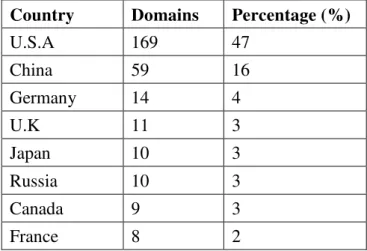
The results of the geographical location for our data
set are shown in Table 1 and Table 2. The
geographical location results for malicious
domains show the leading contributor of malicious
domains to be the USA, contributing at least
one-third of malicious web pages. This results suggests
U.S.A to be most likely to host malicious web
pages. However in Table 2 for benign domains
table, USA again, is the leading contributor with
the percentage contribution towards benign pages
being more than that for malicious distribution web
pages. Due to the fact that the source of our
database for malicious data set is user contributed,
the location of the source of our data can greatly
affect the results obtained for this feature. For
example, if such web service is to be in USA, it is
much likely the users contributing to the overall
database are mostly in the USA. This can be a
contributing factor for the geographical locations
distributions.
Table 1: Geographical distribution of malicious domains
Country Domains Percentage (%)
U.S.A 343 36
Russia 94 10
France 52 5
Germany 48 5
Turkey 44 5
Netherlands 38 4
Australia 36 4
Canada 30 3
U.K 24 3
Italy 22 2
Table 2: Geographical distribution of benign domains
Country Domains Percentage (%)
U.S.A 169 47
China 59 16
Germany 14 4
U.K 11 3
Japan 10 3
Russia 10 3
Canada 9 3
India 8 2
Hong Kong 5 1
Domain duration
The domain duration for a web page is obtained by
calculating the difference between the domain
expiration date and domain registration date.
Figures 2 and 3 show the result obtained for
malicious domains and benign domains
respectively. The domain duration graph for
malicious shows as much as 75% of the malicious
web pages have a duration of less than five years.
A look at the benign web pages graph shows an
average domain duration of 15 years compared to 4
years of malicious web pages. From these results
there is a strong indication of domain duration less
than or equal to one year been popular with
attackers.
Fig.2: Domain duration distribution for malicious domains
Fig.3: Domain duration distribution for benign domains
Registrar
Registrar refers to the organization which has been
accredited to assign and manage the reservation of
internet domain names.
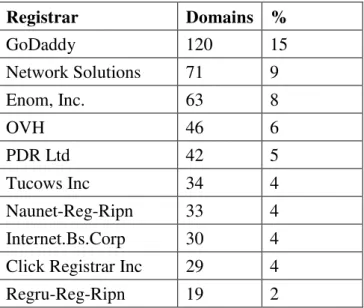
For this feature, we compared our results of
registrars for both types of data with the top ten
domain registrars worldwide. The top ten registrars
based on their market share according to [16], is
shown in Table 5. We also show results for our top
malicious and benign registrars in Tables 3 and 4
respectively. The result shows attackers do
patronize the most popular of registrars as much
benign web masters do.
Table 3: Registrar distribution for malicious domains
Registrar Domains %
GoDaddy 120 15
Network Solutions 71 9
Enom, Inc. 63 8
OVH 46 6
PDR Ltd 42 5
Tucows Inc 34 4
Naunet-Reg-Ripn 33 4
Internet.Bs.Corp 30 4
Click Registrar Inc 29 4
Regru-Reg-Ripn 19 2
Table 4: Registrar distribution for benign domains
Registrar Domains %
Mark Monitor 91 24
GoDaddy 44 11
Network Solutions 42 11
Enom. Inc 22 6
Hichina Zhicheng Ltd 16 4
CSC Corporate Inc 15 4
Melbourne IT Ltd 15 4
Tucows Inc 12 3
Ru-Center-Reg-Ripn 9 2
0 100 200 300 400 500 600 700
0% 20% 40% 60% 80% 100% 120%
F
re
q
u
e
n
cy
0% 20% 40% 60% 80% 100% 120%
0 20 40 60 80 100 120
F
re
q
u
e
n
Register.com 7 2
Table 5: Top 10 Domain Registrars
Registrar Domains %
GoDaddy 28,718,464 32.47
Enom Inc 7,131,517 8.06
Tucows 6,011,360 6.80
Network Solutions 5,408,778 6.12
Schlund+Partner 4,267,855 4.83
Melbourne IT 2,830,735 3.20
Wild West Domains 2,485,786 2.81
Register.com 1,823,513 2.06
ResellerClub.com 1,606,005 1.82
Moniker 1,404,097 1.59
Domain freshness
The domain freshness properties of web page is
indication of the “recentness” of the web page, that
is, when the web page was created with reference
to a particular date. This can be represented by the
equation:
Domain freshness = Referenced date – Creation
date
The referenced in our work was the date of
performing the classification, the creation date can be obtained from a “WHOIS” query as the domain registration date.
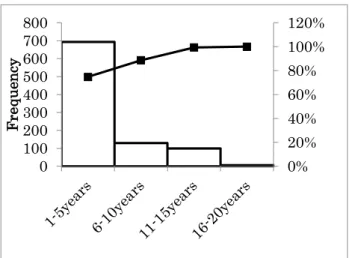
Fig. 4: Domain freshness distribution of malicious domain
Fig. 5: Domain freshness distribution of benign domains
For our data set of malicious web pages, the result
shows that as much as 72% of these were created in
the past four years. Whereas for benign pages,
about 40% of these have been around between 11
to 15 years. Averagely, the domain freshness for
the benign data set was about 11 years, whereas that
for malicious data set was 4 years.
4 CLASSIFICATION AND EVALUATION
4.1 Classification
In order to effectively detect drive by download
pages using the domain information obtained, a
score value system was introduced. A score value
system makes use of numerical values that are
assigned to a candidate web page domain features.
These score values are determined based on how
popular that particular feature is among attackers.
A feature that shows a higher usage in the malicious
data set compared with its usage in the benign data
set, is an indication that the feature is most
patronized by attackers. The calculation of the
score values involve two main steps:
1. For any given feature in our database, we first
obtain the percentage difference of usage in
both set of data. This can be represented by the
equation:
0% 20% 40% 60% 80% 100% 120%
0 100 200 300 400 500 600 700 800
F
re
q
u
e
n
cy
0% 20% 40% 60% 80% 100% 120%
0 20 40 60 80 100 120 140 160
F
re
q
u
e
n
Percentage difference usage =
benign_percentage_usage –
malicious_percentage_usage
Depending on the usage of a given feature, the
result obtained can be positive, negative or neutral
(zero). A positive value will indicate that the given
feature is less likely to be used by attackers in
setting up malicious web pages whiles a negative
result indicates otherwise.
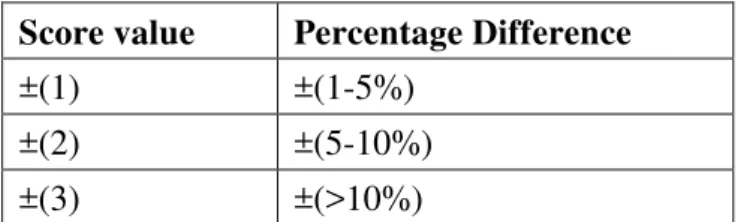
2. The score values are then calculated from the
obtained percentage difference as shown in
Table 6 below:
Table 6: Score values
Score value Percentage Difference
±(1) ±(1-5%)
±(2) ±(5-10%)
±(3) ±(>10%)
A percentage difference ranging from 1% to 5% is
assigned a score value of 1, ranging from 5% to
10% assigned a score value of 2 and any other
difference assigned a score value of 3. In this
classification we consider a negative total score
value result as a malicious web page. A positive
result represents a benign web page.
From our dataset and given a feature of Registrar to
be GoDaddy, the score values will be determined
as follows:
Percentage difference = 11% - 15%, resulting in a
percentage difference of -4%.
As the percentage difference falls within the ranges
of ± (1%-5%), this feature will be assigned a score
value of -1. The determined individual score values
of the features are then added up. A negative sum
implies the web page is malicious else it is
classified as being benign.
4.2 Evaluation
We evaluate the capability of our proposed scheme
using the combinations of domain duration, domain
freshness, registrar and country.
The critical factor for evaluating our proposal are
the detection rate and false negatives of such an
approach.
For the evaluation test, we obtained a data set of
334 known malicious web pages. These are known
malicious web pages that currently carry drive by
download exploits or at one time did. The web
pages were obtained from MDL and dates of
collection spans over a three month period,
specifically they were collected between the period
of November 2012 and January 2013.
For this work, we obtained a detection rate of 85%
and a false negative rate of 15% using the proposed
classification method. This indicates the ability to
correctly detect 85 web pages as malicious given a
dataset of 100 web pages and incorrectly
classifying the rest as benign web pages.
5 CONCLUSION AND FUTURE WORK
Malicious pages that launch drive by download
attacks are very much on the increase. This work
proposed the use of domain information properties
of a web page to detect drive by download pages.
As future work, a number of areas of our proposal
can be looked in order to improve on current results.
One of such areas is the data set. It is imperative
that the current data set be expanded in order to
improve on the integrity and effectiveness of such
an approach. Another area is the adjustment of
score values. It is possible to adjust score values so
as to improve on the detection rate and false
negatives of this approach. Although this proposal
considers the false negatives, future work can look
at the false positives of using such an approach.
We do not view our proposal as a replacement of
existing blacklisting methods but as a complement.
Our experimental results show that a domain based
drive by download pages. Such a proposal can be
implemented together with the slower dynamic
solutions to improve on the detection latency.
Acknowledgement
This work was partially supported by Proactive
Response Against Cyber-Attacks Through
International Collaborative Exchange
(PRACTICE), Ministry of Internal Affairs and
Communications, Japan. The first author of this
research is supported by Monbukagakusho
(MEXT) scholarship.
REFERENCES:
1. Danchev, D.: 80% of Web users running
unpatched versions of Flash Acrobat (Online)
available from
http://blogs.zdnet.com/security/?p=4097.
(accessed February 2013).
2. WEBSENSE INC. Home page, 1994. Available
from: http://www.websense.com; accessed on
February 2013.
3. WEBROOT SOFTWARE INC. Home page, 1997.
Available from: http://www.webroot.com/;
accessed on February 2013.
4. SOPHOS. Home page, 1997. Available from
http://www.sophos.com; accessed on February
2013.
5. MCAFEE, INC. Home page, 2005. Available
from http://www.siteadvisor.com/; accessed on
February 2013.
6. FINJAN. Home page, 1996. Available from
http://www.finjan.com; accessed on February
2013.
7. SCANSAFE. Home page, 1999. Available from
http://www.scansafe.com; accessed on
February 2013.
8. Provos,N., Mavrommatis, P., Rajab, M.A. and
Monrose F.: All your iFRAMEs point to us, In
proceedings of USENIX Security Symposium,
pp 1-15,(2008).
9. PROVOS, N., MCNAMEE, D., MAVROMMATIS, P.,
WANG, K., AND MODADUGU, N. The ghost in
the browser: Analysis of web-based malware.
In HotBots’07 (Cambridge, 2007), Usenix.
10.Fukushima, Y., Hori, Y. and Sakurai, K.:
Proactive Blacklisting for Malicious Web Sites
by Reputation Evaluation Based on Domain
and IP Address Registration, In Proceedings of
International Joint Conference of IEEE
TrustCom-11/IEEE ICESS-11/FCST-11, pp.
352-361 (2011)
11.Felegyhazi, M., Kreibich, C. and Paxson, V.:
On the potential of proactive domain
blacklisting, In Proceedings of the 3rd USENIX
Workshop on Large-scale Exploits and Emergent Threats (LEET’10),pp. 99-107, (2010).
12.Zhang, J., Seifert, C., Stokes, J. and Lee, W.:
ARROW: GenerAting SignatuRes to Detect
DRive-ByDOWnloads In proceedings of WWW’11 , pp. 187-196, (2011).
13.Malware Domain List(MDL) Available from:
http://www.malwaredomainlist.com/mdl.php;
accessed December 2012.
14.Alexa-The Web Information Company.
Available from: http://www.alexa.com/;
accessed December 2012.
15.WebHostingInfo: available from:
http://www.webhosting.info; accessed February
2013.
16.Geo IP Tool, available:
http://www.geoiptool.com/, accessed February,
2013.
17.Interesting statistics from the Secunia PSI,
Available from: http://secunia.com/blog/18/
accessed February 2013.
18.Fu-Hau Hsu, Chang-Kuo Tso, Yi-Chun Yeh,
Wei-Jen Wang, and Li-Han Chen,
Drive-by-Download Attacks,'' IEEE Journal on
Selected Areas in Communications, Volume 29,
Issue 7, pages 1461 - 1468, August 2011.
19.M. Johns. On JavaScript malware and related
threats – Web page based attacks revisited.
Journal in Computer Virology, 4(3):161–178,