Development and Molecular Cytogenetic
Identification of a Novel Wheat
–
Leymus
mollis
Lm#7Ns (7D) Disomic Substitution Line
with Stripe Rust Resistance
Xiaofei Yang, Changyou Wang, Xin Li, Chunhuan Chen, Zengrong Tian, Yajuan Wang, Wanquan Ji*
College of Agronomy, State Key Laboratory of Crop Stress Biology for Arid Areas, Northwest A & F University, Yangling, Shaanxi, 712100, China
Abstract
Leymus mollis(2n= 4x= 28,NsNsXmXm) possesses novel and important genes for
resis-tance against multi-fungal diseases. The development of new wheat—L.mollis introgres-sion lines is of great significance for wheat disease resistance breeding. M11003-3-1-15-8, a novel disomic substitution line of common wheat cv. 7182–L.mollis, developed and selected from the BC1F5progeny between wheat cv. 7182 and octoploidTritileymusM47
(2n= 8x= 56,AABBDDNsNs), was characterized by morphological and cytogenetic
identi-fication, analysis of functional molecular markers, genomicin situhybridization (GISH), sequential fluorescencein situhybridization (FISH)—genomicin situhybridization (GISH) and disease resistance evaluation. Cytological observations suggested that M11003-3-1-15-8 contained 42 chromosomes and formed 21 bivalents at meiotic metaphase I. The GISH investigations showed that line contained 40 wheat chromosomes and a pair ofL. mollischromosomes. EST-STS multiple loci markers and PLUG (PCR-based Landmark Unique Gene) markers confirmed that the introducedL.mollischromosomes belonged to homoeologous group 7, it was designated as Lm#7Ns. While nulli-tetrasomic and
sequen-tial FISH-GISH analysis using the oligonucleotide Oligo-pSc119.2 and Oligo-pTa535 as probes revealed that the wheat 7Dchromosomes were absent in M11003-3-1-15-8. There-fore, it was deduced that M11003-3-1-15-8 was a wheat–L.mollisLm#7Ns(7D) disomic substitution line. Field disease resistance demonstrated that the introducedL.mollis chro-mosomes Lm#7Nswere responsible for the stripe rust resistance at the adult stage.
More-over, M11003-3-1-15-8 had a superior numbers of florets. The novel disomic substitution line M11003-3-1-15-8, could be exploited as an important genetic material in wheat resis-tance breeding programs and genetic resources.
OPEN ACCESS
Citation:Yang X, Wang C, Li X, Chen C, Tian Z, Wang Y, et al. (2015) Development and Molecular Cytogenetic Identification of a Novel Wheat–Leymus mollisLm#7Ns (7D) Disomic Substitution Line with Stripe Rust Resistance. PLoS ONE 10(10): e0140227. doi:10.1371/journal.pone.0140227
Editor:Aimin Zhang, Institute of Genetics and Developmental Biology, CHINA
Received:July 6, 2015
Accepted:September 23, 2015
Published:October 14, 2015
Copyright:© 2015 Yang et al. This is an open access article distributed under the terms of the
Creative Commons Attribution License, which permits unrestricted use, distribution, and reproduction in any medium, provided the original author and source are credited.
Data Availability Statement:All relevant data are within the paper.
Introduction
Leymus mollis(Trin.) pilger (2n= 4x= 28,NsNsXmXm) is an important tetraploid species in Leymus(Poaceae:Triticeae) and a useful genetic resource for wheat breeding as a tertiary gene pool [1].L.mollishas several desirable agronomic traits, such as a perennial growth habit, high fecundity, vigorous growth, strong rhizomes [2], especially good resistance to several fungal diseases, especially stripe rust, powdery mildew [3–5], as well as tolerance to alkaline and saline conditions, low temperatures, and drought stresses [6–9].
Stripe rust is one of the most destructive diseases of wheat resulting in serious yield losses in susceptible varieties, caused by the fungusPuccinia striiformisf.sp.tritici(Pst) [10,11]. Further-more, due to rapid variation in the pathological races of stripe rust, it is really necessary to obtain and utilize new germplasms with resistance genes to breed resistant varieties [12,13]. Wide hybridization can transfer the desirable traits from wild relatives into common wheat and promote the new alien germplasms with advantageous exogenous genes [14], and intro-gression of alien resistance genes from wild relatives has been recognized as an efficient and environmentally safe approach to minimize yield losses due to diseases [15].
Leymus mollishas been extensively applied for hybridization with common wheat (Triticum aestivumL., 2n= 6x= 42,AABBDD) or durum wheat (T.durum, 2n= 4x= 28,AABB). In China, the first hybrids of common wheat 7182 andL.molliswere obtained by embryo rescue and colchicine treatment [16]. Later, many different derivatives have been developed, especially octoploidTritileymus[17–20], which were extensively backcrossed with common wheat as a novel and useful bridge materials for wheat breeding. Several desirable characteristics, includ-ing those of drought tolerance, and high protein quality, especially the disease resistance, have been identified and offered valuable resources for wheat improvement. Osmotic-stress-respon-sive genes fromL.mollishave also been incorporated into common wheat [8]. A translocation line Shannong0096 with resistance to stripe rust was developed from interspecific hybridiza-tion between common wheat cv. Yannong15 and octoploidTritileymusM842 [17]. The multi-ple alien substitution line 05DM6 with resistance to stripe rust at the adult stage, which had three pairs ofNschromosomes fromL.mollis, was also selected from the progeny of octoploid TritileymusM842-12 andT.durumcv. Trs-372 [20]. 10DM57, a 3Ns(3D) disomic substitu-tion line with resistance to leaf rust was isolated from the F5progeny ofT.durumcv.
D4286 × OctoploidTritileymusM842-16 [18]. Previously, a wheat-L.mollispartial amphi-ploid M47 line with highly resistance to stripe rust and powdery mildew at the adult stage in field was developed [21]. In order to further transfer excellent resistance genes of M47 line into common wheat, the development of wheat-L.mollischromosome addition line, substitution line or translocation line may be a novel step. And meanwhile, detecting and identifying alien chromosomes or segments in a wheat background is essential prior to their use in breeding programs [22–24]. Here, we characterized a novel wheat-L.mollisdisomic substitution line via morphological observation, cytogenetic identification, functional molecular markers analysis, genomicin situhybridization (GISH), sequential FISH-GISH and disease resistance
evaluation.
Genomicin situhybridization (GISH) and fluorescencein situhybridization (FISH) are used routinely because they are the most efficient and accurate techniques to directly and pre-cisely detect the alien chromosomes or introgression segments that introduced into the wheat backgrounds [24], and the constitution of chromosomes can thus be analyzed [25]. Moreover, diverse functional molecular markers are also powerful techniques, which can enable reliable identification of alien chromosomes or introgression fragments in wheat backgrounds, and can determine the homoeologous group relationships of alien chromosomes [15].
In the present study, we developed and identified a novel wheat—L.mollisLm#7Ns(7D) disomic substitution line M11003-3-1-15-8, which was derived from the BC1F5progeny of
common wheat cv. 7182 and octoploidTritileymusM47. It was revealed that the introducedL. mollisLm#7Nschromosomes contained new gene(s) for stripe rust resistance in wheat, which can be used as the starting material to incorporate the gene into the wheat genome through chromosome translocation.
Materials and Methods
Materials
The materials included wheat lines cv. 7182, Huixianhong (HXH), Chinese Spring (CS) (2n= 4x= 42,AABBDD),L.mollis(2n= 4x= 28,NsNsXmXm), octoploidTritileymusM47 (2n= 8x= 56,AABBDDNsNs) and nulli-tetrasomics materials based on CS. A wheat—L. mol-lisdisomic substitution line M11003-3-1-15-8, obtained from the BC1F5progeny of common
wheat cv. 7182 and octoploidTritileymusM47, 7182 andL.molliswere the parents of M47, which were all maintained at the College of Agronomy, Northwest A&F University, China. 7182 was used as a control in electrophoretic analyses and in the agronomic trait evaluation. Huixianhong (HXH) was employed as the susceptible controls in the stripe rust resistance tests at the adult stage in the field.
Methods
Cytological identification
The roots and young spikes were all sampled in the field at their appropriate stage, respectively, and then the treatment of root tips and anthers were pretreated as described previously [21]. Cells with a complete chromosomes numbers of materials were photographed with an Olym-pus BX-43 microscope (Japan).
GISH and FISH-GISH
The total genomic DNA of common wheatL.mollisand 7182 were isolated from seedling leaves using a modified CTAB method [26], with one additional purification step using chloro-form to obtain high-quality DNA, which were used for GISH probes and blocks, respectively. The total genomic DNA ofL.molliswas labeled with a Dig-Nick Translation Mix (Roche, Ger-many), sheared genomic DNA of 7182 was used as blocking DNA. The root tips were digested in2% cellulase and 1% pectinase at 37°C for 52–58 min (different digestion time should be needed in various materials); the slides and GISH procedure were performed as described pre-viously [21]. Sequential FISH-GISH was performed to characterize the replaced wheat chromo-somes. Oligonucleotide probes Oligo-pSc119.2 and Oligo-pTa535, 5’end-labelled with 6-carboxyfluorescein (6-FAM) or 6-carboxy tetramethylrhodamine (Tamra) was synthesized by Shanghai Invitrogen Biotechnology Co.Ltd. (Shanghai, China), which were used for identifying the whole set of wheat chromosomes by sequential FISH-GISH analysis, probe labeling andin situhybridization were performed according to Tang et al. [27]. Fluorescent signals were viewed and photographed (Olympus BX53, Japan) equipped with a Photometrics SenSys CCD camera DP 80.
EST-STS and PLUG analysis
different markers were used to further determine homoeologous group relationships of the introduced alien chromosomes in the wheat—L.mollisdisomic substitution line M11003-3-1-15-8. Polymerase chain reaction (PCR) assays were conducted as described previously [21]. The PCR products of EST-STS markers were separated in 8% non-denaturing polyacrylamide gel and visualized with silver staining, while the products of PLUG markers were analyzed by electrophoresis on a 1% agarose gel, to obtain high levels of polymorphism, an 7.5μl aliquot of the product was digested withTaqI (65°C) for 2 h orHaeIII (37°C) for 2 h, respectively. Digested fragments were fractionated by electrophoresis on 2% agarose gel in TAE buffer.
Disease resistance and agronomic trait evaluation
To evaluate resistance to stripe rust at the adult stage, a mixture ofPuccinia striiformisf. sp. tri-tici(Pst) races was used, including CYR31, CYR32, CYR33 and Shuiyuan 11 from Shaanxi Province. Common wheat cv. 7182,L.mollis, line M11003-3-1-15-8, and the susceptible con-trol variety HXH was separately tested in the field at the College of Agronomy, Northwest A & F University.
When the control variety HXH were all fully infected after the artificial inoculation, the reactions to the mixedPstraces were scored according to a previously published method, the infection types (IT) scores of wheat stripe rust at adult stage was assessed on a scale from 0–4, as follows: 0, 0; and 1 were considered to be resistant, 2 was recorded to be moderately resistant, 3 and 4 was assessed to be moderately susceptible and susceptible, respectively [30].
Morphological traits of line M11003-3-1-15-8 and its parents, common wheat cv. 7182,L. mollis, M47, i.e., plant height, plant type, spike length, spikelets per spike, kernels per spikelet, kernels per spike, thousand kernel weight, awnless, self-fertility and maturity, were all sampled randomly and investigated.
Results
Morphology and cytological characterization
M11003-3-1-15-8 was derived from BC1F5progenies of wheat cv. 7182 and partial amphiploid
M47 (2n= 8x= 56,AABBDDNsNs). Plant height, plant type, spike length, long awns of M11003-3-1-15-8 closely resembled those of wheat parent 7182, and exhibiting high seed set as wheat cv. 7182. But M11003-3-1-15-8 had greater kernels per spikelet, higher thousand kernel weight and later maturity than 7182, which were significantly different from wheat parent 7182. No seeds were produced by self- and cross-pollination inL.mollis. (Table 1,Fig 1). The mitotic and meiotic observations of line M11003-3-1-15-8 indicated that root tip cells (RTCs) had a chromosome number of 42 (Fig 2a), pollen mother cells (PMCs) formed a pairing config-uration of 21 II (Fig 2b), and the average chromosome configuration at MI was 0.17 univalent, 1.21 rod, 19.62 ring bivalents, no trivalents or quadrivalents were observed at metaphase I, meanwhile no chromosomes was lagged at anaphase I (Table 2,Fig 2c). Therefore, line M11003-3-1-15-8 exhibited highly cytological stability.
Molecular markers analysis
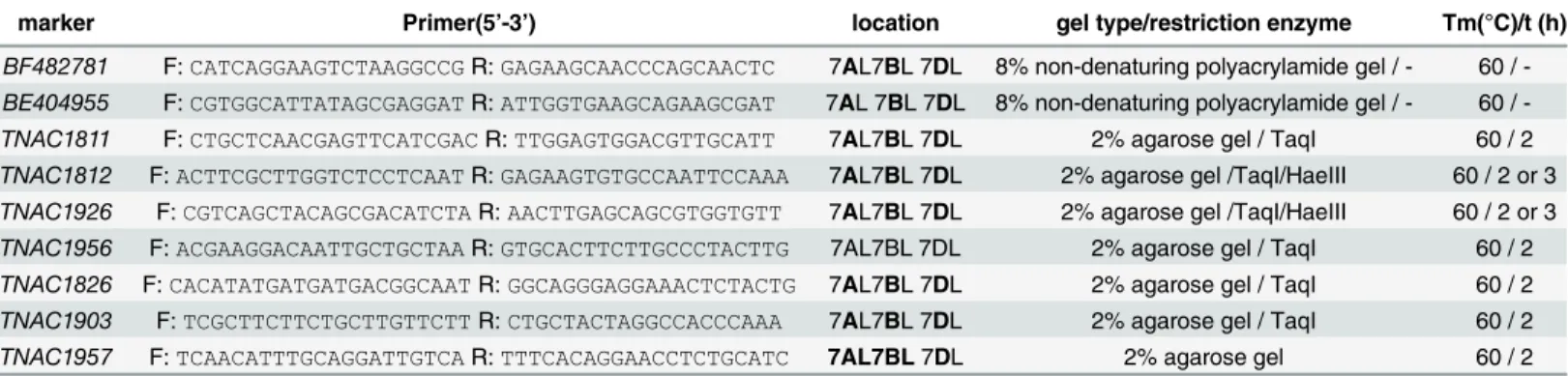
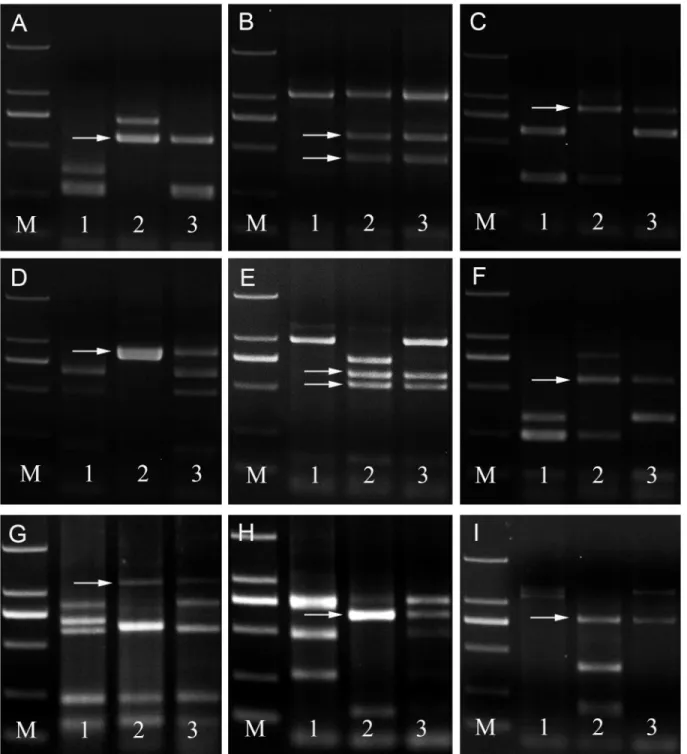
suggested that these markers could be used as specific markers ofL.mollischromosomes in M11003-3-1-15-8 (Table 3, Figs3and4), and meanwhile the introduced pair ofL.mollis chro-mosomes in M11003-3-1-15-8 was demonstrated that they were homoeologous with the sev-enth homoeologous group chromosomes of wheat.
Nulli-tetrasomic analysis
Based on the amplification of nulli-tetrasomic materials of wheat Chinese Spring (CS), the sev-enth homoeologous group PLUG markers can amplify diagnostic bands in wheat chromo-somes 7A, 7B, and 7Dspecific bands, respectively. As shown inFig 5, three PLUG primers TNAC1826-Taql, TNAC1957-Taql and TNAC1926-HaeШ/ Taql clearly amplified fragments of chromosomes 7A, 7B, and 7Din CS, theL.mollis-specific bands appeared in M11003-3-1-15-8, it was also suggested that the introducedL.mollischromosome in M11003-3-1-15-8 belonged to homoeologous group 7, while the chromosome 7D-specific band in
M11003-3-1-Table 1. Agronomic traits of wheat parent cv. 7182,L.mollis, M47 and disomic substitution line M11003-3-1-15-8.
Materials Plant height (cm)
Plant type
Spike length (cm)
Spikelets/ spike
Florets/ spikelet
Kernels/ spike
Thousand kernel weight (g)
Awnedness
7182 86±3 Tighten 10.0±0.4 20±2 4±1 46±4 37.3±0.5 long awn
L.mollis 56±2 Drooping 14.7±0.3 20±2 2±1 1±1 - awnless
M11003-3-1-15-8 83
±2 Tighten 10.5±0.5 22±2 5±1 49±6 41.5±0.4** long awn
**indicates significant differences between the substitution line M11003-3-1-15-8 and wheat parent 7182 (P<0.01). - represent no data.
doi:10.1371/journal.pone.0140227.t001
Fig 1. Morphological comparison of adult plants, spikes, spikelets, and seeds from wheat—L.mollis derivative line M11003-3-1-15-8 and its parents, common wheat cv. 7182 andL.mollis.a adult plants, b spikes, c spikelets and seeds. 1 7182, 2 M11003-3-1-15-8, 3Leymus mollis.
15-8 was significantly absent, therefore it was preliminarily deduced that wheat chromosomes 7Dwere absent in M11003-3-1-15-8.
GISH and FISH-GISH analysis
For GISH, the total genomic DNA of wheat cv. 7182 andL.molliswere used as the block and probe respectively, to identify the introducedL.mollischromosomes in M11003-3-1-15-8. GISH results of somatic cells showed that M11003-3-1-15-8 had two alien chromosomes with clear hybridization signals (Fig 6).
In order to further determine the wheat chromosomes replaced byL.mollischromosomes in M11003-3-1-15-8 line, sequential FISH-GISH analysis was performed. Oligo-pTa535, mainly detecting wheatD-genome chromosomes, and Oligo-pSc119.2, mainly identifyingB -genome chromosomes, which can successfully discriminate the whole set of common wheat 42 chromosomes by combining the two oligonucleotide probes. Therefore, first, the standard FISH karyotype patterns of wheat parent cv. 7182 (Fig 7) was painted using probes Oligo-pTa535 and Oligo-pSc119.2 according to Tang et al. (2014). And also, these two probes were used to hybridize the M11003-3-1-15-8 mitotic spread chromosomes by mutil-color FISH-G-ISH (Fig 8). Compared with the standard FISH painting of wheat parent cv. 7182, it was deduced that the pair of wheat chromosomes 7Dwas really absent in M11003-3-1-15-8, which was consistent with the results of nulli-tetrasomic analysis. Namely, the wheat chromosomes 7Dwere replaced byL.mollischromosomes Lm#7Ns
Disease resistance evaluation
The reactions of adult plants to the mixedPstraces (CYR30, CYR31, CYR32 and Shuiyuan11) were tested in the field. Wheat parent cv. 7182 and control variety HXH were susceptible to stripe rust when infected with a mixture of the corresponding physiological races,L.molliswas almost immune to these isolates whereas, and M11003-3-1-15-8 also performed highly
Fig 2. Mitotic (a), meiotic I (b) and anaphase I (c) chromosome characteristics of M11003-3-1-15-8, a 2n= 42, b 2n= 21П, c 2n= 21+21.
doi:10.1371/journal.pone.0140227.g002
Table 2. Chromosome numbers and configuration pairing at mitotic and meiotic of M11003-3-1-15-8.
Material 2n No. of cells observed Chromosome configuration
Univalent Bivalent Trivalent Quadrivalent
Rod Ring Total
M11003-3-1-15-8 42 77 0.17(0–2) 1.21(1–3) 19.62(19–21) 20.83(20–21) 0 0
resistance to stripe rust at the adult stage (Table 4,Fig 9). The results indicated that the stripe rust resistance of M11003-3-1-15-8 was inherited from the M47 parent, and was traced toL. mollis.
Discussion
Leymus molliscould perform good resistance to fungal diseases such as powdery mildew, stripe rust, leaf rust and scab [3–5]. In previous study, various wheat-L.mollisderivatives with alien chromosomes distributed in different homoeologous groups were developed, especially octo-ploidTritileymusderived from wheat cv. 7182 andL.molliscould be used as an excellent inter-mediate resistant material for wheat disease resistance breeding, which incorporated a novel stripe rust and powdery mildew resistance genes fromL.mollis[17–21,31].
Table 3. EST-STS and PLUG polymorphic markers mapped on seventh homoeologous groups applied to linkage analysis of the Lm#7Ns.
marker Primer(5’-3’) location gel type/restriction enzyme Tm(°C)/t (h)
BF482781 F:CATCAGGAAGTCTAAGGCCGR:GAGAAGCAACCCAGCAACTC 7AL7BL 7DL 8% non-denaturing polyacrylamide gel / - 60 / -BE404955 F:CGTGGCATTATAGCGAGGATR:ATTGGTGAAGCAGAAGCGAT 7AL 7BL 7DL 8% non-denaturing polyacrylamide gel / - 60 / -TNAC1811 F:CTGCTCAACGAGTTCATCGACR:TTGGAGTGGACGTTGCATT 7AL7BL 7DL 2% agarose gel / TaqI 60 / 2
TNAC1812 F:ACTTCGCTTGGTCTCCTCAATR:GAGAAGTGTGCCAATTCCAAA 7AL7BL 7DL 2% agarose gel /TaqI/HaeIII 60 / 2 or 3 TNAC1926 F:CGTCAGCTACAGCGACATCTAR:AACTTGAGCAGCGTGGTGTT 7AL7BL 7DL 2% agarose gel /TaqI/HaeIII 60 / 2 or 3 TNAC1956 F:ACGAAGGACAATTGCTGCTAAR:GTGCACTTCTTGCCCTACTTG 7AL7BL 7DL 2% agarose gel / TaqI 60 / 2
TNAC1826 F:CACATATGATGATGACGGCAATR:GGCAGGGAGGAAACTCTACTG 7AL7BL 7DL 2% agarose gel / TaqI 60 / 2
TNAC1903 F:TCGCTTCTTCTGCTTGTTCTTR:CTGCTACTAGGCCACCCAAA 7AL7BL 7DL 2% agarose gel / TaqI 60 / 2 TNAC1957 F:TCAACATTTGCAGGATTGTCAR:TTTCACAGGAACCTCTGCATC 7AL7BL7DL 2% agarose gel 60 / 2
- represent no data.
doi:10.1371/journal.pone.0140227.t003
Fig 3. EST-STS markers results of M11003-3-1-15-8.The arrow indicates anL.mollisspecific band. M DL2000, 1 7182, 2L.mollis, 3 M11003-3-1-15-8. BE482781-7AL 7BL 7DL,BE404955-7A7BS 7D.
In the present study, M11003-3-1-15-8, a new Lm#7Ns(7D) substitution line with high resistance to stripe rust carried oneNschromosome pair derived fromL.molliswas further developed and screened. It could thus be an interesting germplasm for disease resistance breeding.
Fig 4. PLUG markers results of M11003-3-1-15-8.The arrow indicates anL.mollisspecific band. All PCR products are digested byTaqI orHaeIII. M DL2000, 1 7182, 2L.mollis, 3 M11003-3-1-15-8. a TNAC1811-HaeIII, b TNAC1812-HaeIII, c TNAC1926-HaeIII, d TNAC1956-HaeIII, e TNAC1812-TaqI, f TNAC1926-TaqI, g TNAC1826-TaqI, h TNAC1903-TaqI, i TNAC1957-TaqI.
The stable heritability of alien chromosomes is theoretically and practically significant, therefore, the chromosome constitution and configuration pairing in RTCs and PMCs of M11003-3-1-15-8 was identified by cytological observations, respectively. The results suggested that M11003-3-1-15-8 exhibited highly cytological stability based on 21 bivalents during mei-otic metaphase I and no lagging chromosomes at metaphase I. GISH is the visible, accurate and most essential technique for tracking alien chromosomes introduced into the wheat back-ground. To detect the alien chromosomes in M11003-3-1-15-8, GISH was performed usingL.
Fig 5. Nullisomic-tetrasomic analysis of M11003-3-1-15-8.The arrow indicates anL.mollisspecific band. M DL2000, 1 7182, 2L.mollis, 3 M11003-3-1-15-8, 4 M47, 5 CS, 6 CSN7AT7D, 7 CSN7BT7A, 8 CSN7DT7B; a TNAC1826-TaqI, b TNAC1957-TaqI, c TNAC1926-HaeIII, d TNAC1926-TaqI.
doi:10.1371/journal.pone.0140227.g005
Fig 6. Genomicin situhybridization (GISH) analysis usingL.mollisgenomic DNA (green) as probe on root tip metaphase chromosomes of M11003-3-1-15-8.Chromosomes were counterstained with PI (red).
mollisand wheat parent cv. 7182 as probe and block respectively at the ratio of 1: 20, it was clearly detected two alien chromosomes with yellow-green hybridization signals in M11003-3-1-15-8. In a word, M11003-3-1-15-8 was cytogenetically stable and carried one pair ofL.mollis chromosomes.
To further characterize M11003-3-1-15-8 line, sequential FISH-GISH and nulli-tetrasomic analysis were carried out to determine the substituted wheat chromosomes in M11003-3-1-15-8. FISH is a powerful technique for localizing highly repetitive DNA sequences, detecting spe-cific sites in particular regions of individual chromosomes and discriminate genome constitu-tions [32,33]. Many substitution lines related to common wheat chromosomes and alien chromosomes have been identified using FISH or nulli-tetrasomic analysis, including 6G(6B) [34],1St(1D) [28], 6Js/6B[13], 2Ra(2D) [35], 2Ns(2D) [36], 2Vb(2D) [37], and 3D(3Ns) [18]. In this study, the standard FISH karyotype patterns of wheat parent 7182 was painted for the first time using oligonucleotide probes Oligo-pTa535 and Oligo-pSc119.2, which was conve-nient to distinguish common wheat chromosomes in M11003-3-1-15-8. Thus, based on the
Fig 7. Fluorescencein situhybridization (FISH) analysis using Oligo-pTa535 (red), Oligo-pSc119.2 (green) as probes on root tip metaphase chromosomes of 7182.Chromosomes were counterstained with DAPI (blue). The pair of wheat chromosomes 7Dwas indicated in a small white rectangular box.
doi:10.1371/journal.pone.0140227.g007
Fig 8. Fluorescencein situhybridization (FISH) analysis using Oligo-pTa535 (red), Oligo-pSc119.2 as probes on root tip metaphase chromosomes of M11003-3-1-15-8 (a), Genomicin situhybridization (GISH) analysis usingL.mollisgenomic DNA (green) as probe on root tip metaphase chromosomes of M11003-3-1-15-8.Chromosomes were counterstained with DAPI (blue). The yellow arrows indicate the introducedL.mollis chromosomes in M11003-3-1-15-8.
sequential FISH-GISH and nulli-tetrasomic analysis, it was deduced that the pair of chromo-somes 7Dwas significantly absent in M11003-3-1-15-8.
Molecular markers could provide a simple and precise approach to track the alien DNA in a wheat background based on comparative genome analysis, and could determine the homoeolo-gous group relationship of alien chromosomes in a wheat background, especially those from the conserved genetic region showing high levels of collinearity among the cereal genomes, such as rice, Brachypodium, and wheat [38]. EST-SSR and EST-STS markers could be used to distinguish alien chromosome homoeologous group relationship between aliens chromosomes and those of wheat, and track alien chromosomes [39]. More recently, EST–PCR markers have been employed extensively in terms of convenient manipulation and application as effective tools for genetic and homoeologous relationship analysis ofAgropyron cristatum[40], Dasy-pyrum villosum[41],Hordeum californicum[39],Hordeum chilense[42],Secale cerealeL. [43], Thinopyrum intermedium[28],Thinopyrum ponticum[44],Secale africanum[35], Psathyros-tachys huashanica[45]. In addition, PLUG markers could not only amplify polymorphism among wheatA,BandDgenomes due to the intron polymorphisms, displayed similar homo-eologous chromosome locations to hexaploid wheat [29,46], collinear gene relationships amongTriticeaespecies and sequence polymorphism among different species suggested that PLUG markers could also be used to determine homoeologous group relationships of alien chromosomes. Hu et al. revealed genomic rearrangement between wheat andTh.elongatum using mapped functional molecular markers (EST-SST and PLUG markers). In the present
Table 4. Evaluation of the disease resistance to powdery mildew and stripe rust of 7182,L.mollis, M47 and M11003-3-1-15-8.
Material RTC PMC Alien chromosome type Stripe rust resistance
7182 42 21 II - 3
L.mollis 28 - NsNsXmXm 0
M47 56 28 II AABBDDNsNs 0;
M11003-3-1-15-8 42 21 II Lm#7Ns(7D) 1
HXH 42 21 II - 4
A score of wheat stripe rust at adult stage: resistant: 0–2, susceptible: 3–4. - represent no data
doi:10.1371/journal.pone.0140227.t004
Fig 9. Infection type forPstof susceptible control variety Huixianhong (HXH) (1), 7182 (2),L.mollis(3), octoploidTritileymusM47 (4) and M11003-3-1-15-8 (5) at the adult stage.A score of wheat stripe rust at adult stage: resistant: 0–2, susceptible: 3.
study, we used EST–STS multiple-loci pair primers and PLUG molecular markers from the seven homoeologous groups of wheat to further determine the homoeologous relationships between the introducedL.mollischromosome and those of common wheat. Two EST–STS markers and seven PLUG markers located on wheat chromosome group 7 could specifically amplify polymorphism bands in M11003-3-1-15-8 andL.mollis, it was suggested that the pair ofL.mollischromosomes in M11003-3-1-15-8 belonged to homoeologous group 7. And mean-while, these special markers could also be used as unique tools for tracking alienL.mollisin a wheat background, and for comparative gene mapping, chromosomal evolutionary analysis, and gene introgression during wheat improvement usingL.mollisaccessions as gene donors.
In summary, we further developed a new wheat-L.mollisdisomic substituion line M11003-3-1-15-8 that was produced spontaneously from the BC1F5progeny of a cross between
octo-ploidTritileymusM47 and wheat parent 7182. The introducedL.mollischromosomes in M11003-3-1-15-8 were associated with homoeologous group 7 of wheat chromosome by cyto-genetic, FISH-GISH, and functional molecular markers analysis, and it was temporarily desig-nated as Lm#7Ns. While FISH-GISH and nulli-tetrasomic analysis results demonstrated that the pair of wheat chromosomes 7Dwere absent in 15-8. Therefore, M11003-3-1-15-8 is a new Lm#7Ns(7D) substitution line. The self-fertility of M11003-3-1-15-8 was as high as 91.0%, which approached the normal level found in common wheat, suggested that all of the chromosomes in M11003-3-1-15-8 had normal pairing and separation. Furthermore, although wheat group 7 chromosomes contained the spike characteristics such as spike length and grain weight genes [45], M11003-3-1-15-8 did not take along negative spike traits, this also indicated that the Lm#7Nschromosome fromL.molliscould compensate for the absence of the 7D chro-mosome from wheat. What’s more, wheat—L.mollisdisomic substitution line M11003-3-1-15-8 was highly resistant to stripe rust at adult stage, it was revealed that theL.mollis chromo-some Lm#7Nspossessed stripe rust resistances gene(s). Moreover, the superior spike trait of substitution line M11003-3-1-15-8 will be particularly significant for enhancing the crop yield because it allows more kernels to be formed per spike. It is worth noting that severalL.mollis chromosomes contain novel stripe rust resistance genes, and the introgressed genes can be expressed in the wheat backgrounds.
In a word, M11003-3-1-15-8 was a novel wheat–L.mollisLm#7Ns(7D) disomic substitu-tion line with stripe rust resistance, which could be exploited as an important genetic material in wheat resistance breeding programs and genetic resources.
Acknowledgments
The authors would like to thank Dr. Shulan Fu and Pro. Zongxiang Tang (Sichuan Agricultural University, China) for technical guidance in FISH analysis. The authors would like to thank Dr. Hong Zhang for English language editing of the manuscript.
Author Contributions
Conceived and designed the experiments: XY CW WJ. Performed the experiments: XY XL. Analyzed the data: XY CW YW. Contributed reagents/materials/analysis tools: WJ CC ZT XL. Wrote the paper: XY. Made the final revision: WJ CW.
References
1. Kishii M, Wang RC, Tsujimoto H (2003) Characteristics and behaviour of the chromosomes ofLeymus mollisandL. racemosus(Triticeae, Poaceae) during mitosis and meiosis. Chromosome Res 11: 741–
748. PMID:14712860
3. Fatih A (1983) Analysis of the breeding potential of wheat-Agropyronand wheat-Elymusderivatives, 1 Agronomic and quality characteristics. Hereditas 98: 287–295. PMID:6874401
4. Merker A (1992) The Triticeae in cereal breeding. Hereditas 116: 277–280.
5. Mujeeb-Kazi A, Bernard M, Bekele GT, Mirand JL (1983) Incorporation of alien genetic information from Elymusgiganteus into Triticum aestivum. In: Sakamoto S (ed) Proceedings of the 6th international wheat genetics symposium Plant germplasm Institute, Kyoto, Japan,: 223–231.
6. Anamthawat-Jónsson K, Bödvarsdóttir SK, Bragason BT, Gudmundsson J, Martin PK, Koebner RMD (1997) Wide hybridization between wheat (TriticumL.) and lymegrass (LeymusHochst.). Euphytica 93: 293–300.
7. Habora ME, Eltayeb AE, Oka M, Tsujimoto H, Tanaka K (2013) Cloning of allene oxide cyclase gene fromLeymus mollisand analysis of its expression in wheat-Leymuschromosome addition lines. Breed Sci 63: 68–76. doi:10.1270/jsbbs.63.68PMID:23641183
8. Habora ME, Eltayeb AE, Tsujimoto H, Tanaka K (2012) Identification of osmotic stress-responsive genes fromLeymus mollis, a wild relative of wheat (Triticum aestivumL.). Breed Sci 62: 78–86. doi:10. 1270/jsbbs.62.78PMID:23136517
9. McGuire PE, Dvorak J (1981) High salt-tolerance potential in wheatgrass. Crop science 21: 702–705.
10. Chen XM, Penman L, Wan AM, Cheng P (2010) Virulence races of Pucciniastriiformisf. sp.triticiin 2006 and 2007 and development of wheat stripe rust and distributions, dynamics, and evolutionary relationships of races from 2000 to 2007 in the United States. Can J of Plant Pathol 32: 315–333.
11. Yaniv E, Raats D, Ronin Y, Korol AB, Grama A, Bihamta MR, et al. (2015) Evaluation of marker-assis-ted selection for the stripe rust resistance gene Yr15, introgressed from wild emmer wheat. Mol Breed-ing 35: 1–12.
12. Du WL, Wang J, Lu M, Sun SG, Chen XH, Zhao JX, et al. (2014) Characterization of a wheat-Psathyr-ostachyshuashanica Keng 4Ns disomic addition line for enhanced tiller numbers and stripe rust resis-tance. Planta 239: 97–105. doi:10.1007/s00425-013-1957-2PMID:24085532
13. Hu LJ, Li GR, Zeng ZX, Chang ZJ, Liu C, Yang ZJ (2011) Molecular characterization of a wheat -Thino-pyrum ponticumpartial amphiploid and its derived substitution line for resistance to stripe rust. J Appl Genet 52: 279–285. doi:10.1007/s13353-011-0038-0PMID:21437653
14. Anamthawat-Jónsson K (1995) Wide-hybrids between wheat andlymegrass: breeding and agricultural potential. Icel Agr Sci 9: 101–113.
15. Niu ZX, Klindworth DL, Wang RRC, Jauhar PP, Larkin PJ, Xu SS (2011) Characterization of HMW
glu-tenin subunits inThinopyrum intermedium, Th. bessarabicum, Lophopyrum elongatum, Aegilops mark-grafii, and their addition lines in wheat. Crop Sci 51: 667–677.
16. Chen SY, Fu J, Gao LZ (1985) The hybridization betweenTriticumaestivum andLeymus mollis. Acta Botanica Boreali-Occidentalia Sinica 4: 260–266.
17. Bao Y, Wang J, He F, Ma H, Wang H (2012) Molecular cytogenetic identification of a wheat (Triticum aestivum)-American dune grass (Leymus mollis) translocation line resistant to stripe rust. Genet Mol Res 11: 3198–3206. doi:10.4238/2012.May.22.2PMID:22653669
18. Pang YH, Chen XH, Zhao JX, Du WL, Cheng XN, Wu J, et al. (2014) Molecular cytogenetic characteri-zation of a wheat—Leymus mollis3D(3Ns) substitution line with resistance to leaf rust. J Genet Geno-mics 41: 205–214. doi:10.1016/j.jgg.2013.11.008PMID:24780618
19. Wang XP, Fu J, Zhang XQ, Jing JK, Wen YX (2000) Molecular cytogenetic study on genome constitu-tions of octoploidTritileymus. Acta Botanica Sinica 42: 582–586.
20. Zhao JX, Du WL, Wu J, Cheng XN, Gao Y, Pang YH, et al. (2012) Development and identification of a wheat-Leymus mollismultiple alien substitution line. Euphytica 190: 45–52.
21. Yang XF, Wang CY, Chen CH, Zhang H, Tian ZR, Li X, et al. (2014) Chromosome constitution and ori-gin analysis in three derivatives of Triticum aestivum—Leymus mollisby molecular cytogenetic identifi-cation. Genome 57: 583–591. doi:10.1139/gen-2014-0161PMID:25760775
22. Jiang J, Friebe B, Gill B (1994) Recent advances in alien gene transfer in wheat. Euphytica 73: 199–
212.
23. Schwarzacher T, Anamthawat-Jonsson K, Harrison GE, Islam AKMR, Jia JZ, King IP, et al. (1992)
Genomicin situhybridization to identify alien chromosomes and chromosome segments in wheat. Theor Appl Genet 84: 778–786. doi:10.1007/BF00227384PMID:24201474
24. Zhang P, Friebe B, Gill BS, Park RF (2007) Cytogenetics in the age of molecular genetics. Aust J Agr
Res 58: 498–506.
26. Doyle JJ, Doyle JL (1987) A rapid DNA isolation procedure for small quantities of fresh leaf tissue. Phy-tochem Bull 19: 11–15.
27. Tang ZX, Yang ZJ, Fu SL (2014) Oligonucleotides replacing the roles of repetitive sequences pAs1, pSc119.2, pTa-535, pTa71, CCS1, and pAWRC.1 for FISH analysis. J Appl Genet 55: 313–318. doi:
10.1007/s13353-014-0215-zPMID:24782110
28. Hu LJ, Li GR, Zeng ZX, Chang ZJ, Liu C, Zhou JP, et al. (2010) Molecular cytogenetic identification of a
new wheat-Thinopyrumsubstitution line with stripe rust resistance. Euphytica 177: 169–177.
29. Ishikawa G, Nakamura T, Ashida T, Saito M, Nasuda S, Endo TR, et al. (2009) Localization of anchor
loci representing five hundred annotated rice genes to wheat chromosomes using PLUG markers. Theor Appl Genet 118: 499–514. doi:10.1007/s00122-008-0916-yPMID:19057889
30. Ma H, Singh RP, Mujeeb-Kazi A (1995) Suppression/expression of resistance to stripe rust in synthetic
hexaploid wheat (Triticum turgidum×T. tauschii). Euphytica 83: 87–93.
31. Wang J, Chen XH, Du WL, Zhao JX, Wu J, Cheng XN, et al. (2012) Morphological and molecular cyto-genetic characterization of partial octoploidTritileymus. Genet Resour Crop Ev 60: 1453–1462. 32. Rayburn AL, Gill BS (1986) Isolation of a D-genome specific repeated DNA sequence fromAegilops
squarrosa. Plant Mol Biol Rep 4: 102–109.
33. Leitch IJ, Heslop-Harrison JS (1992) Physical mapping of the 18S-5.8 S-26S rRNA genes in barley by in situhybridization. Genome 35: 1013–1018.
34. Uhrin A, Szakács É, Láng L, BedőZ, Molnár-Láng M (2011) Molecular cytogenetic characterization
and SSR marker analysis of a leaf rust resistant wheat line carrying a 6G(6B) substitution fromTriticum timopheevii(Zhuk.). Euphytica 186: 45–55.
35. Lei M, Li G, Zhang S, Liu C, Yang Z (2011) Molecular cytogenetic characterization of a new wheat
Secale africanum2Ra(2D) substitution line for resistance to stripe rust. J Genet 90: 283
–287. PMID:
21869476
36. Du WL, Zhao JX, Wang J, Wang LM, Wu J, Yang QH, et al. (2014) Cytogenetic and Molecular
Marker-Based Characterization of a Wheat-Psathyrostachys huashanicaKeng 2Ns(2D) Substitution Line. Plant Mol Biol Rep: 1–10.
37. Li GR, Zhao JM, Li DH, Yang EN, Huang YF, Liu C, et al. (2014) A novel wheat-Dasypyrum
breviarista-tumsubstitution line with stripe rust resistance. Cytogenet Genome Res 143: 280–287. doi:10.1159/ 000366051PMID:25247402
38. Heslop-Harrison JS (2000) Comparative genome organization in plants: from sequence and markers to
chromatin and chromosomes. Plant Cell 12: 617–636. PMID:10810139
39. Kong F, Wang H, Cao A, Qin B, Ji J, Wang SL, et al. (2008) Characterization ofT.aestivum-H. californi-cumchromosome addition lines DA2H and MA5H. J Genet Genomics 35: 673–678. doi:10.1016/ S1673-8527(08)60089-2PMID:19022201
40. Wu J, Yang XM, Wang H, Li HJ, Li LH, Li XQ, et al. (2006) The introgression of chromosome 6P specify-ing for increased numbers of florets and kernels fromAgropyron cristatuminto wheat. Theor Appl Genet 114: 13–20. PMID:17031609
41. Qi LL, Pumphrey MO, Friebe B, Zhang P, Qian C, Bowden RL, et al. (2011) A novel Robertsonian trans-location event leads to transfer of a stem rust resistance gene (Sr52) effective against race Ug99 from Dasypyrum villosum into bread wheat. Theor Appl Genet 123: 159–167. doi: 10.1007/s00122-011-1574-zPMID:21437597
42. Said M, Cabrera A (2009) A physical map of chromosome 4Hch fromH. chilensecontaining SSR, STS and EST-SSR molecular markers. Euphytica 167: 253–259.
43. Wang D, Zhuang LF, Sun L, Feng YG, Pei ZY, Qi ZJ (2010) Allocation of a powdery mildew resistance locus to the chromosome arm 6RL ofSecale cerealeL. cv.‘Jingzhouheimai’. Euphytica 176: 157–166. 44. Chen GL, Zheng Q, Bao YG, Liu SB, Wang HG, Li XF (2012) Molecular cytogenetic identification of a
novel dwarf wheat line with introgressedThinopyrum ponticumchromatin. J Biosciences 37: 149–155.
45. Du WL, Wang J, Wang LM, Zhang J, Chen XH, Zhao JX, et al. (2013) Development and
characteriza-tion of aPsathyrostachys huashanicaKeng 7Ns chromosome addition line with leaf rust resistance. PloS one 8: e70879. doi:10.1371/journal.pone.0070879PMID:23976963