Submitted 19 May 2015 Accepted 9 November 2015 Published15 December 2015
Corresponding authors
Ang Li, [email protected], [email protected]
Tingshao Zhu, [email protected]
Academic editor
Harry Hochheiser
Additional Information and Declarations can be found on page 12
DOI10.7717/peerj.1455
Copyright
2015 Lv et al.
Distributed under
Creative Commons CC-BY 4.0
OPEN ACCESS
Creating a Chinese suicide dictionary for
identifying suicide risk on social media
Meizhen Lv1,2,∗, Ang Li3,4,∗, Tianli Liu5and Tingshao Zhu1,6
1Key Lab of Behavioral Science of Chinese Academy of Sciences (CAS), Institute of Psychology,
CAS, Beijing, China
2Department of Psychology, Peking University, Beijing, China 3Department of Psychology, Beijing Forestry University, Beijing, China
4Black Dog Institute, University of New South Wales, Sydney, Australia 5Institute of Population Research, Peking University, Beijing, China
6Key Lab of Intelligent Information Processing of CAS, Institute of Computing Technology, CAS,
Beijing, China ∗
These authors contributed equally to this work.
ABSTRACT
Introduction.Suicide has become a serious worldwide epidemic. Early detection of individual suicide risk in population is important for reducing suicide rates. Traditional methods are ineffective in identifying suicide risk in time, suggesting a need for novel techniques. This paper proposes to detect suicide risk on social media using a Chinese suicide dictionary.
Methods.To build the Chinese suicide dictionary, eight researchers were recruited to select initial words from 4,653 posts published on Sina Weibo (the largest social media service provider in China) and two Chinese sentiment dictionaries (HowNet and NTUSD). Then, another three researchers were recruited to filter out irrelevant words. Finally, remaining words were further expanded using a corpus-based method. After building the Chinese suicide dictionary, we tested its performance in identifying suicide risk on Weibo. First, we made a comparison of the performance in both detecting suicidal expression in Weibo posts and evaluating individual levels of suicide risk between the dictionary-based identifications and the expert ratings. Second, to differentiate between individuals with high and non-high scores on self-rating measure of suicide risk (Suicidal Possibility Scale, SPS), we built Support Vector Machines (SVM) models on the Chinese suicide dictionary and the Simplified Chinese Linguistic Inquiry and Word Count (SCLIWC) program, respectively. After that, we made a comparison of the classification performance between two types of SVM models.
Results and Discussion. Dictionary-based identifications were significantly correlated with expert ratings in terms of both detecting suicidal expression (r=0.507) and evaluating individual suicide risk (r=0.455). For the differentiation between individuals with high and non-high scores on SPS, the Chinese suicide dictionary (t1:F1=0.48; t2:F1=0.56) produced a more accurate identification than
SCLIWC (t1:F1=0.41; t2:F1=0.48) on different observation windows.
Subjects Psychiatry and Psychology, Public Health, Human–Computer Interaction Keywords Weibo, Suicide risk, Microblog, Social media, China
INTRODUCTION
Currently, suicide has been recognized as one of the most serious public health issue worldwide. According to World Health Organization, from 2000 to 2012, over 800,000 people in the world and 7.8 per 100,000 people in China died by suicide each year. Especially for people aged between 15 and 29 years, suicide is one of the leading causes of death (World Health Organization, 2014).
Early detection of suicide risk provides the basis for early intervention programs, which can be effective in preventing suicide deaths. However, in real life, suicidal people are not motivated to disclose their thoughts or plans before an attempt (World Health Organization, 2014), which requires to identify individuals at risk of suicide efficiently among populations. More importantly, individual suicide risk is associated with several risk factors (e.g., marital status and severity of depression), which do change over time (Brown et al., 2000;Roˇskar et al., 2011). Therefore, it is very important to identify suicide risk not only effectively but also timely.
Traditional methods (e.g., self-report ratings, structured interview, and clinical judgment) cannot identify individual suicide risk in real-time, which may lead to delayed reporting (McCarthy, 2010). For instance, for Web-based Injury Statistics Query and Reporting System (WISQARS) of Centers of Disease Control and Prevention in the United States (http://www.cdc.gov/injury/wisqars/index.html), the suicide data report delays almost 3 years.
The emergence of social media may shed light on this direction. Firstly, social media has a large user population. In China, the most popular Chinese microblogging service provider, Sina Weibo (weibo.com) has over 500 million registered users, producing more than 100 million microblogs per day. Particularly, there is a huge overlap between social media users and those with higher suicide risk. In China, 68% of Weibo users between 10 and 30 years in age (China Internet Network Information Center, 2014), which covers people with higher suicide risk (15–29 years) (World Health Organization, 2014). It suggests that social media may help us target a subset of the right people. Secondly, social media data is publicly available. All posts can be collected and processed in real time. Thirdly, social me-dia data is informative. Social meme-dia users are motivated to discuss their health conditions online (Park, Cha & Cha, 2012;Prieto et al., 2014) and some individuals even have used social media to disclose their suicide thoughts and plans (Murano, 2014). In view of these advantages, it inspires us to identify individual suicide risk through social media analysis.
identification of individuals with suicide risk among populations. Recently, some studies have built computational models for predicting suicide risk based on patterns of word use in social media posts (Paul & Dredze, 2014;O’Dea et al., 2015), which performed fairly well. However, since those words were selected based on expert knowledge, without a systematic framework, they are somehow limited and difficult to be expanded for improving the performance of computational models. Dictionary-based methods can be used to address this issue.Pestian et al. (2012)run a sentiment analysis on suicide notes using the Linguistic Inquiry and Word Count (LIWC) program (Pennebaker et al., 2007).Li et al. (2014a)used the Chinese Linguistic Inquiry and Word Count (CLIWC) program to conduct a case study on a suicidal user and analyzed all his blogs within one year before his suicide death.
Huang et al. (2014)examined 53 suicidal users and explored linguistic features in their social media posts using a Chinese sentiment dictionary (HowNet). However, although previous studies confirm the validity of the dictionary-based method, dictionaries used in those studies are general-purpose programs for psycholinguistic analysis, which might be limited in detecting individual suicide risk more accurately. A dictionary is yet to be built for a particular purpose of identifying individual suicide risk on social media.
This study aims to build a Chinese suicide dictionary and test its performance in identifying individual suicide risk on social media.
METHOD
Our work consists of two steps: (1) Building the Chinese suicide dictionary and (2) Testing the performance of the Chinese suicide dictionary. Methods and procedures of this study have been approved by the Institutional Review Board of the Institute of Psychology, Chinese Academy of Sciences (the protocol number: H09036 and H15009).
Building the Chinese suicide dictionary
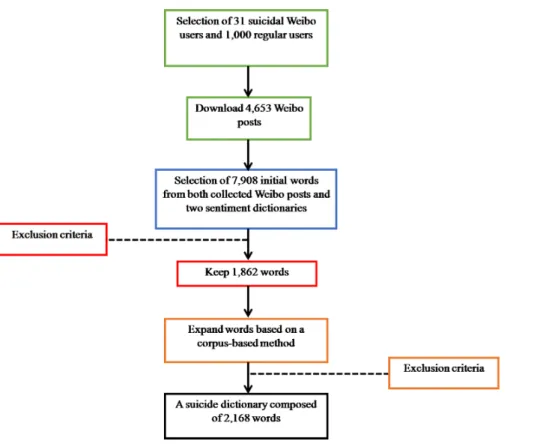
The Chinese suicide dictionary was built on Weibo using a four-step procedure: (1) Collecting Weibo posts; (2) Selecting initial words; (3) Filtering out irrelevant words; and (4) Expanding remaining words (seeFig. 1).
1.Collecting Weibo posts. To create a suicide dictionary, we need to find those Weibo users at risk of suicide and then examine the suicidal expression in their Weibo posts. To find out those Weibo users at risk of suicide, we contacted with Weibo user (逝者如斯夫dead), who is famous for collecting relevant news reports and expressing his condolence on the death of those suicidal Weibo users. He provided us with a list of suicidal Weibo users. We con-firmed the list by checking relevant news reports and looking through comments left on those suicidal Weibo accounts. Then, we conducted a further scrutiny of those confirmed users to exclude the following: (a) users who are not Chinese citizens (excluding one user); (b) users who update posts for business purposes (excluding two users); (c) users who updated less than 20 posts (excluding one user). Finally, we got a total of 31 suicidal Weibo users (12 males and 19 females) and downloaded their Weibo posts since registration.
Figure 1 Procedures in building the Chinese suicide dictionary.
from a customized Weibo database composed of 1.06 million active Weibo users (Li et al., 2014b). For each expanded user, we downloaded his/her three latest Weibo posts.
Finally, we acquired a total of 4,653 Weibo posts, including 1,653 Weibo posts from 31 suicidal users and 3,000 Weibo posts (1,000×3=3,000) from 1,000 expanded users.
2.Selecting initial words. Eight researchers (postgraduate students specializing in suicide research) were recruited to select Weibo posts with suicide risk using a framework of Rudd’s 12 warning signs for suicide risk (Rudd et al., 2006). After a training session, 50 in 4,653 Weibo posts were randomly selected and coded by eight coders independently with a good inter-coder reliability (α=0.819). Then, the eight researchers were divided equally into two groups. Each one group coded one half of all Weibo posts and selected Weibo posts with suicide risk. In addition, each group was also instructed to pick up any word indicating suicide risk from those selected Weibo posts. Both the selection of suicidal Weibo posts and suicidal words were confirmed with an agreement of at least three coders in one group.
Moreover, because people at risk of suicide express negative emotions frequently (Li et al., 2012;Pestian et al., 2012;Li et al., 2014a), the same eight researchers were further instructed to select suicidal words from two Chinese sentiment dictionaries, HowNet (www.keenage.com) and NTUSD (Ku & Chen, 2007), using the same method.
3.Filtering out irrelevant words. After collecting 7,908 initial words, we filtered out irrelevant words and categorized remaining words. To do so, another three researchers, who were also postgraduate students specializing in suicide research, were recruited to tune up the initial words. After a training session, they were instructed to filter out any word as follows: (a) words that change their meanings in different contexts (e.g., individuals suffering from discrimination might express their negative emotions using a word “unfair,” which can be recognized as a warning sign for suicide risk; while, the witness might express their sympathy using the same word, which cannot be recognized as a sign anymore); (b) words that are less sensitive to detect suicide risk; (c) words that appear in the customized Weibo database with a low frequency. If two of three coders agree to filter out one word, it would be eliminated. Upon a scrutiny of words, 1,862 words were kept in a preliminary suicide dictionary. Then, the same three researchers were further required to give weights to those remaining words, ranging from 1 (light) to 3 (heavy). Words with heavier weights are thought to be more sensitive to detect suicide risk. The weights of words were confirmed with an agreement of at least two coders. Among 1,862 words, 990 words were weighted as 1; 505 were weighted as 2; and 367 were weighted as 3.
After that, based on previous studies examining suicidal factors and suicidal themes (Phillips et al., 2002;Brezo, Paris & Turecki, 2006;World Health Organization, 2014;
Jashinsky et al., 2014), we analyzed 1,862 words inductively, and developed an initial framework for categorizing those words. Then, the same three experts provided feedback on the framework, and a final framework was constructed (seeTable 1). Using the framework, the three experts classified 1,862 words into 13 different categories with an agreement of at least two coders.
4.Expanding remaining words. Because of a frequent use of new words and phrases on social media, to improve the performance of a suicide dictionary in detecting innovative suicidal expression, we need to expand the suicide dictionary at all time. In this study, we developed a corpus-based method for expanding words automatically. Specifically, the suicide dictionary can be defined as a set of words (W)
W= {(w,c,x)}mi=1
wherewrefers to each word in the suicide dictionary with its category(c)and weight(x). For each word(w), we search a corpus(C)for similar words(Ww)based on semantic
similarity(F). The search process can be defined as
w+C−→F Ww.
The semantic similarity between different words is estimated by word2vec, an open-source tool for computing vector representations of words (http://code.google.com/ p/word2vec/). The performance of word2vec has been confirmed in previous studies (Mikolov et al., 2013).
Table 1 Outline of the Chinese suicide dictionary.
Category Number of words Definition Representative words
Suicide ideation 586 Words reflecting suicidal thoughts want to die (想死)
escape (逃离)
Suicide behavior 88 Words reflecting self-harm behaviors seppuku (切腹)
hypnotics (安眠药)
Psychache 403 Words reflecting psychological distress want to cry (想哭)
loneliness (孤单)
Mental illness 48 Words reflecting poor mental health status depression (抑郁)
hallucination (幻觉)
Hopeless 188 Words reflecting a feeling of despair dead end (死胡同)
despair (绝望)
Somatic complaints 183 Words reflecting somatic symptoms headache (头疼)
shortness of breath (透不过气)
Self-regulation 36 Words reflecting an attempt to push oneself hardly repression (压抑)
force oneself to smile
(强颜欢笑)
Personality 72 Words reflecting negative personality inferiority complex (自卑)
hate oneself (讨厌自己)
Stress 83 Words reflecting pressure in daily life failure (输)
pressure (压力)
Trauma/hurt 182 Words reflecting traumatic or unpleasant experiences get dumped (失恋)
infidelity (出轨)
Talk about others 47 Words reflecting one’s relatives and friends partner (妻子)
son (儿子)
Shame/guilt 72 Words reflecting a feeling of shame and guilt lose status (丢脸)
making an apology (赔罪)
Anger/hostility 180 Words reflecting a feeling of angry and hostile against others damn it (他妈的)
curse (诅咒)
Platform (LTP) (Che, Li & Liu, 2010) for word segmentation. Using the word2vec, we searched the corpus for similar words. In this study, for each word, we only selected its four most similar words, which share the same category and weight.
Further, the same three researchers were also instructed to filter out irrelevant expanded words using the same criteria as mentioned in the section of “Filtering out irrelevant words.” If two of three coders agree to filter out one word, it would be eliminated. Therefore, we got a total of 306 expanded words. Both the category and the weight of expanded words might be tuned up by these three researchers with an agreement of at least two coders.
Testing the Chinese suicide dictionary
After building the Chinese suicide dictionary, we tested its performance in identifying suicide risk on Weibo.
Participants
We broadcasted participant invitation on Weibo. A total of 1,196 Weibo users agreed to participate in this study. All participants were instructed to complete an online questionnaire and allow us to download their Weibo posts. From May 22th to July 13th in 2014, we received a total of 1,040 completed questionnaires. Among them, 252 participants were excluded based on the following criteria: (a) users who were less than 18 years old; (b) users who published less than 100 Weibo posts; (c) users who provided invalid answers on the online questionnaire; (d) users who had multiple user accounts (different accounts share the same IP address). Finally, a total of 788 participants were recognized as valid participants in this study (298 men, 490 women, and 24.23±4.912 years old).
Measurement
Expert ratingswere used as one of the two gold standards for evaluating the accuracy of the Chinese suicide dictionary in identifying suicide risk on social media.
Suicidal Possibility Scale (SPS)was used to measure individual levels of suicide risk (Cull & Gill, 1988), which can be recognized as another gold standard for evaluating the performance of the Chinese suicide dictionary. SPS is an effective screening tool designed to assess suicide risk in adolescents and adults (Genc¸¨oz, 2006;Naud & Daigle, 2010). SPS consists of 36 self-rating items. Participants rated themselves on each item by a 4-point Likert Scale (1=None or little of the time to 4=All of the time). We computed the Suicide Probability Score for each participant. High scores indicate high suicide risk. The Chinese version of SPS was used in this study (Liang & Yang, 2010). The Cronbach’s Alphas for the whole-questionnaire was 0.749 in our data. All 788 participants were divided into high risk and non-high (medium to low) risk group based on the distribution of SPS scores (69.35±11.66). In other words, participants from high risk group of SPS scored more than 81.01(69.35+11.66=81.01)and participants from non-high risk group of SPS scored less than 81.01.
Data analysis
We tested the performance of the Chinese suicide dictionary at the level of Weibo posts and Weibo users, respectively.
In terms of the analysis at the level of Weibo posts, we tested the performance in (a) detecting suicidal expression in Weibo posts, which can provide the basis for identifying individual suicide risk on social media.
(a) Detecting suicidal expression in Weibo posts. For testing the accuracy in detecting suicidal expression, we compared dictionary-based identifications with expert ratings (Bantum & Owen, 2009).
We randomly selected users from both high and non-high risk group of SPS. In this study, we selected 30 users from each one group and got a total of 60 users (20 men, 40 women, and 24.43±3.652 years old). The performance in detecting suicidal expression was tested on Weibo posts acquired from such 60 Weibo users. Repeated comparisons were made based on Weibo posts with different observation windows (i.e., 1 week, 1 month and 3 months before starting this study). The selection of observation windows depends on whether there are enough Weibo posts to be analyzed.
Specifically, for expert ratings, we recruited another three researchers specializing in suicide research for rating Weibo posts. All three coders were required to rate how each Weibo post relates to each one of the 13 categories defined in the Chinese suicide dictionary by a 7-point Likert-type scale (1=Extremely low consistency to 7=Extremely high consistency). For each Weibo post, the overall rating was acquired by aggregating ratings on each category. Then, the final expert ratings were the average ratings of all three coders. For dictionary-based identifications, both the overall frequency of all dictionary words and the frequency of particular words within each category were estimated by matching the words in each Weibo post automatically.
In psychological studies, to validate a new measuring tool, it needs to test correlations between the new tool and a popular tool measuring the same psychological feature, which is known as convergent validity. If the two measures that theoretically should be related are in fact related, the new tool should be assumed as a valid one. Because the expert-rating method is commonly used to detect suicide risk before (McCarthy, 2010), in this study, we run correlations between dictionary-based identifications and expert ratings.
(b) Evaluating levels of individual suicide risk. For testing the accuracy in evaluating levels of individual suicide risk, we compared dictionary-based identifications with expert ratings.
In this study, we tested the convergent validity by estimating correlations between both the two measures. The performance in evaluating levels of individual suicide risk was tested on the same 60 Weibo users as mentioned in the section (a) (30 users from high risk group of SPS and 30 users from non-high risk group of SPS).
Table 2 Comparison of the performance in detecting suicidal expression between dictionary-based identifications and expert ratings.
Observation window
Correlations between dictionary-based identifications and expert ratings
SI SB Psy MI H SC SR Pers S T/H TAO S/G A/H O
1 week .651** .750** .551** .459** .406** .913** .400** .047 .480** .043 .329* .901** .263* .507**
1 month .254* .146 .437** .032 .077 .637** .300* .291* .328* .027 .138 −0.007 .300* .188
3 months .289* .105 .485** −0.046 .182 .227 .124 −0.029 −0.014 −0.037 0.050 .436** .271* .063
Notes. N=60.
SI, Suicide ideation; SB, Suicide behavior; Psy, Psychache; MI, Mental illness; H, Hopeless; SC, Somatic complaints; SR, Self-regulation; Per, Personality; S, Stress; T/H, trauma/hurt; TAO, Talk about others; S/G, Shame/guilt; A/H, Anger/hostility; O, Overall estimation.
*p<0.05. **p<0.01.
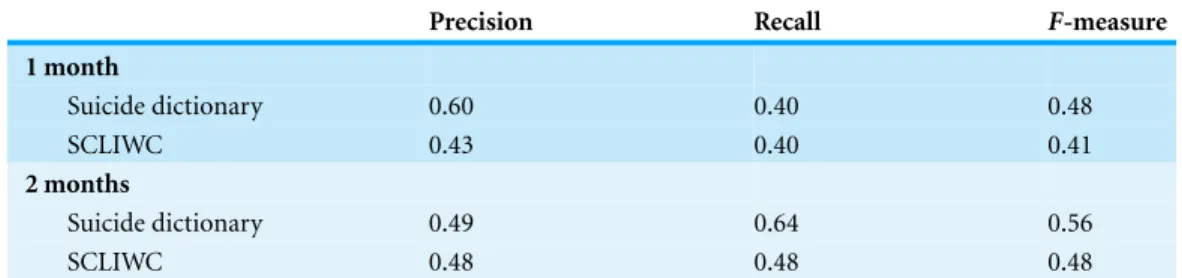
(c) Differentiating between individuals with high and non-high scores on SPS. For testing the accuracy in differentiating between individuals with high and non-high scores on SPS, we built Support Vector Machines (SVM) models (Cortes & Vapnik, 1995) on the Chinese suicide dictionary and the Simplified Chinese Linguistic Inquiry and Word Count (SCLIWC) program (Gao et al., 2013), respectively. The classification accuracy of the SCLIWC models can be recognized as the baseline.
Models were built on all 788 participants who completed SPS successfully, and evaluated on different observation windows (i.e., 1 month and 2 months before conducting SPS test). The selection of observation windows depends on whether there are enough Weibo posts to be analyzed. To build SVM models, we extracted a feature vector(X)from all Weibo posts of each user. Elements(X1,X2...Xn)in this feature vector represent the ratio of
words in different categories, which are defined by either the Chinese suicide dictionary or the SCLIWC. We compared the classification performance between two types of SVM models on different observation windows.
RESULTS
Detection of suicidal expression in Weibo posts
Table 2presents the test results. With a 1-week observation window, for the estimation of suicidal expression in 13 different categories, 11 of 13 correlation coefficients were significant between dictionary-based identifications and expert ratings, ranging from 0.263 to 0.913. The correlations on both of personality and trauma/hurt were not significant. For the overall estimation of suicidal expression, the correlation coefficient was 0.507 (p<0.01). These correlations decreased with an increase in length of observation window.
Evaluation of levels of individual suicide risk
Table 3 Predicting high vs. non-high risk group of SPS using the Chinese suicide dictionary and the SCLIWC.
Precision Recall F-measure
1 month
Suicide dictionary 0.60 0.40 0.48
SCLIWC 0.43 0.40 0.41
2 months
Suicide dictionary 0.49 0.64 0.56
SCLIWC 0.48 0.48 0.48
Notes. N=788.
Precision is the fraction of retrieved instances that are relevant. Recall is the fraction of relevant instances that are retrieved. F-Measure is the harmonic mean of precision and recall.
Differentiation between individuals with high and non-high scores on SPS
Table 3presents the test results. For the same observation window, the Chinese suicide dictionary (t1:F1=0.48; t2:F1=0.56) performs better than SCLIWC (t1:F1=0.41; t2:
F1=0.48).
DISCUSSION
This study built a Chinese suicide dictionary for identifying suicide risk on social media and tested its performance on Chinese social media (Sina Weibo). This study confirmed that a real-time monitoring of suicide risk in population can be realized through social media analysis.
Secondly, based on the accurate detection of suicidal expression in Weibo posts, the Chinese suicide dictionary can be used to evaluate levels of individual suicide risk. A moderate correlation existed between dictionary measures and expert ratings (r=0.455), suggesting an acceptable level of convergent validity.
Thirdly, apart from evaluating levels of individual suicide risk, the Chinese suicide dictionary also can be used to differentiate between individuals with high and non-high scores on self-rating measure of suicide risk. The Chinese suicide dictionary produces a more accurate estimation than the general-purpose dictionary for psycholinguistic analysis (e.g., SCLIWC). It means that building a dictionary for a particular purpose of identifying suicide risk on social media is worthwhile.
It is important to note the limitations of this study: (a) The sample size is a bit limited. We tested the performance in both detecting suicidal expression and evaluating levels of individual suicide risk on Weibo posts acquired from only 60 participants. Collecting and analyzing posts from a larger number of social media users might further validate the performance of the Chinese suicide dictionary; (b) The Chinese suicide dictionary was built and tested on Sina Weibo. We are not sure whether it will perform well on other Chinese social media platforms; (c) This study excluded low-frequency words in the Chinese suicide dictionary, which might also be sensitive to the variation of suicide risk; (d) The development of the suicide dictionary is based on a closed-vocabulary approach, which might limit findings to preconceived relationships with words or categories (Schwartz et al., 2013). Extracting a data-driven collection of words might further improve the performance in identifying suicide risk; (e) The Chinese suicide dictionary focuses on the frequency of words in a particular category and does not take contextual factors into account. Changes in elements of surrounding linguistic context may determine the relationship between individual psychological features and patterns of language use (Jarrold et al., 2011). Future works should not only focus on the frequency of words, but also examine vocabulary words in context; (f) In the Chinese suicide dictionary, the weights of words were assigned by experts. We are not sure whether the automated weight assignment techniques could improve the performance of the Chinese suicide dictionary; (g) The suicide dictionary is built for identifying suicide risk, which cannot predict the suicide action.
However, this study provides an innovative framework to prevent suicide in an effective manner. That is, through social media analysis, we can monitor individual suicide risk and capture those at high risk of suicide. After that, we can deliver intervention programs to those people immediately, which will be beneficial to improve the performance of suicide prevention.
CONCLUSION
real-time monitoring of suicide risk in population, thus improving the performance of suicide prevention and mental health promotion.
ADDITIONAL INFORMATION AND DECLARATIONS
Funding
The authors were supported by the National High-Tech R&D Program of China (2013AA01A606), the National Basic Research Program of China (2014CB744600), the Key Research Program of Chinese Academy of Sciences (CAS) (KJZD-EWL04), the CAS Strategic Priority Research Program (XDA06030800), and the Fundamental Research Funds for the Central Universities (NO. BLX2015-42). The funders had no role in study design, data collection and analysis, decision to publish, or preparation of the manuscript.
Grant Disclosures
The following grant information was disclosed by the authors: National High-Tech R&D Program of China: 2013AA01A606. National Basic Research Program of China: 2014CB744600.
Key Research Program of Chinese Academy of Sciences (CAS): KJZD-EWL04. CAS Strategic Priority Research Program: XDA06030800.
Fundamental Research Funds for the Central Universities: NO. BLX2015-42.
Competing Interests
The authors declare there are no competing interests.
Author Contributions
• Meizhen Lv conceived and designed the experiments, analyzed the data, contributed reagents/materials/analysis tools, wrote the paper, prepared figures and/or tables. • Ang Li conceived and designed the experiments, performed the experiments, wrote the
paper, prepared figures and/or tables, reviewed drafts of the paper.
• Tianli Liu conceived and designed the experiments, wrote the paper, reviewed drafts of the paper.
• Tingshao Zhu conceived and designed the experiments, performed the experiments, analyzed the data, contributed reagents/materials/analysis tools, wrote the paper, performed the computation work, reviewed drafts of the paper.
Human Ethics
The following information was supplied relating to ethical approvals (i.e., approving body and any reference numbers):
The Institutional Review Board of the Institute of Psychology, Chinese Academy of Sciences (the protocol number: H09036 and H15009).
Data Availability
Supplemental Information
Supplemental information for this article can be found online athttp://dx.doi.org/ 10.7717/peerj.1455#supplemental-information.
REFERENCES
Bantum EO, Owen JE. 2009.Evaluating the validity of computerized content analysis programs for identification of emotional expression in cancer narratives.Psychological Assessment21:79–88 DOI 10.1037/a0014643.
Brezo J, Paris J, Turecki G. 2006.Personality traits as correlates of suicidal ideation, suicide attempts, and suicide completions: a systematic review.Acta Psychiatrica Scandinavica 113:180–206DOI 10.1111/j.1600-0447.2005.00702.x.
Brown GK, Beck AT, Steer RA, Grisham JR. 2000.Risk factors for suicide in psychiatric outpatients: a 20-year prospective study.Journal of Consulting and Clinical Psychology 68:371–377DOI 10.1037/0022-006X.68.3.371.
Che W, Li Z, Liu T. 2010.LTP: a Chinese language technology platform. In:COLING ’10 proceedings of the 23rd international conference on computational linguistics: demonstrations. Beijing.
China Internet Network Information Center. 2014.The statistical report on Internet development in China.Available athttp://www1.cnnic.cn/IDR/ReportDownloads/(accessed 31 July 2015).
Cortes C, Vapnik V. 1995. Support-vector networks. Machine Learning 20:273–297 DOI 10.1007/BF00994018.
Cull JG, Gill WS. 1988.Suicide Probability Scale (SPS) manual. Los Angeles: Western Psychological Services.
Gao R, Hao B, Li H, Gao Y, Zhu T. 2013. Developing simplified Chinese psychological linguistic analysis dictionary for microblog.Lecture Notes in Computer Science8211:359–368 DOI 10.1007/978-3-319-02753-1 36.
Genc¸¨oz TOP. 2006.Associated factors of suicide among university students: importance of family environment.Contemporary Family Therapy28:261–268DOI 10.1007/s10591-006-9003-1. Holmes D, Alpers GW, Ismailji T, Classen C, Wales T, Cheasty V, Miller A, Koopman C. 2007.
Cognitive and emotional processing in narratives of women abused by intimate partners. Violence Against Women13:1192–1205DOI 10.1177/1077801207307801.
Huang X, Zhang L, Liu T, Chiu D, Zhu T, Li X. 2014.Detecting suicidal ideation in Chinese microblogs with psychological lexicons. ArXiv preprint.arXiv:1411.0778.
Jarrold W, Javitz HS, Krasnow R, Peintner B, Yeh E, Swan GE. 2011.Depression and self-focused language in structured interviews with older men. Psychological Reports109:686–700
DOI 10.2466/02.09.21.28.PR0.109.5.686-700.
Jashinsky J, Burton SH, Hanson CL, West J, Giraud-Carrier C, Barnes MD, Argyle T. 2014. Tracking suicide risk factors through Twitter in the US.Crisis: The Journal of Crisis Intervention and Suicide Prevention35:51–59DOI 10.1027/0227-5910/a000234.
Li TM, Chau M, Wong PW, Yip PS. 2012.A hybrid system for online detection of emotional distress. In: Chau M, Wang GA, Yue WT, Chen H, eds.Intelligence and security informatics. Berlin: Springer Verlag, 73–80.
Li TM, Chau M, Yip PS, Wong PW. 2014a.Temporal and computerized psycholinguistic analysis of the blog of a Chinese adolescent suicide.Crisis: The Journal of Crisis Intervention and Suicide Prevention35:168–175DOI 10.1027/0227-5910/a000248.
Li L, Li A, Hao B, Guan Z, Zhu T. 2014b.Predicting active users’ personality based on micro-blogging behaviors.PLoS ONE9:e84997DOI 10.1371/journal.pone.0084997. Liang Y, Yang L. 2010.Study on reliability and validity of the Suicide Probability Scale.China
Journal of Psychology18:225–227.
McCarthy MJ. 2010.Internet monitoring of suicide risk in the population.Journal of Affective Disorders122:277–279DOI 10.1016/j.jad.2009.08.015.
Mikolov T, Chen K, Corrado G, Dean J. 2013.Efficient estimation of word representations in vector space. ArXiv preprint.arXiv:1301.3781.
Murano G. 2014.8 shocking suicide attempts posted on the Internet.Available athttp://www. oddee.com/item 98907.aspx(accessed 8 July 2015).
Naud H, Daigle MS. 2010. Predictive validity of the Suicide Probability Scale in a male inmate population.Journal of Psychopathology and Behavioral Assessment 32:333–342 DOI 10.1007/s10862-009-9159-8.
O’Dea B, Wan S, Batterham PJ, Calear AL, Paris C, Christensen H. 2015.Detecting suicidality on Twitter.Internet Interventions2:183–188DOI 10.1016/j.invent.2015.03.005.
Park M, Cha C, Cha M. 2012.Depressive moods of users portrayed in Twitter. In:ACM SIGKDD workshop on healthcare informatics, HI-KDD 2012. Beijing.
Paul MJ, Dredze M. 2014.Discovering health topics in social media using topic models.PLoS ONE 9:e103408DOI 10.1371/journal.pone.0103408.
Pennebaker JW, Chung CK, Ireland M, Gonzales A, Booth RJ. 2007.The development and psychometric properties of LIWC2007.Available athttp://homepage.psy.utexas.edu/HomePage/ faculty/Pennebaker/reprints/LIWC2007 LanguageManual.pdf(accessed 31 July 2015).
Pestian JP, Matykiewicz P, Linn-Gust M, South B, Uzuner O, Wiebe J, Cohen KB, Hurdle J, Brew C. 2012.Sentiment analysis of suicide notes: a shared task.Biomedical Informatics Insights 5:3–16DOI 10.4137/BII.S9042.
Phillips MR, Yang G, Zhang Y, Wang L, Ji H, Zhou M. 2002.Risk factors for suicide in China: a national case-control psychological autopsy study.The Lancet 360:1728–1736 DOI 10.1016/S0140-6736(02)11681-3.
Posner K, Brown GK, Stanley B, Brent DA, Yershova KV, Oquendo MA, Currier GW, Melvin GA, Greenhill L, Shen S, Mann JJ. 2011. The Columbia–Suicide Severity Rating Scale: initial validity and internal consistency findings from three multisite studies with adolescents and adults.The American Journal of Psychiatry168:1266–1277 DOI 10.1176/appi.ajp.2011.10111704.
Prieto VM, Matos S, ´Alvarez M, Cacheda F, Oliveira JL. 2014.Twitter: a good place to detect health conditions.PLoS ONE9:e86191DOI 10.1371/journal.pone.0086191.
Qiu L, Lin H, Ramsay J, Yang F. 2012.You are what you tweet: personality expression and percep-tion on Twitter.Journal of Research in Personality46:710–718DOI 10.1016/j.jrp.2012.08.008. Rogers JM, Lewis MM, Subich LM. 2002.Validity of the Suicide Assessment Checklist
Roˇskar R, Podlesek A, Kuzmani´c M, Demˇsar LO, Zaletel M, Maruˇsiˇc A. 2011.Suicide risk and its relationship to change in marital status.Crisis: The Journal of Crisis Intervention and Suicide Prevention32:24–30DOI 10.1027/0227-5910/a000054.
Rudd MD, Berman AL, Joiner TE, Nock MK, Silverman MM, Mandrusiak M, Van Orden K, Witte T. 2006.Warning signs for suicide: theory, research, and clinical applications.Suicide and Life-Threatening Behavior36:255–262DOI 10.1521/suli.2006.36.3.255.
Rude SS, Gortner EM, Pennebaker JW. 2004. Language use of depressed and depressive-vulnerable college students. Cognition and Emotion 18:1121–1133 DOI 10.1080/02699930441000030.
Schwartz HA, Eichstaedt JC, Kern ML, Dziurzynski L, Ramones SM, Agrawal M, Shah A, Kosinski M, Stillwell D, Seligman MEP, Ungar LH. 2013.Personality, gender, and age in the language of social media: the open-vocabulary approach.PLoS ONE 8:e73791 DOI 10.1371/journal.pone.0073791.
Sueki H. 2015.The association of suicide-related Twitter use with suicidal behaviour: a
cross-sectional study of young internet users in Japan.Journal of Affective Disorders170:155–160 DOI 10.1016/j.jad.2014.08.047.