http://dx.doi.org/10.1590/bjpt-rbf.2014.0086
186 Braz J Phys Ther. 2015 May-June; 19(3):186-193
Is there a relationship between complaints of
impaired balance and postural control disorder in
community‑dwelling elderly women? A cross‑sectional
study with the use of posturography
Erika H. Tanaka1, Paulo F. Santos1, Júlia G. Reis1, Natalia C. Rodrigues1, Renato Moraes2, Daniela C. C. Abreu1
ABSTRACT | Background: Risk of falls increases as age advances. Complaints of impaired balance are very common in the elderly age group. Objectives: The objective of this study was to investigate whether the subjective perception
of impaired balance was associated with deicits in postural control (objective analysis) in elderly community-dwelling
women. Method: Static posturography was used in two groups: elderly women with (WC group) and without (NC group) complaints of impaired balance. The area, mean sway amplitude and mean speed of the center of pressure (COP) in the anterior-posterior (AP) and medial-lateral (ML) directions were analyzed in three stances: single-leg stance, double-leg stance and tandem stance, with eyes open or closed on two different surfaces: stable (irm) and unstable (foam). A digital chronometer was activated to measure the time limit (Tlimit) in the single-leg stance. Kruskal-Wallis tests followed by Mann-Whitney tests, Friedman analyses followed by post hoc Wilcoxon tests and Bonferroni corrections, and Spearman statistical tests were used in the data analysis. Differences of p<0.05 were considered statistically signiicant. Results: The
results of posturography variables revealed no differences between groups. The timed single-leg stance test revealed a shorter Tlimit in the left single-leg stance (p=0.01) in WC group compared to NC group. A negative correlation between
posturography variables and Tlimit was detected. Conclusions: Posturography did not show any differences between the groups; however, the timed single-leg stance allowed the authors to observe differences in postural control performance
between elderly women with and those without complaints of impaired balance.
Keywords: falls; postural balance; elderly; posture; physical therapy specialty.
Registration number of clinical trials: Rebec RBR-3s9m65.
HOW TO CITE THIS ARTICLE
Tanaka EH, Santos PF, Reis JG, Rodrigues NC, Moraes R, Abreu DCC. Is there a relationship between complaints of impaired balance and postural control disorder in community-dwelling elderly women? A cross-sectional study with the use of posturography. Braz J Phys Ther. 2015 May-June; 19(3):186-193. http://dx.doi.org/10.1590/bjpt-rbf.2014.0086
1Curso de Fisioterapia, Departamento de Biomecânica, Medicina e Reabilitação do Aparelho Locomotor, Faculdade de Medicina de Ribeirão Preto,
Universidade de São Paulo (USP), Ribeirão Preto, SP, Brazil
2Núcleo de Apoio à Pesquisa em Doenças Crônico-Degenerativas, Escola de Educação Física e Esporte de Ribeirão Preto, Universidade de São Paulo
(USP), Ribeirão Preto, SP, Brazil
Received: May 11, 2014 Revised: Aug. 07, 2014 Accepted: Nov. 18, 2014
Introduction
The risk of falls increases with age1 and it has been predicted that one-third of the community-dwelling elderly will fall over the course of one year2. After the irst fall, elderly individuals become vulnerable to subsequent falls3. Thus, preventing the irst fall
seems to be essential if one is hoping to minimize the possibility of subsequent falls.
In addition, the prevention of falls is a potential means of preventing post-fall consequences, such as hospitalization, loss or reduction of independence, psychological complications (such as fear of falling,
post-fall syndrome)4,5. Both elderly fallers and non-fallers
experience the fear of falling and have complaints of imbalance, which may cause the elderly to restrict their daily life activities (DLA)6.
187 Braz J Phys Ther. 2015 May-June; 19(3):186-193 studies have used the self-report of imbalance as an
evaluation tool7,8, although these studies evaluated individuals with dizziness-associated symptoms. Lion et al.8 reported a strong correlation between self-reported imbalance and clinical tests such as the Timed Up and Go (TUG), single-leg stance and a 10-m walk. Baloh et al.7 demonstrated that patients who self-reported imbalance and dizziness had increased body sway velocity.
However, there is a need to assess whether there is an association between self-reported imbalance and postural control in independent community-dwelling elderly, using different support bases and visual conditions, and with increased task demand to increase the sensitivity of the assessment9,10. The aim was to identify subtle deicits in postural control10 because
the performance of postural control is the result of the complex integration and coordination of multiple systems11 dependent on the central processing of inputs
of the afferent visual, vestibular and somatosensory systems and of the neuromuscular action of efferent mechanisms12. The perception of imbalance may be associated with an initial decline of some component(s) of the postural control system.
Therefore, the objective of this study was to investigate whether the subjective perception of imbalance was consistent with postural control deicits in community-dwelling elderly women. The study hypothesis was that elderly women who report complaints of imbalance had greater body sway visualized using a force platform (objective analysis) and shorter stays in single-leg stance (clinical trial) than elderly women who do not report complaints of imbalance, assuming imbalance indicates poor posture control.
Method
Forty-four elderly women over the age of 60 years were recruited from the local community from 2011 to 2013 to voluntarily participate in this study. This cross-sectional study was approved by the Human Research Ethics Committee of the Faculdade de Medicina de Ribeirão Preto, Universidade de São Paulo (FMRP-USP), Ribeirão Preto, São Paulo, Brazil,
protocol number 5372/2010. All volunteers signed an informed consent before participating in the study.
The elderly women were divided into two groups: 17 with (WC) and 27 with no (NC) complaints of imbalance. Participants were excluded if they had cardiovascular, neurological or musculoskeletal diseases that could interfere with their semi-static or dynamic balance or if they presented with vestibular
disorders, peripheral neuropathies or cognitive deicits as indicated by scores less than 24 points on the Mini-Mental State Examination13.
The evaluations were performed at the Evaluation and Rehabilitation of Balance Laboratory (Laboratório de Avaliação e Reabilitação do Equilíbrio – LARE), Department of Biomechanics, Medicine and Rehabilitation of the Locomotor System, FMRP-USP. First, the body weight and height were measured for each elderly individual. For the measurement of semi-static balance, a force platform was used during quiet standing posture. For the subjective evaluation of complaints of imbalance, a qualitative questionnaire was used with the following question: “Do you have any imbalance complaints?” The participants had the option to answer “Yes” or “No”.
Balance in semi-static stance was measured using the force platform (EMG System do Brasil) with an
acquisition frequency of 100 Hz and center of pressure (COP) data iltered with a low-pass 4th-order Butterworth digital ilter with a cutoff frequency of 10 Hz.
Data on 8 stances were collected for each subject: standing on a ixed platform with eyes open (FPEO) and closed (FPEC); standing on an unstable platform (5-cm-thick foam with a density of 30 g/dm3) with
eyes open (UPEO) and closed (UPEC)14; in tandem
stance with the right foot in front of the left foot and eyes open (TANDEM EO) and closed (TANDEM EC); and in single-leg stance with eyes open on the right leg (SINGLE R), and standing on the left leg (SINGLE L). The order of evaluation of each stance was randomized, and two attempts were made for each stance, for a total of 16 data collection points for each participant. The bipedal stances were maintained for 60 seconds, the tandem while the single-leg stances were maintained for 30 seconds each. The rest time was approximately 30 seconds between each of the 16 tests.
The number and time of each test were chosen to avoid fatigue in the elderly while maintaining data reliability15. The maximum time in single-leg
stance, prior to the elderly abandoning the stance or losing their balance by touching the platform with the contralateral foot or touching the therapist with their hands (the therapist remained close to the elderly during all tests for safety reasons to avoid any accidents/falls), was timed using the digital stopwatch function in a Nokia X2-01 cellular phone (Manaus, Brazil).
The participants were instructed to stay as still as possible. In the stances with eyes open, the volunteers were instructed to look at a black circle 5 cm in diameter, which was placed in front of the volunteer at a distance of 1.5 m at eye level16. Those individuals
188 Braz J Phys Ther. 2015 May-June; 19(3):186-193
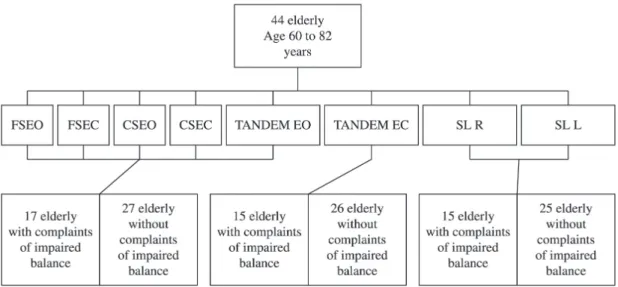
Participants who failed to maintain the stance for the predetermined time had the stance removed from the statistical analysis. In the single-leg stance analysis, because some elderly individuals could not remain in the stance for the stipulated time of data collection (i.e. 30 seconds), only those who managed to stay in the single-leg stance for at least 5 seconds (i.e. maximum time that the majority of elderly managed to stay in the single-leg stance) were included. The performance of the tandem stance with eyes closed was achieved by 15 elderly in the WC group and 26 elderly in the NC group. In the single-leg stance, two elderly from each group failed to perform the test, and the analysis was conducted with 15 and 25 elderly in each group, respectively (Figure 1).
The force platform enabled the examiners to infer the distribution of force at four points, allowing for the analysis of balance, with quantiications of the amplitude and mean velocity of anterior-posterior (AP) and medial-lateral (ML) displacements of the COP and the total displacement area of the COP. The mean amplitude of sway, which corresponded to the variability around the mean of a time series and was used to estimate the stability of the COP17,18, was
calculated by subtracting the mean of the values within the attempt, and then calculating the mean variance of the values of this attempt. The mean velocity was determined by dividing the total displacement of the COP (i.e. the sum of the scale displacement) in each direction for the total time of the attempt19. The area was calculated using the area of the ellipse method, which corresponded to the dispersion of the COP data according to the calculation of the area of the statokinesigram15. During data collection, the
participants stayed on the force platform, barefoot with feet apart at shoulder width and arms along the sides of the body (in double-leg stance) or with one foot in front of the other (in tandem stance) or supported by one foot only (in single-leg stance).
SPSS software (version 18.0 Windows, Inc., Chicago, IL) was used for the statistical analysis. The Shapiro-Wilk test was used to verify the normality of the data, and logarithmic transformation was employed to conirm the non-normal distribution of data related to variables evaluated on the force platform. To compare the anthropometric characteristics between the groups, the Student’s t test was used. To compare the various stances and conditions with each other, the Friedman analysis was used, followed by a post-hoc Wilcoxon test with Bonferroni correction. For analysis of length of stay in the single-leg stance and to compare the various conditions of posturography between groups, the Kruskal-Wallis test was used, followed by a post-hoc Mann-Whitney test with Bonferroni correction. The Spearman correlation test was used to correlate the length of stay in the single-leg stance (right and left legs) and the variables of posturography. The level of signiicance adopted was 5%.
Results
The variables of age, weight, height and body mass index (BMI) (Table 1) of the WC and NC of imbalance groups were compared to test the homogeneity between groups. The Student’s t test indicated that there were no differences in these variables (p>0.05).
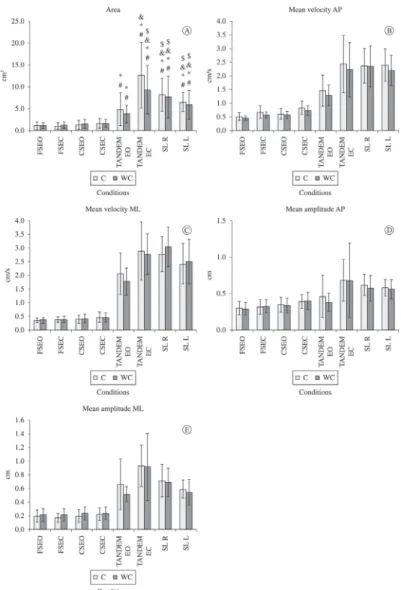
Figure 2A shows the values of the COP area under the eight different situations evaluated, with the WC
Figure 1. Flowchart of the experimental design with the total sample. FSEO: irm surface, eyes open; FSEC, irm surface, eyes closed;
189 Braz J Phys Ther. 2015 May-June; 19(3):186-193 and NC groups showing signiicant increases in the
COP area when comparing the different stances to each other, revealing differences in sway depending
on the stance adopted. Figure 2B shows the values of the mean COP velocity in the AP direction under the different situations evaluated. Figure 2C shows the
Table 1. Values for anthropometric data (age, height, weight and body mass index [BMI]) for 2 elderly groups with and without
complaints of imbalance.
Groups Age
(years)
Height (m)
Body Mass (kg)
BMI (kg/m2)
With complaints of impaired balance 67.18±5.31 1.58±0.07 71.75±11.21 28.66±4.03 Without complaints of impaired balance 65.41±3.53 1.55±0.05 65.81±9.51 27.41±3.38
BMI=body mass index; p<0.05 with complaints of imbalance vs without complaints of imbalance.
Figure 2. Means and standard deviations of posturography variables (i.e. area, mean velocity anterior-posterior, mean velocity
190 Braz J Phys Ther. 2015 May-June; 19(3):186-193
values of the mean COP velocity in the ML direction. Figure 2D shows the mean AP amplitude values. Figure 2E shows the mean ML amplitude values.
For the analysis of time limit (Tlimit) in the single-leg stance, only the SINGLE L stance differed signiicantly between the WC and NC groups (p=0.01), considering a 0.025 signiicance level, according to the Bonferroni corrections (Table 2).
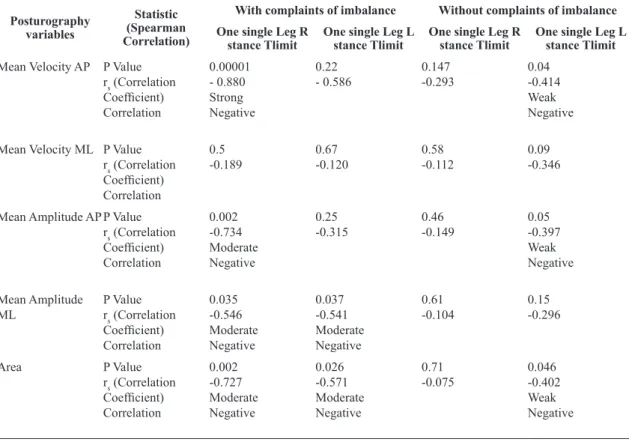
The correlations between the length of stay in single-leg stance and the various variables analyzed by posturography are described in Table 3. This test indicated a negative correlation between the length of stay in single-leg stance and the observed variables (Table 3).
Discussion
Postural control is considered good when the body sway is small20. However, the dificulty of the task is
an important factor when assessing postural control in the elderly10 and the various conditions imposed, as these different tasks and their dificulty may suggest a greater reliance on one afferent system over another21.
In healthy elderly individuals with a stable base of support and in good lighting conditions, the proportion of reliance of the information travelling from the afferent sensory systems to the central nervous system (CNS) are 10% for the visual system, 70% for the somatosensory system and 20% for the vestibular system21. However, the contribution of each sensory system is related to both the environmental conditions and the task21. The hypothesis of reweighing or altering the percentage involvement of the different sensory systems is based on the capacity of the CNS to adapt to different conditions by adjusting the weight of information of each sensory system that controls balance. When a sensory system becomes inaccurate
Table 2. Time limits (Tlimit) in right and left single-leg stances for 2 elderly groups with and without complaints of imbalance.
Tlimit (seconds) With complaints of impaired balance Without complaints of impaired balance p value
Single-Leg Stance (Right) 19.42±9.89 25.53±6.23 0.087
Single-Leg Stance (Left) 19.43±9.34 26.74±5.03 0.013*
*p<0.025 according to the Bonferroni correction.
Table 3. Correlation between Tlimit of one single-leg stance and posturography variables (mean velocity AP and ML, mean amplitude
AP and ML and area) between 2 elderly groups with and without complaints of imbalance.
Posturography variables
Statistic (Spearman Correlation)
With complaints of imbalance Without complaints of imbalance
One single Leg R stance Tlimit
One single Leg L stance Tlimit
One single Leg R stance Tlimit
One single Leg L stance Tlimit
Mean Velocity AP P Value rs (Correlation
Coeficient) Correlation
0.00001 - 0.880 Strong Negative
0.22
- 0.586 0.147-0.293 0.04-0.414 Weak Negative
Mean Velocity ML P Value rs (Correlation Coeficient) Correlation
0.5
-0.189 0.67-0.120 0.58-0.112 0.09-0.346
Mean Amplitude APP Value rs (Correlation Coeficient) Correlation
0.002 -0.734 Moderate Negative
0.25
-0.315 0.46-0.149 0.05-0.397 Weak Negative
Mean Amplitude
ML P Valuers (Correlation Coeficient) Correlation
0.035 -0.546 Moderate Negative
0.037 -0.541 Moderate Negative
0.61
-0.104 0.15-0.296
Area P Value
rs (Correlation Coeficient) Correlation
0.002 -0.727 Moderate Negative
0.026 -0.571 Moderate Negative
0.71
191 Braz J Phys Ther. 2015 May-June; 19(3):186-193 or begins to fail, the CNS reduces the weight of or
reliance on that system and relies more on others21,22. When examining the various conditions and stances (i.e. when doing intragroup analysis), it was observed that in double-leg stance, the elderly had smaller sway of the COP compared to the tandem and single-leg stances, which had smaller support bases, and consequently, greater dificulty imposed by the task, a result that was expected due to the functional/compensatory adaptations of posture described by Strang et al.20. However, no differences were observed between the double-leg stances with and without foam or with eyes open or closed, most likely because they were less challenging stances for the study sample of young, independent, community-dwelling elderly.
There were no differences when comparing the groups of elderly WC and NC in terms of imbalance (i.e. using intergroup analysis). This inding could be due to the heterogeneity of the aging process. It is important to note that the aging process causes deicits in postural control; however, these changes do not occur in a linear fashion23. Thus, complaints of imbalance may be associated with the existence of initial impairments of different components of the postural system. In the present study, the focus was placed on sensory strategies.
In the literature, lateral instability, relected by a higher mean ML amplitude, has been associated with future falls24, and elderly female fallers have higher ML sway in relation to non-fallers25. In regard
to AP sway, AP displacement of the COP was more signiicant in fallers than in non-fallers, especially in the forward direction25. The lack of difference between the elderly WC and NC groups in terms of imbalance could also be explained by the absence of fallers in the study sample.
Although the single-leg stance is one of the most challenging stances, the variables related to posturography revealed no differences between the groups. However, the length of time maintaining this stance was sensitive enough to predict the decreased postural control that the WC group had for imbalance.
According to the literature, the time one is able to maintain a single-leg stance is sensitive for predicting both poor postural control and injurious falls26, has good inter-rater reliability (intraclass correlation coeficient [ICC] =0.75 in elderly without impairments) and intra-rater reliability (ICC=0.73)11, and is an indicator
of falls in the elderly over 70 years of age when the length of time in the stance is less than 30 seconds27.
In a study comparing fallers and non-fallers over
the age of 50 performing the single-leg stance for 45 seconds, it was observed that fallers had a shorter length of time in the stance (mean of 9.6 seconds) compared to non-fallers (mean of 31.3 seconds)28.
Lion et al.8 compared elderly women with and without complaints of dizziness and also observed poor performance in elderly individuals with dizziness in the 5-second single-leg clinical trial and other functional tests. As can be seen, the time set for the single-leg stance test can affect the interpretation of the results.
The results showed that only the time spent in the SINGLE L stance was sensitive for identifying deicits between the WC and NC groups for imbalance. Bohannon et al.29 reported that there was no difference
between the length of time in the right or left single-leg stance. Any difference might be indicative of abnormalities in either leg or in some proximal component of postural control of the leg with the deicit29. Vieira et al.30 reported that the SINGLE Right
stance was more stable than the SINGLE Left stance. This difference might be explained by the fact that the left prefrontal cortex could be more signiicant in postural corrections induced by intrinsic body sway30. Cortical and subcortical structures control the right side of the body in right-handed individuals regulating the low-magnitude feedback of the sensorimotor integration of different sensory sources30. Our results suggest that in the SINGLE Left stance, this control of low-magnitude adjustments was not performed with the same effectiveness or in the same way as in the SINGLE Right stance, which would allow for greater sensitivity in the single-leg LEFT stance when taking into account the subtle deicits in postural control.
When analyzing the correlation between the posturography variables and the length of time in single-leg stance, a strong to moderate negative correlation (-0.54 to -0.8) was observed for the group with complaints of imbalance and a weak negative correlation (-0.21 to -0.41) for the group without complaints of imbalance. This result was expected because the time variable was inversely proportional to the measurements of the posturographic variables. The greater the length of time in the position, the lower the values of the AP and ML amplitudes, mean velocities and the COP area, which would indicate better postural control.
192 Braz J Phys Ther. 2015 May-June; 19(3):186-193
clinical test for the single-leg stance could be used to evaluate postural control because the single-leg stance is already used in clinical practice and offers greater reliability according to the length of time in the stance28. The existence of imbalance complaints could be considered as indicative of subtle deicits in postural control and could be used to establish functional diagnostic and therapeutic targets for elderly individuals.
Based on this result, it could be inferred that, in clinical practice, elderly women with complaints of imbalance might not have postural control deicits detectable by means of objective tests, such as the posturography. However, they already show deicits in clinical tests, such as the length of time in a single-leg stance test. Thus, when observing signs of early deicits in postural control, preventive measures should be taken to avoid the irst fall because, after the irst fall, it has been reported that elderly individuals becomes more susceptible to additional fall episodes3.
Future longitudinal studies should be performed to assess whether elderly complaints of imbalance are related to poor postural control in the short- to medium-term.
Study limitations
This study has some limitations, including the following: 1) the results cannot be generalized to fragile or institutionalized elderly because the study was conducted with healthy, young-old, from the community; 2) the results cannot be extrapolated to men or all elderly in general because the study included only women; and 3) although the single-leg stance test appeared to be a clinical test that was sensitive enough to detect deicits in postural control, it was not used as a form of group division comparing the length of time in this stance.
Conclusion
The study showed no difference in the COP sway between elderly women with or without complaints of imbalance. The subjective analysis of the complaint of imbalance was not related to the objective analysis (posturography); however, the single-leg stance clinical test appeared to be sensitive enough to identify subtle deicits in postural control. Self-reported imbalance is a simple questioning tool likely to detect impairments in postural control; however, it should be used together with clinical tests because
the aging process is heterogeneous. The single-leg stance clinical test indicated that elderly women with complaints of imbalance have shorter lengths of time in the stance position compared to elderly women with no complaints of imbalance, suggesting poor postural control.
Acknowledgements
The authors thank the Fundação de Amparo à Pesquisa do Estado de São Paulo (FAPESP - 2012/05666-4) for
their inancial support; the Evaluation and Rehabilitation of Balance Laboratory (Laboratório de Avaliação e Reabilitação do Equilíbrio – LARE); the Department of Biomechanics, Medicine and Rehabilitation of the Locomotor System at the FMRP-USP; the Ribeirão Preto Medical School, University of São Paulo; the volunteers who participated in this study; Marcela Fernandes Silva for her commitment and dedication to this study and Matheus Machado Gomes for the knowledge shared.
References
1. Nicolussi AC, Fhon JR, Santos CA, Kusumota L, Marques S, Rodrigues RA. Quality of life in elderly people that have suffered falls: integrative literature review. Cien Saude Colet. 2012;17(3):723-30. http://dx.doi.org/10.1590/ S1413-81232012000300019. PMid:22450414
2. Gama ZAS, Gómez-Conesca A. Factores de riesgo de caídas en ancianos: revisión sistemática. Rev Saúde Pública. 2008;42(5):946-56.
3. Perracini MR, Ramos LR. Fall-related factors in a cohort of elderly community residents. Rev Saude Publica. 2002;36(6):709-16. http://dx.doi.org/10.1590/S0034-89102002000700008. PMid:12488937
4. Jenkyn KB, Hoch JS, Speechley M. How much are we willing to pay to prevent a fall? Cost-effectiveness of a multifactorial falls prevention program for community-dwelling older adults. Can J Aging. 2012;31(2):121-37. http:// dx.doi.org/10.1017/S0714980812000074. PMid:22621837 5. Maia BC, Viana PS, Arantes PMM, Alencar MA. Consequences
of falls in older people living in the community. Rev Bras Geriatr Gerontol. 2011;14(2):381-93. http://dx.doi.org/10.1590/ S1809-98232011000200017.
6. Lopes KT, Costa DF, Santos LF, Castro DP, Bastone AC. Prevalence of fear of falling among a population of older adults and its correlation with mobility, dynamic balance, risk and history of falls. Rev Bras Fisioter. 2009;13(3):223-9. http://dx.doi.org/10.1590/S1413-35552009005000026. 7. Baloh RW, Jacobson KM, Enrietto JA, Corona S, Honrubia
193 Braz J Phys Ther. 2015 May-June; 19(3):186-193 8. Lion A, Spada RS, Bosser G, Gauchard GC, Anello G, Bosco
P, et al. Biological determinants of postural disorders in elderly women. Int J Neurosci. 2013;123(1):24-30. http:// dx.doi.org/10.3109/00207454.2012.722570. PMid:22909193 9. Singh NB, Taylor WR, Madigan ML, Nussbaum MA. The
spectral content of postural sway during quiet stance: influences of age, vision and somatosensory inputs. J Electromyogr Kinesiol. 2012;22(1):131-6. http://dx.doi. org/10.1016/j.jelekin.2011.10.007. PMid:22100720 10. Prioli AC, Cardozo AS, Freitas Júnior PB, Barela JA. Task
demand effects on postural control in older adults. Hum Mov Sci. 2006;25(3):435-46. http://dx.doi.org/10.1016/j. humov.2006.03.003. PMid:16647771
11. Mancini M, Horak FB. The relevance of clinical balance assessment tools to differentiate balance deficits. Eur J Phys Rehabil Med. 2010;46(2):239-48. PMid:20485226. 12. Günendi Z, Taskiran ÖÖ, Uzun MK, Öztürk GT, Demirsoy
N. Reliability of quantitative static and dynamic balance tests on kinesthetic ability trainer and their correlation with other clinical balance tests. J PMR Sci. 2010;13:1-5. 13. Folstein MF, Folstein SE, McHugh PR. “Mini-mental state”.
A practical method for grading the cognitive state of patients for the clinician. J Psychiatr Res. 1975;12(3):189-98. http:// dx.doi.org/10.1016/0022-3956(75)90026-6. PMid:1202204 14. Guerraz M, Shallo-Hoffmann J, Yarrow K, Thilo KV, Bronstein
AM, Gresty MA. Visual control of postural orientation and equilibrium in congenital nystagmus. Invest Ophthalmol Vis Sci. 2000;41(12):3798-804. PMid:11053279.
15. Duarte M, Freitas SM. Revision of posturography based on force plate for balance evaluation. Rev Bras Fisioter. 2010;14(3):183-92. http://dx.doi.org/10.1590/S1413-35552010000300003. PMid:20730361
16. Paulus WM, Straube A, Brandt T. Visual stabilization of posture. Physiological stimulus characteristics and clinical aspects. Brain. 1984;107(Pt 4):1143-63. http://dx.doi. org/10.1093/brain/107.4.1143. PMid:6509312
17. Bonfim TR, Grossi DB, Paccola CA, Barela JA. Additional sensory information reduces body sway of individuals with anterior cruciate ligament injury. Neurosci Lett. 2008;441(3):257-60. http://dx.doi.org/10.1016/j.neulet.2008.06.039. PMid:18582536 18. Dutil M, Handrigan GA, Corbeil P, Cantin V, Simoneau
M, Teasdale N, et al. The impact of obesity on balance control in community-dwelling older women. Age (Dordr). 2013;35(3):883-90. http://dx.doi.org/10.1007/s11357-012-9386-x. PMid:22318311
19. Abreu DC, Gomes MM, Santiago HA, Herrero CF, Porto MA, Defino HL. What is the influence of surgical treatment of adolescent idiopathic scoliosis on postural control? Gait Posture. 2012;36(3):586-90. http://dx.doi.org/10.1016/j. gaitpost.2012.05.019. PMid:22743026
20. Strang AJ, Haworth J, Hieronymus M, Walsh M, Smart LJ Jr. Structural changes in postural sway lend insight into effects of balance training, vision, and support surface on postural control in a healthy population. Eur J Appl
Physiol. 2011;111(7):1485-95. http://dx.doi.org/10.1007/ s00421-010-1770-6. PMid:21165641
21. Horak FB. Postural orientation and equilibrium: what do we need to know about neural control of balance to prevent falls? Age Ageing. 2006;35(Suppl 2):ii7-11. http://dx.doi. org/10.1093/ageing/afl077. PMid:16926210
22. Pasma JH, Boonstra TA, Campfens SF, Schouten AC, Van der Kooij H. Sensory reweighting of proprioceptive information of the left and right leg during human balance control. J Neurophysiol. 2012;108(4):1138-48. http://dx.doi. org/10.1152/jn.01008.2011. PMid:22623486
23. El Haber N, Erbas B, Hill KD, Wark JD. Relationship between age and measures of balance, strength and gait: linear and non-linear analyses. Clin Sci (Lond). 2008;114(12):719-27. http://dx.doi.org/10.1042/CS20070301. PMid:18092948 24. Piirtola M, Era P. Force platform measurements as predictors
of falls among older people - a review. Gerontology. 2006;52(1):1-16. http://dx.doi.org/10.1159/000089820. PMid:16439819
25. Merlo A, Zemp D, Zanda E, Rocchi S, Meroni F, Tettamanti M, et al. Postural stability and history of falls in cognitively able older adults: the Canton Ticino study. Gait Posture. 2012;36(4):662-6. http://dx.doi.org/10.1016/j.gaitpost.2012.06.016. PMid:22832469
26. Vellas BJ, Wayne SJ, Romero L, Baumgartner RN, Rubenstein LZ, Garry PJ. One-leg balance is an important predictor of injurious falls in older persons. J Am Geriatr Soc. 1997;45(6):735-8. PMid:9180669.
27. Domínguez-Carrillo LG, Arellano-Aguilar G, Leos-Zierold H. Unipedal stance time and fall risk in the elderly. Cir Cir. 2007;75(2):107-12. PMid:17511906.
28. Hurvitz EA, Richardson JK, Werner RA, Ruhl AM, Dixon MR. Unipedal stance testing as an indicator of fall risk among older outpatients. Arch Phys Med Rehabil. 2000;81(5):587-91. http://dx.doi.org/10.1016/S0003-9993(00)90039-X. PMid:10807096
29. Bohannon RW, Larkin PA, Cook AC, Gear J, Singer J. Decrease in timed balance test scores with aging. Phys Ther. 1984;64(7):1067-70. PMid:6739548.
30. Vieira O Jr, Coelho DB, Teixeira LA. Asymmetric balance control between legs for quiet but not for perturbed stance. Exp Brain Res. 2014;232(10):3269-76. http://dx.doi. org/10.1007/s00221-014-4018-6. PMid:24954557
Correspondence Erika Harumi Tanaka
Avenida Bandeirantes, 3900