www.epjournal.net – 2014. 12(5): 848-877 ¯ ¯ ¯ ¯ ¯ ¯ ¯ ¯ ¯ ¯ ¯ ¯ ¯ ¯ ¯ ¯ ¯ ¯ ¯ ¯ ¯ ¯ ¯ ¯ ¯ ¯ ¯ ¯
Original Article
U.S. Masters Track Participation Reveals a Stable Sex Difference in
Competitiveness
Robert O. Deaner, Department of Psychology, Grand Valley State University, Allendale, MI, USA. Email: [email protected] (Corresponding author).
Vittorio Addona, Mathematics, Statistics, and Computer Science, Macalester College, St. Paul, MN, USA. Michael P. Mead, Department of Psychology, Grand Valley State University, Allendale, MI, USA.
Abstract: It is well established that men are more likely than women to engage in direct competition, but it is unclear if this reflects social structural conditions or evolved predispositions. These hypotheses can be addressed by quantifying competitiveness in sports and testing if the sex difference is decreasing over time in the U.S., a society where social roles have converged. Study 1 assessed participation and the occurrence of relatively
fast performances by masters runners (40–74 years old) at recent road races and track
meets. Fast performances occurred over 20 times more often at track meets than at road
races. Women comprised 55% of finishers at roads races but only 15–28% of finishers at
track meets. Thus, the sex difference in masters track participation can serve as a measure of the sex difference in competitiveness. Study 2 used data from national championship meets and yearly rankings lists to test whether the sex difference in masters track
participation decreased from 1988–2012. The sex difference decreased overall, but there
was no evidence of change since the late 1990s. Therefore, the sex difference in the willingness to engage in direct sports competition appears to reflect both social structural conditions and evolved predispositions.
Keywords: athletics, social roles, evolutionary psychology, distance running, Title IX
¯ ¯ ¯ ¯ ¯ ¯ ¯ ¯ ¯ ¯ ¯ ¯ ¯ ¯ ¯ ¯ ¯ ¯ ¯ ¯ ¯ ¯ ¯ ¯ ¯ ¯ ¯ ¯ ¯ ¯ ¯ ¯ ¯ ¯ ¯ ¯ ¯ ¯ ¯ ¯ ¯ ¯ ¯ ¯ ¯ ¯ ¯ ¯ ¯ ¯ ¯ ¯ ¯ ¯ ¯ ¯ ¯ ¯ ¯ ¯ ¯ ¯ ¯ ¯ ¯ ¯ ¯ ¯ ¯ ¯ ¯ ¯ ¯ ¯ ¯ ¯ ¯ ¯ ¯ ¯ ¯ ¯ ¯ ¯ ¯ ¯ ¯ ¯
Introduction
The origins of sex differences in human preferences and motivations remain unresolved. On the one hand, social structural theory claims that sex differences arise from the different roles men and women occupy in their current societies. It thus predicts sex
differences will weaken and eventually disappear as women’s power increases and social
Evolutionary Psychology – ISSN 1474-7049 – Volume 12(5). 2014.
-849-evolutionary theory holds that sex differences partly reflect innate predispositions that were shaped by the differing challenges that typically faced men and women during human evolutionary history. This theory predicts that, although sex differences may vary as a function of social roles and other factors, some differences will remain robust across all societies (Archer, 2009; Gangestad, Haselton, and Buss, 2006; Lippa, 2009, 2010; Schmitt, 2012).
Researchers have addressed these predictions by making comparisons across nations or within the same society across time periods. Several studies have supported predictions of social structural theory (e.g., Eagly and Wood, 1999; Twenge, 1997b, 2001; Zentner and Mitura, 2012). Nevertheless, other studies indicate that some predicted associations are not robust (e.g., Buss, 1989; Gangestad et al., 2006; Lueptow, Garovich-Szabo, and Lueptow, 2001; Schmitt, 2012). Moreover, studies guided by evolutionary theory have generated and found support for predictions regarding sex differences that do not follow from social structural theory (e.g., Buss, 1989; Gangestad et al., 2006; Lippa, 2009, 2010; Schmitt, Realo, Voracek, and Allik, 2008; Schmitt, 2005). For instance, Gangestad and colleagues (2006) showed that, across nations, pathogen prevalence predicts
sex differences in the preference for a mate’s intelligence.
A major limitation of nearly all of these studies is their reliance on self-reports, which makes interpretation difficult (Lueptow et al., 2001; Schmitt et al., 2008; Wood and Eagly, 2012). It therefore may be fruitful to consider sex differences in behaviorally expressed preferences and motivations. In this spirit, Deaner (2006a, 2013) suggested that the sex difference in competitiveness might be assessed in sports, especially distance running.
Competitiveness, especially the willingness to engage in direct competition
(hereafter “competitiveness”), is an appropriate focus because it apparently constitutes a core component of sex differences (e.g., Archer, 2009; Campbell, 2002; Ellis, 2011; Geary, 2010). In fact, the sex difference in competitiveness is thought to be important for understanding crime, mortality patterns, labor markets, and the arts and sciences (Archer, 2009; Croson and Gneezy, 2009; Kanazawa, 2003; Miller, 2000; Niederle and Vesterlund, 2011; Wilson and Daly, 1985). Evidence for a sex difference in competitiveness has
emerged in many contexts: In laboratory games, men are more likely than women to
choose competitive rather than non-competitive compensation schemes (Croson and Gneezy, 2009; Niederle and Vesterlund, 2011); on surveys, men report greater enjoyment of competition in general (Houston, Harris, Moore, Brummett, and Kametani, 2005; Piko, Skulteti, Luszczynska, and Gibbons, 2010), greater desire to win in interpersonal situations (Gill, 1988; Spence and Helmreich, 1983), and greater desire to strive for success relative to others in sports (Gill, 1988; Merten, 2008); in their free time, boys and men play video games more often than girls and women, particularly competitive games, and males are more likely to report that competition motivates them to play (Hartmann and Klimmt, 2006; Lucas and Sherry, 2004); and, finally, boys and men participate in sports substantially more often than girls and women, although there is no consistent difference for (non-competitive) exercise (Deaner et al., 2012; Lunn, 2010; Stamatakis and Chaudhury, 2008).
Evolutionary Psychology – ISSN 1474-7049 – Volume 12(5). 2014.
-850-affiliation, health, and life meaning (Masters, Ogles, and Jolton, 1993; Ogles and Masters, 2003). Distance running is also advantageous because, unlike most other sports, it is generally accessible, acceptable, and popular for both men and women (Deaner, 2013).
Deaner (2006a, 2013) suggested that a sex difference in competitiveness in distance running could be assessed across contexts and time periods by quantifying the frequency of male and female runners that run fast relative to sex-specific world class standards. For example, in a typical 5 kilometer road race held in the U.S., for every woman that finishes within 125% of the female world record, there are roughly three men that finish within 125% of the male world record (Deaner and Mitchell, 2011; Deaner, 2006b). This approach is based on the assumption that relative performance predicts training volumes and competitiveness similarly in men and women, an assumption with empirical support (Deaner, Masters, Ogles, and LaCaille, 2011; Deaner, 2013).
Deaner (2006a, 2006b, 2013) and colleagues (Deaner and Mitchell, 2011) showed that, although the number of women that participate in distance running in the U.S. has grown greatly since the 1980s so that there is no longer a consistent sex difference in participation, there are still roughly three times as many men that run fast relative to sex-specific world class standards. This pattern holds robustly for elite runners and non-elite (i.e., recreational) runners, and tests reveal no indication that the sex difference in the number of relatively fast performers has diminished over the past few decades.
This temporal stability in relative performance challenges social structural theory because social roles have converged substantially in the U.S. over this time. This is true in education, politics, and the labor force (Koenig, Eagly, Mitchell, and Ristikari, 2011; Lueptow et al., 2001; National Coalition for Women and Girls in Education [NCWGE], 2012; Twenge, 1997a; Twenge, Campbell, and Gentile, 2012). In addition, there is
consensus that great progress has been made in increasing females’ competitive athletic
opportunities (Brake, 2010; Hogshead-Makar and Zimbalist, 2007; NCWGE, 2012). Nevertheless, because relative running performance is an indirect indicator of competitiveness, alternative interpretations for these results remain plausible (Deaner, 2013).
Here, we more directly address the putative sex difference in competitiveness in distance running and the possibility of historical change. In Study 1, we demonstrate that, although participation in road races is not a valid indicator of competitiveness, participation at masters track meets generally is. In particular, we show that most finishers at masters track meets perform at a high level and that, unlike at road races, there is a pronounced sex difference in participation. In Study 2, we examine patterns of masters track participation
from 1988–2012 and test whether the sex difference has diminished.
Evolutionary Psychology – ISSN 1474-7049 – Volume 12(5). 2014.
-851-roster size limitations set by external governing bodies (Brake, 2010; Gavora, 2001; Hogshead-Makar and Zimbalist, 2007; Rhoads, 2004). Thus, some believe that the sex difference in organized school sports participation substantially underestimates the sex difference in the desire to participate (Gavora, 2001; Rhoads, 2004). Recent studies support this suggestion, showing that the sex difference in organized school sports participation is far smaller than the sex difference in participation in unrestricted contexts (Deaner et al., 2012).
For masters runners, by contrast, there are apparently no major incentives for excelling (e.g., scholarships, prizes) or external constraints on participation (Cardenas,
Henderson, and Wilson, 2009; Dionigi and O’Flynn, 2007). Thus, a masters runner
achieving an excellent performance and/or choosing to compete in a context where such performances occur frequently should indicate genuine competitiveness. Furthermore, using cross-temporal data from masters runners provides an especially powerful test of social structural theory (Study 2). This is because childhood and adolescent sport experience is thought to shape adult sports interest (Fredricks and Eccles, 2005; Scheerder et al., 2006), and the youth athletic experience and available role models for female masters runners has increased substantially over time. Therefore, if social structural theory is correct, then the analyses in Study 2 will reveal that the sex difference in masters track participation has decreased.
Study 1
Road races—from 5 kilometers (“5K”) to the marathon (42.195 km)—have grown
tremendously in popularity in the last few decades (Latter, 2012; Running USA, 2012b). In the United States, this growth has been especially strong among women, who comprised less than 25% of finishers in the late 1980s but comprised roughly 55% in 2011 (Deaner
and Mitchell, 2011; Running USA, 2012b). Another notable aspect of this “second running
boom” has been its non-competitive emphasis, at least in the U.S. There is much evidence for this: Although outstanding performers are often awarded medals or prizes, almost all road races distribute memorial clothing to all registrants, and longer races typically award medals to all finishers (Bingham, 2002; Burfoot, 2005; Latter, 2012); many individuals consider finishing a marathon, no matter the time, to be a significant life achievement (Bingham, 2002; Burfoot, 2005); most races aim to attract large fields to support charities or earn profits, whereas few focus on optimizing racing conditions (Latter, 2012; Magill, 2012; Robbins, 2010); for both men and women, median marathon times have slowed by more than 15% since the early 1980s (Running USA, 2012a); and relatively few road race participants report that they are strongly motivated by competition (Masters et al., 1993; Ogles and Masters, 2003).
Distance runners can also participate in track meets, but there is no indication of increased participation in this context (Gerweck, 2012). This is apparently related to the continued emphasis on competition: Although many track meets award medals to winners or near winners, almost none award them merely for finishing, and many track meets that allow participation by older adults focus on formal competition between clubs or allowing individuals to pursue qualifying performances for more prestigious meets.
Evolutionary Psychology – ISSN 1474-7049 – Volume 12(5). 2014.
-852-There’s no running boom in track… There’s nowhere to hide on a track…There’s a
philosophy that’s become prevalent in road racing that as long as you finish, you're
a winner. There’s none of that in track. Track races are a very precise means of
determining who’s a winner, and how far behind everyone else is. There’s no warm,
fuzzy way to spin that. You’re out there naked to the watch, and not too many
people want to do that, have the balls to do that. (Gerweck, 2012, para. 5)
These considerations suggest the hypothesis that participation in track meets, but not road races, indicates competitiveness. This hypothesis can be assessed by testing the prediction that a far larger percentage of masters individuals run fast at track meets than at road races. The basis of this prediction is that fast performances reliably correlate with
self-reported competitiveness (e.g., “to compete with others”) and greater running volumes
(Masters et al., 1993; Ogles and Masters, 2000, 2003; Ogles, Masters, and Richardson, 1995). Moreover, these relationships are similar in men and women (Deaner et al., 2011). In contrast to competitiveness, other running motives (e.g., health orientation) do not correlate with performance and training volume or, in the case of personal goal
achievement (e.g., “to compete with myself”), do so only weakly (Masters et al., 1993; Ogles and Masters, 2000).
We test this key prediction by quantifying the percentage of masters finishers at track meets and road races that achieve fast performances relative to sex-specific, age-specific world class standards. We further assess the validity of masters track meet participation as an indicator of competitiveness by testing the prediction that masters men are substantially more likely than masters women to participate at track meets, but not at road races. As noted above, previous studies have shown that more men than women run relatively fast in road races, and that this seems explicable, at least in part, to more men maintaining high training volumes, a correlate of competitiveness (Deaner, 2013). Moreover, more male than female runners report that competition motivates them to run (Callen, 1983; Johnsgard, 1985; Ogles and Masters, 2003).
Materials and Methods
Track: State games
To obtain a representative sample of large track meets for masters runners, we
focused on the State Senior Games (hereafter “State Games”) that are held in each of the 50
U.S. states and the District of Columbia; top performances allow individuals to qualify for the National Senior Games (www.nsga.com). The State Games generally include a wide variety of sports (e.g., archery, badminton, basketball, etc.), and the track and field meets feature several race distances. The State Games are open to individuals who are at least 50 years of age, and most states only allow participation by their residents. Our sample comprised the first 25 states in alphabetical order that posted track and field results online for the year 2012. We originally planned to use data from all states with available data. However, we elected to stop at 25 states because data collection was tedious and our initial analyses indicated that our sample was already fairly large and that the predicted effects were large.
We took data from the 800 m and 1500 m races, the longest track events held in
most states. We focused on three representative age groups: 50–54, 60–64, and 70–74
Evolutionary Psychology – ISSN 1474-7049 – Volume 12(5). 2014.
-853-We also recorded the number who met or exceeded (i.e., ran faster than) 125% or 150% of the sex-specific, age-specific world record (www.mastersathletics.net). For example, for
the 50–54 age group, the female world record for 1500 m is 4:48.5, meaning that the 125%
standard is 6:00.6 or faster and the 150% standard is 7:12.6 or faster.
Track: All masters
A possible concern about the State Games sample is that it may be unrepresentatively competitive because it carries the prestige of being a state championship and national qualifier. Therefore, we developed a second sample based on a list of masters track meets occurring in the United States (www.mastersrankings.com). This list is maintained by USA Track and Field (USATF) and is meant to be comprehensive. It includes relatively large, prestigious masters meets, smaller masters meets, and masters performances occurring at open (all ages) meets that are primarily oriented towards younger athletes. For convenience, we examined all 177 meets listed for May 2011 and all 302 meets listed for June 2012. These months were selected because they are months when outdoor track meets frequently occur throughout the U.S. We chose different months in each year to ensure that meets would not be duplicated. No State Games meets were included in this sample.
For this sample (hereafter “All Masters”), we included data for the 800 m, 1500 m,
and 5000 m track races. We included the same age groups as we did with the State Games;
however, because data were available, we added the 40–44 age group. For these age groups
and events, there was at least one performance at 138 of the 479 meets; the other meets indicated at least one performance for other events and/or age groups. We again recorded the number of participants and the number who achieved 125% and 150% standards.
Road races
We compiled our road race sample from two sources. First, Deaner (2006b) identified and analyzed 20 of the largest 5Ks in the U.S. occurring in 2003. We sought 2012 data for these races; however, because many of these races no longer occur, data were only available for 10 of them. Second, we added 10 5K races from a website that attempts to maintain a comprehensive list of all road races in the U.S. (www.runningintheusa.com).
We used the advanced search tool and considered races that had “5K” in the title but did not include the words “walk,” “trail,” “women,” or “girls.” To be included, races must have
presented complete finishers’ data for five-year age grouping and must have had at least 200 total finishers of all ages. We included the first 10 races meeting these criteria that
occurred after May 31, 2012. We included data from the 40–44, 50–54, 60–64, and 70–74
age groups and again recorded the number of finishers and the number of them who achieved the 125% and 150% standards.
Results
Participation
Evolutionary Psychology – ISSN 1474-7049 – Volume 12(5). 2014.
-854-632.3; SD = 730.0).
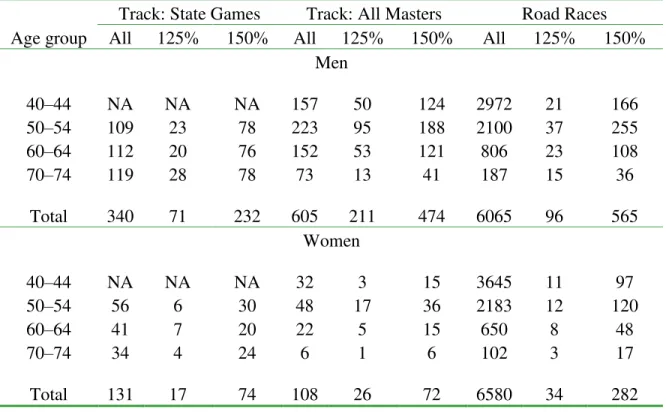
Table 1. The number of men and women in different contexts who finished races and the number of these who achieved the 125% and 150% sex-specific, age-specific standards
Track: State Games Track: All Masters Road Races
Age group All 125% 150% All 125% 150% All 125% 150%
Men
40–44 NA NA NA 157 50 124 2972 21 166
50–54 109 23 78 223 95 188 2100 37 255
60–64 112 20 76 152 53 121 806 23 108
70–74 119 28 78 73 13 41 187 15 36
Total 340 71 232 605 211 474 6065 96 565
Women
40–44 NA NA NA 32 3 15 3645 11 97
50–54 56 6 30 48 17 36 2183 12 120
60–64 41 7 20 22 5 15 650 8 48
70–74 34 4 24 6 1 6 102 3 17
Total 131 17 74 108 26 72 6580 34 282
Fast performances
As predicted, compared to road races, a far higher percentage of finishers at track meets ran fast relative to the appropriate sex-specific, age-specific world records (see Figure 1 and Table 2). For 5K road races, 1% reached the 125% standard, whereas 19% did
this at the State Games meets, and 33% did this at the All Masters meets, Χ2(2, n = 13,829)
= 2564.04, p < .0001. For the 150% standard, the percentages were, respectively, 7%, 65%
and 77%, Χ2(2, n = 13,829) = 4314.22, p < .0001. To illustrate the magnitude of this
difference, we combined the data from the two track meet samples and calculated the odds of running fast at a track meet compared to the odds of running fast at a road race. This revealed that a runner at a track meet was 36 times more likely to achieve either standard than a runner at a road race was (odds ratio: 36.4 for 125% standard; 35.7 for 150%
standard).1
1
Technically speaking, the odds ratio indicates that the odds (not the probability) of achieving the standard is multiplied by a factor of 36 for a runner at a track meet compared to a runner at a road race. We use the
Evolutionary Psychology – ISSN 1474-7049 – Volume 12(5). 2014.
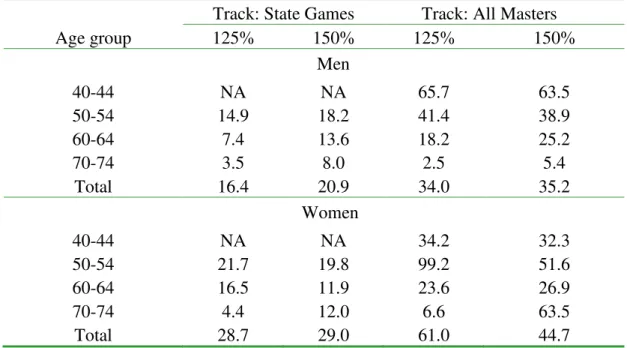
-855-Table 2. The odds ratios of achieving 125% and 150% sex-specific, age-specific standards in track meet contexts compared to road races
Track: State Games Track: All Masters
Age group 125% 150% 125% 150%
Men
40-44 NA NA 65.7 63.5
50-54 14.9 18.2 41.4 38.9
60-64 7.4 13.6 18.2 25.2
70-74 3.5 8.0 2.5 5.4
Total 16.4 20.9 34.0 35.2
Women
40-44 NA NA 34.2 32.3
50-54 21.7 19.8 99.2 51.6
60-64 16.5 11.9 23.6 26.9
70-74 4.4 12.0 6.6 63.5
Total 28.7 29.0 61.0 44.7
Figure 1. Percentages of participating men and women across contexts who achieved the 125% and 150% sex-specific, age-specific standards
0 20 40 60 80 100
125% WR 150% WR
% Reaching
Standard
Male Track: Senior Games
Female Track: Senior Games
Male Track: All Masters
Female Track: All Masters
Male Road Race
Evolutionary Psychology – ISSN 1474-7049 – Volume 12(5). 2014.
-856-A potential concern is that achieving the 125% and 150% standards might be easier at track meets than at 5K road races. This is because most track performances were 800 m or 1500 m rather than 5000 m, and achieving relative performance standards becomes increasingly infrequent and presumably more difficult with longer distances (Deaner, 2006a; Deaner and Mitchell, 2011). Based on equations used in an earlier study (Deaner, 2006a), achieving 150% of an 800 m standard can be estimated as being roughly equivalent to achieving 156% of a 5000 m standard. Although this means that the differences noted above are overstated, the difference would remain very large even if we used formal corrections. This is revealed by the fact that the percentage of finishers reaching the 125% standard at track meets was more than twice as great as the percentage reaching the (much slower) 150% standard at road races. Furthermore, among the 120 finishers of 5000 m races at All Masters track meets (i.e., same distance as 5K road races), 38% reached the 125% standard and 83% reached the 150% standard. Finally, we also gathered data on road race finishers reaching the 160% standard; only 11% did so, meaning that a runner at a track meet was 20.9 times more likely to reach the 150% standard than was a runner in a road race to reach the 160% standard. Thus, we can be confident that runners at track meets are indeed far more likely to run fast than runners at road races.
Another important result is that the difference between road races and track meets
occurred for both men and women (see Tables 1 and 2). Men’s odds ratios for achieving
125% and 150% standards at a track meet (combined samples) compared to a road race were 26.4 and 28.8. For women, these values were 42.2 and 35.1. Similarly, the difference between road races and track meets occurred within all age groups. The odds ratios were
80.1 (125%) and 67.2 (150%) for the 40–44 age group; 41.3 and 33.2 for the 50–54 age
group; 16.1 and 20.3 for the 60–64 age group; and 3.7 and 8.0 for the 70–74 age group.
Sex differences
We next considered the prediction that men would participate more than women at track meets but not at road races. As predicted, women comprised 52% of finishers at 5K road races but only 28% of finishers at State Games meets and 15% of finishers at the All
Masters meets, Χ2(2, n = 13,829) = 457.6, p < .0001. This pattern held across age groups:
In the 40–44 age group, women comprised 55% of finishers at road races and 17% at All
Masters meets (p < .0001); in the 50–54 age group, women comprised 51% of finishers at
road races, 34% at State Games meets and 18% at All Masters meets (p < .0001); in the
60–64 age group, women comprised 45%, 27%, and 13% of the respective samples (p <
.0001); and in the 70–74 age group, women comprised 35%, 22%, and 8% of the samples
(p < .0001).
Finally, we examined whether—among road race finishers—men were more likely
than women to run relatively fast, as reported in previous studies with runners less than 40 years old (Deaner, 2006b; Deaner and Mitchell, 2011). Masters men were 3.1 times as likely as masters women to reach the 125% standard (p < .0001) and 2.3 times as likely to reach the 150% standard (p < .0001; see Figure 1).
Discussion
Evolutionary Psychology – ISSN 1474-7049 – Volume 12(5). 2014.
-857-were. Second, women comprised 52% of masters finishers at 5K road races but only 15–
28% of masters finishers at track meets. Both of these results are novel yet consistent with previous work. In particular, earlier reports indicated slightly greater female than male participation in contemporary U.S. 5K road races (Deaner and Mitchell, 2011; Running USA, 2012b) and that the percentage of runners that run relatively fast at U.S. road races, although quite low, is higher in men than women (Deaner, 2006b; Deaner and Mitchell, 2011).
One concern about this study is that road races were 5K (5000 m) whereas most of the track meet races were of shorter distances (i.e., 800 m or 1500 m). Because achieving the 125% and 150% standards might be easier at shorter distances (Deaner, 2006a; Deaner and Mitchell, 2011), this will overestimate the difference in fast performances between these contexts. However, we showed that the difference between these contexts remained very large even when making conservative comparisons, including direct comparisons of 5000 m track performances and 5K (5000 m) road race performances.
Because fast performances reliably correlate with self-reported competitiveness and the maintenance of larger training volumes (Masters et al., 1993; Ogles et al., 1995; Ogles and Masters, 2000, 2003), these new results support the hypothesis that masters track participation is a valid measure of competitiveness and that, at the population level, the sex difference in master track participation is a reasonable indicator of the sex difference in competitiveness. Of course, this is a population level result and does not signify anything about specific individuals; many road race participants may very well be highly competitive and many track meet participants may not be.
Study 2
In Study 2, we test social structural theory’s prediction that, in the U.S., the sex difference in competitiveness has decreased as social roles have converged in the past few decades (Koenig et al., 2011; Lueptow et al., 2001; NCWGE, 2012; Twenge et al., 2012). We do this by using the sex difference in masters track participation as a proxy for the sex difference in competitiveness, an approach strongly supported by Study 1. We next discuss our measures of masters track participation and social roles.
Masters track participation
Neither sampling method used in Study 1 to assess masters track participation was viable for temporal comparisons. However, we identified a workable analog for each. First, the State Games appear to be a fairly recent occurrence, and we were unable to locate historical data. Fortunately, USA Track and Field (USATF) has annually held a national masters championship meet, and data are publicly available going back several decades. Second, amassing data on participation at hundreds of individual masters track meets
across years, similar to the “All Masters” sample in Study 1, would be very difficult
Evolutionary Psychology – ISSN 1474-7049 – Volume 12(5). 2014.
-858-Social roles
Our primary proxy for convergence in social roles in the U.S. is year—an approach
used by many studies (reviewed in Wood and Eagly, 2012). This approach is appropriate because year correlates positively with many measures of social role convergence (see Figure 2; Twenge et al., 2012). However, we also explored the predictive capacity of more direct measures. First, because the division of labor is thought to play a fundamental role in production of sex-differentiated behavior (Wood and Eagly, 2012), we used the percentage of U.S. civilian women in the paid labor force (see Figure 2; Twenge et al., 2012). A limitation of this measure is that working women remain over-represented in female-typical (communal) occupations and less likely than men to attain high status positions (Kan, Sullivan, and Gershuny, 2011; Queneau, 2006; Wood and Eagly, 2012). Therefore, as a second measure of the division of labor, we used the wage gap between male and female workers (see Figure 2). For instance, the wage gap indicates that in 2011, on average, a full-time, year-round working woman earned 82% as much as her male counterpart (U.S. Bureau of Labor Statistics, 2013). This gap is believed to partly reflect discrimination, although it also reflects men working more hours and holding different jobs (Blau and Kahn, 2007; Mulligan and Rubinstein, 2008). The wage gap should thus provide a
reasonable proxy for working women’s employment converging with men’s. Figure 2. Convergence in social roles over time
Note. Labor Force Participation indicates the percentage of civilian women aged 16 years or older in the U.S. paid labor force. Wage Gap indicates, for full-time U.S. workers, women’s earnings as a
percentage of men’s. High School Sports Participants indicates the percentage of sports participants in U.S. high schools that are women. Olympic Participation indicates the percentage of participants in the Summer Olympic Games that are women.
In addition, because the influence of social roles might be partly domain-specific (Koenig et al., 2011), we used two measures of convergence in sport participation. The first
0 10 20 30 40 50 60 70 80 90
1915 1925 1935 1945 1955 1965 1975 1985 1995 2005 2015 Labor Force Participation
Wage Gap
Evolutionary Psychology – ISSN 1474-7049 – Volume 12(5). 2014.
-859-was the percentage of participants that are female in U.S. high school sports (see Figure 2). This represents a local, readily observable level of sport participation, with high rates of
participation even among individuals of modest athletic ability (Stevenson, 2007). Females’
participation in high schools sports increased dramatically in the wake of Title IX, an education reform that bars sex discrimination in access to athletic opportunities in federally-funded educational institutions (Brake, 2010; Hogshead-Makar and Zimbalist, 2007; Stevenson, 2007). The second measure was the percentage of participants that are female in the Summer Olympic Games (see Figure 2). The Summer Olympic Games
provides the world’s greatest variety of elite sports competition (Lowen, Deaner, and Schmitt, 2014), and the percentage female participation should proxy elite athletic opportunities for girls and women. We also note that the Olympics could have direct effects on perceptions of the appropriateness of female sports. This is because the Olympics are one of the few elite sporting contexts where female athletes receive media coverage that is reasonably similar to that of men (Billings, Angelini, and Duke, 2010), and this coverage is extensive. The 2012 Olympics, for instance, generated over 100,000 hours of coverage spread over more than 500 television channels across the globe, and these broadcasts reached an estimated 3.6 billion viewers (International Olympic Committee, 2013). The U.S. has had much success in the Olympics, although for both men and women, U.S. participation and success in winning medals is unremarkable after controlling for country level characteristics, such as population, gross domestic product, and gender inequality (Lowen et al., 2014).
Lagging social role measures
One limitation of these measures of social role convergence is that adult dispositions are thought to be largely shaped during childhood or adolescence (e.g., Twenge, 1997b, 2001). Thus, the increasing occurrence of women in male-typical (agentic or instrumental) roles in the late 1980s, for example, might be irrelevant to the competiveness of women who were 40 years old at that time. However, these changes could have impacted girls entering high school in the late 1980s; these individuals would be eligible to participate in masters track meets in the early 2010s. To address this issue, we repeated our analyses after lagging social role measures. We did this by taking the year of competition and subtracting the midpoint of the relevant age group and then adding 14
years to approximate early adolescence. For example, for runners in the 40–44 age group
competing in 2012 (born in roughly 1970), we used social role measures from 1984. We also repeated these analyses after adding 8 rather than 14 years, as this would approximate mid-childhood. Unfortunately, we often lacked sufficient data to test the importance of the wage gap and high school sports participation when individuals in an age group cohort would have been in early adolescence and mid-childhood (see Figure 2).
Our primary analyses, which used year as a proxy for social role convergence, did not require lagging years to approximate early adolescence or mid-childhood. This is because year, by definition, increases uniformly for all age groups at all times.
Materials and Methods
Evolutionary Psychology – ISSN 1474-7049 – Volume 12(5). 2014.
-860-we also included the three intermediate age groups, i.e., 45–49, 55–59, and 65–69 years.
Thus, there were 21 events per year.
USA Championships
We obtained data on the USATF’s annual masters national championship meet
(hereafter USA Championships) from the organization’s links, especially
www.mastershistory.org/history/resultsusa.html. We obtained data on all years from 1988– 2012, save that data were available for only 5 of 21 events in 1990 and no data were available for 1991. USATF allows non-Americans to participate in the championship meet,
but for some meets, especially in the 1990s and earlier, participants’ citizenship was not
indicated. To allow fair comparisons across years, we therefore based most analyses on all participants. However, we repeated some analyses using only U.S. citizens; for this we
used data from 1998, 1999, and 2001–2012. For these 14 years, 94% of men and 92% of
women were U.S. citizens. We counted an individual as participating if they were listed as registered for the event in any capacity, even if they did not start, did not finish, or were
disqualified. In a random sample of 40 events occurring from 1998–2012, 93% of male and
92% of female participants legally finished their races.
Rankings
We obtained USATF yearly outdoor rankings for 1988–2012 from
www.mastersrankings.com. Unfortunately, no data were available for 2002. In addition,
from 2003–2006, the lists were restricted to the fastest 25 performers. In 12 out of 84
events (mostly for older age groups), both men and women had 25 or fewer ranked performers, potentially allowing a sex difference to be computed; nonetheless, we did not include this data because such events might be unrepresentative of the typical sex
difference in that event. Therefore, there were no rankings data included from 2002–2006.
Social role convergence
We obtained data on the percentage of U.S. civilian women over the age of 16 participating in the workforce from the U.S. Bureau of Labor Statistics (Bureau of Labor Statistics Data, 2014); we obtained data prior to 1948 from the Statistical Abstracts of the United States (United States Census Bureau, n.d.). We obtained data on the percentage wage gap between male and female full-time workers from the U.S. Bureau of Labor Statistics (Bureau of Labor Statistics, 2013). We obtained data on high school sports participation from the National Federation of State High School Associations (National Federation of State High School Associations, 2013). We obtained data on Summer
Olympic Participation from Wikipedia (“Summer Olympic Games,” 2014), which compiles
information from the International Olympic Committee as well as sports scholars with more accurate information. The Olympics occur once every four years; to maintain an adequate sample size, we assumed the Olympic participation value would remain fixed for the following three years.
Analysis
Evolutionary Psychology – ISSN 1474-7049 – Volume 12(5). 2014.
-861-measure as the explanatory variable of primary interest in order to investigate potential time trends. We also controlled for age group and race distance. Moreover, since the number of runners varied substantially by race distance and especially by age group, our models were weighted by the total number of men and women in a given event. All statistical tests were two tailed and, owing to the substantial number of tests, we used a 1%
significance level (α = 0.01). The choice of α did not qualitatively affect our conclusions,
and exact p-values are reported for all tests in the text or tables.
Results
We first examined the sex difference in participation across all events, age-groups and years. For the USA Championships, there were 7,127 participants, and 27% were
women. The sex difference was smallest in the 40–44 age group, where women comprised
32% of participants; the sex difference was largest in the oldest three age groups, where women comprised 22% (see Table 3). For the yearly rankings, there were 32,696 ranked
individuals (hereafter “participants”), 22% of which were women. The percentage of
female participants ranged from 20–23% across age groups (see Table 3).
Table 3. The number of men and women participating in USA Masters Championships and
appearing on annual rankings lists, 1988–2012
USA Championships Rankings
Age group Men Women % Women Men Women % Women
40-44 947 444 32 4551 1307 22
45-49 920 367 29 4066 1034 20
50-54 986 388 28 4717 1320 22
55-59 740 273 27 3860 1174 23
60-64 717 201 22 3617 1045 22
65-69 529 151 22 2635 734 22
70-74 363 101 22 2053 583 22
Total 5202 1925 27 25499 7197 22
USA Championships
We next examined whether the sex difference in participation decreased over time, beginning with the USA championship meet. The multiple regression revealed that percentage female participation was significantly predicted by year and also by age group, but not by race distance (R2 = .15; βyear = 0.32, p < .0001; Age: F[6,488] = 10.37, p <
.0001; Distance: F[2,488] = 0.23, p = .79). We thus conducted regressions separately for
each age group and found a significant increase in percentage female participation for the
40–44 (0.71% increase per year) and 50–54 (0.73% increase per year) age groups. Table 4
Evolutionary Psychology – ISSN 1474-7049 – Volume 12(5). 2014.
-862-Table 4. Summary of annual trends in the percentage of females for USA Championships
Age Group 1988–2012 1998–2012 1998–2012 US
Citizens 2003–2012
40–44 0.71 (<0.0001) 0.22 (0.53) -0.04 (0.91) -1.28 (0.01)
45–49 0.20 (0.24) 0.21 (0.60) 0.10 (0.82) -0.36 (0.62)
50–54 0.73 (<0.0001) 0.63 (0.07) 0.48 (0.24) 0.59 (0.40)
55–59 0.34 (0.05) 0.86 (0.007) 0.98 (0.009) 1.24 (0.017)
60–64 -0.01 (0.95) -0.43 (0.30) -0.03 (0.95) 1.17 (0.13)
65–69 -0.15 (0.36) -1.09 (0.0023) -0.83 (0.03) -1.56 (0.0084)
70–74 -0.42 (0.07) -0.49 (0.26) -0.24 (0.62) -2.13 (0.0043)
Overall 0.32 (<0.0001) 0.15 (0.28) 0.16 (0.31) -0.17 (0.48)
Note. Values represent slopes, in units of % increase per year, with p-values in parentheses.
Visual inspection of the scatter plots (see Figure 3) suggested, however, that these
increases occurred mainly in the first 10 years of the study, from 1988–1997. We therefore
repeated these analyses using data from only the last 15 years of the study, from 1998–
2012. In the overall model, year was positively associated with percentage female
participation, although it no longer reached significance (R2 = .15; βyear = .15, p = .28; Age:
F[6,488] = 10.37, p < .0001; Distance: F[2,488] = 0.23, p = .79). Within age groups (see
Table 4), there was a significant increase in female participation in the 55–59 age group
(0.86% per year) but a significant decrease in the 65–69 age group (-1.09% per year). We
also repeated these analyses using only U.S. citizens and found nearly identical results (see Table 4). Finally, we repeated these analyses using data from only the last 10 years of the
study, from 2003–2012. In the overall model, year was negatively associated with
percentage female participation, although this did not reach significance (R2 = .15; βyear =
-0.17, p = .48; Age: F[6,488] = 10.37, p < .0001; Distance: F[2,488] = 0.23, p = .79). There
were two significant changes within age groups: decreases in the 65–69 (-1.56% per year)
and 70–74 (-2.13% per year) age groups (see Table 4).
Yearly rankings
We performed similar analyses with the yearly rankings. The initial multiple
regression model indicated that, with data from 1988–2012, the percentage of female
participation was positively associated with year but—at the 1% level—not age group or
race distance (R2 = .064; βyear = .09, p = .0061; Age: F[6,410] = 2.02, p = .061; Distance:
F(2,410) = 4.48 , p = 0.012). Nonetheless, given the earlier results suggesting heterogeneity within age groups, we conducted regressions separately for each (see Table 5). There were
significant increases in the percentage of female participation for the 45–49 (0.29% per
year) and 50–54 (0.23% per year) age groups.
We repeated these analyses using only data from the last 15 years, from 1998–2012.
The percentage of female participation was not predicted by any of the three candidate
variables (R2 = .03; βyear = -.06, p = .34; Age: F[6,200] = 0.34, p = 0.92; Distance: F[2,200]
= 1.13, p = .32). Within age groups, there was a significant increase in the 45–49 age group
(0.60% per year) and a significant decrease in the 70–74 age group (-0.72% per year; see
Evolutionary Psychology – ISSN 1474-7049 – Volume 12(5). 2014.
-863-(no data were available from 2002–2006). In this case, the model suggested an overall
decrease in female participation, although this did not reach significance (R2 = .12; βyear =
-.37, p = .10; Age: F[6,116] = 1.48, p = 0.19 ; Distance: F[2,116] = 1.91 , p = 0.15). There were no significant changes within age groups (see Table 5).
Figure 3. Plots of year and the percentage of females for three running events and three representative age groups
Note. Filled circles indicate USA Championships; Unfilled circles indicate yearly rankings.
Table 5. Summary of annual trends in the percentage of females for yearly rankings
Age Group 1988–2012 1998–2012 2007–2012
40–44 0.09 (0.38) 0.01 (0.95) -0.86 (0.16)
45–49 0.29 (0.0014) 0.60 (0.0005) 0.43 (0.42)
50–54 0.23 (0.0013) 0.28 (0.07) 0.62 (0.32)
55–59 -0.08 (0.27) -0.21 (0.22) -1.08 (0.075)
60–64 0.03 (0.71) -0.33 (0.02) 0.40 (0.35)
65–69 -0.09 (0.28) -0.51 (0.011) -1.68 (0.010)
70–74 0.00012 (1) -0.72 (0.0034) -1.51 (0.048)
Overall 0.09 (0.0061) -0.06 (0.34) -0.37 (0.10)
Evolutionary Psychology – ISSN 1474-7049 – Volume 12(5). 2014.
-864-Social role convergence
Finally, we investigated whether our main results would change if we substituted measures of social role convergence for year. The logic is that although year is, in general, positively associated with various measures of social convergence (see Figure 2), the yearly value of one (or more) of these more direct measures might prove to be a stronger predictor of female participation than year itself. In addition, for each of these measures, we
examined predictive capacity of each measure’s yearly value from the year when the
individuals in an age group were approximately 8 years old and also from the year when they were approximately 14 years old.
In the Supplemental Information (see Tables S1–S22), we present results for each
social role convergence measure pooled across all age groups (controlling for age group
and race distance). Tables S1–S22 also present results stratified by age group, but given the
sometimes small sample sizes, we restrict our summaries in the text to the overall models.
In addition, although we continue to use a 1% significance level (α = 0.01), we note all
p-values less than 0.10.
Labor force
Increased women in the labor force predicted a significant increase in female
participation in the USA championship meet across all 25 years (1988–2012), but not for
the past 15 years (1998–2012) or past 10 years (2003–2012; see Table S1). This pattern
was unchanged when we used labor force data when age group cohorts were 8 years (see Table S2) and 14 years old (see Table S3).
When we examined yearly rankings, rather than the USA championship meets, increased women in the labor force again predicted a significant increase in female track participation across all 25 years, and it was a nearly significant predictor the past 15 years
(p = 0.06) and the past 6 years (2007–2012; p = 0.05; see Table S4). When we used labor
force data when age group cohorts were 8 years (see Table S5) and 14 years old (see Table S6), women in the labor force again predicted a significant increase in female track
participation across all 25 years (1988–2012) but not for the past 15 or 6 years.
Wage gap
Decreased wage gap (i.e., increased women’s earnings relative to men’s) predicted
a significant increase in female participation in the USA championship meet across all 25 years, but not for the past 15 or 10 years (see Table S7). However, the increase for the past 15 was nearly significant (p = 0.06). There was insufficient wage gap data to test any age
groups when cohorts were 8 years old. Only the 40–44 age group could be tested when age
group cohorts were 14 years old, and this only included data from 2007–2012 (see Table
S8). The result was that decreased wage gap predicted a near significant (p = .04) decrease in female participation (i.e., a result contrary to social structural theory).
For yearly rankings, decreased wage gap predicted a significant increase in female track participation across all 25 years, but not for the past 15 or 6 years (see Table S9). There was insufficient wage gap data to test any age groups when age group cohorts were 8
years old. Only the 40–44 age group could be tested when the age group cohorts were 14
years old, and only for the years 2007–2012; there was not a significant effect (see Table
Evolutionary Psychology – ISSN 1474-7049 – Volume 12(5). 2014.
-865-High school sports participation
Increased female high school sports participation predicted a significant increase in female participation in the USA championship meet across all 25 years, but not for the past 15 or 10 years (see Table S11). This pattern was unchanged when we used (the limited) high school participation data when age group cohorts were 8 years (see Table S12) and 14 years old (see Table S13), with one exception: Increased female high school sports participation when age group cohorts were 14 years old predicted a significant decrease in national championship participation (i.e., contrary to social structural theory).
For yearly rankings, increased female high school sports participation predicted a significant increase in female track participation across all 25 years, but not for the past 15 years (see Table S14). Over the past 6 years, increased female high school sports participation predicted a nearly significant decrease in female track participation (p = .02; see Table S14; i.e., contrary to social structural theory). Results were similar when we used (the limited) high school participation data when age group cohorts were 8 years (see Table S15) and 14 years old (see Table S16).
Olympic participation
Increased female Olympic participation predicted a significant increase in female participation in the USA championship meet across all 25 years, but not for the past 15 or 10 years (see Table S17). This pattern was unchanged when we used Olympic participation data when age group cohorts were 8 years (see Table S18) and 14 years old (see Table S19).
For yearly rankings, increased female Olympic participation predicted a significant increase in female participation across all 25 years, but not for the past 15 years (see Table S20). Over the past 6 years, increased female Olympic participation predicted a nearly significant decrease in female track participation (p = .03; see Table S20; i.e., contrary to social structural theory). Patterns were similar when we used Olympic participation data when age group cohorts were 8 years (see Table S21) and 14 years old (see Table S22), although there was no indication of a decrease when using data from the past 6 years.
Discussion
This study had three main results. First, we found a large sex difference in masters participation with two large data sets: USA Championships and yearly rankings (see Table 2). Across all years combined, women constituted 27% of participants in the USA national championships meet and 22% of those individuals who appeared in the yearly rankings. These results fully corroborate Study 1, which found similar sex differences with two other independent data sets.
This study’s second main result was that, in both data sets, we found that the sex difference in masters participation significantly decreased across the 25 years for which we
had data, from 1988–2012. Nonetheless, in both data sets, the decreasing sex difference has
not occurred since approximately the late 1990s. Moreover, the historical change was
modest: For the USA championships, women constituted 21% of participants from 1988–
1992, the first 5-year block, and between 26% and 30% of participants in every 5-year
Evolutionary Psychology – ISSN 1474-7049 – Volume 12(5). 2014.
-866-participants from 1988–1992 and between 21% and 23% in every 5-year block since (22%
from 2008–2012).
This study’s third important result was that these results proved robust when we substituted four direct measures of social role convergence for year (i.e., labor force, wage gap, high school sports participation, and Olympic participation). In particular, for each of the four social role convergence measures and both measures of masters participation (i.e.,
eight tests in total), there was a significant decrease in the sex difference from 1988–2012.
However, in no case did the significant decrease persist when we only examined the last 15
years, 1998–2012. There were two cases that were suggestive (p < 0.10), but in neither case
did the other participation data set corroborate it. First, from 1998–2012, labor force was a
nearly significant predictor for yearly rankings (p = .06; 0.77% increase per year; see Table S5); however, over this period, labor force was not predictive for USA championships (p =
.96; see Table S5). Second, from 1998–2012, wage gap was a nearly significant predictor
for USA championships (p = .06; 0.61% per year; see Table S8); however, over this period, wage gap was not predictive for yearly rankings (p = .65; see Table S10).
We also repeated the analyses of direct measures of social role convergence using
each measure’s yearly value from the year when the individuals in an age group were
approximately 8 years old (mid-childhood) and also from the year when they were approximately 14 years old (early adolescence). For labor force and Olympic participation there was sufficient historical data to conduct complete tests: In both cases, for both
masters participation measures, the sex difference significantly decreased from 1988–2012
but not from 1998–20012. For wage gap and high school sports participation, fewer tests
could be conducted, mostly with younger age groups and for recent years. For both of these predictors, and for both masters participation measures, all tests failed to reach significance, and the coefficients were uniformly in the direction contrary to social structural theory.
The timing and cause(s) of the sex difference in female participation
What aspects of social structural convergence could have caused the increase in female participation? Unfortunately, our analyses could not answer this question because all four direct measures of social role convergence were qualitatively identical to year
itself; they predicted significant increases from 1988–2012 but not since the late 1990s. The
lagged analyses of these measures yielded similar results.
One possibility is that one or more social changes occurring in the 1990s increased the motivation of masters-aged women to compete. There was for example, an increase in female athletes appearing on television during this decade (Messner, Duncan, and Cooky, 2003). Another possibility is that changes occurring during childhood or adolescence were critical, although this possibility is perhaps less likely because the changes would then have occurred at different times for different age groups. For instance, a 70 year-old woman competing in 1998 would have been 14 years old in 1942, whereas a 40 year-old woman competing in 1998 would have 14 in 1972. Future research might explore this issue by tracking specific age group cohorts over time, especially as data accumulates in the coming decades.
Evolutionary Psychology – ISSN 1474-7049 – Volume 12(5). 2014.
-867-example, given the spike in female high school sports participation in the 1970s and 1980s (see Figure 2) if this hypothesis was correct, 40 year-old women in 2012 (who were 14 years old in 1986) should have been participating far more than 40 year-old women in 1998 (who were 14 years old in 1972); however, there was no evidence for such an increase.
General Discussion
There has been long-standing interest in testing the two major theories for the origins of sex differences in preferences and motivations, social structural theory and evolutionary theory. Although much empirical research has been conducted, almost all of it has relied on self-reports. These can be problematic for several reasons, including that the same item might be interpreted differently (e.g., become socially undesirable) in different time periods (Lueptow et al., 2001) and because response variability might reflect
individuals’ choice of comparison group (e.g., own sex vs. both sexes) when responding to rating scales (Wood and Eagly 2012; but see Schmitt et al., 2008). Therefore, the studies
presented in this article—based on real-world behavior rather than self-reports—represent
an important complement to previous work.
Study 1 provided new evidence that, although slightly more women than men participate in masters distance running in the contemporary U.S., among the fairly small number of individuals that run with a competitive orientation, men substantially outnumber women. This was demonstrated because at masters track meets, where we showed that most participants actually run fast, men participate about three times more often than women do.
Because Study 1 established the validity of the sex difference in masters track participation as an indicator of the sex difference in competitiveness, Study 2 could address the possibility of change over time. For both the USA championships and yearly rankings datasets, the results were clear: The sex difference decreased from 1988 to 2012, but there was no evidence of change since the late 1990s. These results provide powerful corroboration of previous studies (Deaner, 2006a, 2013; Deaner and Mitchell, 2011) indicating that the sex difference in competitiveness is large and stable. Because social roles have been generally converging (see Figure 2), these results challenge social structural theory, at least with regards to competitiveness in sports in the U.S.
Objections
One potential objection to our studies is that it might seem odd to measure a sex difference in competitiveness in sports by quantifying the number of men and women who participate at masters track meets. As discussed in Study 1, we believe this is a reasonable approach given that fast performances occurred frequently at track meets, over 20 times more often than at road races, and that previous survey studies have shown that, in large populations of recreational runners, faster performances reliably correlate with greater self-reported competitiveness (Masters et al. 1993; Ogles et al., 1995; Ogles and Masters 2000, 2003). We acknowledge that these surveys did not recruit track meet participants, and it is conceivable that these runners generally run fast despite generally having low competitiveness. However, we know of no reason to anticipate this; furthermore, many track meet participants also participate in road races.
Evolutionary Psychology – ISSN 1474-7049 – Volume 12(5). 2014.
-868-sex difference in competitiveness in U.S. distance runners. First, men are more likely than women to run fast relative to sex-specific world class standards, and this is likely due, in part, to their greater competitiveness and willingness to maintain large training volumes (Deaner, 2006a, 2013; Deaner and Mitchell, 2011). Second, men are more likely than women to report that competition motivates them to run (Callen, 1983; Johnsgard, 1985; Ogles and Masters, 2003). Third, a study reported that when they have the option of entering a single-sex competitive road race or a single-sex non-competitive road race held in the same location on the same day, men were substantially more likely than women to select the competitive race (Garratt, Weinberger, and Johnson, 2013). Finally, it has been shown that there is a robust difference in pacing in the marathon: Men are three times more
likely than women to slow dramatically, and this probably reflects, in part, men’s greater
propensity for risk-taking (Deaner, Carter, Joyner, and Hunter, 2014), which may be related to their greater competitiveness (Cárdenas, Dreber, von Essen, and Ranehill, 2012; Croson and Gneezy, 2009; Wilson and Daly, 1985).
A second potential objection to our interpretation is that social roles have not, in fact, substantially converged over our study period. This is because men are still greatly over-represented in many positions in society, particularly positions of leadership (Koenig et al., 2011; NCWGE, 2012; Wood and Eagly, 2012). This objection is not compelling, however, because tests of social structural theory do not require that men and women have identical social roles; they only require general convergence. And the evidence for convergence in the U.S. is strong even since the 1990s, at least for some measures (see Figure 2). This is true in education, the labor force, and cultural products (NCWGE, 2012; Twenge et al., 2012). Moreover, in Study 2 we showed that analyses using more direct measures of social role convergence (i.e., yearly values for labor force, wage gap, high school sports participation, and Olympic participation) yielded results that were highly similar to those using year itself. These findings underscore that changes in social roles were not consistently associated with changes in the sex difference in masters track participation.
In addition, it has been argued that the influence of social roles might be partly domain-specific (Koenig et al., 2011), and the convergence of social roles has been clear in sports. Most notably, Olympic and professional opportunities for female athletes have greatly increased (see Figure 2; Eitzen and Sage, 2002; Lowen et al., 2014), and girls and women have come to comprise more than 40% of participants in organized school sports in the U.S. (see Figure 2; National Federation of State High School Associations, 2010; NCAA Research, 2010). In fact, Title IX scholars and advocates routinely claim that this convergence in social roles in sports has diminished and will eventually eliminate the remaining sex difference in sports interest (Brake, 2010; Hogshead-Makar and Zimbalist, 2007). Although there is little empirical evidence for these claims (Deaner et al., 2012), their repeated assertion indicates that the expectation of convergence in competitiveness in sports is highly plausible.
Evolutionary Psychology – ISSN 1474-7049 – Volume 12(5). 2014.
-869-or rep-869-ort evidence f-869-or a generation lag; instead, they assumed that if one generational cohort had substantially different experiences in childhood and adolescence than another, they would develop differently (e.g., Twenge, 1997b, 2001). In fact, because childhood and adolescent sport experience may strongly affect adult sports interest (Fredricks and Eccles, 2005; Scheerder et al., 2006), our results seem particularly damaging to social structural theory. This is because the early athletic experience and available role models for female masters runners participating in the late 1990s were strikingly different than those of contemporary female masters runners (see Figure 2).
A fourth objection recognizes that social structural theory has been falsified for distance running but argues this pattern may not hold for other sports. This objection merits consideration, but the available data provide little support for it. Historical and cross-societal studies of sports indicate that many societies have had appreciable female participation and interest, especially in societies where women have enjoyed greater control of resources and political power (Deaner and Smith, 2013). Nonetheless, boys and men appear to be substantially more involved than girls and women in all societies (Deaner and Smith, 2013; Ellis, 2011; Guttman, 1991). In fact, even in the U.S., where many experts assert that there is no sex difference in general sports interest (NCWGE, 2012) or else that it is rapidly disappearing (Brake, 2010; Hogshead-Makar and Zimbalist, 2007), men actually show substantially greater interest (Deaner et al., 2012). Most relevant is a recent study that assessed intramural sports participation at colleges and universities, which mainly entail team sports; intramural participation is a superior measure of sports interest than intercollegiate participation because intramurals do not involve external incentives (e.g., scholarships) or constraints on participation (e.g., quotas or cuts). This study found that, for both co-ed and single-sex intramural competition, men participated about three times as frequently as women, and that this difference had been stable since at least the early 2000s (Deaner et al., 2012).
Social roles and socialization
We have emphasized the finding that the sex difference in track participation has not decreased since the late 1990s, despite continued convergence in social roles. Nonetheless, our results can be fairly interpreted as partially supporting social structural theory because, in both data sets, the sex difference decreased significantly, albeit modestly, across all 25 years of the sample (1988 to 2012). As noted in the Discussion of Study 2, our analyses were unable to specify the factors causing this difference although the timing of change appears inconsistent with the idea that Title IX played a role.
Other lines of evidence are also consistent with the social structural or socialization view of sports competitiveness yet do not demonstrate that socialization plays a causal role. For example, many studies have shown that males and females have different sport-related experiences, with, for instance, adolescent females experiencing greater pressure to eschew sports, especially stereotypically masculine ones (Blinde and Taub, 1992; Kane and Snyder, 1989; Sabo and Veliz, 2008; Shakib, 2003). However, to our knowledge, no systematic comparison or experimental intervention has ever shown that sport-related experience actually affects the development or expression of sports interest or competitiveness. Another line of evidence comes from developmental studies
Evolutionary Psychology – ISSN 1474-7049 – Volume 12(5). 2014.
-870-2005). Although this suggests that parents contribute to individual and sex differences in
sports interest, correlations of this kind might be driven by the children’s behavior
(Fredricks and Eccles, 2005) or heritable genetic variation (Hur, McGue, and Iacono, 1996; Lykken, Bouchard, McGue, and Tellegen, 1993).
In addition, the view that socialization explains all differences in sports interest or competitiveness is undermined by converging evidence implicating a role for prenatal androgens (e.g., testosterone). Females with congenital adrenal hyperplasia, a disease characterized by heightened prenatal androgen exposure, are more likely than unaffected females to show strong interest in stereotypically masculine sports (Berenbaum and Snyder, 1995; Berenbaum, 1999; Frisén et al., 2009). Within both men and women, lower second-to-fourth digit ratio (2D:4D), a putative marker of high prenatal testosterone, is associated with greater athletic ability (reviewed in Hönekopp and Schuster, 2010) and participation in competitive sports (e.g., Giffin, Kennedy, Jones, and Barber, 2012; Manning and Taylor, 2001; Manning, 2002; Pokrywka, Rachon, Suchecka-Rachon, and Bitel, 2005). Finally, much evidence indicates that exposure to prenatal androgens contributes to male-typical childhood activity patterns (reviewed in Berenbaum and Beltz, 2011), and these activity patterns, in turn, predict adult sports interest (Cardoso, 2009; Giuliano, Popp, and Knight, 2000).
In sum, the results from Study 2 suggest a meaningful but constrained role for socialization, and this interpretation is fully consistent with previous empirical research.
Compatibility of social structural theory and evolutionary theory
In considering social structural theory in this article, we have exclusively focused on its prediction that converging social roles will consistently decrease sex differences in preferences and motivations and also that this prediction is at odds with an evolutionary approach. Arguably, this unfairly represents social structural theory in two ways. First, its developers take pains to show its compatibility with evolutionary theory (Wood and Eagly, 2002, 2012). In particular, social structural theory explicitly acknowledges that sex differences in body size, strength, and childrearing capabilities are products of natural selection and that these sex differences (but not partly innate psychological predispositions) have crucial implications for the efficient performance of many activities in human
societies and thus the division of labor and social roles.2
Second, and perhaps more importantly, in explaining how differing social roles eventually produce sex differences in behavior, social structural theory specifies numerous mediating proximate mechanisms (e.g., social role beliefs, hormonal regulation, self-regulation to gender identities; Wood and Eagly, 2002, 2012). Thus, one might argue that
social structural theory has not been challenged by Study 2’s results because, although
social roles changed in the U.S. during the study period, for unknown reasons, these changes did not engage the crucial mediating mechanisms (which we did not assess). This
2