Validation of picogram- and
femtogram-input DNA libraries for
microscale metagenomics
Christian Rinke1, Serene Low1, Ben J. Woodcroft1, Jean-Baptiste Raina2, Adam Skarshewski1, Xuyen H. Le1, Margaret K. Butler1, Roman Stocker3, Justin Seymour2, Gene W. Tyson1,4and Philip Hugenholtz1,5
1Australian Centre for Ecogenomics/School of Chemistry and Molecular Biosciences, University of Queensland, Brisbane, QLD, Australia
2Climate Change Cluster, University of Technology Sydney, Sydney, New South Wales, Australia 3Department of Civil, Environmental and Geomatic Engineering, ETH Zurich, Zurich,
Switzerland
4Advanced Water Management Centre, University of Queensland, Brisbane, QLD, Australia
5Institute for Molecular Bioscience, University of Queensland, Brisbane, QLD, Australia
ABSTRACT
High-throughput sequencing libraries are typically limited by the requirement for nanograms to micrograms of input DNA. This bottleneck impedes the microscale analysis of ecosystems and the exploration of low biomass samples. Current methods for amplifying environmental DNA to bypass this bottleneck introduce considerable bias into metagenomic profiles. Here we describe and validate a simple modification of the Illumina Nextera XT DNA library preparation kit which allows creation of shotgun libraries from sub-nanogram amounts of input DNA. Community composition was reproducible down to 100 fg of input DNA based on analysis of a mock community comprising 54 phylogenetically diverse Bacteria and Archaea. The main technical issues with the low input libraries were a greater potential for contamination, limited DNA complexity which has a direct effect on assembly and binning, and an associated higher percentage of read duplicates. We recommend a lower limit of 1 pg (∼100–1,000 microbial cells) to ensure community composition fidelity, and the inclusion of negative controls to identify reagent-specific
contaminants. Applying the approach to marine surface water, pronounced
differences were observed between bacterial community profiles of microliter volume samples, which we attribute to biological variation. This result is consistent with expected microscale patchiness in marine communities. We thus envision that our benchmarked, slightly modified low input DNA protocol will be beneficial for microscale and low biomass metagenomics.
Subjects Genomics, Microbiology, Molecular Biology
Keywords Nextera XT, 100 fg, Low input DNA library, Picogram, Reagent contamination, Low biomass, Low volume, Microscale metagenomics, Marine microheterogeneity, Illumina Submitted14 June 2016
Accepted24 August 2016
Published22 September 2016
Corresponding authors
Christian Rinke,
[email protected] Philip Hugenholtz, [email protected]
Academic editor
Hauke Smidt
Additional Information and Declarations can be found on page 23
DOI10.7717/peerj.2486 Copyright
2016 Rinke et al.
Distributed under
INTRODUCTION
Over the last decade, advances in high-throughput sequencing technologies have accelerated the exploration of the uncultured microbial majority (Rappe & Giovannoni, 2003). The direct sequencing of environmental samples, termed metagenomics, has revolutionized microbial ecology by providing new insights into the diversity, dynamics and metabolic potential of microorganisms. A remaining limitation of conventional metagenomic library construction is the requirement for relatively large sample amounts, e.g. grams of soil or liters of seawater which comprise millions of microbial cells. However, samples of this size aggregate microbial population heterogeneity and metabolic processes occurring at the microscale.
Within natural habitats, specific physiological niches occupied by microorganisms often occur within discrete microenvironments that are several orders of magnitude smaller than typical sample sizes. For example, in the pelagic ocean dissolved and particulate organic matter is often localized within hotspots, ranging in size from tens to hundreds of micrometers (Azam, 1998). These hotspots include marine snow particles, cell lysis and excretions by larger organisms such as phytoplankton exudates, which result in microscale chemical gradients that chemotactic bacteria can exploit (Azam & Malfatti, 2007; Stocker, 2012). Specific populations and their associated biogeochemical activities can be restricted to these localized microniches (Paerl & Pinckney, 1996). Therefore, understanding processes occurring at the microscale (mg,ml) is important if we are ever to fully understand
ecosystem functionality. Beyond the need for increased ecological resolution, there is a demand for creating metagenomes from small amounts of starting DNA to explore habitats with extremely low biomass such as subseafloor sediments (Kallmeyer et al., 2012),
clean-room facilities (Vaishampayan et al., 2013), human skin samples (Probst, Auerbach & Moissl-Eichinger, 2013), and ocean virus samples (Duhaime et al., 2012).
While MDA is successfully applied to obtain single-cell genomes (Clingenpeel et al., 2015), the approach has been shown to significantly skew microbial community profiles (Yilmaz, Allgaier & Hugenholtz, 2010;Probst et al., 2015).
The recent development of the NexteraTMtechnology substantially speeds up Illumina library creation and reduces input DNA requirements down to 1 ng (Nextera-XT). In this approach DNA is simultaneously fragmented and tagged (“tagmentation”) using in vitro transposition (Syed, Grunenwald & Caruccio, 2009;Caruccio, 2011). The resulting tagged fragments undergo a 12-cycle PCR reaction to add sequencing adaptors and sample-specific barcodes, which facilitate sample multiplexing. A number of attempts have been made to push the limits of Nextera library creation into the sub-nanogram range including the creation of unvalidated libraries from 10 pg of human DNA (Adey et al., 2010) and validated libraries using as little as 20 pg ofE. coliand mouse genomic DNA (Parkinson et al., 2012). The latter study found that this technique provided deep coverage of theE. coliK-12 genome, but also increased the proportion of duplicate reads and resulted in over-representation of low-GC regions. Most recently, the fidelity of picogram-level libraries was assessed using a simple mock microbial community, which found minimal impact of input DNA (down to 1 pg) on community composition estimates using the Nextera-XT kit (Bowers et al., 2015). Here, we extend this approach using a more complex mock community and environmental samples down to the femtogram input DNA range. We find that read-mapping estimates of community composition fidelity are reproducible down to 100 fg and infer that variance in
community structure between replicate 10ml marine samples appears to be primarily due
to microscale biological differences.
MATERIALS AND METHODS
Mock community constructionGenomic DNA extracted from 40 bacterial and 14 archaeal taxa for which reference genomes are available (54 isolate genomes), were combined to create a mock community (Table S1). Purified genomic DNAs from 49 of the 54 mock community members were obtained from collaborators. These DNAs were assessed via gel electrophoresis and quantified with qPCR (Shakya et al., 2013). The DNAs from the remaining five cultures were harvested and purified in our laboratory (see ‘Assembly of mock community genomes’ below). The amount of DNA and the genome size of each isolate were used to calculate their expected relative abundance in the community. The organisms for which only low amounts of gDNA were available were added in lower abundances to the final mix (Table S1). The final DNA concentration of the mock community was 23.1 ng/ml,
which was diluted appropriately for low input library construction.
Marine sampling
Marine surface seawater samples were obtained from Blackwattle Bay in Sydney Harbor (33
52′S, 151
11′E). Seawater was collected in a 10 L sampling container and low volume samples (1 ml, 100 and 10ml) were pipetted individually from the 10 L sample
procedure (SOP), triplicate 10 L samples were collected and transported to the laboratory (∼30 min travel time). Upon arrival, the samples were pre-filtered through a 10mm filter (Millipore, Billerica, MA, USA) to remove large particles and subsequently
filtered through 0.2mm Sterivex filters (Millipore, Billerica, MA, USA). All samples were
kept at-80C until further processing. The entire sample preparation and analysis workflow is shown inFig. S1.
DNA extraction from seawater samples
DNA extraction from seawater samples was performed using the UltraCleanÒ
Tissue & Cells DNA Isolation Kit following manufacturer’s instructions. Minor modifications were made to optimize the DNA extraction for marine samples and the low volume samples (102–106cells/ml), and for consistency were also applied to the filtered marine SOP samples. Briefly, 1 ml (instead of 700ml) Solution TD1 was added directly into the low
volume seawater samples (1 ml, 100 and 10ml; all in 1.5 ml tubes) or directly into the
Sterivex filter (10 L filtered SOP). Using a Vortex-GenieÒ
, samples were lyzed and homogenized by vortexing the tubes and filters respectively at maximum speed for 1 min, without adding the recommended beads. Finally, 20ml (instead of 50ml) of elution
buffer was added and incubated at room temperature for 5 min before centrifugation. For the low input libraries, 1/4 of the DNA extraction volume (5ml) was used for library
creation. Thereby, the amount of input DNA for library preparation was quantified, using a Qubit-fluorometer (Invitrogen), for the SOP and the 1 ml libraries, and was estimated for the 100 and 10ml samples based on the 1 ml sample measurements. The
number of cells in the low volume samples was calculated based on an average DNA content of 1–10 fg per cell.
DNA library preparation
Libraries were prepared using the Nextera XT DNA Sample Preparation Kit (Illumina Inc., San Diego, CA, USA). The standard protocol of the manufacturer was modified to optimize library preparation from DNA input concentrations of less than 1 ng (0.2 ng/ml).
The amplicon tagment mix (ATM), which includes the enzyme used for tagmentation, was diluted one in 10 in nuclease free water. For each sample, a 20ml tagmentation
reaction contained 10ml TD buffer, 5ml of input DNA and 5ml of the diluted ATM.
Tagmentation reactions were incubated on a thermal cycler at 55for 5 min. Subsequently,
tagmented DNA was amplified via a limited-cycle PCR whereby the number of amplification cycles was increased from 12 to 20 cycles to ensure sufficient library quantity for the downstream sequencing reaction. Amplified libraries were purified with 1.6Ampure XP beads and eluted in 20ml of re-suspension buffer. The quality of the
DNA sequencing
All libraries were sequenced with an Illumina NextSeq500 platform 2with 150 bp High Output v.1 run chemistry. The replicate SOP, 100, 10 and 1 pg, 100 fg, negative control, and marine sample libraries were pooled on an indexed shared sequencing run, resulting in 1/37 of a run or∼3.2 Gb per sample. The adapter trimmed fastq read files were deposited on the Microscale Ocean webpage (http://microscaleocean.org/data/category/ 9-low-input-dna-libraries-peerj).
Genome reference database
A genome reference database was created by concatenating the fasta files of the 54 mock community member genomes (Table S1), theM. aerolatumcontaminant genome, the human genome (release GRCh37), and the phiX 174 genome.
Read mapping based mock community profiles
Adapter trimmed sequences were aligned against the genome reference database using BWA MEM 0.7.12 (Li, 2013) through BamM (http://ecogenomics.github.io/BamM/). To improve stringency the seed length was increased to 25 bases in BWA MEM mode (–extras “mem:-k 25”). The resulting bam files were evaluated with samtools (Li et al., 2009), using samtools view (http://www.htslib.org/) and a custom script counting the mapped reads per reference genome.
Insert size
The BamM generated bam files (see read mapping above) were randomly subsampled to one million aligned read pairs and the CIGAR string column nine (TLEN,
observed template length) was extracted, using samtools view and the GNU coreutils command-line programs awk and shuf. Trimmed mean (trim = 0.01) and trimmed standard deviation (trim = 0.01) were calculated with the Rstudio package (https:// www.rstudio.com/). The applied definition of the term “insert size” used throughout this manuscript is the number of bases from the leftmost mapped base in the first read to the rightmost mapped base in the second read.
Read %GC content
Raw FASTQ-format forward reads were converted to FASTA format and the %GC content calculated with a custom perl script for each library replicate. The first 10,000 reads per replicate were used to calculate the average %GC content.
Read duplicates
increments) and subsequent counting of unique (duplicate) read pairs per subsample, which allows plotting of a read duplicate rarefaction curve. The cutoff of 30 bases per read and 100% match was chosen after initial trials showing that this cutoff is comparable to read duplicate levels estimated by read mapping to reference genomes of the mock data set (data not shown). For reference-based read mapping, raw reads were subsampled with seqtk (https://github.com/lh3/seqtk) mapped against the reference genome database with BamM and duplicate read pairs were removed with samtools rmdup (Li et al., 2009), which defines a duplicate as a read with the exact same start and stop position as an already mapped read, and compared to the same file before duplicate removal using samtools flagstat.
Taxonomic profiles
The 16S rRNA gene-based taxonomic profiles of the mock community and seawater samples were generated with GraftM (http://geronimp.github.io/graftM) using the 16S rRNA package (4.06.bleeding_edge_2014_09_17_greengenes_97_otus.gpkg). The pipeline was designed to identify reads encoding 16S rRNA genes based on HMMs and to assign taxonomic classifications by comparing against a reference taxonomy. A detailed feature description, user manual, and example runs are available on the GitHub wiki (https://github.com/geronimp/graftM/wiki). For the heat map, the GraftM output was manually curated, whereby mitochondrial and chloroplast sequences were removed. Taxon counts were trimmed (max > 20), and analyzed with DESeq2, a method for differential analysis of count data using shrinkage estimation for dispersions and fold changes (Love, Huber & Anders, 2014), in the software environment R (www.r-project. org). The data were log transformed (rlog), and displayed as a heat-map (pheatmap).
Functional profiles
Reads were searched against uniref100 (Suzek et al., 2007) (accessed 20151020) using DIAMOND v0.7.12 (Buchfink, Xie & Huson, 2015) with the BLASTX option. The top hit of each read (if above 1e-3) was mapped to KEGG Orthology (KO) IDs using the Uniprot ID mapping files. Hits to each KO were summed to produce a count table. Correlations and significance tests were performed with R (www.r-project.org) after applying and a cut-off > 500.
Assembly and binning
Sequence logo generation
The mock community library forward reads were subsampled to 1,000 reads using seqtk (https://github.com/lh3/seqtk). Reads were trimmed to the first 10 bases with a custom Perl script (trimFasta.pl), and the reads were submitted to weblogo (Crooks et al., 2004) to generate sequence logos (Schneider & Stephens, 1990).
Statistical analysis
The software packages MYSTAT and SYSTAT (http://www.systat.com) and R ( www.r-project.org) were used for all statistical analyses. Datasets were analyzed by ANNOVA (parametric) and Tukey’s Significance Test, the non-parametric Kruskal-Wallis One-way Analysis of Variance, or the Bonferroni probabilities (p-value) for correlations. Results from the 16S rRNA gene based community profiles and the functional profiles were used to calculate the mean coefficient of variation, which is defined as the ratio of the standard deviation to the mean.
Assembly of mock community genomes
The five draft genomes were obtained by harvesting 10 ml of culture medium and extracting the DNA using the PowerSoilÒ
DNA Isolation Kit (MO BIO Laboratories). Genome sequencing was performed on the Illumina NextSeq 500 platform using the Nextera library protocol. Raw sequencing reads were adapter clipped and quality trimmed with trimmomatic (http://www.usadellab.org/cms/?page=trimmomatic) 0.32 using the parameters “LEADING:3 TRAILING:3 SLIDINGWINDOW:4:15 CROP:10000
HEADCROP:0 MINLEN:50” with Nextera adapter sequences. BBMerge (version BBMAP: bbmap_34.94;https://sourceforge.net/projects/bbmap) was used to merge overlapping pairs of reads using default parameters. Quality controlled paired reads were assembled with CLC Genomics Cell assembler v4.4 using an estimated insert size of 30–500 bp. Quality controlled paired reads were mapped to the assembled contigs using BamM v1.5.0 (http://ecogenomics.github.io/BamM/), BWA 0.7.12 (Li, 2013) and samtools (http://www.htslib.org/) 0.1.19. The coverage of each contig was determined with BamM ‘parse’ and the average coverage weighted by contig length estimated. To reduce the deleterious effects of excess sequencing depth, raw reads were subsampled to provide an estimated 100coverage using seqtk ‘sample’ (https://github.com/lh3/seqtk), quality controlled with trimmomatic/BBMerge and reassembled. Contigs less than 2 kb were removed and genome quality assessed with CheckM 1.0.3 (Parks et al., 2014) using ‘lineage_wf.’ All genomes were assessed as being > 95% complete and < 1% contaminated. The resulting five population genome sequences were deposited in NCBI-BioProject under the BioProject ID PRJNA324744.
RESULTS
Low input library and sequence data quality
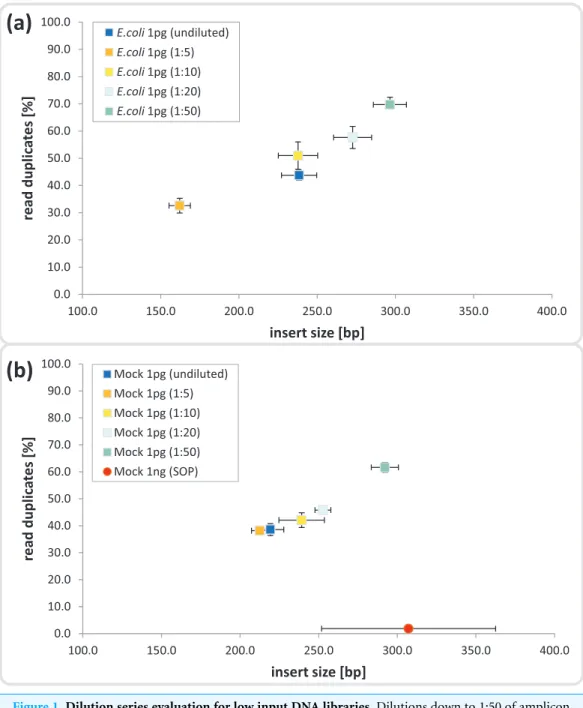
mock microbial community, equivalent to 102–103cells, a relevant range for localized microenvironments found within natural marine systems. The mock community comprised 54 bacterial and archaeal isolates with sequenced genomes and GC contents ranging from 28 to 70%, which were pooled at relative abundances ranging from 0.04 to 25% (Table S1). For 1 pg input DNA, it was necessary to increase the limited cycle PCR from 12 to 20 cycles to ensure sufficient tagmentation amplicon product for library preparation (Bowers et al., 2015) and sequencing (Fig. S2). The ATM used in the Nextera-XT kit includes a transposase that fragments and tags the input DNA during the tagmentation process, and we hypothesized that over-fragmentation of low input DNA could be avoided by diluting the enzyme and/or decreasing the tagmentation reaction time. We found a direct correlation between ATM dilution and insert size for both the pure and mixed templates, ranging from shorter than desired fragments (< 200 bp) in the 1:5 dilutions to fragment sizes equal to the 1 ng SOP in the 1:50 dilutions (∼300 bp;
Figs. 1andS3). Surprisingly, the 1 pg undiluted ATM controls produced insert sizes similar to the 1:10 dilutions (∼240 bp) in contrast to the anticipated over-fragmentation observed in the 1:5 dilutions (seeDiscussion).
Next we investigated the percentage of read duplicates in each library, a known artifact of the limited cycle PCR step (Kozarewa et al., 2009), which may compromise de novo assembly (Xu et al., 2012). In general, the percentage of read duplicates was much higher in the 1 pg libraries than the 1 ng SOP libraries; ∼50 vs∼2%, respectively at a
sampling depth of five million read pairs (Fig. 1). The percentage of read duplicates increased with increasing ATM dilution (Fig. 1), so to achieve an insert size of > 200 bp (recommended by Illumina for Nextera-XT libraries) while minimizing read duplicates, we proceeded with the 1:10 dilution. This ATM dilution gave similar results to the undiluted samples in terms of insert size and read duplicates (Fig. 1), but provides the potential to create multiple libraries from the same ATM starting volume.
input DNA (Fig. 2). The no input DNA negative controls resulted in a higher yield for the DNA extraction plus library kit control (13.8 mil; SD ± 3.8 mil) compared to low read numbers for the library only kit control (5.7 mil; SD ± 3.7 mil,Fig. 2).
The average insert size of the low input mock community libraries, as estimated by read mapping to the reference genomes, was significantly smaller (p < 0.01) than the SOP library, with 307 ± 115 bp observed in the SOP libraries vs 204–257 bp in the low input
0.0 10.0 20.0 30.0 40.0 50.0 60.0 70.0 80.0 90.0 100.0
100.0 150.0 200.0 250.0 300.0 350.0 400.0
re
a
d
duplic
a
te
s
[%
]
insert size [bp]
E.coli 1pg (undiluted) E.coli 1pg (1:5) E.coli 1pg (1:10) E.coli 1pg (1:20) E.coli 1pg (1:50)
(a)
(b)
0.0 10.0 20.0 30.0 40.0 50.0 60.0 70.0 80.0 90.0 100.0
100.0 150.0 200.0 250.0 300.0 350.0 400.0
re
a
d
duplic
a
te
s
[%
]
insert size [bp]
Mock 1pg (undiluted) Mock 1pg (1:5) Mock 1pg (1:10) Mock 1pg (1:20) Mock 1pg (1:50) Mock 1ng (SOP)
E.coli 1pg (undiluted)
E.coli1pg (1:5)
E.coli 1pg (1:10)
E.coli1pg (1:20)
E.coli 1pg (1:50)
Figure 1 Dilution series evaluation for low input DNA libraries.Dilutions down to 1:50 of amplicon
libraries (Fig. 2;Table S2). Although the average read GC content was not significantly different (p < 0.05) between the 1 ng SOP and low input libraries, an appreciable drop was recorded for the 100 fg libraries (Figs. 2andS6). Read duplicates increased with decreasing input DNA from an average of 1.2% for the 1 ng SOP up to 78.8% for 100 fg, at a sampling depth of five million read pairs (Figs. 2andS7A). This is consistent with the higher levels of read duplicates observed in the initial 1 pgE.coliand mock community libraries (Fig. 1). We noted that read duplicates are library-specific as combining reads from the 1 pg library replicates sampled to the same depth reduced the proportion of duplicates and improved assembly statistics (Figs. S7BandS8). This library specificity suggests that successfully tagmented DNA is a random subset of input DNA, which in the case of low input samples increases the proportion of duplicates by further limiting the template for limited cycle PCR. We also explored the relationship between percentage read duplicates and the limited cycle PCR step, whereby we raised the number of cycles from 12 to 20. We predicted that lower cycles should produce a lower proportion of read duplicates. Additional replicated low input libraries were prepared using 12, 14, 16, and 18 cycles, according to Bioanalyzer detectability thresholds, for a given amount of
SOP Modified Protocol
read yield 30.5 ±6.9 19.4 ±2.0 17.8 ±1.2 18.4 ±2.6 14.3 ±2.0 5.9 ±3.8 13.9 ±3.9 1ng SOP 100pg 10pg 1pg 100fg NegLib NegExt
~ no. cells 105– 106 104 – 105 103 – 104 102– 103 101- 102 -
-insert size 307 ±55 257 ±08 254 ±22 219 ±29 204 ±30 197 ±119 176 ±11
0 05 10 15 20 25 30 35 40 45 1ng (1 ) 1ng (2 ) 1ng (3 ) 10 0pg (1) 10 0pg (2) 10
0pg (3) 10p
g ( 1) 10 p g ( 2) 10 p g ( 3) 1pg (1 ) 1pg (2 ) 1pg (3 ) 10 0fg (1 ) 10 0fg (2 ) 10 0fg (3 ) 10 0fg (4 ) 10 0fg (5 ) Ne gL ib (1) Ne gL ib (2) Ne gL ib (3) Ne gExt ( 1 ) Ne gExt ( 2 ) Ne gExt ( 3 ) re ad Yie ld [m illio n r e ad s] unmapped Methylobacterium aerolatum human mock
%GC 55.5 ±0.13 55.3 ±1.36 53.2 ±0.41 53.5 ±0.65 50.3 ±3.26 45.8 ±7.41 56.2 ±5.66 %duplicates 1.2 ±0.1 5.3 ±0.4 21.0 ±1.2 52.1 ±3.5 78.8 ±4.8
Expected reads per sample ~ 21 million/ sequence allocaon 1/37th
Figure 2 Yield and quality assessment of low input libraries.The bar graph shows the absolute number of reads for all replicates of the 1 ng SOP,
the low input libraries (100pg, 10pg, 1pg, 100fg) and the negative controls (grey background). Negative controls are comprised of the library prep kit control (NegLib) and the DNA extraction kit + library prep kit control (NegExt), see Methods for details. Reads are colour coded based on the reference they aligned to, including the bacterial and archaeal mock community (green) and the human genome (blue). The remaining reads are shown as unmapped (orange) or mapped against the contaminant Methylobaterium aerolatum (red). The calculated cell number range (∼no. cells)
input DNA (Fig. S9). In contrast to expectations, the percentage of read duplicates did not change appreciably as a function of PCR cycle for a given DNA input concentration (Fig. S10), suggesting that they are mostly created within the first 12 cycles.
Sequencing contaminants
To determine the identity of possible sequencing contaminants, we assembled the reads from all negative control libraries. A substantially completeMethylobacteriumgenome (87.9% according to CheckM;Parks et al. (2014)was assembled which had 100% identity over 758 bp to the 16S rRNA gene ofM. aerolatumstrain 92a-8 (Weon et al., 2008). Members of the genusMethylobacteriumare recognized reagent contaminants (Salter et al., 2014). This genome was used to aid in identifying contaminant reads in the mock community libraries (Fig. 2). We aligned the sequence reads of the mock community and negative controls against the reference database containing all 54 microbial genomes, theM. aerolatumcontaminant genome, the human genome to detect possible
operator contamination and the phiX 174 genome, which is used as an internal run quality control during Illumina sequencing. For the 1 ng SOP and 100, 10 and 1 pg low input libraries, 95.6–97.7% of reads mapped to the microbial mock community and small percentages mapped to the human reference (0.1–1.9%) or were unmapped (2.1–3.9%;Fig. 2). We found more variable results for the five 100 fg libraries: two libraries produced similar results to the higher input libraries (rep1 & rep2 inFig. 2) and the other three had high human contamination (30.4–45.0% of reads; rep3, rep4 & rep5 in
Fig. 2). Reads from the negative control libraries were mostly human contamination (11.0–60.5%), M. aerolatum(0.4–65.5%), or unmapped (16.0–48.6%). The three UltraClean kit negative control libraries accounted for 98.5% of all reads mapping to
M. aerolatumsuggesting that this DNA extraction kit is the primary source of this contaminant. A small proportion of the negative control reads (0.3–0.9%) mapped to the mock community, which we attribute to cross sample contamination with mock community libraries due to false index pairings of the multiplex sequencing runs (Kircher, Sawyer & Meyer, 2012). A closer examination of the unmapped negative control reads (16.0–48.6%) revealed the presence of mostly Firmicutes (Bacilli and Clostridia), but also
Proteobacteria,ActinobacteriaandElusimicrobia(Fig. S11). We did not detect phiX 174 contamination (data not shown).
Fidelity of community composition
We evaluated community composition fidelity by comparing the relative abundance of the 54 mock community members between the 1 ng SOP library and the low input libraries, based on read mapping to the mock community genome database. Community composition of low-input libraries averaged across replicates (excluding library
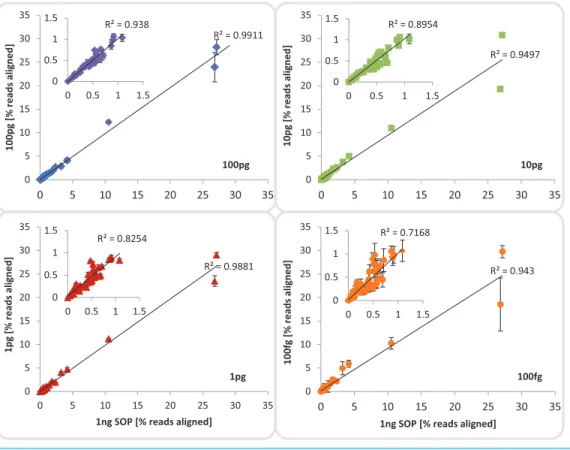
usually unavailable for environmental samples, we also assessed community composition using 16S rRNA-based taxonomic profiling and functional profile analysis using the KEGG database. The 16S rRNA-based taxonomic profiles matched the genome-based read mapping analysis with all libraries being strongly (R20.98) and significantly (p < 0.001) correlated to each other (Fig. S12). Functional profiles between SOP and low input libraries down to 1 pg were also strongly (R20.99) and significantly (p < 0.001) correlated, with lower but still significant correlations to the 100 fg libraries (R20.91; p < 0.01;Fig. S13). We therefore suggest that community composition can be reliably assessed using low input libraries down to 100 fg despite higher proportions of read duplicates (Fig. S7A) provided contaminants are accounted for by including negative controls. To determine if the consistently reduced correlation between the 100 fg and SOP libraries was a systematic effect of the observed difference in average read %GC (Fig. 2), we investigated the relative abundance of community members with high, median and low genomic GC content. No significant differences (p > 0.45) were observed between the relative abundances of reads aligning to high, medium or low GC genomes among all input libraries compared to the SOP (Table S4). This suggests that there is no substantial bias against high GC organisms among our mock community members with
R² = 0.9911
0 5 10 15 20 25 30 35
0 5 10 15 20 25 30 35
100pg [% reads al ig ned]
R² = 0.938
0 0.5 1 1.5
0 0.5 1 1.5
100pg
R² = 0.9497
0 5 10 15 20 25 30 35
0 5 10 15 20 25 30 35
10pg [% r e ad s align e d]
R² = 0.8954
0 0.5 1 1.5
0 0.5 1 1.5
10pg
R² = 0.9881
0 5 10 15 20 25 30 35
0 5 10 15 20 25 30 35
1pg
[% reads
al
ig
ned]
1ng SOP [% reads aligned]
R² = 0.8254
0 0.5 1 1.5
0 0.5 1 1.5
1pg
R² = 0.943
0 5 10 15 20 25 30 35
0 5 10 15 20 25 30 35
100fg
[%
r
e
ads aligned]
1ng SOP [% reads aligned]
R² = 0.7168
0 0.5 1 1.5
0 0.5 1 1.5
100fg
Figure 3 Mock community profile comparisons.Correlation between the 1 ng SOP libraries (x-axes)
decreasing input DNA, although there was a slight trend in this direction (Fig. S14). An analysis of the regions immediately flanking the transposase insertion sites (first 10 bases of each read) indicated a slight preference for insertion into AT-richer regions relative to the mean GC content (Fig. S15). However, this preference was consistent between the different input DNA concentrations and should have had no net effect on average read %GC content.
Assembly and binning
We normalized each replicate dataset to five million read pairs and assembled them using CLC Genomics workbench (see Materials and Methods). Assembly quality
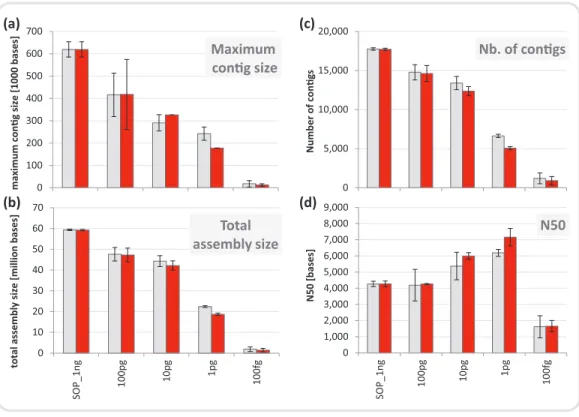
metrics–maximum contig length, total assembly size and number of contigs–were found to deteriorate with decreasing input DNA (Fig. 4). The increasing percentage of read duplicates with decreasing input DNA (Fig. S7A) may be primarily responsible for this observed drop in assembly statistics. However, when duplicates were removed, assembly statistics did not improve relative to the corresponding assemblies using all reads (Fig. 4) suggesting that read duplicates per se did not hamper the assembly. Instead, we noted a strong correlation between decreasing percentage of unique reads and loss of assembly performance for the mock community datasets (Fig. S16). Despite this loss in performance, datasets down to 1 pg still produced thousands of contigs > 1 kb (up to
0 100 200 300 400 500 600 700 SOP _ 1 ng 10
0pg 10p
g 1pg 10 0fg m a xim u m
cong size [1000
bases] Maximum cong size 0 10 20 30 40 50 60 70 SOP _ 1ng 10 0pg 10 p g 1pg 10 0fg total assem b ly size [m illion bases] Total assembly size 0 5,000 10,000 15,000 20,000 SOP _ 1 ng 10
0pg 10p
g 1pg 10 0fg Number of con g s
Nb. of congs
0 1,000 2,000 3,000 4,000 5,000 6,000 7,000 8,000 9,000 SOP _ 1ng 10
0pg 10p
g 1pg 10 0fg N50 [bases] N50 (a) (b) (c) (d)
Figure 4 Mock community assembly statistics.(A) Maximum contig size, (B) total assembly size,
a maximum of 260 kb) from five million read pairs suitable for population genome binning. To assess maximum binning potential for the mock community datasets, we combined and co-assembled replicates (50 million reads) except for the 100 fg libraries which did not meet this sequence read threshold. A drop in assembly performance was also noted with decreasing input DNA for the larger datasets and the removal of read duplicates had no effect on assembly statistics (Fig. S17). However, nine moderately complete (> 50%) to near (> 90%) complete genomes with low contamination (< 10%) were still recovered from the 1 pg library assembly, compared to 24 for the SOP library (Table 1).
Application to environmental samples
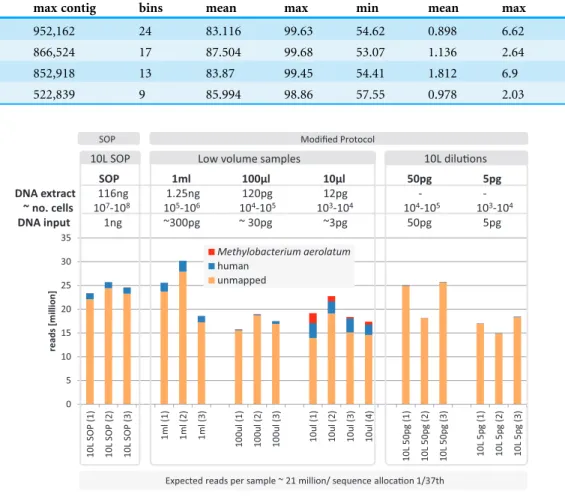
Based on the observation that the mock community profiles were consistent between the SOP and low-input DNA library protocols, we applied our approach to marine surface water samples (Sydney Harbor, Australia). In order to obtain sufficient DNA for the Nextera XT SOP, we filtered 10 L of surface water obtaining > 100 ng bulk DNA. Small unfiltered volumes, obtained from a 10 L surface water sample, comprising 1 ml, 100 and 10ml, were used to create low-input DNA libraries. DNA was extracted from
replicated samples using the UltraClean kit, applying a minor modification to accommodate marine samples and the smaller unfiltered volumes (see Materials and Methods). The bulk DNA from the 10 L filtered sample was used for the SOP libraries and diluted to create low input DNA libraries equivalent to the low sample volume libraries. Library creation was successful for all samples and yielded between 14.8–30.2 million adaptor-trimmed reads for the low input samples compared to 24.6 ± 1.2 million reads for the equimolar pooled 10 L filtered SOP samples (Fig. 5). To detect possible
contamination, we aligned the reads against the reference genome database (see Materials and Methods). No phiXcontamination was found, but varying degrees of human and
M. aerolatumcontamination were detected, with the general trend of increasing contamination with decreasing input DNA (Fig. 5) as seen in the mock community samples (Fig. 2). Substantial contamination was noted in four of the low volume libraries (27.3% reads) highlighting the importance of i) running negative control libraries to identify contaminants, some of which may be kit or reagent specific, and ii) screening low-input DNA shotgun datasets for identified and known contaminants.
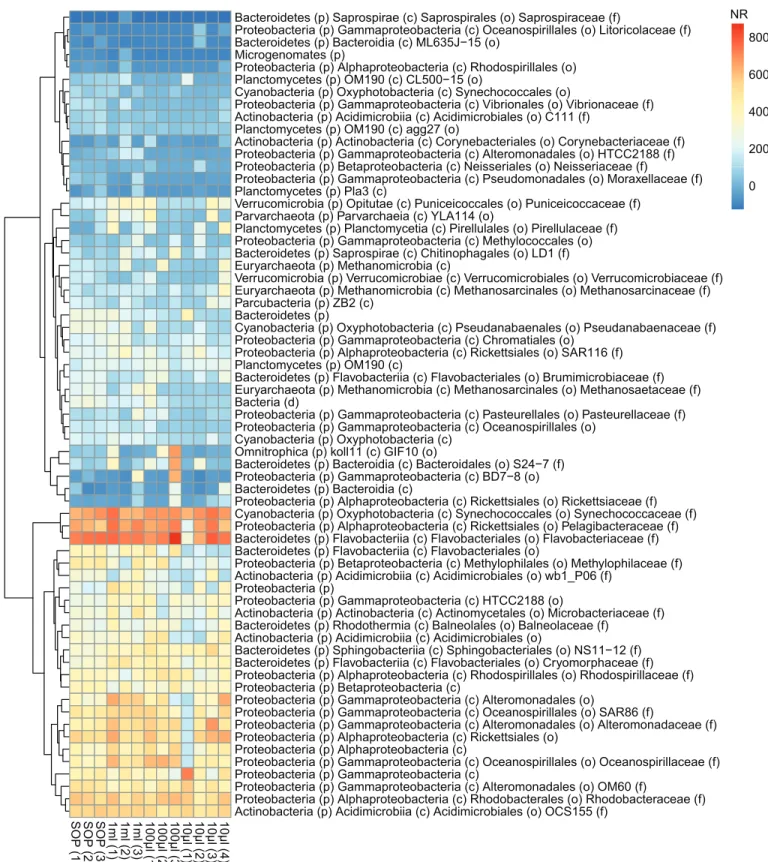
After removing contaminant reads, we used 16S rRNA-based taxonomic and KO-based functional profile analyses to evaluate community reproducibility between the
different libraries in the absence of reference genomes for these samples. The inferred taxonomic profiles were consistent with those expected within surface marine water samples including a dominance of populations belonging to thePelagibacteraceae, Flavobacteriaceae,andSynechococcaceaefamilies (Figs. 6andS18). Profiles averaged across replicates of both the filter dilution and low volume marine communities were
strongly correlated to the SOP libraries down to 5 pg and 10ml, respectively (Figs. 7,S19
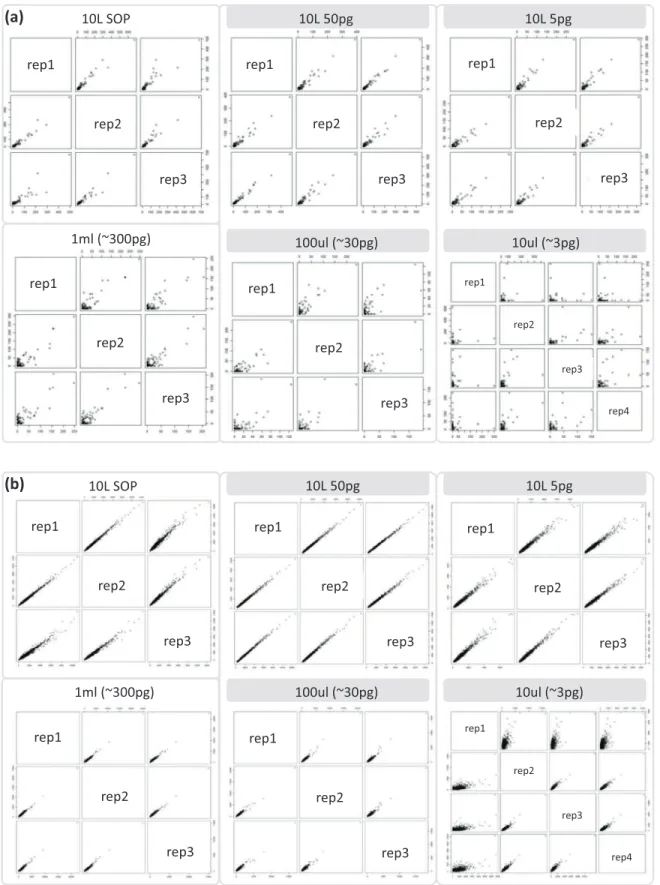
andS20). Replicate profiles were also highly correlated with the exception of the 10ml
Assembly and binning were also assessed for the marine samples. We repeated the approach used for the mock community and found that the assembly and binning of the 10 L filtered dilution libraries (5 and 50 pg) produced similar results to the 10 L filtered SOP (Fig. S21;Table S5). However, the low volume libraries representing between∼3 pg (10ml) and∼300 pg (1 ml) input DNA had poorer assembly
metrics (Fig. S21) and did not produce any population genomes with > 50% completeness as compared to the 10 L filtered datasets which produced five such genomes (Table S5).
Table 1 Mock community population genome bins.Read were subsample to 50 million reads, and only contigs1 kb were used for population
genome binning. Completeness and contamination were estimated based on marker genes, see Material and Methods.
Assembly Completeness Contamination
Size max contig bins mean max min mean max min
mock_SOP_1ng 148,892,162 952,162 24 83.116 99.63 54.62 0.898 6.62 0
mock_100pg 132,682,229 866,524 17 87.504 99.68 53.07 1.136 2.64 0
mock_10pg 115,499,380 852,918 13 83.87 99.45 54.41 1.812 6.9 0
mock_1pg 54,332,814 522,839 9 85.994 98.86 57.55 0.978 2.03 0
10L diluons 0 5 10 15 20 25 30 35 10 L S O P (1) 10 L S OP (2) 10 L S OP (3) 1m l (1) 1m l (2) 1m l (3) 10 0ul (1) 10 0ul (2) 10
0ul (3) 10u
l ( 1 ) 10 u l ( 2 ) 10 u l ( 3 ) 10 u l ( 4 ) 10 L 5 0 pg (1) 10 L 5 0 pg (2) 10 L 5 0 pg (3) 10 L 5 p g ( 1 ) 10 L 5 p g ( 2 ) 10 L 5 p g ( 3 ) re ad s [m illio n ] Methylobacterium aerolatum human unmapped
SOP 1ml 100μl 10μl 50pg 5pg DNA extract 116ng 1.25ng 120pg 12pg -
-~ no. cells 107-108 105-106 104-105 103-104 104-105 103-104
DNA input 1ng ~300pg ~ 30pg ~3pg 50pg 5pg 10L SOP Low volume samples
Expected reads per sample ~ 21 million/ sequence allocaon 1/37th
SOP Modified Protocol
Figure 5 Yield and quality assessment of marine samples. Reads are color coded based on the
reference they aligned to, including the known contaminant Methylobacterium aerolatum (red) and the human genome (blue). The remaining reads are shown as unmapped (orange). The amount of DNA extracted with the modified extraction protocol is given as total DNA in 20ml elution buffer (DNA
extract). Number of cells (∼no. cells) was calculated based on an average DNA content of 1–10 fg per cell. The amount of input DNA for library preparation was measured for the SOP and the 1 ml libraries, and was estimated for the 100 and 10ml samples based on the 1 ml sample measurements. The bar above the
SOP (1) SOP (2) SOP (3) 1ml (1) 1ml (2) 1ml (3) 100µl (1) 100µl (2) 100µl (3) 10µl (1) 10µl (2) 10µl (3) 10µl (4)
Bacteroidetes (p) Saprospirae (c) Saprospirales (o) Saprospiraceae (f)
Proteobacteria (p) Gammaproteobacteria (c) Oceanospirillales (o) Litoricolaceae (f) Bacteroidetes (p) Bacteroidia (c) ML635J−15 (o)
Microgenomates (p)
Proteobacteria (p) Alphaproteobacteria (c) Rhodospirillales (o) Planctomycetes (p) OM190 (c) CL500−15 (o)
Cyanobacteria (p) Oxyphotobacteria (c) Synechococcales (o)
Proteobacteria (p) Gammaproteobacteria (c) Vibrionales (o) Vibrionaceae (f) Actinobacteria (p) Acidimicrobiia (c) Acidimicrobiales (o) C111 (f)
Planctomycetes (p) OM190 (c) agg27 (o)
Actinobacteria (p) Actinobacteria (c) Corynebacteriales (o) Corynebacteriaceae (f) Proteobacteria (p) Gammaproteobacteria (c) Alteromonadales (o) HTCC2188 (f) Proteobacteria (p) Betaproteobacteria (c) Neisseriales (o) Neisseriaceae (f)
Proteobacteria (p) Gammaproteobacteria (c) Pseudomonadales (o) Moraxellaceae (f) Planctomycetes (p) Pla3 (c)
Verrucomicrobia (p) Opitutae (c) Puniceicoccales (o) Puniceicoccaceae (f) Parvarchaeota (p) Parvarchaeia (c) YLA114 (o)
Planctomycetes (p) Planctomycetia (c) Pirellulales (o) Pirellulaceae (f) Proteobacteria (p) Gammaproteobacteria (c) Methylococcales (o) Bacteroidetes (p) Saprospirae (c) Chitinophagales (o) LD1 (f) Euryarchaeota (p) Methanomicrobia (c)
Verrucomicrobia (p) Verrucomicrobiae (c) Verrucomicrobiales (o) Verrucomicrobiaceae (f) Euryarchaeota (p) Methanomicrobia (c) Methanosarcinales (o) Methanosarcinaceae (f) Parcubacteria (p) ZB2 (c)
Bacteroidetes (p)
Cyanobacteria (p) Oxyphotobacteria (c) Pseudanabaenales (o) Pseudanabaenaceae (f) Proteobacteria (p) Gammaproteobacteria (c) Chromatiales (o)
Proteobacteria (p) Alphaproteobacteria (c) Rickettsiales (o) SAR116 (f) Planctomycetes (p) OM190 (c)
Bacteroidetes (p) Flavobacteriia (c) Flavobacteriales (o) Brumimicrobiaceae (f) Euryarchaeota (p) Methanomicrobia (c) Methanosarcinales (o) Methanosaetaceae (f) Bacteria (d)
Proteobacteria (p) Gammaproteobacteria (c) Pasteurellales (o) Pasteurellaceae (f) Proteobacteria (p) Gammaproteobacteria (c) Oceanospirillales (o)
Cyanobacteria (p) Oxyphotobacteria (c) Omnitrophica (p) koll11 (c) GIF10 (o)
Bacteroidetes (p) Bacteroidia (c) Bacteroidales (o) S24−7 (f) Proteobacteria (p) Gammaproteobacteria (c) BD7−8 (o) Bacteroidetes (p) Bacteroidia (c)
Proteobacteria (p) Alphaproteobacteria (c) Rickettsiales (o) Rickettsiaceae (f) Cyanobacteria (p) Oxyphotobacteria (c) Synechococcales (o) Synechococcaceae (f) Proteobacteria (p) Alphaproteobacteria (c) Rickettsiales (o) Pelagibacteraceae (f) Bacteroidetes (p) Flavobacteriia (c) Flavobacteriales (o) Flavobacteriaceae (f) Bacteroidetes (p) Flavobacteriia (c) Flavobacteriales (o)
Proteobacteria (p) Betaproteobacteria (c) Methylophilales (o) Methylophilaceae (f) Actinobacteria (p) Acidimicrobiia (c) Acidimicrobiales (o) wb1_P06 (f)
Proteobacteria (p)
Proteobacteria (p) Gammaproteobacteria (c) HTCC2188 (o)
Actinobacteria (p) Actinobacteria (c) Actinomycetales (o) Microbacteriaceae (f) Bacteroidetes (p) Rhodothermia (c) Balneolales (o) Balneolaceae (f)
Actinobacteria (p) Acidimicrobiia (c) Acidimicrobiales (o)
Bacteroidetes (p) Sphingobacteriia (c) Sphingobacteriales (o) NS11−12 (f) Bacteroidetes (p) Flavobacteriia (c) Flavobacteriales (o) Cryomorphaceae (f) Proteobacteria (p) Alphaproteobacteria (c) Rhodospirillales (o) Rhodospirillaceae (f) Proteobacteria (p) Betaproteobacteria (c)
Proteobacteria (p) Gammaproteobacteria (c) Alteromonadales (o)
Proteobacteria (p) Gammaproteobacteria (c) Oceanospirillales (o) SAR86 (f)
Proteobacteria (p) Gammaproteobacteria (c) Alteromonadales (o) Alteromonadaceae (f) Proteobacteria (p) Alphaproteobacteria (c) Rickettsiales (o)
Proteobacteria (p) Alphaproteobacteria (c)
Proteobacteria (p) Gammaproteobacteria (c) Oceanospirillales (o) Oceanospirillaceae (f) Proteobacteria (p) Gammaproteobacteria (c)
Proteobacteria (p) Gammaproteobacteria (c) Alteromonadales (o) OM60 (f)
Proteobacteria (p) Alphaproteobacteria (c) Rhodobacterales (o) Rhodobacteraceae (f) Actinobacteria (p) Acidimicrobiia (c) Acidimicrobiales (o) OCS155 (f)
0 200 400 600 800 NR
Figure 6 Abundance profiles of the marine microbial samples.Bacterial taxonomy was assigned based on 16S rRNA gene sequence detection of
DISCUSSION
The typical requirement of microgram quantities of DNA for metagenome library creation often necessitates the use of bulk samples comprising millions to billions of individual microbial cells in macroscale quantities (ml, g). Low input DNA library creation protocols provide the opportunity to dissect microbial communities into microscale volumes (ml, mg), containing hundreds to a few thousands of cells
comprising picogram quantities of DNA. Such protocols will also aid efforts to characterize microbial communities in very low biomass environments. Currently, the most widely used commercially available low input DNA kit is Nextera XT (Illumina Inc., San Diego, CA, USA), which uses transposase insertion to fragment and tag the DNA with sequencing adapters. Using E. coligenomic DNA, a mock community of 54 phylogenetically diverse bacterial and archaeal isolates, and environmental samples obtained from coastal seawater, we evaluated a modified Nextera XT low input DNA library protocol for sequence yield and contamination, community composition fidelity, and assembly and population genome binning.
The manufacturer recommended Nextera XT library insert size range is 200 bp to 1 kb. We hypothesized that lowering the amount of input DNA may decrease average insert size due to a higher ratio of transposase to DNA resulting in more frequent tagmentations
16S rRNA gene taxonomic profile
KO-based funconal profile
SOP 10L SOP 10L
1ml 10μl 100μl 10L 5pg
10L 50pg 10L 50pg
10L 5pg
100μl
10μl
1ml
Figure 7 Marine communities profile correlations.Correlation coefficients are shown for the marine
1ml (~300pg) 10L SOP
rep1
rep2
rep3
rep1
rep2
rep3 rep1
rep2
rep3
rep1
rep2
rep3 rep1
rep2
rep3
rep2 rep1
rep3
rep4
10L 50pg 10L 5pg
10ul (~3pg) 100ul (~30pg)
(b)
10L SOP
rep1
rep2
rep3
1ml (~300pg)
rep1
rep2
rep3
rep1
rep2
rep3
rep1
rep2
rep3
rep1
rep2
rep3
rep2 rep1
rep3
rep4
10L 50pg
100ul (~30pg) 10ul (~3pg) 10L 5pg
(a)
Figure 8 Profile analyses of marine sample replication.Replicate correlation plots of (A) 16S rRNA gene based taxonomic profiles and
(cutting and attaching of adapters) per unit length of DNA. Indeed, a recent study by Bowers et al. (2015)found that insert size did indeed decrease as a function of input DNA for the Nextera XT kit. In theory, the insert size would only be restricted to a lower boundary of ∼20 nt due to steric interference between adjacent transposase complexes, which require at least a 19 bp binding site (Steiniger et al., 2006). The issue of
over-tagmentation may be addressable by reducing reaction time or diluting the
transposase. We observed a direct correlation between ATM dilutions (1:5 down to 1:50) and insert size, with the largest insert sizes at the highest dilutions (Fig. 1). It was surprising, however, that the 1 pg undiluted ATM controls produced larger than expected insert sizes, similar to the 1:10 dilutions (Fig. 1). A possible explanation is that the ATM includes a factor that inhibits the hyperactive Tn5transposase and subsequently a dilution of the mix would also result in a dilution of the inhibitor, allowing an increase in enzyme efficiency. Inhibition of the Tn5transposase activity is known forE. coli, in which an inhibitor of the transposition protein (a Tn5transposase variant which lacks the N-terminal 55 amino acids and thus does not possess DNA-binding activity) forms a complex with Tn5and interferes with transposition (de la Cruz et al., 1993). Based on these findings we prepared low input libraries using a 1:10 ATM dilution.
Average GC content is an often-reported metric in regard to Illumina libraries because of observed biases of GC-poor or GC-rich genomes and regions (Chen et al., 2013). We observed a slight decrease in the average read GC content with lower amounts of input DNA in the mock community libraries (Fig. 2). This was associated with a slight trend
0 50 100 150 200 250 300 350 400
1 2 3 4
coeffi
ci
e
nt
of
v
a
ri
a
on (%)
10L_diluons
low volume
1ml (~300pg) 100ul (~30pg) 10ul (~3pg) 10L SOP 1ng - 10L 50pg 10L 5pg
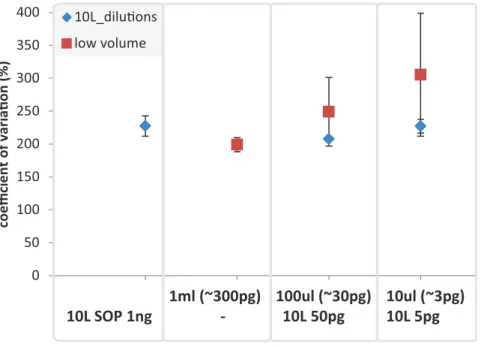
Figure 9 Mean coefficient of variation for taxonomic marine community profiles. The mean
towards over-representation and under-representation of low and high GC organisms, respectively, with lower input DNA (Fig. S14). A slightly reduced coverage in high but also low GC regions was observed using the Nextera protocol (50 ng SOP) for virus genomes and the GC coverage trend was attributed to an amplification bias that occurred during the Nextera limited-cycle PCR (Marine et al., 2011). The opposite trend was observed byBowers et al. (2015), which they attributed to organism specific differences. Another possible contributor to GC bias could be transposase insertion, as suggested previously (Lamble et al., 2013). An analysis of the regions immediately flanking the transposase insertion sites revealed a GC content∼2% lower than the average read GC content, despite the known preference of Tn5to insert at a guanine (Goryshin et al., 1998) (Fig. S15). However, this drop in GC content was consistent between the different input DNA concentrations suggesting that the limited cycle PCR is the main source of the observed slight shift in average GC content. This conclusion is in agreement with previous results who point to the PCR as the most important cause for GC-content bias during library preparation (Risso et al., 2011).
The largest difference in sequencing metrics between the Nextera XT 1 ng SOP and low input libraries, however, was the proportion of read duplicates, which increased dramatically with decreasing input DNA (Fig. 2). This is consistent with previous studies that found high levels of read duplicates for low input DNA libraries, whereby duplication levels of over 60% have been observed for 50 pg libraries at a sampling depth of five million reads, and up to 74% duplication occurring in 1 pg libraries with a sampling depth of 15 million reads (Chafee, Maignien & Simmons, 2015;Bowers et al., 2015). Read duplicate rates were positively correlated with ATM dilutions (Fig. 1), which is
presumably the result of fewer transposase insertions producing fewer DNA fragments and subsequently less unique templates, increasing the likelihood of read duplicates during PCR. The number of limited cycle PCR cycles (12–20) had no consistent effect on the percentage of read duplicates (Fig. S10), thus at a given ATM dilution the amount of input DNA is the primary factor determining the fraction of read duplicates (Fig. S7). This is consistent with previous findings that PCR duplicates arise from a lack of DNA complexity (unique templates) due to low levels or quality of input DNA (Smith et al., 2014). While it is also possible that read duplicates are “community derived” and created by the fragmentation of two identical DNA molecules that are tagmented at exactly the same location, the probability of such an event in metagenomic samples is extremely low (Gomez-Alvarez, Teal & Schmidt, 2009). By subsampling reads we could show that read duplicates are library specific and their proportion is reduced by combining library replicates (Fig. S7B). This is likely due to the random loss of up to 90% of the initial DNA during library creation (Parkinson et al., 2012;Zhou et al., 2014), which in the case of Nextera XT libraries would be due to tagmentations that do not produce limited cycle PCR-amplifiable products. Thus, a repeat of this random process from the same
GC content, and insert size (Fig. 2) had no impact on either our taxonomic or
functional-based community profiles as evidenced by significant correlations between the 1 ng SOP and the low input libraries of the mock community (Figs. 3,S12andS13). Furthermore, read duplicates per se did not affect assemblies (Fig. 4), which are instead limited by the number of unique reads in a sequence dataset (Fig. S16). Therefore, combining library replicates improves assembly outcomes because it increases the number of unique reads (Fig. S8). Based on these results, we suggest that low input DNA libraries are reproducible down to 100 fg using the minimally modified Nextera XT protocol of a 1:10 ATM dilution and 20 cycles of limited cycle PCR, regardless of the observed increase in duplicate reads. However,1 pg libraries gave results more consistent with the SOP than the 100 fg libraries in terms of insert size, read duplicates, GC content, and community composition fidelity (Fig. 2). We therefore recommend 1 pg (∼102–103cells) as the lowest DNA input amount using the modified protocol.
An important consideration when preparing low input DNA libraries is contamination. Small amounts of contaminating DNA are common in nucleic acid extraction kits and other laboratory reagents as indicated by no input DNA negative controls (Salter et al., 2014). Documented contaminants include representatives of the Proteobacteria, Actinobacteria, Firmicutes, Bacteroidetes, fungi, green plants and animals (Lusk, 2014; Strong et al., 2014). Such contamination is typically negligible in the context of standard input DNA libraries, but becomes an issue with decreasing input DNA, for example, with low biomass samples (Lusk, 2014;Salter et al., 2014). Therefore, we ran negative controls for both DNA extraction and library preparation in parallel with the low input DNA samples, where we substituted input DNA with ultrapure water. We recovered a near complete genome closely related toMethylobacterium aerolatumfrom the negative control libraries, which our data indicates can be mostly attributed to the UltraClean DNA extraction kit (Fig. 2). The genusMethylobacteriumis a known contaminant introduced during sample preparation, possibly through molecular biology grade water, PCR reagents, or DNA extraction kits (Salter et al., 2014). One way to reduce potential reagent contamination is UV irradiation, which has been successfully used to
decontaminate reagents for single-cell genomics (Woyke et al., 2011). However, since
isolation procedure to identify reagent-specific contaminants, and to include them in contaminant screens of low input DNA sequencing libraries.
Having addressed contamination issues and established the preservation of community composition for the low input DNA libraries in the mock community, we applied the modified Nextera XT protocol to marine samples, one of the most intensively studied ecosystems using metagenomics (Gilbert & Dupont, 2011;Reddy et al., 2015). We extracted DNA from samples having a range of volumes, representing standard (10 L filtered control) down to microscale (10ml) samples. We also prepared libraries from dilutions of
the 10 L control to match the DNA inputs of the low volume samples. Ten microliter samples were the lowest volumes used as they were estimated to comprise∼3 pg of DNA, which is above our recommended 1 pg library input DNA threshold (Fig. 5). Community profiles based on 16S rRNA sequences identified in the samples were consistent with those of previously described marine surface waters (Fig. 6). As was observed with the mock community, both the taxonomic and functional profiles of the low volume and filtered dilution control samples were strongly correlated to the 10 L filtered SOP libraries when comparing replicate averages (Figs. 7,S19andS20). However, we noticed a high degree of variance between replicates of the 10ml libraries (Figs. 8andS18), above the
expected technical variation observed in the corresponding 5 pg filtered dilution replicates of the taxonomic profiles (Fig. 9). We attribute this elevated variation to microscale biological differences between replicates of the same sample volume. Indications of such microscale patchiness have been reported previously for bacterioplankton with significant variation in bacterial species richness amongst microliter samples using denaturing gradient gel electrophoresis (Long & Azam, 2001). Therefore, our results constitute the first metagenomic data of microscale heterogeneity in marine surface waters, which has mostly been overlooked to date (Azam & Malfatti, 2007;Stocker & Seymour, 2012). Indeed, the observed microheterogeneity may be an underestimate of in-situ conditions as the low volume samples were taken from a 10 L subsample in which localized mixing may have occurred.
De novo assembly and binning are important bioinformatic steps in metagenomic workflows (Leung et al., 2013), which we assessed in relation to low input DNA libraries using the mock community and marine datasets. It is important to consider that 1 pg of DNA only comprises ∼1.2 Gb of potentially sequenceable template (cf.∼1.2 Tb template for the 1 ng SOP), therefore expectations of assembly and binning should be appropriately calibrated. Both steps are known to be dependent on community composition with the general rule of thumb that increasingly complex communities produce lower quality assembly and binning results (Mavromatis et al., 2007;Dro¨ge & McHardy, 2012). Therefore, we did not directly compare the mock to marine results, instead focusing on within community type comparisons. As expected, both assembly and binning deteriorated with decreasing input DNA, although substantial assemblies (kb range) were still obtained down to 1 pg libraries for both community types (Figs. 4and
simpler mock community in which no bins of this quality were recovered from 1 pg Nextera XT libraries (Bowers et al., 2015). The low volume marine datasets yielded no bins, although only five bins were obtained from the marine SOP in total (Table S5), consistent with the higher complexity of this community, again emphasizing the case-by-case nature of assembly and binning.
CONCLUSIONS
We demonstrate that it is possible to successfully prepare and sequence low input metagenome libraries down to 100 fg of DNA using a slightly modified version of the Nextera XT protocol, with the important caveat that negative controls are included to detect possible reagent and other contaminants. Community composition was highly reproducible down to 1 pg despite a pronounced increase in the
proportion of read duplicates with decreasing input DNA indicating that duplicate formation is random. Assembly and binning are both compromised by lowering input DNA due to decreasing sequenceable template and associated number of unique reads. However, both assembly and binning are still possible in the pg range depending on community complexity. Applying the approach to surface marine waters, we found evidence for microscale community composition heterogeneity in 10 ml volumes, demonstrating the utility of applying metagenomics at spatial
scales relevant to microorganisms.
ACKNOWLEDGEMENTS
We thank Mircea Podar and Stuart Denman for generously providing DNA for construction of the mock community, David Wood and Pierre-Alain Chaumeil for providing bioinformatics support, Yun Kit Yeoh for contributing reference population genomes bins, Paul Evans for assistance with the mock community, and the ACE team (http://ecogenomic.org) for stimulating discussions.
ADDITIONAL INFORMATION AND DECLARATIONS
Funding
This work was primarily funded by the Gordon and Betty Moore Foundation (Grant ID: GBMF3801). PH was also supported by an Australian Research Council Laureate Fellowship (FL150100038), and BJW and GWT by the Genomic Science Program of the United States Department of Energy Office of Biological and Environmental Research, grant DE-SC0004632. BJW was also supported by Australian Research Council Discovery Early Career Research Award #DE160100248. The funders had no role in study design, data collection and analysis, decision to publish, or preparation of the manuscript.
Grant Disclosures
The following grant information was disclosed by the authors: Gordon and Betty Moore Foundation: GBMF3801.
Genomic Science Program of the United States Department of Energy Office of Biological and Environmental Research grant: DE-SC0004632.
Australian Research Council Discovery Early Career Research Award: #DE160100248.
Competing Interests
The authors declare that they have no competing interests.
Author Contributions
Christian Rinke conceived and designed the experiments, performed the experiments, analyzed the data, contributed reagents/materials/analysis tools, wrote the paper, prepared figures and/or tables, reviewed drafts of the paper.
Serene Low performed the experiments, contributed reagents/materials/analysis tools, reviewed drafts of the paper.
Benjamin J. Woodcroft analyzed the data, contributed reagents/materials/analysis tools, reviewed drafts of the paper.
Jean-Baptiste Raina contributed reagents/materials/analysis tools, reviewed drafts of the paper.
Adam Skarshewski analyzed the data, reviewed drafts of the paper.
Xuyen H. Le analyzed the data, reviewed drafts of the paper.
Margaret K. Butler contributed reagents/materials/analysis tools, reviewed drafts of the paper.
Roman Stocker reviewed drafts of the paper.
Justin Seymour reviewed drafts of the paper.
Gene W. Tyson conceived and designed the experiments, reviewed drafts of the paper.
Philip Hugenholtz conceived and designed the experiments, wrote the paper, reviewed drafts of the paper.
Field Study Permissions
The following information was supplied relating to field study approvals (i.e., approving body and any reference numbers):
There is no permit required in Australia to sample seawater from the Ocean.
DNA Deposition
The following information was supplied regarding the deposition of DNA sequences: We generated a mock community of 54 Bacteria and Archaea (Table S1). Ten mock community genomes were sequenced and assembled in this study, the sequences were deposited in NCBI-BioProject under the BioProject IDPRJNA324744.
Data Deposition
The following information was supplied regarding data availability:
Supplemental Information
Supplemental information for this article can be found online athttp://dx.doi.org/ 10.7717/peerj.2486#supplemental-information.
REFERENCES
Adey A, Morrison HG, Asan, Xun X, Kitzman JO, Turner EH, Stackhouse B, MacKenzie AP, Caruccio NC, Zhang X, Shendure J. 2010.Rapid, low-input, low-bias construction of shotgun fragment libraries by high-density in vitro transposition.Genome Biology11(12):R119 DOI 10.1186/gb-2010-11-12-r119.
Azam F. 1998.Microbial control of oceanic carbon flux: the plot thickens.Science
280(5364):694–696DOI 10.1126/science.280.5364.694.
Azam F, Malfatti F. 2007.Microbial structuring of marine ecosystems.Nature Reviews Microbiology5(10):782–791DOI 10.1038/nrmicro1747.
Bowers RM, Clum A, Tice H, Lim J, Singh K, Ciobanu D, Ngan CY, Cheng J-F, Tringe SG, Woyke T. 2015.Impact of library preparation protocols and template quantity on the metagenomic reconstruction of a mock microbial community.BMC Genomics16(1):856 DOI 10.1186/s12864-015-2063-6.
Buchfink B, Xie C, Huson DH. 2015.Fast and sensitive protein alignment using DIAMOND.
Nature Methods12(1):59–60DOI 10.1038/nmeth.3176.
Button DK, Robertson BR. 2001.Determination of DNA content of aquatic bacteria by flow cytometry.Applied and Environmental Microbiology67(4):1636–1645
DOI 10.1128/AEM.67.4.1636-1645.2001.
Caruccio N. 2011.Preparation of next-generation sequencing libraries using NexteraTM technology: simultaneous DNA fragmentation and adaptor tagging by in vitro transposition. In: Kwon YM, Ricke SC, eds.High-Throughput Next Generation Sequencing. New York: Humana Press.
Chafee M, Maignien L, Simmons SL. 2015.The effects of variable sample biomass on comparative metagenomics.Environmental Microbiology17(7):2239–2253DOI 10.1111/1462-2920.12668. Chen Y-C, Liu T, Yu C-H, Chiang T-Y, Hwang C-C. 2013.Effects of GC bias in
next-generation-sequencing data on de novo genome assembly.PLoS ONE8(4):e62856 DOI 10.1371/journal.pone.0062856.
Clingenpeel S, Clum A, Schwientek P, Rinke C, Woyke T. 2015.Reconstructing each cell’s genome within complex microbial communities—dream or reality?Microbial Physiology and Metabolism5:771DOI 10.3389/fmicb.2014.00771.
Crooks GE, Hon G, Chandonia J-M, Brenner SE. 2004.WebLogo: a sequence logo generator.
Genome Research14(6):1188–1190DOI 10.1101/gr.849004.
de la Cruz NB, Weinreich MD, Wiegand TW, Krebs MP, Reznikoff WS. 1993.Characterization of the Tn5 transposase and inhibitor proteins: a model for the inhibition of transposition.Journal of Bacteriology175(21):6932–6938.
Dro¨ge J, McHardy AC. 2012.Taxonomic binning of metagenome samples generated by next-generation sequencing technologies.Briefings in Bioinformatics13(6):646–655 DOI 10.1093/bib/bbs031.
Ekblom R, Wolf JBW. 2014.A field guide to whole-genome sequencing, assembly and annotation.
Evolutionary Applications7(9):1026–1042DOI 10.1111/eva.12178.
Gilbert JA, Dupont CL. 2011.Microbial metagenomics: beyond the genome.Annual Review of Marine Science3(1):347–371DOI 10.1146/annurev-marine-120709-142811.
Gomez-Alvarez V, Teal TK, Schmidt TM. 2009.Systematic artifacts in metagenomes from complex microbial communities.ISME Journal3(11):1314–1317
DOI 10.1038/ismej.2009.72.
Goryshin IY, Miller JA, Kil YV, Lanzov VA, Reznikoff WS. 1998.Tn5/IS50 target recognition.
Proceedings of the National Academy of Sciences of the United States of America
95(18):10716–10721DOI 10.1073/pnas.95.18.10716.
Kallmeyer J, Pockalny R, Adhikari RR, Smith DC, D’Hondt S. 2012.Global distribution of microbial abundance and biomass in subseafloor sediment.Proceedings of the National Academy of Sciences of the United States of America109(40):16213–16216DOI 10.1073/pnas.1203849109. Kang DD, Froula J, Egan R, Wang Z. 2015.MetaBAT, an efficient tool for accurately
reconstructing single genomes from complex microbial communities.PeerJ3(8):e1165 DOI 10.7717/peerj.1165.
Kircher M, Sawyer S, Meyer M. 2012.Double indexing overcomes inaccuracies in multiplex sequencing on the Illumina platform.Nucleic Acids Research40(1):e3DOI 10.1093/nar/gkr771. Kozarewa I, Ning Z, Quail MA, Sanders MJ, Berriman M, Turner DJ. 2009.Amplification-free Illumina sequencing-library preparation facilitates improved mapping and assembly of (G+C)-biased genomes.Nature Methods6(4):291–295DOI 10.1038/nmeth.1311.
Lamble S, Batty E, Attar M, Buck D, Bowden R, Lunter G, Crook D, El-Fahmawi B, Piazza P. 2013.Improved workflows for high throughput library preparation using the transposome-based nextera system.BMC Biotechnology13(1):104DOI 10.1186/1472-6750-13-104. Leung HCM, Wang Y, Yiu SM, Chin FYL. 2013.Next-generation sequencing on metagenomic
data: assembly and binning. In: Nelson KE, ed.Encyclopedia of Metagenomics. New York: Springer, 1–7.
Li H. 2013.Aligning sequence reads, clone sequences and assembly contigs with BWA-MEM.
Available athttp://arxiv.org/abs/1303.3997[q-bio].
Li H, Handsaker B, Wysoker A, Fennell T, Ruan J, Homer N, Marth G, Abecasis G, Durbin R, 1000 Genome Project Data Processing Subgroup. 2009.The sequence alignment/map format and SAMtools.Bioinformatics25(16):2078–2079DOI 10.1093/bioinformatics/btp352. Long RA, Azam F. 2001.Microscale patchiness of bacterioplankton assemblage richness in
seawater.Aquatic Microbial Ecology26:103–113DOI 10.3354/ame026103.
Love MI, Huber W, Anders S. 2014.Moderated estimation of fold change and dispersion for RNA-seq data with DESeq2.Genome Biology15(12):550DOI 10.1186/s13059-014-0550-8. Lusk RW. 2014.Diverse and widespread contamination evident in the unmapped depths of high
throughput sequencing data.PLoS ONE9(10):e110808DOI 10.1371/journal.pone.0110808. Marine R, Polson SW, Ravel J, Hatfull G, Russell D, Sullivan M, Syed F, Dumas M,
Wommack KE. 2011.Evaluation of a transposase protocol for rapid generation of shotgun high-throughput sequencing libraries from nanogram quantities of DNA.Applied and Environmental Microbiology77(22):8071–8079DOI 10.1128/AEM.05610-11.
Otto M. 2010.Staphylococcuscolonization of the skin and antimicrobial peptides.Expert Review of Dermatology5(2):183–195DOI 10.1586/edm.10.6.
Paerl HW, Pinckney JL. 1996.A mini-review of microbial consortia: their roles in aquatic production and biogeochemical cycling.Microbial Ecology31(3):225–247
DOI 10.1007/BF00171569.
Parkinson NJ, Maslau S, Ferneyhough B, Zhang G, Gregory L, Buck D, Ragoussis J, Ponting CP, Fischer MD. 2012.Preparation of high-quality next-generation sequencing libraries from picogram quantities of target DNA.Genome Research22(1):125–133
DOI 10.1101/gr.124016.111.
Parks DH, Imelfort M, Skennerton CT, Hugenholtz P, Tyson GW. 2014.CheckM: assessing the quality of microbial genomes recovered from isolates, single cells, and metagenomes.PeerJ PrePrints2:e554v1DOI 10.7287/peerj.preprints.554v1.
Probst AJ, Auerbach AK, Moissl-Eichinger C. 2013.Archaea on human skin.PLoS ONE8(6): e65388DOI 10.1371/journal.pone.0065388.
Probst AJ, Weinmaier T, DeSantis TZ, Santo Domingo JW, Ashbolt N. 2015.New perspectives on microbial community distortion after whole-genome amplification.PLoS ONE10(5): e124158DOI 10.1371/journal.pone.0124158.
Raghunathan A, Ferguson HR, Bornarth CJ, Song W, Driscoll M, Lasken RS. 2005.Genomic DNA amplification from a single bacterium.Applied and Environmental Microbiology
71(6):3342–3347DOI 10.1128/AEM.71.6.3342-3347.2005.
Rappe MS, Giovannoni SJ. 2003.The uncultured microbial majority.Annual Review of Microbiology57(1):369–394DOI 10.1146/annurev.micro.57.030502.090759.
Reddy TBK, Thomas AD, Stamatis D, Bertsch J, Isbandi M, Jansson J, Mallajosyula J, Pagani I, Lobos EA, Kyrpides NC. 2015.The Genomes OnLine Database (GOLD) v.5: a metadata management system based on a four level (meta) genome project classification.Nucleic Acids Research43(D1):D1099–D1106DOI 10.1093/nar/gku950.
Risso D, Schwartz K, Sherlock G, Dudoit S. 2011.GC-content normalization for RNA-Seq data.
BMC Bioinformatics12(1):480DOI 10.1186/1471-2105-12-480.
Salter SJ, Cox MJ, Turek EM, Calus ST, Cookson WO, Moffatt MF, Turner P, Parkhill J, Loman NJ, Walker AW. 2014.Reagent and laboratory contamination can critically impact sequence-based microbiome analyses.BMC Biology12(1):87DOI 10.1186/s12915-014-0087-z. Schneider TD, Stephens RM. 1990.Sequence logos: a new way to display consensus sequences.
Nucleic Acids Research18(20):6097–6100DOI 10.1093/nar/18.20.6097.
Shakya M, Quince C, Campbell JH, Yang ZK, Schadt CW, Podar M. 2013.Comparative metagenomic and rRNA microbial diversity characterization using archaeal and bacterial synthetic communities.Environmental Microbiology15(6):1882–1899
DOI 10.1111/1462-2920.12086.
Smith EN, Jepsen K, Khosroheidari M, Rassenti LZ, D’Antonio M, Ghia EM, Carson DA, Jamieson CH, Kipps TJ, Frazer KA. 2014.Biased estimates of clonal evolution and subclonal heterogeneity can arise from PCR duplicates in deep sequencing experiments.Genome Biology
15:420DOI 10.1186/s13059-014-0420-4.
Solonenko SA, Ignacio-Espinoza JC, Alberti A, Cruaud C, Hallam S, Konstantinidis K, Tyson G, Wincker P, Sullivan MB. 2013.Sequencing platform and library preparation choices impact viral metagenomes.BMC Genomics14(1):320DOI 10.1186/1471-2164-14-320.