* Corresponding author at: Tel.: +603-5543-5538, Fax: +603-5543-5563 E-mail address: [email protected](A. Sulaiman).
Biofuel Research Journal 1 (2014) 2-6
Mini Review
Enzymatic saccharification of Tapioca processing wastes into biosugars through
immobilization technology
Nurul Aini Edama, Alawi Sulaiman*, Siti Noraida Abd. Rahim
Tropical Agro-Biomass Research Group, Faculty of Plantation and Agrotechnology, Universiti Teknologi MARA, 40450 Shah Alam, Selangor, Malaysia
HIGHLIGHTS
Significance of cassava solid wastes and wastewater for production of biosugars. Cassava-oriented biosugars as an economically-feasible source for second-generation bioethanol production. Unique advantages of enzyme
immobilization technologies in increasing the overall viability of cassava waste treatment industry.
ARTICLE INFO ABSTRACT
Article history:
Received 15 November 2013
Received in revised form 20 March 2014 Accepted 25 March 2014
Available online 28 March 2014
Keywords:
Enzymatic Saccharification Tapioca Starch Processing Tapioca Agrowastes Biosugars
Immobilization Technology
Cassava is very popular in Nigeria, Brazil, Thailand and Indonesia. The global cassava production is currently estimated at more than 200 million tons and the trend is increasing due to higher demand for food products. Together with food products, huge amounts of cassava wastes are also produced including cassava pulp, peel and starchy wastewater. To ensure the sustainability of this industry, these wastes must be properly managed to reduce serious threat to the environment and among the strategies to achieve that is to convert them into biosugars. Later on, biosugars could be converted into other end products such as bioethanol. The objective of this paper is to highlight the technical feasibility and potentials of converting cassava processing wastes into biosugars by understanding their generation and mass balance at the processing stage. Moreover, enzyme immobilization technology for better biosugar conversion and future trends are also discussed.
© 2014 BRTeam. All rights reserved.
1. Introduction
Cassava is one of the major crops in the world and is ranked sixth as the most important food crop (Rattanachomsri et. al., 2009). The major world producers of cassava products are Nigeria, Brazil, Thailand and Indonesia (Hermiati et. al., 2012). Wuttiwai (2009) reported that the global production of cassava in 2007 was 228.14 million tons. Currently, Thailand is the largest exporter of cassava products in the world which represents more than 80% of its global trade (Hermiati et. al., 2012; Wuttiwai, 2009). Among the important cassava root products are tapioca starch and flour. Tapioca starch (95% starch) could be used in many industries such as food, textile, chemical and pharmaceutical (Hermiati et. al., 2011). There are seven major stages involved in the production of starch from cassava root including washing, chopping and grinding, fibrous residue separation, dewatering and protein
separation, dehydration, drying and packaging (Chavalparit and Ongwandee, 2009). During these processing stages, large amounts of solid as well as liquid wastes (starchy wastewater) are produced. The solid wastes include cassava pulp (also known as cassava bagasse) and cassava peel (Hermiati et al., 2011). Pandey et. al. (2000) reported that processing of 250 to 300 tons of cassava root results in approximately 1.16 tons of cassava peels, 280 tons of cassava pulp and 2655 m3 of starchy wastewater. The wastewater contains
high amount of starch and fibers. If not properly handled, these wastes and
wastewater could pose serious threats to the environment (Djuma’ali et al.,
Edma et al. / Biofuel Research Journal 1 (2014) 2 - 6
carbohydrates which could be converted into different kinds of chemicals or bioproducts such as biofuels, biochemical and biomaterials (Hermiati et. al., 2012; Olaniwoninu and Odunfa, 2012).
Utilization of organic waste materials for renewable energy is currently one of the hottest topics in the market. One of the demanded intermediate products for renewable energy (e.g. bioethanol and biobuthanol) is fermentable sugar. Therefore, the need for cheap biosugars supply such as glucose has recently increased remarkably and one of the potential sources to generate a considerable amount of biosugars would be the cassava processing wastes. In better words, cassava wastes such as peel, bagasse and starchy wastewater can be utilized to produce biosugars since they contain starch, cellulose and hemi-cellulose (Srinorakutara et al., 2006). As discussed earlier the source of cassava wastes is abundant and therefore their utilization is economically feasible and promising because of their availability and continuous supply by tapioca industries as well as consistent quality and characteristics. At the same time, this strategy could also help to address the problems related to wastes treatment and disposal.
Hence, this mini review paper will highlight the cassava industry in terms of wastes generation and mass balance at the processing stage, potential of biosugars production from cassava wastes. Moreover, the potential application of enzyme immobilization technology for better biosugar conversion is briefly discussed.
2. Industrial processing of tapioca starch and its agrowastes
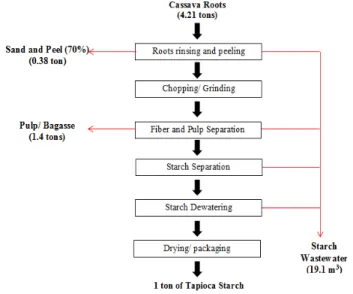
Figure 1 shows the stages involved in the processing of cassava roots into tapioca starch with its mass balance. As presented, it is clear that large amounts of solid and liquid wastes are produced along with tapioca starch. The liquid wastewater, however is produced in much greater amount i.e more than 3 times of cassava roots mass (Virunanon et. al., 2012). The liquid wastewater usually contains about 1% solids and is generally treated using open lagoon systems. On the other hand, the solid wastes are generally discarded in the environment as landfill without any treatment and therefore can cause serious problems to the environment (Pandey et. al., 2000). The basic chemical compositions of tapioca processing wastes are shown in Table 1.
Table 1
Chemical composition of tapioca agrowastes.
2.1 Cassava Peel
In the processing of cassava roots, the roots are normally peeled to remove two outer covering layers i.e the thin brown outer layer and slightly thicker but softer and leathery parenchymatous inner layer (Kongkiattikajorn and Sornvoraweat, 2011). This process is usually being done manually and the peels constitute 20-35% of the total weight of the roots (Olanbiwoninu and Odunfa, 2012). Ubalua (2007) reported that the peels are usually discarded as waste and are let to decompose naturally leading to major environmental concerns such as bad smell and river and underground water contamination.
2.2 Cassava Pulp (Bagasse)
Together with cassava peel, huge amounts of cassava pulp are also produced (Woiciechowski et. al., 2002). Cassava pulp is a fibrous byproduct of the cassava processing industry and is generally used as low-value animal feed. According to Rattanachomsri et. al. (2009), cassava pulp contains about 50-70% starch on dry weight basis and 20-30% fibers which are mainly composed of cellulose and other non-starch polysaccharides. Therefore, cassava pulp is an ideal substrate for the bioconversion into value-added product due to its high organic and low ash contents. Cassava pulp also offers other advantages such as easier hydrolysis process, low collection cost and lack of competition with other industrial uses (Rattanachomsri et. al., 2009). In a study, Hermiati et. al., (2012) reported that, besides starch, some other carbohydrates such as cellulose, galactan, xylan, ramnan, arabinan and mannan are also present in cassava pulp.
Fig.1. Processes involved in tapioca starch production and mass balance (Source: Chavalparit and Ongwandee, 2009 with modifications).
2.3 Tapioca Starch Wastewater
As clearly illustrated in Figure 1, in the tapioca starch manufacturing process, starchy wastewater is produced at the root rinsing and peeling, fiber and pulp separation, starch separation and starch dewatering processes. In the conventional tapioca starch wastewater treatment process, the wastewater is treated using a series of open lagoon treatment system before being discharged into the river (Aisien et. al., 2010). In an investigation, Sangyoka et. al. (2007) elaborated that, 1 kg of fresh cassava roots leads to the production of about 0.2 kg of starch, 0.4-0.9 kg of cake and about 5-7 liters of wastewater. The generated wastewater has a very high chemical oxygen demand (COD), biochemical oxygen demand (BOD) and total solid (TS). A study by Kamaraj (2006) reported that the total BOD, COD and TS in the cassava starch wastewater were at 6820, 10363 and 5290 mg/L, respectively. Therefore, the treatment and disposal of this wastewater require high cost and impose additional burden on the tapioca starch manufacturers.
3. Potential utilization of tapioca agrowates for biosugars production
Biosugars are one of the important intermediate products that can be produced from tapioca or cassava processing wastes (Ayoola et. al., 2012). As mentioned earlier, one of the main waste feedstock generated by the tapioca processing industry is cassava peels. Due to the presence of high amounts of starch, this feedstock could be well used to produce biosugars (Yoonan and Kongkiattikajorn, 2004; Ubalua, 2007; Olanbiwoninu and Odunfa, 2012). Yoonan and Kongkiattikajorn (2004) compared the production of glucose from cassava peels using both diluted acid and enzymatic hydrolysis processes. They argued that enzymatic saccharification using amylase followed by amyglucosidase led to better results. They also 3
Parameters Unit
Solid Agrowastes content Cassava Wastewaterc Cassava
Peela
Cassava Pulpb
Starch g/100g 42.6-64.6 66-68.89 14.98-25.5
Fibers g/100g 11.7-12.5 21.10-27.75 -
Ash g/100g 5.0-6.4 1.50-1.70 -
Protein g/100g 1.6-8.2 1.52-1.55 -
pH - - - 6.21
TDSd g/L - - 13.52
COD mg/L - - 20433
BOD mg/L - - 9750
Cyanide mg/L - - 64.0
Glucose g/100g - - 5.62-6.09
a
Oboh (2006) & Obadina et. al. (2006). b
Woiciechowski et. al. (2002).
Edma et al. / Biofuel Research Journal 1 (2014) 2 - 6
found sequential treatment by alpha amylase and amyglucosidase more promising than the other hydrolytic enzymes i.e. cellulose, xylanase and pecticnase (Yoonan and Kongkiattikajorn, 2004).
Another waste feedstock that could be used in biosugars production is cassava bagasse. According to Woiciechowski et. al. (2002), cassava bagasse could be ideally converted into reducing sugars (mainly glucose) due to its richness in organic materials mainly starch. To obtain reducing sugars from cassava bagasse, this waste must also undergo acid treatment or enzymatic hydrolysis. Woiciechowski et. al. (2002) also reported that reducing sugar recovery from cassava bagasse by using enzymatic hydrolysis stood at about 97%. This rate was only slightly higher than that of acid hydrolysis (95%). But the major weakness of using acid hydrolysis is that the equipment used must be designed to withstand corrosive conditions as well as high temperature and pressure. These lead to higher production cost which could jeopardize the economic viability of the whole process (Yoonan and Kongkiattikajorn, 2004). Beside economic issues, enzymatic hydrolysis is also preferred over acid treatment due to the prevention of unwanted browning compounds (Srinorakutara et. al., 2006).
According to Chotineeranat et. al. (2004), sachharification of cassava pulp using mixed enzymes (alpha-amylase and glucoamylase) compared to using a single enzyme resulted in higher yields of reducing sugar at 9.88 mg/mL. More specifically, combined application of alpha-amylase and glucoamylase led to about 4 and 1.3 times higher biosugars yield than by amylase and glucoamylase alone. This is ascribed to the fact that alpha-amylase supplies the non-reducing end groups to glucoalpha-amylase (Chotineeranat et. al., 2004).
Akaracharanya et. al. (2011) also reported that glucose levels climbed up by increasing glucoamylase levels from 0.4 U/g (11.8 g glucose/L) to 2.0 U/g and that the maximum glucose yield of 22.6 g/L was achieved when cassava pulp underwent enzymatic saccharification process using both alpha amylase and glucoamylase enzymes. In an earlier study, Ubalua (2007) reported the multi-enzyme hydrolysis of cassava residues by cellulase and pectinase at 28 ºC for 1 hour, followed by alpha-amylase treatment at 100 ºC for 2 hours and finally glucoamylase treatment at 60 ºC for 4 hours. In that investigation, it was found out that cassava residues with an initial non-water-soluble carbohydrate concentration of 11% (w/v), could yield 122.4 g/L of reducing sugars. The significantly increased amount of produced reducing sugars was achieved owing to the synergistic action of cellulase, alpha-amylase and glucoamylase (Ubalua, 2007).
4. Enzyme Immobilization
Immobilization can be defined as the limitation of movement of biocatalyst, such as enzymes, through the application of chemical and or physical treatment (Abdelmajeed et. al., 2012). Some other researchers have defined immobilization as a biocatalyst which has been confined or localized so that it could be reused continuously (Murty et. al., 2002). Abdelmajeed et. al. (2012) and Sheldon (2007) studied and compared free and immobilized enzyme systems and concluded that the latter offers several advantages as it allows enzymes to be easily reused multiple times for the same reaction. Immobilization also results in longer enzyme half-life and less degradation and moreover, it provides a straightforward method for controlling reaction rate as well as reaction start and termination times. Immobilization also prevents the contamination of the substrate with enzyme/protein or other compounds, which consequently results in decreased purification costs. These benefits attributed to enzyme immobilization have highlighted the applicability of this technology in a wide range of biotechnologies including biosugars and biofuel industry (Abdelmajeed et. al., 2012).
Currently there are different methods commonly used to immobilize enzymes which involve different degree of complexity and efficiency. The common methods to immobilize enzymes are listed in Table 2 which include adsorption, covalent binding, cross-linking, entrapment, and encapsulation (Murty et al., 2002; Abdelmajeed et. al., 2012). In recent years, using immobilized enzymes in starch processing has been extensively studied to obtain high purity sugars from starch. Currently in the cassava industry, biosugars such as glucose is commonly produced by processing the cassava starch. However, the tendency of using cassava for producing biosugars would affect supply of cassava as food. Therefore, the utilization of cassava wastes from the tapioca industry combined with the application of modern
technologies such as enzyme immobilization could offer promising outcomes in this vast industry. (Hermiati et. al., 2012).
Despite the fact that to date there has been an increasing number of studies on the utilization of the cassava wastes for biosugar production, however, most of them have applied free enzyme systems. To the best of our knowledge, so far just a couple of studies have reported the utilization of cassava wastes for biosugars production by using enzyme immobilization technology. Recently, Abdul Rahim et. al. (2013) investigated enzyme encapsulation for glucose production by using cassava starch as substrate. In their study, multi-enzymes (α-amylase, cellulase and glucoamylase) were successfully encapsulated within the alginate-clay beads and the beads were reused 5 times with remaining relative activity of 12%. A few years before, Baskar et. al. (2008) investigated enzyme immobilization through gel
entrapment. They immobilized α-amylase enzyme through this technique in order to produce glucose from cassava starch. These few examples highlight the necessity of using enzyme immobilization technology as a replacement for the free enzyme system for glucose production from cassava waste to increase efficiency and lower production cost.
5. Future trends
In dealing with global warming and other environmental crises caused by the increasing utilization of fossil fuels and consequent emission of greenhouse gases, renewable energy resources has been increasingly highlighted (Ayoola et. al., 2012). One of such renewable alternatives is bioethanol obtained from waste-oriented biosugars. As mentioned earlier, cassava roots processing wastes could be used for producing biosugars which could be then fermented into bioethanol (Ubalua, 2007, Hermiati et. al., 2012). In a study conducted by Oyeleke et. al. (2012) revealed that the yield obtained through enzymatic production of bioethanol from cassava peel was higher than that of sweet potato peels. This could be due to the presence of higher amount of carbohydrate (starch) in cassava peel which could be fermented into bioethanol.
Other ways to utilize cassava wastes such as pulp would be for the production of various fermentation products, including citric acid by Candida lipolytica, Lactic acid by Lactobacilli, and glutamic acid or xanthan gum (Rattanachomsri et. al., 2009; Hermiati et. al., 2012). There were also some reports indicating that the cassava pulp could be used as a medium for the production of amylase enzyme as well as for preparing composite materials (Hermiati et. al., 2012). In an investigation, Pandey et. al., (2000) managed to generate fumaric acid; an important organic acid, by using cassava pulp.
Fumaric acid has a wide range of applications as an intermediate in chemical synthesis involving esterification reactions. It is toxic and non-hygroscopic in nature and due to these properties is also used as an acidulant in food and pharmaceutical industries (Pandet et. al., 2000).
As mentioned earlier, starch recovery from cassava roots is commonly achieved by wet processing which generates a large volume of high strength liquid stream containing volatile fatty acid (VFA). These VFAs i.e. acetic, propionic and butyric acids are the intermediates for the production of biohydrogen (Reunsang et. al., 2006; Sangyoka et. al., 2007). Biohydrogen is expected to receive more attention in near future as a promising alternative energy due to the fact that its combustion is clean and non-polluting.
Cassava wastewater also can be used as fertilizer, herbicide, insecticide, biosurfactant and etc. (Aisien et. al., 2010) and last but not least, Virunanon et. al. (2012) reported this wastewater can be utilized to replace the fresh water used in fermentation practices to produce bioethanol form other resources. This not only results in saving water and preventing the discharge of polluting wastewater, but also in an increased ethanol yield, due to the starch content of the cassava wastewater.
6. Conclusions
Edma et al. / Biofuel Research Journal 1 (2014) 2 - 6
a critical step in order to achieve a fully-economized process while preserving the environment in the developing countries.
Table 2.
Methods of enzyme immobilization.
References
Abdul Rahim, S. N., Sulaiman A., Ku Hamid, K. H., 2013. Performance encapsulated enzymes within calcium alginate-clay beads in a stirred bioreactor for biosugar production. Adv. Environ. Biol. 7, 3783-3788. Abdulmajeed, N. A., Khelil, O. A., Danial, E. N., 2013. Immobilization
technology for enhancing bio-products industry. Afr. J. Biotechnol. 11, 13528-13539.
Aisien, F. A., Aguye, M. D., Aisien, E. T., 2010. Blending of ethanol produced from cassava waste water with gasoline as source of automobile fuel. Electron. J. Environ. Agric. Food. Chem. 9, 946-950.
Akponah, E., Akpomie, O. O., 2012. Optimization of bio-ethanol production from cassava effluent using Saccharomyces cerevisiae. Afr. J. Biotechnol. 11, 8110-8116.
Ayoola, A. A., Adeeyo, O. A., Efeovbokhan, V. C., Ajileye, O., 2012. A comparative study on glucose production from sorghum bicolor and manihot esculenta species in Nigeria. Intl. J. Sci. Technol. 2, 353-357. Baskar, G., Muthukumaran, C., Renganathan, S., 2008. Optimization of
enzymatic hydrolysis of manihot esculenta root starch by immobilized α -amylase using reponse surface methodology. Intl. J. Chem. Biomol. Eng. 13, 364-368.
Chavalparit, O., Ongwandee M., 2009. Clean technology for the tapioca starch industry in Thailand. J. Clean. Prod. 17, 105-110.
Chotineeranat, S., Pradistsuwana, C., Siritheerasas, P., Tantratian, S., 2004. Reducing sugar production from cassava pulp using enzymes and ultra-filtration 1: enzymatic hydrolyzation. J. Sci. Res. Chulalongkorn Univ. 29, 119-128.
Djuma’ali, Soewarno, N., Sumarno, Primarini, D., Sumaryono, W., 2011.
Cassava pulp as a biofuel feedstock of an enzymatic hydrolysis process. J. Makara Teknol. 15, 183-192.
Gaewchingduang, S., Pengthemkeerati, P., 2010. Enhancing efficiency for reducing sugar from cassava bagasse by pretreatment. J. Word Acad. Sci. Eng. Technol. 46, 727-730.
Hermiati, E., Azuma, J., Mangunwidjaja, D., Sunarti, T., Suparno, O., Prasetya, B., 2012. Hydrolysis of carbohydrates in cassava pulp and tapoca flour under microwave irradiation. Indones. J. Chem. 11, 238-245. Hermiati, E., Mangunwidjaja, D., Sunarti, T., Suparno, O., Prasetya, B., 2012.
Potential utilization of cassava pulp for ethanol production in Indonesia. J. Sci. Res. Essays, 7, 100-106.
Kamaraj, A., 2006. Biofuel production from tapioca starch industry wastewater using a hybrid anaerobic reactor. Energy Sustain. Dev. 10, 73-77.
Kongkiattikajorn, J., Sornvoraweat, B., 2011. Comparative study of bioethanol production from cassava peels by monoculture and co-culture of yeast. Kasetsart J.: Nat. Sci. 45, 268-274.
Mahmoud, D. A. R., Helmy, W. A., 2009. Potential application of immobilization technology in enzyme and biomass production. J. Appl. Sci. Res. 5, 2466-2476.
Murty, V., Bhat, J., Muniswaran, P., 2002. Hydrolysis of oils by using immobilized lipase enzyme: A review. Biotechnol. Bioprocess Eng. 7, 57-66.
Nasr, M., Tawfik, A., Ookawara, S., Suzuki, M., 2013. Biological hydrogen production from starch wastewater using a novel up-flow anaerobic staged reactor. BioResour. 8, 4951-4968.
Obadina, A. O., Oyewole, O. B, Sanni, L. O., Abiola, S. S., 2006. Fungal enrichment of cassava peels protein. Electron. Afr. J. Biotechnol. 5, 302-304.
Oboh, G., 2006. Nutrient enrichment of cassava peels using mixed culture of Saccharomyces carevisae and Lactobacillus spp solid media fermentation techniques. Electron. J. Biotechnol. 9, 46-49.
Olanbiwoninu, A. A., Odunfa, S. A., 2012. Enhancing the production of reducing sugars from cassava peels by pretreatment methods. Intl. J. Sci. Technol. 2, 650-657.
Edma et al. / Biofuel Research Journal 1 (2014) 2 - 6
Pandey, A., Sccol, C. R., Nigam, P., Soccol, V. T., Vandenberghe, L. P. S., Mohan, R., 2000. Biotechnological potential of agro-industrial residues. II: cassava bagasse. Bioresour. Technol. 74, 81-87.
Park, B. W., Yoon, D. Y., Kim, D. S., 2010. Recent progress in bio-sensing techniques with encapsulated enzyme. Biosens. Biotechnol. 26, 1-10. Rattanachomsri, U., Tanapongpipat, S., Eurwilaichitr, L., Champreda, V.,
2009. Simultaneous non-thermal saccharification of cassava pulp by multi-enzyme activity and ethanol fermentation by Candida tropicalis. J. Biosci. Bioeng. 107, 488-493.
Reunsang, A., Sangyoka, S., Imai, T., Chaiprasert, P., 2006. Biohydrogen production from cassava starch manufacturing wastewater. Asian J. Energy Env. 7, 367-377.
Sangyoka, S., Reungsang, A., Samart, M., 2007. Repeated batch fermentative for biohydrogen production from cassava starch manufacturing wastewater. Pak. J. Biol. Sci. 10, 1782-1789.
Sheldon, R. A., 2007. Enzyme Immobilization: The Quest for Optimum Performance. Adv. Synth. Catal. 349, 1289-1307.
Silva, R. D. N., Quintino, F. B., Monteiro, V. N., Asquieri, E. R., 2010. Production of glucose and fructose syrups from cassava (Manihot esculenta Crantz) starch using enzymes produced by microorganisms isolated from Brazilian Cerrado soil. Ciênc. Tecnol. Aliment. 30, 2466-2476.
Srinorakutara, T., Kaewvimol, L., Saengow, L., 2006. Approach of cassava waste pretreatments for fuel ethanol production in Thailand. J. Sci. Res. Chulalongkorn Univ. 31, 77-84.
Virunanon, C., Ouephanit, C., Burapatana, V., Chulalaksananukul, W., 2012. Cassava pulp enzymatic hydrolysis process as a preliminary step in bio-alcohols production from waste starchy resources. J. Clean. Prod. 1-7. Woiciechowski, A. L., Nitsche, S., Pandey, A., Ricardo, C., 2002. Acid and
enzymatic hydrolysis to recover reducing sugars from cassava bagasse: an economic study. J. Braz. Arch. Biol. Technol. 45, 393-400.
Wongskeo, P., Rangsunvigit, P., Chavadej, S., 2012. Production of glucose from the hydrolysis of cassava residue using bacteria isolates from Thai higher termies. J. Word Acad. Sci. Eng. Technol. 64, 353-35.
Wuttiwai, P., 2009. Cassava solves world’s crisis. The 9th International Students Summit on Food, Agriculture and Environment in the New Century. Tokyo, Japan.
Yoonan, K., Kongkiattikajorn, J., 2004. A study of optimal conditions for reducing sugars production from cassava peels by diluted acid and enzymes. Kasetsart J.: Nat. Sci. 38, 29-35.