ISSN 1982-4327 (online version)
Article
1 2
1 Correspondence address: Denise de Souza Fleith. Instituto de Psicologia, Universidade de Brasília, Campus Darcy Ribeiro. CEP 70.910-900.
Brasí-Teaching Practices for Creativity at University:
A Study in Portugal and Brazil
Abstract: Creativity is nowadays seen as an essential feature in higher education. Nevertheless, there is a discrepancy between the need for creativity and what higher education classrooms provide. This study assessed the perceptions of 1599 higher education students from two countries (1059 Brazilian and 540 Portuguese students), from two academic domains (Sciences and Technologies – Sc&T; Social Sciences, Arts, and Humanities – SScA&H), about the presence of creativity in their teachers’ instruction and evaluation practices. The study’s findings evidence interactive effects between the variables country and academic domain for most of the assessed factors: encou-ragement of new ideas, climate for the expression of ideas, and interest in students’ learning. Brazilian Sc&T students presented more negative perceptions of their classroom environments when compared to SScA&H students; Portuguese students showed opposite patterns of results. Some hypothetical explanations are discussed and future directions for research are presented.
Keywords: higher education, creativity, teaching work, students, culture
Práticas Docentes para Criatividade na Universidade:
Estudo em Portugal e no Brasil
Resumo: Criatividade é atualmente tomada como aspecto essencial na Educação Superior. Há, contudo, discrepância entre a necessidade de criatividade e o que a universidade proporciona. Este estudo avaliou percepções de 1599 alunos universitários de dois países (1059 brasileiros e 540 portugueses), de duas áreas curriculares (Ciências e Tecnologias – Sc&T; Ciências Sociais, Artes e Humanidades – Ss-cA&H) sobre a presença de criatividade nas práticas docentes, instrucionais e avaliativas, de que são alvo. Os resultados mostraram efei-tos interativos significativos entre as variáveis país e área curricular para a maioria dos fatores avaliados: encorajamento de novas ideias, clima para expressão de ideias e interesse pela aprendizagem dos alunos. Os estudantes brasileiros de Sc&T mostraram percepções mais negativas da sala de aula, comparados com os de SScA&H; os alunos portugueses obtiveram padrões opostos nos resultados. Algumas hipóteses explicativas são discutidas e são apresentadas orientações para pesquisa futura.
Palavras-chave: ensino superior, criatividade, trabalho docente, estudantes, cultura
Prácticas Docentes para Creatividad en la Universidad:
Estudio en Portugal y Brasil
Resumen: La creatividad está actualmente considerada como aspecto esencial en la Educación Superior. Sin embargo, existe discrepan-cia entre la necesidad de creatividad y lo que la universidad ofrece. Este estudio evaluó percepciones de 1.599 estudiantes universitarios (1.059 de Brasil y 540 de Portugal) de dos áreas curriculares (Ciencia y Tecnología – Sc&T; Ciencias Sociales, Artes y Humanidades – SscA&T) acerca de la presencia de creatividad en las prácticas docentes, instructivas y evaluativas dirigidas a ellos. Los resultados mos-traron efectos de interacción significativos entre las variables país y área curricular para la mayoría de los factores evaluados: fomento de nuevas ideas, entorno para la expresión de ideas e interés en el aprendizaje del estudiante. Los estudiantes brasileños de Sc&T mostraron percepciones más negativas de la clase en comparación con los de SSCA&H; los estudiantes portugueses obtuvieron patrones opuestos en los resultados. Algunas hipótesis explicativas se discuten y se presentan directrices para investigación futura.
Palabras clave: educación superior, creatividad, trabajo docente, estudiantes, cultura Denise de Souza Fleith
Universidade de Brasília, Brasília-DF, Brazil
Leandro Silva Almeida
Universidade do Minho, Braga, Portugal
Ivete Azevedo
Torrance Center Portugal, Rio Tinto, Portugal
Eunice Maria Lima Soriano de Alencar
Universidade de Brasília, Brasília-DF, Brazil
Alexandra M. Araújo
Universidade Portucalense, Porto, Portugal
Maria de Fátima Morais
Universidade do Minho, Braga, Portugal
Guilford’s (1950) presidential address at the American Psychological Association Convention, pointing out the scar-city of scientific research about creativity, was decisive for the systematic study of creativity. Nowadays, creativity is seen
as essential for innovation and for personal and organization-al success (Ahrweiler & Keane, 2013; Péter-Szarka, 2012). Since unpredictability, complexity and fast changes are con-stant features of our world, individuals have to be adaptive and show competencies to (re)create (Kim & Hull, 2012; Weinstein, Clark, DiBartolomeo, & Davis, 2014). The finan-cial recession of early 2000 also proved that creativity was
dents’ skills, teaching practices for creativity in higher edu-cation are an important issue to study (Grove-White, 2008; Walker & Gleaves, 2008). One of the most interesting sources for this research has been to inquire students about how they perceive their college teachers’ practices, and if there is a fo-cus on creativity in these practices (Slate, LaPrairie, Schulte, & Onwuegbuzie, 2011).
Some studies about teaching for creativity have been published in different parts of the world. In the UK, Oliver, Shah, McGoldrick, and Edwards (2006) found some criticism to teaching and evaluation strategies that do not promote cre-ativity, among other assessed dimensions of instruction. In Lithuania, Klimovienė, Urbonienė and Barziukienė (2010) re-lated students’ perceptions of creativity in the classroom to their learning of a foreign language. In Portugal, students presented reasonable appreciations of the interests teachers demonstrated in creativity, as well as of teachers’ incentives for innovation in the classroom, but were critical concerning certain formal as-pects of teaching and learning that were not promoting creativ-ity (Morais, Almeida, & Azevedo, 2014). In Iran, Sadeghi and Ofoghi (2011) showed that college students valued indicators of imaginative and innovative teaching. Milgram and
Davi-dovich (2010), in Israel, illustrated that perceptions of students
about creativity in teaching were related to their assessment of teaching efficiency. These perceptions may also vary with stu-dents’ academic domains, since generality and specificity co-exist in creativity but specificity seems to predominate (Baer, 2011). In this sense, competencies and specific knowledge may influence the expression of creativity (Weinstein et al., 2014).
In education in general, and specifically at university, there are different types of instruction and assessment meth-ods, expectations and values in different academic areas. A. Cropley and D. H. Cropley (2009) illustrate the relationships between different domains of study and innovation: for exam-ple, the Arts can often be more open to radical or challeng-ing creativity (more tolerant of risk and originality), while Physics or Mathematics will tolerate more socially accepted creativity (more concerned with problem solving), and learn-ing a foreign language may not accept any kind of creativity. Accordingly, Glück, Ernst and Unger (2002) also show that groups of students from different fields of study differ in their perceptions of creativity.
Oliver et al. (2006) suggest that college students value creativity based on the teachers they have and the contents they approach, as students from Arts perceive more creativity, while students from Exact Sciences are the ones with the low-est levels of perceptions of creativity, with Humanities stu-dents in the middle of both. The study conducted by Hosseini (2011) revealed different patterns in these perceptions, as En-gineering students perceive higher levels of the application of creative instructional strategies, followed by students from Sciences and students from Humanities, the latter showing lower levels of perceived creativity in their instructional en-vironments. On the other hand, studies by Zhang (2013) and Zhang and Sternberg (2011), involving Asian students, did not observe differences in perceptions when comparing ar-eas such as Mathematics, Management or Education. Sadeghi and Ofoghi (2011) also found no differences between students in order for the resolution of social and economic problems
(Lubart & Zenasni, 2010; Simona & Savvas, 2012).
If creativity has been the focus of increasing attention by professionals and researchers in diverse domains (Zhang, 2011), it is at school that there seems to be a privileged en-vironment for its development, as people spend a large part of their lifetime in this learning context (Soulé & Warrick, 2015). Creativity can be promoted in many domains and throughout students’ academic lives, in or beyond institution-al spaces (Jackson, 2006a).
Although higher education has been recognized as an important context for the development of creativity (Yama-moto, 1975), further attention is needed regarding how to develop teachers and students’ creative skills. Universities represent the stage immediately preceding people’s entry into the job market, which requires a specialized workforce with the ability to transform society (Grove-White, 2008; Pachuc-ki, Lena, & Tepper, 2010). Concerned with the optimization of higher education, Florida (2002) stated that a third of the workforce will have to be creative. Universities, “reposito-ries of research and knowledge with a high innovative po-tential, are key-elements for the (global) agenda of innova-tion” (Smith-Bingham, 2006, p. 17). Nowadays, universities must not be seen as solely concerned with the transmission of knowledge. Universities also have the role of preparing stu-dents for future challenges and opportunities, by promoting their flexibility and creativity - preparing students “with skills to manage life” (Sternberg, 2004, p. 196).
Due to the need for innovation, the relevance of promot-ing a creative climate has been widely stated, includpromot-ing higher education (A. Cropley & D. H. Cropley, 2009; Gibson, 2010). At university, teaching practices should focus on more than promoting the transmission of contents and routines (Deverell & Moore, 2014), but rather train students to inquire and inves-tigate, problematize, take risk, and think and act critically and with self-confidence. It should also include a diversity of ap-proaches, enthusiasm for teaching, and the promotion of cu-riosity, self-regulation and intrinsic motivation (Hargreaves, 2008; Sternberg, 2004). These teaching practices would break free of the PowerPoint tradition and increase inspiration and creativity (Nordstrom & Korpelainen, 2011).
The recognition of the importance of creativity in high-er education co-occurs, howevhigh-er, with discourses that signal difficulties and even contradictions. Brook and Milner (2014, p. 135) affirm that it is difficult “for academics, used to being in a position of authority, to resile from that position”, as the use of creative practices can demand more flexibility between teachers’ and students’ actions. It is questionable if higher ed-ucation successfully manages to match society’s need for cre-ative transformation nowadays (MacLaren, 2012; Walker & Gleaves, 2008). McWilliam (2008) alerts that universities are not successfully updating their contents and methodologies, not only regarding the future, but also for the present moment. Therefore, there seems to be some contradictions between the social-political positions (as well as universities discourses) that incentive creativity in higher education, and the actual observed practices (MacLaren, 2012).
stu-of Sciences, Engineering and Humanities/Social Sciences re-garding the encouragement of creativity in the classroom.
It is also important to highlight that creativity is a cul-tural and contextually embedded phenomenon (Simonton & Shing-Shiang, 2010). The cultural environment has a strong influence on creativity by supporting or inhibiting the devel-opment of individual creative efforts. The acceptance of rule defying and of what is not seen as traditionally correct, as well as social role modelling (of gender or age), influence the development and quality of creativity, and necessarily of teaching practices and opportunities to express it (A. Cropley & D. H. Cropley, 2009; Grove-White, 2008). Personal barri-ers to creative expression (e.g. resistance to change, shyness, criticism) are developed throughout life and can be evidenced by students and teachers in college (Hargreaves, 2008; Lima & Alencar, 2014). MacLaren (2012), when specifically refer-ring to the opportunities a creative university provides, de-scribes the harmful influence of society’s neoliberal values, such as time pressure, balancing cost-effectiveness, and con-trolling for productivity. This broader cultural environment is operationalized into different teaching and evaluation prac-tices regarding the development of creativity, across differ-ent domains (A. Cropley & D. H. Cropley, 2009; Jackson, 2006b). According to Jackson (2006b, p. 202), “the academ-ic disciplines (...) are the fundamental cultural domains” at university. Therefore, it is important to investigate in which ways cultural groups are taught to be creative and how cul-ture channels creativity toward certain domains and groups (Holm-Hadulla, 2013; Hong & Milgram, 2010).
Some studies have shown broader cultural influences on teachers’ and students’ perceptions about creativity in higher education. J.-K. Chen and I.-S. Chen (2012) emphasized the influence of family values, relationships with neighbours, and more general values of the Asian culture on the existence of fewer opportunities to express creativity, particularly at uni-versity. Research conducted by Zhang (2013) and Zhang and Sternberg (2011), in China and Hong Kong, revealed differ-ences in students’ conceptions about creativity, in particular about the role of intelligence in the development of creativity. Cultural differences (e.g. the education and economic condi-tions) are described by Zhang (2013) as an explanation hy-pothesis for the variations observed in this topic.
Research about students’ perceptions of university teaching practices for creativity is still very limited (Craft, Hall, & Costello, 2014). The current study addresses students’ perceptions of favourable conditions for the encouragement of creativity in their university courses. More specifically, the purpose is to compare university students from two countries (Portugal and Brazil) and from different academic areas (So-cial Sciences, Arts and Humanities; Sciences and Technolo-gy), with respect to the extent to which their teachers’ prac-tices enhance creativity in the classroom.
Method Participants
Participants were 1599 students from Brazil (n = 1059)
and Portugal (n = 540), enrolled in the third or fourth year of their undergraduate degrees, mostly women (n = 932) and from Social Sciences, Arts and Humanities courses (n = 814). Ages ranged from 16 (one student) to 68 years (one student), and the average age was 23.7 years (SD = 6.09). Participants attended mostly public institutions; however, the Brazilian subsample also included students from private institutions. Brazilian students in the Sciences and Technologies (Sc&T) group attended courses such as Maths, Geology, Computer Sciences, Physics, Engineering, Agronomy Sciences and Bio-logical Sciences; in the Social Sciences, Arts and Humanities (SScA&H), students were enrolled in courses such as Eco-nomics, Administration, Law, Pedagogy, Anthropology, and Health Sciences, Humanities and Arts courses. In Portugal, students were studying Maths, Statistics, Physics, Biochem-istry and Engineering (Sc&T), as well as Education, Psychol-ogy, Communication Sciences, Languages and Literatures, Music, Architecture and Fashion Communication (SScA&H).
Instrument
The Instruction Strategies for Creativity in Higher
Ed-ucation Inventory was administrated in Brazil in its
origi-nal version (Alencar & Fleith, 2004b) and in Portugal in its version validated for Portuguese students (Morais, Almeida, Azevedo, Alencar, & Fleith, 2014). Some of the instrument items were designed based on a literature review about cre-ativity in educational contexts, especially studies that focused on creativity in the university classroom. Other items were developed based on results from a study conducted by Alen-car (2000), about the university professor as a facilitator and inhibitor of creativity, in which two open-ended questions were used for graduate students to describe these professors’ profile. This inventory assesses four dimensions of students’ perceptions of creativity in the classroom: instruction and evaluation strategies (e.g., “in general, the professor…uses the same teaching method” - reversed score); encouragement of new ideas (e.g.“...cultivates students’ interest in new dis-coveries and new knowledge”); climate for the expression of ideas (e.g.,“…values students’ original ideas”); and teach-ers’ interest in students’ learning (e.g., “…is ready to clarify students’ doubts”). The original version of this measure in-cludes 37 items and the Portuguese validation is composed of 22 items. In the Portuguese version, the items retained in the four dimensions coincide with the factorial structure found for the Brazilian version. Two reasons explain the elimina-tion of 15 items from the original version: (1) items that the Portuguese students found ambiguous or misleading in the adaptation phase; and (2) items with factor loadings above .35 in more than one factor in the validation phase (Morais, Almeida, Azevedo, Alencar, et al., 2014). The original version was reviewed in order to be adapted to Portuguese for Portu-guese native speakers and two independent experts evaluated this adaptation.
Students rate their perceptions using a Likert scale for-mat, ranging from 1 (“Completely disagree”) to 5 (“Com-pletely agree”). Both versions present good psychometric properties. In the Brazilian version, Cronbach’s alphas ranged
from .72 to .93. Alphas ranged from .75 to .93 for the Portu-guese inventory, except for instruction and evaluation strat-egies which had a lower consistency (alpha = .53). Explor-atory factor analyses showed that the four identified factors explain 49.9% of the items’ variance for Brazilian students and 58.5% for Portuguese students. Previous publications ex-plain the construction and validation of the inventory process in Brazil, and its adaptation and validation in Portugal (Alen-car & Fleith, 2004b; Morais, Almeida, Azevedo, Alen(Alen-car, et al., 2014).
Procedure
Data collection. In both countries, university teachers
were contacted to administer the inventories in the classroom. Students were asked to evaluate their previous academic year teachers. The administration was conducted by the authors of this paper. The administration of the inventory took approxi-mately 15 minutes, in both countries.
Data analyses. Analyses were conducted using IBM
SPSS 20.0. Subscale scores were transformed in Z scores (M = 0, SD = 1), based on factor scores obtained from exploratory factor analysis, in order to permit comparisons between Bra-zilian and Portuguese students. This procedure is justified
be-cause the number of items in the Brazilian and the Portuguese version is different.
Ethical Considerations
This research project was approved by the Scientific Board of the Research Centre of Education (CIEd-UMinho). The participants were requested to sign an Informed Consent Form.
Results
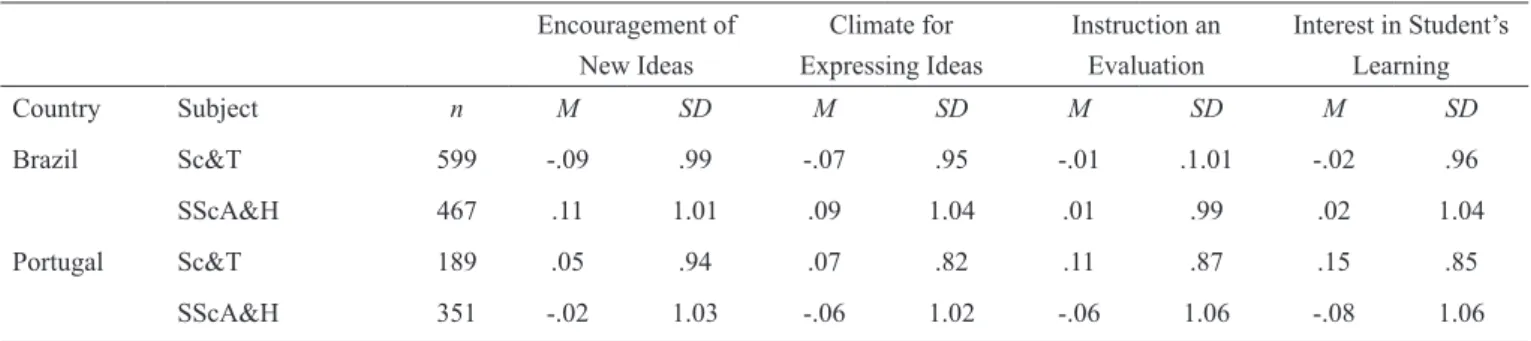
Table 1 presents the means and standard deviations of z scores (M = 0; SD = 1.0) in the four dimensions of the inven-tory. Factor scores were obtained based on regression analy-sis conducted with exploratory factor analyanaly-sis, using princi-pal components analysis with varimax rotation. As the items grouped in the Portuguese version also belong to the same factor in the Brazilian version of the inventory, this proce-dure permits obtaining comparable results in latent variables, based on students’ responses from both countries and both subject areas. Results are presented regarding students’ na-tionality and field of study (Sc&T and SScA&H).
Table 1
Results (Z-Scores) for the Four Dimensions of the Inventory, by Country and Subject Area Encouragement of New Ideas Climate for Expressing Ideas Instruction an Evaluation Interest in Student’s Learning Country Subject n M SD M SD M SD M SD Brazil Sc&T 599 -.09 .99 -.07 .95 -.01 .1.01 -.02 .96 SScA&H 467 .11 1.01 .09 1.04 .01 .99 .02 1.04 Portugal Sc&T 189 .05 .94 .07 .82 .11 .87 .15 .85 SScA&H 351 -.02 1.03 -.06 1.02 -.06 1.06 -.08 1.06
Results show variations in the means of the various subgroups for the four dimensions of the scale. The highest variation is observed for the factor Interest in Students’ Learn-ing –related to teachLearn-ing strategies and resources that motivate students to learn in a creative way – (ranging from -.08 to .15), which are the results of Portuguese students from the SScA&H and Sc&T, respectively. The second highest values are found for the factor Encouragement of New Ideas – which involves items related to the fostering of cognitive skills and affective characteristics associated with students’ creativity –, with values between -.09 and .11; in this case, both values
came from Brazilian students, belonging to the Sc&T and SS-cA&H subgroups, respectively.
In order to assess the statistical significance of the ob-served variations in students’ means in terms of nationality and subject area, we conducted a 2 x 2 analysis of variance. For the dimension Encouragement of New Ideas there was found a significant effect of the interaction between the two factors (F (1, 1594) = 5.756, p = .017, eta2 = .004) and,
there-fore, further analyses were limited to this secondary effect. Figure 1 presents variations in means, based on students’ na-tionality and subject area.
Figure 1. Results in the dimension Encouragement of New Ideas, by students’ nationality and subject area.
The difference between Brazilian students’ means from the subgroup of Sc&T and SScA&H is higher than for Por-tuguese students from the two main domains. On the other hand, while the Brazilian sample shows a more positive per-ception for students attending SScA&H courses, this relation is the reverse for the Portuguese sample, as Sc&T students present higher results for this dimension, even though the Portuguese students’ means are not clearly differentiated in terms of students’ subject area. Regarding the Climate for the Expression of Ideas – related to teachers’ attitudes of respect for and acceptance of the ideas presented by university stu-dents –, there is a significant effect of the interaction between students’ nationality and course (F (1,1594) = 6.997, p = .008,
eta2 = .004), as presented in Figure 2.
Figure 2. Results in the dimension Climate for the Expression of Ideas, by students’ nationality and subject area.
Figure 2 shows a clear contrast between students from the fields of study, in the Brazilian and Portuguese samples. It is interesting to note, however, that there is another con-trast in students’ scores, suggesting the possibility of higher results for Brazilian SScA&H students and for Sc&T students in Portugal. This situation was already found regarding stu-dents’ results for Encouragement of New Ideas, although the mean difference between the two groups of students is higher in the Portuguese sample.
Concerning the factor Instruction and Evaluation Strat-egies – which includes items related to the teachers’ educa-tional strategies and methods for evaluating students’ perfor-mance that foster students’ creativity –, no significant effect was found, combining both the independent variables, or ana-lysing their isolated impact in the scores. Finally, in Interest in the Student’s Learning, there is a significant interaction effect between nationality and subject area, F(1, 1594) = 6.677, p = .010, eta2 = .004. In order to illustrate this interactive effect,
Figure 3 presents variations in the means, combining students’ nationality and subject area.
Figure 3. Results in the dimension Interest in Students’ Learning, by students’ nationality and subject area.
In the factor Interest for Students’ Learning, Brazilian Sc&T and SScA&H students are not different in their mean scores. However, Portuguese Sc&T students present higher mean than SScA&H students for this subscale. In conclusion, in three dimensions of the scale results shows higher scores for Brazilian SScA&H students and Portuguese Sc&T stu-dents. Regarding the Encouragement of New Ideas, the mean difference between both groups is higher for Brazilian stu-dents, while the mean difference was higher for Portuguese students regarding scores in Interest for Students’ Learning. The pattern of results for both countries was the same con-cerning students’ scores for Climate for the Expression of Ideas but, in this case, mean differences between subgroups tend to be the same for both countries.
Brazil Brazil Portugal Portugal Brazil Portugal Nationality Nationality Nationality Student’s academical domains
Student’s academical domains
Student’s academical domains ,15 ,10 ,05 ,00 -,05 -,010 ,10 ,05 ,00 -,05 -,010 ,20 ,15 ,10 ,05 -,00 -,05 -,10 SScA&H Sc&T SScA&H Sc&T SScA&H Sc&T
Discussion
This study aimed to explore how university students from two countries (Portugal and Brazil) and from different academic areas (Sciences and Technology, and Social Scienc-es, Arts and Humanities) perceive creativity in their teachers’ performance. Brazilian Sc&T students presented a more neg-ative perception about the Climate for the Expression of Ideas and about the Encouragement of New Ideas in the classroom compared to SScA&H students. Data from the study conduct-ed by Alencar and Fleith (2008), involving Engineering stu-dents, are in accordance with the present study’s findings. In the former study, engineering undergraduates report that the most common barriers to creativity at university were emo-tional - fear of making mistakes, being criticized and express-ing themselves - and related to the conditions of the university and their course - lack of incentive and preparation to produce ideas. Ribeiro and Fleith (2007), examining the perceptions of Brazilian college students about the climate of the classroom for creativity, found higher scores for Humanities students when compared to Sc&T students. On the other hand, Alencar and Fleith (2004a) showed that higher education institutions - public or private - interacted with students’ area of studies. Sc&T students attending public institutions and Humanities students in private institutions reported the best representa-tions about their teachers’ practices to promote creativity. It is important to notice that, in this study, the type of institution was not considered, since the Portuguese data collection was performed only at a public university.
In Portugal, the research about perceptions of creativity by university students concerning their subject areas is prac-tically inexistent. Based on studies conducted with teachers of elementary and secondary education (compulsory educa-tion in Portugal), Humanities teachers reported less participa-tion in events and less access to informaparticipa-tion about creativity compared to Science teachers (Monteiro, Morais, Braga, & Nakano, 2013; Morais & Azevedo, 2008). Portuguese Hu-manities teachers also suggested the need for more training in creativity (Monteiro et al., 2013) and consider that initial training is less conducive to creativity when compared to Sci-ence teachers’ ratings (Morais & Azevedo, 2008). Academic training and a culture of interests and expectations common to teachers of the same subject therefore seem to be related to the perceptions and practices in teaching and learning envi-ronments, supporting results found for Portuguese students in the present study.
As for the differences between the two countries found in this study - the more favourable evaluations provided by Sc&T Portuguese students contrasting with the Brazilian SS-cA&H students’ perceptions of practices that promote cre-ativity in higher education, a possible explanation may be related to students’ political and socioeconomic environment. Economic and political restructuring, and consequent new processes of production management, lead to dynamic chang-es in the nature of and qualification levels in the job market (Carpim, Behrens, & Torres, 2014). The Portuguese econom-ic crisis may have stimulated, especially among science stu-dents, higher levels of competitiveness, pursuit of innovation
and a differential that puts them at an advantage in the job market. Portugal is also living an intense moment of migra-tion of young people who are looking for specialized jobs. In Portugal, students and teachers may be investing more in the domain of Science and Technology in order to prepare innovative and flexible workers. In the case of Brazil, which is characterized by social, economic and educational inequali-ties that are paired with a certain progress in the quality of life of the population, little has changed in recent decades. In this sense, Brazilian SScA&H students will be engaged in a class-room environment in which their teachers encourage them to exercise creativity more than Sc&T students, as reported by previous studies.
In addition, although Brazil and Portugal seem to share some similar values and traditions, such as conformity, ad-aptation to social rules and acceptance of social hierarchies, there are also differences. Brazilian people can be character-ized as group-oriented, emotional and extroverted (Fleith, 2011). Moreover, Brazilians are known as the ones who adopt the jeitinho – “an innovative problem-solving strat-egy in which the individual uses social influence combined with cunning tricks to achieve goals, despite the fact that it breaks formal rules” (Rodrigues, Milfont, Ferreira, Porto, & Fischer, 2011, p. 29). Those characteristics can eventually be required more frequently in domains like SScA&H, which more easily permit risk taking, expressing personal opinions or not following formal rules that strictly. Students of those domains can perhaps more easily perceive creativity through these characteristics. Portuguese people, on the other hand, share more traditional values, are less group-oriented and ex-pansive (Lins, Cavalcanti, & Faria, 2011). Considering that artistic domains are much more explicitly related to the devel-opment of creativity at university (Edwards, McGoldrick, & Oliver, 2006), SScA&H students can be more demanding of a creative climate in their educational environments, contrari-ly to Sc&T Portuguese students. Literature about creativity has already drawn attention to the influence of cultural factors in the development of creative potential and, therefore, one cannot talk about ahistorical, asocial and timeless creativity (Simonton & Shing-Shiang, 2010).
This study called attention to the need to understand how culture influences people’s attitudes towards the value and utility of creative endeavours, as well as how cultural groups are encouraged to be creative, considering domains and groups they belong to. Furthermore, the lack of attention to the development of creative abilities of university students has been previously highlighted (Jackson, 2006a; Morais, Almeida, & Azevedo, 2014; Wechsler & Nakano, 2011). These study findings may offer university professors some guidance concerning their practices in the classroom, consid-ering the Brazilian and the Portuguese educational environ-ment. In sum, the present study provided insights about how creativity is context dependent, even in countries that show cultural differences but also similarities – as is the case of Portugal/Brazil or Hong Kong/China (Zhang, 2013; Zhang & Sternberg, 2011). As pointed out by Lubart (1999, p. 347), “culture promotes creativity in certain forms and domains and in certain segments of the population”.
This study presents some limitations. There is an imbal-ance between the Brazilian and the Portuguese sample size, although the respective population discrepancy is also large; the data are related to Brazilian public and private institutions while, in Portugal, students attended a public institution. Also, the courses representing the academic domains are not exactly the same in both countries. It should also be kept in mind that data were self-reported. The discussion of results presented in this study is also limited by a lack of previous research about the theme. Therefore, it is difficult to comment or compare data obtained in this study and to provide robust explanations for different results considering students’ country and do-main. Future studies may include the documental analysis of public policies and educational guidelines for higher educa-tion in both countries, as well as a focus on the percepeduca-tions of teachers in different academic areas about the extent to which creativity is stimulated in higher education. In addition, this study would benefit from the adoption of qualitative methods, such as interviews and classroom observations.
References
Ahrweiler, P., & Keane, M. T. (2013). Innovations networks.
Mind & Society, 12(1), 73-90. doi:10.1007/s11299-013-0123-7
Alencar, E. M. L. S. (2000). O perfil do professor facilitador e do professor inibidor da criatividade segundo estudantes de pós-graduação [Characteristics of the creativity facili-tating and the creativity inhibiting professor according to graduate students]. Boletim da Academia Paulista de
Psi-cologia, 19(1/00), 84-95.
Alencar, E. M. L. S., & Fleith, D. S. (2004a). Creativity in the university courses: Perceptions of professor and students.
Gifted and Talented International, 19(1), 24-28. doi:10.1
080/15332276.2004.11673029
Alencar, E. M. L. S., & Fleith, D. S. (2004b). Inventário de práticas docentes que favorecem a criatividade no ensino superior [The instruction strategies for Creativity in High-er Education Inventory]. Psicologia: Reflexão e Crítica,
17(1), 105-110. doi:10.1590/S0102-79722004000100013
Alencar, E. M. L. S., & Fleith, D. S. (2008). Criatividade pes-soal: Fatores facilitadores e inibidores segundo estudantes de Engenharia [Personal creativity: Facilitating and inhib-iting factors according to Engineering students]. Magis.
Revista Internacional de Investigación en Educación, 1(1), 113-126.
Baer, J. (2011). Why teachers should assume creativity is very domain specific. The International Journal of Creativity
& Problem Solving, 21(2), 57-61.
Brook, C., & Milner, C. (2014). Reflections on “creative” action learning in business education: Some issues in its theory and practice. Teaching in Higher Education, 19(2), 126-137. doi:10.1080/13562517.2013.827651
Carpim, L., Behrens, M. A., & Torres, P. L. (2014). Paradig-ma da complexidade na prática pedagógica do professor de educação profissional no século 21 [Paradigm of com-plexity in the pedagogical practice of the professional ed-ucation teacher in the XXI century]. Boletim Técnico do
Senac, 40(1), 90-107.
Chen, J.-K., & Chen, I.-S. (2012). Critical creativity criteria for students in higher education: Taking the interrelation-ship effect among dimensions into account. Quality &
Quantity, 46(4), 1057-1075. doi:10.1007/s11135-011-9448-7
Craft, A., Hall, E., & Costello, R. (2014). Passion: Engine of creative teaching in an English university? Thinking Skills
and Creativity, 13, 91-105. doi:10.1016/j.tsc.2014.03.003
Cropley, A., & Cropley, D. H. (2009). Fostering creativity: A
diagnostic approach for higher education and organiza-tions. Cresskill, NJ: Hampton.
Deverell, A., & Moore, S. (2014). Releasing creativity in teaching and learning: The potential role of organizational legitimacy and increased dialogue. Innovations in
Educa-tion and Teaching InternaEduca-tional, 51(2), 164-174. doi:10.1
080/14703297.2013.771968
Edwards, M., McGoldrick, C., & Oliver, M. (2006). Creativ-ity and curricula in higher education: Academic’s per-spectives. In N. Jackson, M. Oliver, M. Shaw, & J. Wis-dom (Eds.), Developing creativity in higher education:
An imaginative curriculum (pp. 59-73). New York, NY:
Routledge.
Fleith, D. S. (2011). Creativity in the Brazilian culture.
On-line Readings in Psychology and Culture, 4(3), 1-20.
doi:10.9707/2307-0919.1037
Florida, R. (2002). The rise of the creative class: And how it’s
transforming work, leisure, community and everyday life.
New York, NY: Basic Books.
Gibson, R. (2010). The ‘art’ of creative teaching: Implications for higher education. Teaching on Higher Education,
15(5), 607-613. doi:10.1080/13562517.2010.493349
Glück, J., Ernst, R., & Unger, F. (2002). How creatives define creativity: Definitions reflect different types of creativity.
Creativity Research Journal, 14(1), 55-67. doi:10.1207/
S15326934CRJ1401_5
Grove-White, A. (2008). Editorial. Innovations in
Edu-cation and Teaching International, 45(3), 205-207.
doi:10.1080/14703290802175958
Guilford, J. P. (1950). Creativity. American Psychologist,
5(9), 444-454. doi:10.1037/h0063487
Hargreaves, J. (2008). Risk: The ethics of a creative curricu-lum. Innovations in Education and Teaching
Holm-Hadulla, R. M. (2013). The dialectic of creativity: A synthesis of neurobiological, psychological, cultural and practical aspects of the creative process. Creativity
Re-search Journal, 25(3), 293-299. doi:10.1080/10400419.2
013.813792
Hong, E., & Milgram, R. M. (2010). Creative thinking abili-ty: Domain generality and specificity. Creativity Research
Journal, 22(3), 272-287. doi:10.1080/10400419.2010.50
3535
Hosseini, A. S. (2011). University student’s evaluation of cre-ative education in universities and their impact on their learning. Procedia - Social and Behavioral Sciences, 15, 1806-1812. doi:10.1016/j.sbspro.2011.04.007
Jackson, N. (2006a). Imagining a different world. In N. Jack-son, M. Oliver, M. Shaw, & J. Wisdom (Eds.), Developing
creativity in higher education: An imaginative curriculum
(pp. 1-9). New York, NY: Routledge.
Jackson, N. (2006b). Making sense of creativity in higher education. In N. Jackson, M. Oliver, M. Shaw, & J. Wis-dom (Eds.), Developing creativity in higher education:
An imaginative curriculum (pp. 197-215). New York, NY:
Routledge.
Kim, K. H., & Hull, M. F. (2012). Creative personality and anticreative environment for high school dropouts.
Cre-ativity Research Journal, 24(2-3), 169-176. doi:10.1080/1
0400419.2012.677318
Klimovienė, G., Urbonienė, J., & Barziukienė, R. (2010). Creative classroom climate assessment for the advance-ment of foreign language acquisition. Studies about
Lan-guage, (16), 114-121.
Lima, V. B. F., & Alencar, E. M. L. S. (2014). Criatividade em programas de pós-graduação em educação: Práticas pedagógicas e fatores inibidores [Creativity in gradu-ate degrees programs: Teaching practices and inhibiting factors]. Psico-USF, 19(1), 61-72. doi:10.1590/S1413-82712014000100007
Lins, S. L. B., Cavalcanti, C. M., & Faria, R. C. P. (2011). Valores humanos e comportamento ecológico de univer-sitários brasileiros e portugueses [Human values and eco-locical behavior of Brazilian and Portuguese university students]. EDUCAmazônia, 6(1), 42-74.
Lubart, T. (1999). Creativity across cultures. In R. J. Stern-berg (Ed.), Handbook of creativity (pp. 339-350). New York, NY: Cambridge University Press.
Lubart, T., & Zenasni, F. (2010). A new look at creative gift-edness. Gifted and Talented International, 25(1), 53-57. doi:10.1080/15332276.2010.11673549
MacLaren, I. (2012). The contradictions of policy and prac-tice: Creativity in higher education. London Review of
Education, 10(2), 159-172. doi:10.1080/14748460.2012.
691281
McWilliam, E. (2008). Unlearning how to teach. Innovations
in Education and Teaching International, 45(3), 263-269.
doi:10.1080/14703290802176147
Milgram, R. M., & Davidovich, N. (2010). Creative think-ing and lecturer effectiveness in higher education. The
International Journal of Creativity and Problem Solving, 20(1), 7-14.
Monteiro, A. S., Morais, M. F., Braga, A., & Nakano, T. (2013). Representações sobre criatividade: Diferenças entre docentes portugueses do ensino básico e secundário [Representations of creativity: Differences between basic and secondary education Portuguese teachers].
Amazôni-ca – Revista de Pesquisa em EduAmazôni-cação, Psicopedagogia e Psicologia, 11(1), 327-357.
Morais, M. F., Almeida, L., & Azevedo, I. (2014). Criativida-de e práticas docentes no ensino superior: Como pensam os alunos de áreas curriculares diferentes? [Creativity and teaching practices in higher education: How do students of different fields of study think?]. Amazônica – Revista
de Pesquisa em Educação, Psicopedagogia e Psicologia, 12(2), 97-126.
Morais, M. F., Almeida, L. S., Azevedo, I., Alencar, E. M. L. S., & Fleith, D. S. (2014). Validação portuguesa do Inventário de Práticas Docentes na Educação Superior [Validation of the Instruction Strategies in Higher Educa-tion Inventory]. Avaliação Psicológica, 13(2), 167-175. Retrieved from http://pepsic.bvsalud.org/pdf/avp/v13n2/ v13n2a04.pdf
Morais, M. F., & Azevedo, I. (2008). Criatividade em con-texto escolar: Representações de professores dos Ensinos Básico e Secundário [Creativity in the school context: Basic and secondary education teachers’ representations]. In M. F. Morais & S. Bahia (Orgs.), Criatividade e
edu-cação: Conceitos, necessidades e intervenção
[Creativi-ty and education: Concepts, necessities and intervention] (pp. 157-196). Braga, Portugal: Psiquilíbrios.
Nordstrom, K., & Korpelainen, P. (2011). Creativity and in-spiration for problem solving in engineering education.
Teaching in Higher Education, 16(4), 439-450. doi:10.10
80/13562517.2011.560379
Oliver, M., Shah, B., McGoldrick, C., & Edwards, M. (2006). Student’s experiences of creativity. In N. Jackson, M. Ol-iver, M. Shaw, & J. Wisdom (Eds.), Developing creativity
in higher education: An imaginative curriculum (pp.
43-58). New York, NY: Routledge.
Pachucki, M. A., Lena, J. C., & Tepper, S. J. (2010). Creativ-ity narratives among college students: SociabilCreativ-ity and ev-eryday creativity. The Sociological Quarterly, 51(1), 122-149. doi:10.1111/j.1533-8525.2009.01161.x
Péter-Szarka, S. (2012). Creative climate as a means to pro-mote creativity in the classroom. Electronic Journal of
Ribeiro, R. A., & Fleith, D. S. (2007). O estímulo à criativi-dade em cursos de licenciatura [Stimulating creativity in undergraduate students]. Paidéia (Ribeirão Preto), 17(38), 403-416. doi:10.1590/S0103-863X2007000300010 Rodrigues, R. P., Milfont, T. L., Ferreira, M. C., Porto, J. B.,
& Fischer, R. (2011). Brazilian jeitinho: Understanding and explaining an indigenous psychological construct.
In-teramerican Journal of Psychology, 45(1), 27-36.
Sadeghi, A., & Ofoghi, N. (2011). The psychological factors affecting student’s creativity inside the class. Procedia
So-cial and Behavioral Sciences, 15, 263-270. doi:10.1016/j.
sbspro.2011.03.084
Simonton, D. K., & Shing-Shiang, T. (2010). Creativity in Eastern and Western civilizations: The lessons of histo-riometry. Management and Organizational Review, 6(3), 329-350. doi:10.1111/j.1740-8784.2010.00188.x
Simona, M.-Y., & Savvas, S. (2012). Creativity in business schools – post financial crisis implications.
Internation-al JournInternation-al of OrganizationInternation-al AnInternation-alysis, 20(2), 187-202.
doi:10.1108/19348831211227828
Slate, J. R., LaPrairie, K. N., Schulte, D. P., & Onwuegbuzie, A. J. (2011). Views of effective college faculty: A mixed analysis. Assessment & Evaluation in Higher Education,
36(3), 331-346. doi:10.1080/02602930903428684
Smith-Bingham, R. (2006). Public policy, innovation and the need for creativity. In N. Jackson, M. Oliver, M. Shaw, & J. Wisdom (Eds.), Developing creativity in higher
educa-tion: An imaginative curriculum (pp. 10-18). New York,
NY: Routledge.
Soulé, H., & Warrick, T. (2015). Defining 21st century
readi-ness for all students: What we know and how to get there.
Psychology of Aesthetics, Creativity, and the Arts, 9(2),
178-186. doi:10.1037/aca0000017
Sternberg, R. J. (2004). Teaching college students that creativ-ity is a decision. Guidance & Counseling, 19(4), 196-200. Walker, C., & Gleaves, A. (2008). An exploration of students’ perceptions and understandings of creativity as an as-sessment criterion in undergraduate-level studies within higher education. Irish Educational Studies, 27(1), 41-54. doi:10.1080/03323310701837855
Wechsler, S. M., & Nakano, T. C. (Orgs.). (2011).
Criativi-dade no ensino superior: Uma perspectiva internacional
[Creativity in higher education: An international perspec-tive]. São Paulo, SP: Vetor.
Weinstein, E. C., Clark, Z., DiBartolomeo, D. J., & Davis, K. (2014). A decline in creativity? It depends on the domain.
Creativity Research Journal, 26(2), 174-184. doi:10.1080
/10400419.2014.901082
Yamamoto, K. (1975). Creativity and higher education: A review. Higher Education, 4(2), 213-225. doi:10.1007/ BF01569170
Zhang, L.-F. (2011). The developing field of intellectual styles: Four recent endeavours. Learning and Individual
Differ-ences, 21(3), 311-318. doi:10.1016/j.lindif.2010.11.018
Zhang, L.-F. (2013). Conceptions of creativity among Hong Kong university students. Educational Psychology: An
International Journal of Experimental Educational Psy-chology, 33(5), 521-539. doi:10.1080/01443410.2013.81
2615
Zhang, L.-F., & Sternberg, R. J. (2011). Revisiting the invest-ment theory of creativity. Creativity Research Journal,
23(3), 229-238. doi:10.1080/10400419.2011.595974
Maria de Fátima Morais is a professor of the Instituto de Educação at Universidade do Minho.
Denise de Souza Fleith is a professor of the Instituto de
Psico-logia at Universidade de Brasília.
Leandro Silva Almeida is a full professor of the Instituto de
Educação at Universidade do Minho.
Ivete Azevedo is the director of Torrance Center Portugal. Eunice Maria Lima Soriano de Alencar is an Emeritus
Profes-sor of the Instituto de Psicologia at Universidade de Brasília.
Alexandra M. Araújo is a professor in the Departamento de
Psicologia e Educação at Universidade Portucalense.
Received: Oct. 10, 2015 1st Revision: Apr. 20, 2016 Approved: June 15, 2016
How to cite this article:
Morais, M. F., Fleith, D. S., Almeida, L. S., Azevedo, I., Alencar, E. M. L. S., & Araújo, A. M. (2017). Teaching practices for creativity at university: A study in Portu-gal and Brazil. Paidéia (Ribeirão Preto), 27(67), 56-64. doi: 10.1590/1982-43272767201707