Abstract
This article presents part of the results of a research project aimed at analyzing factors of attraction and rejection associated to a teaching career as perceived
by a cohort of undergraduate, inalist and graduate students of the teaching
degree courses in Pedagogy and Mathematics of a private higher education institution in the Federal District. This project administered questionnaires and conducted focal group sessions and individual interviews. Thematic Analysis of Content was used for data analysis. The results show that some of the factors of attraction associated to a teaching career are those intrinsic to the profession
(emotional gratiication, reciprocal learning), while the factors of rejection are mostly extrinsic, such as inancial rewards, social devaluation, work overload,
violence in schools, teacher malaise and others. The paper concludes that, in spite
of ofering low salaries, teaching is an attractive career for candidates socially, economically and culturally less well of.
Keywords: Higher education. Teaching career. Career choice. Teacher education.
1 Introduction
Choosing a career marks a determinant moment in the life of any young person. The process of deining a profession and entering into the world of work depends on a series of intrinsic and extrinsic factors that relate to one another in diferent
ways. Several authors have underscored that people’s professional destinies do not only depend on their personal characteristics but also on the historical, social,
a Universidade Católica de Brasília. Brasília, Distrito Federal, Brasil. b Universidade Católica de Brasília. Brasília, Distrito Federal, Brasil.
Recebido em: 23 fev. 2016 Aceito em: 18 abr. 2016
Teaching career’s attraction and
rejection factors: analysis of
students and graduates perceptions
in teacher education programs
Candido Alberto Gomes a
political economic, family and other contexts they ind themselves in (GATTI, 2009; RAMOS; LIMA, 1996; SOARES, 2002; VALLE, 2006). Ferreira, Nascimento and Fontaine (2009) state that the construction of vocational development is a social process that takes place in the interaction of the individual with himself,
with others and with her/is social environment, depending on opportunities that
may appear in the life of the individual. In the context of choosing a teaching career, Valle (2006) proposes two hypotheses for its occurrence: a) as the result
of a conscious or unconscious decision made during higher secondary education,
or before, due to the attraction that a teaching career efectively exercises on the student; or b) as a result of the impossibility of the student entering some other
career for which he really has a vocation.
There are data showing that the numbers of students concluding teaching degree
courses, especially in the ields of Chemistry, Physics, Mathematics and Biology are insuicient to meet the needs of the education systems (BECA, 2007; RUIZ; RAMOS; HINGEL, 2007), thereby showing that teaching has attracted too few young people in Brazil. That fact may make renovation diicult and lead to a shortage of professionals in Brazil in the not too distant future. Thus, the question arises: what are the factors of attraction and rejection associated to a
teaching career?
The classical sociological research carried out by Lortie (2002) in five cities in the greater Boston metropolitan area identiied the main factors of
attraction of teaching in that particular spatial and temporal context. The
author classiied the results around ive themes: 1) interpersonal relations; 2) teaching as “priesthood”, a giving of oneself; 3) continuity; 4) material beneits; 5) compatibility of time.
The irst theme was the most mentioned by the interviewees. “A taste for working with people” was the factor of attraction of the career. Indeed, teaching is one of the professions that ofer constant contact with younger people. According to that author, while it is true that other professions like pediatrics and social assistance also work with children, in the teaching career contact is not restricted to sick or socially disadvantaged children. The second factor concerns the aspect
of priesthood or a calling, giving of oneself. Many of the survey respondents cited this humanitarian and assistance-orientated aspect of the profession as being one of its attractions. The third theme includes those that quite simply
like school and want to work in the ield of education and others that like certain
environment. The fourth aspect concerns material beneits (salary, prestige and employment security).
In turn, Rabelo (2010a; 2010b) investigated the reason for their choice of teaching as a career among male teachers working in the early schooling years of basic
education in Aveiro, Portugal and in Rio de Janeiro and found that intrinsic
factors (liking the profession and being fond of children) were the most relevant. Extrinsic factors like employability, proitability, the need for a job, and lack of opportunities were also mentioned. Souza (2010) found that most of the teaching
degree undergraduates in his study had chosen the course because they wanted to
become teachers. Liking the profession was also cited as a motive for the teachers to remain in it (GIESTA, 2008). The study of samples of students drawn from three diferent generations studying in the irst and second semesters of a public teacher education school in Mexico City, conducted by Garduño and Sandoval (2006), showed that almost half those interviewed had chosen the profession for
extrinsic reasons.
According to Valle (2006), the low level of attraction associated to a teaching career is connected to the following factors 1) uncertainty regarding the future of the profession; 2) poor salaries; 3) limited possibilities for personal ascension; and 4) precarious working conditions. In the view of Diniz-Pereira (2011), the crises that have afected teaching undergraduate programs are related to students’ diicult experiences with their own upkeep during the course, the expectation
of a poor salary level for the profession and the decline of teaching’s social
prestige. Based on bibliographic-documental research, Barbosa (2011; 2012)
concluded that the salary is one of the main factors responsible for the increasing
precariousness of teaching work.
In an investigation of perceptions of attractive aspects of the teaching profession conducted among students in higher secondary education, Lima (2010) and Tartuce, Nunes and Almeida (2010) concluded that the main aspects discouraging students from entering the profession are linked to social and economic questions like poor pay, bad working conditions and the profession’s lack of social recognition. Indeed, only 2% of students in higher secondary education had any intention of becoming teachers (TARTUCE; NUNES; ALMEIDA, 2010).
Gatti and Barreto (2009) argue that the unattractive salaries and career plans that
the teaching profession. Fröhlich’s (2013) research showed that if there were an increase of 1% in teachers’ average salary as compared to other professionals in
the municipality, the probability of the teaching degree courses being selected
would increase by 8 to 20%. However, it must be underscored that valuing the
educators and their profession is not related to the salary alone but to various
other factors such as social prestige and the recognition of their role as conlict mediators in the light of society’s social, cultural and economic diiculties (PIMENTEL, PALAZZO, OLIVEIRA, 2009).
The unattractiveness of the teaching profession in Brazil has been conirmed by a series of research studies and in the practice of administrators. The lack of teachers makes itself felt in certain study subjects and certain regions and
apparently the situation is currently getting worse. For those very reasons, as part
of a study of this phenomenon (PALAZZO, 2015) begun in 2011, the present
article sets out to analyze the factors of attraction and rejection associated to the teaching career.
2 Method
This exploratory research takes the form of a case study. Thus, the intentional
sample was determined by the criteria that it should be a private institution and therefore have lower candidate/vacancy ratio than the public ones. A college with
around 4,000 students enrolled, it was in the average degree of selectivity among the private ones. Its location was in an administrative region with an average
family income close to the average family income for the Federal District as a
whole (GOVERNO DE BRASÍLIA, 2012).
To generate and gather data, the study administered questionnaires and conducted focal group sessions and individual interviews. The questionnaires were
administered live to undergraduate beginners and inalists. The return was 65.6% for beginners in the Pedagogy course and 78.3% of those in the Mathematics course; and among the inalists it was 67.4% from those in the Pedagogy course and 100% from those concluding their Mathematics course. In the case of university
graduates, the questionnaires were administered by e-mail but the response rate
was unsatisfactory (16.8% for Pedagogy and 23.4% for Math graduates). It was therefore decided to hold interviews by phone in order to complete at least 33.3%
of the sample.
(F for female and M for male) and after that came a number from one to 689. Thus, a code such as GPM-35 would represent participant number 35 who was a graduate (G) of the Pedagogy course (P) and a male (M).
2.1 Participants
Research focused on groups made up of students and graduates in diferent situations: a) beginners in the Mathematics and Pedagogy courses who entered in the second semester of 2010 and the first semester of 2011; b) students concluding the same two courses in the irst semester of 2012; and c) students that had graduated and left in any one of the ive semesters from the 2nd semester of 2010 to the 2nd semester of 2012. Table 1 shows the numbers of students,
by course and by condition in the course (undergraduate beginner, undergraduate
inalist or graduate).
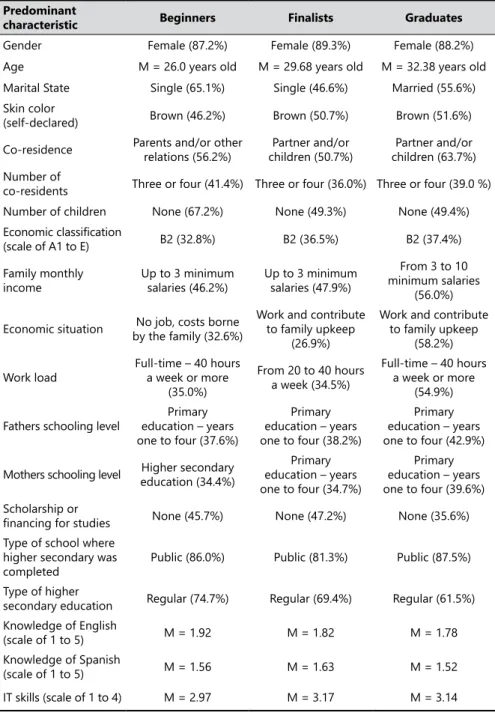
The answers to the questionnaires deined the social-economic-cultural proile of the participants. Table 2 is a synthesis of the predominant features of each group.
The results show that survey participants were students from low-income families
with very little knowledge of foreign languages, not frequent readers of books or newspapers and with only a timid presence in diversiied cultural activities, these
last usually being limited to the movies. Most of them had a higher schooling level
than their parents. On the other hand, they declared that they had good knowledge of IT and access to the internet – mostly broad-band access. Furthermore, the
internet was their main source of information and updating. The economic, social
and cultural situation of the inal semester students compared to the beginners
appeared to be better. Part of the statistics gathered by the survey showed that students in the teaching degree courses had a lower socioeconomic status than
those in the Law course (PALAZZO, 2015; PALAZZO; GOMES, 2012). In the social hierarchy of curricula, the qualiication of educators appears once more
with a relatively low level of social prestige, selected by less privileged people
(BELTRÃO; MANDARINO, 2014).
Table 1. Numbers of participants by courses and by conditions.
Condition Pedagogy Mathematics Total
Beginners 145 42 187
Finalists 62 13 75
Graduates 155 25 180
Total 362 80 442
Table 2. Predominant characteristics of beginners, inalists and graduates participating
in the research, 2011, 2013, 2014.
Predominant
characteristic Beginners Finalists Graduates
Gender Female (87.2%) Female (89.3%) Female (88.2%)
Age M = 26.0 years old M = 29.68 years old M = 32.38 years old
Marital State Single (65.1%) Single (46.6%) Married (55.6%) Skin color
(self-declared) Brown (46.2%) Brown (50.7%) Brown (51.6%)
Co-residence Parents and/or other relations (56.2%) Partner and/or children (50.7%) Partner and/or children (63.7%) Number of
co-residents Three or four (41.4%) Three or four (36.0%) Three or four (39.0 %)
Number of children None (67.2%) None (49.3%) None (49.4%)
Economic classiication
(scale of A1 to E) B2 (32.8%) B2 (36.5%) B2 (37.4%)
Family monthly income
Up to 3 minimum salaries (46.2%)
Up to 3 minimum salaries (47.9%)
From 3 to 10 minimum salaries
(56.0%)
Economic situation No job, costs borne by the family (32.6%)
Work and contribute to family upkeep
(26.9%)
Work and contribute to family upkeep
(58.2%)
Work load
Full-time – 40 hours a week or more
(35.0%)
From 20 to 40 hours a week (34.5%)
Full-time – 40 hours a week or more
(54.9%)
Fathers schooling level
Primary education – years one to four (37.6%)
Primary education – years one to four (38.2%)
Primary education – years one to four (42.9%)
Mothers schooling level Higher secondary education (34.4%)
Primary education – years one to four (34.7%)
Primary education – years one to four (39.6%) Scholarship or
inancing for studies None (45.7%) None (47.2%) None (35.6%)
Type of school where higher secondary was completed
Public (86.0%) Public (81.3%) Public (87.5%)
Type of higher
secondary education Regular (74.7%) Regular (69.4%) Regular (61.5%) Knowledge of English
(scale of 1 to 5) M = 1.92 M = 1.82 M = 1.78 Knowledge of Spanish
(scale of 1 to 5) M = 1.56 M = 1.63 M = 1.52
IT skills (scale of 1 to 4) M = 2.97 M = 3.17 M = 3.14
3 Results
First it must be stated that for many students, especially those in the Pedagogy
course, the teaching course was not their irst choice. In some cases, the decision was taken because they had been beneited by the ofer of a scholarship of the
University for All Program (Prouni). For most of the students in Almeida’s
(2015) study, obtaining a Prouni scholarship was the only way they could get
in to higher education. In other words, it is an alternative for students in the low income bracket:
I intend to inish my Pedagogy course, work in Youth and Adult Education, and then when I can afford it, I intend to study psychology (BPF-42).
Continuation
Computer use
frequency Always (49.7%) Always (52.0%) Always (58.2%)
Internet access Yes (95.2%) Yes (98.6%) Yes (97.8%)
Use of broad band
service Yes (81.2%) Yes (89.0%) Yes (95.6%)
Computer use location Home (89.8%) Home (94.7%) Home (95.6%)
Purpose of computer
user School work (94.6%) School work (96.0%)
Communication via e-mail (85.9%)
Number of
(nonacademic) books read in the year before
Maximum two (44.4%)
Maximum two (44.4%)
From three to ive
(34.1%)
Type of book most read Fiction (39.2%) Religious books (40.0%)
Religious books (52.5%)
Frequency of reading newspapers
Several times a week (40.8%)
Several times a week (40.8%)
Several times a week (38.7%)
Topic most read in newspapers
Culture and/or Art (39.8%) Science. Health and/or technology (41.9%) Science. Health and/or technology (47.1%) Culture and/or Art
(47.1%)
Means for keeping up
to date Internet (80.6%) Internet (78.4%) Internet (92.3%)
Artistic/cultural
preference Cinema (68.8%) Cinema (80.0%) Cinema (81.3%)
Well, I had the chance of a scholarship. I wanted to take biology, but I am really liking it [Pedagogy] (BPF-55).
Well, actually it was not exactly what I had decided to do, was it? When I sat the entrance exams I had only just inished high school so I did not have a very clear idea of what I wanted. So then I sat the ENEM exams and the Prouni and for the Prouni I had to mark ive choices and I ended up choosing Pedagogy [Pedagogy was third choice after Administration and language and literature]. And that was what I got a scholarship for. So because I did not know what I really wanted to do, I ended up in the Pedagogy course (GPF-664).
Because I love the area of exact sciences. Actually at irst I had wanted to take engineering but then the scholarship was awarded for Mathematics and I liked that area too (GMF-633).
The perspectives revealed by those graduates seem to conirm the hypothesis
of auto-selection in the choice of a higher education course. That is to say, the students anticipate the moment of formal selection and choose courses that are
compatible with their socioeconomic and academic characteristics (NOGUEIRA, 2012; NOGUEIRA; ALMEIDA; QUEIROZ, 2011; NOGUEIRA; PEREIRA,
2010; PAUL; SILVA, 1998). The selection occurs on the basis of an a priori
estimate of their capacity in comparison with the rest of the candidates and of the intensity of the competition to access each one of the prospective careers (academic
auto-selection) in addition to the auto-selection based on their socioeconomic characteristics and gender. In the view of Bueno and Enge (2004), the students,
especially those with a socially inferior origin, identify the less sought after
courses even if they are not their irst choice. Zago (2006, p. 232) goes so far as to question the use of the term “choice” when referring to a higher education course, considering that “for most of them there is no true choice involved at all
but, instead, an adaptation, an adjustment to the conditions that the candidates
consider to be compatible with their realities and which, accordingly, ofer less risk of exclusion.”
One aspect that stood out was the dichotomy in the participants’ discourse on
the social valuing of teaching: at one time, they referred to it as a positive aspect and, at others, as something that was lacking. On the one hand, they recognized
the teachers’ important role in society, and praised it for that reason, as in the
following speech of one of the graduates: “The teacher educates the doctor,
On the other hand, they questioned the social devaluation of the profession
frequently associated to poor salaries and precarious working conditions. The very fact of entering on their course had modiied some students’ views in regards to the profession: “I began to value it more, to acquire a vision that valued the teacher... everyone here knows that teachers are highly undervalued” (BPF-15).
Reciprocal learning is one of the positive aspects mentioned in relation to the
course, or as Pimenta and Anastasiou (2005, p, 205) put it, “the “teaching-learning” process in which “the act of teaching is only deined in relation to the act of
learning, because apart from the goal, which reveals intentionality, teaching
necessarily sets in motion the act of learning”. For the survey participants,
teaching is a profession that allows for, and requires continuous learning. Apart
from that, there is the emotional gratiication, as revealed in the words of the following participants:
I think that what is attractive about it is that you... it’s kind of like…. you are transmitting to the child and the child is managing to learn (BPF-35).
[...] Apart from the personal satisfaction of collaborating with the students’ achievement (FMM-195).
Being a teacher means being an agent of change. Change begins in the classroom and carries on throughout the person’s life. The teacher makes a strong contribution to molding mentalities, and that is a highly relevant task. I believe that society is in need of structural changes (FPF-261).
[...] Seeing the results is really something and you get the feeling of having done your duty (FPF-209).
It is rewarding because being a teacher is a mission; it is an opportunity to be part of various individuals who are in the process of formation (FPF-217).
To be able to live in the social reality and know that I can make a diference (FPF-248).
Because I work with something I really like to do. It is not the kind of job where you wake up and say “Oh God, I’ve got to go!” No! It’s the kind where you say: “Hey… So-and-so will be there. He is so cute. He has already learned to spell his name. He knows to count.” Anything they achieve, however small it may seem, I am there, taking part alongside them. I helped them to build. So I think it is just as much an achievement for me as for them (GPF-680).
Because, you know, it is a satisfaction, isn’t it?... teaching other children to learn to read, to write. It really gives me tremendous satisfaction (GPF-666).
Nowadays a teacher’s function is to, is… I believe we are in a very diicult situation but, even so, it is very gratifying. So from the moment you see a child’s smile, you perceive that its developing and learning, you can see in that little face that he can get ahead, become a good citizen, get a good job, because I believe, I do believe that education will be the salvation of our country (GPF-643).
Several participants saw teaching as an assistance-orientated, altruistic, humanitarian project and associated it to their own wish to help their neighbor,
to contribute towards improving education in the country and improving Brazilian society, thereby conirming, once more, the literature on this theme (LELIS, 2009; LORTIE, 2002; MELLO, 2003). According to Tardif and Lesard (2009, p. 283), “happiness in work stems from the joy of working with children, youngsters, of helping them; it stems from seeing them grow and progress, change, learn, teach themselves, make discoveries…”. In those authors’ view, the love that stems from the children is a decisive factor in making choice of the profession and remaining in it, deining the teachers’ relation with the work; a fact that is conirmed by the
relevant research. The statements below illustrate that vision of giving, priesthood,
and vocation, still very much present in society’s collective imagery:
It is my way of contributing to society (GMF-510).
It [the profession] is rewarding insofar as you undertake work that will inluence the construction of a better, more critical and autonomous society (GPF-521).
From the fact of being aware of the relevance of education and how it collaborates in the life and molding of a citizen (GPF-517).
For the love of education. For the need to improve education in our country more and more (GPF-628).
[I intend] to change the vision, you know, that a lot of people have
of education in the public sphere, because many are dissatisied with education. So then I would like to change their vision a little, wouldn’t I? It is not what they think it is (GPF-666).
I think all teachers would like to improve education, wouldn’t they? That is what we work towards (GPF-641).
Mello (2003) stated that teaching was seen, above all, as a kind of priesthood, self-giving and humanitarian, for the welfare of others “motivated by subjective reasons such as ‘achieve fulillment as a person, serve ones fellow man, being at peace with oneself” (p. 75). According to Lelis (2009, p. 59), “current collective
social imagery is still founded on the rhetoric of mission, of priesthood and vocation,
an archetype that strongly impregnates that professional group”. Indeed, intrinsic factors such as “working with children, intellectual satisfaction and contributing to society” are important motivations among those that choose to enter the teaching profession in many countries like Australia, Belgium, Canada, France, Holland, Slovakia and the United Kingdom (ORGANIZAÇÃO PARA COOPERAÇÃO E DESENVOLVIMENTO ECONÔMICOS, 2006, p. 70).
Furthermore, some participants, especially those in the Pedagogy course, attributed
considerable importance to the question of employability. In their view, the course ofers a general qualiication that opens up various diferent labor opportunities:
Because it opens not only professional doors but also doors in terms of civil service entrance exams, because this Pedagogy course opens up a range of opportunities (FPF-236).
It is a course with a broad scope that gives access to various areas of work (FPF-241).
At the time, [I chose the course] because it was one that I could see would beneit me in the future. A broad labor market, a ield of work in which I would not only be able to work in the classroom but would have other possible ields I could work in. It was more a question of the labor market (GPF-652).
It is a profession which will never leave us unemployed (GPF-597).
Well, at irst it was because of the labor market. My father persuaded me to take it. It was not because I really wanted to, no. I am being sincere […]. Actually the labor market really is good. When you inish university you don’t ind yourself unemployed. Today I am teaching on a temporary contract with the Federal District government (GPF-624).
Those data conirm the results that Silva and Speller (2008) obtained. They surveyed graduates in Pedagogy from the Federal University of Mato Grosso (UFMT) and found that one of the motives for which they had originally entered
the course was the ease of getting a job after qualifying. According to Miranda
(2011, p. 75) teaching is often seen as being “a professional ield which has space enough to absorb its qualiied professionals; a ield with ‘open doors’ even during
times of economic crisis and high unemployment rate, thereby constituting a
‘stronghold’ of employment”.
All the above declarations seem to show that the choice of the course was motivated
by practical considerations of people in low-income brackets, anxious to gain
employment and achieve their social ascension and, to some extent, for salary considerations. Thus, the data in the literature suggest that the profession is not
chosen because of the high level of inancial rewards it ofers; instead, because of
the expectation that it will facilitate entry to the labor and provide relative stability
in spite of the steady drops registered in fertility rates and birthrates in Brazil over
the last few decades and, consequently, that is, a drop in the numbers of future students. Such points of attraction tend to be less interesting for people that aspire
to excellence and high position and more to those who seek alternatives for their
professional lives because they feel that other options are almost unattainable,
given the limitations inherent to their status, including their inancial possibilities.
and qualify their citizens and workers. In other words, they concentrate their
attention on the foundations and not on the roofs of their construction.
Negative aspects, in turn, are not only more numerous but they are also cited more frequently. Various earlier studies (BRANDÃO, 2012; ENS; EYNG; GISI, 2009; LEME, 2012; LIMA; SICCA; DAVID, 2012; LUNKES; ROCHA FILHO, 2011; OLIVEIRA et al., 2011; TARTUCE; NUNES; ALMEIDA, 2010; VALLE, 2006) revealed that low salaries and social devaluation are the main motives for
dissatisfaction with a teaching career and those were the predominant factors of rejection mentioned by the participants in the present survey.
The question of social devaluation is to some extent related to the low salaries paid to teachers and was also one of the factors with a negative association to the profession and to the teaching degree course itself as can be seen in the excerpt
from this participant’s statement:
[...] The devaluation of the teacher makes it an unattractive career; and we can see that, can’t we? Even in the street it is a course that nobody values much. When you see other professions it seems that everyone in them has a determined value. When you say you are taking a Pedagogy degree, everyone looks down on
you… (BPF-689).
[The profession] is rewarding if you love it and develop it for that same reason because the poor pay, conditions that are often unfavorable, among other things, contribute towards professional discouragement (FPF-206).
[The profession] is rewarding in some aspects but not in others because, unfortunately, teachers are not highly thought of by society; we work a lot for very low salaries (BPF-249).
One of the undergraduate beginners expressed indignation at the devaluation of the course and the prejudice of other students, narrating what she had overheard
in the corridors of the institution: “One day we heard a young man talking to
On the other hand, it is sometimes the students themselves who express disdain
for the course they are taking as for example the student who declared that he could not aford to take a better course, as if the teaching degree course was
something no good: “I am taking the pedagogy course because I like it but also
because I am not in a position, as yet, to take a better course, but I think I am doing well because I want to become a teacher and dedicate myself to the study of law” (BPF-13).
The participants were unanimous in citing the rewards, inancial or otherwise (like health plans and food vouchers) as negative aspects of the profession. Due
to the poor salaries, there is a need to complement income, that is, engage in an
additional activity or work longer hours. Working conditions were mentioned in direct relation to the question of remuneration. More speciically mentioned
were the large numbers of students in a single class, the accumulation of
responsibilities and the great number of hours worked. Barbosa (2011) explains that the teaching profession involves many working hours (distinct from teaching hours which only take place in the classroom), because their work is
not limited to the classroom but also involves their private spaces where they
carry out tasks such as preparing classes, planning, correcting students’ work,
elaborating tests, etc.
Teaching malaise, associated to stress caused by overwork or overload and bad working conditions was yet another factor for the rejection of a teaching career. In the research undertaken by Jesus et al. (1992), in the Portuguese context, surveying a sample of 151 teachers in the 2nd and 3rd cycles of Basic education (years 5–6 and years 7, 8, 9 respectively) and in secondary education (years 10, 11, 12), the factors that most contributed to teachers’ malaise were related to overload and the lack of control over tasks, followed by relations with their peers. The statements taken from the participants reveal that unease:
Continuing in the career wears you down a lot, doesn’t it? For someone who starts of very early in life, when age comes creeping in, I am getting older and I just can’t take it anymore. That is why the Federal District has so many people pensioned of; everything is coming to a standstill (BPF-130).
It is an area that pays little and the routine is very tiring and wears you out (GPF-529).
Well, it is very tiring and depending on which municipality you teach in, there is an enormous diference in working conditions (GPF-520).
I learned a lot in the Pedagogy course so I felt a bit frustrated when I entered the labor market, you know? That was because I could see that it is a job that demands a lot from people, a lot. It is not just the work of literacy training and formation or some such thing. You are molding a human being in various ways and so you are constantly called to account and there is a lot of work so we have to really dedicate ourselves. And in the end there is very little recognition considering the work we do, you know? We have work that really wears you down (GPF-664).
The literature conirms the low level of salaries and the profession’s social
devaluation as factors for the rejection of a teaching career and also as motives for
abandoning the profession (BARBOSA, 2011; 2012; BRANDÃO, 2012; BUENO; ENGE, 2004; ENS; EYNG; GISI, 2009; LIMA, 2010; LIMA; SICCA; DAVID, 2012; LUNKES; ROCHA FILHO, 2011; OLIVEIRA et al., 2011; SILVA, 2012; TARTUCE; NUNES; ALMEIDA, 2010; VALLE, 2006). Some cases of teachers abandoning the profession were also identiied in the present study:
I have no intention of going back [to work in education] I don’t want that at all. I was highly frustrated when I left. I have worked in the area already. So, that is the way it is. I don’t want it. I have all the traumas. I don’t want it (GPF-649).
At the moment I have a job that is outside of my area of qualiication. And the work is better, there is better pay that allows me to take the studies I am engaged in. [I worked in education] yes, for a period of six months and I left it for questions of remuneration (GPF-605).
Another negative aspect of the profession that emerged in one of the groups was
the question of violence in school directed as much at teachers as among students:
Nowadays violence among the students and against teachers ends up being a strong discouraging factor, for those who really want to grow and develop in this area; who wants to teach. Because today we can see in the news that a ten year-old child attacked a teacher, you know? I think that kind of thing discourages us a lot (BPF-2).
The graduates surveyed by Gomes and Pereira (2009) also expressed their concern with violence in schools as well as their lack of any training in how to handle
it. The absence of parents in the formation of their children and the placing of blame on the school and teachers for the problems in education also came up for discussion when the subject was the factors that repel students from the prospect
of embarking on a teaching career “because education is increasingly seen as if it
were a cure for all the problems of a salary-earning society and the transformations
of the economy” (TARDIF; LESSARD, 2009, p. 282). The participants were also concerned about the responsibility of looking after children:
Nowadays, parents think that the school has to take on their role: educate, correct and everything else. But that is not the case because they do not give us the right to correct the child itself. So I think that much of this violence takes place because the parents do not participate in the education ofered in school (BPF-3).
To sum up, the following were identiied as factors of attraction associated to teaching:
1. Emotional gratiication.
2. Reciprocal learning (teaching-learning).
3. Demand for professionals.
4. Valuation of the profession.
The factors that follow were associated to rejection of the profession and were
1. Rewards (financial and non-financial), that make it necessary to
complement income.
2. Social devaluation.
3. Teaching malaise related to the teacher’s stress and health.
4. Violence in schools, both among students and directed at teachers.
5. Divergence between the ideal and the real.
6. Work load, namely classes with too many students, long working hours and
accumulated responsibilities.
7. Absence of parents in the formation of their ofspring.
4 Conclusion
It was categorically shown that most of the factors of attraction associated to teaching were those intrinsic to the profession (emotional gratiication, reciprocal learning), while the factors of rejection were mainly extrinsic to it, such as remuneration and reward, social valuation, work load, school violence, malaise and others. Thus. the results corroborate Herzberg’s Two Factor Theory (MELLO, 2003; TRIGO-SANTOS, 1996), whereby factors of personal satisfaction are intrinsic to the work (eiciency in performing it, recognition, fulillment, responsibility, progress in the career), whereas those of dissatisfaction are extrinsic to the work and include salary, social status, policy measures, technical working conditions, interpersonal relations (with colleagues, superiors or subordinate personnel),
security, supervision and personal life.
Thus, public policies need to focus on extrinsic sources if they wish to change the status quo. The forms of dissatisfaction are reiterated, nevertheless, efective
actions are lacking to meet the challenges; obstacles which appear to be more of a political nature than of an economic-inancial one. Obviously, in most cases it is not feasible to ofer large linear salary increases. However, the present research
shows that there are other ways to increment extrinsic satisfaction. One fear is
Compared to other professions that require a university degree, teaching ofers lower salaries. Nevertheless, for socially, economically and culturally (in the sense of cultural capital) less well-of candidates, teaching becomes an attractive
professional possibility as a way of achieving social and economic ascension. On the other hand, the undergraduate beginners that participated in the survey were fully aware of the negative factors associated to their course right at the beginning of it. Therefore, they must have made a conscious choice and enrolled in spite of them. The data suggest that for a considerable portion of those students
teaching is a residual option, “chosen” according to their academic capabilities
and, even more so, to their economic capacities. There may still be those with alternative motives such as human relationships, especially with children, while others, inspired by career motivations associated to more competitive and
better-rewarded careers seek out other pathways.
How can a country possibly aspire to have quality education if its future educators are those that only chose education because they felt that there were no other
openings for them? While other countries are looking to the future and dedicating themselves to research and high quality, democratic education, Brazil persists in its “depositories” for children and young people: in its unequal health service provision that victimizes the majority of the population; in its provincialism; in its “positions of trust” in the sense of making personal indications instead of indications based on merit; in facilitating the issue of diplomas and certiicates; in its intellectual and linguistic provincialism; in servile copying instead of original
creation. The option continues to be between a fair, competent and democratic
country or a country with untreated sewage running in the open air; with the
Fatores de atratividade e rejeição da carreira do
magistério: uma análise a partir de estudantes e
egressos de licenciatura
Resumo
O presente artigo relata parte dos resultados de uma pesquisa cujo objetivo foi analisar fatores de atratividade e rejeição da carreira docente por parte de uma coorte de alunos ingressantes, concluintes e egressos dos cursos de Licenciatura em Pedagogia e em Matemática de uma instituição privada de ensino superior no Distrito Federal. Para tanto, foram aplicados questionários e conduzidos grupos focais e entrevistas individuais. Os dados foram analisados por meio da análise temática de conteúdo. Os resultados revelam que grande parte dos fatores de atração do magistério foram os intrínsecos à proissão (gratiicação emocional, aprendizagem recíproca), enquanto os fatores de rejeição foram majoritariamente extrínsecos a ela, tais como recompensas inanceiras, valorização social, carga de trabalho, violências escolares, mal-estar, entre outros. O trabalho conclui que o magistério, apesar de oferecer baixos salários, é uma carreira atrativa aos candidatos menos aquinhoados social, econômica e culturalmente. Palavras-chaves: Educação superior. Magistério. Escolha proissional. Formação de professores.
Factores de atracción y de rechazo a la carrera del
magisterio: un análisis de estudiantes y egresados de
programas de licenciatura
Resumen
Este artículo reporta parte de los resultados de una investigación que buscó analizar factores de atracción, así como de rechazo a la carrera docente, en relación a una cohorte de estudiantes ingresantes, concluyentes y egresados de cursos de Pedagogía y Matemática de una institución privada de educación superior en el Distrito Federal. Fueron aplicados cuestionarios y realizadas entrevistas individuales, así como grupos focales, utilizándose el análisis de contenido para análisis de los datos. Sus resultados revelan que los más fuertes factores de atracción del magisterio son intrínsecos a la profesión (gratiicación emocional, aprendizaje recíproco), mientras los factores de rechazo fueron mayoritariamente extrínsecos, tales como recompensa inanciera, valoración social, carga de trabajo, violencia escolares y mal estar. Este trabajo concluye que el magisterio, a pesar de ofrecer bajos salarios, es una carrera atractiva para candidatos menos favorecidos desde los puntos de vista social, económico y cultural.
References
ALMEIDA, W. M. Os herdeiros e os bolsistas do ProUni na cidade de
São Paulo. Educação e Sociedade, v. 36, n. 130, p. 85-100, jan./mar. 2015.
doi:10.1590/ES0101-73302015139538
BARBOSA, A. Os salários dos professores brasileiros: implicações para o
trabalho docente. Brasília, DF: Líber Livro, 2011.
______. Implicações dos baixos salários para o trabalho dos professores
brasileiros. Revista Educação e Políticas em Debate, v. 2, n. 2, p. 384-408,
jul./dez. 2012.
BECA, C. E. A situação do magistério no Brasil: peril dos professores da
educação básica. In: BALZANO, S. (Org.). O desaio da proissionalização
docente no Brasil e na América Latina. Brasília, DF: Unesco, 2007. p. 33-40.
BELTRÃO, K. I.; MANDARINO, M. C. F. Escolha de carreiras em função
do nível socioeconômico: Enade 2004 a 2012.Rio de Janeiro: Fundação Cesgranrio, 2014. (Relatório técnico, n. 1/2014).
BRANDÃO, D. F. Você quer ser professor?: um estudo sobre o interesse
de licenciandos em Pedagogia pela proissão docente. 2012. 97f. Dissertation (Masters in Social Psichology) – Universidade Federal de Sergipe, Aracaju, 2012.
BUENO, B. O.; ENGE, J. S. Magistério e mercado de trabalho: motivações
e dilemas na escolha proissional. Ensaio:Avaliação e Políticas Públicas em
Educação, v. 12, n. 44, p. 789-809, jul./ set. 2004.
DINIZ-PEREIRA, J. E. O ovo ou a galinha: a crise da proissão docente e a
aparente falta de perspectiva para a educação brasileira. Revista Brasileira de Estudos Pedagógicos, v. 92, n. 230, p. 34-51, jan./abr. 2011.
ENS, R. T.; EYNG, A. M.; GISI, M. L. Políticas de formação de professores
e as representações de estudantes de pedagogia e biologia sobre o trabalho do docente. Nuances: estudos sobre Educação, v. 16, n. 17, p. 69-83, jan./dez.
2009. doi:10.14572/nuances.v16i17.321
FERREIRA, A. F.; NASCIMENTO, I.; FONTAINE, A. M. O papel do
FRÖHLICH, C. E. A relação entre salários de professores e seleção de candidatos a carreiras de magistério: estimativas para municípios brasileiros entre 2004 e 2010. 2013. 67f. Dissertation (Masters in Economic Development) – Universidade Federal do Paraná, Curitiba, 2013.
GARDUÑO, J. M. G.; SANDOVAL, J. O. Motivación y expectativas para ingresar a la carrera de profesor de educación primaria: un estudio de tres
generaciones de estudiantes normalistas mexicanos de primer ingreso. Revista Electrónica de Investigación Educativa, v. 8, n. 2, 2006. Available from: <http://redie.uabc.mx/vol8no2/contenido-garduno.html>. Acess: 2011 Nov. 30.
GATTI, B. A. Atratividade da carreira docente no Brasil: relatório preliminar.
São Paulo: Fundação Carlos Chagas, 2009.
GATTI, B. A. (Coord.).; BARRETO, E. S. S. Professores do Brasil: impasses
e desaios. Brasília, DF: Unesco, 2009.
GIESTA, N. C. Professores do ensino médio em escolas públicas: o gosto pelo
que sabem e fazem na proissão docente. Araraquara: Junqueira & Marin, 2008.
GOMES, C. A.; PEREIRA, M. M. A formação do professor em face das
violências das/nas escolas. Cadernos de Pesquisa, v. 39, n. 136, p. 201-24,
jan./abr. 2009. doi:10.1590/S0100-15742009000100010
GOVERNO DE BRASÍLIA. Companhia de Planejamento do Distrito
Federal – CODEPLAN. Pesquisa Distrital por Amostra de Domicílios:
Distrito Federal – PDAD/DF 2011. Brasília, DF: Codeplan, 2012. Available
from: <http://www.codeplan.df.gov.br/component/content/article/261-pesquisas-socioeconomicas/257-pdad-2011.html>. Acess: 2012 Dec. 1
JESUS, S. N. et al. Estudo dos factores de mal-estar na proissão docente.
Psychologica, n. 8, p. 51-60, 1992.
LELIS, I. A construção social da proissão docente no Brasil: uma rede de
histórias. In: TARFIF, M.; LESSARD, C. (Org.). O ofício de professor: história,
perspectivas e desaios internacionais. 3. ed. Petrópolis: Vozes, 2009. p. 54-66.
LEME, L. F. Atratividade do magistério para a educação básica: estudo com
LIMA, R. C. P.; SICCA, N. A. L.; DAVID, A. Representações sociais de estudantes de pedagogia sobre o trabalho docente em sua trajetória
de formação. Educação & Linguagem, São Paulo, v. 15, n. 25, p. 58-82,
jan./jun. 2012. doi:10.15603/2176-1043/el.v15n25p58-82
LIMA, T. Atratividade da carreira docente: um estudo em uma escola
da rede pública de ensino de um município da Grande São Paulo. 2010. 131f. Dissertation (Profssional masters in Teaching Maths) – Pontifícia Universidade Católica de São Paulo, São Paulo, 2010.
LORTIE, D. C. Schoolteacher. 2. ed. Chicago: The University of Chicago
Press, 2002.
LUNKES, M. J.; ROCHA FILHO, J. B. A baixa procura pela licenciatura em física, com base em depoimentos de estudantes do ensino médio público
do oeste catarinense. Ciência e Educação, v. 17, n. 1, p. 21-34, 2011.
doi:10.1590/S1516-73132011000100002
MELLO, G. N. Magistério de 1º grau: da competência técnica ao
compromisso político. 13. ed. São Paulo: Cortez, 2003.
MIRANDA, M. H. G. Magistério masculino: (re) despertar tardio da
docência. Recife: Ed. Universitária da UFPE, 2011.
NOGUEIRA, C. M. M. Escolha racional ou disposições incorporadas: diferentes referenciais teóricos na análise sociológica do processo de escolha
dos estudos superiores. Estudos de Sociologia, v. 2, n. 18, 2012. Available
from: <http://www.revista.ufpe.br/revsocio/index. php/revista/article/ view/66>. Acess: 1 Jul. 2013.
NOGUEIRA, C. M. M.; ALMEIDA, F. J.; QUEIROZ, K. A. S. A escolha da
carreira docente: complexiicando a abordagem sociológica. Revista Vertentes,
v. 19, n. 1, 2011. Available from: <http://www.ufsj.edu.br/portal2-repositorio/ File/vertentes/v.%2019%20n.%201/Claudio_Nogueira_e_outros.pdf>. Acess: 2013 May 9.
NOGUEIRA, C. M. M.; PEREIRA, F. G. O gosto e as condições de sua realização: a escolha por Pedagogia entre estudantes com peril social e
escolar mais elevado. Educação em Revista, Belo Horizonte, v. 26, n. 3,
p. 15-38, dez. 2010. doi:10.1590/S0102-46982010000300002
ORGANIZAÇÃO PARA A COOPERAÇÃO E DESENVOLVIMENTO
ECONÔMICO. Professores são importantes: atraindo, desenvolvendo e
retendo professores eicazes. São Paulo: Moderna, 2006.
PALAZZO, J. A escolha do magistério como carreira: por quê (não)?. 2015. 286f.
Thesis (Doctor in Educacion) – Universidade Católica de Brasília, Brasília, 2015. PALAZZO, J.; GOMES, C. A.. Origens sociais dos futuros educadores:
a democratização desigual da educação superior. Avaliação, v. 17, n. 3,
p. 877-98, nov. 2012. doi:10.1590/S1414-40772012000300013
________. Professores de menos, licenciados demais? Educação Online, n.
15, p. 14-35, jan./abr. 2014.
PAUL, J.-J.; SILVA, N. V. Conhecendo o seu lugar: a auto-seleção na escolha
de carreira. Revista Brasileira de Política e Administração da Educação,
v. 14, n. 1, p. 115-30, jan./jun. 1998.
PIMENTA, S. G.; ANASTASIOU, L. G. G. Docência no ensino superior.
2. ed. São Paulo: Cortez, 2005.
PIMENTEL, G. S. R.; PALAZZO, J; OLIVEIRA, Z. R. B. B. Os planos
de carreira premiam os melhores professores?, Ensaio:Avaliação e Políticas Públicas em Educação, v. 17, n. 63, p. 355-80, abr./jun. 2009. doi:10.1590/S0104-40362009000200009
RABELO, A. “Eu gosto de ser professor e gosto de crianças”: a escolha
proissional dos homens pela docência na escola primária. Revista Lusófona de
Educação, n. 15, p. 163-73, 2010b.
________. Professores homens nas séries iniciais: escolha proissional
e mal-estar docente. Educação & Realidade, v. 35, n. 2, p. 279-298,
maio/ago. 2010a.
RAMOS, S. G.; LIMA, E. R. O secundarista e o processo de escolha
da proissão. Revista Brasileira de Estudos Pedagógicos, v. 77, n. 185,
p. 191-219, jan./abr. 1996.
RUIZ, A. I.; RAMOS, M. N.; HINGEL, M. Escassez de professores no Ensino
Médio: propostas estruturais e emergenciais. Brasília, DF: MEC, 2007.
SILVA, A. C. E.; SPELLER, M A. R. Formação e proissão docente. Cuiabá:
SILVA, D. O curso de Licenciatura em Matemática da PUC/SP e a trajetória proissional de seus egressos (2005-2010). 2012. 107f. Dissertation (Masters in Mathematics Education) – Pontifícia Universidade Católica de São Paulo, São Paulo, 2012.
SOARES, D. H. P. A escolha proissional: do jovem ao adulto. 2. ed. São
Paulo: Summus, 2002.
SOUZA, L. O. Motivações para a escolha da Licenciatura em Matemática
e Pedagogia: um estudo com alunos da PUC/SP e UFMT. 2010. 104f. Dissertation (Masters Proissional em Ensino de Matemática) – Pontifícia Universidade Católica de São Paulo, São Paulo, 2010.
TARDIF, M.; LESSARD, C. O trabalho docente: elementos para uma teoria da
docência como proissão de interações humanas. 5. ed. Petrópolis: Vozes, 2009. TARTUCE, G. L. B. P.; NUNES, M. M. R.; ALMEIDA, P. C. A.
Alunos do ensino médio e atratividade da carreira docente no Brasil.
Cadernos de Pesquisa, v. 40, n. 140, p. 445-77, maio/ago. 2010. doi:10.1590/S0100-15742010000200008
TRIGO-SANTOS, F. Atitudes e crenças dos professores do ensino secundário:
satisfação, descontentamento e desgaste proissional. Lisboa: Instituto de Inovação Educacional, 1996.
VALLE, I. R. Carreira do magistério: uma escolha proissional deliberada? Revista
Brasileira de Estudos Pedagógicos, v. 87, n. 216, p. 178-187, maio/ago. 2006. ZAGO, N. Do acesso à permanência no ensino superior: percursos
de estudantes universitários de camadas populares. Revista
Brasileira de Educação, v. 11, n. 32, p. 226-37, maio/ago. 2006. doi:10.1590/S1413-24782006000200003
Informações dos autores:
Candido Alberto Gomes: Doutor em Educação pela Universidade da Califórnia, Los
Angeles. Professor na Universidade Católica de Brasília. Contato: [email protected]
Janete Palazzo: Doutora em Educação pela Universidade Católica de Brasília. Contato: