TRANSFORMATION OF SOMATIC EMBRYOS OF VITIS SP. (GRAPEVINE)
WITH
DIFFERENT CONSTRUCTS CONTAINING NUCLEOTIDE SEQUENCES
FROM NEPOVBUS COAT PROTEIN GENES
GOLLES, R., A. DA CAMARA MACHADO, V. TSOLOVA, A. BOUQUET, R. MOSER, M . S . LOPES, D. MENDONCA,
H.
~ T I N G E R & M. LAIMER DA CAMARA MACHADO L 1996. Transformation o f somatic e m b r y o s o f Vitis sp. (grapevine) with differentconstructs containing nucleotide sequences f r o m nepovirus c o a t protein genes. Arqiiipe'lngo. L i f e a n d M a r i n e Sciences 14A: 67-74. P o n t a Delgada. I S S N 0873- 4 7 0 4 .
Breeding of grapevines. one of the world's most widcly-grown fruit crop, as in the case with many woody crops, is hampered by genetic heterozygozity and long generation time. Transformation offcrs new alternatives in the genetic improvement of grapevine. Nepovimses are the grapevine viruses of greatest economic importance because of their worldwide occurrence and the severe damages they cause. An Agrobncteriurn-mediated gene transfer system relying o n repetitive embryogencsis has been used to regenerate transgenic grapevines. Embryogenic cultures of Vitis vinifera (Russalka
-
selfpollinatcd) and 1 10 Richter (Vitis rupestris x Vitis berlandieri) were transformed with Agrobacteriron turnefacierzs strain LBA 4404 containing various binary plasmids. pBinCUSint. carrying the marker gene P-glucuronidasc (GUS). and seven different constructs containing chimeric coat protein (CP) genes of grapevine fanleaf virus (CFLV), including nontranslatable and truncated forms of the C P gene. and arabis mosaic virus (ArMV), respectively. Putative transformed embryos werc selected by continued proliferation on kanamycin containing medium. Embryos transformed with the plasmid pBinCUSint were shown to exprcss the GUS gene by histochemical analyses.GOLLES, R., A. DA CAMARA MACHADO, V. TSOLOVA, A. BOUQUET, R. MOSER, M.S. LOPES, D. MENDONCA, H. UTlNGER & M. LAIMER DA CAMARA MACHADO
1996. Transforma@o d e embri6es s o m j t i c o s d e Vitis sp. (videira) c o m diferentes produtos, c o n t e n d o s e q d n c i a s nucleotidicas d e g e n e s d e proteina d a c6psula d e nepovirus. Arquipe'lngo. C i h c i a s Biol6gicas e M a r i n h a s 14A: 67-74. P o n t a Delgada. I S S N 0873-4704.
0 melhoramento de videiras. uma das plantas mais cultivadas no mundo. tal como muitas outras plantas lenhosas. C dificultado devido h sua elevada heterozigocidadc gcnitica e longo ciclo vegetativo. Assim a engcnharia genktica torna-se um instrumento importante num programa de melhoramento de videiras. 0 s nepovirus s5o os virus da videira corn maior importhcia econ6mica. devido i sua distribuiGBo pelo mundo inteiro e aos graves danos que provocam. Um sistema de transformaq50 genCtica atravCs d e Agrobncreri~on baseado na embriogenese somfitica repetitiva, foi utilizado para regenerar vinhas transginicas. Culturas embriogCnicas de Vitis virtifera (Russalka
-
auto-polinizada) e Richter 110 (Vitis rupestris x Vitis berlandieri) foram transformadas com AgroDacterrum turnefacierzs estirpe LBA 4404. contendo vfirios plasmideos binfirios. pBinGUSint.transportando diferentes marcadores genbticos, P-glucuronidase (GUS), e sete construgies diferentes contendo quimeras do gene da proteina da capsula do virus do urticado da videira (GFLV) e do virus mosaico-arabico (ArNV), incluindo formas n2o transcn'veis e incompletas, respectivamente. 0 s embri8es transformados foram selecionados atravbs da sua continua proliferagi'o em meios contendo kanarnicina. A express20 do gene marcador foi demonstrada atraves de anases histoquimicas do produto do gene GUS.
R. .Golles, R. Moser, H. Katinger & M. Laimer da Cdmara Machado, University of Agriculture and Forestry, Institute of Applied Microbiology, NuJdotferlZinde 11, 1190 Vienna, Austria
-
A. da C h a r a Machado, M.S. Lopes & D. Mendonca, Vniversidade dos Agores, Departamento de Ci&zcias Agra'rias, Terra Chii., PT-9700, Angra do Heroismo, Acores, Portugal-
V. Tsolova, Institute of Viticulture and Enology, 1 Kala Tepe, BG-5800 Pleven, Bulgaria-
A. Bouquet, INRA, Domaine de Chapitre, FR-34571 Villeneuve lks Maguelonne Cedex, France.INTRODUCTION
Grapevine fanleaf nepovirus (GFLV), the most widespread soil-borne grapevine virus, together with arabis mosaic virus (ArMV) and other nepoviruses is responsible for grapevine fanleaf disease. Control of nematode vectors by soil fumigation is largely inefficient. Furthermore the use of nematicides is being restricted because of the detrimental effects on the soil inhabiting fauna and pollution of surface waters. Therefore new approaches for introducing virus resistance to grapevine would be desirable.
It has been shown that the expression of the viral coat protein (CP) even in altered forms can protect plants efficiently against virus infection (BEACHY et al. 1990; LINDBO & DOUGHERTY 1992). Given the economic importance of nepoviruses, several laboratories are working on the introduction of CP genes into plants in order to induce virus resistance (STEINKELLNER et al. 1991; BARDONNET et al. 1994; KRASTANOVA et al. 1995; MAURO et al. 1995).
Somatic embryogenesis offers an interesting opportunity for genetic transformation by the repetitive process of proliferation of embryos in culture (TSOLOVA et al. 1995). These new secondary embryos are formed from single epidermal cells of primary embryos (POLITO et al. 1989; MACHADO et al. 1995a), ensuring the genetic uniformity of the resulting transformants.
From what has been reported so far, not only the regeneration of transgenic plants from transformed cells, but also the efficiency of the selection procedure is a major problem in the transformation of grapevines due to the extreme sensitivity of Vitis tissue to kanamycin (COLBY &
MEREDITH 1990).
We present the principal steps of an Agrobacterium-mediated gene transfer system based on repetitive embryogenesis. Somatic embryos were obtained from immature zygotic embryos of seedless V. vinifera (TSOLOVA &
ATANASSOV 1994) and from anthers of 110 Richter (LE GALL et al. 1994).
These explants were transformed with 6 different constructs of the CP gene of GFLV, carrying either the full-length CP,
3
truncated forms of the CP and 2 untranslatable forms of the CP gene either in antisenes (AS) or sense (S) orientation (GOLLES 1994), and the ArMV CP gene.The P-glucuronidase (GUS) gene (VANCANNEYT et al. 1990) was used to gain information about transformation, behaviour of the tissue during the cocultivation with Agrobacterium tumefaciens, and the selection procedures that followed. The obtained data served as guidelines for the handling of presumptive transformants with different forms of the GFLV or A r m CP gene.
MATERIAL AND METHODS
For the construction of plant transformation vectors containing different forms of the
GFLV
CP gene the full-length CP gene was first cloned into the vector pSP73 (Promega). The resulting plasrnid pGFLV-CP (GOLLES 1994) was used for the amplification of the various forms of the GFLV CP gene by PCR with specific primers. The particular genes were inserted into the ~ g i U site of the plant expression vector pGA643 (AN et al. 1988). The obtained plasmids are the following: pGA-CP+ contains the full-length CP gene of GFLV with an introduced start codon. pGA-CP differs from the former by a deletion of 15 bp within the CP gene corresponding to the nt 238
-
252 of the CP gene of GFLV strain F13 (SERGHINI et al. 1990). pGA-AS carries the same gene construct as pGA-CP+ but in antisense orientation, resulting in an untranslatable form of the gene. In the plasmid pGA-S two stop codons were introduced after the inserted start codon by PCR. The sequence GGATTAGCTGGTAGAwas changed to GGATAAGCTGGTTGA
resulting in an untranslatable CP gene in sense orientation. pGA5'TR contains a CP cDNA which is shortened by 138 bp at the 5'-end. Plasmid pGA3'TR carries a CP gene with a truncatiop of
168 bp at the 3'-end of the gene.
The binary plasmid pROK-ArMV contains the ArMV CP gene downstream of the enhanced 35s promotor and the TMV omega leader sequence and before the NOS terminator sequence (BERTIOLI et al. 199 1).
Two repetitively embryogenic Vitis-lines were used in our transformation experiments: Line 7- 312E1 (selfpollinated Russalka 3) was established by inducing embryogenesis from immature ovules of this stenospermocarpic Vitis vinijera
cultivar (TSOLOVA & ATANASSOV, 1994). The second embryogenic line was a long-term somatic embryogenic callus culture obtained from the vegetative tissues of anthers of the grapevine rootstock 110 Richter (Vitis rupestris x Vitis berlandieri) (LE
GALL
et al. 1994).Culture conditions were as previously described (MACHADO et al. 1995b; LE GALL et al. 1994).
The influence of different concentrations of kanamycin on the root development and the adventitious embryogenesis of seedless grapes (line 7-312E1, Russalka
-
selfpollinated) was determined by culturing somatic embryos on modified NN69 medium (TSOLOVA &ATANASSOV 1994) with 12.5, 25, 50, and 100 mgA kanamycin.
An Agrobacterium tumefaciens LBA4404 suspension, containing the wanted plasrnid, was inoculated from an overnight culture and grown to a density of OD600=0.6. For cocultivation, the suspension was diluted 1 5 0 in 3 % sucrose solution and white embryogenic clusters were dropped into the Agrobacterium suspension. After incubation at room temperature (5 - 10 min) for inoculation, the embryos were placed onto solid modified NN69 medium without charcoal.
After a 48 h cocultivation with the bacterium embryos were transferred to plates containing modified NN69 medium with 300 mgll cefotaxime and activated charcoal in order to inhibit further agrobacterial growth.
Kanamycin was added
as
a selective agent after 2 months of proliferation without selection pressure. We started either directly with 100 mgA kanamycin or increased the concentration stepwise during successive monthly transfers (12.5; 25; 50; 75; 100 mgA).ANALYSIS OF THE GUS ACTIVITY
Expression of the introduced GUS gene in the new generation of somatic embryos was analysed by the x-Glu (5-bromo-4-chloro-3-indolyl- glucuronide) histochemical assay according to JEFFERSON et al. (1987). After 14 days and subsequently in intervals of 2 months, the embryos were removed from putatively transformed clusters, exposed to x-Glu for 24 h at 37"C, and observed by light microscopy.
RESULTS
Plant transformation vectors containing various forms of the GFLV CP gene are shown in Fig. 1. All constructs were tested for their expression in
Nt'cotiana be~ztlzamiartu as a herbaceous model
plant. Expression was determined on a transcriptional level by RT-PCR and, in the case of the full-length CP gene construct, also by ELISA. With all of these gene constructs plant lines expressing the gene in a correct manner were obtained (GOLLES et al. pers. commn.). The transformation of N. tabncunz cv. White Birrley with pROK-ArMV has been reported previoirsly (STEINKELLNER et al. 1991).
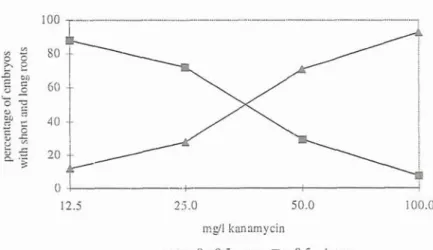
KANAMYCIN SENSITIVITY To optimize the level of kanamycin during selection we observed a kanamycin response curve after 2 months exposure to the antibiotic (Fig. 2) with special attention to the root ' development of grape somatic embryos. Only high concentrations (more than 100 mgll) were lethal. Up to
50
A
kanamycinsecondary embryogenesis was observed in some of the
31R ATG GGA T U GCT CG1' AGA
....
GAG GGA A m ACA TAG l b l l nt S'TK UBut AIG CCT ACT TI% M G ATA.,.
ACT TTC CCA GTC TAG AS CU CAC TGG GAA ACT TGG.,.
TCA AGC TTA TCC CATS ATG GCA TAA CCI' GGT TGA
,,.
AGT TTC CCA GTC TAG -IS nt CP ATG GGA TTA GCT GCT AGA..,
AGT TTC CCA GTC TAG -15 nt CFC ATG GGA TTA GCT GGT ACA-.
AGT TTC CCA GTC TAGFig. 1. Schematic presentation of the G different vectors and primers used for their amplification used for transformation. CP+ contains the entire coat protein sequence; CP contains the coat protein gene with an internal deletion of 15 nucleotides; S contains the same sequence in sense orientation, but without start codon, so that no protein synthcsis is to be expected; AS contains the CP+ sequence in antisense orientation, therefore also yielding no protcin, and; 5'TR and 3'TR are truncated sequences either at the 3' or 5' cnd of the CP+ sequence shortened 168 and 135 nucleotides respectively.
m@l kannrnycin
+O - 0,s mil -m- 0,5
-
1 rnmFig. 2. Influence of diffcrcnt concentrations of kanamycin on the percentage of embryos of Vifis embryogenic line 7-312E1 with short and long roots (N = 120).
treated explants. Thus a kanamycin concentration of 2 7 5 mgll is needed in order to inhibit the formation of non-transformed secondary embryos. TRANSFORMATION AND SELECTION
PERL et al. (1994) reported tissue necrosis and subsequent cell death after very short exposures of grape embryogenic tissue to diluted cultures of Agrohcreri~im. Therefore, to define the optimal incubation time for the explants we inoculated white embryogenic culture for 5 - 10 min at room temperature with bacterial suspension. Local tissue necrosis could be observed in some of the explants, but during the following subcultures a high amount of embryos grew on the tissue surface and the embryogenic competence was maintained.
Parallel testing of selcction procedures with 100 mgll kanamycin and stepwise increasing the concentration during successive subcultures (1 2.5; 25;
50;
75; 100 mgll) showed that an initial concentration of 100 mgll kanamycin caused a strong reduction of growth and a strong inhibition of the embryogenic process. Because of this inhibitory effect we decreased the kanamycin concentration stepwise to 25 mg/l in part of these embryogenic cultures. Recovery of proliferation of embryogenic cultures could be obtained and a stepwise increase of the selective pressure could be applied again. However, also those cultures which were maintained at 100 mg/I kanamycin during the successive subcultures recovered and proliferated, although to a much reduced extent. W e found that the strategy of proliferation without kanamycin for 2 months and a stepwise increase of the kanamycin concentration to a final concentration of 75 mgll is the best suitable way to regenerate and select transformed embryos.Somatic embryos transformed with the GUS gene and selected for kanamycin resistance for 5 and 10 months respectively, showed a strong GUS-activity in histochemical assays (Fig. 3), confirming that the developed transformation system is suitable to transform grapevine. Different media to induce germination are under
investigation.
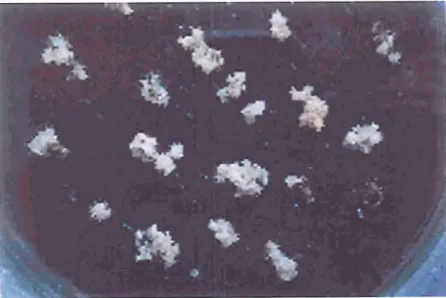
All six constructs of the GFLV CP gene and the plasmid pROK-ArMV were used to transform somatic embryos from line 7-312E1. Embryogenic callus from 110 Richter was transformed with the plasmids pGA-CP+, pGA-CP, pGA-AS, pGA-S, and pGA5'TR by now. Currently the selection of somatic embryos transformed with the different forms of the GFLV or ArMV CP genes has almost been con~pleted (Fig. 4) and regeneration of transgenic plants will be carried out following the optimized procedures.
DISCUSSION
Conditions for gene transfer in grapevine were elaborated, investigating the influence of kanamycin on somatic embryos and evaluating the efficiency of the transfomation method by GUS visualization. Obviously somatic embryos and adventitious somatic embryogenesis as a regeneration process are more tolerant towards the toxic and inhibitory effects of kanamycin than adventitious grape shoots obtained through organogenesis, as was reported by COLBY &
MEREDITH (1990) and MULLINS et al. (1990). Similar results were also described by MARTINELLI & MANDOLINO (1 994).
Six plasmids containing different forms of the GFLV CP gene were constructed and together with the ArMV-CP gene, used for grapevine transformation.
After germination of the embryos we plan to analyze the transgenic plants both at the transcriptional and, in case of the full-length CP, translational level. Plant lines, which show the highest expression level will be used for challenge infection experiments in order to determine the protection against homologous and heterologous nepoviruses.
As indicated by results of coat protein- mediated protection obtained with N. be~ztha~ninnn (BARDONNET et al. 1994) the presented strategy of pathogen-derived resistance is an important contribution to resistance breeding in grapevine.
Fig.
3. GUS-activity in grape somatic embryos (embryogenic line 7 - 3 1 a ) : a- 14 days after cocultivation the bIue colour is lodized mainly in rootand
cotyledonary tissue: b- after 10 months in culture with selection plressure GUS-positive reaction over the whole embryo; c- after 12 months in culture with selection pressure deeply blue coloured embryo.a
I
REFERENCES
AN, G., P.R. EBERT, A. MITRA & S.B. HA 1988. Binary vectors. Pp A3:l-13 in: Plant Molecular Biology Manual. GELVIN S.B. & R.A. SCHILPEROORT (Eds). Kluwer Academic, Dortrecht.
B~RDONNET, N., F. HANS, M.A. SERGHINI & L. PINCK 1994. Protection against virus infection in tobacco plants expressing the coat protein of grapevine fanleaf nepovirus. Plant Cell Reports 13:357-360. BEACHY, R.N., S. LOESCH-FRIES & N.E. TUMER 1990.
Coat protein mediated resistance against virus infection. Annual Review of Phytopathology 28:45 1-474.
BERTIOLI, D.J., D.R. HARRIS, M.L. EDWARDS, J.I. COOPER & W.S. HAWES 1991. Transgenic plants and insect cells expressing the coat protein of arabis mosaic virus produce empty virus-like particles. Journal General Virology 72: 1801- 1809. COLBY, S.M. & C.P. MEREDITH 1990. Kanamycin
sensitivity of cultured tissues of Vitis. Plant Cell Reports 9:237-240.
GOLLES, R. 1994. Expression verschiedener Varianten des Hiillproteingens von Grapevine Fanleaf Virus in transgenen Pflanzen. Diploma Thesis, University of Agriculture, Vienna.
JEFFERSON, J.M., T.A. KAVANAGH & M.W. BEVAN 1987. GUS fusion: P-glucuronidase as a sensitive and versatile gene fusion marker in higher plants. EMBO Journal 6:3901-3907.
KRASTANOVA, S., M. PERRIN, P. BARBER, G. DEMANGEAT, P. CORNUET, N. BARDONNET, L. OTTEN, L. PINCK & B. WALTER 1995. Transformation of grapevine rootstocks with the coat protein gene of grapevine fanleaf nepovirus. Plant Cell Reports 14: 550-554.
GALL, O., L. TORREGROSA, Y. DANGLOT, T. CANDRESSE & A. BOUQUET 1994. Agrobacteriwn- mediated genetic transformation of grapevine somatic embryos and regeneration of transgenic plants expressing the coat protein of grapevine chrome mosaic nepovirus (GCMV). Plant Science 102: 161-170.
LINDBO, J.A. & W.G. DOUGHERTY 1992. Pathogen- derived resistance to a potyvirus: immune and resistant phenotypes in transgenic tobacco expressing altered forms of a potyvirus coat protein nucleotide sequence. Molecular Plant-Microbe Interactions 5: 144- 153.
MACHADO, A.C., M. PUSCHMANN, H. POHRINGER, R. KREMEN. H. KATINGER & M. LAIMER DA CAMARA
MACHADO 1995a. Somatic embryogenesis of Prunus subhirtella autumn0 rosa and regeneration of transgenic plants after Agrobacterium-mediated transformation. Plant Cell Reports 14:335-340. MACHADO, A.c., V. TSOLOVA, R. GOLLES, H.
P ~ I N G E R , A. ATANASSOV, H. KATINGER & M. LAMER DA C ~ A R A MACHADO 1995b. Agrobacterium-mediated transformation of somatic embryos of Vitis vinifera L. genotypes as a method for production of transgenic plants. VIIth International Symposium on Vine & Wine, Plovdiv, Bulgaria, 6-8/2/1995.
MARTINELLI, L. & G. MANDOLINO 1994. Genetic transformation and regeneration of transgenic plants in grapevine (Vitis rupestris S.). Theoretical Applied Genetics 88:621-628.
MAURO, M.C., S. TOUTAIN, B. WALTER, L. PINCK, L.
OTTEN, P. COUTOS-THEVENOT, A. DEMIRE & P. BARBER 1995. High efficiency regeneration of grapevine plants transformed with the GFLV coat protein gene. Plant Science 1 12: 97-106.
MULLINS, M.G., A.F.C. TANG & D. FACCIOTTI 1990. Agrobacterium-mediated genetic transformation of grapevines: transgenic plants of Vifis rupestris Scheele and buds of Vitis vinifera L. Bio/Technology 8: 1041
-
1045.PERL, A., D. HOLLAND & 0. LOTAN 1994. Antioxidants during grape-Agrobacreriwn mediated transformation. Elimination of tissue necrosis following co-cultivation. IVth International Congress of Plant Molecular Biology, Amsterdam, June 1994.
POLITO, V.S., G. MCGRANAHAN,
K.
PINNEY & C. LESLIE 1989. Origin of somatic embryos from repetitively embryogenic cultures of walnut (Juglans regia L.): implications for Agrobacterium-mediated transformation. PlantCell Reports 8:219-221.
SERGHINI, M.A., M. FUCHS, M. PINCK, J. REINBOLT, B. WALTER & L. PINCK 1990. RNA2 of grapevine fanleaf virus: sequence analysis and coat protein cistron location. Journal General Virology 71:1433-1441.
STEINKELLNER, H., A. W E I N ~ U S L , M. LAIMER, A. DA CAMARA MACHADO & H. KATINGER 1991. Identification of the coat protein gene of arabis mosaic nepovirus and its expression in transgenic plants. Acta Horficulturae 308:37-41.
TSOLOVA, V. & A. ATANASSOV 1994. Induction of polyembryony and secondary embryogenesis in culture for embryo rescue of stenospermocarpic genotypes of Vitis vinifera L. Vitis 33: 55-56.
TSOLOVA, V., A. DA CAMAKA MACHADO. R. GOLLES, Construction of an intron containing marker gene:
11. PUHRINGER, A. ATANASSOV. H. KATINGER & M. splicing of the intron in transgenic plants and its LAIMER DA CAMARA MACHADO 1995. Plant use in monitoring early events in Agrobacteriwn- regeneration by organogenesis and embryogcnesis mediated plant transformation. Molec~~lar Geneml in Vitis sp. VIIth International Symposium on Vine Generics 220:245-250.
and Wine. Plovdiv, Bulgaria. 6-8/2/1995.
VANCANNEYT. G.. R. SCHMIDT. A. O'CONNOR