ABSTRACT: Biogas digestates contain valuable nutrients but also have high water contents. Di-gestates were sampled from two different biogas facilities before and after solid-liquid separation and were analyzed with regard to their composition and phosphorus (P) fractions. Additionally, to investigate the P fertilizer effects of these digestates in comparison with undigested slurry or TripleSuper-P (TSP), they were applied in a pot experiment (6 kg soil per pot) in an amount cor-responding to 200 mg P per pot in combination with various crops (amaranth, maize, maize + beans mixed cropping, sorghum). A separation of digestates resulted in higher P concentrations of the solid fraction in comparison with the liquid fraction. The proportion of the readily soluble P fractions (H2O-P, NaHCO3-P) to the total P was higher than 70 % in all digestates. The digestates increased P uptake of the tested crops and concentrations of bioavailable P in the soil to the same extent as highly soluble TSP. Activities of soil enzymes were lower after application of the digestates in comparison to unfermented slurry. The fertilizer management of digestates can be improved by a solid-liquid separation since the solid fraction showed a relatively high concentra-tion of P resulting in a reducconcentra-tion in applicaconcentra-tion doses required to meet the P demands of crops. Keywords: phosphorus fractions, anaerobic digestion, amaranth, mixed cropping, soil enzymes University of Rostock – Dept. of Agronomy,
Justus-von-Liebig-Weg 6 – 18051 – Rostock, MV – Germany.
*Corresponding author <[email protected]>
Edited by: Vinicius de Melo Benites
Phosphorus distribution and availability in untreated and mechanically separated
Silvia Bachmann, Ralf Uptmoor, Bettina Eichler-Löbermann*
Received February 20, 2015 Accepted June 30, 2015
Introduction
The anaerobic digestion of organic wastes is be-coming more important as a source of energy and a treatment of wastes. Most biogas installations use ani-mal slurries which are co-fermented with energy crops. Other substrates are by-products from slaughterhouses, the food sector, and bio-wastes from private households (Nkoa, 2014). The digestates which are left after the biogas process contain important plant nutrients like phosphorus (P), nitrogen (N), potassium (K) (Arthurson, 2009). During anaerobic digestion the total amount of nutrients generally remains stable but other character-istics of the input substrate may change. It has been shown that the C/N ratio decreases, while the
miner-al N (NH4-N) content and substrate pH may increase
(Möller and Müller, 2012). P solubility may decrease af-ter anaerobic digestion due to the formation of struvite (MgNH4PO4 * 6 H2O) and poorly soluble hydroxylapatite (Ca5(PO4)2OH) compounds (Field et al., 1984, Güngör et al., 2007). However, previous studies have shown that an application of digestates increases such crop P uptake and readily available P pools in soil to an extent compa-rable with high soluble P fertilizers like TripleSuper-P (TSP) (Bachmann et al., 2011; Loria and Sawyer, 2005). The high water content of digestates, makes a separation of solid and liquid parts an important tool for achieving better handling of these residues. Mechanical separation with screw presses or decanter centrifuges are efficient and simple techniques and are widely used, whereby the results of the separation process also depend on the type and the dry matter content of the slurries (Møller et al., 2002). Furthermore, mechanical solid-liquid-sep-aration of residues efficiently leads to an enrichment of
biogas digestates
P in the solid phase, whereas N is often found in higher concentrations in the liquid phase. According to the state of the art research, it can be assumed that the solid frac-tion of biogas residues is an effective P fertilizer, but to our knowledge, very little data regarding P solubil-ity in separated digestates and their impact on P nutri-tion of crops is available. The aim of our study was to analyse the P fractions in biogas digestates before and after solid-liquid separation. Furthermore, we wanted to evaluate the P fertilizer effects they may have in combi-nation with different crop species, as crops develop vari-ous strategies to influence either the spatial or chemical availability of P in soil (Eichler et al., 2004; Richardson et al., 2011) and thus influence the use-efficiency of fer-tilizer applied.
Materials and Methods
Digestate sampling and analysis
plant silage, and 4 % grass silage, w/w) only. Here the solid-liquid separation was done via a decanter centri-fuge, which works on the principle of different specific gravities of the material. The digestates are pumped into a cylinder, which rotates at about 2000 and 4500 rpm. The centrifuge separates approximately 89 % of the fresh digestate into liquid and 11 % solid. Samples from both plants were taken directly before and after the separation device. The digestates from both biogas plants were sampled two times; i.e. in September 2012 for characterization of the nutrient composition and P availability, and in April 2013 for analysis of the nutri-ent composition and the following application in a pot experiment.
The dry matter (DM) content of the dairy slurry, the digestates and the solid and liquid fractions were de-termined by freeze drying and subsequent oven drying at 105 °C. Organic matter content (OM) in the dry mate-rial of the products was determined after ashing in an oven at 550 °C and weighing (Bauer et al., 2009). Total P, K and Mg concentrations in the slurry and digestate samples were determined after digesting the ash with 25 % HCl. Phosphorus contents were determined spectro-metrically via the Vanadate-molybdate method (Page et al., 1982), K via flame spectroscopy, and Mg spectropho-tometrically. Total N contents were determined in the fresh slurry using a Kjeldahl analyzer. NH4-N contents were determined after shaking 20 g of fresh sample in 500 mL ultrapure water and analyzing the N contents in the supernatant using a Kjeldahl apparatus (Schmitt, 1954). Sulfur was measured with the CNS elemental an-alyzer. The pH value (H2O) was determined in the fresh slurry with a pH electrode according to DIN EN 12176.
The separation index (Et(x)) for a respective com-pound was calculated according to Hjorth et al., (2010)
and expresses the distribution of the respective
com-pound between the solid and liquid fractions. For the solid fraction this value was calculated as follows:
Et x( ) ,
,
=
m m
x solid
x slurry
where mx,solid is the mass (g) of the respective compound in the solid fraction and mx,slurry is the mass of the respec-tive compound in the slurry/digestate treated. For the liquid fraction the value was calculated in a similar way:
Et x( ) ,
,
=
m m
x liquid
x slurry
The solubility of P in the dairy slurry, the diges-tates, and their solid and liquid fractions were deter-mined according to Dou et al., (2000). In brief, 0.3 g of the freeze-dried slurry sample was shaken in 30 mL of deionized water for 16 hours on a horizontal shaker at 150 rpm. Samples were centrifuged for 20 minutes at 1700 g and the supernatant was decanted. Subsequently, the residue was extracted with 0.5 mol L−1 NaHCO
3 (pH
8.5), 0.1 mol L−1 NaOH and 1.0 mol L−1 H
2SO4 as
de-scribed above. Total P content in the supernatant of each
phase was measured using inductively coupled plasma spectroscopy (ICP-OES) on a wavelength of 214.91 nm. Inorganic P content was determined using the molyb-date-blue method as described by Schinner et al., (1996). Residual P content was calculated as follows: total P –
(H2O-P+NaHCO3-P+NaOH-P+H2SO4-P). All samples
were analyzed in parallel. P solubility in the digestates was analysed only for samples taken in September 2012.
Experimental design of the pot experiment
An outdoor pot experiment covered by a wire cage was carried out at an experimental station in Rostock (Mecklenburg-Vorpommern, Germany: 54°3'41.47''N and 12°5'5.59'' E) in April 2013. The soil which was sampled from a field experiment of the experimental sta-tion was a moderately acidic loamy sand and according to the World Reference Base for Soil Resources is classi-fied as Stagnic Cambisol. To achieve a very low bioavail-able P content (double lactate-soluble phosphorus Pdl: 37 mg kg−1), a 1:1 mixture of soil from the A horizon
and the B horizon was used. The pots (height 21 cm, diameter 19.5 cm) were filled with approximately 6 kg of soil. Four different crops were cultivated, amaranth (Amaranthus cruentus), sorghum (Sorghum bicolor), maize (Zea mays) and beans (Phaseolus coccineus; four seeds) intercropped with maize (four seeds). Crops were culti-vated for 8 weeks with distilled water used for irrigation. The pots could freely drain to field capacity, and perco-lated water was collected in a bowl below the pots and was replenished.
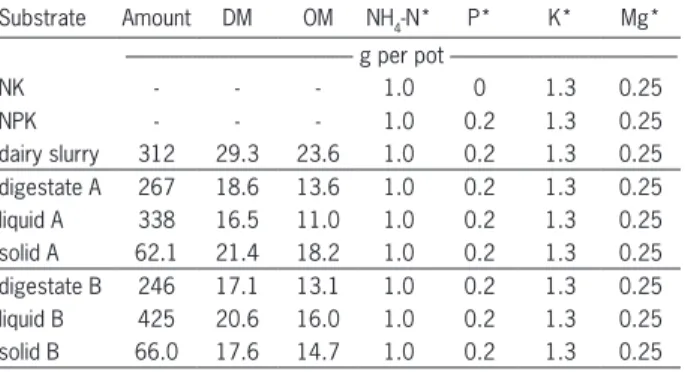
Nine different treatments were established: I) mineral treatment without P (NK), II) mineral treat-ment with TripleSuperPhosphate (TSP) (NPK), III) unfer-mented dairy slurry, IV) digestate A (from biogas Plant A – see above), V) liquid phase A, VI) solid phase A, VII) digestate B (from biogas Plant B – see above) VIII) liquid phase B, IX) solid phase B. The P containing prod-ucts were applied in an amount equivalent to 200 mg P per pot (except the control). As other nutrients besides P were applied with the digestates (see Table 1), the
ad-Table 1 − Amendments and nutrients applied in the pot experiment.
Substrate Amount DM OM NH4-N* P* K* Mg*
g per pot
---NK - - - 1.0 0 1.3 0.25
NPK - - - 1.0 0.2 1.3 0.25
dairy slurry 312 29.3 23.6 1.0 0.2 1.3 0.25
digestate A 267 18.6 13.6 1.0 0.2 1.3 0.25
liquid A 338 16.5 11.0 1.0 0.2 1.3 0.25
solid A 62.1 21.4 18.2 1.0 0.2 1.3 0.25
digestate B 246 17.1 13.1 1.0 0.2 1.3 0.25
liquid B 425 20.6 16.0 1.0 0.2 1.3 0.25
solid B 66.0 17.6 14.7 1.0 0.2 1.3 0.25
dition of N, K, and Mg was adapted to ensure a uniform supply of these nutrients to all treatments according to the following amounts per pot: NH4-N: 1 g, K: 1.3 g, and Mg: 0.25 g with nutrient salts (NH4-N as calcium ammo-nium nitrate, K as potash (KCl) and Mg as magnesium sulfate (MgSO4·7 H2O)). Each treatment consisted of 4 replications. For this experiment the digestates sampled in April 2013 were used.
At the end of the experiment, plant and soil sam-ples were taken from each pot for laboratory analysis. For the analysis of soil microbial activity a sub-sample was stored frozen.
Plant and Soil analyses
The dry matter yield of the crops was determined by drying the harvested biomass in an oven at 60 °C for seven days and then weighing it. To determine the P content of the plant tissue, the dried plant material was ground and the P content was measured after dry ash-ing usash-ing the vanadate-molybdate method (Page et al., 1982). The P uptake was calculated by multiplying dry matter yield by P or N concentration.
For the analysis of the chemical soil parameters, the soil was air-dried and sieved (< 2 mm). The double lactate soluble P (Pdl) concentration, which is a stan-dard procedure for estimating plant available P in soil in Germany, the water soluble P (Pw) and the pH values were measured using the method described by Blume et al., (2000). To determine the effect of the digestates on the activity of soil microorganisms the frozen samples were thawed and kept at room temperature for 24 hours before analysis. Thawed samples were sieved and roots were removed as quickly as possible using tweezers in order to avoid drying. Dehydrogenase activity (DHA) in the soil was measured after incubating 1 g of soil for 24 hours with triphenyltetrazolium chloride solution and the DHA was estimated after measuring the triphenyl-formazan (TPF) concentration photometrically (Schinner et al., 1996). The alkaline phosphatase (alkPase)
activi-ties were determined after incubating 1 g soil with p-nitrophenolphosphate for 1 hour at pH 11.0 and after, the subsequent photometrical measurement of the p-nitrophenol (pNP) according to Tabatabai and Bremner (1969).
Statistics
For statistical analysis, the software package PASW Statistics 18 was used. Soil and plant data correspond-ing to four replications were subjected to a two facto-rial analysis of variance (ANOVA, general linear model). The means of soil and plant parameters were compared using the Duncan multiple range test. Significance was determined at p ≤ 0.05 and significantly different means were indicated by different letters. Data from digestate analysis were subjected to a one factorial ANOVA.
Results and Discussions
Effect of mechanical solid-liquid separation on the nutrient content and nutrient distribution in the digestates
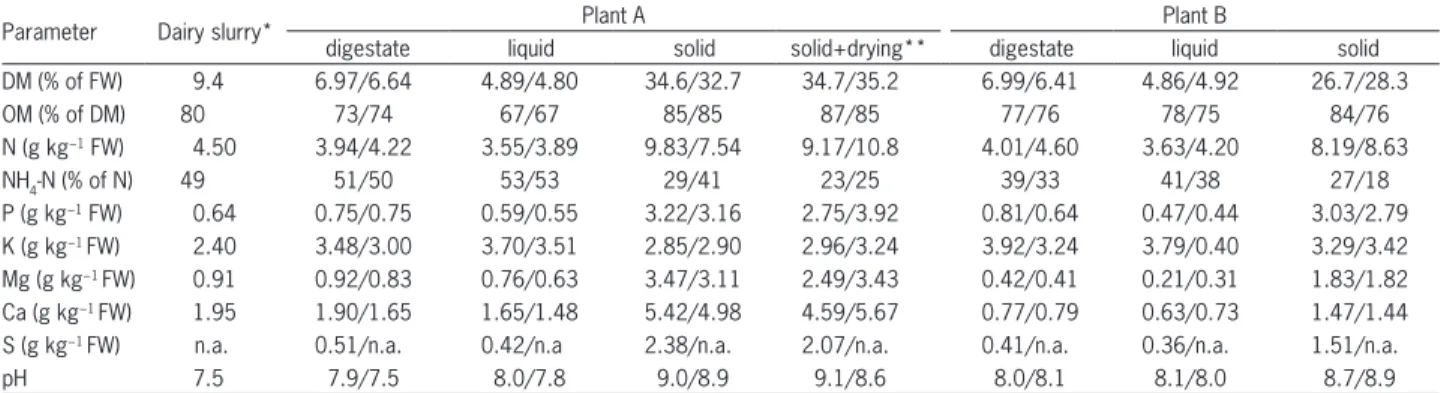
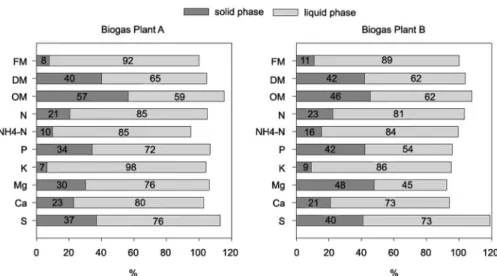
Results of both sampling dates (Sep 2012 and Apr 2013) consistently showed, that after mechanical separa-tion the solid fracsepara-tion is characterized by a relative high dry matter and organic matter content (Table 2 and Fig-ure 1). After mechanical separation the dry matter (DM) content was about 5 % in the liquid fraction and about 30 % in the solid fraction. This makes the solid fraction better for storing and easier to transport, as less water must be moved. Our results are consistent with studies from Bauer et al., (2009) and Möller et al., (2010) who found a DM content between 4 - 8 % in the liquid frac-tion and 19 -23 % in the solid fracfrac-tion of digestates from on-farm biogas plants.
Additionally, except for K, the N, P, Mg, Ca and S concentrations were high in the solid fraction of the digestates, which makes them, in combination with the relative low water content, a potentially viable organic
Table 2 − Composition of the dairy slurry and digestates from two biogas plants and their liquid and solid phases after mechanical separation at two sampling dates (sampling date Sept 2012 – first number, Apr 2013 – second number, n = 3).
Parameter Dairy slurry* Plant A Plant B
digestate liquid solid solid+drying** digestate liquid solid
DM (% of FW) 9.4 6.97/6.64 4.89/4.80 34.6/32.7 34.7/35.2 6.99/6.41 4.86/4.92 26.7/28.3
OM (% of DM) 80 73/74 67/67 85/85 87/85 77/76 78/75 84/76
N (g kg−1 FW) 4.50 3.94/4.22 3.55/3.89 9.83/7.54 9.17/10.8 4.01/4.60 3.63/4.20 8.19/8.63
NH4-N (% of N) 49 51/50 53/53 29/41 23/25 39/33 41/38 27/18
P (g kg−1 FW) 0.64 0.75/0.75 0.59/0.55 3.22/3.16 2.75/3.92 0.81/0.64 0.47/0.44 3.03/2.79
K (g kg−1 FW) 2.40 3.48/3.00 3.70/3.51 2.85/2.90 2.96/3.24 3.92/3.24 3.79/0.40 3.29/3.42
Mg (g kg−1 FW) 0.91 0.92/0.83 0.76/0.63 3.47/3.11 2.49/3.43 0.42/0.41 0.21/0.31 1.83/1.82
Ca (g kg−1 FW) 1.95 1.90/1.65 1.65/1.48 5.42/4.98 4.59/5.67 0.77/0.79 0.63/0.73 1.47/1.44
S (g kg−1 FW) n.a. 0.51/n.a. 0.42/n.a 2.38/n.a. 2.07/n.a. 0.41/n.a. 0.36/n.a. 1.51/n.a.
pH 7.5 7.9/7.5 8.0/7.8 9.0/8.9 9.1/8.6 8.0/8.1 8.1/8.0 8.7/8.9
depends on the separator, as well as on the type and composition of the input slurry, amongst other factors such as the organic matter content, the particle size dis-tribution and the pH value (Bauer et al., 2009; Hjorth et al., 2010; Møller et al., 2002). In both biogas plants studied, about 40 % of the DM previously present in the untreated digestate was separated to the solid fraction, while 60 % of the DM remained in the liquid fraction. These results are comparable to the findings of Popovic et al., (2012) who reported that 46 % of the DM slurry was transferred to the solid separated fraction when us-ing a commercial screw press.
Only 7-20 % of the N, NH4-N and K previously
present in the digestate was separated into the solid fraction, whereas over 80 % remained in the liquid phase. On the other hand, between 30 and 40 % of the total P previously present in the digestate was found in the solid phase after mechanical separation. Bauer et al., (2009) reported that as much as 52 % of P found in the inflow was found in the solid fraction after digestate separation. NH4 and K salts are very soluble and most of the NH4 and K in slurries is present in dissolved form, and thus remains in the liquid fraction after separation. On the other hand, more than 80 % of the P in untreated slurry is present in crystalline form (mainly Ca-P or Mg-P) or adsorbed onto particles, and therefore a higher proportion is separated into the solid fraction (Massé et al., 2005).
More P was separated into the solid fraction in Plant B than Plant A. Apart from the different original material this could also be attributed to the separation technology. A screw press, which was applied at Plant A, has a lower efficiency when separating P into solids than other separation techniques (Hjorth et al., 2010; Møller et al., 2002). In the screw press the DM-rich solid frac-tion is pressed against a filter plate to press out more liquid, and the small particles are forced to pass through fertilizer. P concentration in the solid fraction (2.8 to 3.2
g kg−1 FW) was about four times as high as in the
un-treated digestate (0.6-0.8 g kg−1 FW), and five to six times
higher than in the liquid fraction (0.4-0.6 g kg−1 FW).
Comparable P contents of the solid and liquid fractions of digestates and slurry were also reported by other au-thors (Fangueiro et al., 2012; Jørgensen and Stoumann-Jensen, 2009). The N:P ratio was considerably lower in the solid fraction (about 3.0 – Plant A, 2.5 – Plant B) than in the liquid fraction (about 7.0 – Plant A and 8.0 – Plant B) or untreated digestate (5.5 – Plant A, 6.0 – Plant B) (the average of both sampling dates). A low N:P ratio of 3.4:1 in the solid fraction of separated digestates was also reported by Möller et al. (2010), and demonstrates the preferential accumulation of P in the solid fraction. The low N:P ratio is also positive in terms of plant nutri-tion because the P demand of field crops could be met without excessive N supply.
Although total N concentration in the solid phase was high, only less than 30 % of the total N was analyzed as NH4-N, which is regarded as being easily available to crops. In the liquid fraction and in the non-separated digestates the proportion of NH4-N to total N was about 50 % for biogas from Plant A and about 40 % from Plant B. The solid fraction is also a potential source of S, as the S concentrations were about four times higher compared to that of the untreated digestate. In addition, the pH value of the solid fraction was high (8.7-9.0), probably due to the high Ca content. Additional drying of the solid fraction with waste heat from biogas plant A did not in-crease DM content significantly, but led to a reduction
in total N and NH4-N content. The composition of the
liquid fraction was very similar to that of the untreated digestate.
To evaluate the efficiency of the separation pro-cess, the simple separation index (Et) was calculated as described by Hjorth et al. (2010). Separation efficiency
the filter and end up in the liquid fraction (Popovic et al., 2012). Interestingly, Mg showed the same partition tendencies between the solid and liquid fractions as P, demonstrating that P is associated with Mg in slurries and digestates, e.g. as struvite (Dou et al., 2000).
Effect of mechanical solid-liquid separation on P availability in the digestates
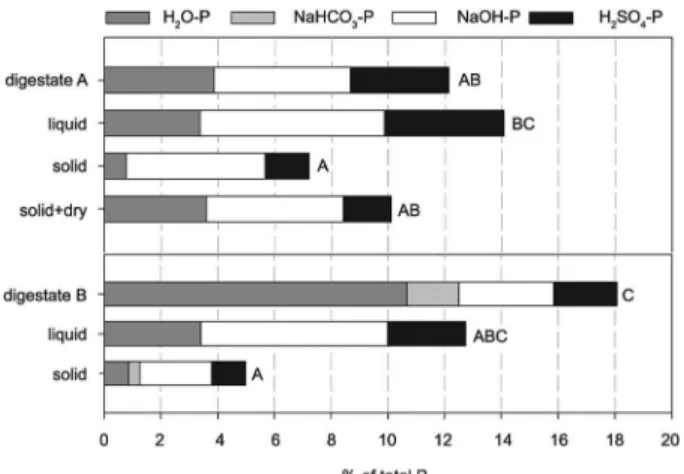
The sequential P fractionation has often been used to evaluate P solubility and potential P availability in farmyard manure or agroindustrial by-products (Ajiboye et al., 2004; Dou et al., 2000; Kruse et al., 2010; Sharpley and Moyer, 2000). In both biogas plants, 70 to 90 % of the total P in the digestates and its solid and liquid fractions were extracted with mild agents such as H2O and NaHCO3 (Figure 2). Neither the mechanical separation technique nor the subsequent drying process (in plant A) had a sig-nificant effect on the readily soluble P (H2O+NaHCO3-P; p ≤ 0.178). The H2O-P and the NaHCO3-P fractions gen-erally represent labile and highly soluble P forms, such as dicalcium phosphate dihydrate (CaHPO4*2H2O), stru-vite (MgNH4PO4*6H2O), hydrated aluminum phosphate (AlPO4*2H2O), P sorbed to CaCO3 or phospholipids, DNA
and simple phosphate monoesters (Ajiboye and
Akrin-remi, 2007; Turner and Leytem, 2004). Thus, our results indicate, that the bioavailablity of P in digestates is high, even in the P-rich solid phase after digestate separation. The fact that most of the P contained in slurries and diges-tates is present in easily bioavailable form has also been demonstrated in previous studies (Bachmann et al., 2011; Güngör and Karthikeyan, 2005).
Between 5 - 15 % of the total P in the digestates and its solid and liquid fractions were extracted with NaOH and H2SO4. This proportion is also comparable with our previous results (Bachmann et al., 2011) where 12 % of the total P in the digestate was extracted with NaOH and H2SO4. The NaOH and H2SO4 fractions are considered to
represent P forms of moderate to low solubility. In the NaOH-fraction of farmyard manure organic P forms dom-inate, whereas complex Ca-P compounds i.e. low soluble hydroxylapatite (Ca5(PO4)2OH) or phytic acid and Ca-phy-tate, dominate in the H2SO4/HCl-P fraction (Ajiboye and Akrinremi, 2007; Kruse et al., 2010; Turner and Leytem, 2004). Between 5 - 23 % of total P was not extracted by the different agents and was considered Residual-P.
The mineral P predominated in all digestate sam-ples. The organic P represented only 5 - 18 % of the total P (Figure 3). This range is quite similar to what was re-ported by Dou et al., (2000) indairy slurry samples. In contrast, a higher proportion of organic P, between 29 - 45 % of the total P, was found for solid manures (Aijboye et al., 2004). The proportion of organic P to total P in the di-gestates varied between the two biogas plants and was in-fluenced by the use of mechanical separation (p = 0.020). The digestate from Plant B had a higher proportion of or-ganic P (18 % of the total P) than that from plant A (12 % of the total P). This might be attributed to the different in-put substrates used. Animal slurries are composed of or-ganic and inoror-ganic P forms, but inoror-ganic P is usually the principal P form. In a wide variety of organic wastes of different origins and treatments animal slurry was found to have a low concentration of organic P (about 1 %) in relation to total P (García-Albacete et al., 2012). Biogas Plant A mainly used dairy slurry (57 %, w/w) which may explain the relatively low proportion of organic P in the digestates. Surprisingly, in both biogas plants, we found a considerably lower proportion of organic P to total P in the solid fraction (5 - 7 % of the total P for plant B and plant A) than in the liquid fraction (13 - 14 % of the total P for plant B and plant A). This indicates that organic P compounds in digestates probably have a very low par-ticle size and thus remain in the liquid fraction.
Figure 2 − P-fractions of the total P in digestates from two different biogas plants as influenced by mechanical solid-liquid separation (sampling date Sept 2012). Drying of the solid digestate was applied only in biogas plant A.
Effect of the digestates on plant and soil parameters
The dry matter yield and P uptake differed be-tween crops and were affected by the amendments ap-plied. Significant interactions between crops and fertil-izer treatments indicate that the efficacy of the organic amendments also depended on the crop cultivated.
All types of digestates resulted in higher P up-take than the control and were in the range of that of TSP and unfermented dairy slurry (Table 3). The diges-tates can, therefore, be considered a suitable P source for plants. These results confirmed previous outcomes of an experiment with maize and amaranth (Bachmann et al., 2011). As regards yield, the positive effect of the amendments was not so clear. All amendments resulted in higher yield of maize and sorghum in comparison to the control whereas for amaranth only the unseparated digestates increased yield and none of the amendments resulted in higher yields of the mixed cropped maize and beans (see also below). On average, we could not detect an effect of separation on the crops and the unseparated digestates had the same effect as the solid or liquid frac-tion of the separated digestates. Differences occurred, however, between the digestates and the digestate B and
its liquid fraction resulted in higher P uptake than di-gestate A and its liquid fraction (average of all crops). As the same amount of P was provided to all pots we assume that other components in the digestates affected the soil characteristics and the P delivery to plant. Due to the varying P concentration, the digestates were ap-plied in different amounts to warrant a P supply of 200
mg per pot. Other ingredients except P, NH4-N, K and
Mg (which were balanced for all pots) were thus also applied in different amounts.
Soil P concentration (Pw and Pdl) also increased when P was applied (Table 4). The only exception was the Pdl concentration in combination with amaranth cultivation, where only two treatments resulted in high-er values than the control without P. The Pw concentra-tion in soil of all pots almost doubled when P was ap-plied in comparison to the control. As mentioned above, we could not detect stringently a different effect of the digestates or differences between the solid or liquid frac-tion.
The pH values in soil rose when the organic amendments were applied, which can be explained by the high pH values of the substrates (see Table 4).
The microbial metabolitic activity (DHA) was highest when undigested dairy slurry was applied (Table 5). This was the case in combination with all crops test-ed. It is well documented that the application of organic materials enhances the microbial biomass and microbial activity of soils (Ehlers et al., 2010; Krey et al., 2013; Requejo and Eichler-Löbermann, 2014). Nonetheless, this depends on the material applied. After digestate ap-plication (separated or unseparated) the DHA was gen-erally lower than after application of dairy slurry. This was also found in previous experiments with digested and undigested animal slurries (Bachmann et al., 2011, Bachmann et al., 2014; Elfstrand et al., 2007). Elevated values in comparison to the control after digestate ap-plication were only found in combination with maize and maize + bean. The activity of the dehydrogenase in soil is closely related to microbial activity and can be regarded as a sensitive indicator of changes in the nutri-ent and carbon turnover in soil because this enzyme is an integral part of their cellular metabolism (Watts et al., 2010; Brookes, 2001).
As the activity of soil microorganisms strongly de-pends on the presence of available organic C, the lower microbial activity in soil after application of the diges-tates can be attributed, in part, to the lower amount of applied organic matter. Furthermore, the quality of the organic matter in the digestates could also have affected the microbial activity. Obviously, the organic matter ap-plied with the digestate did not stimulate the growth of the soil microorganisms. After anaerobic digestion, mainly stable lignin-like organic C compounds remain, which can hardly be used as carbon and energy sourc-es by most soil microorganisms (Marcato et al., 2009; Thomsen et al., 2013). Our results, therefore, show that changes in substrate composition due to anaerobic
diges-Table 3 − Yield and P uptake of different crop species as influenced by different amendments at the end of an eight week pot experiment on a P-poor loamy sand.
Fertilizer/p-values
Amaranth Maize Maize + Bean Sorghum DM yield (g per pot) (105 °C)
p≤ 0.036 p≤ 0.001 ns p≤ 0.001
NK 33.1 a 37.4 a 43.0 a 30.0 a
NPK 33.1 a 68.8 b 54.9 a 40.2 b
dairy slurry 35.9 abc 64.0 b 56.2 a 49.8 e
digestate A 39.5 bc 63.0 b 53.3 a 43.8 bcd
liquid 37.9 abc 61.2 b 52.8 a 44.8 bcde
solid 36.2 abc 59.8 b 49.6 a 42.0 b
digestate B 41.1 c 63.5 b 48.6 a 47.5 cde
liquid 38.2 abc 64.9 b 53.5 a 43.4 bc
solid 35.2 ab 59.4 b 52.6 a 48.8 de
mean 36.7 A 59.1 D 51.6 C 43.4 B
P uptake (mg per pot)
Fertilizer/p-values p≤ 0.001 p≤ 0.001 p≤ 0.001 p≤ 0.001
NK 112 a 58.3 a 68.9 a 53.3 a
NPK 150 b 110 bc 116 c 81.9 bc
dairy slurry 186 c 112 bc 112 bc 77.3 b
digestate A 172 bc 101 b 98.7 b 76.4 b
liquid 166 bc 101 b 103 bc 73.7 b
solid 169 bc 106 bv 117 c 85.0 bc
digestate B 186 c 115 c 114 c 94.1 c
liquid 213 d 108 bc 117 c 98.1 c
solid 182 c 102 b 106 bc 85.9 bc
mean 171 C 101 B 106 B 80.7 A
Results of One-Way ANOVA and post hoc comparison of means (Tukey-Test p≤
tion influence the activity of enzymes, which in turn can affect the P turnover in the soil. In our experiment we found a significant correlation between Pw contents in soil and DHA (0.349, p ≤ 0.001).
The activities of the alkaline phosphatase (alkPase) were also influenced by the fertilizer application. Al-though averaged for all crops the addition of dairy slurry and digestate A resulted in higher activities in compari-son to the NK and the NPK treatment, the effect of or-ganic matter supply was not as clear as was found for
DHA. Obviously it was not decisive if the applied organ-ic material was digested or not. The activity of alkPase is also affected by pH value and alkPase develops higher activities when soil pH rises (Tabatabai and Bremner, 1969). The correlation between pH values and alkPase was highly significant (0.262, p > 0.001) when all treat-ments and crops were included, and even higher (until
0.47 p ≤ 0.001) when only amaranth or sorghum were
considered. A higher activity of Pase indicates a greater potential for mineralizing P from organic compounds. The alkPase is mainly produced by soil microorganisms, and the extent of its synthesis and excretion should be coupled to the microbial activity and/or population (Al-biach et al., 2000). Thus, correlations between DHA and alkPase were also found (0.291 p ≤ 0.001, including all crops and fertilizer treatments). Higher activity of alk-Pase after addition of organic fertilizers (compost and manure) in a field experiment was also shown in a study of Krey et al., (2013), where this was also related to an increase in pH and soil organic matter.
Table 4 − Bioavailable P concentration and pH of the soil after application of different amendments and cultivation of different crop species in an eight week pot experiment on a P-poor loamy sand.
Fertilizer/p-values
Amaranth Maize Maize + Bean Sorghum Pdl, mg kg−1
p = 0.048 p≤ 0.001 p≤ 0.001 p≤ 0.001
NK 35.8 ab 31.0 a 30.0 a 29.5 a
NPK 34.7 a 44.1 d 39.3 b 37.6 b
dairy slurry 38.4 ab 36.6 bc 36.9 b 36.4 b
digestate A 38.1 ab 39.0 bcd 35.6 b 38.3 b
liquid 40.8 b 36.7 bc 37.8 b 38.4 b
solid 34.3 a 33.8 ab 36.0 b 35.1 b
digestate B 33.4 a 34.4 ab 35.9 b 36.7 b
liquid 37.4 ab 42.3 d 39.0 b 37.7 b
solid 41.6 b 41.8 cd 36.6 b 35.2 b
mean 36.9 A 37.9 A 36.3 A 36.1 A
Pw, mg kg−1
Fertilizer/p-values p≤ 0.001 p≤ 0.001 p = 0.002 p≤ 0.001
NK 3.62 a 4.31 a 4.77 a 5.05 a
NPK 6.31 bc 8.06 b 12.9 c 6.54 b
dairy slurry 6.81 c 8.00 b 9.33 bc 9.42 de
digestate A 7.50 c 8.62 b 9.31 b 8.67 cde
liquid 7.31 c 7.87 b 7.62 ab 10.0 e
solid 7.06 c 8.75 b 11.0 bc 8.37 cd
digestate B 5.62 b 7.75 b 9.89 bc 9.62 de
liquid 9.31 d 8.73 b 9.25 b 9.22 de
solid 7.18 c 8.35 b 8.25 b 7.71 bc
mean 6.81 A 7.80 B 9.13 C 8.25 B
pH
Fertilizer/p-values p ≤ 0.001 p≤ 0.001 ns p≤ 0.001
NK 4.47 a 4.64 a 4.77 a 4.92 ab
NPK 4.45 a 4.80 b 4.76 a 4.86 a
dairy slurry 4.56 ab 5.12 f 4.88 a 5.21 e
digestate A 4.56 ab 5.10 ef 4.83 a 5.21 e
liquid 4.68 bc 5.16 f 4.87 a 5.22 e
solid 4.46 a 4.96 cd 4.75 a 5.07 cd
digestate B 4.48 a 5.00 de 4.79 a 5.06 cd
liquid 4.70 c 4.94 cd 4.84 a 5.10 d
solid 4.56 ab 4.88 bc 4.84 a 5.00 bc
mean 4.55 A 4.96 C 4.82 B 5.07 D
Results of One-Way ANOVA and post hoc comparison of means (Tukey-Test p≤
0.05). Different lower case letters in one column indicate significantly different means between the fertilizer treatments. Different upper case letters indicate significantly different means between the crop species. NK = Mineral fertilizer without P-addition; NPK = Mineral fertilizer with P-addition; Pdl = double-lactate soluble P; Pw = water soluble P; ns = not significant.
Table 5 − Microbial metabolic activity and activity of alkaline phosphatase in soil after application of different amendments and cultivation of different crop species in an eight week pot experiment on a P-poor loamy sand.
Fertilizer/p-values
Amaranth Maize Maize + Bean Sorghum Microbial metabolic activity, TPF,
µg g−1 soil (DM) (after 24 h)
p≤ 0.001 p≤ 0.001 p≤ 0.001 p≤ 0.001
NK 20.9 a 26.8 a 28.5 a 30.1 ab
NPK 25.1 ab 39.3 ab 46.5 b 41.5 abc
dairy slurry 42.5 d 99.5 e 80.4 e 65.1 d
digestate A 28.5 abc 67.2 cd 53.2 bc 45.8 bc
liquid 30.5 bc 58.5 cd 65.3 cd 41.6 abc
solid 34.2 c 53.3 bcd 50.1 bc 47.5 c
digestate B 27.8 abc 68.1 d 72.3 de 41.6 abc
liquid 21.0 a 49.2 bc 53.2 bc 25.7 a
solid 27.8 abc 54.4 bcd 52.7 bc 42.8 bc
mean 28.7 A 57.4 C 55.8 C 42.4 B
Activity of alkaline phosphatase, pNP, µg g−1 soil (DM)
Fertilizer/p-values p≤ 0.001 ns p = 0.047 p = 0.004
NK 19.8 a 31.4 31.1 abc 25.0 a
NPK 23.5 a 38.3 28.6 abc 22.9 a
dairy slurry 34.6 bc 44.2 35.6 c 35.1 bc
digestate A 38.5 c 42.3 37.3 c 37.4 bc
liquid 34.5 bc 35.4 31.0 abc 31.8 abc
solid 34.0 bc 25.1 24.0 a 28.3 ab
digestate B 21.2 a 34.4 25.1 ab 40.8 c
liquid 35.6 bc 35.5 32.7 abc 31.4 ab
solid 26.6 bc 27.7 34.3 bc 31.5 ab
mean 29.8 A 34.9 B 31.1 A 31.6 AB
Results of One-Way ANOVA and post hoc comparison of means (Tukey-Test p≤
On average for all fertilizer treatments, the shoot yield ranged as follows: maize > maize + bean > sorghum > amaranth (Table 3). The relatively small effect of P sup-ply on yields (see above) may indicate that the amount of P in the soil (despite the low Pdl contents in the treatment without fertilization) was still sufficient to cover plant de-mand. Even P compounds with relatively low solubility can be mobilized in soil by crops and microorganisms, and such processes might not be reflected adequately by stan-dard soil-P extraction like the double-lactate method (Re-quejo and Eichler-Löbermann, 2014; Dakora and Phillips, 2002). To improve the spatial or chemical availability of P in soil, crops can change their root morphology (mainly the formation of fine roots) to explore a larger soil vol-ume; others excrete P-solubilizing compounds like organic acids, organic and inorganic ions, sugars, vitamins, nucle-osides, and enzymes (Richardson et al., 2011). This can be especially advantageous in mixed cropping where two major processes occur: complementarity and facilitation. Resource complementarity minimizes the niche overlap in space and time and facilitation enhances the resource availability and growth of a crop by another crop (Hins-inger et al., 2011). This can be the reason, that in the pres-ent study for the mixed cropping with maize and beans no yield effect of the treatments was observed.
The internal P utilization efficiency also varied be-tween crops. Despite the comparable low yield, shoot uptake of P by amaranth was, with 171 mg per pot, con-siderably higher than the P uptake of the other crops and unproportionally high in relation to the shoot bio-mass, because of the high P concentration in the plant tissue (data not shown). This implies a low internal P utilization (biomass production in relation to P uptake). However, the high P uptake of amaranth did not result in lower bioavailable P concentrations in the soil (Pdl) in comparison to the other crops. This suggests on the other hand a relatively high efficiency for P acquisition. The lowest pH values in soil were also found for ama-ranth which can probably be explained by the release of organic acids which was shown by Li et al., (2006) who cultivated amaranth under K stress. We assume that in our experiment the amaranth roots released organic acids to mobilize P resources in soil to cover the high P demand of this crop. Outstandingly high P uptakes by amaranth were also found in other studies (Ojo et al., 2010; Brandt et al., 2011; Bachmann et al., 2011). Lower pH values after amaranth cultivation were probably also the reason for the decrease in enzyme activities.
Conclusion
Digestates showed the same P fertilizer effects as the high soluble mineral P fertilizer (TSP) and undigest-ed dairy slurry and thus represent a valuable P source. Nutrient management and the nutrition of crops can be improved by a solid-liquid separation of digestates as the solid phase showed relatively high concentration of P and a low N:P ratio. Because of the low water content of
the solid phase, it is more easily transported, and allows for targeted application on soils with low P status and low risk of P losses. The reduced activity of enzymes in soil after application of the digestates (mainly activity of dehydrogenase) indicated a lower C and P turnover in the digestate-amended soils which needs to be investi-gated for a longer time span under field conditions.
References
Ajiboye, B.; Akrinremi, O.O.; Racz, G.J. 2004. Laboratory characterization of phosphorus in fresh and oven-dried organic amendments. Journal of Environmental Quality 33: 1062-1069. Ajiboye, B.; Akrinremi, O.O. 2007. Phosphorus speciation of
sequential extracts of organic amendments using nuclear magnetic resonance and x-ray absorption near-edge structure spectroscopies. Journal of Environmental Quality 36: 1563-1576. Albiach, R.; Canet, R.; Pomares, F.; Ingelmo, F. 2000. Microbial
biomass content and enzymatic activities after the application of organic amendments to a horticultural soil. Bioresource Technology 75: 43-48.
Arthurson, V. 2009. Closing the global energy and nutrient cycles through application of biogas residues to agricultural land. Energies 2: 226-242.
Bachmann, S.; Wentzel, S.; Eichler-Löbermann, B. 2011. Co-digested dairy slurry as a phosphorus and nitrogen source for Zea mays L. and Amaranthus cruentus L. Journal of Plant Nutrition and Soil Science 174: 908-915.
Bachmann, S.; Gropp, M.; Eichler-Löbermann, B. 2014. Phosphorus availability and soil microbial activity in a 3 year field experiment amended with digested dairy slurry. Biomass and Bioenergy 70: 429-439.
Bauer, A.; Mayr, H.; Hopfner-Sixt, K.; Amon, T. 2009. Detailed monitoring of two biogas plants and mechanical solid-liquid separation of fermentation residues. Journal of Biotechnology 142: 56-63.
Blume, H.P.; Deller, B.; Leschber, R.; Paetz, A.; Schmidt, S.; Wilke, B.M. 2000. Book of Soil Analyses. Physical, Chemical and Biological Methods = Handbuch der Bodenuntersuchung. Physikalische, Chemische und Biologische Untersuchungsverfahren. Wiley-VCH, Weinheim, Germany (in German).
Brandt, C.; Balko, C.; Eichler-Löbermann, B. 2011. Interactive effects of soil water content and phytin supply on phosphorus nutrition of different crops species. Landbauforschung Volkenrode 4: 317-326.
Brookes, P. 2001. The soil microbial biomass. Microbes Environment 16: 131-140.
Dakora, F.D.; Phillips, D.A. 2002. Root exudates as mediators of mineral acquisition in low-nutrient environments. Plant Soil 245: 35-47.
Dou, Z.; Toth, J.D.; Galligan, D.T.; Ramberg, C.F.; Ferguson, J.D. 2000. Laboratory procedures for characterizing manure phosphorus. Journal of Environmental Quality 29: 508-514. Ehlers, K.; Bakken, L.R.; Frostegard, A.; Frossard, E.; Bünemann,
Eichler, B.; Zachow, B.; Bartsch, S.; Köppen, D.; Schnug, E. 2004. Influence of catch cropping on nitrate contents in soil and soil solution. Landbauforschung Volkenrode 54: 7-12.
Elfstrand, S.; Bath, B.; Martensson, A. 2007. Influence of various forms of green manure amendment on soil microbial community composition, enzyme activity and nutrient levels in leek. Applied Soil Ecology 36: 70-82.
Fangueiro, D.; Lopes, C.; Surgy, S.; Vasconcelos, E. 2012. Effect of the pig slurry separation techniques on the characteristics and potential availability of N to plants in the resulting liquid and solid fractions. Biosystems and Engineering 113: 187-194. Field, J.A.; Caldwell, J.S.; Jeyanayagam, S.; Reneau, R.B.;
Kroontje, W.; Collins, E.R. 1984. Fertilizer recovery from anaerobic digesters. Transactions of the ASAE 27: 1871-1876. García-Albacete, M.; Martín, A.; Cartagena, M.C. 2012.
Fractionation of phosphorus biowastes: characterisation and environmental risk. Waste Management 32: 1061-1068. Güngör, K.; Jürgensen, A.; Karthikeyan, K.G. 2007. Determination
of phosphorus speciation in dairy manure using XRD and XANES Spectroscopy. Journal of Environmental Quality 36: 1856-1863.
Güngör, K.; Karthikeyan, K.G. 2005. Probable phosphorus solid phases and their stability in anaerobically digested dairy manure. Transactions of the ASAE 48: 1509-1520.
Hinsinger, P.; Betencourt, E.; Bernard, L.; Brauman, A.; Plassard, C.; Shen, J.; Tang, X.; Zhang, F. 2011. P for two, sharing a scarce resource: soil phosphorus acquisition in the rhizosphere of intercropped species. Plant Physiology 156: 1078-1086. Hjorth, M.; Christensen, K.V.; Christensen, M.L.; Sommer, S.G.
2010. Soli-liquid separation of animal slurry in theory and practice: a review. Agronomy for Sustainable Development 30: 153-180.
Jørgensen, K.; Stoumann-Jensen, L. 2009. Chemical and biochemical variation in animal manure solids separated using different commercial separation technologies. Bioresource Technology 100: 3088-3096.
Krey, T.; Vassilev, N.; Baum, C.; Eichler-Löbermann, B. 2013. Effects of long-term phosphorus application and plant growth promoting rhizobacteria on maize phosphorus nutrition under field conditions. European Journal of Soil Biology 55: 124-130. Kruse, J.; Negassa, W.; Appathurai, N.; Zuin, L.; Leinweber, P. 2010.
Phosphorus speciation in sequentially extracted agro-industrial by-products: Evidence from X-ray absorption near edge structure spectroscopy. Journal of Environmental Quality 39: 2179-2184. Loria, E.; Sawyer, J. 2005. Extrable soil phosphorus and inorganic
nitrogen following application of raw and anaerobically digested swine manure. Agronomy Journal 97: 879-885. Marcato, C.E.; Mohtar, R.; Revel, J.C.; Pouech, P.; Hafidi, M.;
Guiresse, M. 2009. Impact of anaerobic digestion on organic matter quality in pig slurry. International Biodeterioration and Biodegradation 63: 260-266.
Massé, L.; Massé, D.I.; Beaudette, V.; Muir, M. 2005. Size distribution and composition of particles in raw and anaerobically digested swine manure. Transactions of the ASAE 48: 1943-1949.
Møller, H.B.; Sommer, S.G.; Ahring, B.K. 2002. Separation efficiency and particle size distribution in relation to manure type and storage conditions. Bioresource Technology 85: 189-196.
Möller, K.; Müller, T. 2012. Effects of anaerobic digestion on digestate nutrient availability and crop growth: A review. Engineering in Life Science 12: 242-257.
Möller, K.; Rudolf, S.; Müller, T. 2010. Substrate inputs, nutrient flows and nitrogen loss of two centralized biogas plants in southern Germany. Nutrient Cycling in Agroecosystems 87: 307-325.
Nkoa, R. 2014. Agricultural benefits and environmental risks of soil fertilization with anaerobic digestates: a review. Agronomy for Sustainable Development 34: 473-492.
Ojo, O.D.; Akinrinde, E.A.; Akoroda, M.O. 2010. Residual effects of phosphorus sources in grain amaranth production. Journal of Plant Nutrition 33: 770-783.
Page, A.L.; Miller, R.H.; Keeney, D.R. 1982. Methods of Soil Analysis. Part 2. Chemical and Microbial Properties. ASA/ CSSA/SSSA, Madison, WI, USA.
Popovic, O.; Hjorth, M.; Stoumann-Jensen, L. 2012. Phosphorus, copper and zinc in solid and liquid fractions from full-scale and laboratory-separated pig slurry. Environmental Technology 33: 2119-2131.
Requejo, M.; Eichler-Löbermann, B. 2014. Organic and inorganic phosphorus forms in soil as affected by long-term application of organic amendments. Nutrient Cycles in Agroecosystems 100: 245-255.
Richardson, A.E.; Lynch, J.P.; Ryan, P.R.; Delhaize, E.; Smith, F.A.; Smith, S.E.; Harvey, P.R.; Ryan, M.H.; Veneklaas, E.J.; Lambers, H.; Oberson, A.; Culvenor, R.A.; Simpson, J.R. 2011. Plant and microbial strategies to improve the phosphorus efficiency of agriculture. Plant and Soil 349: 121-156.
Schinner, F.; Öhlinger, R.; Kandeler, E. 1996. Methods in Soil Biology. Springer, Berlin, Germany.
Schmitt, L. 1954. Book of the agricultural methods and analyses. The Analyses of Fertilizers = Handbuch der Landwirtschaftlichen Versuchs- und Untersuchungsmethodik. Die Untersuchung von Düngemitteln. Verband Deutscher Landwirtschaftlicher Untersuchungs- und Forschungsanstalten, 2ed. Neumann, Radebeul, Germany (in German).
Sharpley, A.N.; Moyer, B.G. 2000. Forms of phosphorus in manure and their release during rainfall. Journal of Environmental Quality 29: 1462-1469.
Tabatabai, M.A.; Bremner, J.M. 1969. Use of p-nitrophenyl phosphate for assay of soil phosphatase activity. Soil Biology and Biochemistry 1: 301-307.
Thomsen, I.K.; Olesen, J.E.; Møller, H.B.; Sørensen, P.; Christensen, B.T. 2013. Carbon dynamics and retention in soil after anaerobic digestion of dairy cattle feed and faeces. Soil Biology and Biochemistry 58: 82-827.
Turner, B.L.; Leytem, A.B. 2004. Phosphorus compounds in sequential extracts of animal manures: chemical speciation and a novel fractionation procedure. Environmental Science & Technology 38: 6101-6108.