doi: 10.1590/0101-7438.2017.037.01.0067
SELECTING WORKING TEAMS FOR INFORMATION TECHNOLOGY OUTSOURCING PROJECTS THROUGH
A COMBINATION OF METHODOLOGIES
Mar´ıa Alejandra Castellini
1*, Jos´e Luis Zanazzi
2and Gabriela Pilar Cabrera
3Received December 22, 2015 / Accepted March 16, 2017
ABSTRACT.This paper deals with a problem that Information Technology outsourcing suppliers generally face when selecting a working team technically capable for specific roles in software development projects. A combination of methodologies, interactively integrated, is proposed. They are Soft System Methodology to structure the problem, Repertory Grid for individual interviews and elicitation of the selection criteria, DRV Processes to assess the candidates and to generate knowledge and consensus on the selection pro-cess and Linear Programming to assign people to each position. This multimethodology allowed finding a more comprehensive solution than that initially requested by the company, since it helped to establish the necessary transformations for the selection model to operate in the right way, set the competencies to be considered as selection criteria, develop a consensus estimate of the weighted criteria, and award global values to candidates, optimizing the assignment of roles in the group for the project.
Keywords: outsourcing, information technology, SSM, Repertory grid, DRV Processes, Linear Program-ming, TODIM.
1 INTRODUCTION
Information Technology (IT) outsourcing services is a widespread practice in the field of infor-mation technology management (Ravindran, Susarla, Mani & Gurbaxani, 2015); (Han & Mithas, 2013); (Willcocks, 2010). However, this strategy involves different risks for both the client and
*Corresponding author.
1Facultad de Ingenier´ıa y Tecnolog´ıa Inform´atica, Universidad de Belgrano, Buenos Aires, Argentina. Proyecto UBA-CYT 20620130100024BA, Facultad de Ingenier´ıa, Universidad de Buenos Aires, Argentina.
E-mail: [email protected]
2Laboratorio de Ingenier´ıa y Mantenimiento Industrial, Facultad de Ciencias Exactas, F´ısicas y Naturales, Universidad Nacional de C´ordoba, Argentina. E-mail: [email protected]
the supplier of such services, among which is the possibility of an incorrect selection of the pro-fessionals or assignment of roles (dos Santos & da Silva, 2015). Therefore, this paper proposes and applies to a real case a combination of methodologies for the selection of working teams, aimed at increasing the chances of success, from the point of view of the provider of the projects that apply this type of practices.
When working in an outsourced basis, the client organization interested in developing an infor-matics system, hires for a limited time, the services of a group of professionals who depend on a supplier company. In general, the technical staff then works in direct contact with the client. Such modality offers great advantages for both parties, such as greater flexibility, capacity to have technical skills, innovation and reduction of overall costs (Lacity et al., 2010); (Svejvig & Pries-Heje, 2011). Nevertheless, it also poses risks to the organizations involved (de S´a-Soares, Soares & Arnaud, 2014) including the possibility of resignation by some members of the project team.
From the point of view of the supplier, for each requirement it is necessary to select a group of people among its employees, who could meet the conditions to carry out the project.
However, this continuity is always threatened due to the high job rotation of contracted pro-fessionals. It should be noted that once the project started, the selected group remains in the client company for several months. Under these conditions, the initial relationship is often un-dermined and it is common for professionals to be tempted to migrate to the contracting organi-zation, or to other companies. Therefore, suppliers must worry about developing a certain sense of belonging and identification among their professionals.
In other words, this implies that the supplier must pay particular attention to the critical aspects of outsourcing, specially being the interface of the relationships with the client (Duhamel et al., 2012). Following this logic, it is recommended that the management of working teams is done with a systemic approach, both at the time of selecting the technical equipment, and during the post-project monitoring as well. Such an approach must consider the needs and priorities of the professionals involved.
In those terms, the problem faced by IT outsourcing providers is the need to select a team tech-nically capable for specific roles determined by the client and also for the individual and social needs of the team.
In this context, it can be considered a complex problem since the organizations and individuals involved operate in network environments densely interconnected and they are affected by the uncertainty generated by the concurrence of changing perceptions (Georgiou, 2008). Moreover, it is also necessary to observe the positions of different people or entities and to ensure that their decisions are sustained over time (Vidal, 2006). Furthermore, the organizational environment also offers complexity.
recommended for situations of high complexity (Franco & Lord, 2011). Thus, this article does at least two contributions to knowledge: an original methodology to solve a known problem in the management of IT outsourcing and experience with a multimethodology that was not used before.
Regarding this document structure, after the introduction, bibliographic references are presented for the different approaches used to face the problem of selection of working teams. Afterwards, the multimethodological approach adopted and the results of the corresponding implementa-tion are explained. The article continues with the necessary discussion of these results. Finally, conclusions and suggestions for future research are included.
2 BIBLIOGRAPHIC REFERENCES
2.1 Approaches to the problem of selecting working teams
The problem of selecting working teams requires the consideration of the potential members’ competencies. In accordance with Loufrani-Fedida & Missonier (2015), this document considers competence as “the ability of an individual, a team, or a company, to mobilize and combine resources (i.e., knowledge, skills, and attitudes), in order to implement an activity in situation. Moreover, we understand competence management as the set of managerial actions taken by one or more organizations to identify, construct, and develop competencies”.
Usually, there is no agreement about which skills have to be assessed in this type of analysis because the authors who define the competences required for the performance of certain roles do not agree on their appraisal. For example, there are significant discrepancies characterizing leadership roles (M¨uller & Turner, 2010; Yang, Huang & Wu, 2011; Bri`ere et al., 2015). However, since the professional groups that must be selected in this work should be directed to the development of IT Projects, it is necessary to incorporate a Project Management (PM) per-spective to the study of the problem. In that area of knowledge, the interest in project manage-ment competencies (PMCs) is increasing (Bredillet et al., 2015). Its evolution, both in theory and in practice, has placed the project manager and his/her competencies at the center of a project’s and an organization’s success.
As an example of this interest, Mayumi Takey & de Carvalho (2015) propose a seven-step method for the PMC map based on the “description of competences and performance criteria, an assess-ment process, a diagnosis of the current proficiency level, the identification of competence levels that differentiate professional categories, the establishment of expected profiles, a gap analysis and the association between experience and competency development”.
However, the competences to be considered are not only technical, but also they have to consider the skills to work in situations of high complexity. Ramazani & Jergeas (2015) in a qualita-tive study of project managers, emphasize the importance of “1) developing critical thinking for dealing with complexity, 2) developing softer parameters of managing projects, especially interpersonal skills and leadership as opposed to just technical skills, and 3) preparing project managers to be engaged within the context of real life projects”.
Regarding the evaluation of competences, there are various studies about the applicability of Multicriteria Decision Making (MCDM) methodologies in problems about selection and eval-uation of personnel. Among them, one of the methodologies used is the multi-criteria method Analytic Hierarchy Process (AHP). Moreover, there are various approaches using AHP and fuzzy sets to represent uncertainty and inaccuracy of evaluations (Lin et al., 2009).
Different methodological possibilities have been considered. Shahhosseini & Sebt (2011) pro-pose an interesting combination of neural networks with AHP, where the criteria are measured using linguistic variables. Meanwhile, in Kelemenis et al. (2011), skills are represented by the adoption of fuzzy sets and subsequent aggregation is done with TOPSIS method.
In general, previous contributions assume that the decision maker is a single person and is not a group that must agree on key issues for the selection to be effective. An exception is the work of Alencar & Almeida (2010) who use Promethee to analyze individual preferences that are then conveniently aggregated. De Morais, Costa & Almeida (2014), propose a similar approach to facilitate different activities of decision-making in small groups of organizations with IT out-sourcing modality.
However, in these approaches it is not necessary the consensus of the whole group of decision makers. In this sense, it should be clarified that the term consensus refers to an agreement reached by all members of the group. The problem is that the lack of basic arrangement can reduce the level of commitment to the project and, consequently, their chances of success.
In short, it is desirable that the selection of team members working for IT Project consider that they will operate in complex environments. In addition, since it isn’t possible to define the set of skills to be considered, they must be identified for each particular application. Finally, since there are several actors involved, it is appropriate to consider the different views and ensure a certain level of consensus.
2.2 Multimethodologies to support group decision-making
Multicriteria decision methods (MCDM) have been strongly developed in recent decades (Velasquez & Hester, 2013). A significant fraction of the contributions considers that the de-cider is a unique and individual entity (de Almeida et al., 2014; Gonc¸alo & Alencar, 2014; Nepomuceno & Costa, 2015; Santos et al., 2015; Gomes et al., 2015).
the ability to structure problems solidly, considering the views of different stakeholders. At the same time, the exchange of knowledge and subsequent commitment with the adopted decisions is favored.
The evolution of this approach led to the development of strategies oriented to the analysis of complexity through combinations of methodologies (Franco & Lord, 2011; Small & Wainwright, 2014; Henao & Franco, 2016). In relation to the application of the multiple methodologies (MM) of Operational Research to real situations, there were not found any records of multimethodolog-ical approaches applied to personnel selection processes.
However, reality shows that behavioral aspects are determining factors in decision problems. Its incorporation is analyzed in the stream Behavioral Operational Research (H¨am¨al¨ainen, Luoma & Saarinen, 2013) and (Franco & H¨am¨al¨ainen, 2016).
On the other hand, the application of group Multicriteria Decision Making (MCDM) contributes to the construction of shared knowledge and favors participation and commitment of the partic-ipants in taking decisions (Ferreti, 2016). This includes approaches using Multiattribute Utility Theory Additive (MAUT) (Keeney & Raiffa, 1993).
In that line, it is possible to recognize different strategies; some do not attempt to reduce dis-turbances that affect the decision process. Indeed, a first set of authors worries about finding reasonable solutions by proposing different types of aggregation, for example through geomet-ric or arithmetic means (Forman & Peniwati, 1998), (Dong & Saaty, 2014) and (Wu & Xu, 2012). Another set of authors is aimed at modeling the noise, but without an attempt of its reduc-tion. An approach inscribed in this line is the family of methods called Stochastic Multicriteria Acceptability Analysis (SMAA) (Tervonen, 2014) and (Kontu et al., 2015).
In this regard, Montibeller & Winterfeld (2015) highlight that, although attention has been paid to obtain judgments (probabilities, values, weights, etc.) for decision-making and risk analysis, is scarce the attention given to possible distortions in the analysis. However, they emphasize that one should try to reduce these disturbances to increase the chances of success of the agreed proposed action.
This fact is recognized by a third group of researchers whose contributions are interested in reducing noise with different methodological approaches (Dias & Climaco, 2005), (Altuzarra et al., 2007), (Altuzarra et al., 2010) and (Fu & Yang, 2012). In particular, the methodology used in this document: Processes DRV (Zanazzi et al., 2014) and (Zanazzi, 2016); is part of the latter aspect. This method aims to facilitate the identification of solutions, while reducing the effects of group pressure and minimizes disturbances.
2.2.1 Presentation of the DRV Processes Method
The DRV method is presented in Zanazzi & Gomes (2009), Zanazzi et al. (2014) and Zanazzi (2016). It is the most recently and less widespread method, among the tools used in this mul-timethodology approach, and for that reason it is considered appropriate to describe its general characteristics.
This methodology has been developed to facilitate the work of groups that share its objectives; therefore, scenarios of non-negotiation or conflict are not contemplated. Moreover, the method does not allow you to assign greater or less weight to certain members of the group.
The dynamic included in the methodology seek to reduce the disturbances that affect the group’s decision processes. Among these problems are both, group pressure and the influence of cer-tain leaders. For this reason, the methodology includes in its stabilization phase, moments of group and individual work. In particular, the determination of weights and preferences is per-formed individually. This is so because, it is considered important to capture all the individual contributions.
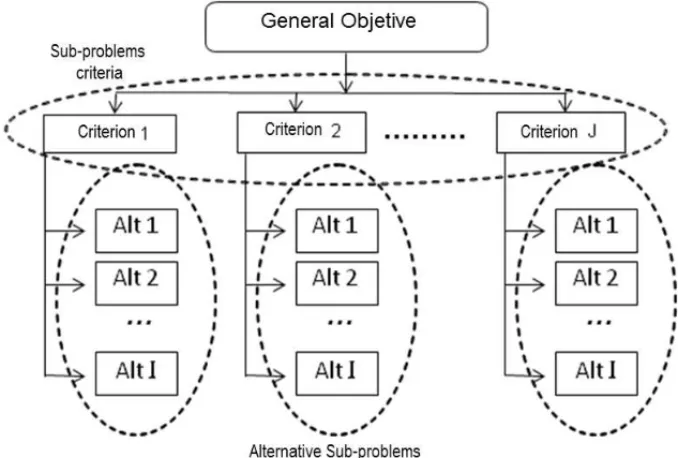
In a working team of N members, the decision problem is structured and it is represented in a tree diagram that can be divided into sub-problems. One of them is the comparison of criteria with each other and the assignment of weights to them; another is the comparison of alternatives in light of each criterion, and the assignment of utilities to each alternative, as shown in Figure 1.
Figure 1– Decision-making tree diagram and associated sub-problems.
The first phase is where the reduction of both, imprecision and uncertainty of the process, takes place. At the beginning of the sub-problem analysis, it is possible that the knowledge, preferences and hence the group’s priorities are completely different. In order to reach an agreement, an iterative cycle of analysis that allows the exchange of knowledge and experience, takes place. Thus, it contributes to reduce the different views among group members. The stable condition is achieved when the positions of the group may not vary too much, even when the analysis is extended.
In order to verify if this requirement has been met, the group members are asked to assign sub-jective utilities to the compared elements (Keeney & Raiffa, 1993). Those assigned utilities can be regarded as observations of a multidimensional random variable, with a marginal distribution for each element analyzed.
Following this logic, a situation without consensus can be reflected by Uniform Marginal Dis-tributions. Otherwise, if the members align their positions, assigned utilities are similar and the probability distribution is Normal.
For this reason, the stability condition is verified by normality analysis of each sub-problem valuation and through the IVR (in Spanish: “´Indice de Variabilidad Remanente”) indicator. This compares the sum of squares of the observations, with which would be obtained if the true distribution were uniform.
In practice, IVR values below 25% indicate a condition of stable consensus. If stability is not achieved, the group should repeat the sub-problem analysis in a plenary in order to identify, and if possible, eliminate points of dissent.
When all sub-problems have been stabilized, the second phase called aggregation starts. Then, it is possible to determine global values for each alternative. DRV processes method offers the possibility of aggregation by two modalities: linear weighting and TODIM method formulation. In the first variant, ifWj represents the weights of the criteria, and Uij the utilities assigned to candidates under the criterion j, the partial contribution to the priority assigned to a generic alternativei, when considering the criterion j is obtained as the product of the two random variables mentioned, under the expression (1)
Zij=Wj∗Uij (1)
Where the distributions ofZi j variables can be formulated with the expression (2).
P(Wj∗Uij<z)=
(w,u)∈{Wj∗Uij<z} 1 2π
1 σwjσuij
e− 1 2
wj−µwj σwj
2
e− 1 2
ui j−µUij σUij
2
dwdu (2)
The global values of a generic alternative (Vi) can be obtained as indicated in the expression (3).
Vi= J
j=1
Wj∗Uij= J
j=1
Zanazzi & Gomes (2009) state that when the distributions of Wj andUi j variables are
Gaus-sian, then the marginal distributions of the global values of generic alternatives (Vi) can also be
considered Normal.
In the second variant, it is possible to aggregate expressions with TODIM method (Gomes et al., 2015; Machado et al., 2015; Paredes-Frigolett & Gomes, 2016). Therefore, it is adopted one of the criteria as referential (rcriterion) and partial dominance matrices and final dominance matrix are calculated. The global dominance of alternativei, is obtained as the sum of the partial dominances.
This latter option allows improving the representation of the group of decision makers’ prefer-ences, because it provides a method of practical application of the concepts of Prospect Theory. Indeed, this is a way to reflect the risk attitude that participants show, since the impact perceived by decision makers, when losses occur, is usually greater than that generated by profits ones (Gomes & Zanazzi, 2012).
In the third and final phase: ordering, the samples of global values obtained are analyzed in order to define order relations among the alternatives, so hypotheses tests comparing means of dependent variables are applied. Furthermore, this method uses an algorithm (Benjamini & Yekutieli, 2001) to control the probability of type I error.
3 METHODOLOGY
This paper proposes the following combination of methodologies for the problem of selecting working teams, aimed at increasing the chances of success, both from the point of view of the supplier and of the projects that apply this modality.
• Soft System Methodology (SSM): to structure the selection problem.
• Repertory Grid: as support of individual interviews and to elicit the selection criteria.
• DRV Processes: to assess the candidates and generate knowledge and consensus in the selection process.
• Linear programming: to define the person to be assigned to each position.
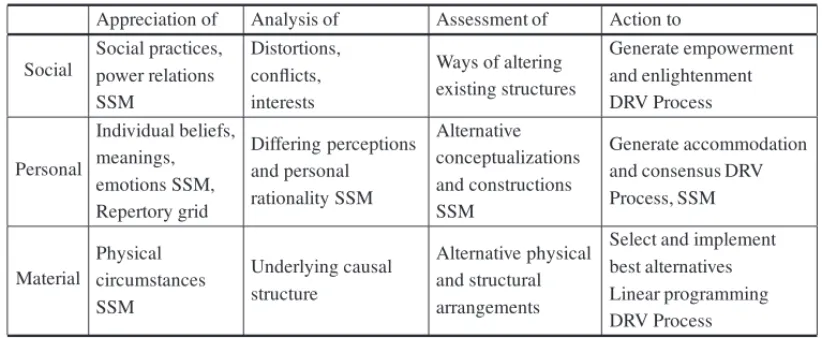
In Table 1, the methodologies selected are shown as well as the way they complement and provide feedback to each other. The conceptual framework adopted is Mingers & Brocklesby (1997) which discriminates the dimensions to be considered (social, personal and material) as well as the type of phases required. The interaction of these methods in the dynamics of implementation is highlighted.
Table 1– Configuration Intervention.
Appreciation of Analysis of Assessment of Action to
Social
Social practices, power relations SSM
Distortions, conflicts, interests
Ways of altering existing structures
Generate empowerment and enlightenment DRV Process
Personal
Individual beliefs, meanings, emotions SSM, Repertory grid
Differing perceptions and personal rationality SSM
Alternative conceptualizations and constructions SSM
Generate accommodation and consensus DRV Process, SSM
Material
Physical circumstances SSM
Underlying causal structure
Alternative physical and structural arrangements
Select and implement best alternatives Linear programming DRV Process
3.1 Modality adopted for SSM
In order to structure the problem of selection, Checkland’s principles (2000) were adopted. Some modifications were introduced to achieve management effectiveness, according to Geor-giou (2008, 2012), whose version helped to define the context of the decision-making process, namely: problematic situations to be considered, stakeholders, interactions, characterization of the organizational environment and definition of the type of transformations that it was neces-sary to implement.
The focus was placed on the exploration and expression of the problematic situation. Hence, oral semi structured interviews were conducted with the two Partner-Managers of the company, the Development Manager and twelve people with different roles in the working teams (project leaders and employees with experience in the organization), in order to extract clear information on the context in which the problem was immersed.
Questions and additional activities were combined, such as the construction of rich pictures to graphically represent their perceptions in decision-making process. Three types of analyzes were performed: identification and characterization of roles, socio-cultural dynamics and power re-lations in the context of the problem, which allowed the identification of those involved, the relations among them, the prevailing values and the systems restrictions.
The rigorous definition of the problematic situation was essential for its resolution, and it was achieved identifying the transformations, where the observed situations (conflicts) and the ideal situation were made explicit; being the former the input of the transformation that returns as output, the expected change.
process, changes a defined input or current situation into a defined output or ideal situation;W: the reasons that justify the transformation;O: owners, who could disrupt or limit the transforma-tion;E: environment restrictions that may interrupt, limit or complicate the transformation). Each T is transcribed in a phrase that became a declaration, leading the systematic planning of this transformation and the global planning of all as a whole. These transformations should be both: systematically convenient (on the basis of logic models) and culturally feasible for those who are immersed in the problematic situation (Mingers & Rosenhead, 2004).
A root definition was developed for each CATWOE, and a realistic planning of actions that would facilitate its implementation was programmed for each of them.
As a summary, the contributions of SSM helped identify the necessary transformations for the selection model to operate correctly. In this setting, the next step was to establish the compe-tencies to be adopted as selection criteria.
3.2 Modality adopted for the Repertory Grid
In order to elicit the competencies required for the members of the working team, individual in-terviews were conducted to all the participants involved in the SSM modality (managers, project leaders and employees with experience in the supplier company).
These interviews were structured through the Kelly Repertory Grid; tool that is based on the Personal Construct Theory (Kelly, 1955; Alexander et al., 2010). According to this theory, people build their individual world from their interpretation of the outside world. Thus, it facilitates the interpretation of how a person understands their experiences, so that it constitutes an appropriate interface for conducting interviews.
A version of the Repertory Grid, called Grid of Rankings was applied, in which the roles to be assessed were disposed; each interviewee indicated bipolar constructs, which according to their perception, operated as evaluation criteria for these roles. Thus, each interviewee proposed a set of criteria to evaluate an employee for a given role.
The Repertory Grid has an important quality, called the principle of commonality. According to this property, if the members of a group that share objectives on the same subject, individually identify their personal constructs, these constructions are similar. That is, group members tend to repeat the constructs proposed by their peers.
3.3 Modality adopted for DRV Processes
In order to value the candidates and produce knowledge and consensus in the selection process, a workshop was organized forNparticipants with leading roles and experience in the company. Hereinafter, the sub indexn(with 1≤n≤N) identifies the participants.
The activity was divided into two stages. In the first, criteria weights used in the selection of the four roles to be considered were elicited: functional analyst; testing analyst; developer and referent.
A sub indexk, (where 1≤k≤K) was assigned to identify each role.
The activity was designed as an instance of construction of group knowledge. For that, the recommendations of teaching specialists were considered in the design. In this respect, Wenger-Trayner & Wenger-Wenger-Trayner (2015) emphasize that collaborative learning requires that the group adopt a common language code and develop a shared discourse. That is, linguistic activity is fundamental (Wenger et al., 2014). On the other hand, there are activities that favor the joint construction of knowledge; those include the development of joint definitions, the sharing of knowledge and experience, as well as problem solving as a whole (Hmelo-Silver & Barrows, 2008).
With this idea and for each role, the group began with the analysis of the results obtained with the Repertory Grid, which were elaborated in the individual interviews. First, it was agreed that it was possible that the constructs identified in the interviews were adopted as criteria for the selection to be implemented. Emerging constructs were analyzed and definitions were developed for possible criteria. The revision and improvement of these definitions allowed specifying the criteria to be considered for each role and to agree on the way of valuing them. Group applica-tions were also made, with alternatives of fictitious decision, to favor the construction of sense around each criterion.
When a state of apparent agreement was reached, it continued the individual task. For every role, each group member had to perform the following tasks, with complete independence among partcipants:
• Sort the criteria to be considered, from highest to lowest priority.
• Compare in pairs the adjacent elements in the preorder mentioned, answering the question: “how many times is preferable a criterion, compared to the adjacent one?”. The priority intensity of criterionm, on criterion (m−1), was expressed by an amounthm, defined
in the field of real numbers; such that one represents indifference and for example, three means that the first element of the relationship has three times more priority than the other.
• Obtain global utilities for each criterion j, by doing:
Cj = j
m=1
• Standardize the weights performed by each participant, on(0.1)scale, dividing by the sum of the allocations.
w∗k,j,n=Cj J
m=1
Cm (5)
The obtained valueswk∗,j,nare preliminary values. To be considered definitive, they must comply stability and consensus requirements. According to Zanazzi (2016), these conditions require that:
• The valuesw∗k,j,ncould be assumed to be extracted from a population with Normal Distri-bution.
• The IVR indicator takes a value close to zero.
When these conditions were verified, the preliminary values were assumed as definitive weights and the process continued with the analysis of other criteria; otherwise, an analysis to improve the criteria definition, had to be taken up in plenary. In this way, the set of weights can be organized in the following matrix:
W =
wk,1,1 wk,2,1 . . . wk,J,1 wk,1,2 wk,2,2 . . . wk,J,2
. . . .
wk,1,n wk,2,n . . . wk,J,n
(6)
Once criteria weights for all roles were determined, it begins the second stage, intended to com-pare candidates. This part of the activity is summarized in the following iterative process.
a. The analysis is positioned at thejth criterion.
b. TheI candidates are analyzed, in light of the jcriteria considered, until the process sta-bilizes. This includes comparing, in plenary, the characteristics of the candidates, then assign utilities individually and finally, check if the stability and consensus condition are met. Assigned utilities are represented asui,j,n, con 1≤i≤I.
c. Return to stage a., in order to analyze another criterion. When all criteria were analyzed, the obtained utilities for each criterion j, were ordered in a matrix:
Uj =
u1,j,1 u2,j,1 . . . uI,j,1
u1,j,2 u2,j,2 . . . uI,j,2
. . . .
u1,j,n u2,j,n . . . uI,j,n
(7)
Then, it is time to aggregate. Lineal weighting is used to obtain the global valuesvk,i,n, which
are determined to each candidate, for each rolek, through the expression (4).
Vk,i,n = J
j=1
Where sub indexkindicates the role considered, sub index j identifies the criterion, sub index icorresponds to the candidate or alternative being analyzed and n indicates the participant who makes the assignations.
d. Representative global values of each candidate for each role are determined by the expres-sion (5).
¯ vk,i=
N
n=1
vk,i,nN (9)
Finally, the optimal assignation of available people to the different roles in the project group is executed.
3.4 Modality adopted to assign people to required roles
When assigning a person to a certain role in the working team, it was considered appropriate to do the selection taking into account that the global evaluation of the group was as high as possible. Since, the employees of the supplier company had a common training; it was assumed that they had the flexibility to adapt to different possible roles.
A classic process of assigning people to jobs, which was resolved through Linear Programming (Alberto & Carignano, 2013) was proposed. The structure of this program is indicated in the system of expressions (6).
Max
K
k=1
I
i=1 ¯ vk,iyk,i
s.t.
K
k=1
yk,i =1∀1≤i ≤ I
I
i=1
yk,i =1∀1≤k≤K
(10)
Where the variablesyk,i have a value of 1, when the candidateiis assigned the rolek. When the
number of people available in the supplier company is greater than the amount of roles to cover, additional variables (roles) are defined to balance the problem. Obviously, these variablesyk,i
are incorporated with zero utility, and(K+1)≤k≤Iis fulfilled.
3.5 Summary of the multimethodology used
S E L E C T ING W O RK ING T E A M S F O R INF O RM A T IO N T E CHNO L O G Y O U T S O URCING P R O J E C T S
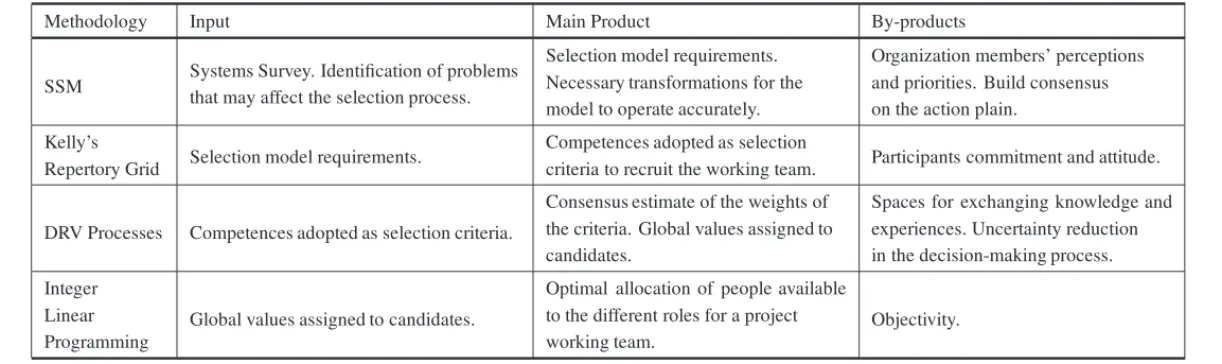
Table 2– Input and products of the methodologies used.
Methodology Input Main Product By-products
SSM Systems Survey. Identification of problems that may affect the selection process.
Selection model requirements. Necessary transformations for the model to operate accurately.
Organization members’ perceptions and priorities. Build consensus on the action plain.
Kelly’s
Repertory Grid Selection model requirements.
Competences adopted as selection
criteria to recruit the working team. Participants commitment and attitude.
DRV Processes Competences adopted as selection criteria.
Consensus estimate of the weights of the criteria. Global values assigned to candidates.
Spaces for exchanging knowledge and experiences. Uncertainty reduction in the decision-making process.
Integer Linear Programming
Global values assigned to candidates.
4 RESULTS
The case study analyzed in this paper was a company oriented to both, the production of software and outsourcing of services. Initially, the company requested the development and implementa-tion of a methodology, which under a client request of outsourcing service, allowed facilitating the selection of the suitable working team to be assigned to the project, that is to say, the people involved and the roles each should play. At the time of the study, the company had one hundred and twenty employees and fifteen years of experience in the market, so it was a consolidated structure.
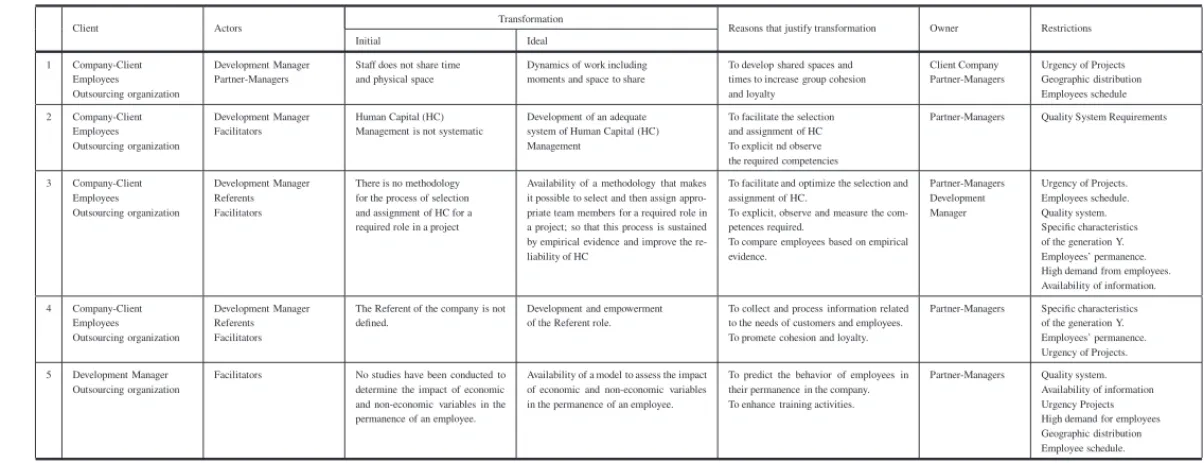
As indicated in Table 3, the application of the amended version of SSM according to Georgiou (2008, 2012) allowed detecting five CATWOE elements with their corresponding transforma-tions, related to the recruitment process.
The initial problematic situations to be improved were: there was no time sharing and there were not common physical spaces, Human Capital (HC) Management was not systematized, there was no methodology for the recruitment and allocation of suitable employees for a required role in a project, there was not a Referent figure defined and there were not studies to determine the impact of economic and non-economic variables in the permanence of an employee.
Root definitions of each CATWOE element were extracted. For example, as a result of the third row of Table 3, the following root definition emerged: The design of a recruitment and allocation methodology to assign suitable HC for a specific role in a project, based on empirical evidence, will improve the effectiveness and efficiency of the selection process.
For the implementation of the actions resulting from this transformation, it was necessary to define the roles required for the working teams. These were: Functional Analyst, Developer, Testing Analyst, and Referent of the organization. In a plenary session with the group of the fifteen people who were interviewed during the SSM modality, the roles identified were charac-terized as shown in Table 4.
In the fifteen individual interviews, structured through the Grid of Ratings, interviewees sug-gested between 6 and 12 emerging constructs that in their opinion would allow assessing an employee for a given role.
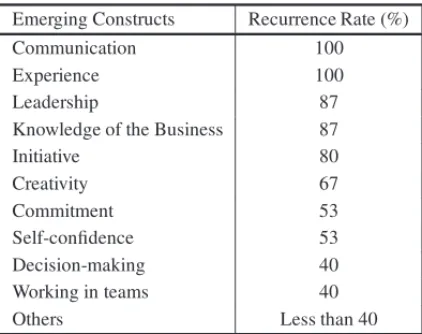
In a plenary session, the observable similarities in the grids of ratings resulting from the inter-views were analyzed, consequently the list of emerging constructs was designed and the recur-rence rate was obtained for each, as shown in Table 5.
The five constructs with the highest rate were considered, as a set of criteria to assess a person for a given role. Participants agreed that the remaining constructs were included in the five selected. Thus, in agreement they proposed: communication, experience, leadership, business knowledge, and initiative as the competences to guide the assessment. Moreover, the group agreed unanimously that the same criteria could be used for all the roles.
S E L E C T ING W O RK ING T E A M S F O R INF O RM A T IO N T E CHNO L O G Y O U T S O URCING P R O J E C T S
Table 3– CATWOE for the selection process.
Transformation Client Actors
Initial Ideal
Reasons that justify transformation Owner Restrictions
1 Company-Client Employees Outsourcing organization
Development Manager Partner-Managers
Staff does not share time and physical space
Dynamics of work including moments and space to share
To develop shared spaces and times to increase group cohesion and loyalty
Client Company Partner-Managers
Urgency of Projects Geographic distribution Employees schedule 2 Company-Client Employees Outsourcing organization Development Manager Facilitators
Human Capital (HC) Management is not systematic
Development of an adequate system of Human Capital (HC) Management
To facilitate the selection and assignment of HC To explicit nd observe the required competencies
Partner-Managers Quality System Requirements
3 Company-Client Employees Outsourcing organization Development Manager Referents Facilitators
There is no methodology for the process of selection and assignment of HC for a required role in a project
Availability of a methodology that makes it possible to select and then assign appro-priate team members for a required role in a project; so that this process is sustained by empirical evidence and improve the re-liability of HC
To facilitate and optimize the selection and assignment of HC.
To explicit, observe and measure the com-petences required.
To compare employees based on empirical evidence.
Partner-Managers Development Manager
Urgency of Projects. Employees schedule. Quality system. Specific characteristics of the generation Y. Employees’ permanence. High demand from employees. Availability of information. 4 Company-Client Employees Outsourcing organization Development Manager Referents Facilitators
The Referent of the company is not defined.
Development and empowerment of the Referent role.
To collect and process information related to the needs of customers and employees. To promete cohesion and loyalty.
Partner-Managers Specific characteristics of the generation Y. Employees’ permanence. Urgency of Projects. 5 Development Manager
Outsourcing organization
Facilitators No studies have been conducted to determine the impact of economic and non-economic variables in the permanence of an employee.
Availability of a model to assess the impact of economic and non-economic variables in the permanence of an employee.
To predict the behavior of employees in their permanence in the company. To enhance training activities.
Table 4– Definition of Roles.
Role Description
Functional Analyst
Functional Analyst is responsible for data collection, analysis and design of solutions to meet user requirements. May or may not participate in the development itself. He follows-up the project up to the implementation, may design testing instances with users to validate the products. He must know the client’s business since users can not always explain their needs. He is generally responsible for the initial basic training of the user.
Developer
Developer must be able of interpreting the requirements indicated by the Functional Analyst, resolves solely technical issues. He may perform uni-tary tests when requested by the Functional Analysts, and has nocontact with the user.
Testing Analyst
Testing Analyst is responsible for testing, at the functional level, that user requirements have been correctly interpreted, validates the product, follows-up that it has the behavior expected by the user and verifies that it meets standards of development. He may control or facilitate the correct imple-mentation process.
Referent of the company
Referent is the nexus between the business needs and the employee and vice versa, also links the customer’s needs with those of the company. He coordinates daily tasks and activities for the people in charge.
Table 5– Emerging Constructs and Recurrence Rate.
Emerging Constructs Recurrence Rate (%)
Communication 100
Experience 100
Leadership 87
Knowledge of the Business 87
Initiative 80
Creativity 67
Commitment 53
Self-confidence 53
Decision-making 40
Working in teams 40
Others Less than 40
Table 6– Agreements on the definition of criteria (competences to be considered).
Criteria Definition
Initiative (I) Proactivity, vocation for innovative and feasible proposals. Willingness to take responsability.
Experience (E) Concrete experience in exercising the role or related roles.
Knowledge of the Business (N) Knowledge of the processes of the organization, where he/she would work.
Leadership (L) Ability to guide, monitors, motivates and transmits the vision of the business to its peers.
Communication (C) Skills to transmit ideas liston to group members and develop interpersonal relationships.
Once criteria were defined, estimates of weights for different roles were discussed. The estima-tion process was carried out with the method described in paragraph 3.3, i.e. group members assigned weights to each criterion individually and then the resulting sample was analyzed to infer if stability was achieved. Figure 2 illustrates the results of these activities, and shows the box diagrams obtained in the first cycle of analysis for the position of Developer. By analyzing the figure, it can be detected a strong variability in opinions. The greatest variability is related to the experience (E) and knowledge (N) of the business, while there are positions placed very far from the rest related to initiative (I) and leadership (L).
Figure 2– Box Diagram of Weighted criteria for the role Developer.
It is worthy to explain that an additional step was necessary to achieve stability, as shown in Figure 3. It is interesting to note that in two cycles of analysis, it was possible to reduce the sum of squares of the weights assigned individually, to 24% of the sum of squares taken as reference, that is, the one corresponding to a uniform distribution.
Figure 3– Evolution of the IVR indicator criteria for the role Developer.
Similar results were obtained when assessing the criteria for the remaining roles; in some cases with IVR values lower than 20%. On the other hand, at most three steps were needed to achieve stability. In Table 7 average weights for the five criteria agreed, are summarized for each of the roles.
Table 7– Average weights for the criteria agreed for each role.
Role Experience Knowledge Commmunication Leadership Initiative
of Business
Functional Analyst 0,29 0,3 0,11 0,2 0,1
Testing Analyst 0,2 0,32 0,27 0,09 0,12
Developer 0,45 0,09 0,15 0,06 0,25
Referent of the organization 0,15 0,23 0,28 0,16 0,18
Based on this information, the recruitment of a working team for a project that required four members (one for each of the roles considered) was performed. They were selected from six employees who were not yet assigned to any project. Utilities were assigned to the six candi-dates in the light of the criteria adopted. Therefore, the activities formulated in the algorithm in section 3.3 listed from a to e, were performed.
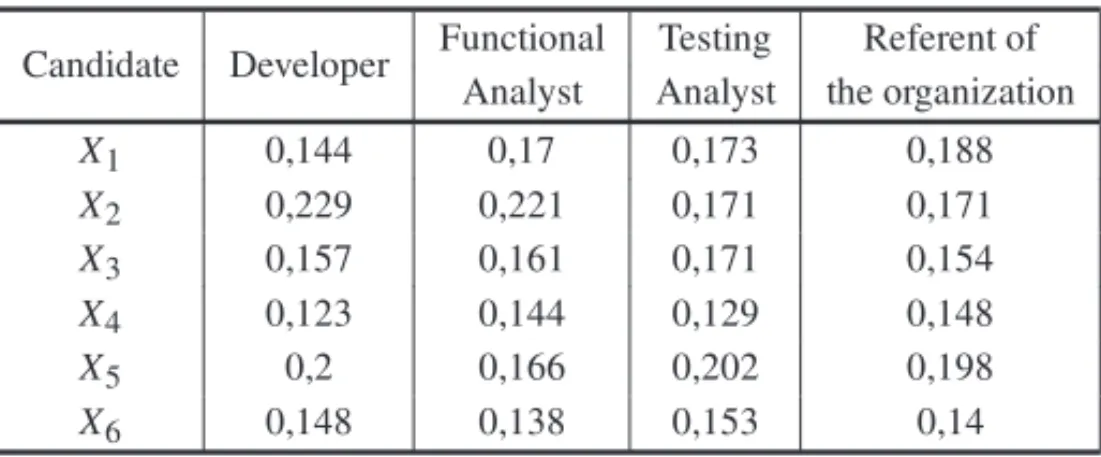
Once utilities were assigned to the candidates, their global values were calculated (global average utilities for each dependent and for each role:vk¯,i). In Table 8 these results are presented, where
the names have been replaced by the designationsX1,X2, . . . ,X6.
Table 8– Global Values for candidates to each role.
Candidate Developer Functional Testing Referent of Analyst Analyst the organization
X1 0,144 0,17 0,173 0,188
X2 0,229 0,221 0,171 0,171
X3 0,157 0,161 0,171 0,154
X4 0,123 0,144 0,129 0,148
X5 0,2 0,166 0,202 0,198
X6 0,148 0,138 0,153 0,14
These values are the input for the linear programming of the expression (6). With these values, the solution to the problem was to assign individualX2to the role Functional Analyst,X1to the
role Referent,X4to the role Testing Analyst and finallyX6to the role Developer.
The first application of this methodological proposal was managed by the authors of this paper. At the same time, the development manager and one of the professionals were trained, so that they could act as facilitators in the following applications. The authors conducted a face tracking of the two subsequent applications without detecting significant difficulties.
5 DISCUSSION
This experience started with the requirement, from a supplier company of IT Outsourcing, of a model that would make the selection process of suitable working teams (technically competent and with chances to remain and finish the project). This type of problem is highly complex, because technical, individual and social issues are involved.
Thus, the application of SSM methodology allowed determining that finding an effective solution to the problem, implied going beyond the selection method. In fact, it was detected the need to improve the human capital management, by recognizing the employees needs and perceptions, by setting places and moments to develop and strengthen their relationship with the company and by developing the role of the Referent in the organization.
The group also agreed to use the same competences to assess the employees in the four roles. Although it is not essential to the proposed methodology, it should be recognized that it is desir-able, because then the selection methodology can be structured similarly, with differences only in the weights assigned to the criteria.
Despite the existence of the coincidences mentioned above, the first applications of the DRV Pro-cesses proved that there were important differences in priorities and perceptions of participants. In fact, the results showed the lack of consensus and asked for an expansion and improvement of the analysis. Such situations should not be surprising; in plenary meetings often groups express agreements that are not really such. The problem is that these differences introduce imprecision in the valuations and create uncertainty on the outcome of the selection process. However, along these activities, an important reduction of disturbances was achieved. Indeed, the remaining dis-persion was estimated in twenty percent of the original. Moreover, it should be noted that the participants recognized that the activities offered an interesting opportunity to exchange knowl-edge and experiences what it was not frequent in the company.
Regarding the results of the linear programming, they were accepted as natural and reasonable by the members of the company. It was highlighted that those values should be updated with high frequency for the system to work properly.
In conclusion, the combination of methodologies allowed finding a more complete and more appropriate solution than that initially requested by the company. Moreover, the methodolo-gies used seem to complement very well, since each contributed essential information to the remaining ones.
6 CONCLUSIONS
In this paper, a methodology is proposed to select a group of people who could focus on the development of IT projects. The problem is complex since the decision is affected by high levels of uncertainty and it is necessary to identify and consider both the organization values, and the participant’s personal interests.
stakeholders, generating a space for joint learning and improvement in the level of commitment to the decision adopted.
Regarding the limitations of the proposal, it is an approach that cannot be applied in emergen-cies, since it requires a time of considerable analysis and participation of stakeholders.
Conversely, it is possible to transfer this multi-methodological approach without difficulty to different contexts. In fact, it can be adapted to the development of other management systems such as quality or the environment, for example.
ACKNOWLEDGMENTS
The research, on which this paper is based, was financed by Secretar´ıa de Ciencia y T´ecnica de la Universidad Nacional de C´ordoba, Argentina and UBACYT Project 20620130199924BA, Universidad de Buenos Aires, Argentina.
REFERENCES
[1] ALBERTO C & CARIGNANO C. 2013. Apoyo Cuantitativo a las Decisiones. Cuarta Edici´on. Cooperadora Facultad de Ciencias Econ´omicas, UNC, Argentina.
[2] ALENCARL & ALMEIDAAT. 2010. A Model for Selecting Project Team Members Using Multicri-teria Group Decision Making.Pesquisa Operacional,30: 221–236.
[3] ALEXANDER P, VAN LOGGERENBERGJ, LOTRIET H & PHAHLAMOHLAKAJ. 2010. The Use of the Repertory Grid for Collaboration and Reflection in a Research Context.Group Decision and Negotiation,19: 479–504.
[4] ALTUZARRAA, MORENO-JIMENEZ´ JM & SALVADORM. 2007. A Bayesian priorization procedure for AHP-group decision making.European Journal of Operational Research,182(1): 367–382.
[5] ALTUZARRAA, MORENO-JIMENEZ´ JM & SALVADORM. 2010. Consensus building in AHP-group decision making: a Bayesian approach.Operations Research,58(6): 1755–1773.
[6] BREDILLETC, TYWONIAKS & DWIVEDULAR. 2015. What is a good project manager? An Aris-totelian perspective.International Journal of Project Management,33(2): 254–266.
[7] BRIERE` S, PROULXD, NAVAROFLORESO & LAPORTEM. 2015. Competencies of project man-agers in international NGOs: Perceptions of practitioners.International Journal of Project Manage-ment,33: 116–125.
[8] BENJAMINIY & YEKUTIELID. 2001. The Control of the False Discovery Rate in Multiple Testing under Dependency.Annals of Statistics, pp. 1165–1188.
[9] CHECKLANDP. 2000. Soft Systems Methodology: A Thirty Year Retrospective.Systems Research and Behavioral Science,17: 11–58.
[10] DEALMEIDAJAD, ALMEIDAATD & COSTAAP. 2014. Portfolio selection of information systems projects using PROMETHEE V with C-optimal concept.Pesquisa Operacional,34(2): 275–299.
[12] DIASL & CL´IMACOJ. 2005. Dealing with Imprecise Information in Group Multicriteria Decisions: A Methodology and GDSS Architecture.European Journal of Operational Research,160: 291–307.
[13] DONGQ & SAATYTL. 2014. An analytic hierarchy process model of group consensus.Journal of Systems Science and Systems Engineering,23(3): 362–374.
[14] DOSSANTOSJC &DASILVAMM. 2015. Mapping Critical Success Factors for IT Outsourcing: The Providers’ Perspective.International Journal of Enterprise Information Systems (IJEIS),11(1): 62–84.
[15] DUHAMELF, GUTIERREZ´ -MARTINEZ´ I, PICAZO-VELAS & LUNA-REYESLF. 2012. The Key Role of Interfaces in IT Outsourcing Relationships.International Journal of Information Technologies and Systems Approach (IJITSA),5(1): 37–56.
[16] FERRETTIV. 2016. From stakeholders analysis to cognitive mapping and Multi-Attribute Value The-ory: An integrated approach for policy support.European Journal of Operational Research,253(2): 524–541.
[17] FORMANE & PENIWATIK. 1998. Aggregating Individual Judgments and Priorities with the Analytic Hierarchy Process.European Journal of Operational Research,108: 165–169.
[18] FRANCOL & LORDE. 2011. Understanding Multi-Methodology: Evaluating The Perceived Impact of Mixing Methods for Group Budgetary Decisions.Omega,39: 362–372.
[19] FRANCOLA & H ¨AMAL¨ AINEN¨ RP. 2016. Behavioural operational research: returning to the roots of the OR profession.European Journal of Operational Research,249(3): 791–795.
[20] FUC & YANGS. 2012. An Evidential Reasoning Based Consensus Model for Multiple Attribute Group Decision Analysis Problems With Interval-Valued Group Consensus Requirements.European Journal of Operational Research,223: 167–176.
[21] GEORGIOUI. 2008. Making Decisions In The Absence of Clear Facts.European Journal of Opera-tional Research,185: 299–321.
[22] GEORGIOUI. 2012. Messing About In Transformations: Structured Systemic Planning For Systemic Solutions To Systemic Problems.European Journal of Operational Research,223: 392–406.
[23] GOMESLFAM, RANGELLAD & JERONIMOˆ RL. 2010. A study of professional mobility in a large corporation through cognitive mapping.Pesquisa Operacional,30(2): 331–344.
[24] GOMESLFAM, MACHADOMAS, SANTOSDJ & CALDEIRAAM. 2015. Ranking of Suppliers for a Steel Industry: A Comparison of the Original TODIM and the Choquet-extended TODIM Methods. Procedia Computer Science,55: 706–714.
[25] GOMESL & ZANAZZIJ. 2012. An´alisis Multicriterio Com Multiples Decisores: Aplicaci´on Combi-nada de los M´etodos Todim y Procesos DRV.Revista De Administrac¸˜ao do Gestor,2: 105–136.
[26] GONC¸ALOTEE & ALENCARLH. 2014. A supplier selection model based on classifying its strategic impact for a company’s business results.Pesquisa Operacional,34(2): 347–369.
[27] H ¨AMAL¨ AINEN¨ , LUOMA& SAARINEN. 2013. On the importance of behavioral operational research: The case of understanding and communicating about dynamic systems.European Journal of Opera-tional Research,228: 623–634.
[29] HENAOF & FRANCOA. 2016. Unpacking multimethodology: Impacts of a community development intervention.European Journal of Operational Research,253: 681–696.
[30] HMELO-SILVERCE & BARROWSHS. 2008. Facilitating collaborative knowledge building. Cogni-tion and instrucCogni-tion,26(1): 48–94.
[31] KEENEYRL & RAIFFAH. 1993. Decisions with Multiple Objectives: Preferences and Value Trade-Offs. Cambridge University Press.
[32] KELLY G. 1955. The Psychology of Personal Constructs. Vol. 1: A Theory of Personality. Vol. 2: Clinical Diagnosis and Psychotherapy. New York. Norton.
[33] KELEMENISA, ERGAZAKISK & ASKOUNISD. 2011. Support Managers Selection Using an Ex-tension of Fuzzy Topsis.Expert Systems with Applications,38: 2774–2782.
[34] KONTUK, RINNES, OLKKONENV, LAHDELMAR & SALMINENP. 2015. Multicriteria evaluation of heating choices for a new sustainable residential area.Energy and Buildings,93: 169–179.
[35] LACITYMC, KHANS, YANA & WILLCOCKSLP. 2010. A Review of the IT Outsourcing Empirical Literature and Future Research Directions.Journal of Information Technology,25(4): 395–433.
[36] LOUFRANI-FEDIDAS & MISSONIERS. 2015. The project manager cannot be a hero anymore! Understanding critical competencies in project-based organizations from a multilevel approach. International Journal of Project Management,33: 1220–1235.
[37] MACHADOMAS, GOMESLFAM, SANTOSDJ & CALDEIRAAM. 2015. Using a Bipolar Choquet Neural Network to Locate a Retail Store.Procedia Computer Science,55: 741–747.
[38] MEDINAA & FRANCISAJ. 2015. What Are the Characteristics That Software Development Project Team Members Associate With a Good Project Manager? Project Management Journal, 46(5): 81–93.
[39] MINGERSJ & ROSENHEADJ. 2004. An´alisis Racional Reestudiado para un Mundo Problem´atico: M´etodos para Estructurar Problemas en Condiciones de Complejidad, Incertidumbre y Conflicto. Instituto Venezolano de Planificaci´on, Espa ˜na.
[40] MINGERS J & BROCKLESBYJ. 1997 Multimethodology: Towards A Framework For Mixing Methodologies.Omega,25(5): 489–509.
[41] MINGERSJ. 2000. Variety Is the Spice of Life: Combining Soft and Hard OR/MS Methods. Interna-tional Transactions in OperaInterna-tional Research,7(6): 673–691.
[42] MINGERSJ & GILLA. (Eds.) 1997. Multimethodology: Towards Theory And Practice And Mixing And Matching Methodologies. John Wiley & Sons Incorporated.
[43] MONTIBELLERG & WINTERFELDTD. 2015. Cognitive and motivational biases in decision and risk analysis.Risk Analysis,35(7): 1230–1251.
[44] MORAISDC, COSTAAPC &DEALMEIDAAT. 2014. Group Decision Model for Outsourcing IT Services.Procedia Technology,16: 562–568.
[45] M ¨ULLERR & TURNERR. 2010. Leadership competency profiles of successful project managers. International Journal of Project Management,28(5): 437–448.
[47] PAREDES-FRIGOLETT H & GOMES LFAM. 2016. A novel method for rule extraction in a knowledge-based innovation tutoring system.Knowledge-Based Systems,92: 183–199.
[48] RAMAZANI& JERGEAS2015 Project managers and the journey from good to great: The benefits of investment in project management training and education.International Journal of Project Manage-ment,33: 41–52.
[49] RAVINDRANK, SUSARLAA, MANID & GURBAXANIV. 2015. Social Capital, Reputation and Contract Duration in Buyer-Supplier Networks for Information Technology Outsourcing.Information Systems Research, Forthcoming.
[50] SANTOSMARD, SALOMONVAP & MARINSFAS. 2015. Analytic Network Process and Balanced Scorecard applied to the performance evaluation of Public Health Systems.Pesquisa Operacional, 35(2): 353–361.
[51] SHAHHOSSEINIV & SEBTMH. 2011. Competency-Based Selection and Assignment of Human Resources to Construction Projects.Scientia Iranica,18: 163–180.
[52] SMALLA & WAINWRIGHTD. 2014. SSM and Technology Management: Developing Multimethod-ology through practice.European Journal of Operational Research,233(3): 660–673.
[53] SVEJVIGP & PRIES-HEJEJ. 2011. Enterprise Systems Outsourcing Behind The Curtain: A Case Study Showing how Rational and Institutional Explanations Coexist and Complement Each Other. International Journal of Enterprise Information Systems (IJEIS),7(1): 1–17.
[54] TAKEYSM & MONTEIRO DECARVALHOM. 2015. Competency mapping in project management: An action research study in an engineering company.International Journal of Project Management, 33: 784–796.
[55] TERVONEN, T. 2014. JSMAA: Open source software for SMAA computations.International Journal of Systems Science,45(1): 69–81.
[56] VELASQUEZ M & HESTER PT. 2013. An analysis of multi-criteria decision making methods. International Journal of Operations Research,10(2): 56–66.
[57] VIDALRVV. 2006. “Operational Research: A Multidisciplinary Field”.Pesquisa Operacional,26: 69–90.
[58] WILLCOCKSL. 2010. The Next Step for the CEO: Moving IT-Enabled Services Outsourcing To the Strategic Agenda.Strategic Outsourcing: An International Journal,3(1): 62–66.
[59] WUZ & XUJ. 2012. A consistency and consensus based decision support model for group decision making with multiplicative preference relations.Decision Support Systems,52(3): 757–767.
[60] WENGER-TRAYNER E & WENGER-TRAYNER B. 2015. Communities of practice. A brief in-troduction. URI: http://wenger-trayner. com/wp-content/uploads/2015/04/07-Brief introduction-to-communities-of-practice.pdf. Cited, 6, 16.
[61] WENGER-TRAYNER E, FENTON-O’CREEVY M, HUTCHINSON S, KUBIAK C & WENGER -TRAYNERB. 2014. Learning in Landscapes of Practice: Boundaries, identity, and knowledgeability in practice-based learning. Routledge. a. 62.
[63] YOLLESM. 2010. Exploring complex sociocultural situations through Soft Operational Research. Pesquisa Operacional,30(2): 345–370.
[64] ZANAZZIJ & GOMES L. 2009. La B´usqueda de Acuerdos en Equipos de Trabajo: El M´etodo Decisi´on con Reducci´on de la Variabilidad (DRV).Pesquisa Operacional,29: 195–221.
[65] ZANAZZIJL, GOMESLFAM & DIMITROFFM. 2014. Group Decision Making applied to Preventive Maintenance Systems.Pesquisa Operacional,34(1): 91–105.
[66] ZANAZZIJ. 2016. Tesis doctoral: “Toma de decisiones en grupos de trabajo. El m´etodo Proce-sos DRV (Decisi´on con Reducci´on de Variabilidad)”. FCEFyN, Universidad Nacional de C´ordoba,