Abstract
This article objectiies the implementation of a conveyor belt in an iron ore mine. The mine operational costs of the company Vale S.A. have a tendency to increase in coming years. This increase is related to the rising price of labor, fuel, tires, mainte-nance costs and large transport distances. Meanwhile, environmental impacts also need to be reduced. The case study of the Fabrica mine operated by VALE in the city of Congonhas, in Minas Gerais State of Brazil, was chosen aiming for a comparative study between the employment of big trucks and the deployment of conveyor belts. The decision for the best alternative would be made by an economic analysis of the incremental cash low. After the economic evaluation of the project, economic and environmental gains were expected for the alternative of conveyor belt deployment.
Keywords: conveyor belts, incremental cash low, mining projects economic evaluation.
Breno Gonçalves Cardozo Ribeiro Engenheiro de Minas
Ferrosos - Planejamento Estratégico Vale Nova Lima - Minas Gerais - Brasil [email protected]
Wilson Trigueiro de Sousa Dsc, Professor Titular
Universidade Federal de Ouro Preto – UFOP Escola de Minas
Departamento de Engenharia de Minas Ouro Preto – Minas Gerais – Brasil [email protected]
José Aurélio Medeiros da Luz Dsc, Professor Associado
Universidade Federal de Ouro Preto – UFOP Escola de Minas
Departamento de Engenharia de Minas Ouro Preto – Minas Gerais – Brasil [email protected]
Feasibility project for
implementation of conveyor
belts in an iron ore mine.
Study case: Fabrica Mine in
Minas Gerais State, Brazil
Mining
Mineração
http://dx.doi.org/10.1590/0370-44672013690021
1. Introduction
Mining operational costs have increased signiicantly due to increased prices for diesel, large truck tires, equip-ment maintenance, and manpower.
The competitiveness of the global market for iron ore has demanded efforts from companies to design studies that enable operational cost reductions. The global economic crisis in 2009 produced a decline in sales and, consequently, the price of iron ore for large mining com-panies also declined, forcing them to halt
their operations with high operating costs. The mining is divided into drill-ing, blastdrill-ing, loading and transportation operations, whereby the transportation of iron ore and waste is predominantly carried out by trucks.
The conveyor belt technology is used in various mines around the world, proving to be effective and having a low operating cost. This option applies to the transport of run of mine ore (ROM) for different types of minerals and varied
transport distances.
The need to perform mining activi-ties with responsibility and sustainability has increased in recent decades, and busi-ness concerns to reduce the impacts on the environment have been important in the development of mining projects.
A case study of Fabrica Mine was conducted searching to elaborate an alternative comparison for ore trans-port between using trucks and using conveyor belts.
2. Methods
The methodology adopted was that of incremental economic analysis. This was done through an economic evaluation of the difference in cash low for the two situations studied (Lapponi, 2007). This analysis was
necessary whenever there was no in-crease in production. In the case study, production was maintained and was performed only to compare the trans-port of ROM done by off-road trucks and conveyor belts.
Positive NPV shows that the re-placement of the off-road trucks by a conveyor is economically viable.
Oth-erwise, the best solution is to continue to perform the transport of ROM with off-road trucks.
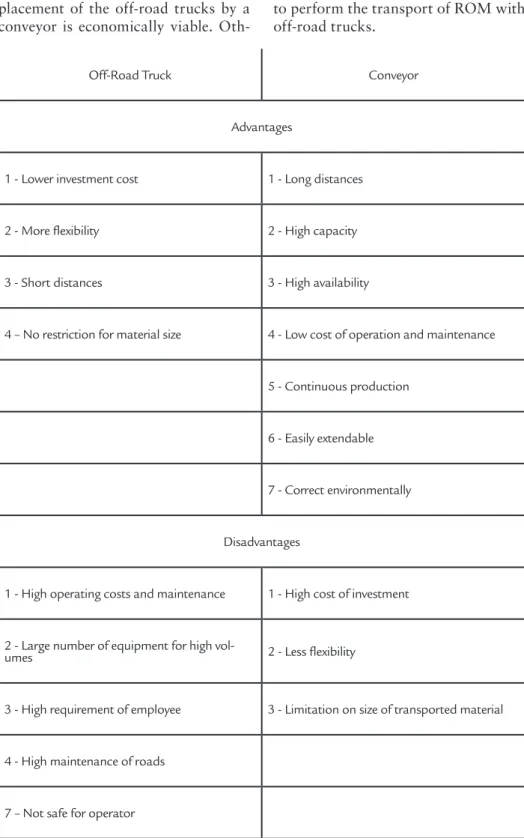
Advantages and disadvantages be-tween conveyor belt and off-road trucks are shown in Table 1.
Off-Road Truck Conveyor
Advantages
1 - Lower investment cost 1 - Long distances
2 - More flexibility 2 - High capacity
3 - Short distances 3 - High availability
4 – No restriction for material size 4 - Low cost of operation and maintenance
5 - Continuous production
6 - Easily extendable
7 - Correct environmentally
Disadvantages
1 - High operating costs and maintenance 1 - High cost of investment
2 - Large number of equipment for high
vol-umes 2 - Less flexibility
3 - High requirement of employee 3 - Limitation on size of transported material
4 - High maintenance of roads
7 – Not safe for operator Table 1Comparison between
Conveyor Belt and Off-Road Trucks
The rainy season can be a problem for conveyor or off-road truck transport if the pit is not utilized correctly. It is recommended to mine the top of the pit in this season or above the ground wa-ter. The off-road trucks have lexibility to quickly abandon the looded areas. Under the same conditions, the conveyor needs a good mine plan because time and high costs are involved to relocate this equipment.
There are two main types of layout
systems for continuous transport: by belts from within the pit or straps located out-side of the pit.
The layout system depends primarily on whether the material is friable or re-quires crushing before being transported. If the material is friable, it can be removed by excavators and transported directly by belts or trucks to the primary crusher (ixed ex pit or semi-mobile in pit). If the material is not friable, it is detonated, loaded into a primary crusher (mobile),
or loaded onto trucks and transported to the primary crushing station (ex pit or semi-mobile in pit).
Semi-mobile Crusher
In this case, the crushing plant is located inside the limits of the pit and has off-road truck accesses as an es-sential requirement. The semi-mobile crushing plant must be relocated regularly according to the mining plan. The material is transported by conveyor from the crusher to the ben-eiciation plant.
Advantages of this system:
• Low transportation distance; • Increase the safety of the mine; • Reduction of CO2 emissions; • The trucks can temporarily re -place the conveyor belt in the event of
operational problems;
• It is possible to adapt existing
operations to some reconigurations of
the pit and make some possible long-term changes.
Disadvantages of this system:
• It needs a period of time for relocation;
• Interference with mine planning
because the mining sequence depends on the location of the crusher.
Mobile Crusher
This is a fully mobile system in which the crusher is fed directly by the loading machine, thus eliminating all trucks. After crushing the material, it is transported via conveyor to the process-ing plant.
Advantages of this system:
• Eliminates the use of trucks; • Increases the safety of the mine; • Reduction of CO2 emissions; • Low operating cost mine;
• Flexibility to change in accordance
with the mine planning.
Disadvantages of this system:
• High initial investment;
• If there is any operational problem,
the production is completely dependent on the system.
A conveyor device consists of a horizontally or inclined (upward or downward) profile, curved (concave or convex) or not, or a combination of these proiles designed for the handling of bulk materials. Shipping is done by a continuous belt with reversible move-ment or not, and it moves on drums,
rollers or sliding tables. The equipment is employed in the handling of various types of materials which may be part of an automated complex.
According to Conder and Richard-son (2004), there are four main types of belts used in mining for materials transportation:
• conventional belts; • cable belts; • tubular belts; • high strapped slope.
The belts can also be classiied ac-cording to their mobility in ixed belts, straps, belts and semi-mobile. Webbing straps are mounted on ixed structures and are the most widely used long dis-tance conveyor belts (LDCB's or over-lands), and also, in cases of crushing in the pit where the straps will not suffer reallocations. When in the pit, they are connected to the belts of countertops. Electric drives require more skilled and more resistant carpets and their automa-tion is more elaborate because they most often have long lengths. They can operate
at higher speeds.
The semi-mobile belts are those called bench belts, and are periodically reallocated in accordance with the mining plan for the fronts and changes in the min-ing benches. They are designed to be versa-tile, mobile and easy to be transported and relocated. Mounted on steel structures, this modular machine can be moved eas-ily, optimizing the mining process. The drives are smaller and the carpets are of least resistance and automated.
Thus, this study included three al-ternatives comparisons for the two cases: the use of off-road trucks and conveyor belts by varying the position of the crush-ing system:
A. Semi-Mobile Crushing System,
outside of the pit with conveyor belts;
B. Semi-Mobile Crushing System,
within the pit with conveyor belts;
C. Mobile Crushing System, within the pit with conveyor belts. Table 3 shows the summary of the three alternatives of conveyor belts compared to the current scenario of off-road trucks.
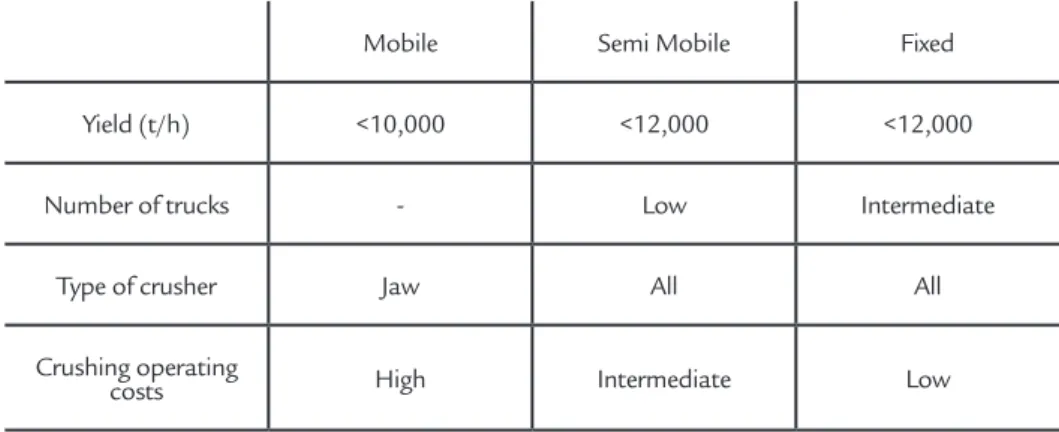
Generally, a fixed crusher is not located inside the pit, but on the edge of the pit or within walking dis-tance. The material is transported by trucks to the crushing plant and then transported by conveyor belt to the processing plant.
Advantages of this system:
• Reduction of transport distance; • The trucks can temporarily replace the belts if a problem occurs;
• Greater lexibility;
• Easy system implementation; • Can be adapted to existing opera
-tions without geometric changes to the pit. Disadvantages of this system:
• The system remains ixed in place for several years;
• High costs associated with the relocation of the equipment, if necessary;
• Interference with mine planning.
Fixed Crusher
Mobile Semi Mobile Fixed
Yield (t/h) <10,000 <12,000 <12,000
Number of trucks - Low Intermediate
Type of crusher Jaw All All
Crushing operating
costs High Intermediate Low
The operation cost can be seen in Table 5.
Table 5
Operation Cost
Conveyor Belt (US$/t) Off-road Truck (US$/t)
Alternative A 0.68 0.97
Alternative B 0.44 0.97
Alternative C 0.23 0.97
The commitment to the preservation of the environment is a key factor in the sustainability strategy of mining compa-nies. Nowadays, they seek a balance be-tween socio-economic development of the territories where the companies operate, while maintaining the quality of natural resources, biodiversity and life.
CO2 is the gas that has the greater
contribution to global warming. Carbon dioxide currently emitted by burning fos-sil combustive remains in the atmosphere for a long time (about 100 years). The reduction in the distance and hence the reduction of off-highway trucks allows for the reduction of CO2 emission.
It is possible to calculate the
en-vironmental beneits for reducing CO2
emissions. According to Bartholomeu (2006), a liter of diesel fuel consumed creates 2.7458 kg of carbon dioxide. The off-road trucks consume an average of 0.25 liters/t. From these data, it was pos-sible to calculate the reduction in CO2 emissions considering the reduction of the number of off-road trucks, for the three alternatives studied.
3. Results and discussion
The NPV of the three alterna-tives presented was calculated based on the difference of the discounted
cash low of the conveyor and off-road truck options, considering the assess-ment of investassess-ments, operating costs,
depreciation and taxes. Table 6 shows the results obtained by the incremental economic analysis:
Table 6
NPV of Alternatives
NPV (US$)
Alternative A -16,980,401
Alternative B 366,498
Alternative C 26,564,712
Table 3
Summary of Alternatives
Number of Crusher Length of Conveyor (meter) Off-Road TrucksReduction of
Alternative A 1 2.560 5
Alternative B 2 4.660 8
Alternative C 3 6.760 9
Conveyor Belt (US$) Off-road Truck (US$)
Alternative A 55,000,000 12,460,000
Alternative B 56,600,000 19,936,000
Alternative C 90,933,333 53,828,000 Table 4
Capital Cost
4. Conclusions
Incremental analysis used in the economic evaluation of alternatives clearly presents the results for the comparative economic low boxes amongst the alterna-tive ROM transportation with off-road trucks and conveyor belts.
The results of the economic studies conducted show that Alternative C is the
most attractive and feasible, mainly be-cause there is a strong trend for increasing fuel, labor and tire costs in Brazil.
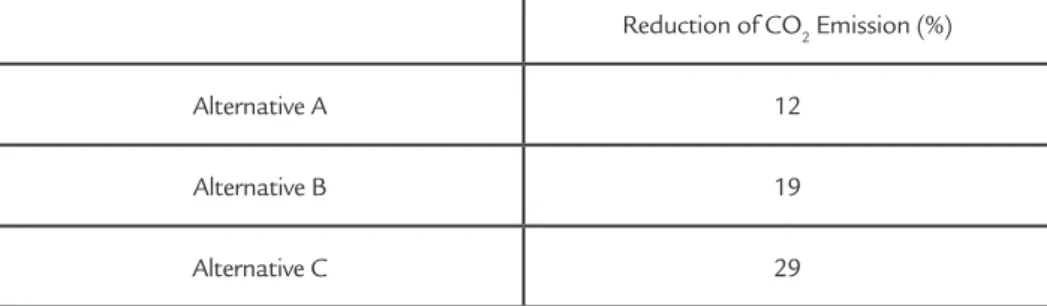
Alternative C will reduce CO2
emissions by approximately 29% and eliminate part of the fleet of off-road trucks used for transporting ROM while increasing the safety of the operating area.
The study showed considerable se-curity and economic gains while lessoning environmental impacts and demonstrated an ability to ight the trend of high operat-ing costs. Cost parameters for operatoperat-ing trucks and conveyor investment must be constantly reevaluated due to their great inluence on the results.
5. Acknowledgments
The authors thank the management of Planning and Development of Vale,
who provided much of the data used in this article.
6. References
BARTHOLOMEU, Daniela Bacchi. Quantiicação dos impactos econômicos e am-bientais decorrentes do estado de conservação das rodovias brasileiras. 2006.
COUTO JUNIOR, Arnor B., ROCHA, Antonio C., and CHAUSSON, Daniel S.
Strip, Mine Method with IPCC System for Vale’s Iron Ore Mines. 2011.
HARTMAN, Howard L. SME Mining Engineering Handbook. (2nd Ed.).
International Mining, June 2009. (IPCC innovations. Operation focus in pit crushing and conveying).
LAPPONI, J. C. Projetos de Investimento na Empresa. 2007.
LOPES, José Raimundo. Custo operacional - sistema de britagem semimóvel Fora da cava e correias transportadoras. 2012.
RICHARDSON, R. J., CONDER, R. E. Evaluation of materials handling transpor -tation systems. Metso.
VALE, NCL BRASIL, Internal Report, Estudo Conceitual de Avaliação de Transpor-tadores Contínuos na Mineração, 2010.
ZIMMERMANN, E., KRUSE, W. Mobile crushing and conveying in quarries – a
chance for better and cheap production. 2006. Received: 25 November 2013 - Accepted: 17 November 2015.
Table 7 Reduction of the Number of Trucks
Average Reduction of Trucks (unit)
Alternative A 3
Alternative B 5
Alternative C 8
With the lowest number of dump trucks, it was possible to reduce CO2 emissions as shown in Table 8.
Table 8 Reduction of CO2 Emission
Reduction of CO2 Emission (%)
Alternative A 12
Alternative B 19
Alternative C 29