DOI: 10.5007/2175-8026.2017v70n3p185
MEASUREMENTS FOR ACCENTEDNESS, PAUSE AND NUCLEAR STRESS
PLACEMENT IN THE EFL CONTEXT
Pedro Luis Luchini*
Universidad Nacional de Mar del Plata Mar del Plata, ARG
Abstract
his study reports on an experimental research conducted with 50 Spanish-L1 college students, divided into 2 groups (A and B). hey were presented with a teacher-centered approach based on controlled exercises, but group B received an awareness-building component in which students completed a sequence of tasks with a focus on phonological form. Both groups recorded a speaking test before and ater instruction which was used to measure and compare degrees of accentedness, frequency and duration of pauses and nuclear stress placement. Diferent groups of raters listened and judged the speech samples. Multivariate analysis showed that group B obtained better results in all 3 parameters than the other group. Finally, some pedagogical implications for the teaching of L2 pronunciation in ELT contexts will be discussed.
Keywords: pronunciation instruction; accentedness; pauses; nuclear stress; awareness-rising
* Doctor in Letters, UNMDP, 2015; MA in ELT and Applied Linguistics, King’s Collage, University of London, UK. 2003; ELT, Universidad Nacional de Mar del Plata (UNMDP), Argentina, 1993. Currently: Teacher-researcher and Full time Adjunct Professor, English Teacher Training Program, Humanities Division, UNMDP. Head of Language Studies at UCAECE MdP. Teaches Phonetics and Phonology I & II, English/Spanish Translation Program, UCAECE. Areas of interest: English Language Development and English Applied Phonology. His e-mail address is [email protected].
Esta obra tem licença Creative Commons
In the past, the teaching of pronunciation was highly overlooked and thus disregarded from the current ELT (English language teaching) mainstream. However, during the last two decades a change of paradigm has taken place which has brought pronunciation instruction back on stage (Murphy and Baker, 2015). his emergence of pronunciation teaching has pushed teachers and researchers to redirect their goals if successful communication is to be achieved (Baker, 2011; Derwing and Munro, 2015; Levis, 2005). In the past, the main goal was to push learners to develop a near-native like pronunciation. Aligned with this objective, most pronunciation teachers used (and some of them still do it in diferent contexts) what some would typify as an imitative-intuitive methodology based on controlled exercises such as drilling and mechanical activities. he general assumption under this approach
is that through repetition and imitation teachers believe that learners will be able to eradicate their foreign accents and thus perfect their L2 pronunciation to reach native-like standards. However, empirical research results along with a more globalized view of pronunciation teaching have demonstrated that this goal is neither realistic nor attainable (Celce-Murcia et al., 2010; Derwing and Munro, 2015; Derwing, Munro and Wiebe, 1998)
Levis, 2005). hat is, pronunciation teachers should aim to help their L2 learners understand diferent English accents, being them native or non-native (Jenkins, 2000), and produce comprehensible speech regardless of their regional accents (Derwing and Munro, 1998; Derwing and Munro, 2009; Munro and Derwing, 2015; Troimovich and Isaacs, 2012). Such a change of goals implies a consequential change in pronunciation teaching objectives whereby consciousness-raising tasks function as a central focus in a supportive and natural context for language learning to occur (Ellis, 2001; 2003; 2015; Luchini, 2015). In pronunciation teaching contexts, a consciousness-raising task is a pedagogic activity in which the learners are presented with L2 data related to a phonological feature that they will later on have to produce, and in which they perform some operation on the data to arrive at an explicit understanding of how that phonological feature functions in discourse, and how it can be best realized in free speech (adapted from Ellis, 2015).
his paper reports on a study conducted with two groups of college students from an Argentinean university, whereby the irst language (L1) is Spanish and the L2 English. Each group received a diferent treatment. Group A was exposed to a teacher-centered approach, while group B received an additional teaching component aimed at raising students’ phonological awareness. he purpose of this study was to evaluate the beneits of adding such a component and compare results with the other group that did not include it. To delimit the scope of this research, from the total number of prosodic dimensions, only measurements of degree of accentedness, frequency and duration of silent pauses, and nuclear stress placement were analyzed. Finally, based on the indings obtained some implications for pronunciation teaching will be addressed.
Literature Review
For the last decades, there has been a slow but steady movement to bring L2 pronunciation instruction back on stage as the general goals of teaching worldwide have prioritized the efective use of the spoken language. Research studies by Brown
(1991), Morley (1991), Raymond (1995), Taylor (1993), Yule and MacDonald (1995), Mac Donald, Yules and Powers (1994) and Munro and Derwing (1995), among others, initiated a new period of empirical research to inform the work of L2 pronunciation teaching. his phenomenon has brought about an emergent debate about what features of L2 phonology are necessary to teach, how to efectively teach them, and what teachers and students think and know about pronunciation teaching (Derwing and Munro, 1997; Derwing, Munro and Wiebe, 1997; 1998; Derwing and Murno, 2015; Murphy and Baker, 2015).
In the past, pronunciation teaching was more sided with what Levis (2005) has coined the nativeness principle (though, at present, this view is still alive and kicking in many teaching contexts worldwide!). Following this principle, teachers concentrate chiely on the description of phonemes and their meaningful contrasts, along with some structurally based interest in stress, rhythm, and intonation. Pedagogically speaking, instruction centers on articulatory descriptions, imitation, repetition and memorization of patterns through drills and dialogues, with extensive attention to correction. It also takes as read the accessibility to native speaker models to listen to, an option that has been enhanced by the use of tape recorders and language labs in the mid-twentieth century, followed by audio- and videocassettes and more lately by compact disks and digital video disks. All this is done in the hope that learners will eventually pronounce the rhythms and sounds of the target language like an English native speaker. Such concern for accurate pronunciation, based on native models, aims at enabling learners to come as close as possible to native-like performance models (Breitkreutz, Derwing and Rossiter, 2002; Celce-Murcia, Brinton and Goodwin, 2010).
187
Ilha do Desterro v. 70, nº 3, p. 185-200, Florianópolis, set/dez 2017to identify the most important aspects of both the suprasegmentals and segmentals and amalgamate them appropriately in classes that meet the needs of any given group of learners; that is, learners are explicitly informed about and pushed to focus their attention on the sound, rhythm and intonation systems of the target language (Murphy and Baker 2015). his focus on language as communication has brought about a remarked interest in re-directing the goals for teaching pronunciation (Celce-Murcia et. al., 2010; Ferreiro and Luchini, 2015). We know that nonnative speakers have a threshold level of pronunciation, and if they fail to reach it, they will probably have to deal with some interactional obstacles when communicating, no matter how well their management of English grammar and vocabulary might be. Aligned with the intelligibility principle, then, the goal of pronunciation instruction is not to make learners sound like native speakers of English, unless they are rarely gited or motivated to do so, but to enable them to go beyond their threshold level so that their pronunciation will not threaten their ability to communicate efectively (Derwing and Munro, 1995; 1998; 2015; Murphy and Baker, 2015; Luchini, 2015). We know that pronunciation is an essential component of communicative competence and, as such, it should be given high priority in the English language classroom (Morley, 1991; 1994; Taylor, 1991; Celce-Murcia et al., 1996; 2010; Pennington, 1996). As a consequence of its importance, many more teachers are now interested in pronunciation, but the truth is that most of them are not quite sure which dimensions of L2 phonology are important to teach or how they might be most efectively taught in language classrooms. For the most part, they base their teaching practices on their own experience as language teachers and on their intuitions.
A reasonable and realistic teaching goal then would be to focus on pedagogic attention to those items which are teachable and learnable and also essential for L2 oral communication (Dalton and Seidlhofer, 1994; Jenkins, 1998; 2000; Cruttenden, 2001). Reciprocal tasks (Ellis, 2001) with a speciic focus on form are crucial for the development of key phonological features (Jenkins, 2000; Jones and Evans, 1995; Luchini, 2005; 2015; Swain, 1997; Swain and Lapkin, 2001; hornbury,
1993) because they involve negotiation of meaning and thus more opportunities for learners to adjust and accommodate their receptive as well as productive pronunciation skills (Jenkins, 1996; 1998; 2000; Ellis, 2003; 2015). Learners need to be given opportunities for noticing gaps in their interlanguage and thus compare their output with target language models (Rutherford, 1987; Schmidt, 1990; hornbury, 1997; Willis, 1996; Samuda, 2001). On the other hand, controlled sessions are also essential to classroom work in accommodation skills and where changes to L1 phonological habits are necessary (Brown, 1991; 1995; Jenkins, 2000) because they push learners to move from receptive to productive competence in core problematic areas such as segment production (Kenworthy, 1987; Jenkins, 2000; Levis, 2001; Levis and Grant, 2003; Raymond, 1995).
Receptively speaking, learners need to range far beyond the limits of the dominant native-speaker accents such as RP (the standard British accent) or GA (General American) in their receptive repertoires to be able to cope with the diferent accent varieties of their interlocutors whom they are most likely to meet, whether they are native or non-native English speakers. he best way to achieve this familiarity is through repeated exposure to assorted L1 and L2 accents of English with a focus on areas of diference, especially those which are considered highly risky for establishing mutual intelligibility (Celce-Murcia et al., 2010; Jenkins, 1998; 2000; Luchini, 2008; 2011; 2012a; 2012b; 2015; Rosewarne, 2002; Walker, 2001; 2010).
Only one signiicant diference was perceived in the students’ pronunciation of the self-study group which rendered considerably better results than those coming from the learners in the control condition right ater intervention. However, there were a number of important limitations to their study which do not allow to lay claim to accomplishment of goals. Despite this observation, this study was important in that it examined the eicacy of pronunciation instruction in terms of NS judgments of accentedness and because it paved the way for further studies.
In 1998, Derwing, Munro and Wiebe extended that research by comparing the implementation of 3 perspectives on pronunciation teaching over a longer period of time (10-week instructional intervals vs. 2 days for Macdonald et al.’s study, 1994). hey collected pre- and post-speech samples from 3 groups of ESL learners. One received segmental training, the second was taught with a global focus and the third received no speciic phonological instruction. Forty-eight English native speaker listeners assessed the speech samples by rating them for accentedness, comprehensibility and luency in blind tasks. Although both groups instructed in pronunciation showed signiicant improvements in comprehensibility and accentedness when completing a controlled task, only the global group showed improvement in comprehensibility and luency when dealing with a more extemporaneous task.
In a recent study, Saito (2012) conducted a research synthesis to summarize the state of the art of the pedagogical potential of pronunciation teaching. In his report, the author described the extent to which explicit instruction in L2 pronunciation favors phonological acquisition, how its efectiveness may vary according to (a) focus of instruction (segmentals vs. suprasegmentals), (b) type of instruction (focus on form vs. focus on formS), or (c) type of outcome measures (controlled vs. spontaneous production).
Following Saito’s line of research, Lee, Jang and Plonsky (2014) carried out a meta-analysis of efectiveness of L2 pronunciation instruction. In their study, these researchers determined the overall efects of pronunciation instruction and the sources and extent of variance observed with respect to practical
and pedagogical relevance. hey discuss their indings in relation to instructed L2 acquisition research in general and in comparison with other reviews on pronunciation instruction. hey point out some areas of pronunciation instruction that call for further investigation and ine-tuning.
We can see now that a wealth of empirical research is being conducted and used to inform the teaching of ESL pronunciation instruction. However, there are still insuicient studies targeting pronunciation learning and teaching in the EFL context. hus an investigation of the efects of such modes of instruction in this particular context is warranted (Derwing et al., 2012; Saito, 2012). In this experimental study, we set out to evaluate the efect of adding a communicative, awareness-building component (Luchini, 2005) to a teacher-centered, form-focused pronunciation course and compare its results with those coming from another group that did not include such component. Both teaching experiences were carried out in the EFL context, and the comparison of results was done taking into account measurements of degree of accentedness, frequency and duration of pauses and allocation of nuclear stress.
189
Ilha do Desterro v. 70, nº 3, p. 185-200, Florianópolis, set/dez 2017indings in studies exploring the correlations among these prosodic features demonstrated that they operate independently (Derwing and Munro, 2005; Isaac and Troimovich, 2012; Luchini, 2015; Troimovich and Isaacs, 2012).
Pausing is closely associated with luency and with the degree of foreign accent (Derwing, homson and Murno, 2006). Pausological research has shown that both pause duration and pause frequency afect listeners’ rating of foreign accent in L2 speech, and that both are oten considered determinants of luency and intelligibility (Lennon, 1990; Troimovich and Baker, 2006). L2 learners on average use more pauses than native speakers do, perhaps relecting the diiculties in processing and memory constraints, characteristics of L2 production (Schachter, Christenfend, Ravina and Bilous, 1991). he development of speech luency, as measured by frequency and duration of pauses, is relatively well established in adults acquiring an L2 (Troimovich and Baker, 2006). he frequency and duration of pauses in adult L2 learners’ speech typically decreases as learners gain more experience with their L2 (Tromifovich, 2006). It seems that adult L2 learners’ ability to produce L2 speech using fewer and shorter pauses may depend more on learners’ age at the time of irst exposure to their L2 than on the amount of their experience with the L2 (Olynyk, D’Anglejan and Sankof, 1987). Möle (1994) claims that it may be feasible to make some assessment of learner luency by exploring a variety of temporal variables, including length and allocation of silent pauses, length of luent speech runs between pauses and frequency and distribution of illed pauses. he diference between native like speech and L2 speech mainly lies in the frequency and distribution of such features rather than their presence versus absence (Lennon, 1990).
he nucleus or nuclear syllable (O’Connor and Arnold, 1973; Wells, 2006), or tonic syllable or prominence (Brazil, 1980; 1994; 1997; Halliday and Greaves, 2008) or information focus (Levis 2001) is the highest value of pitch or its acoustic correlate (F0), relative to the accented syllable in a tone unit. A tone unit represents a way of dividing up spoken language into units of information. he span of speech
over which an intonation pattern or contour extends is called a tone unit. his must include at least one accented syllable. Depending on the number of phrases and clauses and the speaker’s speech rate, an utterance may be made up of one or several tone units. Every tone unit contains, at least, one major change in pitch (a fall or a rise or a combination of both), which begins on an accented syllable. his combination of stress and pitch variation is also known as sentence stress (Dauer, 1983; 1993). Normally, the tonic syllable occurs on the last accented syllable of a tone unit. Because stress oten occurs in content words, it can be said that, in English, sentence stress usually falls on the last lexical item before a pause or a potential pause. For intelligibility and comprehensibility purposes, the location of the nucleus is crucial in English (Field, 2005; Hahn, 2004). A frequent mistake made by non-native speakers is either to put a major pitch change on every stressed syllable, to have no one word with a major pitch change or to misplace it. Shiting nuclear stress may bring about confusion to the listener who might be expecting one nuclear stress on the last lexical content word. Unless this happens, the listener might think that the speaker means something else (Dauer, 1983). Given its importance for the attainment of efective oral communication, the teaching of nuclear stress placement should be prioritized in the English pronunciation class (Field, 2005; Hahn, 2004; Jenkins, 2000; Luchini, 2015).
From the total number of prosodic dimensions we selected only these three constructs because we needed to limit and narrow down our scope of study. We chose these measures at the expense of others because they are strong predictors of efective oral communication.
Research question
- Which are the efects of adding an awareness-building component to a teacher-centered pronunciation approach?
Method
Context
he experiment was carried out in Discurso Oral II (DOII), a course on English pronunciation taught in 2nd year of the Teacher Training Program, Universidad Nacional de Mar del Plata, Argentina. DO II aims at enabling students to acquire a highly acceptable non-native pronunciation. Students meet for four 2-hour sessions per week over a four-month period. he contents of this course focus on suprasegmentals and the approach adopted is mainly grounded in the intelligibility principle.
To enter the program, learners need to master an English proiciency level equivalent or superior to B2+ (Common European Framework of Reference for Languages). Before taking DOII, students need to take and pass Phonetics and Phonology I and II, in which they are presented with the description and nature of the English sound system, and made to repeat and imitate, in a language lab, a series of recordings of English native speaker models (preferable with an RP accent). Along with these two pronunciation classes, they need to complete a number of other courses aiming at developing general linguistic knowledge and initial teacher training skills.
Participants
Fity Spanish-L1 student teachers participated in the experiment. hey were divided into two groups: group A (n=25) and group B (n=25). heir ages ranged from 20-41 (mean: 21.88 years) in group A, and 19-30 (mean: 21.60) years in group B. heir years of formal L2 instruction ranged from 5-9 at private local language institutes in Mar del Plata, Argentina (years of instruction, A: 7.12%, and B: 7.32%). In each group there were 23 female participants and 2 males. None of them reported having lived in an
English-speaking country before taking the course. Outside the classroom, the participants in both groups never used English and did so only when completing homework. Native and non-native speaker models were the input they received in their classes at the university. he language of instruction in both groups was English.
For the sake of the experiment, each group was exposed to a diferent treatment. Group A was taught using a teacher-centered, form-focused pronunciation type of instruction. he students were given lectures on stress, rhythm and intonation. Later, using phonetic script, stress and intonation conventions, they took dictations. his was done to help them recognize sounds in connected speech as well as stress placement and tone orientation. Ater the dictation sessions, the students went to the language lab where they listened to and repeated recorded stimuli produced by English native speakers.
191
Ilha do Desterro v. 70, nº 3, p. 185-200, Florianópolis, set/dez 2017introduced, but using a diferent context. hat new task was used as recourse to consolidate and check the level of internalization, if any, of the new target form, (vi) a inal discussion and relection section followed, aiming at raising the students’ awareness of what had happened phonologically when they had engaged in such tasks. hey were also asked to explore the methodological implications underlying each task and examine how they had contributed to self-monitor and thus self-regulate their learning processes (Reed and Michaud, 2015), (vii) they were later asked to read literature related to the topics discussed in the practical sessions to bridge the gap between theory and practice and further expand their conceptual knowledge (Luchini, 2005).
Instrument for data collection
Both groups (A and B) took the same speaking achievement test before and ater instruction (pre- and post-test, respectively). Approximately, 15 weeks separated the administration of these tests, thus reducing the possibility that the outcomes evidenced the result of memory or practice efects. he students were asked to complete three communicative tasks in which they had to speak spontaneously in English, irst, individually (task 1 and 2) and then in pairs (task 3) (Luchini, 2004). Both tests were recorded on tape in a language laboratory. All the recordings in each group were done simultaneously. Only part of Task 2 of this test was used. In this task, students had to
compare and contrast two pictures of people leading diferent types of lives. his task was chosen because the speakers were not engaged in reciprocal talk and as such there were no speech overlaps and variations in pitch as a result of turn taking. he number of speech samples amounted to 100. Task 2 had a total duration of 1 minute and 30 seconds. Only 30 seconds of this task in both pre- and post-tests were selected. All the speech sequences were equally delimited by time boundaries. Neither the beginning nor the end of each sample was included. his was done to work with the middle portion of each speech signal, in which the greatest rate of luency was expected.
Procedure
Accentedness
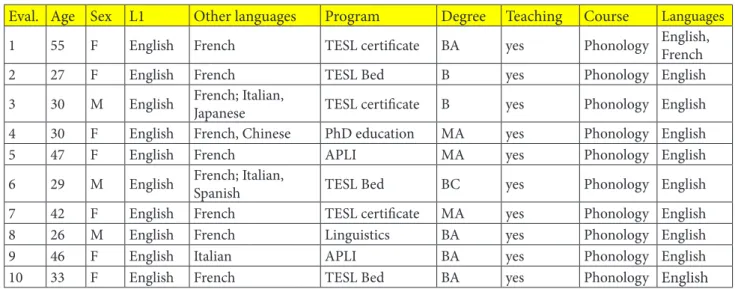
Ten English-native-speaker-raters from Canada, working individually, listened to the 100 recordings and rated them using a 1-9-rating scale to determine the speakers’ degree of perceived accentedness. he listeners made a scalar judgment of accentedness (9= no accent, 1= extremely strong accent). he raters heard each stimulus once and were given time to judged each recording. To reduce the efects of fatigue, they were given short breaks of about 3 minutes in between the recordings. None of the raters reported having had hearing impediments. Table 1 shows some more information about these Canadian raters.
Table 1: Information about the 10 Canadian raters
Eval. Age Sex L1 Other languages Program Degree Teaching Course Languages
1 55 F English French TESL certiicate BA yes Phonology English, French
2 27 F English French TESL Bed B yes Phonology English
3 30 M English French; Italian,
Japanese TESL certiicate B yes Phonology English 4 30 F English French, Chinese PhD education MA yes Phonology English
5 47 F English French APLI MA yes Phonology English
6 29 M English French; Italian,
Spanish TESL Bed BC yes Phonology English
7 42 F English French TESL certiicate MA yes Phonology English
8 26 M English French Linguistics BA yes Phonology English
9 46 F English Italian APLI BA yes Phonology English
Nuclear stress placement
Two Spanish-L1 specialists (aged 42, 62 respectively), working separately and guided by the rules that govern nuclear stress location in English, the context and their vast experience as English pronunciation teachers (more than 25 years each), segmented the transcriptions. All the illed and empty pauses were removed. Using inter-marker reliability, they compared results until they reached inal consensus. he inal product of each recording/ transcription was used as “master rating” against which each student’s production was evaluated. he major diiculty in the procedure was speech segmentation. he problem with working with free speech data is normalizing for speech length. Diferent people many produce speech samples that are diferent in length and, therefore, they have diferent opportunities to produce the items that are being measured. To get a measure for each participant, it was agreed to divide each count by the total number of possibilities. hese counts and possibilities depend on what it is being measured. If, for example, in a given speech sample there are ive nuclear stresses (as suggested by the specialists), then there are 5 possibilities. So everything the student has done will be counted out of 5. If, for example, a student got 3 out of 5 of these nuclear stresses right, then the correct count for this student is 3. And the inal measure will be 3 divided by 5 (3/5), that is, 3 stresses out of 5. So the counts will be a proportion of nuclear stresses produced correctly. If a student got more nuclear stresses than there should be, then, these extra stresses were not counted down. To illustrate this procedure, the transcription of a recording belonging to student 1 from group A (pre-test) is shown below. Pauses that separate the tone units are indicated by slanted bars (/). Syllables bearing nuclear stresses are highlighted in bold type, and rhythmic stresses are indicated by asterisks.
Analysis of the specialists using rules for stress
placement and their experience: “master rating”
Student 1 - Pre-Test
/there are *many *dishes on the table/ so I think that *maybe they are *foreign *people *trying
*local dishes/ and in the second photograph/ I see a *boy *sitting on the *street alone/ and I think that he’s *thinking about something/ and I *think that/
As can be seen, in this speech sample the specialists identiied 5 nuclear stresses.
Perceptual analysis done by the specialists
Student 1 - Pre-Test
/there are *many *dishes on the table/, so I *think that *maybe they are foreign/ people/ *trying *local dishes/ and in the *second
photograph/ I *see a boy/ *sitting on the
street/ alone / and I think that/ he’s *thinking about something/ I *think *that/
Ater the specialists listened to the speech sample, they identiied 10 nuclear stresses. Four of these matched the 5 stresses recognized by the specialists. On applying the quotient suggested, a ratio for this parameter was obtained, indicating how measurements for this parameter were made.
Pause frequency and duration
195
Ilha do Desterro v. 70, nº 3, p. 185-200, Florianópolis, set/dez 2017investigated: accentedness, nuclear stress placement and frequency/duration of pauses. On looking at the results obtained a number of assumptions can be made.
In the irst place, results show that adding an awareness-building component to a pronunciation course was conducive to the development of students’ near native like L2 accent. From pronunciation research (Derwing and Munro, 2015; Levis, 2005), we know that it is extremely diicult for an adult L2 learner to acquire a native-like accent, and that if that is the student’s or the teacher’s ultimate goal, then, there is a high probability that they may both encounter disappointment on their way. Accent is partially independent from comprehensibility and intelligibility. It is oten the case that diiculties with these two other dimensions may cause communication problems, but sometimes an accent may not impede understanding. It is clear then that the ideal focus for pronunciation instruction is to follow the intelligibility principle (Levis, 2005), that is, help students develop speech that listeners can easily understand, even though they may have a very strong foreign accent. However, in the particular context of this experiment, the participants were pre-service non-native English teachers who will be expected to serve as models and source of input in English for their students. A very strong foreign accent may cause harm to them because such prospective teachers may be in great frustration and develop a sense of inadequacy in their future profession unless they develop a near-native accent (Demirezen, 2007). Medgyes (1992) reports that these teachers oten feel insecure and unconident using the language they have to teach, and they might even experience fear of speaking in the ield of language education. Foreign accent may also lead to social or professional discrimination between non-native and native teachers (Derwing, Rossister and Munro, 2002). To avoid this, non-native teachers need to reduce their foreign accents. From the evidence provided in this experiment, it seems that adding an awareness-building component helps trainees reduce their foreign accents, a fact that will eventually contribute to boost up their self-conidence to operate successfully in any given teaching context (Luchini and García Jurado, 2015).
Secondly, it can also be observed that the awareness-building component had a positive efect on the number of empty pauses used and their duration. In this study, we considered pauses as a temporal construct of luency as we measured the number and time attributed to silent pauses of a particular stretch of discourse produced in a limited time span. Describing group B learners as being disluent is understood to mean that the language knowledge they have is somewhat diicult to access and that their oral language is produced with excessive hesitation (Segalowitz, 2010). here is an indirect correlation between pause duration/frequency and luency; that is, a decrease in the number of pauses and their duration produces an increase in luency (Munro and Derwing, 1998; Luchini, 2015). In the pronunciation literature, luency is a term oten associated with other measures of spoken language: comprehensibility and degree of accentedness (Derwing, homoson and Munro, 2006; Isaac and homson, 2013). Although these dimensions are oten combined and studied together, given the similarity in how they are measured, luency is quite distinct from these other prosodic parameters (Derwing, Rossiter, Munro and Ron, 2004; Luchini and García Jurado, 2015).
these two prosodic dimensions seem to be the current ultimate goals of pronunciation instruction, then instructional methodologies that promote the correct allocation of nuclear stress should be adopted in EFL classrooms.
Based on these measurement results, it seems that the awareness-building component gave room for a number of pedagogical innovations that favored pronunciation. In the irst place, this block allowed for the combination of diferent types of activities, ranging from more controlled to less controlled ones. Communicative sessions grounded in consciousness-raising tasks, with a speciic focus on form, are crucial for the development of key phonological features (Jenkins, 2000; Jones and Evans, 1995; Swain and Lapkin, 2001; hornbury, 1993; Luchini, 2005; 2015). Interactive tasks–of the type used in this block– are vital for phonological acquisition, because they involve negotiation of meaning and thus provide more opportunities for learners to adjust and accommodate their receptive as well as their productive oral skills (Jenkins, 2000; Luchini, 2015). Students need to be given chances of noticing gaps which, even if essentially meaning-driven, allow them to devote some attentional focus on form, and, moreover, provide both the data and the incentive for the learners to make comparisons between interlanguage output and target language models (Samuda, 2001).
More controlled sessions dedicated to repetition and imitation, on the other hand, are also necessary to classroom work in accommodation skills and where changes to L1 phonological habits are required, as learners will not be able to converge with one another on more target-like pronunciations unless it is within their capability to produce them successfully (Jenkins, 2000; Luchini, 2013). Minimal pair exercises, drilling and knowing about the rules of contrastive and nuclear stress, for instance, will assist learners to move from receptive to productive competence in core problematic areas (Jenkins, 2000). In all, the main purpose of this awareness-building block in this regard was to establish a degree of controlled to less controlled task-type balance appropriate to a monolingual class composed of students of diferent talents, diferent motivations,
and even diferent stages of development but sharing a common L1.
As regards receptive skills, within the framework of the awareness-building component, learners were exposed to diferent varieties of English. hey need to range far beyond the limits of the dominant native-speaker accents such as RP (the standard British accent) or GA (General American) in their receptive repertoires to be able to cope with the diferent accent varieties of their interlocutors with whom they are most likely to interact, whether they were native speakers or non-native speakers. he best way for this familiarity to be achieved is through repeated pedagogic exposure to varied L1 and L2 accents of English with a focus on areas of divergence between the students’ L1 and the target language, especially those which are considered highly risky for establishing mutual understanding.
Another element that the awareness-building component allowed for was metacognition. In this context, metacognition refers to listener awareness of the cognitive processes involved in comprehension, and the capacity to manipulate, self-regulate, and self-direct these processes (Vandergrit and Goh, 2012). Most of the tasks completed in this block called for the use and enhancement of metacognitive strategies in that, right ater they completed each task, the students were asked to analyze the sequence followed, self-evaluate and assess their performance, and relect upon the implications of each task for the development of their own L2 pronunciation skills.
Limitations
197
Ilha do Desterro v. 70, nº 3, p. 185-200, Florianópolis, set/dez 2017was analyzed here. To be able to make further claims vis-à-vis the impact of pauses on oral luency, pause location should also be explored.
Conclusion
In this study, we have compared the oral production of two groups of students exposed to diferent treatments. he evaluation of their production was done based on measurements of degree of accentedness, frequency/ duration of silent pauses and nuclear stress placement. Results indicate that the group that integrated an awareness-building component obtained better results than the other group which did not include it. Founded on this information, we encourage the integration of explicit, focused luency tasks such as the ones included in the awareness-building component presented to group B, with more controlled activities, mainly because this combination enhances learners’ L2 communicative competence, thereby increasing their opportunities for successful oral communication. Teachers’ challenges in implementing these types of consciousness-raising tasks in the pronunciation class, determination of maintenance of attention of luency skills, and identiication of ideal combinations of metacognitve strategies (Scarcella and Oxford, 1994) for optimal results are all questions that should be addressed in more detail in upcoming research studies of this type. We suggest that other researchers replicate this study in other EFL contexts to analyze and compare results. It would also be interesting to explore the impact of the awareness-building component in similar contexts, but measure its results using other prosodic dimensions such as intelligibility, comprehensibly, speech rate, stress/rhythm and intonation, to name a few. here is a clear demand for more empirical research in this area.
References
Baker, A. A. (2011). ESL teachers and pronunciation pedagogy: exploring the development of teachers’ cognitions and classroom practices. In: Proceedings of the 2nd Pronunciation in Second Language Learning and Teaching Conference., J.M. Levis and K. Le Velle (eds.), September 2010, 82-94, Ames, IA: Iowa State University.
Brazil, D. (1994). Pronunciation for Advanced Learners of English. Cambridge: Cambridge University Press.
Brazil, D. (1997). he Communicative Value of Intonation in English. Cambridge: Cambridge University Press.
Brazil, D., Courthard, M. and Jones, C. (1980). Discourse intonation and language teaching.Essex: Longman Group Limited.
Breitkreutz, J., Derwing, T. and Rossister, M. (2002). Pronunciation teaching practices in Bu s t i ngor r y Canada. TESL Canada Journal, 19: 51-61.
Brown, A. (1991). Teaching English Pronunciation: A Book of Readings. London/New York: Routledge.
______. (1995). Minimal pairs: Minimal importance?
English Language Teaching Journal, 49, 169-175.
Butragueño, P. M. (2008). Aspectos prosódicos de la tematización lingüística: datos del español de México, Fonología instrumental. Patrones fónicos y variación. (Eds.). E. Herrera y P. M. Butragueño. El Colegio de México, México, 275-333.
Celce-Murcia, M., Brinton, D. M., and Goodwin, J. M. (1996). Teaching pronunciation: A reference for teachers of English to speakers of other languages. Cambridge, UK: Cambridge University Press
Celce-Murcia, M., Brinton, D. M., Goodwin, J. M. and Griner, B. (2010). Teaching pronunciation: A course book and reference guide. Cambridge, UK: Cambridge University Press.
Cutler, A. and Cliton, C. E. (1984), he use of prosodic information in word recognition. In H. Bouma y D. G. Bouwhuis (Eds.), Attention and performance X (pp. 183-196). Hillsdale, NJ, Lawrence Erlbaum.
Cutler, A., Dahan, D. and van Donselaar,W. (1997). Prosody in the comprehension of spoken language: A literature review. Language and Speech, 40, 141-201.
Cruttenden, A. (2001). Gimpson’s Pronunciation of English. 6th Edition. London: Arnold International Students’ Edition.
Dalton, C., and Seidlhofer, B. (1994). Pronunciation. Oxford: Oxford University Press.
Dauer, R. M. (1983). Stress timing and syllable-timing reanalyzed. Journal of Phonetics, 11, 51-62.
______. (1993). Accurate English. A complete course on pronunciation. he United States of America, Prentice Hall, Inc.
Deirdre, W., and Wharton, T. (2006). Relevance and prosody. Journal of Pragmatics, 38, 1559-1579.
Derwing, T. M. y Munro, M. (2005). Second language accent and pronunciation teaching: A research-based approach. TESOL Quarterly, 39, 3, 379-397.
______. (2009). Putting accent in its place: Rethinking obstacles to communication. Language Teaching, 42,
476-490.
______. (1997). Accent, intelligibility, and comprehensibility: Evidence from four L1s. Studies in Second Language Acquisition, 19, 1-16.
______. (2015). he interface of teaching and research: What type of pronunciation instruction should L2 learners expect? In Luchini, P., García Jurado, M. A., and Alves, U. (Eds.) Fonética y Fonología: Articulación entre enseñanza e investigación (pp.14-26). Mar del Plata: Universidad Nacional de Mar del Plata/PINCU.
Derwing, T. M., Munro, M. J., and Wiebe, G. (1997). Pronunciation instruction for ‘fossilized’ learners. Can it help? Applied Language Learning, 8 (2), 217-235.
______. (1998). Evidence of a broad framework for pronunciation instruction. Language Learning, 48 (3), 393-410.
Derwing, T. M., Rossiter, M. J., and Munro, M. J. (2002). Teaching native speakers to listen to foreign-accented speech. Journal of Multilingual and Multicultural Development, 23, 245–259.
Derwing, T., Rossiter, M., Munro, M. and Ron, I. (2004). Second language Fluency: Judgments on diferent tasks. Language Learning, 54 (4), 655-679.
Derwing, T.M., homson, R. I. and Munro, M.J. (2006). English pronunciation and luency
development in Mandarin and Slavic speakers. System, 34, 183-193.
Derwing, T.M., homson, R., Foote, J. and Munro, M. (2012). A Longitudinal Study of listening Perception in Adult Learners of English: Implications for Teachers.
he Canadian Modern Language Review/La Revue canadienne des langues vivantes, 68 (3), 247-266. Cambridge, Cambridge University Press.
Ellis, R. (2001). Non-reciprocal tasks, comprehension and second language acquisition. In M. Bygate, P. Skehan and M. Swain. Researching pedagogic tasks second language learning, teaching and testing (pp. 49-74).
London: Pearson Education Limited.
______. (2003). Task-based Language Learning and
Teaching. Oxford, New York: Oxford Applied
Linguistics.
______. (2015). Understanding Second Language Acquisition (2nd Ed.). Oxford: Oxford University Press.
Ferreiro, G. and Luchini, P. (2015). Redirecting goals for Pronunciation Teaching: A new proposal for adult Spanish-L1 learners of English. International Journal of Language Studies (IJLS), 9 (2), 49-68.
Field, J. (2005). Intelligibility and the Listener: he Role of Lexical stress. TESOL QUARTERLY, 39 (3), 399-423.
Hahn, L. (2004). Primary stress and intelligibility: Research to motivate the teaching of
suprasegmentals. TESOL Quarterly, 38 (2): 201-223.
Halliday, M. and Greaves, J. (2008), Intonation in the Grammar ofEnglish.London: Equinox.
Isaac, T. and homson, R. (2013). Rater experience, rating scale length, and judgments of L2 pronunciation: revisiting research conventions. Language Assessment Quarterly, 10 (2), 135-19.
Isaac, T. and Troimovich, P. (2012). Deconstructing comprehensibility. Studies in second language acquisition. 34, 475-505.
Jenkins, J. (1996). Changing priorities. Speak Out!,18, 33-40.
______. (1998). Which pronunciation norms and models for English as an International Language? English Language Teaching Journal, 52 (2), 119-126.
______. (2000). he phonology of English as an international language. Oxford: Oxford University Press.
Jenner, B. (1996). Changes in objectives in pronunciation teaching. IATEFL Speak Out!, 18, 41-44.
Jones, R. and Evans, S. (1995). Teaching pronunciation through voice quality. English Language Teaching Journal, 49, 3: 244-251.
Kenworthy, J. (1987). Teaching English Pronunciation. Longman: Longman Group UK Limited.
Lee, J., Jang, J., and Plonsky, L. (2014). he efectiveness of second language pronunciation instruction: A meta-analysis. Applied Linguistics, 36 (3), 1-23.
Lennon, P. (1990). Investigating Fluency in EFL: A Quantitative Approach. Language Learning,40, 387– 417.
Levis, J. M. (2001). Teaching focus for conversational use.
English Language Teaching
Journal, 55 (1), 47-54.
______. (2005). Changing contexts and shiting paradigms in pronunciation teaching. TESOL Quarterly,39, 369-377.
Levis, J. and Grant, L. (2003). Integrating pronunciation into ESL/EFL classrooms. TESOL Jounal,12 (2), 13-19.
199
Ilha do Desterro v. 70, nº 3, p. 185-200, Florianópolis, set/dez 2017of English Pronunciation, (pp.139-155). West Sussex: Wiley Blackwell.
Luchini, P. (2004). Designing a pronunciation test for assessing free speech production: an evaluative case study. Speak Out!,31, 12-24.
______. (2005). A New Approach to Teaching Pronunciation: An Exploratory Case study. Journal of Asia TEFL,2 (2), 35-62.
______. (2008). El inglés como lengua internacional: Factores fonológicos que afectan la inteligibilidad. En Actas del XV Congreso Internacional de laALFAL
(Asociación de Lingüística y Filología de América Latina) en el marco del Proyecto P19. Fonología: Teoría y Análisis. Montevideo, Uruguay.
______. (2011). Variaciones fonológicas que producen rupturas en el discurso hablado entre hablantes de inglés no-nativos: Implicancias pedagógicas. DILL (Didáctica, Lengua y Literatura). Publicaciones Universidad Complutense de Madrid, España, 23, 249-272.
______. (2012a). Monitoring the impact that an exploratory task on ELF had on Spanish-L1 trainee pronunciation skills. Speak Out! IATEFL, Pronunciation newsletter, 46, 18-22.
______. (2012b). An Experimental Study on ELF Pronunciation Integrating a Language Awareness Component. he Journal ofEnglish as an International Language, 7, 7: 57-78. [online]. Accessed 15 Jan. 2013: http://www.eilj.com
______. (2013). Suprasegmental Phonology: Handbook for Pronunciation Skill Teaching. Integrating heory with Practice (2nd. Ed. revisited). Universidad Nacional de Mar del Plata.
______. (2015). Incidencia de rasgos prosódicos en la adquisición de una pronunciación cercana a la nativa en alumnos de inglés: Un estudio comparativo con diseño experimental mixto. Tesis de Doctorado en Letras, Facultad de Humanidades, Universidad Nacional de Mar del Plata
Luchini, P. y García Jurado, M. A. (2015). Sobre el grado de acento extranjero y luidez en la clase de pronunciación inglesa: Un estudio evaluativo. ORGANON, Porto Alegre, Brasil, 30 (58), 193-213.
MacDonald, D., Yule, G., and Powers, M. (1994). Attempts to improve English L2 Pronunciation: he variable efect of diferent types of instruction. Language Learning, 44 (1), 75-100.
Medgyes, P. (1992). Native or non-native: Who’s worth more? ELT Journal46 (4), 340–349.
Morley, J. (1991). he pronunciation component in teaching English to speakers of other languages.
TESOL Quarterly, 25 (3), 481-520.
______. (1994). Pronunciation pedagogy and theory: New views, new dimensions. Alexandria, VA: TESOL.
Möle, D. (1994). A comparison of the second language speech production of diferent native speakers. In H. W. Dechert, D. Möle, and M. Raupach (Eds.), Second language productions (pp. 26-49). Tübingen, FRG: Narr.
Munro, M. J. and Derwing, T. M. (1995). Foreign accent, comprehensibility and intelligibility in the speech of second language learners. Language Learning, 45, 73-97.
______. (1998). he efect of speaking rate on listener evaluations
of native and foreign-accented speech. Language Learning, 48, 159-182.
______. (2015). Intelligibility in research and practice: Teaching priorities. In: Reed, M. and Levis, J. he Handbook of English Pronunciation, (pp-377-396). West Sussex: Wiley Blackwell.
Murphy, J. and Baker, A. (2015). History of ESL pronunciation teaching. In: Reed, M. and J. Levis (Eds.), he Handbook of English Pronunciation (pp.36-65). West Sussex: Wiley Blackwell.
Neufeld, G. (1977). Language learning ability in adults: A study on the acquisition of
prosodic and articulatory features. Working papers in Bilingualism, 12, 45-60.
O’Connor, J. and Arnold, G. (1973). Intonation of Colloquial English. (2nd ed.). Longman:
Bristol.
Olynyk, M., D’Anglejan, A. and Sankof, D. (1987). A quantitative and qualitative analysis of speech markers in the native and second language speech of bilinguals.
Applied Psycholinguistics, 8, 121-136.
Pennington, M.C. (1996). Phonology in English language teaching: An international approach. London: Longman.
Raymond, E. (1995). Foreign language phonology: Field independence, attitude, and the success of formal instruction in Spanish pronunciation. he Modern Language Journal, 79, 4: 530-542.
Rosewarne, D. (2002). Changes in English pronunciation and some implications for teachers and non-native learners. Speak Out!, 23, 15-21.
Rossister, M., Derwing, T., Manimtim, G. and R. homson. (2010). he Canadian Modern Language Review, 66
(4), 583-606.
Rutherford, W. (1987). Second language grammar: Teaching and learning. Harlow: Pearson Educational Trust.
Saito, K. (2012). Efects of instruction on L2 pronunciation development: A synthesis of 15 quasi-experimental intervention studies, TESOL Quarterly,46: 842–54.
Samuda, V. (2001). Guiding relationships between form and meaning during task performance: he role of the teacher. In M. Bygate, P. Skehan and M. Swain (Eds.),
Researching pedagogic tasks: Second language learning, teaching and testing (pp. 119-140). London: Longman.
Segalowitz, N. (2010). Cognitive basis of second language luency. New York: Routledge.
Scarcella, R. C., and Oxford, R. (1994). Second language pronunciation: State of the art in instruction. System, 22, 2: 221-230.
Schachter, S., Christenfend, N., Ravina, B. and Bilous, F. (1991). Speech disluency and the structure of Knowledge. Journal of Personality and Social Psychology, 60, 362-367.
Schmidt, R. (1990). he role of consciousness in second language learning. Applied Linguistics, 11, 129-158.
Swain, M. (1997). he output hypothesis, focus on form and second language learning. In V. Berry, B. Adamson, and W. Littlewood (Eds.), Applying Linguistics (pp.1-21). Hong Kong: University of Hong Kong.
Swain, M., and Lapkin, S. (2001). Focus on form through collaborative dialogue: Exploring task efects. In M. Bygate, P. Skehan and M. Swain (Eds.), Researching pedagogic tasks: Second language learning, teaching and testing (pp. 99-118). Pearson Education Limited.
Taylor, D. (1991). Who speaks English to whom? he question of teaching English pronunciation for global communication. System, 19 (4), 425-435.
______. (1993). Intonation and accent in English: What teachers need to know. International Review of Applied Linguistics, 31, 1-21.
hornbury, S. (1993). Having a good jaw: Voice-setting phonology. English Language Teaching Journal, 47 (2), 126-131.
______. (1997). Reformulation and reconstruction: Tasks that promote “noticing”. English Language Teaching Journal, 51 (4), 326-335.
homson, R. (2015). Fluency. In Reed, M. and Levis, J.
he Handbook of English Pronunciation, (pp-209-226). West Sussex: Wiley Blackwell.
Troimovich, P. and Isaacs, T. (2012). Disentangling accent from comprehensibility. Bilingualism: Language and Cognition, 15 (4), 905-916.
Troimovich, P. and Baker. I. (2006). Learning second language superasegmentals: Efect on L2 Experience on Prosody and Fluency Charactersitics of L2 speech.
Studies in Second Language Acquisition, 28: 1-30. Cambridge: Cambridge University Press.
Troimovich, P. and Baker, W. (2007). Learning prosody and luency characteristics of second language speech: he efect of experience on child learners’ acquisition of ive suprasegmentals. Applied Psycholinguistics, 28, 251-276. Cambridge: Cambridge University Press.
Yule, G., and MacDonald, D. (1995). he diferent efect of pronunciation teaching. IRAL, 33 (4), 345-350.
Van Els, T., and de Bot, K. (1987). he role of intonation in foreign accent. Modern Language Journal, 71, 147-155.
Vandergrit, L. and Goh, C. (2012). Teaching and learning second language listening: Metacognition in action. New York: Routledge.
Walker, R. (2001). Pronunciation for International Intelligibility. English Teaching Professional, 21, 1-7. Accessed on Nov. 18, 2002: http://www3.bc.sympatico. ca/linguisticsissues/internationalintelligibility.html
______. (2010), Teaching the pronunciation of English as a lingua franca. Oxford, Oxford University Press.
Wells, J. (2006). English Intonation: An introduction. Cambridge: Cambridge University Press.
Willis, J. (1996). A framework for task-based learning. Halow: Longman.