Abstract
The last decade has brought a number of changes for higher education in continental Europe and elsewhere, a major one being the increasing use of English as a lingua franca (ELF) as the medium of instruction. With this change, EAP is faced with a new group of learners who will need to use it predominantly in ELF settings to communicate with speakers from other first language backgrounds. This overview paper first discusses the changes that have taken place in the field of EAP in terms of student body, followed by an outline of the main findings of research carried out on ELF. These changes and the results of recent ELF research have important implications for EAP instruction and testing. It is argued here that EAP needs to be modified accordingly to cater for the needs of this group. These revolve around the two major issues: norms and standards for spoken English and target use. If the aim of EAP instruction and testing is to prepare speakers for academic settings where English is the lingua franca, the findings of ELF research need to be taken into consideration and then integrated into EAP curriculum design and testing, rethinking norms and target use. The norms and standards used by EAP instruction must be based on this realistic English, and educational resources should be deployed more realistically, including the usage of ELF, thereby validating the pluralism of English. This paper argues that any practice that excludes this perspective would be reducing EAP qualitatively and quantitatively.
Keywords: English as a lingua franca (ELF), English-medium education, EAP instruction, EAP testing.
Resumen
El inglés como lengua franca en la educación superior: implicaciones para el inglés con fines académicos
La última década ha sido testigo de múltiples cambios en la educación superior en el continente europeo y en más lugares, y el cambio más importante es el uso
education: Implications for EAP
Beyza Björkman
creciente del inglés como lengua franca (ILF) y como medio de instrucción. Con este cambio, el inglés con fines académicos (IFA) se enfrenta a un nuevo grupo de alumnos que en su mayoría habrán de utilizar la lengua inglesa en entornos de ILF para comunicarse con hablantes de distintas lenguas maternas. El presente trabajo tiene un carácter general y estudia, en primer lugar, los cambios producidos en el ámbito del ILF por lo que respecta al grupo de estudiantes, esbozando seguidamente los resultados principales obtenidos tras una investigación realizada sobre el ILF. Estos cambios, así como los resultados procedentes de otras investigaciones recientes sobre ILF repercuten con fuerza en la instrucción y evaluación del IFA. Se argumenta que el IFA debe modificarse a fin de ajustarse a las necesidades de este grupo, y dichas necesidades atienden a dos cuestiones principales: normas y estándares para el inglés hablado, por un lado, y, por otro, objetivos de uso. Si la instrucción y la evaluación del IFA tienen por finalidad preparar hablantes para los entornos académicos en los que el inglés es la lengua franca, habrán de tenerse en cuenta los resultados de las investigaciones en torno al ILF para integrarlos en el diseño y la evaluación de los currícula de IFA, reconsiderando las normas y los objetivos de uso. Las normas y los estándares utilizados en la instrucción del IFA deberán basarse en esta realidad y las recursos educativos deberían distribuirse de un modo más realista, incluyendo el empleo del IFA como lengua franca y validando así el pluralismo del inglés. El presente trabajo expone que toda práctica que no tenga en cuenta esta perspectiva estará reduciendo el potencial del IFA tanto cualitativa como cuantitativamente.
Palabras clave: inglés como lengua franca (ILF), inglés como medio de instrucción, enseñanza del inglés con fines académicos, evaluación del inglés con fines académicos.
1. Introduction
communication has contributed to the growth of the field of English for Academic/Specific Purposes (Ferguson, 2007).
This paper will have as its starting point the changes that have taken place in the student body in the field of English for Academic Purposes (EAP), especially in the last decade, with reference to English as a lingua franca (ELF). The very large groups of speakers who use ELF in academia make it necessary to adjust EAP instruction and testing accordingly. The first prerequisite for such an endeavor is to describe authentic language usage from EAP settings today, and to be able to do so, we need appropriate corpora. After a discussion of the available corpora with reference to the groups they cater for, the paper will move onto a review of findings from leading ELF research and will discuss the theoretical and practical implications of these findings for EAP instruction and testing. It is claimed here that excluding the ELF perspective from EAP instruction and testing would be excluding the very large groups of speakers in higher education settings throughout the world.
2. English for Academic Purposes: emerging groups,
corpora and materials
The nature of the typical EAP learner has changed dramatically with the emergence of ELF (Björkman, 2008). globalization has made English-medium higher education a common feature of many academic institutions in northern Europe and elsewhere. Although northern European universities seem to be more anglicized compared to the universities in southern Europe, English is gaining significance with increasing academic mobility, which involves both students and staff. The medium of communication for this growing group is ELF. many institutions in continental Europe have acted to accommodate such groups and introduced English-medium programs consequently. In Sweden, for example, this proportion has increased to about 65 per cent in master’s programs (Salö, 2010). In Swedish engineering education, it is not uncommon to have a german scholar lecturing a group of students from different language backgrounds, or for a group of Chinese, Spanish, Indian and Italian students to work on a group project, all through the medium of English. This linguistic development has given rise to a third target group of EAP including such speakers: Those who speak English as a lingua franca (Björkman, 2009). This third group consists of speakers from different first language backgrounds and uses English primarily as a “spoken” medium.
As this development largely took place in the last decade, the materials used in EAP instruction have remained geared towards the needs of the first two groups described above with respect to mode (writing vs. speaking) and target (native-speaker as the ideal target): those studying in English-speaking countries and others who need it for their studies in non-English speaking countries.
effort to help users develop their academic skills (mauranen, Pérez-Llantada & Swales, 2010). Taken together, these factors explain the strong focus on written discourse in early EAP instruction.
About a decade ago, the focus shifted from written discourse to spoken discourse in EAP, which will be our primary concern throughout this paper. This is a cause of the emergence of major spoken corpora of academic English. The first corpora of spoken academic English came from English-speaking countries. The availability of the mICASE (michigan Corpus of Academic Spoken English) corpus has provided us with an insight as to the usage of spoken academic English from an English-speaking country (Simpson et al., 2002). The recordings in this corpus come naturally from the north American academic context and mostly from native speakers, with only about 12 per cent of the corpus capturing the speech of the first group described earlier in this section. The compilation of the mICASE corpus paved the way for other spoken corpora. An example is the BASE corpus of
British spoken academic discourse.1 developed at the Universities
of Warwick and reading, it is also largely based on native speaker speech. Similar to the mICASE corpus, BASE also provides us with information regarding the first group of EAP students. The T2k-SWAL, based on north American academic contexts, was compiled to determine whether the listening and reading tests in exams mirror what goes on in academic contexts. Again, like mICASE and BASE, T2k-SWAL includes the speech of the first group of EAP users.
These three corpora have been invaluable in documenting speech from English-speaking countries but fall short in describing ELF speech, which is natural considering that the research teams are based in English-speaking countries. If our purpose is to understand the use of spoken English in academia today, we should analyze data from real ELF settings. how do speakers express themselves in various academic situations? how do they communicate when they are in high-stakes spoken communication? how do they achieve communicative effectiveness in diverse language groups? how
do they resolve conflicts? As Schegloff (2000: 122)2argues:
Compilation of such spoken data is by no means straightforward; it is time-consuming, complicated and costly. however, if we want to understand how lecturers and students interact through the medium of ELF, we must investigate lingua franca settings.
The increasing use of English as an academic lingua franca and the scarcity of spoken information from ELF settings have resulted in two major corpus projects. The ELFA (English as a Lingua Franca in Academic Settings) corpus work from Finland is the largest work on ELF usage in academic
contexts.3It has provided authentic data from a wide spectrum of
naturally-occurring academic speech events. Another very important corpus work is
the VoICE corpus (Vienna-oxford International Corpus of English).4
Unlike the ELFA corpus, VoICE does not consist entirely of academic recordings, including a variety of settings. These ELF corpora have provided us with information on the use of ELF from authentic ELF settings and on what ELF speech is like. At the time of writing, an Asian corpus of English (ACE) is being compiled by a team of researchers led by kirkpatrick. This team is working closely with the VoICE team and has the primary aim of analyzing and describing the distinctive linguistic features of ELF.
The second issue mentioned in the beginning of this section concerns target use outlined in EAP instruction and testing. To cater for the needs of the first two groups mentioned above, target use has been native-speaker production in EAP classes. To see why this is not appropriate for ELF settings, we will need to turn to the primary findings of research carried out in academic ELF settings.
3. Research on ELF in academic settings
primary relevance or utility to international settings, and that native speaker practices may actually be less effective than such ELF practices in ELF settings (Björkman, 2008, 2009, 2010 & 2011).
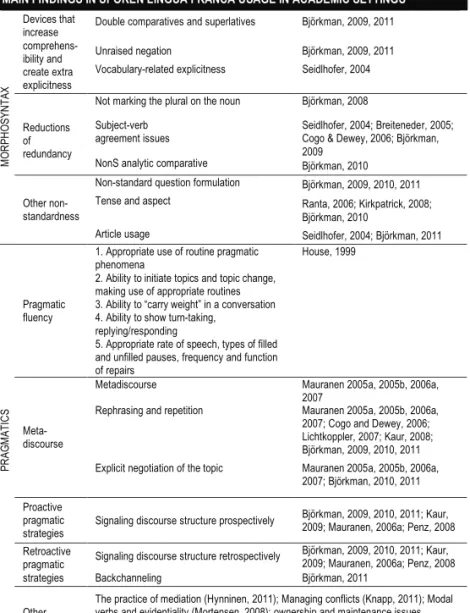
MAIN FINDINGS IN SPOKEN LINGUA FRANCA USAGE IN ACADEMIC SETTINGS
Double comparatives and superlatives Björkman, 2009, 2011
Unraised negation Björkman, 2009, 2011 Devices that increase comprehens-ibility and create extra explicitness
Vocabulary-related explicitness Seidlhofer, 2004
Not marking the plural on the noun Björkman, 2008 Subject-verb
agreement issues
Seidlhofer, 2004; Breiteneder, 2005; Cogo & Dewey, 2006; Björkman, 2009
Reductions of redundancy
NonS analytic comparative Björkman, 2010
Non-standard question formulation Björkman, 2009, 2010, 2011
Tense and aspect Ranta, 2006; Kirkpatrick, 2008; Björkman, 2010 M O R P H O S Y N T A X Other non-standardness
Article usage Seidlhofer, 2004; Björkman, 2011
Pragmatic fluency
1. Appropriate use of routine pragmatic phenomena
2. Ability to initiate topics and topic change, making use of appropriate routines 3. Ability to “carry weight” in a conversation 4. Ability to show turn-taking,
replying/responding
5. Appropriate rate of speech, types of filled and unfilled pauses, frequency and function of repairs
House, 1999
Metadiscourse Mauranen 2005a, 2005b, 2006a,
2007
Rephrasing and repetition Mauranen 2005a, 2005b, 2006a, 2007; Cogo and Dewey, 2006; Lichtkoppler, 2007; Kaur, 2008; Björkman, 2009, 2010, 2011
Meta-discourse
Explicit negotiation of the topic Mauranen 2005a, 2005b, 2006a, 2007; Björkman, 2010, 2011
Proactive pragmatic strategies
Signaling discourse structure prospectively Björkman, 2009, 2010, 2011; Kaur, 2009; Mauranen, 2006a; Penz, 2008
Signaling discourse structure retrospectively Björkman, 2009, 2010, 2011; Kaur, 2009; Mauranen, 2006a; Penz, 2008
Retroactive pragmatic
strategies Backchanneling Björkman, 2011
P R A G M A T IC S Other
The practice of mediation (Hynninen, 2011); Managing conflicts (Knapp, 2011); Modal verbs and evidentiality (Mortensen ,2008); ownership and maintenance issues (Haberland, 2011) P H O N O LO G Y 5
Lingua franca core (Jenkins, 2000), Attitudes towards ELF (Jenkins, 2007), Intelligibility and comprehensibility (Pickering, 2006), Teaching ELF pronunciation (Walker, 2010), Question intonation (Björkman, 2011)
These research results find support from previous research on the topic of ELF. Thus, there are different types of non-standardness of morphosyntax (see Table 1), and despite these non-standardnesses, there appear to be very few cases of overt miscommunication (mauranen 2006a; Björkman, 2009; kaur, 2009). Speakers use a number of pragmatic strategies to ensure the effectiveness of communication (mauranen 2005a, 2005b, 2006a & 2007; Björkman, 2009, 2010 & 2011; kaur, 2009). Table 1 is a brief summary of the findings of ELF studies from a variety of academic settings, ranging from different types of student talk (mauranen, 2006a; mortensen, 2008; kaur, 2009; Björkman, 2010 & 2011; hynninen, 2011; knapp, 2011) to teacher talk (Cogo, 2009; Björkman 2011). It includes the main findings of investigations into the morphosyntax, pragmatics and phonology of ELF usage from academic settings.
When these research results are considered, it becomes clear that the native speaker as the ideal target for spoken production is inappropriate, if the aim of EAP instruction is to help those who will use it mostly in ELF settings. The following section argues that targets in such ELF settings need to be set by taking into account how effectiveness is achieved in such settings.
We will now turn to the theoretical implications of these findings for the field of EAP and then to some practical applications for EAP instruction and testing.
4. Adjusting EAP for ELF settings: Theoretical
implications
4.1. Norms and standards for spoken English
one of the most critical issues regarding EAP today is the norms and standards for spoken English. As mentioned earlier in Section 2, the EAP focus remained on writing for both instruction and testing, at least until the emergence of major spoken corpora (mauranen, Pérez-Llantada & Swales, 2010). It is not surprising that norms and standards for spoken English were consequently more appropriate for writing than for speaking. So, in the light of the new information from ELF research, how should the norms and standards be modified? What is correct in spoken English and therefore acceptable?
Some features that are considered incorrect can be observed in native speaker speech frequently. When native speakers have non-standard usage in their speech, it is generally termed “variation” whereas when non-native speakers have the same usage (see Shaw (1992) for a discussion of “variation”), it is considered an “error” in the language classroom. ELF research has shown that non-native speakers too can have variation in their speech (earlier shown by gass, 1989), especially that the non-standardness shows clear patterns of reducing redundancy and increasing explicitness, both aimed for communicative effectiveness. The important question for this study concerns the standards for speech.
If we approach the general concept of language as a set of rules, a clear and solid set of rules to prescribe for standard usage of the language becomes necessary. What is considered standard in traditional grammar books is traditionally based on written English. In other words, the standards for spoken English have long been set by written English and what would be considered correct and therefore acceptable in written discourse. A very significant step in recognizing this was taken by Svartvik and Quirk’s (1980) Survey of English usage.
Written norms are not appropriate for speaking, for speech and writing are two very different types of discourse. The fact that speech is generally impromptu and requires real-time production and processing creates the biggest difference between these two types of discourse with regard to one’s production. So evaluating a speaker’s communicative competence by his/her adherence to the norms of writing would be against the nature of speaking, would be unjust to the speaker, being a practice that does not comply with the way natural speech is.
The first preliminary in describing speech properly involves the compilation of spoken corpora – for instance, part of British national Corpus (BnC), London-Lund Corpus (LLC), mICASE (Simpson et al., 2002), BASE, ELFA and VoICE. These corpora all serve the purpose of providing spoken data from different settings.
document spoken English by non-native speakers. The speech recorded for CAnCodE comprises speech from native speakers of English only, and the findings that arise from this corpus can explain variation in the spoken language of native speakers only, not in non-native speakers’ speech. In this sense, not only does the CAnCodE corpus include a narrower group of speakers than the other corpora compiled in English-speaking countries, it also brings us back to the “target use” problem (see next sub-section).
4.2. Target use
Carter and mcCarthy suggest the usage of CAnCodE data by learners of English so that they can “see, hear and understand conversational English in a range of different contexts of use” (Carter and mcCarthy, 1997: 7). It would be ideal that those who are studying English and consider themselves learners could be exposed to authentic usage of spoken English from a variety of contexts, situations and settings, and undoubtedly, CAnCodE data are of great interest. They reveal variation in native speaker usage of spoken English, which is very important in studying spoken English. however, they exclude speech by speakers who speak it as a lingua franca. In this respect, they are not appropriate for speakers of English who will use it in ELF settings.
In ELF contexts, the third essential is the availability of corpora that document usage of English in settings where it is used as a lingua franca. Target use for speakers in ELF settings is not native spoken usage that is culturally-loaded and is full of idioms, but rather effective speech. The CAnCodE project was criticized by Prodromou (1996) for this very reason. Presenting learners of English with the heavy idiomaticity present in native spoken English is not likely to provide them with more choices; it is only likely to create opacity in their speech. Prodromou (1996) discusses the concept of “authenticity” and claims that it is embedded in the context. When it is taken out of its context,
it simply stops being authentic. Wall Street JournalEnglish may be authentic to
those who deal with similar matters and are familiar with it (Prodromou, 1996), but it certainly is not to speakers in all lingua franca settings. native speaker usage is not necessarily helpful for speakers in ELF settings. Although rising question intonation is not always present in native speaker usage, it helps speakers in ELF settings register questions.
descriptions of the use of ELF. A thorough documentation of spoken English from authentic settings should contribute to the understanding of a “spoken grammar” and whether it is possible to set rules that reflect the nature of spoken English successfully. To date, there is no clear explanation or documentation of spoken grammar.
however, the application of the research findings based on these corpora is critical. The place to apply the research findings is the language classroom, which brings the need for a discussion of the teaching of English for academic purposes. Before moving on to such practical implications, a useful preliminary is a discussion of what good English may mean and whether it is synonymous with correct English.
4.3. Good English
The results of the present study and a discussion of the general notions of ELF situations bring to the fore another important notion, albeit a much more general one: “good English”. What is good English? This question will naturally receive a variety of answers depending on a number of factors. greenbaum (1996: 17) discusses “good English” by contrasting it to “correct English” as follows:
good English is sometimes equated with correct English, but the two concepts should be differentiated. Correct English is conformity to the norms of the standard language. good English is good use of the resources available in the language. In that sense we can use a non-standard dialect well and can use the standard language badly. By good English we may mean language used effectively or aesthetically; language that conveys clearly and appropriately what is intended and language that is pleasing to the listener or the reader.
effectively takes precedence over language complexity. “Conformity to the norms” will naturally be less critical for anyone who is trying to complete a task through the medium of that language.
This approach does not imply that correctness is irrelevant. naturally, grammatical accuracy is important; a sentence needs to be made up of the right constituents to be sensical. however, in ELF settings where speakers are from a range of levels of proficiency, both native speakers/highly proficient speakers and those who are non-native speakers are challenged.
5. Adjusting EAP for ELF settings: Practical
implications
This section aims to address some pedagogical and practical applications of the ELF research findings and make some tentative suggestions to adjust EAP teaching and testing to ELF settings. There are three important issues for the EAP instruction: (1) the needs and expectations of the specific group; (2) comprehensibility as the priority in teaching English to those who will use ELF in academic settings; and (3) the use of realistic course materials and testing criteria for spoken production.
how the language is used primarily among its non-native speakers for different purposes in international settings will be more relevant than how it is used in English-speaking countries by its native speakers. So EAP can take steps towards meeting current demands instead of feeding on dated descriptions of English, and differentiating between different types of learners and their needs.
more research and proper descriptions from a variety of settings will undoubtedly provide EAP with invaluable information as to what English usage is like in different settings. Until then, realizing the needs and expectations of different types of learners and producing materials including features they will need to use frequently in their target settings will be important steps in the right direction. The transition from description to prescription needs to be made with caution, and this task needs to be undertaken only after thorough descriptions from a variety of settings have been made available.
The second issue of importance here is prioritizing comprehensibility in language teaching. In ELF settings, the priority must be comprehensibility, followed by language complexity, provided that achieving complexity is one of the aims at all. Prioritizing comprehensibility in language teaching was first put forward as early as in the 1970s, with the functional hypothesis and the Functional Sentence Perspective (although not a teaching approach). So, the issue is by no means a new one. The challenge has been to suggest ways of putting such theory into practice. What should then the language teacher actually do in the classroom and how should the teaching of English be modified to prioritize comprehensibility and provide the learner with a realistic model?
These issues have recently been brought to discussion in ELF research. The importance of exposing learners to a wider range of English has been discussed in a number of studies (for instance, jenkins, 2006), as well as general “efforts to reduce the nativespeakerist element in some teaching materials” (jenkins, 2006: 169), “the merits of native and non-native teachers of English” (jenkins, 2006: 172), “challenges to learner language theory” (jenkins, 2006: 166) and the importance of providing the learner with modern and broad-based descriptions of language:
models that can be applied to a variety of communicative goals (...) (mauranen, 2006b:144)
All these are central to improving language teaching. however, ways of achieving what is seen as important has been discussed much less, with the exception of the lingua franca core (jenkins, 2000), the inappropriateness of unilateral idiomaticity for ELF settings (Seidlhofer, 2004) and the importance of accommodation strategies (jenkins, 2000 & 2006). The question, then, remains: what types of modifications are suggested for the language classroom? This brings us to the third point, namely the use of realistic course materials and testing criteria for spoken production.
The first modification needs to be made to course materials in an attempt to produce realistic course materials (jenkins, 2006: 169). This issue need not be as radical as some have suggested. There need not be a set of acceptable features in the form dimension for learners to adhere to. It has been shown that ELF usage is in fact characterized by variability (Firth, 2009) and is by no means a monolithic variety but a polylithic one. In this respect, the integration of ELF usage into the forms traditionally used in EAP teaching adds to the existing set of standards.
The present study and other ELF research point towards prioritizing the following items:
• The inclusion of pragmatic strategies in speaking and listening materials: It is clear in the findings of ELF research (Table 1) that pragmatic strategies and negotiating meaning play an essential role in achieving communicative effectiveness in ELF settings. After learners are presented with materials of authentic usage from ELF settings (listening), role-plays and other communicative activities can be used to enable learners to practice these skills. This has been recently covered in Walker’s work on teaching the pronunciation of ELF (Walker, 2010).
• The inclusion and prioritizing of materials practicing features whose absence leads to overt disturbance: Questions have been reported to be important for the effectiveness of spoken communication in ELF settings (Björkman, 2008, 2009 & 2011). They should be addressed thoroughly in language classrooms in communicative activities such as information-gap activities, or group-work activities, which would mirror real-life communicative situations. In connection with questions, word order issues need to be given enough space in the classroom. It appears that non-standardness in word order can impede communication, create irritation, which in turn, may cause turbulence in communication.
The inclusion of non-native speaker accents in listening comprehension materials: It is important that speakers who will operate in ELF settings are exposed to a variety of accents, since this is precisely what they will need to do when they use ELF. of special importance are materials for listening comprehension including a variety of accents (Smith, 1982; Smith & Bisazza, 1982) and cases of disturbance where meaning is negotiated and where communicative strategies are employed (Watterson, 2008). In addition, authentic recordings can be turned into course materials in which students test their listening comprehension and note-taking skills. Another positive outcome of this practice would be increased student awareness of what authentic English is in international settings.
The production of realistic materials is an issue primarily for material production but also for EAP instructors who prepare course materials for their students. Especially in higher education settings where students will use ELF, listening materials must include English by speakers in lingua franca settings. This can be enabled by proper descriptions of lingua franca settings, as discussed above.
The view that prioritizes comprehensibility in teaching is not shared by all. Some have claimed that ELF research suggests all teaching be done only based on comprehensibility, because “what is needed for comprehension is all that is needed to be produced” (kuo, 2006: 216). This is not the case. The present study suggests that features that are critical in terms of communicative effectiveness are prioritized, followed by features that are not equally vital for communicative purposes.
authentic usage. Testing is not necessarily an issue that needs to be dealt with after addressing issues concerning teaching. ELT examination boards base their practices on the ownership of English predominantly by its native speakers. The same approach is taken by most teachers and teacher trainers (jenkins, 2006). If World Englishes and ELF researchers together point to a need for pluralism and inclusivity (Bolton, 2005; Seidlhofer, 2005), EAP practice needs to follow. Excluding the usage of English by its non-native speakers in ELF settings and not giving it the airing space it needs in EAP would be reducing EAP qualitatively and quantitatively, and therefore, unhelpful to the learners.
So how can testing be adjusted in the light of comprehensibility-based teaching and the findings of the ELF literature so far (including the findings of the present study)? Any set of criteria to evaluate the spoken production of a learner of English will need to consider the following carefully:
• one of the types of non-standard morphosyntactic usage in the present study concerns successful reductions of redundancy. An example of this type of usage is the non-marking of the plural on the noun. It cannot be suggested that such non-standard forms should be taught to learners; however, not penalizing them on items that do not hinder communication and help communicative effectiveness could be a practice worth considering.
purposes the items are repeated. repetition for emphasis both in dialogic and monologic speech, and other repetition in dialogic speech help learners achieve communicative effectiveness.
• dialogic speech gives us more information with reference to disturbance, pragmatic strategies and how speakers negotiate meaning in interaction. If teachers aim to test a learner’s ability to negotiate meaning and achieve communicative effectiveness through appropriate strategies, they should assign learners dialogic tasks. This would enable teachers to test the pragmatic strategies that they have exposed their students to (the present section, see priorities in teaching). In most language teaching classrooms in Sweden, however, learners are assigned monologic tasks, presentations being a popular one. It is not possible to test how meaning is negotiated in such prepared speech. It is recommended that both monologic and dialogic speech events are used in the testing of a learner’s spoken production. This would be an attempt to mirror authentic ELF situations in a language classroom setting, and it would be useful in preparing the learner for dialogic speech events.
• It is important that native-speaker accents are not presented as the only acceptable accents to achieve the highest grades in the evaluation of a learner’s spoken production. The learner should be free to approximate his/her speech to a native variety if this is the learner’s aspiration, but this should not be a criterion.
• In general, assessment criteria need to be adjusted considering the above, giving “effective use of the language” as the target. The criteria for higher grades should not be “native-like production”, for instance native-like pronunciation, for those who will use English as an academic lingua franca. This is a very questionable practice for two main reasons. First, as discussed in the present paper, it is problematic to define what “native speaker usage” is with the variability in native varieties. Second, previous research (Björkman, 2010) has shown that native-speaker-like production does not necessarily ensure communicativeness in ELF settings, for instance in question intonation.
most countries within the EU are now in the process of implementing the Common European Framework of reference for Languages (CEFr). The Council of Europe (2001) defines this framework as a document that describes in a comprehensive manner i) the competences necessary for communication, ii) the related knowledge and skills and iii) the situations and domains of communication. It is precisely the competences necessary for communicative effectiveness that the ELF paradigm emphasizes. So, on this note, criteria need to be adjusted accordingly, considering the aim of the task that is performed through English.
6. Conclusion
In this paper, we focused on one of the important changes that has taken place in higher education: the wide use of ELF in a large number of higher education institutions and the emerging groups of ELF speakers. The aim here has been to provide an overview of the use of ELF in higher education today, with specific reference to northern Europe, to outline the main findings of ELF research, and to make tentative suggestions for EAP instruction and testing. The discussion in this paper contributes to an ongoing debate on the extent of the use of English in English-medium higher education settings in Europe.
Acknowledgements
my thanks go to Philip Shaw, the anonymous reviewers and the guest editor maria kuteeva for valuable comments on an earlier version of this paper.
[Paper received October 2010] [Revised paper accepted March 2011]
References
Bex, T. (2008). “‘Standard’ English, discourse grammars and English language teaching” in M.A. Locher & J. Strässler (eds), Standards and Norms
in the English Language, 221 -239. Berlin: Mouton
de Gruyter.
Björkman, B. (2008). “‘So where we are’: Spoken lingua franca English at a Swedish technical university”. English Today24: 11-17.
Björkman, B. (2009). “From code to discourse in spoken ELF” in A. Mauranen & E. Ranta (eds.), 225-252.
Björkman, B. (2010). Spoken Lingua Franca English at a Swedish Technical University: An Investigation of Form and Communicative
Effectiveness. Unpublished PhD thesis.
Björkman, B. (2011). “Pragmatic strategies in English as an academic lingua franca: ways of achieving communicative effectiveness?” Journal of Pragmatics 43: 950-964.
Bolinger, D.W. (1998). “Intonation in American English” in D. Hirst & A. Di Cristo (eds.) Intonation Systems: A Survey of Twenty Languages, 45-55. Cambridge: Cambridge University Press.
Bolton, K. (2005). “Symposium on world Englishes (Part II). Where WE stands: Approaches, issues, and debate in world Englishes”. World Englishes
24: 69-83.
Breiteneder, A. (2005). “The naturalness of English as a European lingua franca: The case of the ‘third person -s’”. Vienna English Working Papers14: 3-26.
Carter, R. & M. McCarthy. (1997). “Grammar and the spoken language”. Applied Linguistics16: 141-158.
Cogo, A. (2009). “Accommodating difference in ELF conversations” in A. Mauranen & E. Ranta (eds.), 254-274.
Cogo, A. & M. Dewey. (2006). “Efficiency in ELF communication: From pragmatic motives to lexico-grammatical innovation”. Nordic Journal of English Studies5: 59-93.
Council of Europe (2001). The Common European
Framework of Reference for Languages.
Cambridge: Cambridge University Press.
Ferguson, G. (2007). “The global spread of English, scientific communication and ESP: questions of equity, access and domain loss”.
Ibérica 13: 7-38.
Firth, A. (2009). “The lingua franca factor”.
Intercultural Pragmatics6: 147-170.
Gass, S. (1989).Variation in Second Language
Acquisition: Discourse and Pragmatics. Clevedon:
Multilingual Matters.
Greenbaum, S. (1996). The Oxford English
Grammar. Oxford: Oxford University Press.
Haberland, H. (2011). “Ownership and maintenance of a language in transnational use: Should we leave our lingua franca alone?” Journal
of Pragmatics43: 937-949.
House, J. (1999). “Misunderstanding in intercultural communication: Interactions in English as a lingua franca and the myth of mutual intelligibility” in C. Gnutzmann (ed.) Teaching and
Learning English as a Global Language, 133-160.
Tübingen: Stauffenburg.
Hynninen, N. (2011). “The practice of ‘mediation’ in
English as a lingua franca interaction”. Journal of
Pragmatics43: 965-977.
Jenkins, J. (2000). The Phonology of English as an International Language: New Models, New Norms,
New Goals. Oxford: Oxford University Press.
Jenkins, J. (2006). “Current perspectives on teaching world Englishes and English as a lingua franca”. TESOL Quarterly40: 157-181.
Jenkins, J. (2007). English as a Lingua Franca: Attitude and Identity. Oxford: Oxford University Press.
Jenkins, J. (2011). “Accommodating (to) ELF in the international university”. Journal of Pragmatics43: 926-936.
Kaur, J. (2009). “Pre-empting problems of understanding in English as a lingua franca” in A. Mauranen & E. Ranta (eds.), 107-124.
Kirkpatrick, A. (2008). “English as the official language of the association of southeast Asian nations (ASEAN): Features and strategies”.
English Today24: 27 -34.
Kirkpatrick, A. (ed.) (2010). The Routledge
Handbook of World Englishes. Oxon: Routledge.
Knapp, A. (2011). “Using English as a lingua franca for (mis-)managing conflict in an international university context: An example from a course in engineering”. Journal of Pragmatics43: 978-990.
Kuo, I-C V. (2006). “Addressing the issue of teaching English as a lingua franca”. ELT Journal
60: 213-221.
Lichtkoppler, J. (2007). “– ‘Male. Male.’ – ‘Male?’ – ‘The Sex is Male.’ The role of repetition in English as a lingua franca conversations”. Vienna English
Working Papers 16: 39-65.
Mauranen, A. (2005a). “English as a lingua franca – an unknown language?” in G. Kortese & A. Duszak (eds.) Identity, Community, Discourse: English in Intercultural settings, 262-292. Frankfurt am main: Peter Lang.
Mauranen, A. (2005b). “Speaking academics” in I. Bäcklund, U. Börestam, U. Melander, U. Marttala & H. Näslund (eds.) Text i Arbete/Text at Work, 330-339. Uppsala: ASLA.
Mauranen, A. (2006a). “Signaling and preventing misunderstanding in English as lingua franca communication”. International Journal of the
Sociology of Language177: 123-150.
Beyza Björkmanis currently a lecturer at the royal Institute of Technology in Stockholm (http://www.speech.kth.se/~beyza/). She has a Ph.d. in Applied Linguistics, on the topic of English as an academic lingua franca. She has published on this topic in journals, edited a Special Issue on the topic
for the Journal of Pragmatics, written book chapters and an encyclopaedia
entry and has presented her work at a number of international conferences. her general research interests include linguistic equality, language change and the use of English as a lingua franca for academic purposes.
theory and practice, 143-158. London: Palgrave Macmillan.
Mauranen, A. (2007). “Hybrid voices: English as the lingua franca of academics” in K. Flottum (ed.)
Language and Discipline Perspectives on
Academic Discourse, 243-259. Newcastle:
Cambridge Scholars.
Mauranen, A. & E. Ranta (eds.) (2009). English as
a Lingua Franca: Studies and Findings.
Newcastle: Cambridge Scholars.
Mauranen, A., C. Pérez-Llantada & J.M. Swales. (2010). “Academic Englishes: a standardized knowledge?” in A. Kirkpatrick (ed.), 634-653.
Mortensen, J. (2008). “‘Circus ‘English?’ Investigating English as an academic lingua franca at BA study group meetings at Roskilde University” in H. Haberland, J. Mortensen, A. Fabricius, B. Preisler, K. Risager & S. Kjaerbeck (eds.) Higher Education in the Global Village, 85-96. Roskilde: Department of Culture and Identity.
Penz, H. (2008). “‘What do we mean by that?’ – ELF in intercultural project work”. Paper presented at the ESSE conference. University of Aarhus, Denmark, August 22-26.
Pickering, L. (2006). “Current research on intelligibility in English as a lingua franca”. Annual Review of Applied Linguistics 26: 219-233.
Prodromou, L. (1996). “Correspondence from Luke Prodromou”. ELT Journal50: 371-373.
Ranta, E. (2006). “The ‘Attractive’ Progressive – Why use the -ing form in English as a lingua franca?” Nordic Journal of English Studies5: 95-116.
Salö, L. (2010). Engelska eller svenska? En kartläggning av språksituationen inom högre utbildning och forskning. Stockholm: Språkrådet.
Seidlhofer, B. (2004). “Research perspectives on teaching English as a lingua franca”. Annual Review of Applied Linguistics 24: 209-239.
Seidlhofer, B. (2005). “English as a lingua franca”.
ELT Journal59: 339-341.
Seidlhofer, B. (2010). “Lingua franca English: the European context” in A. Kirkpatrick (ed.), 355-372.
Shaw, P. (1992). “Variation and universality in communicative competence: Coseriu’s model”.
TESOL Quarterly26: 9-25.
Simpson, R.C., S.L. Briggs, J. Ovens & J.M. Swales. (2002). The Michigan Corpus of Academic
Spoken English. Ann Arbor, MI: The Regents of the
University of Michigan.
Smit, U. (2010). English as a lingua franca in higher education. Berlin/New York: De Gruyter Mouton.
Smith, L.E. (1982). Readings in English as an
International Language. Pergamon: London.
Smith, L.E. & J.A. Bisazza (1982). “The comprehensibility of three varieties of English for college students in seven countries”. Language
Learning32: 259-269.
Svartvik, J. & R. Quirk (eds.) (1980). A Corpus of English Conversation. Lund Studies in English, 56. Lund: Liber/Gleerups.
Walker, R. (2010). Teaching the Pronunciation of
English as a Lingua Franca. Oxford: Oxford
University Press.
Watterson, M. (2008). “Repair of non-understanding in English in international communication”. World Englishes27: 378-406.
NOTES
1The BASE corpus is available at UrL: http://www2.warwick.ac.uk/fac/soc/al/research/collect/base/
2See Wong and olsher, 2000: 122.
3The ELFA corpus is available at UrL: http://www.eng.helsinki.fi/elfa/elfacorpus.htm
4The VoICE corpus is available at UrL: www.univie.ac.at/voice
5not all of these studies are based on spoken academic usage. They have been included here, because