ABSTRACT The objective of this study was to estimate and to analyze the extent of the socio-environmental adverse impacts during the moratorium period provided in the Minamata Convention for two mercury emission sources: the industrial sectors of chlor-alkalis and of fluorescent lamps. The application of the conceptual integrated model DPSIR, of the case study and calculations utilizing available sectorial data has found an estimated total emission of 18.6 thousand tons of mercury, which will impact several environmental compartments and life in them. The moratorium period granted by the Minamata Convention is not justified because alternative technologies already exist that replace both electrolytic cells and bulbs without producing mercury pollution.
KEYWORDS Mercury poisoning. Environmental impact. Health.
RESUMO O objetivo do presente estudo foi estimar e analisar a magnitude dos impactos socio-ambientais adversos durante o período de moratória previsto na Convenção de Minamata para duas fontes de emissão de mercúrio: os setores das indústrias de cloro-álcalis e das lâmpadas flu-orescentes. A aplicação do modelo conceitual integrado Driver-Pressure-State-Impact-Response (DPSIR), do estudo de caso e de cálculos a partir de dados setoriais disponíveis encontrou a emissão total estimada de 18.6 mil toneladas de mercúrio, que impactará os diversos comparti-mentos ambientais e a vida neles inserida. O período de moratória outorgado pela Convenção de Minamata não se justifica, porque já existem tecnologias alternativas que substituem tanto as células eletrolíticas, como as lâmpadas, sem causar poluição de mercúrio.
PALAVRAS-CHAVE Intoxicação por mercúrio. Impacto ambiental. Saúde.
Minamata Convention: analysis of the
socio-environmental impacts of a long-term
solution
Convenção de Minamata: análise dos impactos socioambientais de
uma solução em longo prazo
Rafaela Rodrigues da Silva1, Jefer Castelo Branco2, Silvia Maria Tagé Thomaz3, Augusto Cesar4
1 Universidade Federal
de São Paulo (Unifesp), Núcleo de Estudos, Pesquisas e Extensão em Saúde Socioambiental – Santos (SP), Brasil.
rafaellarodrigues@hotmail. com
2 Universidade Federal
de São Paulo (Unifesp), Núcleo de Estudos, Pesquisas e Extensão em Saúde Socioambiental – Santos (SP), Brasil.
3 Universidade Federal
de São Paulo (Unifesp), Núcleo de Estudos, Pesquisas e Extensão em Saúde Socioambiental – Santos (SP), Brasil.
4 Universidade Federal
de São Paulo (Unifesp), Instituto do Mar - Santos (SP), Brasil.
Introduction
Mercury is a noble liquid metal that is in the elemental metallic species, in organic and inorganic compounds and in the oxi-dation states Hg°, Hg¹ and Hg². The metal is toxic and vaporizes even at zero degree Celsius. It is persistent in the environment and is still widely used in society.
The deleterious effects of mercury have been observed for decades, especially in the workplace. Goldsmiths and hatters, for example, had signs and symptoms of chronic occupational mercurialism, due to their constant contact with the mercury vapors in their elemental form (the expression ‘mad hatter’ comes from the workmanship of the hatters in the 19th century). Going further, in the roman empire, christians and slaves were forced to work in the mercury mines (ZAVARIZ, 1994).
The awakening of public awareness of the consequences of mercury and its compounds widened in the 1960s with the environmental disaster in Japan, where, for more than twenty years, an industry has released in its liquid effluents the mercury in its organic form directly into the Minamata bay.
The bay, located in the southern archi-pelago of the Country, was contaminated by the residues of the Chisso company, which contaminated the marine fauna and, through the trophic chain, reached man. In addition to the sequelae in the body and mind of the victims, Minamata is also a history of the political struggle of the population for the recognition of ‘Minamata Disease’ or ‘Minamata Harm’.
Despite technological modernity, the advancement of laws protecting the working environment, mercury and its compounds are still used in processes and products around the world, especially in peripheral countries. Therefore, exposure to metal vapors in the workplace is diffi-cult to control. Although naturally existing
trace amounts in the crust of the earth, the anthropogenic emissions of mercury are higher and, on the other hand, have in-creased significantly since the beginning of the industrial period (POULIN; GIBB, 2008).
The chemical reactions of mercury in the environment are complex, and, once released by anthropic action, consider-ing its volatility, its biogeochemical cycle, providing circulation between soil, air and water, added to circulation and at-mospheric phenomena, mercury can be found in most remote locations of planet Earth. The metal mercury when released is a pollutant that tends to remain in sus-pension from 4 months to up to a year in the atmosphere, react with other sub-stances present and suffer deposition, and can, in this cycle, become organic by biotic factors (WATKINS III; KLAASSEN, 2012). Although the organic form of mercury is considered the most toxic (methylmercury), elemen-tal mercury and inorganic mercury are also toxic.
Recent research has shown that mercury causes changes in the sexual behavior of birds (CONDON; CRISTOL, 2009), however, other species that feed on fish also already have detectable levels of methylmercury (FREDERICK; JAYASENA, 2011). Although scarcer, there are still cases of children diagnosed with mercury contamination (acrodynia), emphasizing that the diagnosis can be confused with other diseases (KHODASHENAS; AELAMI; BALALI-MOOD, 2015).
Mercury is considered an endocrine dis-rupter. Studies indicate that, in its organic form, it can cause male infertility (DUARTE, 2008). Mercury was found in higher con-centrations in breast biopsies of women with breast cancer (INCA, 2012). Genotoxic tests reveal mutations, responsible for the emergence of cancers. There is a possibil-ity that the emergence of cancer by expo-sure is related to the ability of mercury to affect the immune system (CARDOSO, 2001).
its characteristic of reacting and trans-forming, increasing toxicity, is a threat to the various life forms in the environ-ment, especially considering that there is no control once it is emitted. In 2002, the United Nations Environment Programme (Unep) stated that mercury levels are already high both in freshwater and saltwa-ter fish and in people whose fish is part of the regular diet. These levels may be respon-sible for adverse health effects (UN, 2002).
From evidence that public and col-lective health is at serious risk with the disorderly release of mercury into the en-vironment, discussions began in the inter-national political scope, lasting for about six years, resulting in a legally binding international treaty which aims to protect human health and the environment from the anthropogenic emissions of mercury and its compounds. In October 2013, the Minamata Convention for mercury had the final text approved and signed by 92 countries, among them, Brazil. Currently, it has 128 signatures and 28 ratifications, noting that only after the 50th country has submitted to the Convention secre-tariat the ratification document is that it becomes formally effective at the interna-tional level.
The purpose of the Convention is to protect, mainly, populations considered to be most vulnerable to mercury, such as fetuses, children and pregnant women. Organic mercury can overcome the pla-cental barrier with greater efficiency, and it is possible to find the inorganic species in amniotic fluid and in breast milk (AZEVEDO, 2003). Mercury devastates the neu-rological system at the moment that the human being is still developing, includ-ing fetal development. Mercury damages vary, ranging, for example, from atten-tion deficit, blindness, deafness, muscular atrophy, mental retardation, to death.
Although the international treaty is a breakthrough for the protection of human
health and the environment, it brings long moratorium periods to mercury-contain-ing processes and products. For example: products such as batteries, computers, switches, fluorescent lamps, cosmetics, barometers, hygrometers, manometers, thermometers, sphygmomanometers, pes-ticides, biocides and antiseptics will have a moratorium of use by 2020; the produc-tion of chlor-alkalis with mercury cells, by 2025; and the production of acetalde-hyde, by 2018. The Convention excludes from prohibition many other mercury products and activities, such as those for: civil protection or military use, research products, instrument calibration, cultural and religious practices, and vaccines with thimerosal.
There are other activities and other products of which the Minamata Convention does not provide for elimina-tion, but suggests control, such as: power plants and boilers operated with mineral coal, foundry and roasting processes used for the production of non-ferrous metals, waste incineration plants, cement pro-duction plants, artisanal and small scale gold mining, production of vinyl chloride monomers, sodium or potassium methyl-ate or ethylmethyl-ate, production of polyure-thane, using mercury-containing catalysts, and dental amalgam.
agrochemicals and for sanitary purposes. Alkalis, mainly caustic soda, are used in the manufacture of soaps, detergents and in various industrial uses, such as metal-lurgical, textile, food, pharmaceutical, among others.
In this way, the objective of the present work was to analyze the impacts of the mora-torium period of these two sectors, that of fluorescent lamps, through the integrated conceptual model DPSIR (Driver-Pressure-State-Impact-Response), and the chlor-alkali sector, by case study and by means of calcula-tions of emissions.
The totals of national and international emissions of these two productive sectors during the moratorium period proposed in the treaty were calculated from data col-lected from various sources, such as the Brazilian Association for the Chlor-Alkali and Derivatives Industry, the Ministry of Environment and the World Chlorine Council (WCC) for chlor-alkali; the Brazilian Association of Lighting Industry (Abilux) and the China Association of Lighting Industry for the lamp sector.
Analysis of the impacts
caused by mercury lamps
through the DPSIR model:
Driving Forces, Pressures,
State, Impact and Response
The DPSIR model, an acronym that, in Portuguese, means: Driving force – Pressure – State – Impact – Response, developed by the European Environmental Agency (EEA), helps to organize the analytical thinking about an environmental problem. The model makes it possible to analyze a given problem from its origin, its ramifications, to measures aimed at mitigating the impact, considering the ecosystem management that seeks inter-action between environment, economy and society and sustainable development.
Considering that the destination of fluo-rescent lamps after their useful life becomes an environmental problem, since their dis-posal is, most often, done in an inappropri-ate place or in an inappropriinappropri-ate way and in massive quantities, the DPSIR was used to analyze this context as an environmental conditioner.
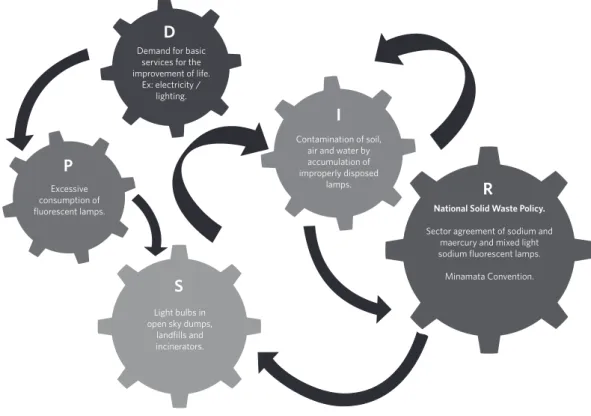
From the increase in population con-sumption, which is geometrically larger than the population growth, even though it does not reach the whole of society, it is observed as driving force the demand for light electric energy and, by pressure, the excessive con-sumption of fluorescent lamps, mainly after the energy crisis of 2001 in the Country. The response of the brazilian government and energy sectors was to adopt the policy of replacing incandescent lamps with fluores-cents, which culminates in 2016 (MONTEIRO; MEIRIÑO, 2015). As an impact, there was an 80% reduction in luminous energy consumption
(CAMBESES POLANCO, 2007), but no strategy was used to adjust the increase in the use of fluo-rescent lamps due to the inherent risks.
Fluorescent, compact, tubular and mixed lamps, after use, are listed as class 1 hazard-ous wastes, listed in the annex B of the NBR 1004 of the Brazilian National Standards Organization. Due to environmental pres-sure, we have the inadequate storage of the post-consumption lamps, the lamp breaks at disposal in landfills and dumps, and there is no control of these impacts.
After the end of their useful life, lamps are considered an ‘externality’ for produc-ers, who do not get involved in the result of their product after use. There is no way to know precisely the amount of mercury in the lamps entering the market. And, completing the framework, there is no effort to raise public awareness about environmental and health risks, related to the post-use of fluo-rescent lamps and other mercury models. Figure 1. Example of element interaction in the DPSIR analytical model for fluorescent lamps
National Solid Waste Policy.
Sector agreement of sodium and maercury and mixed light sodium fluorescent lamps.
Minamata Convention.
Light bulbs in open sky dumps,
landfills and incinerators. Excessive
consumption of fluorescent lamps.
Demand for basic services for the improvement of life.
Ex: electricity / lighting.
Contamination of soil, air and water by accumulation of improperly disposed
lamps. R
S P
D
In the sphere of impacts, during the elaboration of the DPSIR, it was considered that people are sensitive to the exposure to ultraviolet rays of the lamps and their scintillation, involving skin, eye, neurologi-cal problems and even the immune system (EUROPEAN COMMISSION, 2012). Another impact of the lamp sector comes from the productive sector, with workers intoxicated by mercury in the workplace.
LED lamps (light emitting diodes) have higher energy efficiency. Although they can be considered as a response, that is, an alter-native to fluorescent lamps, they also have harmful substances, such as lead, so that their after-use handling requires care. As a re-sponse, we also have the National Solid Waste Policy (NSWP), which has been in force since 2010, and, also, the sectoral agreement on fluorescents, sodium vapor (mercury) and mixed light lamps, signed in 2014 between The Ministry of Environment and the lamp sector. The international response to the en-vironmental problem of mercury-containing lamps is the Minamata Convention.
To better qualify the possible environ-mental health impacts that the moratorium period will entail, indirect data were col-lected from the companies and associations of lamps and calculations were made to
estimate the amount of emission from this sector in the period.
Estimated cumulative
emission of the mercury
lamp industry due to the
moratorium offered at the
Minamata convention
Brazil imports, on average, 313.000,000 lamps per year (BRASIL, 2016). Tubular fluores-cent lamps have, on average, inside, 15 mg/ Hg, the compact 4 mg/Hg, the mixed 17 mg/Hg, the mercury vapor 32 mg/Hg, the sodium vapor 19 mg/Hg and metallic vapor 45 mg/Hg (AMBIENSYS, 2014).
In 2014, 250 million compact lamps, 100 million tubular lamps and 11 million sodium/ metal lamps were commercialized, which also contain mercury (ABILUX, 2015) (table 1). And, still, 300 million incandescent lamps. After the prohibition of the production and commercialization of these lamps, in 2016, other lamps, such as LEDs, LFCs and tubular lamps (the last two of Hg), are consumed in their place. Considering that these mercury lamps have, respectively, 4, 15 and 32 mg, a rate of 8 mg per lamp is reached, on average.
Table 1. Estimated average amount of Hg per lamp
Consumption by Type of Lamp and Total Hg - BRAZIL
Amount of lamps Amount of Hg Total of Hg
250 million of compact 4 mg 1.000.000.000 mg
100 million of tubular 15 mg 1.500.000.000 mg
11 million (sodium/metallic) 32 mg 352.000.000 mg
The Minamata Convention introduced a moratorium to produce lamps by 2020, and the signatory countries may, still, with justification, extend this moratorium by 2030. Considering that, in Brazil, are used, each year, 313.000,000 lamps, it may be estimated that these lamps at the end of their cycle introduce into the envi-ronment about 2.504 kg/Hg/year.
With the moratorium period being ex-tending for 17 years (2013-2030), will be introduced in the environment by Brazil
42.568 kg of mercury, without consider-ing the rate of 6% of recyclconsider-ing. Worldwide, with a production of 6,69 billion (BEIGL, 2016) of lamps, considering a rate of 8 mg of mercury per lamp, we will have an estimated emission of 909.840 kg of mercury, without consider-ing the 20% of recyclconsider-ing (table 2). The table 2 below, presents the estimated calculations of mercury introduced into the environment, considering that recycled mercury will not be released into the environment.
Table 2. Estimated emission of Hg by total discarded lamps
ESTIMATION OF EMISSION AND RELEASE OF HG BY DISPOSAL OF LAMPS
Scope Production of lamps Mg/Hg per lamp Total/Kg/Hg/year
Brazil 313.000.000 per year 8 2.504
World (China) 6.690.000.000 per year 8 53.520
Estimated emission in the worst Hypothesis with Production and Disposal until 2030
Brazil (17 years) 42.568 Kg World (17 years) 909.840 Kg
Brazil (6% of recycling) 40.014 Kg World (20% of recycling) 727.872 Kg
Case study of a chlor-alkali
industry that uses mercury
electrolytic cells
Through the case study, it was analyzed the issue of the environmental impact of mercury in a brazilian chlor-alkali industry that still uses the metal in the electrolytic process. One of the arguments in relation to technology change in outdated processes that harm the environment is the high cost of restructuring, which is a threat to em-ployability. This way, it is created among the people a conservative thinking and behavior of acceptance of practices harmful to the environment, in which it is understood that care for the environment would be a way of containing economic development and
progress. Thus, in society, there is a massi-fication of a linear, immediate thought that does not consider the finiteness of natural resources, nor its contamination and degra-dation, which puts pressure on ecosystems, as well as the well-being of workers and the urban population.
outsourced, and is in a city that has one of the largest industrial parks in the Country.
Despite the great wealth produced by the industrial complex of the metropolitan region, of which the study industry is a part, the distribution is deficient, since the mu-nicipality that houses this industry has one of the highest poverty, violence and crime rates in the region (murder, robbery and theft of vehicles), as well as the lack of ade-quate sewer system, among other precarious health indicators. It is from the developmen-talist dictatorial package the growth without the proper urban, socioeconomic and envi-ronmental planning of the territory of the city that houses this chlor-alkali industry, due to the industrial expansion.
Since the 1960s, this producer of chlorine and derivatives has been active at the indus-trial pole, and among the seven industries of the fertilizers and petrochemical industries studied by the Environmental Sanitation Technology Company of the State of São Paulo (Cetesb) in the 1970s, was the one that contributed most to the mercury pollution of the river of important use for the region where it is located (HORTELANNI, 2003). In the 1975s, it consumed 440 grams of mercury per ton of chlorine produced, with an estimated loss of 40 tons/year. Like the others in the same segment, the industry develops projects of social and environmental responsibility and, this way, explores green marketing with the image of a company that is environmen-tally friendly, concerned about the health and quality of life of the local population, despite maintaining polluting activity.
The chlor-alkali company is located on the left bank of the Perequê river, at the confluence with the Cubatão river, where it launches its ‘treated effluents’, and in the right bank of the Cubatão river, about 300 meters away, there are five residential districts. Research with children fed on fish from the Cubatão river showed differ-ences in the concentration of mercury in the blood, compared to the concentration
found in children of the same place that did not consume any type of fish (SANTOS FILHO ET AL., 1993).
The industry has caused environmental impacts related to mercury and other pol-lutants and, since 2003, is in the relation of contaminated areas of the environmental organ of the state in which it is. In these documents, there are several sources of con-tamination: storage, discard, disposal, pro-duction, infiltration, maintenance. Impacted environment are surface waters, surface soil and subsoil (within the property), ground-water and sediments (outside the property). Due to these notes, the company is in envi-ronmental recovery (SÃO PAULO, 2015).
The industry studied was fined for not carrying out complementary examina-tions in workers exposed to Hg. There were cases of intoxication of workers by metallic Hg, however, the industry did not allow in-depth tests, such as, for example, a set of neuropsychological tests for the detection of symptoms and signs of hy-drargirism in people whose urine test was between 5 and 35 ug of Hg/g.
In 2013, analyses of atmospheric emis-sions of the chlor-alkali industries showed that there are atmospheric mercury emis-sions, including that of the case study, which presented a constant emission and greater than the other industries analyzed (CASTELO BRANCO, 2013). What is verified is the absence of rigorous and constant atmospheric evalu-ation (transparent, public and enlightened) with industries that launch, through steam, effluent and waste, complex behavioral pol-lutants such as Hg.
Cumulative emission
estimate of the
chlor-alkali industry due to the
moratorium offered at the
Minamata Convention
Although there is no transparency in all in-formation on quantity, use, disposal and loss of mercury in the chlor-alkali industries, an
emission of 127 gr. of mercury per ton of chlo-rine produced is estimated (BRASIL, 2013). Using this data and multiplying it by the brazilian production of chlorine, which is 217.000 tons/ year, a loss of 27.559 kg/year of mercury can be inferred. Multiplying 127 gr. by the world production of mercury cells, currently, around 6,4 million tons of chlorine (UN, 2011), there is an annual loss of 812.800 kg of mercury by the chlor-alkali industries (table 3).
For the chlor-alkali industries that use mercury cells, the Minamata Convention introduced a moratorium by 2025, enabling the signatory countries, through justifica-tion, to apply for a five-year exempjustifica-tion, renewable for a further five, and being able to, thus, extend this moratorium by 2035. If it happens, the industry will have a total of 22 years to continue polluting. Considering this possibility, only Brazil will emit a total of 606.298 kg of mercury, and, globally, these numbers will reach 17.881.600 kg.
Discussion
One should not ignore the toxic potential of Hg and its compounds, because once mercury is released, control is lost, and its consequences can appear in many ways, some of which are still not fully understood,
with the permanence of its effects for long periods. The disorderly release of mercury by anthropic action is a risk to mankind.
The release of mercury and its com-pounds, in Brazil, as well as its illegal entry into the Country, for activities such as mining, or even legal, but not even consid-ered, through products containing mercury, such as electronics, are not yet properly con-trolled, which makes it difficult to detail the measurement of impacts.
The Minamata Convention provides long deadlines for the termination of activities and products that already have substitute technologies. This shows that there is still the dependence of the society on harmful substances, especially the resistance of these business sectors to acting at the forefront of environmental protection.
There are several specific sources of mercury emission from activities and Table 3. Estimated emission of Hg by chlor-alkali cells
ESTIMATION OF EMISSION AND RELEASE OF HG BY ELECTROLYTIC CELLS
Scope Production of Cl2 GrHg/TonCl2 Total / year
Brazil 217.000 Ton. /year 127 27.559 Kg
World 6.400.000 Ton. /year 127 812.800 Kg
Estimated emission in the worst Hypothesis with Production until 2035
products that already have mercury-free al-ternatives, but which are still in circulation, such as those mentioned in annex ‘A’ of the Minamata Convention. Multi-dose vaccines (which are more economical for govern-ments) are still in circulation, mercury fumes in the open sky mining, thermometers and lamps whose vapors, in the case of a break in homes, cannot be considered harmless.
The membrane electrolytic cell is a mercury-free technology that has been available in the market for more than 20 years. Moreover, the chlor-alkali indus-tries that use mercury cells have already adopted substitute technology, but they resist banning obsolete activity. Although they seek, on the one hand, to ‘sell’ the image of a company that is friendly to the environment and society, they are one of the continual sources of mercury pollu-tion, especially mercury in metallic ele-mental form, which is very volatile. Thus, the mercury vapors of this activity can reach long distances, and their residues and effluents pollute rivers and soils.
Although they are a hazardous waste after use, mercury lamps are normally handled without proper care, being dis-carded in the streets, sidewalks, yards, empty lots and in the common garbage, where they will end up massively in land-fills and dumps, since the culture of recy-cling in Brazil is inefficient. And, although we have as reference the laws of national scope, such as the NSWP and the sector agreement of lamps, they still have little effect on the global problem of mercury for this sector, since they are in the initial phase and they need the political will for their accomplishment.
The data presented represent only two sectors selected for study, among the various sectors covered by the Minamata Convention, and have considered 10 years beyond the moratorium period, estab-lished by the Convention, that is, 2030 for lamps and 2035 for chlor-alkalis, since
the parties may request an exemption of 5 years, which may be extended for another 5 years, in accordance with para-graphs 5 and 6 of article 6 of the Minamata Convention.
Even if countries do not apply for exemption when ratifying the treaty, mercury emissions into the atmosphere will remain, the working environment will remain unhealthy, the rivers will, in turn, continue to receive water with significant doses of mercury, traditional popula-tion, as the riverine and indigenous, will present mercury content in their bodies.
If the adoption of tolerance values for the release of mercury effluent remains, the continuity of its entry into the envi-ronment may cause it to accumulate and make it organic in aquatic organisms. Thus, it is observed that the permanence of the current conditions implies the con-tinuity and the aggravation of the impacts of the mercury in the environment and in the human health.
Conclusions
The Minamata Convention recognizes the impact of mercury and its compounds on public and collective health, especially on the most vulnerable populations. Studies have, gradually, shown deleterious effects on the body, such as neurological, endocrine and reproductive systems.
Mercury is still widely used in products and processes. Nowadays, there are many activities that depend on mercury, and po-litical and economic aspects cause mercury to remain in various activities, such as, for example, in dental amalgam, although there are alternatives.
be responsible for a possible total emission of up to 18,6 thousand tons of mercury during the total moratorium period. Regarding these activities, as well as the activities of dental amalgams, vaccines and mining, there is a historical commitment of the Country with the society in the mitigation of the re-sulting impacts.
Thus, the present work considers that the extension of deadlines granted by the Minamata Convention is not fully justified, especially for activities that already have al-ternative technologies, such as electrolytic cells, lamps, vaccines, amalgam, mining, among others.
Collaborators
Rafaela Rodrigues da Silva is the author of the study that originated the article. Jeffer Castelo Branco contributed to the analysis, interpretation of the data, preparation of the text and approval of the final version. Silvia Maria Tagé Thomaz contributed to the criti-cal revision of the text and participated in the approval of the final version. Augusto Cesar is the author of the study that originated the article, contributed to the critical revision of the content and participated in the approval of the final version of the manuscript. s
References
AMBIENSYS. Alternativa eficiente e segura para destinação de lâmpadas fluorescentes. 2014. Disponível em: <http://www.mma.gov.br/port/co-nama/processos/0E732C8D/ApresBULBOX%20 R1_AmbiensysAlexandre_11nov09.pdf>. Acesso: 10 jan. 2016.
ASSOCIAÇÃO BRASILEIRA DA INDÚSTRIA DE ILUMINAÇÃO (ABILUX). Projetos. 2015. Disponível em: <http://www.abilux.com.br/portal/institucional/3/ projetos>. Acesso em: 28 nov. 2016.
AZEVEDO, F. A Toxicologia do mercúrio. Rima: São Carlos, 2003.
BEIGL, P. China Fluorescent Lamps collection and tre-atment demonstration project (Project CFL). Vienna: University of Natural Resources and Life Sciences, 2016. Disponível em: <https://forschung.boku.ac.at/fis/
suchen.projekt_uebersicht?sprache_in=en&menue_id_ in=300&id_in=9925>. Acesso em: 20 jan. 2016.
BRASIL. Ministério do Desenvolvimento, Indústria e Comércio Exterior. Sistema AliceWeb. Disponível em: <http:aliceweb.mdic.gov.br>. Acesso em: 2 maio 2016.
_______. Ministério do Meio Ambiente. Diagnóstico Preliminar sobre o Mercúrio no Brasil. Perfil do Gerenciamento de Mercúrio no Brasil, incluindo seus Resíduos. Ministério do Meio Ambiente. Brasília, DF, 2013. Disponível em: <http://www.mma.gov.br/ima- ges/arquivo/80037/Mercurio/Diagnostico%20prelimi-nar%20do%20mercurio%20no%20Brasil_FINAL%20 _2013.pdf >. Acesso em: 10 jan. 2016.
de Processos Químicos e Bioquímicos) – Escola de Engenharia Mauá do Centro Universitário, Instituto Mauá de Tecnologia, São Caetano do Sul, 2007.
CARDOSO, P. C. S. et al. Efeitos biológicos do mercúrio e seus derivados em seres humanos: uma revisão bi-bliográfica. Rev. Paranaense. Med., Curitiba, v. 15, n. 4, p. 51-58, 2001.
CASTELO BRANCO, J. Emissões Atmosféricas de Mercúrio da Indústria de Cloro-Álcalis no Brasil. 2013. Disponível em: <http://www.mma.gov.br/images/ar-quivo/80037/Mercurio/RELATORIO%20LUMEX%20 CLORO-ALCALIS%20FINAL%202013.pdf>. Acesso em: 25 dez. 2015.
CONDON, A. M.; CRISTOL, D. A. Feather growth influences blood mercury level of Young songbirds. Environmental Toxicology and Chemistry, Nova York, v. 28, n. 2, p. 395-401, 2009.
DUARTE, P. A. F. Novos poluentes: principais im-pactos de compostos desreguladores endócrinos na saúde pública. 2008. 125 f. Dissertação (Mestrado em Engenharia do Ambiente) – Faculdade de Ciências e Tecnologia, Universidade Nova de Lisboa, Lisboa, 2008.
EUROPEAN COMMISSION. Scientific Committee on Emerging and Newly Identified Health Risks: SCENIHR. Health Effects of Artificial Light. European Union, 2012. Disponível em: <https://ec.europa. eu/health/scientific_committees/emerging/docs/ scenihr_o_035.pdf>. Acesso em: 3 maio 2017.
FREDERICK, P.; JAYASENA, N. Altered pairing beha-vior and reproductive success in white ibises exposed to environmentally relevant concentrations of methyl-mercury. Proceedings of the Royal Society, Londres, v. 278, n. 1713, p. 1851-1857, 2011.
HORTELANNI, M. A. Avaliação da contamina-ção por mercúrio dos sedimentos do estuário Santos: São Vicente, no período de 1996-2000. 2003. 137 f. Dissertação (Mestrado em ciências) – Instituto de Pesquisas Energéticas e Nucleares, Universidade de São Paulo, São Paulo, 2003.
INSTITUTO NACIONAL DO CÂNCER (INCA). Diretrizes para a vigilância do câncer relacionado ao trabalho. Rio de Janeiro: INCA, 2012.
KHODASHENAS, E.; AELAMI, M.; BALALI-MOOD, M. Mercury poisoning in two 13-year-old twin sisters. Journal of Research in Medical Sciences, Isfahan, v. 20, n. 3, p. 308-311, 2015.
MONTEIRO, F. T.; MEIRIÑO, M. J. Análise comparati-va de programas nacionais de eficiência energética na eliminação das lâmpadas incandescentes no mercado sul americano. In: CONGRESSO NACIONAL EM EXCELÊNCIA EM GESTÃO, 11., INOVARSE, 3., Rio de Janeiro, 2015. Anais... Rio de Janeiro: Firjan, 2015.
PEREIRA, C. D. S. et al. Metrópole e meio ambiente: aplicação do modelo DPSIR na RMBS. In: BRANDAO, M. V. M.; MORELL, M. G. G.; SANTOS, A. R. (Org.). Baixada Santista: transformações na ordem urbana. Rio de Janeiro: Letra Capital: Observatório das Metrópoles, 2015. p. 355-373. Disponível em: <http://web.obser-vatoriodasmetropoles.net/new/images/abook_file/ serie_ordemurbana_baixadasantista.pdf >. Acesso em: 3 maio 2017.
POULIN, J.; GIBB, H. Mercurio: Evaluación de la carga de morbilidad ambiental a nivel nacional y local. Genebra: Prüss-Üstün, 2008. (Serie Carga de Morbilidad Ambiental, n. 16).
SANTOS FILHO, E. et al. Concentrações sanguíneas de metais pesados e praguicidas organoclorados em crian-ças de 1 a 10 anos. Rev. Saúde Pública, São Paulo, v. 27, n. 1, p. 59-67, 1993.
SÃO PAULO. Companhia Ambiental do Estado de São Paulo (Cetesb). Relação de áreas Contaminadas. 2015. Disponível em: <http://areascontaminadas.cetesb. sp.gov.br/wp-content/uploads/sites/45/2013/11/or-dem-alfab%C3%A9tica-1.pdf >. Acesso em: 5 jan. 2016.
Mercury-Poster-Chlor-Alkali.pdf>. Acesso em: 2 maio 2016.
______. United Nations Environment Programme. Global Mercury Assessment. Genebra: UNEP Chemicals, 2002. p. 258.
WATKINS III, J. B; KLAASSEN, C. D. Fundamentos em toxicologia de Casaret e Doull. 2. ed. Porto Alegre: AMGH, 2012.
ZAVARIZ, C. Avaliação da utilização industrial de mercúrio metálico no estado de São Paulo e aplicação de metodologia de intervenção nas condições de trabalho. 1994. 200 f. Dissertação (Mestrado em Saúde Pública) – Universidade de São Paulo, São Paulo, 1994.