ABSTRACT This research aimed to know the level of satisfaction and the importance of the work for the multidisciplinary team of Primary Health Care. This is quantitative and explor-atory, cross-sectional research. The satisfaction level of the professionals was rated in the good score; however, some issues indicated low level of satisfaction. The importance degree of the work stood out in a higher level on issues related to the quality of the work developed and the communication with the team. It is concluded that there is a need for changes in orga-nizational management, especially regarding the expansion of human and material resources, as they are identified as significant indicators that contribute to lower satisfaction with work and high impact on worker’s health.
KEYWORDS Primary Health Care. Quality of life. Professionals. Human resource.
RESUMO Esta pesquisa objetivou conhecer o nível de satisfação e a importância do trabalho para a equipe multiprofissional de Atenção Primária à Saúde. Trata-se de pesquisa quantitativa e de caráter exploratório, transversal. O nível de satisfação dos profissionais foi classificado no esco-re bom, porém, algumas questões indicaram baixo grau de satisfação. O grau de importância do trabalho destacou-se em nível mais elevado nas questões relacionadas à qualidade do trabalho desenvolvido e à comunicação com a equipe. Conclui-se que existe a necessidade de mudanças na gestão organizacional, especialmente no que diz respeito à ampliação de recursos humanos e ma-teriais, pois identificam-se como indicadores expressivos que contribuem para menor satisfação com o trabalho e alto impacto sobre a saúde do trabalhador.
PALAVRAS-CHAVE Atenção Primária à Saúde. Qualidade de vida. Profissionais. Recursos humanos.
Satisfaction in the work of the
multidisciplinary team which operates in
Primary Health Care
A satisfação no trabalho da equipe multiprofissional que atua na
Atenção Primária à Saúde
Letícia de Paula Tambasco1, Henrique Salmazo da Silva2, Karina Moraes Kiso Pinheiro3, Beatriz Aparecida Ozello Gutierrez4
1 Universidade de São Paulo (USP), Escola de Artes, Ciências e Humanidades – São Paulo (SP), Brasil.
leticia.depaula7@gmail. com
2 Universidade de São Paulo (USP), Escola de Artes, Ciências e Humanidades – São Paulo (SP), Brasil.
henriquesalmazo@yahoo. com.br
3 Irmandade da Santa Casa de Misericórdia – São Paulo (SP), Brasil.
4 Universidade de São Paulo (USP), Escola de Artes, Ciências e Humanidades – São Paulo (SP), Brasil.
Introduction
Primary Health Care (PHC) or Basic Health Care (BHC) are simplified, scientifically based and socially compliant methods and technolo-gies, made available to the universal scope of the population as a first contact with the health system, providing care in a regionalized, con-tinuous and systematized way, and attending to most of the health needs of a population. This proposal became internationally known at the Conference on Primary Health Care held in Alma-Ata in 1978 (AITH, 2013).
In Brazil, Dias et al. (2009) reported that this
concept was internalized in the institutional legal framework of health, inscribed in ar-ticles 196 and 200 of the 1988 constitutional charter and in the regulation of the Unified Health System (SUS), which determines health practices that seek to defragment knowledge through interdisciplinary and intersectoral actions, contextualizing the health-disease process in living and working environments, aiming at accomplishing the right to health, in close dialogue with orga-nized social movements.
Therefore, the entire construction process of this new health system requires an extended, critical and reflexive practice, along with the insertion of new knowledge and practices in the field of collective health
(MASCARENHAS; PRADO; FERNANDES, 2013). In this
context, Guimarães and Grubits (2004) talked
about ‘the health of those who produce health’, that is, the need to change the para-digm of the health system and its practices and, also, about the quality of health work.
Although the professionals of PHC con-stitute a large contingent of workforce in the brazilian health system, their working and health conditions are still little discussed and valued. Tomasi et al. (2008) affirmed that these
professionals are the base of the health system and, therefore, protagonists of the develop-ment and the improvedevelop-ment of this system. Thinking this way, it is relevant to approach the subject of work satisfaction because it is
believed that the level of satisfaction inter-feres in the daily life of professionals.
According to research conducted by Martinez, Paraguay and Latorre (2004),
sat-isfaction is associated with the health of professionals, such as mental health and work capacity, suggesting that the psycho-social factor is very important for the health and well-being of the professionals, because work dissatisfaction can affect the physical and mental health of the worker, even in-terfering with his/her social behavior. Also, Paraguay and Latorre (2004) associate work
satisfaction with work ability, demonstrat-ing that there are several aspects of the pro-fessional and work environment that can be impaired by lack of satisfaction.
For Marqueze and Moreno (2004),
satisfac-tion at work can be presented as an emosatisfac-tional, personal, subjective, dynamic and constantly changing condition by intrinsic and extrinsic conditions of the work and the worker.
Regardless of the adopted conception of work satisfaction, it is important to highlight that this aspect interferes in the health-illness process of professionals and, consequently, in the work environment and personal life, so the importance of reflecting on the quality of life at work.
Rebouças, Legay and Abelha (2007) pointed
out that, historically, the health area in Brazil suffers from a lack of resources, mainly human resources, since, in government or private institutions, the provision of health services has the need to generate profits and exploit the workforce. However, some factors, such as lack of qualification of professionals, low salaries, non-replacement of personnel, high turnover of workers and coexistence of em-ployees under authoritarian regimes within institutions, lead to difficulties in health system management and low Quality of Life at Work (QLW) of these professionals.
According to Alves (2007), the work
carried out by a multiprofessional health team, in addition to other support profes-sionals – cleaning, laundry, kitchen – and, also, professionals of the administrative sector – planning, secretarial, management.
Pires (1996) stated that health
profession-als are seen as unproductive employees of capital from the governmental or private sector, since the health service is recognized as a means of non-material production, because the final product is the provision itself of health care, which is concluded at the time of its implementation. However, the author adds that, despite the absence of a material product, there is a commercializa-tion, which is defined by the evaluation of an individual or group, with indication and/or accomplishment of a therapeutic course.
In this approach, the quality of life at work is a complex subject that encompasses the sub-jectivity of the individual, being relevant the survey of aspects that influence the satisfac-tion with the multiprofessional health team, aiming, therefore, to find efficient ways so that the work of this team achieves the quality of care required to meet the needs of PHC users without harming the QLW of professionals working in this modality of health equipment.
It is evident that there is a need to carry out researches and publications of results that show the level of satisfaction with the work of professionals who act in basic care and provide assistance to people. There are also few articles published on interdisciplin-ary researches carried out with the work team and in the PHC, given that most articles address the issue by professional categories.
In this context, this research aimed: to know the level of satisfaction and the impor-tance of the work for the multiprofessional team that works in the PHC.
Methods
This is an exploratory cross-sectional study, with a quantitative methodological
approach. The study was conducted with professionals working in all sectors of the Center for Healthy School (CSE) located in the city of São Paulo.
The research was approved by the Ethics Committee in Research with Human Subjects (CEP) of the School of Arts, Sciences and Humanities of the University of São Paulo and by the CEP of the studied institution, under the CAAE registration number: 30184414.0.3001.5479.
Data collection was initiated after the authorization of the participants, through the Informed Consent Form. To ensure the rights of the participants, all the items present in the Resolution of the National Health Council 466/12 were observed.
The population was constituted by the multiprofessional team of the CSE. This team consists of physicians, physiothera-pists, nurses, psychologists, social workers, community health agents, dentist, speech therapist, pharmacist, administrative tech-nicians, nursing assistants, totaling 120 em-ployees. The sample of the present study consisted of 40 professionals of the CSE, for convenience.
After a bibliographical review was carried out, aiming at establishing instruments for evaluating work satisfaction, the instrument was constructed and validated by Carandina (2003), whose purpose is to measure the QLW of nurses. However, to achieve the objectives of this research, which covers Satisfaction in the work of the multiprofes-sional health team, and not only the nurses, it was necessary to make some adaptations.
The instrument used to collect data from this research, entitled ‘Measurement of Quality of Life in the Work of Multiprofessional Health Team’, consists of three parts.
you satisfied with?’. And, also, there are 64 other questions, divided into 13 distinct domains, which may have six different types of responses that fall into a Likert-type scale, in the categories: Very Satisfied, Satisfied, Neither satisfied nor dissatisfied, Dissatisfied, Very dissatisfied and Not applicable.
The part 3 of the instrument favored the evaluation of the importance given to the ‘quality of life in the work’ by professionals through an initial question: ‘How much do you care with?’. And, yet, another 64, sepa-rated into 13 domains equal to those of part 2, which may have six different types of re-sponses that fall into a Likert-type scale, in the categories: Very important, Important, More or less important, Little important, Not at all important and Not applicable.
The domains that make up the instru-ment, following the initial model of division of the author Carandina (2003), are: Domain
1 - Relationship/vertical communication – question 02 to 14; Domain 2 – Recognition/ support – question 15 to 18; Domain 3 – Quality of work/horizontal communication – question 19 to 22; Domain 4 – Autonomy/ Stability/Recognition of heads – question 23 to 25; Domain 5 – Work operationalization – question 26 to 29; Domain 6 – Institution image – question 30 to 33; Domain 7 – Professional and their institution – question
34 to 38; Domain 8 – Institutional Stimulus – question 39 to 42; Domain 9 – Health/ welfare/safety – question 43 to 48; Domain 10 – Forms of remuneration/rewards – ques-tion 49 to 53; Domain 11 – Time for work/ opportunities for professional growth – tion 54 to 57; Domain 12 – Profession – ques-tion 58 to 60; and Domain 13 – Personnel/ material – question 61 to 64. Question 1 is characterized as introductory and aims to detect the perception of the employee of the overall quality of life in the company.
The research began at a general meeting of the professionals, in which the presenta-tion of the research and the delivery to fill the instrument Measure of Quality of Life in the Work of Multiprofessional Health Team were made.
The data obtained through the question-naire were inserted in a spreadsheet of the Microsoft Office Excel 2007 program and, later, treated and analyzed through the program Statistical Package for the Social Sciences 19 (SPSS-19).
Results and discussion
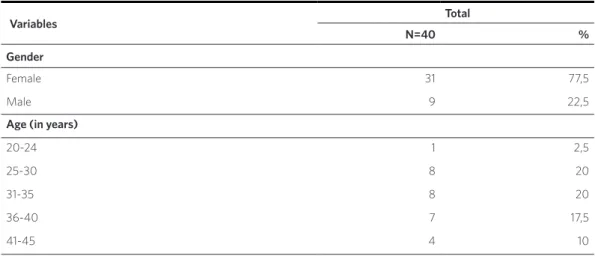
The data coming from this research will be presented through tables 1, 2, 3 and 4.
Table 1. Sociodemographic characteristics attributed to participants. São Paulo, 2014
Variables Total
N=40 %
Gender
Female 31 77,5
Male 9 22,5
Age (in years)
20-24 1 2,5
25-30 8 20
31-35 8 20
36-40 7 17,5
According to table 1, most of participants are female (77,5%). It was also observed that the number of single participants (40%) is very close to the amount of married partici-pants (37,5%). Regarding the time of profes-sion, 16 interviewees worked for 10 years or more in the profession, with the general average of the interviewed being equal to 8,45 years.
In the characterization about gender, female predominance in the health work-force is shared by other authors, reproducing
the historical characteristic that began with nursing, a profession practiced almost exclu-sively by women (MARTINS ET AL. 2006; WERMELINGER
ET AL., 2010).
Concerning marital status, 40% of the interviewees are single and 37,5% are married. Even though there is little dif-ference in the current literature, most in-terviewees with health professionals are married or have a stable union (TOMASI ET AL., 2008; LEAL; BANDEIRA; AZEVEDO, 2012; THEME FILHA; COSTA; GUILAM, 2013).
Table 1. (cont.)
46-50 2 5
51-55 7 17,5
56-60 1 2,5
61-65 2 5
Marital Status
Single 16 40,0
Married 15 37,5
Widower 0 0
Divorced 7 17,5
Time of profession/year
Up to 1 year 5 12,0
1-2 6 15,0
2-3 3 7,5
3-4 1 2,5
4-5 1 2,5
5-6 2 5,0
6-7 2 5,0
8-9 2 5,0
9-10 2 5,0
10-11 3 7,5
11-12 1 2,5
12-13 1 2,5
13-14 5 12,5
19-20 2 5,0
20-21 3 7,5
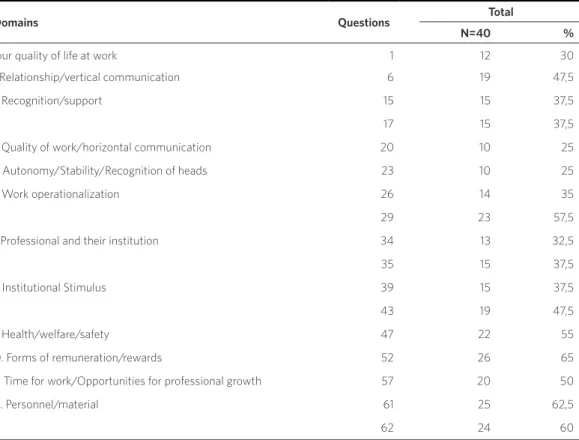
Table 2. Presentation of the questions evaluated with low degree of satisfaction. São Paulo, 2014
Domains Questions Total
N=40 %
Your quality of life at work 1 12 30
1. Relationship/vertical communication 6 19 47,5
2. Recognition/support 15 15 37,5
17 15 37,5
3. Quality of work/horizontal communication 20 10 25
4. Autonomy/Stability/Recognition of heads 23 10 25
5. Work operationalization 26 14 35
29 23 57,5
7. Professional and their institution 34 13 32,5
35 15 37,5
8. Institutional Stimulus 39 15 37,5
43 19 47,5
9. Health/welfare/safety 47 22 55
10. Forms of remuneration/rewards 52 26 65
11. Time for work/Opportunities for professional growth 57 20 50
13. Personnel/material 61 25 62,5
62 24 60
The level of satisfaction of the profession-als was classified in the good score, however, in some domains, some questions are evi-denced with low degree of satisfaction.
It is clarified that in this study only the domains in which the answers of the ques-tions were pointed out by most of the par-ticipants are demonstrated.
In table 2, it is observed that all domains, except domain 6, presented questions evalu-ated with a low degree of satisfaction. It is considered, here, that the low degree of satisfaction refers to the answers: very dis-satisfied, disdis-satisfied, neither satisfied nor dissatisfied.
Regarding domain 5, entitled Work Operationalization, question 29 was evalu-ated by 57,5% of the participants, as they presented low satisfaction due to the inter-ruptions that occur in the work. This result
corroborates a study about the quality of the work of nurses working in hospitals (UMANN; GUIDO; FREITAS, 2011). It corroborates, as well,
the research findings about the evaluation of the quality of mental health service from the professional perspective (LEAL; BANDEIRA; AZEVEDO, 2012).
The domain 9 refers to Health/Welfare/ Safety, in question 47, which addresses the occupational health service. 55% of respon-dents reported low satisfaction.
The theme ‘occupational health’ was addressed by Garcia (2012), and the results
showed an intense degree of dissatisfaction among the participants. The same author suggested that the organization studied needed to look for ways to improve this aspect internally.
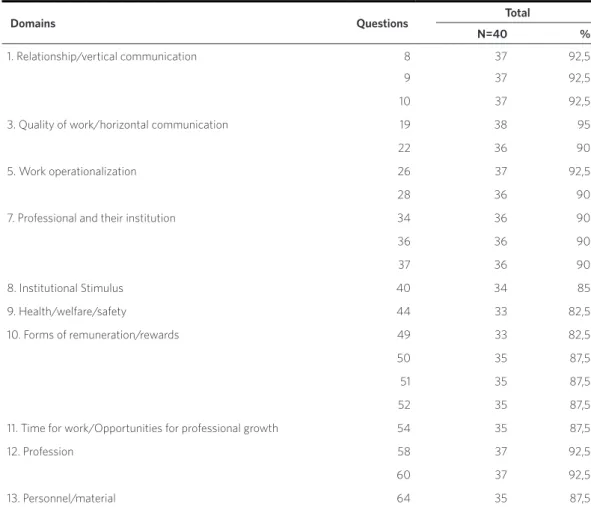
Table 3. Presentation of the questions that were evaluated with some degree of importance. São Paulo, 2014
Domains Questions Total
N=40 %
1. Relationship/vertical communication 8 37 92,5
9 37 92,5
10 37 92,5
3. Quality of work/horizontal communication 19 38 95
22 36 90
5. Work operationalization 26 37 92,5
28 36 90
7. Professional and their institution 34 36 90
36 36 90
37 36 90
8. Institutional Stimulus 40 34 85
9. Health/welfare/safety 44 33 82,5
10. Forms of remuneration/rewards 49 33 82,5
50 35 87,5
51 35 87,5
52 35 87,5
11. Time for work/Opportunities for professional growth 54 35 87,5
12. Profession 58 37 92,5
60 37 92,5
13. Personnel/material 64 35 87,5
with 65% of those interviewed declaring discontent. This theme was discussed by other authors who reported high dissatis-faction with low salaries and the precarious working conditions offered to health profes-sionals (VALLA, 1999; SCHMIDT; DANTAS, 2006; PINTO; MENEZES; VILLA, 2010).
Also, it is recalled that low salaries lead nursing professionals to have other employ-ment bonds, aiming at better socioeconomic conditions and dignity of life (SCHMIDT; DANTAS, 2006). However, it should be emphasized that
the double employment relationship can lead to both physical and emotional exhaustion.
Looking at domain 13, issues 61 and 62 stand out, related to the quantity and quality of materials available for work, about 62,5% and 60%, respectively. This has a direct impact on the adequate conditions for the full exercise of their activities, since it pre-vents the knowledge and experience of a professional being properly put into prac-tice, and may, also, have direct influences on stress and demotivation (UMANN; GUIDO; FREITAS, 2011; DAUBERMANN; TONETE, 2012). Therefore, the
In the questionnaire about the degree of importance among the questions per domain, all questions were evaluated as important by the participants. Next, the questions that stand out with a degree of importance equiv-alent to a ≤ 82,5% will be presented.
In domain 1, named Relationship/Vertical Communication, the selected questions with a high degree of importance deal with sub-jects related to communication with their leaders; the treatment that the managers give to the professional and the management by the example given by them. In other works, such themes are also present and converge to the need to improve communication between managers and subordinates, promoting a more participatory management (COSTA; OLIVEIRA, 2010, REBECHI; FIGARO, 2013, FERREIRA ET AL., 2013).
Already the domain 3 refers to Quality of Work/Horizontal Communication, and the questions highlighted were: The quality of the work that you develop; and your com-munication with your team, being that the question related to the quality of the work obtained the degree of greater importance.
Regarding domain 5, entitled Work Operationalization, the questions are rela-tive: to the volume of daily tasks; and to your daily task rhythm.
Domain 7 deals with Professionals and their institutions. The questions address how im-portant the themes are: the order of your work sector; the institution in which you work; and your identification with the institution.
In domain 8, denominated Institutional Stimulus, the question that stood out was: the care given by the institution to the health of the professional.
Already in domain 9, named Health/ Welfare/Security, the question that stood out was: the safety of the work sector.
In domain 10, entitled Forms of remu-neration/Rewards, the questions address: the recognition that the professional re-ceives from the institution; the possibilities that the institution offers to listen to people; the support that the professional has of
the institution in which he works; and the monthly net salary of the professional.
Domain 11 refers to Time for work/ Opportunities for professional growth. In it, the question is highlighted: weekly work-load of the professional.
In domain 12, titled Profession, the issues in evidence were those that asked about how important the profession of the participant is to him and how important he himself is a professional.
Domain 13 deals with Personnel/ Material, and the issue in question ad-dresses the quality of the personnel working with the professional.
Some of these themes have already been discussed in table 2, but, because they are important and problematic organizational aspects, more authors also pointed out in their studies the quality of the work of profes-sionals affected by real conditions of lack of human and material resources for the proper execution of the work, as well as the need for improvements in the work organization, in the infrastructure of the services (REBOUÇAS; LEGAY; ABELHA, 2007; LEAL; BANDEIRA; AZEVEDO, 2012).
In this approach, Daubermann and Tonete
(2012) also pointed out that satisfaction with
working conditions is associated with the supply of human, material and environmen-tal resources, as well as the organization of the work process, ways of caring, the result, the recognition of the work and remunera-tion as important factors for QLW.
Carandina (2003) emphasized in her work
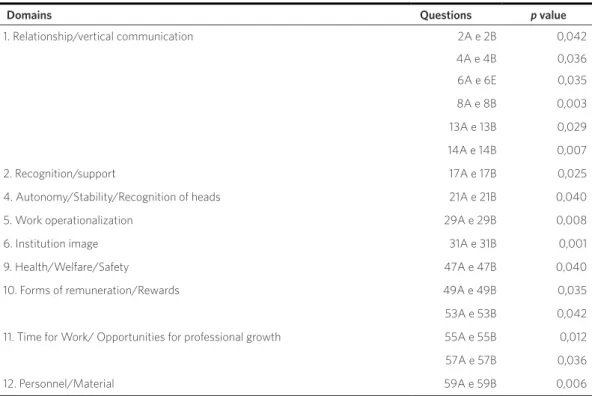
The table 4 shows only the questions that present a correlation between the degree of satisfaction of the professionals and the degree of importance.
The domain 1 presents the largest number of correlated questions. Question 2 deals with the possibility of the worker being heard at work; question 4 refers to the support that the professional receives from the managers; question 6 indicates the flow of information coming from the bottom up in the institution; question 8 addresses direct communication with managers; question 13 interrogates the freedom of expression of ideas at work; and question 14 interrogates the participation of the professional in decisions in their work. The other issues of greater significance are included in domains 5, 6 and 12.
Faced with these responses, it is noticed how professionals value communication in
the workplace. This theme is always much discussed, and, nevertheless, human beings continue to fail in verbal, nonverbal and written communication.
Conclusions
In the present study were addressed the level of satisfaction with the work and its importance for the multiprofessional team working in PHC, and the results in-dicated that the Relationship/Vertical Communication domain is the most highly valued. Therefore, the levels of satisfaction and importance resulting from this domain suggest changes in work organization, pro-moting a more participative management with the objective of providing all profes-sionals with the opportunity to interact more Table 4. Presentation of the correlation between the answers of the questions. São Paulo, 2014
Domains Questions p value
1. Relationship/vertical communication 2A e 2B 0,042
4A e 4B 0,036
6A e 6E 0,035
8A e 8B 0,003
13A e 13B 0,029
14A e 14B 0,007
2. Recognition/support 17A e 17B 0,025
4. Autonomy/Stability/Recognition of heads 21A e 21B 0,040
5. Work operationalization 29A e 29B 0,008
6. Institution image 31A e 31B 0,001
9. Health/Welfare/Safety 47A e 47B 0,040
10. Forms of remuneration/Rewards 49A e 49B 0,035
53A e 53B 0,042
11. Time for Work/ Opportunities for professional growth 55A e 55B 0,012
57A e 57B 0,036
in activities of creation and implementation of new projects.
It is believed that these modifications can be directed at reducing the impact of work on the health and quality of life of professionals. The well-being of any individual is tied to different biopsychosocial aspects that in-fluence the way he/she interacts with other people and in his/her work environment. In order to, in effect, health professionals to be able to meet the needs of the users, they must have adequate working conditions and an organizational culture free of retaliation.
It is concluded that there is a clear need for changes by the management of the or-ganization, especially regarding the expan-sion of human and material resources, since these are identified as expressive indicators that contribute to the lower satisfaction with work and the high impact on the health of the worker.
It is considered relevant the need to conduct more research and publication of results that demonstrate the satisfaction with the work of professionals who work in basic care and provide assistance to people, as there are few published articles that focus on this topic.
It is noteworthy that, during the re-search, there were limiting factors that made it difficult to construct the study. One of the important factors was the low adherence of the professionals to the re-search, since few submitted the question-naire on the first day of collection, which required a greater amount of displace-ments for visits to the health equipment, until a sample of 40 participants was reached. Some possible causes for this behavior of the health professionals were, also, identified: the instrument for collec-tion shows to be extensive, causing the im-pression of having to spare a lot of time to be completed; some professionals did not deliver the questionnaire alleging lack of time to finish it or forgetfulness at home; fear of exposing their opinion about the bosses and the workplace; and the delicate moment that the CSE is undergoing due to political reforms, which may be causing insecurity among professionals.
References
AITH, F. M. A. Marcos legais da promoção da saúde no Brasil. Rev. Med., São Paulo, v. 92, n. 2, p. 148-154, 2013.
ALVES, A. C. Reflexões sobre o processo de trabalho em saúde e suas implicações no cotidiano profis-sional do serviço social, na realidade do Hospital Universitário de Juiz de Fora. Libertas, Juiz de Fora, v.1, n. 2, p. 114-135, 2007.
CARANDINA, D. M. Qualidade de vida no trabalho: construção de um instrumento de medida para enfer-meiras. 2003. 263 f. Tese. (Doutorado em Enfermagem) – Escola de Enfermagem, Universidade de São Paulo, São Paulo, 2003.
COSTA, M. F.; OLIVEIRA, B. M. Comunicação interna e relações interpessoais no desenvolvimento organi-zacional: o caso de uma agência bancária. Rev. Ciênc. Admin., Fortaleza, v. 16, n. 2, p. 403-415, 2010.
DAUBERMANN, D. C.; TONETE, V. L. P. Qualidade de vida no trabalho do enfermeiro da Atenção Básica à Saúde. Acta Paul Enferm. São Paulo, v. 25, n. 2, p. 277-283, 2012.
DIAS, E. C. et al. Saúde ambiental e saúde do trabalha-dor na atenção primária à saúde, no SUS: oportunida-des e oportunida-desafios. Ciência & Saúde Coletiva, Rio de Janeiro, v. 14, n. 6, p. 2061-2070, 2009.
FERREIRA, M. C. et al. Estudo das relações comuni-cativas no processo de gestão de uma Instituição de Saúde. Rev. CEFAC. São Paulo, v. 15, n. 6, p. 1560-1569, 2013.
GARCIA, D. F. Qualidade de vida no trabalho: a satisfa-ção dos servidores do Hemocentro Regional de Pelotas, janeiro de 2012. 2012. 41 f. Trabalho de Conclusão de Curso (Especialização em Gestão em Saúde) – Universidade Federal do Rio Grande do Sul, Porto Alegre, 2012.
GUIMARÃES, L. A. M.; GRUBITS, S. Série Saúde Mental e trabalho. São Paulo: Casa do Psicólogo, 2004.
LEAL, R. M. A. C.; BANDEIRA, M. B.; AZEVEDO, K. R. N. Avaliação da qualidade de um serviço de saúde men-tal na perspectiva do trabalhador: satisfação, sobrecar-ga e condições de trabalho dos profissionais. Psicologia: teoria e prática, São Paulo, v. 14, n. 1, p. 15-25, 2012.
MASCARENHAS, C. H. M.; PRADO, F. O.;
FERNANDES, M. H. Fatores associados à qualidade de vida de Agentes Comunitários de Saúde. Ciência &
Saúde Coletiva, Rio de Janeiro, v. 18, n. 5, p.1375-1386, out. 2013.
MARTINEZ, M. C.; PARAGUAY, A. I. B. B.; LATORRE, M. R. D. O. Relação entre satisfação com aspectos psi-cossociais e saúde dos trabalhadores. Revista de Saúde Pública, São Paulo, v. 38, n. 1, p. 55-6, 2004.
MARTINS, C. et al. Perfil do enfermeiro e necessidades de desenvolvimento de competência profissional. Texto & Contexto Enfermagem. Florianópolis, v. 15, n. 3, p. 472-478, 2006.
MARQUEZE, E. C.; MORENO, C. R. C. Satisfação no trabalho – uma breve revisão. Rev. bras. saúde ocup. São Paulo, v. 30, n. 112, 2005.
PINTO, E. S. G.; MENEZES, R. M. P.; VILLA, T. C. S. Situação de trabalho dos profissionais da Estratégia Saúde da Família em Ceará-Mirim. Rev. Esc. Enferm
USP. São Paulo, v. 44, n. 3, p. 652-658.
PIRES, D. A estrutura objetiva do trabalho em saúde. In: LEOPARDI, M. T. et al. (Org.). O processo de
tra-balho em saúde: organização e subjetividade. Santa Catarina: Papa-livros, 1996. p. 25-48.
REBECHI, C. N.; FIGARO, R. A comunicação no mundo do trabalho e a comunicação da organização: duas dimensões distintas. Revista Interamericana de Comunicação Midiática. Santa Maria, v. 12, n. 23, p. 148-154, 2013.
serviço de saúde mental. Rev. Saúde Pública, São Paulo, v. 41, n. 2, p. 244-50, 2007.
SCHMIDT, D. R. C.; DANTAS, R. A. S. Qualidade de vida no trabalho de profissionais de enfermagem, atu-antes em unidades do bloco cirúrgico, sob a ótica da satisfação. Rev Latino-am Enfermagem, Brasília, DF, jan./fev. v. 14, n. 1, p. 54-60, 2006.
THEME FILHA, M. M.; COSTA, M. P. S.; GUILAM, M. C. R. Estresse ocupacional e autoavaliação de saúde entre profissionais de enfermagem. Rev.
Latino-Am. Enfermagem, Ribeirão Preto, mar./ abr. v. 21, n. 2, 2013. Disponível em: <http://www. scielo.br/scielo.php?script=sci_arttext&pid=S0104--11692013000200475&lng=en&nrm=iso&tlng=pt>. Acesso em: 10 jul. 2016.
TOMASI, E. et al. Perfil sócio-demográfico e epidemio-lógico dos trabalhadores da atenção básica à saúde nas regiões Sul e Nordeste do Brasil. Cad. Saúde Pública, Rio de Janeiro, v. 24, supl.1, p. 193-201, 2008.
UMANN, J.; GUIDO, L. A.; FREITAS, E. O. Produção de conhecimento sobre saúde e doença na equipe de enfermagem na assistência hospitalar. Ciência Cuidado
Saúde, Maringá, jan./mar. v. 10, n. 1, p. 162-168, 2011.
VALLA, V. V. Educação popular, saúde comunitária e apoio social numa conjuntura de globalização. Cad
Saúde Pública. Rio de Janeiro, jan./mar. v. 2, n. 1, p. 7-14, 1999, 2015.
WERMELINGER, M. et al. A Força de Trabalho do Setor de Saúde no Brasil: Focalizando a Feminização.
Divulgação em Saúde para Debate, Rio de Janeiro, n. 45, p. 54-70, maio 2010.