Journal of Public Health
Universidade de São Paulo
Faculdade de Saúde Pública
VOLUME 34
NÚMERO 4
AGO STO 2000
Revista de Saúde Pública
p. 396-401
CARRAZZA a Maria Zilda N, Francisco R Carrazzab and Seizi Ogac Clinical and laboratory parameters in dapsone
acute intoxication Rev. Saúde Pública, 34 (4): 396-401 , 2000 www.fsp.usp.br/rsp
Clinical and laboratory parameters in dapsone
acute intoxication
Parâmetros clínicos e laboratoriais na
intoxicação aguda pela dapsona
M aria Zilda N Carrazzaa, Francisco R Carrazzab and Seizi O gac
aPrograma de Controle de Intoxicações, Secretaria de Saúde do Município de São Paulo. São Paulo, SP,
3 9 6 3 9 63 9 6 3 9 6
3 9 6 Rev Saúde Pública 2000;34(4):396-401
www.fsp.usp.br/rsp
Abstract
Objective
To determine the severity of dapsone (DDS) acute intoxication – an uncommon medical event – using clinical and laboratory parameters.
Methods
Two hundred and seventy four patients with acute DDS intoxication, aged 1 month to 50 years old, were studied and classified into four age groups. Clinical evaluation was assessed through a protocol and correlated with laboratory parameters. Spectrophotometric methods were used to analyze methemoglobinemia (MHbp) and dapsonemia (DDSp).
Results
The most prevalent clinical sign of intoxication was cyanosis, seen in 65.7% of the patients and in 100% of children less than 5 years of age. According to laboratory criteria, MHbp-related severe clinical intoxication was seen in 56.2% and DDSp-related occurred in 58% of the patients. Regarding DDSp, intoxication was considered severe when 20 tablets (100 mg each) were ingested, a median of 29 µg/ml. Regarding MHbp, intoxication was severe when 7.5 tablets were ingested, a median of 38% of the total Hb. The correlation between MHbp and DDSp was statistically significant (n=144, r=0.32, p<0.05). Negative correlation was observed between MHbp and the time elapsed since DDS intake (n=124, r=-0.34, p<0.001). There was also a negative correlation between DDSp and the time elapsed since DDS intake (n=63, r=-0.35, p<0.0001).
Conclusions
Longitudinal analysis showed a significant association between methemoglobinemia and the time elapsed after the intake (t), according to the equation:
Dapsonemia = 12.9256 - 0.0682t + 0.234 methemoglobinemia
Resumo
Objetivo
Definir a gravidade da intoxicação aguda por dapsona (DDS) – uma ocorrência médica não usual – usando parâmetros clínicos e laboratoriais.
Métodos
Foram estudados 274 pacientes intoxicados por DDS, divididos em quatro grupos etários; as idades variaram de um mês a 50 anos. A avaliação clínica foi efetuada
Clinical and laboratory parameters in
dapsone acute intoxication
Parâmetros clínicos e laboratoriais na
intoxicação aguda pela dapsona
M aria Zilda N Carrazzaa, Francisco R Carrazzab and Seizi O gac
aPrograma de Controle de Intoxicações, Secretaria de Saúde do Município de São Paulo. São Paulo, SP, Brasil. bDepartamento de Pediatria da Faculdade de Medicina da Universidade de São Paulo. São Paulo, SP, Brasil. cDepartamento de Análises Clínicas e Toxicologia da Faculdade de Ciências Farma-cêuticas da Universidade de São Paulo. São Paulo, SP, Brasil
Keywords
Dapsone, poisoning#.
Methemoglobinemia, blood#.
Cyanosis#. Intoxication, acute.
Correspondence to:
Maria Zilda N. Carrazza Rua Desembargador Aragão, 48 04102-010 São Paulo, SP, Brasil E-mail: [email protected]
D escritores
Dapsona, envenenamento#. Metemoglobinemia, sangue#. Cianose#. Intoxicação aguda.
3 9 7 3 9 7 3 9 7 3 9 7 3 9 7 Rev Saúde Pública 2000;34(4):396-401
www.fsp.usp.br/rsp
Dapsone acute intoxication Carrazza MZN et al.
por meio de um questionário e correlacionada com parâmetros laboratoriais. A metemoglobinemia (MHbp) e a dapsonemia (DDSp) foram analisadas por métodos espectrofotométricos.
Resultados
O sinal clínico mais prevalente da intoxicação foi a cianose, presente em 65,7% dos pacientes e em 100% das crianças menores de 5 anos. A intoxicação grave, definida laboratorialmente, de acordo com a MHb ocorreu em 56,2% dos pacientes e, de acordo com a DDSp, em 58%. A intoxicação foi grave, de acordo com a DDSp, quando houve a ingestão mediana de 20 comprimidos (100mg cada) e, de acordo com a MHbp, quando a ingestão foi de 7,5 comprimidos. A mediana de MHbp foi de 38% da Hb total. A correlação entre MHbp e a DDSp foi significativa (n=144, r=0,32, p<0,05). Observou-se uma correlação negativa entre a MHbp e o tempo decorrido da intoxicação (n=124, r=-0,34, p<0,001). Correlação negativa, entre o DDSp e o tempo decorrido da intoxicação, também foi observada ( n=63, r=-0,35, p<0,0001).
Conclusões
A gravidade da intoxicação representada pelos valores da dapsonemia, determinada pela análise longitudinal, demonstrou uma associação significativa entre metemoglobinemia e o tempo decorrido da ingestão (t), de acordo com a equação: Dapsonemia = 12,9256-0,0682.t + 0,234.metemoglobinemia
IN TRO D U CTIO N
Dapsone – DDS – (4,4’-diaminodiphenyl sulphone) is a drug of the sulphone group with bac-teriostatic and low bactericide activities, used as an important component of the multidrug treatment of leprosy.16 This drug may produce adverse effects such as methemoglobinemia, hemolytic anemia, and less often agranulocytosis, peripheral neurophathy, psychoses, hepatotoxicity and renal toxicity.14 These adverse effects may be related to dose or individual susceptibility. Apart from adverse and toxic effects, DDS hypersensitivity is associated with multidrug therapy.11
Brazil is ranked second in the number of leprosy cases. DDS as a monotherapy or part of a multidrug therapy has been used to treat leprosy and other dis-eases, exposing a great number of individuals to acute intoxication.
The patients included in this study were those who were taking DDS as part of the leprosy treat-ment, and other people socially related to them, in-cluding children.
Based on clinical and laboratory data and the avail-able literature, degrees of intoxication severity were hypothesized, according to MHbp and DDSp8,9 mea-sures.8,9 MHbp values of less than 16% indicate mild intoxication, 16% to 30% moderate, and 30% or more severe. DDSp values up to 10 times the thera-peutic level (1 µg/ml) were considered mild, 10 to 21(10-21 µg/ml) were moderate and over 21 times, severe.
The objective of the study was to provide clinical and laboratory data to determine the severity of DDS acute intoxication.
M ETH O D S
A retrospective evaluation was made in the records of 274 patients intoxicated with DDS. The patients age ranged from 1 month old to 50 years old and, for physiological reasons, they were classified into 4 age groups: Group 1 (under age 5), group 2 (ages 5 to 12), Group 3 (ages 13 to 18), and Group 4 (ages 19 to 50).
Blood samples were analyzed at the S. Paulo Poison Control Center (PCC-SP) Laboratory between Janu-ary 1985 and December 1995. Samples came from dif-ferent hospitals of the greater S. Paulo area, since the PCC-SP Laboratory was the only one in the city well equipped to perform emergency toxicological analy-ses. A clinical history was obtained from each patient and a protocol was then filled out by a member of the laboratory staff and checked by one of the research-ers (MZNC). The samples were immediately processed according to the laboratory routine for toxicological analyses. During the patients’ treatment, other blood samples were drawn and more information collected. The number of samples received per patients varied from 1 to 10, and in some severe cases the follow-up was of more than 10 days.
3 9 8 3 9 83 9 8 3 9 8
3 9 8 Rev Saúde Pública 2000;34(4):396-401
www.fsp.usp.br/rsp
Dapsone acute intoxication Carrazza MZN et al.
To determine the dapsonemia, Tawada & Midio method (1989) was used.15 The analyses were per-formed in a Beckman DB-GT spectrophotometer.
Statistical analysis
The Center for Disease Control (Atlanta, Georgia,USA) Epi Info Version 6.04 was processed as a database for epidemiological statistical analysis in PCs. Nonparametric statistical analyses, including correlations, were carried out.
The method for analyzing each risk factor contri-bution (such as independent variables) on the in-toxication severity (seen as dependent variable) was
the “generalized linear models for dependent data,
via generalized estimating equations” (GEEVersion
4.4, 1996 from program S-PLUS, 1988, 1994, by Math Soft Inc.).1,6
The significance level was 5%.
RESU LTS
Table 1 shows the 266 patients with dapsone intoxi-cation (age or gender information was missing in eight patients) distributed by age and gender: 162 were fe-males (61%) and group 1(< 5 years old) was the larg-est one (55.2%). The most common clinical symptoms were cyanosis, vomiting, mental confusion, tachycar-dia and dyspnea. There was a relationship between the number of tablets ingested (confirmed by the pa-tient or person in charge) and the symptoms seen in 120 intoxicated patients. Cyanosis was present in more than 90% of all patients, and tachycardia in about 30%. Vomiting and dyspnea occurred in 15%. Mental con-fusion was seen in 13.7% and when 10 DDS tablets (100 mg) or more were ingested.
Circumstantial causes are those presumably respon-sible for the acute intoxication.
Table 2 shows the number of patients and percent-ages for each circumstantial causes, their respective MHbp and DDSp medians and ranges.
Table 3 exhibits the means, medians and ranges of MHbp in the 265 patients studied and distributed into four age groups. The MHbp values were similar in all age groups.
Causes Patients M H bp%* Patients D D Sp µg/mL
N(%) Median (range) N(%) Median (range)
Suicide attempts 70 (25.6) 36.5 (3.5-94.0) 32 (54.2) 22.4 (5.5-65.0) Accident 148 (54.2) 31.3 (3.2-78.0) 14 (23.7) 10.0 (0.8-39.2) Unknown causes 30 (11.0) 28.5 (4.1-43.1) 4 (6.8) 12.6 (6.9-39.2) Improper intake 14 (4.8) 21.0 (8.7-34.2) 6 (10.1) 9.2 (1.6-29.6) Other causes 12 (4.4) 30.3 (12.0-53.0) 3 (5.1) 10.2 (9.5-10.6)
Table 2 – Prevalence of circumstantial causes of intoxication, medians and ranges of methemoglobinemias and dapsonemias.
*Percentual of methemoglobin in relation to total Hb.
Table 4 shows the means, medians and ranges of DDS plasma concentration in the four groups. The DDSp was significantly lower in group 2 (p<0.05).
Using the methemoglobinemia as severity criteria, 9.5% of the patients developed mild, 33.9% moderate and 56.4% severe intoxication. According to dapsonemia levels, 35.6% patients showed mild, 25.4% moderate and 39% severe intoxication.
1 < 5 147 (55.2) 66 81 2 5 - 12 33 (12.4) 12 21 3 13 - 18 39 (14.7) 7 32 4 19 - 50 47 (17.7) 19 28
Table 1 – Groups of patients distributed by age and sex.
Groups Age (years) Patients Male Female N (%)
G 1 147 31.6 ± 0.88 5.1-58.0 31.2
G 2 33 31.6 ± 2.54 8.6-78.0 31.2
G 3 38 32.5 ± 2.92 3.5-94.0 33.8
G 4 47 34.5 ± 2.29 3.2-90.0 34.5
Table 3 – Methemoglobinemia in all groups of intoxicated patients.
SE = standard error
* percentual of methemoglobinemia in relation to total Hb Group N M ethemoglobinemia (%)*
Mean ± SE Range M edi an
1 15 15,7 ± 2,96 5.5-39.2 10.2
2 7 7.6 ± 2,35 0.8-18.1 5.5*
3 23 23.3 ± 3.67 2.5-65.0 18.0
4 13 24.5 ± 4,77 2.1-57.8 24.0
Table 4 – Dapsonemia in all groups of intoxicated patients.
* (p<0.05) in relation to the groups 3 and 4 ( Kruskal-Wallis) Group N Dapsonemia (µg /mL)
3 9 9 3 9 9 3 9 9 3 9 9 3 9 9 Rev Saúde Pública 2000;34(4):396-401
www.fsp.usp.br/rsp
Dapsone acute intoxication Carrazza MZN et al.
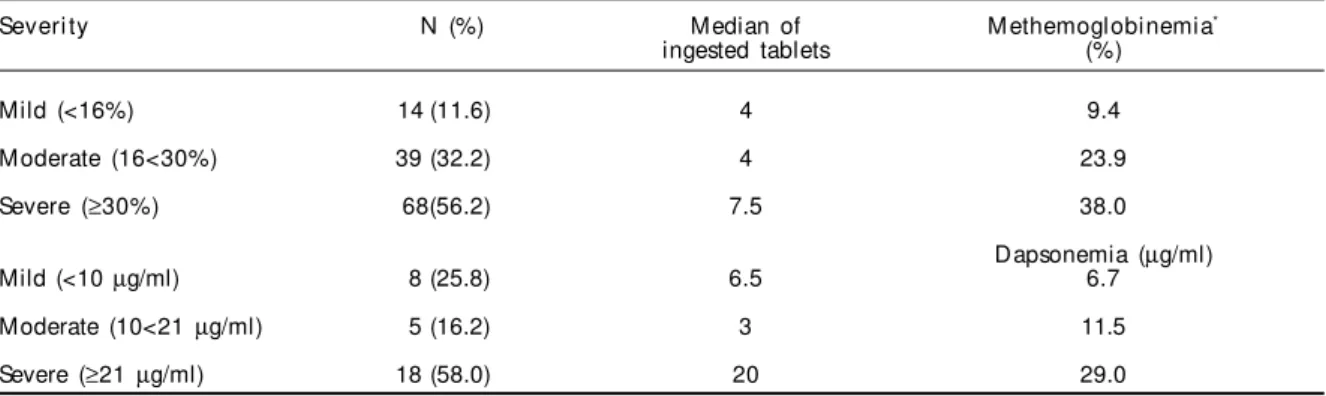
Table 5 shows that 88.4% of the patients who had taken between 4 and 7.5 tablets (100 mg each) had moderate to severe intoxication when evaluated with MHbp criteria. Moderate and severe intoxication oc-curred in 32.2% and 56.2% of the cases, respectively. The median MHbp was 38% of the total Hb. Accord-ing to DDSp levels determined in 31 patients who con-firmed taking the drug, 58% had severe intoxication. With a median dapsone intake of 20 tablets, DDSp median was 29 µg/ml.
MHbp and DDSp showed a significant correlation (n=144, r=0.32, p<0.05). Methemoglobinemia and time elapsed after the intake revealed a significant nega-tive correlation (n=124, r = -0.34, p<0,001).
DDSp and the number of hours elapsed after the intake showed a significant negative correlation (n=63, r = -0.35, p<0.0001).
The longitudinal analysis followed a GEE model. Dapsonemia values were considered the dependent variable. Independent variables were: the number of tablets ingested, methemoglobinemia levels, time elapsed after intake, MHbp levels, age and gender.
Initially, the model used was represented by the fol-lowing general expression:
Dapsonemia = number of tablets + time elapsed after intake + methemoglobinemia + age + gender.
Wald’s test was applied to evaluate the model vari-ables. The association between the 5 independent variables and the intoxication severity was only sta-tistically significant for the time elapsed and meth-emoglobinemia. Therefore:
Dapsonemia = time elapsed after intake + methemo-globinemia
In the above expression, there is a significant asso-ciation between the intoxication severity (represented by dapsonemia values), methemoglobinemia, and the time elapsed after intake (t). Replacing the calculated factors, dapsone plasma concentration can be esti-mated by the following equation:
Dapsonemia = 12.9256 – 0.0682t + 0.234 methemo-globinemia
D I SCU SSI O N
The Poison Control Center Laboratory analyzed clinical and laboratory data of patients with acute dapsone intoxication between January 1985 to De-cember 1995. The average number of patients was 32±4 per year for the first 6 years, and 19±1 (p<0.05) for the second period (1990 to 1995). The decrease in the number of DDS intoxication cases over the last five years could be attributed to a better control of the distribution of DDS tablets (given to the patients) and change in the tablets package. DDS intoxication in developed countries is almost exclusively related to suicide attempts and are always medical anec-dotes.10 Dapsone acute intoxication in developed countries usually occurs in patients using DDS for several conditions such as dermatitis herpetiformis, malaria prophylaxis, polychondritis, rheumathoid arthitis, Pneumocystis carinii pneumonia in AIDS patients and others, while in Brazil and India its main use is in the treatment of leprosy.
The symptoms in all 4 age groups were cyanosis, vom-iting, tachycardia and dyspnea. In Group 1, all patients (100%) had cyanosis, probably due to the immaturity of their defense mechanisms against the chemical aggres-sor. Two patients had convulsions. One of them, aged 17, had taken 100 mg of DDS daily, and his methemoglo-binemia was 18%. The other, a boy aged 9, had an initial methemoglobinemia level of 33%. Visual hallucinations
*percentual of methemoglobinemia in relation to total Hb
Mild (<16%) 14 (11.6) 4 9.4
M oderate (16<30%) 39 (32.2) 4 23.9
Severe (≥30%) 68(56.2) 7.5 38.0
Dapsonemia (µg/ml)
Mild (<10 µg/ml) 8 (25.8) 6.5 6.7
Moderate (10<21 µg/ml) 5 (16.2) 3 11.5
Severe (≥21 µg/ml) 18 (58.0) 20 29.0
Table 5 – Severity of intoxication, median of intake of D D S tablets (100 mg each) and respective methemoglobinemia and dapsonemia medians.
Severi ty N (%) Median of M ethemoglobinemia*
4 0 0 4 0 04 0 0 4 0 0
4 0 0 Rev Saúde Pública 2000;34(4):396-401
www.fsp.usp.br/rsp
Dapsone acute intoxication Carrazza MZN et al.
were present in 3 patients, two of who were children under age 5 and the third was a teenager.
When intake was between 1 and 5 DDS tablets, 100% of patients in Group 1 presented cyanosis and 29.3% tachycardia.
Schvartsman & Marcondes13 reported 12 intoxi-cated children who presented cyanosis, 75% nausea and vomiting, 33.3% dyspnea and 66.6%, neurologi-cal manifestations.Cyanosis was the major sign men-tioned in all studies on dapsone intoxication since the first case reported by Davies3 (1950)until those observed by Hansen3,4 (1994). Methemoglobin pro-duction in dapsone intoxicated patients is related to the formation of hidroxylamine metabolites. Colleman & Jacobus2 used a combination with an initial dap-sone hydroxylamine/hemoglobin ratio of 1:16 and there was seen more than 30% oxidation of the he-moglobin after five minutes of incubation at 37°C, showing that one hydroxylamine molecule can react with more than five molecules of hemoglobin.
Circumstantial causes of DDS intoxication showed that suicide attempts (94%) predominated in the groups of adolescents and adults (Groups 3 and 4) and 71% of them were females. Group 1 had the lowest intake with 68% of children having ingested 1 to 4 tablets, with a median of 4, whereas the adolescent group (Group 3) showed a median of 10 tablets, and the median for adults (Group 4) was 20 tablets.
DDS intoxication was severe in 58% of the cases, with an intake of 20 tablets when tested for DDSp and 7.5 tablets when MHbp was evaluated.
In this study, 154 patients had an initial MHbp of more than 30%, and 65 presented more than 40%. There is no indication in the medical literature of such high methemoglobinemia levels in cases of DDS intoxica-tion, as was seen in these patients.
Methemoglobinemia has been the most important pa-rameter monitored in acute DDS intoxication. For that reason, an oximeter to measure the MHbp should not be used after the beginning of the therapy with methylene blue (1mg/kg), since errors in the instruments readings may occur regarding the absorption of light at the same wavelength of methemoglobin and methylene blue.5,8,12
The means and medians of the dapsone plasma concentration were similar in all groups, except in
Group 2, where it was significantly lower. This group consisted of children aged 5 to 12 who ingested a smaller amount of tablets and whose main cause of intoxication was accidental. Higher methemoglobin-emia values and DDS plasma concentrations were seen in adults, where the predominant cause of in-toxication was suicide attempts.
Severity when evaluated with DDS plasma levels indicated that patients under age 13 presented mild to moderate intoxication, while adolescents and adults showed severe intoxication in 50% of the cases.
When intoxication severity was evaluated by mea-suring MHbp and its distribution in the 4 groups, moderate and severe intoxication occurred in Group 1 (57%). DDS median intake in this group was 4 tablets. In the groups of adolescents and adults, intoxication severity was generally higher (median = 10 and 20, respectively) due to the fact that dapsone intake was also higher.
Initial DDSp and MHbp levels showed a signifi-cant correlation. There was no correlation between the time elapsed after intake and the initial measure-ments of MHbp or DDSp. However, when time elapsed was correlated with all methemoglobin or DDS measurements, there was seen a significant negative correlation.
Longitudinal analysis (GEE) of intoxication severity revealed a significant correlation only between meth-emoglobinemia and time elapsed after the intoxication onset. This suggests that the dose is not the most important factor in determining the DDS intoxication severity. The mathematical model allows a good esti-mate of DDS plasma levels, since the methemoglobin-emia values and the time elapsed after dapsone intake are known.
ACKN O W LED GM EN TS
4 0 1 4 0 1 4 0 1 4 0 1 4 0 1 Rev Saúde Pública 2000;34(4):396-401
www.fsp.usp.br/rsp
Dapsone acute intoxication Carrazza MZN et al.
REFEREN CES
1. Carey V. Data objects for matrix computations: an overview. In: 21th Proc of Computer Sci and Stat/ 21th
Annual Symposium on the Interface; 1989. p.157-61.
2. Coleman MD, Jacobus DP. Reduction of dapsone hydroxilamine to dapsone during methaemoglobin formation in human erytrocytes in vitro. Biochem Pharmacol 1993;45:1027-33.
3. Davies R. Fatal poisoning with Udolac. Lancet 1950;1:905-6.
4. Hansen DG, Challoner KR, Smith DE. Dapsone intoxication: two case reports. J Emerg M ed 1994;12:347-51.
5. Kessler MR, EideT, Humayun B, Poppers PJ. Spurious pulse oximeter desaturation with methylene blue injection. Anesthesiology 1986;65:435-6.
6. Liang K, Zeger SL. Longitudinal data analysis using generalized linear models. Biometrika 1986;73:13-22.
7. M eunier J. Toxicologie d’urgence. Paris: L’expansion Scientifique Française; 1972. p.175-6.
8. Price D. Methemoglobinemia. In:. Goldfrank LR, Flomenbaum NA, Lewin NA, Weisman RS, Howland, MA Hoffman RS, editors. Goldfrank’s toxicologic emergencies Norwalk: Appleton & Lange; 1994. p.1169-78.
9. Queiroz RHC. Avaliação das alterações bioquímicas e hematológicas em pacientes hansenianos na terapia com dapsona [tese]. São Paulo: Faculdade de Ciências Farmacêuticas da USP; 1995.
10. Reigart JR, Trammel HL, Lyndsey JM. Repetitive doses of activated charcoal in dapsone poisoning in a child. J Toxicol Clin Toxicol 1982/83;19:1061-6.
11. Richardus JH, Smith, TC. Increased incidence in leprosy of hipersensitivity reactions to dapsone after introduction of multydrug therapy. Lepr Rev 1989;60:267-73.
12. Rieder HU, Frei J, Zbinden AM, Thomson DA. Pulse oximetry in methaemoglobinaemia. Anaesthesia 1989;44:326-7.
13. Schvartsman S, M arcondes E. Intoxicação acidental por sulfonas em pediatria. Rev H osp Clin Fac Med São Paulo 1963;18:345-50.
14. Smith RP. Toxic responses of the blood. In: Klaassen DC, Amdur OM, Doull J, editors. Casarett & Doull‘s toxicology: the basic science of poisons. New York: McGraw-Hill, 1996. p.335-50.
15. Tawada JC, Midio AF. Determinação de dapsona total em plasma e urina. Rev Farm Bioquim Univ São Paulo 1989;25:177-8.