Accuracy of probabilistic and deterministic
record linkage: the case of tuberculosis
Gisele Pinto de OliveiraI, Ana Luiza de Souza BierrenbachII, Kenneth Rochel de Camargo JúniorIII,
Cláudia Medina CoeliIV, Rejane Sobrino PinheiroIV
I Programa de Pós-Graduação em Saúde Coletiva. Instituto de Estudos em Saúde Coletiva. Universidade Federal do Rio de Janeiro. Rio de Janeiro, RJ, Brasil
II Instituto de Ensino e Pesquisa. Hospital Sírio-Libanês. São Paulo, SP, Brasil
III Instituto de Medicina Social. Universidade do Estado do Rio de Janeiro. Rio de Janeiro, RJ, Brasil IV Instituto de Estudos em Saúde Coletiva. Universidade Federal do Rio de Janeiro. Rio de Janeiro, RJ, Brasil
ABSTRACT
OBJECTIVE: To analyze the accuracy of deterministic and probabilistic record linkage to identify TB duplicate records, as well as the characteristics of discordant pairs.
METHODS: he study analyzed all TB records from 2009 to 2011 in the state of Rio de Janeiro. A deterministic record linkage algorithm was developed using a set of 70 rules, based on the combination of fragments of the key variables with or without modiication (Soundex or substring). Each rule was formed by three or more fragments. he probabilistic approach required a cutof point for the score, above which the links would be automatically classiied as belonging to the same individual. he cutof point was obtained by linkage of the Notiiable Diseases Information System – Tuberculosis database with itself, subsequent manual review and ROC curves and precision-recall. Sensitivity and speciicity for accurate analysis were calculated.
RESULTS: Accuracy ranged from 87.2% to 95.2% for sensitivity and 99.8% to 99.9% for speciicity for probabilistic and deterministic record linkage, respectively. he occurrence of missing values for the key variables and the low percentage of similarity measure for name and date of birth were mainly responsible for the failure to identify records of the same individual with the techniques used.
CONCLUSIONS: he two techniques showed a high level of correlation for pair classiication. Although deterministic linkage identiied more duplicate records than probabilistic linkage, the latter retrieved records not identiied by the former. User need and experience should be considered when choosing the best technique to be used.
DESCRIPTORS: Tuberculosis, epidemiology. Data Accuracy. Sensitivity and Specificity. Epidemiological Surveillance, statistics & numerical data.
Correspondence: Gisele Pinto de Oliveira Instituto de Estudos em Saúde Coletiva – IESC
Praça Jorge Moreira Machado, 1000 Cidade Universitária 21941-598 Rio de Janeiro, RJ, Brasil E-mail: [email protected]
Received: 15 Apr 2015 Approved: 1 Sept 2015
How to cite: Oliveira GP, Bierrenbach ALS, Camargo Jr KR, Coeli CM, Pinheiro RS. Accuracy of probabilistic and deterministic record linkage: the case of tuberculosis. Rev Saude Publica. 2016;50:49.
Copyright: This is an open-access article distributed under the terms of the Creative Commons Attribution License, which permits unrestricted use, distribution, and reproduction in any medium, provided that the original author and source are credited.
INTRODUCTION
Like other countries, Brazil has a large volume of health data collected via national information
systems and available in diferent databases. Linkage between databases aims to identify if two or more records relate to the same entity, generally the same individual. his technique is used to identify duplications in a same ile or between two or more iles whose information must be
gathered in a single database12. he absence of an univocal identiier ield in databases prevents
direct identiication of records of a same individual in diferent databases, requiring the application of more sophisticated chaining algorithms based on the combination of identiication variables. Probabilistic and deterministic record linkage are techniques used to this end6,10,18,19.
Probabilistic record linkage uses approximate comparison functions. Diferent weights are assigned to each ield based on their discrimination power and vulnerability to error. Deterministic record linkage uses exact comparison functions and classiication based on
rules developed from the knowledge of specialists6. Speciic computational routines must be developed for each problem. Low data quality, such the occurrence of missing data and
typos, can contribute to the mismatch of variables, hence the importance of evaluating the
accuracy of database linkage techniques.
he Ministry of Health is responsible for developing, managing and storing data from national
health information systems. Although the systems are not automatically interconnected,
it is possible to link these databases thanks to the existence of nominal identiication
variables with high discrimination power, especially when used in combination, which
are standardized in the systems. Tuberculosis (TB) cases are compulsorily recorded in a national information system for disease notiication (Notiiable Diseases Information System – Sinan-TB)a. he TB surveillance system provides diferent entries for each individual, since current regulation requires the notiication of cases of recurrence and return following abandonment. However, there are incorrect duplicate records related to the same case, which must be identiied and properly eliminated1-3,b.
Few studies compare the accuracy of linkage processes between secondary databases15.
Moreover, the scientiic literature seems to lack guidance on how to choose between existing techniques and comparison of their results.
he aim of this study was to analyze the accuracy of deterministic and probabilistic record
linkage to identify TB duplicate records, as well as the characteristics of discordant pairs.
METHODS
he study used information from the Sinan-TB database from 2009 to 2011 related to the state of Rio de Janeiro, available from the State Health Department. TB notiications terminated due to diagnosis change were excluded.
A data preprocessing phase was carried out to correct errors and standardize the content
of the key variables (name; mother’s name; date of birth; address; and district) used in each technique. Data transformations included: removal of punctuation marks, accents, repeated blanks and prepositions; conversion of letters to uppercase; removal of numbers from variables intended to be exclusively composed of letters and vice versa; removal of terms indicating lack of information (doesn’t know, unknown, among others); replacement of double letters by a single one; standardization of date formats; standardization of address terms (“S.” was replaced by “Street,” “Av.” by “Avenue,” etc.).
Subsequently, new variables were generated from standardized mother’s name and address formats, with the performance of the following processes: 1) Parsing (separation of fragments into irst name, second name, and so forth) and 2) Substringing ( fragment parts such as “Maria” → “Mari;” “Oliveira” → “Veira”). Each new variable was also transformed into another containing its Soundex code8. his feature aims to transform the text into a phonetic
code to homogenize small spelling diferences (resulting from errors of pronunciation or understanding by the recorder), use or not of double consonants, among others.
he probabilistic approach involves standardizing, blocking and forming links (record pairs to be compared), applying comparison algorithms and generating similarity scores, setting
thresholds to classify links into true pairs, non-pairs and doubtful pairs, manually reviewing doubtful pairs and removing duplications7,c.
he cutof score, above which the links were classiied as belonging to the same individual5,c,
was obtained by linkage of the Sinan-TB database with itself, for a shorter period: 2010-2011. A single, more sensitive blocking strategy was used, with the Soundex of the irst name and sex, to allow the largest possible number of record combinations. he links ile was manually
reviewed to classify them as pairs or non-pairs, i.e., as belonging or not to the same individual,
respectively. he distribution of links classiied as non-pairs ranged from -7.5 to 19.7, while that of pairs ranged from 6.9 to 34.9. he cutof point was set at 18.3 based on the exploratory analysis of score distribution and the inspection of the ROC curves and precision-recall. he study used the ROCR library of the R statistical package version 2.15.317.
To identify duplicate records, the same blocking strategy was used. he linkage variables were name, mother’s name and date of birth. he irst two were compared using Levenshtein distance, and the third by using an exact algorithm6. For each link, a score given by the compound weight
was calculated by the sum of the agreement or disagreement for each variable to be compared9,c.
he score of 18.3 was applied for automatic classiication and to form groups of records which were likely to belong to the same individual. he software used was OpenReclink, a widely employed program in health care with a speciic routine to identify duplicationsc. he result of this routine is an input ile plus a score and the group identiication code. herefore, it is no known which links were formed. For example, for a group composed of records A, B, C and D,
it is not known if all records were linked with each other in the linkage process or if A linked
with B and C, and B linked with D. A strategy was devised to rebuild those links: when there was no score equality of all records of the same group, the choice was to consider the record in the group with the highest score to form the link with the diferent score record.
A deterministic record linkage algorithm was developed in Stata 12.0, based on 70 rules,
to identify the record groups of a same individual and classify them as a pair or non-pair.
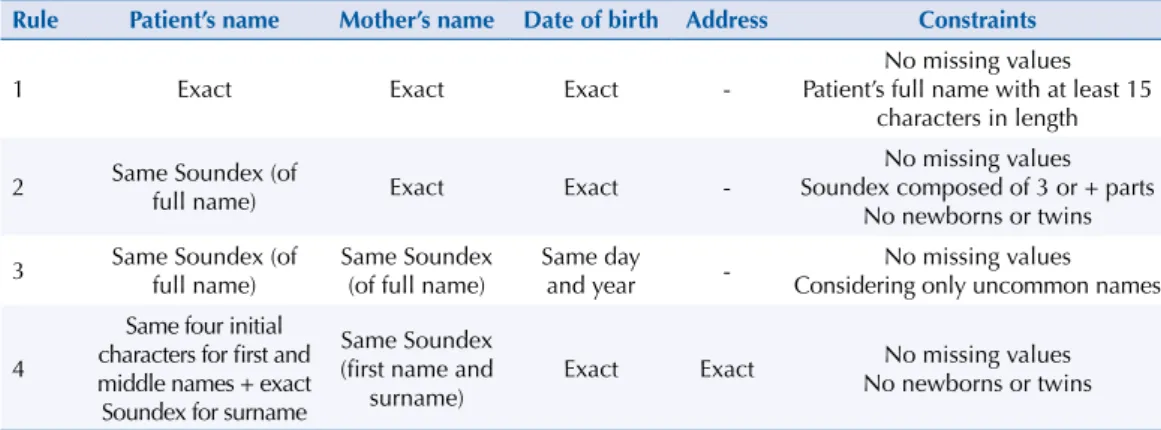
hese rules were based on the key variables, as well as those created in the preprocessing phase. Some rules also used Soundex codes in a concatenated format (e.g., “Maria Antonia Santos” was represented by M600A535S532). In each rule, the content of three or more variables was compared exactly, regardless of the presence of data constraints (Table 1). he variable name was used in almost all rules, given its high discrimination power. Date of birth
was used in some rules with information on day, month and year, while in others one or more of
its components were used in combination. he variables city of residence or of notiication, sex, date of notiication, date of conclusion, notiication number, notiication unit code, as well as
c Camargo Jr KR, Coeli CM.
OpenReclink: guia do usuário [cited 2015 Jun 5]. Available from: http://reclink.sourceforge.net/
Table 1. Examples of rules used in the sequential algorithm.
Rule Patient’s name Mother’s name Date of birth Address Constraints
1 Exact Exact Exact
-No missing values Patient’s full name with at least 15
characters in length
2 Same Soundex (of
full name) Exact Exact
-No missing values Soundexcomposed of 3 or + parts
No newborns or twins
3 Same Soundex (of full name)
Same Soundex (of full name)
Same day
and year
-No missing values Considering only uncommon names
4
Same four initial characters for first and middle names + exact Soundex for surname
Same Soundex (first name and
surname)
Exact Exact No missing values
others related to place of residence (district, phone number, zip code and house number) were used in the original form. District was the only one of these variables to undergo preprocessing.
The rules were laid out sequentially, from those using fewer variables, with greater
discrimination power, to those using several variables in combination, but which individually
had less discrimination power. Discrimination power is understood as a variable’s capacity
to independently discriminate an individual.
he inclusion of rules aimed to increase the algorithm’s sensitivity without losing speciicity. With each new rule, new groups were found or new records added to existing groups, even though they did not pair with all the records already identiied in the group. Rules that generated incorrect groups were modiied or ultimately discarded following an extensive manual review. Several data constraints were imposed in many rules. he universal constraint for all rules
was that the groups could only be formed with records whose variables had no missing
values. In addition, for certain rules which used a combination of variables with lower
discrimination power, the content of some of those variables needed to have a minimum
length of characters. Similarly, in some rules, the Soundex code had to have a minimum number of blocks (Maria Antonia Santos → M600-A535-S532 → 3 blocks).
Name infrequency was also considered in some rules. To this end, three separate databases were created indicating the frequency of the irst, middle and last name in the Brazilian Mortality Information System (SIM) database for 2008-2010. Names appearing in the TB database but absent in SIM were considered rare. Records containing the same rare irst,
middle or last names were combined into groups, even when some of the other variables
used in the rule had incomplete information. However, records with common rare names but with birth dates more than 20 years apart were not considered as belonging to the same group, since they could refer to father and son, for example. his possibility had to be
considered, especially in the case of an infectious disease whose main transmission occurs
within the household. he deinition of rarity ranged from 500 to 1.000 for name frequency,
according to the discrimination power of the other variables of the rule.
A manual review was carried out of the links classiied as pairs by both techniques and of those with discordant classiication. he classiication of the manual review was considered the gold standard for calculations of sensitivity and speciicity.
he following indicators were analyzed to proile records with discordant classiication between the techniques:
1. Percentage of missing values for the variables name, mother’s name, sex, date of birth and address;
2. Score median of duplicate records identiied by probabilistic linkage and not identiied by deterministic linkage;
3. Percentage of same group records identiied by probabilistic linkage with diferences in the variable sex;
4. Similarity measure median for the variables name, mother’s name and date of birth of discordant records (calculated only for records with no missing values).
Levenshtein distance (LD) should be analyzed considering the size of the character string,
as long strings are more likely to generate higher values19. A similarity measure (SM) was obtained
by subtracting LD from the length of the longest full string and also dividing by this value. he result was multiplied by 100 to obtain the percentage and facilitate the analysis of results.
assuming that the record associated with the highest score would tend to be spelled more
correctly. Records presenting diference in sex were excluded from the SM analysis, since they were not submitted to probabilistic linkage because they belonged to diferent logical blocks. Stata 12.0 software was used to analyze the records.
he project was approved by the Research Ethics Committee of the Institute of Studies in Collective Health of the Federal University of Rio de Janeiro (Process 114,604 of October 3, 2012).
RESULTS
he Sinan-TB database contained 43,825 records. Table 2 shows the percentage of single records or of those forming groups of two to 10 records identiied by deterministic and probabilistic linkage. In deterministic linkage, 78.7% were single records, and in probabilistic linkage the igure was 80.5%.
In deterministic linkage, 21.3% of the records were classiied as pairs, and in probabilistic linkage, 19.5%. Discordant classiication appeared in 1,812 records. In total, 527 records were classiied as pairs by probabilistic linkage and not by deterministic linkage, and 1,285 records formed pairs by deterministic linkage and not by probabilistic linkage. he subsequent manual review, performed to determine the gold standard, showed no classiication change for the group of records classiied as pairs by both techniques (Table 3).
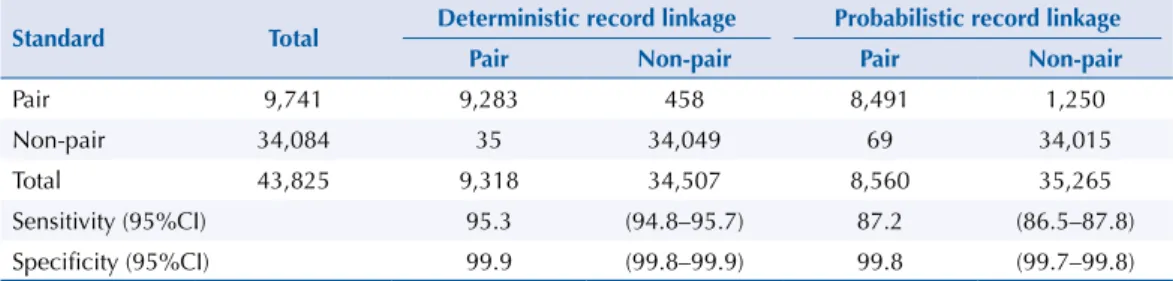
In the accuracy analysis, sensitivity and speciicity values for deterministic linkage were 95.3% and 99.9%, respectively. For probabilistic linkage the igures were 87.2% and 99.8%, respectively (Table 4).
Of the records classiied as pairs by deterministic linkage and non-pairs by probabilistic linkage, none had missing values for the variables name and sex, 5.3% had missing values for mother’s name, 6.3% for date of birth and 0.5% for address. Ten percent of the records presented missing values for at least one of these variables. he score median of records classiied as pairs by probabilistic linkage and as non-pairs by deterministic linkage was 24.2, ranging from 20.3 to 32.3. No records were found with missing information for the variables name and sex. For
Table 2. Number and percentage of single records or by groups by deterministic and probabilistic record linkage. Sinan-TB, 2009-2011.
Records by group (n)
Deterministic record linkage Probabilistic record linkage Cases (n) % Cases (n) %
1 34,506 78.7 35,266 80.5
2 6,944 15.8 6,546 14.9
3 1,502 3.4 1,280 2.9
4 548 1.3 468 1.1
5 215 0.5 160 0.4
6 66 0.2 60 0.1
7 35 0.1 35 0.1
9 9 0 -
-10 - - 10 0
Total 43,825 100 43,825 100
Table 3. Correlation analysis of record linkage techniques.
Probabilistic record linkage
Deterministic record linkage Non-pair Pair
Total
n % n %
Non-pair 33,980 96.4 1,285 3.6 35,265
Pair 527 6.2 8,033 93.8 8,560
mother’s name, 14.4% of records had missing values; for date of birth, 11.0%; and for address, 3.8%. More than a quarter of the records had missing values for at least one of the analyzed variables.
Of the 733 links classiied as pairs by deterministic linkage and non-pairs by probabilistic linkage, 15.7% showed diferences for the variable sex. Approximately 26.0% had SM lower than 70.0% for the variable name, 26.6% for mother’s name, and 8.3% for date of birth. For links classiied as pairs only by probabilistic linkage, 16.6% had SM lower than 70.0% for the variable mother’s name and 10.6% for date of birth. As to the SM median, the biggest diference between the groups was for the variable name (81.6 for pair links by deterministic linkage and 100 for pair links by probabilistic linkage) (Table 5).
Table 5. Characteristic of records with discordant classification by deterministic and probabilistic record linkage.
a Calculating Levenshtein distance and assessing the difference in sex between records required comparing the
records of the record group of the same patient. Comparing discordant records: (i) when the two discordant records were identified by only one of the techniques, the calculation was done between them; (ii) when they were records identified by both techniques and only one of them was not identified by one of the techniques, the calculation was done by comparing the unidentified record with the record of highest score in the group. b For this calculation, the group of records that were blocked by sex or had missing information for one of the
variables were excluded.
Record characteristics
Pair by deterministic and non-pair by probabilistic linkage
Pair by probabilistic and non-pair by deterministic linkage
(N = 1,285) (N = 527) Median CI95%
Score - - 24.2 20.3–32.3
n % n %
Missing sex value 0 0 0 0
Missing name value 0 0 0 0
Missing mother’s name value 68 5.3 76 14.4
Missing date of birth value 81 6.3 58 11.0
Missing address value 7 0.5 20 3.8
Combined: unknown mother’s name; or unknown date
of birth; or unknown address 129 10.0 141 26.7
Link characteristics
Pair by deterministic and non-pair by probabilistic
linkagea,b
Pair by probabilistic and non-pair by deterministic
linkagea,b
(N = 733) (N = 293)
n % n %
Difference in sex 115 15.7 0 0
Similarity measure for name lower than 70,0% 160 25.9 0 0
Similarity measure for mother’s name lower than 70,0% 147 26.6 36 16.6
Similarity measure for date of birth lower than 70,0% 45 8.3 25 10.6
Median IC95% Median IC95%
Similarity measure for name x 100 81.6 69.4–94.4 100 95.0–100
Similarity measure for mother’s name x 100 91.3 68.2–100 94.4 85.7–100
Similarity measure for date of birth 100 10.0–100 87.5 75.0–100
Table 4. Sensitivity and specificity analysis of record linkage techniques.
Standard Total Deterministic record linkage Probabilistic record linkage Pair Non-pair Pair Non-pair
Pair 9,741 9,283 458 8,491 1,250
Non-pair 34,084 35 34,049 69 34,015
Total 43,825 9,318 34,507 8,560 35,265
Sensitivity (95%CI) 95.3 (94.8–95.7) 87.2 (86.5–87.8)
DISCUSSION
he two techniques showed a high correlation in classifying records as pairs. However, deterministic linkage retrieved 8.8% more records than probabilistic linkage, despite the latter having identiied records that were not identiied by the former. Although the speciicity of both techniques was similar, sensitivity was higher in deterministic linkage, corroborating the indings of other studies using the Sinan database8,15. he sensitivity and speciicity values for
probabilistic linkage in this study are consistent with those presented in other studies9,12,13,16.
he occurrence of variables with missing values and SM lower than or equal to 70.0% for key variables was the main reason for not identifying pairs in both techniques. Additionally, blocking by sex in probabilistic linkage was also responsible for the failure to form certain groups. Removing the variable sex from the initial blocking to set the cutof point might
minimize this problem, but greatly increase the volume of links to be manually reviewed,
because the blocking key would become even more sensitive. On the other hand, the manual review would be performed only once and the established cutof point would be applied
to works with the same database. Although there are no missing values for the variable
name, the lack of information for the variables mother’s name and date of birth in Sinan-TB is still signiicant2. Improving the quality of TB data is a constant challenge in Brasil1,13,17.
his problem is relected in the epidemiological and performance indicators, masking the
real situation of TB in the country, which skews the analyses needed for decision-making and developing new control strategies1,2,11,14.
Variables related to address were used as auxiliary criteria in classifying records by
deterministic linkage. Even though this variable should be used with caution, since patients
might change their address between notiications, it assists in the decision. In probabilistic linkage between diferent databases, these variables can be used in the manual review to support classiication. In this study, we chose not to perform the manual review after implementing the routine to identify duplications. In deterministic linkage, a diferent treatment was considered for common names in the algorithm. he inluence of these strategies in retrieving pairs was not investigated, but they are believed to have inluenced classiication. he strategy of matching by frequency (information on name infrequency)
could be incorporated into the probabilistic linkage software, minimizing the occurrence of false positives in high scores due to the presence of homonyms.
he high-score median for records classiied as pairs by probabilistic linkage and non-pairs by deterministic linkage indicates that mutually similar key variables were not identiied. his attests the need to improve the deterministic routine.
he deterministic algorithm used commercial statistical software whose interface is in English and requires prior knowledge of users of the programming language used by the software. In addition, the adaptation of the algorithm to databases other than Sinan-TB is conditional on knowledge of these databases and programming experience. Transcribing
it using free software might facilitate its wider use. Probabilistic linkage used free national
software which also requires prior knowledge. However, as the OpenReclink routine to identify duplications allows automatic classiication of groups, it is easier to use4,c.
he study did not measure time and diiculties in using each technique. However, both the elaboration of the deterministic algorithm and the manual revision to set the cutof point for probabilistic linkage demanded a considerable amount of time and experience from the researchers.
Sinan has speciic intrinsic routines to identify and treat duplicate records15. However, its
algorithm uses the variable name with no previous correction, which reduces its eiciency.
Additional limitations include the large number of records, absence of feedback from national
level to other levels, and the need for local computer networks with good quality and speed. Due to the high number of annual notiications, treatment of duplications at national level must be done “outside” Sinan, requiring the application of linkage techniques at each data
he deinition of which technique to use to identify duplicate records in Sinan-TB depends
on the purpose and need of users. As the search for methodological perfection is a premise in research, deterministic linkage may be used initially to retrieve most of the links, followed
by probabilistic linkage to retrieve the links that were not found by the former. In routine
TB control programs at the three levels of government, removal of duplication is performed
several times a year, which is extremely time-consuming for the professionals involved. he use of deterministic linkage is recommended provided the prerequisites for its use are met. Otherwise, probabilistic linkage is indicated, which, if necessary, can be rendered
more sensitive with the performance of a manual review of the groups with scores below
the set cutof point, to retrieve new links previously unidentiied. As for the construction of new deterministic routines and improvement of existing ones, probabilistic linkage, being
generic, should be used as an initial strategy to accumulate knowledge to be incorporated
in the development of deterministic linkage. Such accumulation of knowledge is important, since deterministic linkage is less speciic and might generate far less accurate results
than those obtained by probabilistic linkage. For Grannis et al., although the sensitivity of
deterministic linkage may reach 100%, it can be considerably reduced for data with diferent characteristics of identiication (ethnic names, for example), and therefore probabilistic linkage is considered to be more eicient9. Probabilistic linkage, on the other hand, can
increase its accuracy even further by incorporating new variables or strategies to improve
comparison and classiication of links.
Sinan undergoes routine updates to meet the needs of users and of the national surveillance
systema. his study contributes to the discussion and incorporation of new decision strategies for duplication removal. It also supports researchers and professionals of the Brazilian Uniied Health System in choosing the best linkage technique to use. Given the signiicant
contributions and good results generated by the use of database linkage in the health sector, it is important that further studies on record linkage accuracy be carried out in Brazil.
REFERENCES
1. Bartholomay P, Oliveira GP, Pinheiro RS, Vasconcelos AMN. Melhoria da qualidade das
informações sobre tuberculose a partir do relacionamento entre bases de dados. Cad Saude
Publica. 2014;30(11):2459-70. DOI:10.1590/0102-311X00116313
2. Bierrenbach AL, Stevens AP, Gomes ABF, Noronha EF, Glatt R, Carvalho CN, et al. Efeito da
remoção de notificações repetidas sobre a incidência da tuberculose no Brasil. Rev Saude
Publica. 2007;41 Supl 1:67-76. DOI:10.1590/S0034-89102007000800010
3. Bierrenbach AL, Oliveira GP, Codenotti S, Gomes AB, Stevens AP. Duplicates and
misclassification of tuberculosis notification records in Brazil, 2001–2007. Int J Tuberc Lung Dis.
2010;14(5):593-99.
4. Camargo Jr KR, Coeli CM. Going open source: some lessons learned from the development of
OpenRecLink. Cad Saude Publica. 2015;31(2):257-63. DOI:10.1590/0102-311X00041214
5. Capuani L, Bierrenbach AL, Abreu F, Takecian PL, Ferreira JE, Sabino EC. Accuracy of a probabilistic record-linkage methodology used to track blood donors in the
Mortality Information System database. Cad Saude Publica. 2014;30(8):1623-32.
DOI:10.1590/0102-311X00024914
6. Christen P. Data matching: concepts and techniques for record linkage, entity resolution, and duplicate detection. New York: Springer; 2012. (Data-centric systems and applications).
7. Coeli CM, Camargo Jr KR. Avaliação de diferentes estratégias de blocagem no
relacionamento probabilístico de registros. Rev Bras Epidemiol. 2002;5(2):185-96.
DOI:10.1590/S1415-790X2002000200006
8. Fonseca MGP, Coeli CM, Lucena FFA, Veloso VG, Carvalho MS. Accuracy of a probabilistic record linkage strategy applied to identify deaths among cases reported
to the Brazilian AIDS surveillance database. Cad Saude Publica. 2010;26(7):1431-8.
DOI:10.1590/S0102-311X2010000700022
9. Grannis SJ, Overhage JM, Hui S, McDonald CJ. Analysis of a probabilistic record linkage
10. Herzog TN, Scheuren FJ, Winkler WE. Data quality and record linkage techniques. New York: Springer Science and Business Media; 2007.
11. Malhão TA , Oliveira GP, Codenotti SB, Moherdaui F. Avaliação da completitude do Sistema de
Informação de Agravos de Notificação da Tuberculose, Brasil, 2001-2006. Epidemiol Serv Saude.
2014;19(3):245-56. DOI:10.5123/S1679-49742010000300007
12. Migowski A, Chaves RBM, Coeli CM, Ribeiro ALP, Tura BR, Kuschnir MCC, et al. Acurácia do
relacionamento probabilístico na avaliação da alta complexidade em cardiologia. Rev Saude
Publica. 2011;45(2):269-75. DOI:10.1590/S0034-89102011005000012
13. Mohamed GQ, Zhang H. Accuracy of public health data linkages. Matern Child Health J.
2009;13(4):531-8. DOI:10.1007/s10995-008-0377-6
14. Moreira CMM, Maciel ELN. Completude dos dados do Programa de Controle da Tuberculose no Sistema de Informação de Agravos de Notificação no Estado do Espírito
Santo, Brasil: uma análise do período de 2001 a 2005. J Bras Pneumol. 2008;34(4):225-9.
DOI:10.1590/S1806-37132008000400007
15. Pacheco AG, Saraceni V, Tuboi SH, Moulton LH, Chaisson RE, Cavalcante SC, et al. Validation
of a hierarchical deterministic record-linkage algorithm using data from 2 different cohorts
of human immunodeficiency virus-infected persons and mortality databases in Brazil. Am J
Epidemiol. 2008;168(11):1326-32. DOI:10.1093/aje/kwn249
16. Silveira DP, Artmann E. Acurácia em métodos de relacionamento probabilístico de
bases de dados em saúde: revisão sistemática. Rev Saude Publica. 2009;43(5):875-82.
DOI:10.1590/S0034-89102009005000060
17. Sing T, Sander O, Beerenwinkel N, Lengauer T. ROCR: visualizing classifier performance in R.
Bioinformatics. 2005;21(20):3940-1. DOI:10.1093/bioinformatics/bti623
18. Van Hest NA, Story A, Grant AD, Antoine D, Croft JP, Watson JM, et al. Record-linkage and capture-recapture analysis to estimate the incidence and completeness of reporting
of tuberculosis in England 1999-2002. Epidemiol Infect. 2008;136(12):1606-16.
DOI:10.1017/S0950268808000496
19. World Health Organization. Assessing tuberculosis under-reporting through inventory studies. Geneva: WHO; 2012.
Funding: Health Surveillance Secretariat/Ministry of Health (TC 234/12); Conselho Nacional de Desenvolvimento Cientíico e Tecnológico (CNPq – Processes 481654/2012-7, 309728/2012-6 and 305545/2015-9); Fundação de Amparo à Pesquisa do Estado do Rio de Janeiro (FAPERJ – Process E-26/203.195/2015).
Authors’ Contribution: All authors participated in all phases of the study design and approval.