1
Article based on the master’s thesis of the DS CAVALCANTI intiled “Consumo de ferro dietético e sua associação com a anemia ferropriva nas famílias de trabalhadores rurais do Nordeste do Brasil”. Universidade Federal de Pernambuco; 2013.
2
Universidade Federal de Pernambuco, Centro de Ciências da Saúde, Programa de Pós-Graduação em Nutrição. Av. Prof. Moraes Rego, 1235, Cidade Universitária, 50670-901, Recife, PE, Brasil. Correspondência para/Correspondence to: DS CAVALCANTI. E-mail: <[email protected]>.
3
Universidade Federal de Pernambuco, Centro de Ciências da Saúde, Curso de Nutrição. Recife, PE, Brasil.
Iron intake and its association with
iron-deficiency anemia in agricultural
workers’ families from the
Zona da
Mata
of
Pernambuco
, Brazil
1Consumo de ferro e sua associação com a
anemia ferropriva nas famílias de
trabalhadores rurais da Zona da
Mata de Pernambuco, Brasil
Débora Silva CAVALCANTI2
Priscila Nunes de VASCONCELOS2
Vanessa Messias MUNIZ2
Natália Fernandes dos SANTOS3
Mônica Maria OSÓRIO2
A B S T R A C T
Objective
To verify the association between dietary iron intake and the occurrence of iron-deficiency anemia in agricultural workers’ families from the municipality of Gameleira in the state of Pernambuco, Brazil.
Methods
Results
The prevalence of anemia was high in all ages groups and highest (67.6%) in children aged <5 years with a mean hemoglobin of 10.37 g/dL (±1.30 g/dL). Children aged <5 years had low percentage of iron intake adequacy (53.1%). Most of them consumed diets with low iron bioavailability (47.5%). Associations between the occurrence of anemia and dietary variables were significant for total iron (heme and nonheme), its bioavailabilities, and general meat intake.
Conclusion
Inadequate dietary iron intake and inadequate intake of factors that facilitate iron absorption can be considered decisive for the occurrence of iron-deficiency anemia. Food insecurity occurs between family members, with some members being favored over others with regard to the intake of good dietary iron sources.
Indexing terms: Iron deficiency anemia. Family. Food consumption. Iron deficiency. Iron dietary.
R E S U M O
Objetivo
Verificar a associação entre o consumo de ferro dietético e a ocorrência da anemia ferropriva em famílias de trabalhadores rurais do município de Gameleira, Pernambuco.
Métodos
A população foi composta por 46 famílias de trabalhadores de cana-de-açúcar, totalizando 225 indivíduos. Para cada indivíduo, foram realizados três inquéritos alimentares pelo método de registro alimentar por pesagem direta dos alimentos e dosagem de hemoglobina por meio do equipamento Hemocue. Utilizou-se o método da adequação aparente para avaliar a ingestão de ferro, e o teste t pareado na comparação entre grupos de indivíduos. Para estimar associações entre variáveis dietéticas e anemia, foi utilizado o teste de Mann-Whitney.
Resultados
A prevalência de anemia foi elevada em todas as faixas etárias, sendo maior (67,6%) no grupo de crianças com menos de 5 anos de idade, com média de hemoglobina de 10,37 g/dL (±1,30 g/dL). Na análise da adequação aparente, as crianças menores de 5 anos apresentaram baixo percentual de adequação (53,1%). A maioria delas apresentou um percentual elevado de dieta com baixa biodisponibilidade de ferro (47,5%). As associações entre a ocorrência de anemia e as variáveis dietéticas mostraram-se estatisticamente significantes para ferro total (heme e não heme), suas biodisponibilidades e consumo de carnes em geral.
Conclusão
A inadequação do consumo de ferro dietético e dos fatores facilitadores da sua absorção pode ser considerada determinante para a ocorrência da anemia ferropriva. As famílias vivenciam insegurança alimentar intrafamiliar, com discriminação do consumo de alimentos fontes de ferro entre seus membros.
Termos de indexação: Anemia ferropriva. Família. Consumo de alimentos. Deficiência de ferro. Ferro na
dieta.
I N T R O D U C T I O N
Iron-deficiency anemia is one of the most prevalent nutritional deficiencies that translates as an important indicator of malnutrition and poor health, affecting one out of every four individuals, that is, 24.8% of the world population. Although the most affected groups are children, women of childbearing age, and low-income families, all individuals regardless of social stratum are susceptible to this deficiency1,2.
Food and nutrition security regards ensuring and facilitating food access to the population and making sure that individuals have healthy food habits3 in order to promote health and general wellbeing. Thus, planned strategies are needed in the regions with the greatest social and economic inequalities because their inhabitants are even more prone to nutrition disorders.
workers’ families from the municipality of
Gameleira in Pernambuco, one of the municipalities with the lowest Human Development Index (HDI) in the Brazilian Northeast. These families live in marginalized areas and are usually paid low production-based salaries for harvesting sugarcane4. Hence, the general situation of this population gets worse off season, when they face financial instability and higher food and nutrition insecurity.
A successful fight against nutritional deficiencies is closely related to the ability to intervene on its determinants5. In the understanding of iron-deficiency anemia as a nutritional deficiency of multifactorial etiology, it is important to consider dietary factors as one of its main determinants. Roughly 90% of anemia cases involve iron deficiency: either the iron intake is low, or its bioavailability is low1. However, the number of population-based studies on iron-deficiency anemia that investigate inadequate iron intake as the determinant of anemia during different life phases is still small.
In this sense, it is important to verify the association between dietary iron intake and the presence of anemia in families of sugarcane harvesters to determine the severity of the problem and the life phases where the nutritional risk is greatest, and to provide information for the creation and implementation of effective food and nutrition security strategies.
M E T H O D S
This is an observational, analytical, cross-sectional study of a limited population of neighboring residents of cane sugar mills. The sample consists of 46 families of sugarcane harvesters from the rural area of the municipality of Gameleira, in the State of Pernambuco in the Brazilian Northeast. These families represent a population composed of 225 individuals where 40 are less than 5 years of age; 50 are 5 to 11 years of age; 15 are 12 to 14 years of age; 50 are females aged ≥15 years; 5 are pregnant women
aged ≥15 years; and 65 are males aged ≥15
years.
The study lasted from February to April 2007, a period between sugarcane harvests. Data were collected by a team of dieticians consisting of six researchers and a field supervisor previously trained by the Department of Nutrition of the
Universidade Federal de Pernambuco (UFPE). Individual food intake was determined by directly weighing the foods consumed by an individual during the day for three nonconsecutive days, including a weekend day. For this purpose, a researcher would stay at an individual’s home during the entire day, weighing or measuring and recording the solid and liquid foods consumed.
The solid foods consumed by each family member during each meal were weighed in all homes. Each food/preparation was weighed individually before being consumed using the utensils in which the foods were served and zeroing the scale before the addition of each food. A portable electronic scale with a capacity of 5 kg and accuracy of 1 g was used for weighing the solid foods. The liquid foods were measured by 100 mL and 500 mL graduated cylinders with 1 mL and 10 mL increments, respectively. The foods not consumed by each individual were weighed/ measured and subtracted from the initial weight.
The food weights were entered into and analyzed by the software DietPro 5.1i Profissional (Agromídia Software, Minas Gerais, Brazil). This software analyzes macro- and micronutrients. The breast milk consumed by some children was determined by the software Virtual Nutri (Department of Nutrition, School of Public Health, Universidade de São Paulo, São Paulo, Brazil), according to breastfeeding frequency and volume according to the child’s age.
(meats in general, including organ meats) and nonheme iron by foods of plant origin (grains, legumes, and vegetables). For the foods of plant origin, 100% of the iron was considered nonheme; for those of animal origin, 60% of the iron was considered nonheme6.
The method used for assessing individual dietary iron bioavailability was developed by Monsen & Balintfy6 and Monsen et al.7, who consider the general meat and ascorbic acid intakes and characterize dietary iron as of low, medium, or high bioavailability. Vitolo & Borlolini8 presented the data for this method considering cooked meat amounts, a method repeated by the present study. Diets having low iron bioavailability were those with less than 23 g of meat and less than 75 mg of vitamin C; diets with medium iron bioavailability were those with 23 g to 70 g of meat and less than 25 mg of vitamin C; diets with high iron bioavailability were those with more than 70 g of meat and more than 25 mg of vitamin C.
The algorithm of Monsen & Balintfly6 algorithm was used for calculating the percentage of nonheme iron bioavailable in the diet. This algorithm considers Stimulating Factors (SF) for iron absorption, specifically meats and vitamin C present in meals. One SF=1 mg of ascorbic acid or 1 g of cooked meat.
The absorption of dietary nonheme iron may vary from 3% (no SF) to 8% (SF≥75) and
when the SF sum <75, the percentage of absorption corresponds to 3+8.93 log ((SF+100)/ 100). Twenty-three percent of the heme iron was estimated to be bioavailable, given that it is not affected by other dietary nutrients. In the present study, the absorption percentage of the heme and nonheme iron of each daily food record was calculated for the complete diet. The study also used as reference an individual iron reserve of 500 mg since the iron reserves of the study individuals are unknown6.
Hemoglobin level was determined on the first home visit by fingerstick, read by the device Hemocue (HemoCue Inc., Laguna Hills, United States of America). The cut-off points for
iron-deficiency anemia used were those provided by the World Health Organization (WHO) according to gender and age1 as follows: Hb<11 g/dL for children aged 6 to 59 months and pregnant women; Hb<11.5 g/dL for children aged 5 to 11 years; Hb<12 g/dL for adolescents aged 12 to 14 years and women aged ≥15 years; and Hb<13 g/dL
for men aged ≥15 years.
The database was constructed in the software Epi Info version 6.04 (Centers for Disease Control and Prevention-CDC, Atlanta, United States of America) and Statistical Package for the Social Sciences (SPSS) version 13.0, which also performed the statistical analyses. The significance level α for all tests was set at 5%.
The Mann-Whitney test investigated possible associations between the dependent variable iron-deficiency anemia and the independent variables total iron, including its subtypes and bioavailability, vitamin C, and meats in the diets of all individuals. The Mann-Whitney test was used because the sample data was asymmetrically distributed.
Intakes of iron and its subgroups (mg) were first checked by adjusting the normal distribution curve of these nutrients for each age group using the nonparametric Kolmogorov-Smirnov test. The study used the mean total iron intake, mean heme iron intake, and mean nonheme iron intake given that the distribution of this mineral was symmetric in all life phases.
The apparent adequacy method assessed whether the iron intakes met the individuals’ requirements: the intakes were analyzed according to life phase and some life phases were represented by fewer than 30 individuals9. This is a statistical approach that compares the difference between habitual intake and Estimated Average Requirement (EAR), and considers the varying requirements and intrapersonal daily variation. The method refers to a Z-score that indicates the probability of dietary adequacy.
given by food intake studies of American populations9, since Brazilian studies do not include this information.
For children aged one to three years, the present study used the intrapersonal variation for children aged four to eight years, since the required datum for children under four years of age was not available in the literature. Breastfed children under one year of age were excluded from the food intake analysis because there is not intrapersonal variation for the apparent adequacy method and because this age group has very specific nutritional requirements.
The Z-score area was given by the normal distribution table, which indicated the probability of adequate iron intake. The reliability level was set at p≥0.70.
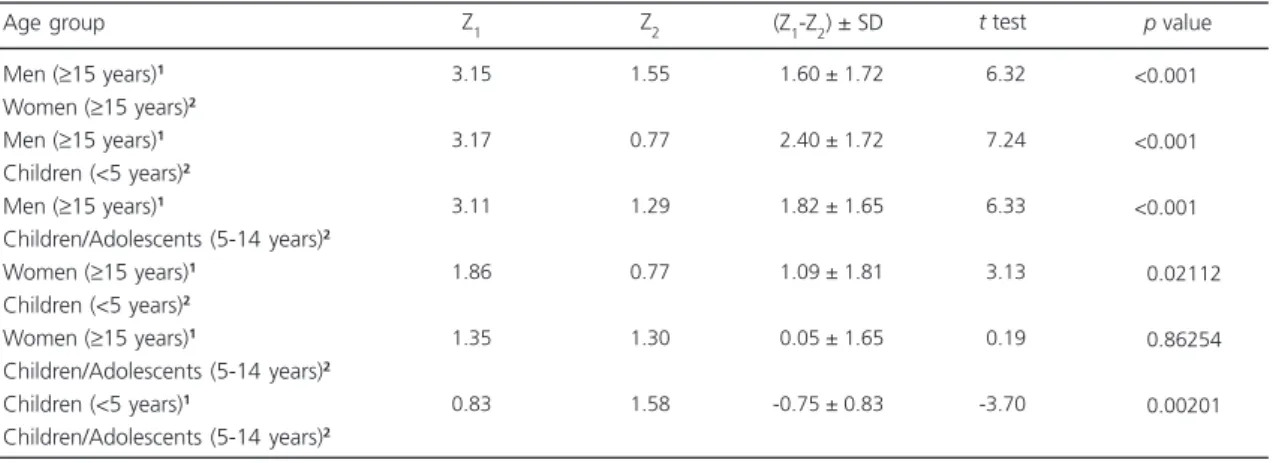
The Z-scores verified the difference between the apparent adequacy of dietary iron intake of each age group. Two groups were compared at a time: men ≥15 years x women ≥15 years; men ≥15 years x children <5 years; men ≥15 years x
children/adolescents 5-14 years; women ≥15 years
x children <5 years; women ≥15 years x children/
adolescents 5-14 years; children <5 years x children/adolescents 5-14 years. Children and adolescents were analyzed together because the number of adolescents was not enough for the said analysis in the study families.
In families with more than one individual per group, the mean Z-score was used. Given the heterogeneous composition of the families, some families were excluded from some analyses because they did not have individuals from one of the paired groups.
The Z-score differences between the groups in each family were calculated. Considering a two-tailed distribution, the paired Student’s t test compared the Z-scores of the groups of all families to investigate whether significant differences occurred.
The present study was approved by the Research Ethics Committee of UFPE under Protocol (Certificado de Apresentação para
Apre-ciação Ética - CAAE) number 1460.0.172.000-05 and met the regulations for human research given by Resolution nº 196/96 from the National Health Council. Individuals diagnosed as anemic received ferrous sulfate supplements for six months and were advised to visit a health care facility.
R E S U L T S
The groups most affected by iron-deficiency anemia were children aged <5 years and pregnant women, with rates of 67.6% (95% Confidence Interval - 95%CI=51.6-83.6) and 60% (95%CI=9.6-110.3), respectively. On the other hand, men aged ≥15 years are the least
affected, with a rate of 20.3% (95%CI=13.0-27.6). Additionally, the pregnant women had the lowest percentage (20.0%) of apparent iron intake adequacy, followed by children aged <5 years (53.1%). Men aged ≥15 years presented adequate
iron intake and the highest mean iron intake (21.66±7.87 mg) (Table 1).
The data in Table 2 shows that anemia was inversely associated with total iron, iron subtypes (heme and nonheme iron), its bioavailabilities, and meat intake. Despite the significant association between anemia and vitamin C, the association was directly proportional to vitamin C intake.
The apparent iron intakes of the study groups differed significantly for most paired groups, except for women aged ≥15 years and
children/adolescents aged 5 to 14 years (p=0.86). Men aged ≥15 years consumed significantly more
iron than the other groups, and the difference was even greater when they were compared with the iron intake of children aged <5 years (t=7.24;
p<0.001). Generally, the apparent iron intakes of the children aged <5 years is always worse than the apparent iron intakes of all other groups (Table 3).
intake difference of all study groups. The mean heme, nonheme, and total iron intakes increase gradually with age, peaking in men aged ≥15
years.
Table 1. Anemia rate, mean hemoglobin, mean iron intake, and apparent adequacy of iron intake of sugarcane harvesters’ families by age group. Gameleira (PE), Brazil, 2007.
<5 years 5 a 11 years 12 a 14 years
≥15 years (women)
≥15years (pregnanta)
≥15 years (men)
Note: aAll pregnant women were aged 15 years or more; bThe apparent adequacy was not calculated for children under 12 months of age.
95%CI: 95% Confidence Interval; M: Mean; SD: Standard Deviation. Age group 40 50 15 50 05 65 N 67.6 44.0 53.3 38.8 60.0 20.3 (51.6-83.6) (39.5-48.5) (30.4-76.2) (33.2-44.4) (9.6-110.3) (13.0-27.6) Anemia % 95%CI
10.37 ± 1.30 11.57 ± 1.37 11.95 ± 1.10 12.28 ± 1.18 11.26 ± 1.19 13.98 ± 1.24
Hb (g/dL)
M SD
05.03 ± 03.78
09.40 ± 03.19 12.39 ± 03.84 14.57 ± 05.65 16.55 ± 10.78 21.66 ± 07.87
Iron (mg)
M SD
Apparent adequacy (%)
053.1b 082.0b 086.7b 084.0b 020.0b
100.0b
Table 2. Distribution of dietary heme iron, nonheme iron, total iron, respective bioavailabilities, vitamin C, and meats according to anemia in sugarcane harvesters’ families. Gameleira (PE), Brazil, 2007.
Heme iron Nonheme iron Total iron
Heme iron bioavailability Nonheme iron bioavailability Vitamin C Meats Variables 0.68 (0.35-1.22) 9.97 (6.59-13.54) 10.95 (7.34-14.97) 0.16 (0.08-0.28) 0.78 (0.51-1.08) 107.16 (43.86-203.69) 87.83 (42.68-162.04) 1.00 (0.58-1.39) 12.93 (8.80-17.91) 14.04 (9.35-19.55) 0.23 (0.13-0.32) 1.03 (0.69-1.43) 64.59(27.80-132.13) 119.0 (69.75-189.33) Yes No 0.009 0.001 0.001 0.009 0.001 0.015 0.009 p Anemia
Note: Dietary variables expressed as medians and 25 and 75 percentiles; p according to the Mann-Whitney test.
Table 3. Difference between the apparent iron intakes of members of different age groups of sugarcane harvesters’ families. Gameleira
(PE), Brazil, 2007.
Men (≥15 years)1
Women (≥15 years)2
Men (≥15 years)1
Children (<5 years)2
Men (≥15 years)1
Children/Adolescents (5-14 years)2
Women (≥15 years)1
Children (<5 years)2
Women (≥15 years)1
Children/Adolescents (5-14 years)2
Children (<5 years)1
Children/Adolescents (5-14 years)2
3.15 3.17 3.11 1.86 1.35 0.83 1.55 0.77 1.29 0.77 1.30 1.58
-1.60 ± 1.72
-2.40 ± 1.72
-1.82 ± 1.65
-1.09 ± 1.81
-0.05 ± 1.65
-0.75 ± 0.83
-6.32 -7.24 -6.33 -3.13 -0.19 -3.70
Note: 1Group one Z
1;
2Group two Z
2.
Z: Mean apparent iron intake; SD: Standard Deviation.
Age group Z1 Z2 (Z1-Z2) ± SD
<0.00100 <0.00100 <0.00100 <0.02112 <0.86254 <0.00201
t test p value
(4.0%) children aged 5 to 11 years and women aged ≥15 years consume diets with low iron
bioavailability, and 38.0% of the said children consume diets with high iron bioavailability. None of the adolescents aged 12 to 14 years, pregnant women, and men aged ≥15 years consume diets
with low iron bioavailability (Figure 2).
D I S C U S S I O N
The present study found high prevalences of anemia in members of sugarcane harvesters’ families of all age groups from the municipality of Gameleira (PE), indicating a moderate public Figure 1. Mean dietary heme iron, nonheme iron, and total iron intakes of sugarcane harvesters’ families by age group.
Gameleira (PE), Brazil, 2007.
Figure 2. Iron bioavailability in the diets of sugarcane harvesters’ families. Gameleira (PE), Brazil, 2007.
health problem in women (38.8%) and men (20.3%). However, the situation is severe in preschool children (aged <5 years), schoolchildren (aged 5 to 14 years), and pregnant women, with rates of 67.6%, 46.2%, and 60%, respectively. These rates are much higher than the mean global rates: 30.2% in women; 12.7% in men; 47.4% in preschool children; 25.4% in schoolchildren; and 41.8% in pregnant women1.
As the rates of iron-deficiency anemia found by the present study show, children aged <5 years are the most susceptible age group, with a rate similar to that found in Africa1 and higher than those found by other Brazilian studies for children of the same age group10-12.
The prevalence of anemia in children is relatively well studied. The Brazilian literature contains three systematic reviews on the prevalence of anemia and its determinants13-15. Fifty-three percent of the children aged <5 years are anemic13. However, Vieira & Ferreira15 point out different mean prevalences of anemia in children according to some epidemiologic landscapes: population-based studies (40.1%), schools or daycare centers (52.0%), health services (60.2%), and socioeconomically vulnerable populations (63.5%). These authors also emphasize that in socioeconomically vulnerable populations, which include indigenous communities, rural settlements, slums, and Pastoral da Criança (Children’s Pastoral) users, anemia is concerning because the children in these populations are almost three times more likely to be anemic than those in the general population. Children of sugarcane harvesters’ families from Gameleira (PE) present a rate of anemia similar to those found in those vulnerable populations, hence evidencing a socioeconomic context of vulnerability to this condition.
The rate of anemia in women (38.8%) found by the present study was higher than that for women of childbearing age of the state of
Child and Woman Demographic and Health Survey)12.However, the PNDS of the Brazilian Northeast region found a prevalence of anemia in women of 39.1%, similar to that of the present study.
Studies of anemia in pregnant women have found great variations in the prevalences of anemia that stem mainly from different socioeconomic contexts, gestational week, and age17-19. Since the number of pregnant women in the study sample is small, it is not possible to make comparisons.
There is literature consensus that children aged <5 years and pregnant women are the most vulnerable groups to nutritional deficiencies, especially iron-deficiency anemia, because of their higher energy and nutritional requirements1. In infants, there is also the influence of the exhaustion of the iron reserves between the fourth and sixth months of life, usually accompanied by early weaning and incorrect supplementary feeding5,9. Therefore, special attention should be given to the diet of these groups, and proper food intake should be encouraged by other family members, but what has been found by the present study is that these groups have the worst apparent iron intake adequacy and in the case of children, a high exposure to diets with low iron bioavailability.
There are only a few studies on the prevalence of anemia in other population groups20-22. Studies of anemia in children and adolescents aged 6 to 18 years enrolled in public schools found prevalences of 3.6% in 2005 in
Recife (PE) to 39.3% in 2008 in Maringá (PR)21, 22. A study done in Pelotas (RS) found a prevalence of anemia in adults of 20.6%20.
Serum hemoglobin is the most sensitive and widely used indicator of iron-deficiency anemia in a population. Its determination is inexpensive and the estimates are appropriate. The means found for the study sample are higher than the cut-off points provided by the WHO1, except for children aged <5 years and adolescents aged 12 to 14 years whose means are closer to
the respective cut-off points. Mild anemia is the most prevalent in all age groups (results not shown). However, this fact cannot be underestimated since the presence of iron-deficiency anemia is a late stage of severe iron deficiency, leading to functional impairments7.
Iron is found in foods in the form of heme and nonheme, and both have specific absorption percentages. The absorption of nonheme iron depends on intrinsic dietary factors, such as ascorbic acid and meats in general6,23,24.
Vitamin C keeps iron in the ferrous state and forms a more soluble compound, the chelate iron ascorbate23. In meats, some amino acids such as cysteine, histidine, and lysine, and some peptides affect iron absorption because these free amino acids in the intestine form soluble chelates with nonheme iron, increasing its bioavailability24. However, vitamin C only promotes iron absorption when consumed together with dietary iron sources2,9.
Therefore, the intake of meats and vitamin C is very important for this population since most of the iron it consumes is nonheme, present in foods of plant origin such as legumes, tubers, and grains. Beans, a food item considered part of a healthy diet, was the main dietary source of nonheme iron for all study age groups (results not shown). The Pesquisa de Orçamentos Fami-liares (POF, Household Budget Survey) of 2008/ 200925 found that adults with lower income have a high intake of beans and the intake is even higher in rural areas. However, bean intake has been decreasing in Brazil.
prevention of iron-deficiency anemia because it is well absorbed by the body (15% to 35%) and nearly not affected by other food constituents6. Additionally, children aged <5 years are less likely to consume a diet with high iron bioavailability because they consume fewer foods with high iron content than other family members.
The importance of consuming foods high in iron for the occurrence of anemia in the study population was also evidenced by the direct moderate correlation between the hemoglobin level and dietary iron intake, including its bioavailability (results not shown). Such associations are corroborated by Ai-Assaf26 and Rodríguez et al.27, reinforcing the proposition that inadequate iron intake and low bioavailability are the main determinants of anemia and confirming the validity of food surveys for detecting individuals at risk of anemia.
Although families have access to the same dietary sources of iron, the distribution of these foods within the family is unequal since the different iron requirement of each family member is not met, especially the requirements of women and children. This fact is evident when we compare the apparent iron intake of different age groups, noting a significant difference regarding the adequacy of men’s intake as opposed to the adequacy of women’s, children’s, and adolescents’ intakes. Women and schoolchildren have similarly inadequate intakes. Between preschool children and schoolchildren, the former are less likely to meet their iron requirement. Therefore, in addition to the physiological factors that place children and women at risk of anemia, there are still issues of food distribution within the family that prevent meeting the nutritional requirements of some groups.
Romanelli28 states that men are favored in this issue because women tend to leave the best part of the food preparations to their spouses when they take their meals to work. Moreover, discrimination within the family favoring men is also possibly due to the fact that they are the main providers29.Sudo et al.30 and Andrieu & Caillavet31 also claim that adult males and male
partners are favored in their iron intake requirements in detriment of other family members.
One of the limitations of this study is the small number of families, which resulted in a small number of individuals of certain groups. This was solved by combining some groups (children aged 5 to 11 years and adolescents aged 12 to 14 years) when analyzing the differences between their Z-scores. Another limitation regards not determining individual iron reserves, such as ferritin, to better estimate iron absorption. Iron absorption inhibitors present in foods of plant origin were also not considered.
It is important to point out that in the northeastern Zona da Mata where the municipality of Gameleira (PE) is located, the dominant presence of sugarcane monoculture opens a small and temporary space for subsistence agriculture in marginal areas not appropriate for sugarcane. Hence, given the economic structure of inadequate dynamism and small product diversity, salaried sugarcane harvesters’ families living in this region have little access to food diversity, contributing even more to their nutrition disorders. This situation aggravates between sugarcane harvests, when family income decreases dramatically and these families survive, in most cases, with benefits provided by welfare programs and loans from relatives, friends, and retired family members4.
In summary, given the high prevalence of anemia and the inadequate intake of high-iron foods among sugarcane harvesters’ families from the Brazilian Northeast, especially among children and women, there is an immediate need of adding nutritional surveillance to the permanent dietary, nutritional, and health care provided to this population in order to control and monitor this nutritional deficiency and implement effective food and nutrition security strategies.
C O N T R I B U T O R S
and review the manuscript. PN VASCONCELOS helped to write and review the manuscript. VM MUNIZ and NF SANTOS helped to analyze the data, write and review the manuscript.
R E F E R E N C E S
1. World Health Organization. Worldwide prevalence of anaemia 1993-2005: WHO Global Database on Anaemia. Geneva: WHO; 2008.
2. Borges CQ, Silva RC, Assis AMO, Pinto EJ, Fiaccone RL, Pinheiro SMC. Fatores associados à anemia em crianças e adolescentes de escolas públicas de Salvador, Bahia, Brasil. Cad Saúde Pública. 2009; 25(4):877-88. doi: 10.1590/S0102-311X200900 0400019
3. Kepple AW, Segall-Corrêa AM. Conceituando e medindo segurança alimentar e nutricional. Ciênc Saúde Colet. 2011; 16(1):187-99. doi: 10.1590/ S1413-81232011000100022
4. Campos LHR, Raposo I, Maia A. Empregabilidade do cortador de cana-de-açúcar da zona da mata pernambucana no período de entressafra. Rev Econ Nordeste. 2007 [acesso 2012 out 14]; 38(3):329-42. Disponível em: <http://www.bnb.gov.br/projweb ren/exec/artigoRenPDF.aspx?cd_artigo_ren= 1013>.
5. Oliveira MAA, Osório MM, Raposo MCF. Con-centração de hemoglobina e anemia em crianças no Estado de Pernambuco, Brasil: fatores sócio-econômicos e de consumo alimentar associados. Cad Saúde Pública. 2006; 22(10):2169-78. doi: 10.1590/S0102 311X2006001000023
6. Monsen ER, Balintfy JL. Calculating dietary iron bioavailability: Refinement and computerization. J Am Diet Assoc. 1982; 80(4):307-11.
7. Monsen ER, Hallberg L, Layrisse M, Hegsted DM, Cook JD, Mertz W, et al. Estimation of available dietary iron. Am J Clin Nutr. 1978; 31(1):134-41. 8. Vitolo MR, Bortolini GA. Biodisponibilidade do ferro
como fator de proteção contra anemia entre crian-ças de 12 a 16 meses. J Pediatr. 2007; 83(1):33-8. doi: 10.1590/S0021-75572007000100007 9. Institute of Medicine. Dietary reference intakes: The
essential guide to nutrient requirements. Washington (DC): National Academies Press; 2006. 10. Oliveira JS, Lira PIC, Osório MM, Sequeira LAS, Costa EC, Gonçalves FCLSP, et al. Anemia, hipovitaminose A e insegurança alimentar em crian-ças de municípios de baixo índice de desenvol-vimento humano do Nordeste do Brasil. Rev Bras Epidemiol. 2010; 13(4):651-64. doi: 10.1590/S1 415-790X2010000400010
11. Leal LP, Batista Filho M, Lira PIC, Figueiroa JN, Osório MM. Prevalência da anemia e fatores associados em crianças de seis a 59 meses de Pernambuco. Rev Saúde Pública. 2011; 45(3):457-66. doi: 10.1590/S0034-89102011000300003
12. Brasil. Ministério da Saúde. Pesquisa Nacional de Demografia e Saúde da Criança e da Mulher - PNDS 2006: dimensões do processo reprodutivo e da saúde da criança. Brasília; 2009. Série G. Estatística e Informação em Saúde.
13. JordãoRE, Bernardi JLD, Filho AAB. Prevalência de anemia ferropriva no Brasil: uma revisão sistemática. Rev Paul Pediatr.2009; 27(1):90-8. doi: 10.1590/ S0103 05822009000100014
14. Leal LP, Osório MM. Fatores associados à ocorrência de anemia em crianças menores de seis anos: uma revisão sistemática dos estudos populacionais. Rev Bras Saúde Matern Infant. 2010; 10(4):417-39. doi: 10.1590/S1519-38292010000400003
15. Vieira RCS, Ferreira HS. Prevalência de anemia em crianças brasileiras, segundo diferentes cenários epidemiológicos. Rev Nutr. 2010; 23(3):433-44. doi: 10.1590/S1415-52732010000300011 16. Migliolo TC, Brito AM, Lira PIC, Figueroa JN, Batista
Filho M. Anemia no binômio mãe-filho no estado de Pernambuco, Brasil. Cad Saúde Pública. 2010; 26(9):1807-20. doi: 10.1590/S0102-311X20100 00900014
17. Ferreira HS, Moura FA, Cabral Júnior CR. Prevalência e fatores associados à anemia em gestantes da região semi-árida do Estado de Alagoas. Rev Bras Ginecol Obstet. 2008; 30(9):445-51. doi: 10.1590/ S0100-72032008000900004
18. Côrtes MH, Vasconcelos IAL, Coitinho DC. Preva-lência de anemia ferropriva em gestantes brasileiras: uma revisão dos últimos 40 anos. Rev Nutr. 2009; 22(3):409-18. doi: 10.1590/S1415-52732009000 300011
19. Fujimori E, Sato APS, Szarfarc SC, Veiga GV, Oliveira VA, Colli C, et al. Anemia em gestantes brasileiras antes e após a fortificação das farinhas com ferro. Rev Saúde Pública. 2011; 45(6):1027-35. doi: 10.1590/S0034-89102011005000078
20. Santos IS, Minten GC, Valle NCJ, Tuerlinckx GC, Boccio J, Barrado DA, et al. Helicobacter pylori and anemia: A community-based cross-sectional study among adults in Southern Brazil. Cad Saúde Pú-blica. 2009; 25(12):2653-60. doi: 10.1590/S0102-3 11X2009001200012
revistas.ufg.br/index.php/fen/article/view/6430/ 6900>. doi: 10.5216/ree.v12i2.6430
22. Lemos MCC. Anemia em alunos de escolas públicas no Recife: um estudo de tendências temporais. Ciênc Saúde Colet. 2011; 16(10):3993-4000. doi: 10.1590/S1413-81232011001100004
23. Cook JD, Reddy MB. Effect of ascorbic acid intake on nonheme-iron absorption from a complete diet. Am J Clin Nutr. 2001; 73(1):93-8.
24. Storcksdieck S, Bonsmann G, Hurrell RF. Iron-binding properties, amino acid composition, and structure of muscle tissue peptides from in vitro digestion of different meat sources. J Food Sci. 2007; 72(1):S019-29. doi: 10.1111/j.1750-3841.2 006.00229.x
25. Instituto Brasileiro de Geografia e Estatística. Pesquisa de orçamentos familiares 2008-2009: análise do consumo alimentar pessoal no Brasil. Rio de Janeiro: IBGE; 2011 [acesso 2012 out 10]. Disponível: <http://www.ibge.gov.br/home/ estatistica/populacao/condicaodevida/pof/ 2008_2009_analise_consumo/pofanalise_2008_ 2009.pdf>.
26. Ai-Assaf AH. Anemia and iron intake of adult Saudis in Riyadh City-Saudi Arabia. Pak J Nutr. 2007 [acesso 2012 dez 18]; 6(4):355-8. Disponível em: <http://www.pjbs.org/pjnonline/fin708.pdf>.
27. Rodríguez SC, Hotz C, Rivera J. Bioavailable dietary iron is associated with hemoglobin concentration in Mexican preschool children. J Nutr. 2007; 137(10):2304-10.
28. Romanelli G. O significado da alimentação na família: uma visão antropológica. Medicina. 2006; 39(3):333-9.
29. Canesqui AM. Mudanças e permanências da prática alimentar cotidiana de famílias de trabalhadores. In: Canesqui AM, Garcia RWD. Antropologia e Nu-trição: um diálogo possível. Rio de Janeiro: Fiocruz; 2005. Coleção Antropologia e Saúde.
30. Sudo N, Sekiyama M, Maharjan M, Ohtsuka R. Gender differences in dietary intake among adults of Hindu communities in lowland Nepal: Assessment of portion sizes and food consumption frequencies. Eur J Clin Nutr. 2006;60(4):469-77. doi: 10.1038/sj.ejcn.1602339
31. Andrieu E, Caillavet F. Inégalités nutritionnelles au sein des ménages: la pauvreté joue-t-elle un rôle? Cah Nutr Diét. 2006;41(2):75-85. doi: 10.1016/ S0007-9960(06)70611-3