520
Communication/Comunicação
1. Setor de Microbiologia, Centro de Pesquisa em Medicina Tropical, Porto Velho, RO. 2. Centro de Pesquisa Leônidas e Maria Deane, Fundação Oswaldo Cruz, Manaus, AM. 3. Direção de Pediatria, Hospital Infantil Cosme Damião, Porto Velho, RO. Address to: Dra. Patrícia Puccinelli Orlandi. Rua Terezina 476, Adranópolis, 69057-070 Manaus, AM, Brasil.
Phone: 55 92 3621-2333
e-mail: patrí[email protected] Received in 16/12/2010
Accepted in 17/05/2011
Revista da Sociedade Brasileira de Medicina Tropical 45(4):520-522, Jul-Aug, 2012
Rotavirus genotyping in gastroenteritis cases of an infantile
population from Western Brazilian Amazonia
Genotipagem de rotavírus em casos de gastrenterites de uma população infantil do oeste da
Amazônia brasileira
Maria Sandra Moura Costa
1, Paulo Afonso Nogueira
1,2, Gleicienne Félix Magalhães
1, Paula Taquita
2,
Luis André Mariúba
2, Marilene Penati
3and Patrícia Puccinelli Orlandi
1,2ABSTACT
Introduction: During the period from 2000 to 2002, 79 rotavirus-positive stool samples were collected from children presenting diarrhea in the Western Brazilian Amazon. Methods: Molecular characterization of the G and P genotypes was performed using RT-PCR and electropherotyping analysis by polyacrylamide gel electrophoresis. Results: A total of 59 samples were conirmed as group A rotavirus. A long electrophoretic proile was exhibited by the G1P[8], G3P[8], and G4P[8] genotypes. he G1P[8] genotype was found in greater proportion. he short electropherotype was exhibited only by G2 genotype strains. Conclusions: he proportion of the rotavirus genotypes observed was not diferent from that in other areas of Brazil. his study is the irst genotyping of rotavirus in the Western Brazilian Amazon.
Keywords: Group A rotavirus. Genotyping. Brazilian Amazonia.
RESUMO
Introdução: Entre 2000 e 2002, 79 amostras positivas para rotavírus foram coletadas de crianças com diarreia na Amazônia ocidental brasileira.
Métodos: Para a caracterização molecular dos genótipos G e P foram realizadas as reações de RT-PCR e a análise dos eletroferotipos por eletroforese em gel de poliacrilamida (PAGE). Resultados: 59 amostras foram conirmadas como pertencentes ao rotavírus grupo A. Os genótipos G1P[8], G3P[8] e G4P[8] apresentaram peris eletroforéticos longos. O genótipo G1P[8] foi encontrado em maior proporção. O eletroferotipo curto ocorreu apenas em genótipos G2. Conclusões: A proporção dos genótipos de rotavírus observada não foi diferente de outras áreas do Brasil. Este estudo é a primeira genotipagem de rotavírus na Amazônia ocidental brasileira.
Palavras-chaves: Rotavírus grupo A. Genotipagem. Amazônia brasileira.
Rotavirus is the main cause of acute gastroenteritis in children under ive years old worldwide. It is estimated that 130 million children are infected with rotavirus gastroenteritis, causing 2 to 4 million hospital admissions and 600,000 deaths every year1.
Rotavirus belongs to the Reoviridae family, and the capsid is made of a triple protein layer. he genome is composed of eleven segments of double-stranded RNA, and each segment encodes for a speciic protein. Two proteins that make up the outer capsid of the virion, the VP7 (glycoprotein) and the VP4 (protease-sensitive), are
important for the genetic diversity of rotaviruses. he VP7 or VP4 antigens are used to classify G and P genotypes, respectively. In the host, both proteins induce neutralizing antibodies, which are essential for protection against rotavirus infections2.
On the basis of antigenic and genetic diversities, 23 G and 30 P rotavirus types have been identiied among strains of both human and animal origin, the serotypes G1 to G4 being the most common cause of disease worldwide3. Ten G types and 11 P types (mostly, G1-G6,
G8-G10, and G12, and P[4], P[6], P[8], and P[9], respectively) have been recovered in association with human infections. he combinations G1P[8], G2P[4], G3P[8], and G9P[8] are the most frequently found3-4.
Recently, a study on the etiology of gastroenteritis in the infantile population showed group A rotavirus to be the most frequent enteropathogen, occurring in 23.6% of the total diarrhea cases; the second group consisted entirely of pathogenic categories of diarrheogenic Escherichia coli diferentiated by PCR technique, occurring in 18.2% of cases, followed by Salmonella sp. (9.3%),
Adenovirus (6.3%), and Shigella sp. (5.1%)5.
his study aimed to characterize G and P genotypes infecting an infantile population admited with viral gastroenteritis and to extend our knowledge of rotavirus infection in individuals from Western Brazilian Amazonia.
From March 2000 to March 2002, 330 stool samples were collected from diarrheic children presenting acute gastroenteritis at the Cosme Damião Infantile Hospital, located in downtown Porto Velho, the capital of the State of Rondonia, Brazil. he hospital admits children from the periphery of the city. he stool samples were collected from children ater consent was given by their parents or other legal guardians, through writen signature. his study received approval from the commitee on ethics (Center of Tropical Medicine Ethical Commitee - Porto Velho, number 463). he rotavirus was diagnosed through two tests. First, the samples were analyzed using the commercial kit Virotec Rota (Omega Diagnostics,Scotland, United Kingdom), which uses latex particle agglutination. Samples were then conirmed by a combined Enzyme Immunoassay for Rotavirus and Adenovirus (EIAA Biomanguinhos/Oswaldo Cruz Foundation, Healthy Ministerial of Brazil).
he rotavirus-positive stool samples were dissolved in 0.01M Tris-HCl-CaCl (pH 7.2) and clariied by centrifugation at 800g, and the supernatants were frozen at -20oC. he viral RNA was extracted as
described by Boom et al.6, followed by separation by polyacrylamide
gel electrophoresis (PAGE)7. he segments of double-stranded RNA
521
Costa MSM et al - Rotavirus genotyping from Western Brazilian Amazonia
TABLE 1 - G and P rotavirus genotypes found in an infantile population from Porto Velho, Rondonia, presenting viral gastroenteritis.
G1 G2 G3 G4 Total
P[4] 0 12 0 0 12
P[8] 36 0 4 2 42
Not typed 2 3 - - 5
Total 38 15 4 2 59
he reverse transcriptase reaction and PCR were performed as described by Das et al.8 and Gentsch et al.9, respectively. For G genotypes, the irst PCR was performed using the consensus primer pair 9con1/9con2. In this reaction, one fragment of 904bp was ampliied, and the product was submited to the nested reaction, the combination between primers 9con1 and a pool of G-speciic primers, 9TI-1, 9T1-2, 9T-3P, 9T-4, and 9T-9B genotypes for variable regions of the VP7 gene, speciically to G1, G2, G3, G4, and G98. For P genotypes, the irst PCR was performed using the consensus primer pair con2/con3; one fragment of 876bp was ampliied. In the nested reaction, the combinations were between con3 primer and the pool of P-speciic primers for variable regions of the VP4 gene, 1T-1, 2T-1, 3T-1, and 4T-1, speciically to the P[8], P[4], P[6], and P[9] genotypes9. he products were visualized under UV in 1% agarose gels stained with ethidium bromide.
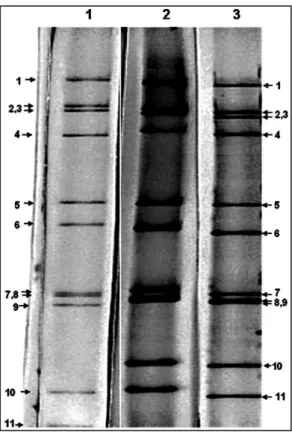
Of 79 rotavirus-positive stool samples collected, 75% gave PAGE results positive for group A rotavirus. he most frequent proile was the long PAGE proile that was observed in 74.5% (44/59) of the samples. he 15 remaining samples presented the short PAGE proile (Figure 1).
When the G and P genotyping results were combined, the most frequent genotypes observed were identiied as G1P[8], G2P[4], G3P[8], and G4P[8] (Table 1), the G1P[8] genotype being the most common, found in 61% of samples; this was followed by G2P[4] in 20%, G3P[8] in 6.7%, and G4P[8] in 3.3%. Some samples with G1 and G2 genotypes did not have had their P genotype identiied; these represented 3.3% and 5% of the samples, respectively. All short proiles were G2P[4] genotypes. We did not ind an occurrence of mixed genotypes in our samples.
FIGURE 1 - A rotavirus PAGE proile beforethe introduction Rotarix in the Brazilian Expanded Immunization Program. Running of dsRNA from typical group A rotavirus isolated from the stool of children with diferent PAGE results. Column 1 shows the long proile, columns 2 and 3 the short proile.
PAGE: polyacrylamide gel electrophoresis.
Studies carried out by our group with populations of ambulatory or hospitalized children in Porto Velho, State of Rondonia, showed rotavirus as the main cause of gastroenteritis, occurring in 23.6% of the total diarrhea cases5,10.
In the current study, the PAGE proiles of stool samples from children in Porto Velho revealed both long and short migration proiles. Luz et al.11, in a study comprising most rotavirus strains of serotypes G1, G3, G4, and G9, showed a predominance of rotavirus strains with long electropherotype. In fact, this electropherotype profile was observed in 74% of our samples. Rotavirus strains displaying short electropherotype represented 25.5% of total and are usually associated with G2 serotypes12, which was conirmed in this study.
On the basis of the current binary system for rotavirus characterization, the majority of isolates from diarrheic children fall into four groups: G1P[8], G2P[4], G3P[8], and G4P[8]. Among the rotavirus genotypes observed, the G1P[8] and G2P[4] rotavirus strains were the most prevalent - which is not diferent from the worldwide trend - in 26 years of monitoring in areas of Brazil13.
he stool samples used in this study were collected before the introduction of the combined live and atenuated G1P[8] group A rotavirus vaccine Rotarix by the Brazilian Expanded Immunization Program. G2P[4] genotypes were prevalent in our study, with a proportion very similar to that in the pre-vaccination era (before 2005), as reported by Leite and colleagues13.
Interestingly, in Brazil as a whole, the reemergence of the G2P[4] or G2P[NT] genotypes has been remarkable during the last few years, and it seems to relect a continental phenomenon. High incidence of the G2P[4] genotype has been reported in El Salvador, Guatemala, and Honduras14. However, the resurgence of G2P[4] in neighboring countries happened before the introduction of Rotarix vaccination into the public sector, and in the case of Brazil the increase of G2P[4] occurred prior to the implementation of Rotarix vaccination.
On the other hand, according to Leite et al.13 a significant predominance of G2P[4] and G2P[NT] strains following the introduction of the Rotarix vaccine in Brazil has been observed. As eicacy in the protection achieved against the fully heterotypic G2P[4] immunization was low, there is growing concern for regarding the lower protection against G2P[4] group A rotavirus of vaccinated children. herefore, only continuous monitoring of rotavirus disease burden and genotype surveillance will provide this information.
522
Rev Soc Bras Med Trop 45(4):520-522, Jul-Aug, 2012
he authors declare that there is no conlict of interest.
CONFLICT OF INTEREST
REFERENCES
Extensive and continuous monitoring of rotavirus disease burden and surveillance studies are necessary to assess the question that emerges regarding the early post-vaccination era, that is, whether the monovalent rotavirus A vaccine will contribute to additional changes in genotype distribution in the Western Brazilian Amazon and nationwide.
In conclusion, our study provides relevant data about the irst genotyping of rotavirus from children in the Western Brazilian Amazon and about epidemiological surveillance of rotaviruses. he results of our study should help future investigations into the genotypes that circulate ater the introduction of the vaccine against rotavirus in Brazil.
1. Grimwood K, Buttery JP. Clinical update: rotavirus gastroenteritis and its prevention. Lancet 2007; 370:302-304.
2. Estes MK, Kapikian AZ. Rotaviruses. In: Knipe DM, Howley PM, editors. Fields Virology. 5th ed. Lippincot: Williams & Wilkins; 2007. p. 1917-1974. 3. Ursu K, Kisfali P, Rigo D, Ivanics E, Erdelyi K, Dan A, et al. Molecular analysis
of the VP7 gene of pheasant rotaviruses identiies a new genotype, designated G23. Arch Virol 2009; 154:1365-1369.
4. Soares LS, Mascarenhas JDP, Gabbay YB, Gusmão RHP, Linhares AC. Molecular characterization of G1 human rotaviruses detected in children from Belém, Pará, Brazil. Rev Pan-Amaz Saude 2010; 1:125-130.
5. Orlandi PP, Magalhães GF, Matos NB, Silva T, Penati M, Nogueira PA, et al. Etiology of diarheal infections in children of Porto Velho (Rondônia, Western Amazon region, Brazil). Braz J Med Biol Res 2006; 39:507-517.
6. Boom R, Sol CJ, Salimans MM, Jansen CL, Wertheim-van Dillen PM, van der Noordaa J. Rapid and simple method for puriication of nucleic acid. J Clin Microbiol 1990; 28:495-503.
7. Pereira HG, Azeredo RS, Leite JP, Barth OM, Sutmoller F, Farias V, et al. Comparison of polyacrylamide gel electrophoresis (PAGE), immuno-electron microscopy (IEM) and enzyme immunoassay (EIA) for the rapid diagnosis of rotavirus infection in children. Mem Inst Oswaldo Cruz 1983; 78:483-490.
8. Das S, Sen A, Uma G, Varghese V, Chaudhuri S, Bhatacharya SK, et al. Genomic diversity of group A rotavirus strains infecting humans in eastern India. J Clin Microbiol 2002; 40:146-149.
9. Gentsch JR, Glass RI, Woods P, Gouvea V, Gorziglia M, Flores J, et al. Identiication of group A rotavirus gene 4 types by polymerase chain reaction. J Clin Microbiol 1992; 30: 365-1373.
10. Magalhães GF, Nogueira PA, Grava AF, Penati M, Silva LH, Orlandi PP. Rotavirus and adenovirus in Rondônia. Mem Inst Oswaldo Cruz 2007; 102: 555-557. 11. Luz CRN, Mascarenhas JDP, Gabay BY, Mota ARB, Lima RVT, Soares LS, et
al. Rotavirus serotype and electropherotypes identiied among hospitalized children in São Luis, Maranhão, Brazil. Inst Med Trop S Paulo 2005; 47: 287-293.
12. Mascarenhas JDP, Linhares AC, Gabbay YB, Leite JPG Detection and Characterization of rotavirus G and P Types from Children Participating in a rotavirus Vaccine Trial in Belem, Brazil. Mem Inst Oswaldo Cruz 2002; 97:113-117.
13. Leite JPG, Carvalho-Costa FA, Linhares AC. Group A rotavirus genotypes and the ongoing Brazilian experience - A Review. Mem Inst Oswaldo Cruz 2008; 103:745-753.
14. Patel MM, Oliveira LH, Bispo AM, Gentsch J, Parashar UD. Rotavirus P[4]G2 in a vaccinated population, Brazil. Emerg Infect Dis 2008; 14:863.