SELF CONSTRUCTING IN ADOLESCENCE
Jelena Vranješevi
ć
1Tachers' College, University of Belgrade
The aim of this study was to explore “theories” adolescents have about themselves, i. e. about the changes in the ways they construe themselves in the period of middle adolescence: how they construe their changes and estimate them according to some dimensions relevant for change (appreciation of change, its importance, expectancy, timing, comprehensiveness, intensity and visibility in social surroundings).
The study was explorative and it was performed on the sample of 96 adolescents aged 15-17 (middle adolescence). Instruments used for the study were: interview and Role Construct Repertory Grid, adjusted to the need of study.
The results show that the adolescents’ construct system is highly monolithic and tight in regard to constructs (black and white construing), but at the same time rather vague and predictively unclear in regard to elements, i. e. the stated changes, meaning that adolescents are not able to construe those changes according to certain constructs. It seems that this study included the beginning of the loosening phase (creativity cycle) in which the system is still tight and, therefore, protects from threat and anxiety, while the elements are not predictively clear (this is what Erikson calls moratorium, i.e. the process of active experimenting). Changes which are fully predictively unclear are those which refer to adults' roles, such as: self confident, experienced, independent and has responsibilities, worries. On the other hand, changes which are predictably the most clear to adolescents (and not appreciated) are depression and nervousness. Adolescents face an implicative dilemma: positive implications of maturity are not clear enough, while negative implications, such as nervousness, depression and not trusting other people are clear, predictable and negative. This dilemma can be the cause of their ambivalence towards growing-up and accepting the roles of adults.
Key words: adolescence, self-concept, change, construing, predictive clearness/unclearness
1
INTRODUCTION
Authors in the field of adolescence describe this period as a developmentally transitional period from childhood to adulthood. Lewin’s expression “marginal person” (Lewin, 1939), which he uses for describing the adolescent, is a good illustration of the position which characterizes the adolescent, because it indicates the constant balance between the role of the child and the role of the adult. The period of adolescence is the period of transition, i.e. of changes, instability and development, that makes the bridge between childhood and adulthood. Successful adjusting and further development of an adult person depend on changes that occurred in adolescence and the ways of the realization of developmental tasks in this period.
One of the important changes in this period is the change of self-concept, i.e. the way in which adolescents perceive themselves. In this period, both the way in which adolescents describe themselves is changed as well as the very contents of the self-concept. According to many authors (Harter, 1990; Coleman, 1996; Damon and Hart, 1988), self-concept in adolescence becomes more abstract, organised, structured and coherent, on the one side, and more differentiated in relation to different social contexts, on the other. The important task in adolescence becomes the integration of different aspects of self-concept (especially those which refer to “public” and “private” self) in a coherent self-concept (Harter, 1990).
problematic period from the point of change (Mead, 1970, Benedict, 1976) and that the image of “stormy and problematic” adolescence is in a great sense a myth determined by culture and its expectancies of the roles it offers.
According to some authors, the cause of these dilemmas lies in the so-called “adult - centred view at adolescence” (Valsiner, 1989, pg.343), and the so-called “imposed identity” (du Preez, 1979), which means construing a person as an object. This means moulding the person into the previously prepared role (for example, the rebellious adolescent) by others (adults) instead of attempts of construing the person’s point of view, i.e. to enter the “role relationship” (Kelly, 1955) with the person. It was Lewin who spoke about the need of perceiving changes in adolescence from the adolescents’ own point of view. Nowadays, more and more authors are trying to approach the problem of adolescence in a new way, construing it from the adolescents’ point of view, and to perceive their behaviour as the active creation of meaning which organizes the experience and leads to the development of the self and which exchanges through social interaction (Valsiner, 1989).
That is why the study is about the problem of the self-concept in adolescence, trying to shed light on it from the adolescents’ own point of view and the ways they observe their own changes in this period. Bearing in mind the “theoretical pluralism” in psychology, meaning that there is not a generally accepted theory, the Personal Construct Theory (PCT) was chosen as a frame of reference, since it stresses that the change should be observed from the point of view of the person experiencing changes. Instead of forcefully moulding the person into previously prepared moulds, which are in accordance with our assumptions what it really is like, the PCT proposes the approach which starts from the person and the way he or she construes him/herself and his/her changes. Change is the process based upon constant construing of events around us. The person constantly tests and checks his or her hypotheses about him or herself and the world around them in order to achieve better understanding and control of events. The basis of this change is an attempt of the person to construe the world around him or her and interpret it (anticipation of events).
Self in PCT is understood as a form of construing: it is not a conclusively determined and unchangeable construct, but it is prone to constant change, i.e. the reconstruction and creation of new constructs which represent new possible pathways along which people are free to move. Understanding the change of self-concept in adolescence means exploring new dimensions of meaning which adolescents use to conceptualize their changes.
PROBLEMS AND AIMS OF THE STUDY
intensive. The aim of this study is to explore “theories” adolescents have about themselves, about the changes in the ways they construe themselves in the period of middle adolescence (age 15-17): How they construe their changes, i.e. how do they estimate them according to some dimensions relevant for change, referring to appreciation of change, its importance, expectancy, timing, comprehensiveness, intensity and visibility of those changes in social surroundings?
METHOD
Sample
The study was explorative and it was performed on the sample of 96 adolescents (47 females and 49 males) aged 15-17 (middle adolescence).
Instruments
The instrument used for study is a form of Repertory Grid: Role Construct Repertory Grid, adjusted to the need of study. This technique results from the basic postulates of the PCT, i.e. understanding that each person is construing the world in a unique way, i.e. that his or her constructs are making a system which enables either more or less success in predicting events. By the Role Construct Repertory Grid, it is possible to determine structure and contents of the interviewee's way of construing as well as his or her implicit theories in a particular domain. There are three components of this technique:
• Elements – those are some events encompassed by a construct and they define the domain of construing which will be explored. Elements used in the Repertory Grid have been elicited from the interviewees themselves: by using a semi-structured interview in which questions were referred to changes in the interviewees' construing of themselves. Based upon the interview, there is a list of 13 changes which the interviewees stated as the most important ones: mature; self confident; responsible; nervous; cautious in relation to people; independence;
experienced; depressed; autonomous in relation to parents; cares about what others think of him/her; thinking about future, planning; have responsibilities, worries;
sociable (more intimate friendships).
aims of the study and some theoretical assumptions. Constructs: expected – unexpected, sudden – gradual, well timed – ill timed, long duration - temporary and
comprehensive – limited are chosen because they have great significance in the theory of crisis. Constructs: positive for parents - negative for parents, positive for me - negative for me, positive for friends - negative for friends, important for me - not important for me, important for parents - not important for them,
important for friends - not important for them, represent the estimation of significance and positive/ negative effect that each change has for an adolescent, as well as for parents and peers, since these are the two important groups of reference. Construct: noticed by others – not noticed by others, has been chosen in order to see to which extent the adolescents estimate that these changes are noticed by significant people in their life.
• Way of connecting, i.e. estimation of elements in relation to each construct.
Data processing
Data processing was carried out by the use of the FLEXIGRID program (Tchudi, 1988), i.e. the analysis of principal components. The aim of APC is to determine the relations among constructs and elements themselves as well as between constructs and elements. The APC represents one way of decomposing data: large number of constructs are reduced to a small number of variables, i.e. principal components. Principal components are sets of inter-related constructs, used by interviewees while structuring, construing their experience and are independent from each other. Since the construct system has an infinite number of dimensions according to which a person construes and structures events and that those dimensions are inter-related, i.e. they are always used together while construing and structuring events, the basic aim of APC is to reduce a large number of dimensions of meaning to a small number of components which are orthogonal in relation to each other. Those components represent an implicit theory of the interviewees on the matter which is explored.
Procedure
RESULTS AND DISCUSSION
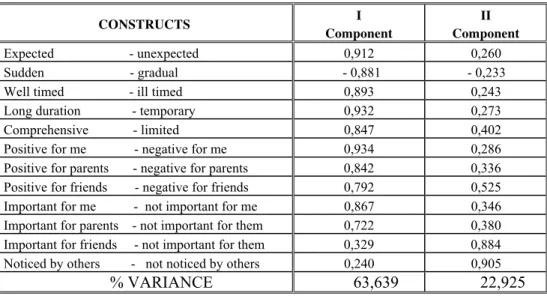
As the result of APC, there are two components which explain 86,56% of total variance and they are orthogonal, i.e. they do not correlate between themselves. Correlations (loadings) of each construct with the first and second component, are presented in Table 1. The more the construct is loaded on one side and less on the other, the more we can be sure that it belongs to a single component (the one which is more loaded with this construct). The percentage of the total variance explained by the first component is 63,64% and that tells how complex/simple the construct system is. The higher the percentage, the simpler the construct system. That means that constructs are tightly connected in so called constellations, i.e. what is usually called black and white or stereotypical thinking. The question is what can be considered as a high variance and some authors (Tchudi,1988) suggest that the variance higher than 60% can be considered a high variance.
Table 1: Constructs loadings on the first and second component and percentage of the total variance explained by first and second component
CONSTRUCTS I
Component
II Component Expected - unexpected 0,912 0,260 Sudden - gradual - 0,881 - 0,233 Well timed - ill timed 0,893 0,243 Long duration - temporary 0,932 0,273 Comprehensive - limited 0,847 0,402 Positive for me - negative for me 0,934 0,286 Positive for parents - negative for parents 0,842 0,336 Positive for friends - negative for friends 0,792 0,525 Important for me - not important for me 0,867 0,346 Important for parents - not important for them 0,722 0,380 Important for friends - not important for them 0,329 0,884 Noticed by others - not noticed by others 0,240 0,905
% VARIANCE 63,639 22,925
A - mature E – cautious in relations I – autonomous in relation to parents B – self confident F - independent J – cares about others opinion C –responsible G - experienced K – thinking about future, planning D - nervous H - depressed L – have responsibilities, worries M - sociable
8 positive for friends 5 comprehensive 10 important to parents 9 important to me 7 positive for parents 6 positive for me 4 long duration 1 expected 3 well timed 2 gradual 12 noticed by others
11 important to friends
COMPONENT 2
2 sudden 3 ill timed 1 unexpected 4 temporary 6 negative for me 7 negative for parents 9 not important to me 10 not important to parents 5 limited
8 negative for friends 11 not important to friends 12 not noticed by others
COMPONENT 12
8
5
1 9
7
2
11 8
5
9 1
7
134
4613
A
B C
D
E
F G
H
I
J L
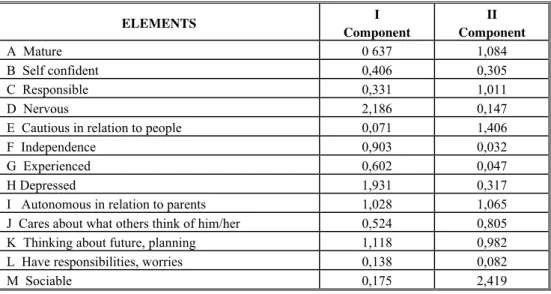
Graphical representation tells us more clearly about the ways the constructs are inter-connected and where the elements are in such a construct structure (elements are presented by letters and constructs by numbers). In the Table 2, there are the so-called factor scores which tell us how much each of the elements is loaded by a certain component, i.e. how significant it is in the construct system. The bigger the factor score, the more predictively clear the element. A smaller score shows that the element has less meaning, i.e. that it is difficult to construe.
Table 2 – Factor scores, i.e. element loading on the first and second component
ELEMENTS I
Component
II Component
A Mature 0 637 1,084
B Self confident 0,406 0,305
C Responsible 0,331 1,011
D Nervous 2,186 0,147
E Cautious in relation to people 0,071 1,406
F Independence 0,903 0,032
G Experienced 0,602 0,047
H Depressed 1,931 0,317
I Autonomous in relation to parents 1,028 1,065 J Cares about what others think of him/her 0,524 0,805
K Thinking about future, planning 1,118 0,982
L Have responsibilities, worries 0,138 0,082
M Sociable 0,175 2,419
This relation can also be viewed on the graph representing elements by the points in coordinate system. Those points are located along axes that approximate the their best values achieved by the estimation on the repertory grid scale on each construct. The farther the element from origo, the more predictably clear it is. If the element is close to origo, that means that it is predictively vague, i.e. an interviewee could not decide on which pole of the construct the element was (or that the element is out of the range of convenience of certain constructs).
adolescents and their surroundings. This is in accordance with the theory of crisis, which stresses the importance of the ways in which a person construes certain changes in the estimation of potential stress impact of that change. The more the change is perceived as gradual, well timed and expected, the lesser the effect of stress that the change can cause. (Vlajkovic, 1992). By the PCT frame of reference, if the change is such that it cannot be construed by existing constructs, i.e. it is out of their range of convenience, it can produce certain transitions (emotions) such as anxiety, fear, threat etc. and to seriously jeopardize the system stability. Since this study is concerned with developmental changes, the dimensions of comprehensiveness and long duration (which could have a negative connotation with regard to accident crises), are perceived as appreciated and important. The second component consists of only two constructs: noticed by others – not noticed by others and important to friends – not important to friends. This component represents the so called “public side” of a change connected with the referent group, which becomes more important in this period, i.e. friends (peer group). It is interesting that constructs referring to the importance of those changes to parents are not included in this component. This might mean that in this period peers, and not parents, represent a group of reference towards which a public side of self is being presented.
Taking into account that constructs within a cluster correlate a lot and together they explain the larger of the variance, we can conclude that the construct system of adolescents is highly monolithic when construing self changes are in question. The monolithic system in construing means that constructs within it are connected in constellations as well as that on the loose and tight dimension, they are on the latter pole. Tight constructs are those which lead to unvarying predictions, and loose constructs are those which lead to varying predictions, while at the same time keep enough structure to retain their identity. (Kelly, 1955). The monolithic system would therefore mean black and white construing with clearly predicted outcomes and elements which are fully predictively clear. But, if we look at the predictive clearness of stated changes, it can be seen that they are rather vague, i.e. adolescents are not able to construe them according to certain constructs. Changes which are fully predictively unclear are those which refer to adults' roles, such as: self confident, experienced, independent and has responsibilities, worries, can cause anxiety in adolescents when they realise that they are not able to construe and predict those changes adequately. It is also interesting that changes: being responsible and mature are clearer on the second component which represents the public side of change, i.e. some sort of feedback from others. This implies the importance that others have on perceiving their own changes: it seems that adolescents are more certain about their changes when they have feedback from others, compared with the situation when they only rely on themselves. Changes which are predictively the most clear to adolescents are depression and nervousness.
what they desire it is not fully clear. According to those findings it is possible to conclude that within the theory which adolescents have on their own changes, growing-up and maturity, besides positive implications (which are predictively vague) there are also negative implications (depression, nervousness) which are totally predictively clear and elaborated. This is a very important finding from the identity formation in adolescence point of view, since it indicates predictive clearness of desirable self and at the same time clearly elaborated negative self (threat).
Finally, we can mention the finding about the connection between the elements: autonomous in relation to parents, thinking about future, planning and
cautious in relation to people. Adolescents start to perceive themselves as agents directed to the future and autonomous in relation to parents (meaning someone who is growing up), but at the same time the implication of that change and that they no longer trust others. What is mutual for all these elements is that they are, compared to others, predictively clear on the second component, but they are defined by poles not important to friends and not noticed by others. This might be in favour of the assumption that adolescents start to make a difference between private and public self, and that they do not show others some of their important changes (first of all to peer group).
CONCLUSION
In view of the already discussed predictive unclearness of a great number of changes, we can conclude that there is a certain paradox in question here: on the one side, the system is very tight, i.e. predictively clear when we talk about constructs, and at the same time it is loose, when we talk about elements. This finding can be explained by two cycles which explain development and change in the PCT. They are the so called creativity cycle and the CPC cycle (circumspection, pre-emption
The phase of moratorium discussed by Erikson and Marcia, is seen as increasing predictive unclearness of the system in the study of Repertory Grid (Vranješevic, 1995). It seems that this study included the beginning of the loosening phase (creativity cycle) in which the system is still tight and, therefore, protects from threat and anxiety, while the elements are not predictively clear (particularly those which refer to adult roles).
The processes of testing the system, i.e. the phase of loosening, as well as the process of concluding final choices, could be explained with the help of the PIN cycle, which describes the sequence leading to choice and action. There are three phases: circumspection in which different ways in which a situation can be observed are discussed, preemption where the decision is made, and control, where there is a specific action. Adolescence is the period in which the first phase of circumspection is significantly prolonged. Because of the many possible choices, a young person has difficulties in making final decisions. What Erikson calls moratorium (Erikson, 1976), and Lewin "the process of active experimenting" (Levin, 1939) is the process of prolonged circumspection phase, which is very important in adolescence. According to cultural anthropologists (Benedict, 1976; Mead, 1970) what represents the basic reason for discontinuity in the development during adolescence is the fact that there is a great number of choices in the Western culture for young people, which is different form traditional societies in which there is a small number of possible choices, so the phase of circumspection is shorter. This is why in those societies there is no concept of adolescence crisis.
Beside a great number of choices, which can significantly prolong the phase of circumspection, is a so called implicative dilemma which adolescents face. This can be the cause of their ambivalence towards growing-up and accepting the roles of adults. Adulthood and maturity have both positive (self confidence, responsibility and independence) and negative implications (depression and nervousness). Since negative implications are fully predictively clear, as opposed to positive changes of growing-up, which are insufficiently elaborated and vague, there is nothing left to adolescents but to prolong the phase of circumspection, thus hesitating with growing-up.
REFERENCES
Benedict, R. (1976). Continuities and Discontinuities in Cultural Conditioning. In. Skolnick, A. (Ed.) Rethinking Childhood. Perspectives on Development and Society. Boston, Little, Brown and Company.
Coleman, J. C. & Hendry, L. (1996). The nature of adolescence – adolescence and society.London and New York, Routledge
Erikson, E. (1976). Omladina, kriza, identifikacija. Titograd, NIP Pobjeda.
Hall, G. S. (1904). Adolescence. Its Psychology and its Relation to Phychiology, Anthropology, Sociology, Sex, Crime, religion and Education (Vols. 1 - 2). New York, Appleton.
Harter, S. (1990). Causes, correlates and the functional role of global self-worth. A life - span perspective. In. Kolligian, J. & Sternberg, R. (Eds.) Perceptions of competence and incompetence across the life-span. New Haven (CT), Yale University Press.
Kelly, G. A. (1955). The psychology of personal constructs. New York, Norton Kimmel, D. C., & Weiner, I. W. (1995). Adolescence - A Developmental transition.
New York, John Wiley & Sons, Inc.
Lewin, K. (1939). Field theory and experiment in social psychology - Concepts and methods. American Journal of Sociology, 44, 868 - 896.
Marcia, J. E. (1966). Development and validation of ego identity status. Journal of Personality and Social Psychology, 3, 551 - 559.
Marcia, J. E. (1967). Ego identity status. Relationship to change in self - esteem, "general maladjustment" and authoritarianism. Journal of Personality, 35, 118 - 133.
Mead, M. (1970). Culture and commitment. New York, American Museum of Natural History.
Offer, D., & Offer, J. B. (1975). From Teenage to Young Manhood. A Psychological Study. New York, Basic Books.
Offer, D., Ostrov, E., & Howard, K. I. (1981). The Adolescent. A Psychological Self - Portrait. New York, Basic Books.
Preez, P. (1979). Politics and Identity in South Africa. In. Stringer, P., & Bannister, D. (Eds.) Constructs of Sociality and Individuality. New York, Academic Press. Savin - Williams, R. C., & Demo, D. H. (1984). Developmental change and stability
in adolescent self - concept. Developmental Psychology, 6, 1100 - 1110. Tschudi, F. (1988). Notes on FLEXIGRIG. Unpublished paper, University in Oslo. Valsiner, J. (1989). Human Development and Culture. The Social Nature of
Personality and Its Study. Massachusetts / Toronto, Lexsington Books. Vlajković, J. (1992). Životne krize i njihovo prevazilaženje. Beograd, Nolit.
Vranješević, J. (1995). Opažaj sličnosti i razlike od drugih u krizi identiteta..
REZIME
SAMOOPAŽANJE U ADOLESCENCIJI
Jelena Vranješevi
ć
Problem promene slike o sebi u adolescenciji, predmet je mnogih rasprava, pošto postoji neslaganje autora u pogledu načina na koji se slika o sebi menja u ovom periodu: da li su u pitanju burne i nagle promene, koje dovode do diskontinuiteta u razvoju, ili su te promene postepene i kontinuirane. Prema nekim autorima uzrok ovih dilema leži u tzv. ''centriranom pogledu na adolescenciju'' od strane odraslih (Valsiner, 1989, str. 343), tj. činjenice da se problem promena u adolescenciji uvek sagledava sa tačke gledišta odraslih. Danas, sve više autora pokušava da problemu adolescencije priđe na jedan nov način, posmatrajući ga sa stanovišta samih adolescenata i da njihovo ponašanje vidi u svetlu ''aktivnog stvaranja značenja, koja organizuju iskustva i vode razvoju samstva i koja se kroz socijalnu interakciju razmenjuju'' (Valsiner, 1989).
Ovo istraživanje se bavi načinima na koje adolescenti opažaju svoje promene, tj. koliko sa njihovog stanovišta ima smisla govoriti o kontinuitetu/diskontinuitetu. Cilj istraživanja je da ispita ''teorije'' koje adolescenti imaju o sebi, o promenama u načinu opažanja sebe u periodu srednje adolescencije (od 15 do 17 godina), tj. da utvrdi kako adolescenti konstruišu svoje promene, procenjujući ih po nekim dimenzijama koje su relevantne za promenu (poželjnost i važnost te promene, očekivanost, uvremenjenost, obuhvatnost, brzina javljanja, procena trajanja i primećenost promene u socijalnom okruženju). Kao referentni okvir istraživanja, izabrana je Teorija Ličnih Konstrukata (TLK), pošto naglašava važnost razumevanja načina na koji osobe opažaju (konstruišu) svoje promene
Istraživanje je eksplorativnog karaktera i sprovedeno je na uzorku od 96 adolescenata (47 ispitanika ženskog i 49 ispitanika muškog pola), učenika srednjih škola i gimnazija, starosti između 16 i 17 godina (period srednje adolescencije). Uzorak je slučajan.
Instrumenti koji su korišćeni u istraživanju su: intervju i Mreža repertoara konstrukata (jedna forma Mreže Repertoara) prilagođena potrebama istraživanja. U obradi podataka korišćen je program FLEXIGRID (Tchudi,1988), tj. APK (Analiza principalnih komponenti)
adolescenti nisu u stanju da te promene procene po dimenzijama važnosti, primećenosti od strane važnih drugih osoba, sveobuhvatnosti, očekivanosti i uvremenjenosti. Jedine promene koje su potpuno prediktivno jasne, a u isto vreme opažene kao nepoželjne su depresija i nervoza. Istovremeno, postoji povezanost između promena vezanih za odrastanje, tj. doživljaja sebe kao agensa usmerenog ka budućnosti, autonomnog i nezavisnog i negativno opađenih promena kao što su oprez u odnosu na ljude, depresija i nervoza. Ovo su veoma važni nalazi, pošto mogu da objasni pretnju pred kojom se adolescenti nalaze u ovom periodu: proces odrastanja i autonomije, pored pozitivnih implikacija (koje adolescentima nisu baš jasne), ima i negativne implikacije (koje su im prediktivno sasvim jasne i nepoželjne). Biti zreo i samostalan za njih znaći i biti oprezan, ne verovati mnogo ljudima, kao i biti nervozan i depresivan. Ova implikativna dilema se nalazi u osnovi njihove ambivalencije prema odrastanju i prihvatanju uloga odraslih i može značajno da produži taj process.
S obzirom da je adolescencija shvaćena kao period preispitivanja sistema i aktivnog eksperimentisanja u kojem je stepen prediktivne nejasnoće veliki, iznenađuje podatak da je sistem konstrukata adolescenata, veoma monolitan, stegnut (crno belo konstruisanje) kada su u pitanju dimenzije za procenu promena (konstrukti). Ovaj podatak je moguće objasniti pomoću ciklusa kreativnosti koji u TLK objašnjava razvoj i promenu i koji se sastoji od faza labavljenja (preispitivanja sistema) i stezanja (prediktivne jasnoće i validiranih ishoda). Izgleda da je u ovom istraživanju zahvaćen sam početak faze labavljenja, (inače neophodnog za stvaranje novih dimenzija značenja), u kojoj je sistem i dalje stegnut tako da čuva adolescente od prevelike anksioznosti i pretnje, ali elementi (pogotovo oni vezani za uloge odraslih) nisu prediktivno jasni.