A
RTIGOO
RIGINAL ©Revista Brasileira de FisioterapiaEffects of ELTGOL and Flutter VRP1
®
on the
dynamic and static pulmonary volumes and
on the secretion clearance of patients
with bronchiectasis
Efeitos da ELTGOL e do Flutter
®nos volumes pulmonares dinâmicos e estáticos
e na remoção de secreção de pacientes com bronquiectasia
Fernando S. Guimarães1,2, Vanessa J. R. Moço1, Sara L. S. Menezes1,2, Cristina M. Dias1, Raquel E. B. Salles3, Agnaldo J. Lopes1,3,4
Abstract
Background: Although respiratory physical therapy is considered fundamental in the treatment of hypersecretive patients, there is little evidence of its physiological and therapeutic effects in bronchiectasis patients. Objective: To evaluate the acute physiological effects of ELTGOL and Flutter VRP1® in dynamic and static lung volumes in patients with bronchiectasis and, secondarily, to study
the effect of these techniques in sputum elimination. Methods: Patients with clinical and radiological diagnosis of bronchiectasis were included. Patients underwent three interventions in a randomized order and with a one-week washout interval between them. Before all interventions patients inhaled two puffs of 100 μcg of salbutamol. There was a cough period of five minutes before and after the control protocol and the interventions (ELTGOL and Flutter VRP1®). After each cough series patients underwent assessments
of dynamic and static lung volumes by spirometry and plethysmography. The expectorated secretions were collected during the interventions and during the second cough series, and quantified by its dry weight. Results: We studied 10 patients, two males and eight females (mean age: 55.9±18.1 years). After using Flutter VRP1®and ELTGOL there was a significant decrease in residual
volume (RV), functional residual capacity (FRC) and total lung capacity (TLC) (p<0.05). There was a higher sputum production during ELTGOL compared with Control and Flutter VRP1® (p<0.05). Conclusion: The ELTGOL and Flutter VRP1® techniques acutely reduced
lung hyperinflation, but only the ELTGOL increased the removal of pulmonary secretions from patients with bronchiectasis. Trial Registration ClinicalTrials.gov NCT01300403.
Keywords: bronchiectasis;plethysmography; physical therapy; respiratory therapy.
Resumo
Contextualização: Embora a fisioterapia respiratória seja considerada fundamental para o tratamento de pacientes hipersecretivos, há poucas evidências acerca de seus efeitos fisiológicos e terapêuticos em indivíduos com bronquiectasia. Objetivos: Avaliar os efeitos fisiológicos imediatos da ELTGOL e do Flutter® nos volumes pulmonares dinâmicos e estáticos em pacientes com
bronquiectasia e, secundariamente, determinar o efeito dessas técnicas na remoção de secreção brônquica. Métodos:
Participaram do estudo pacientes com diagnóstico clínico e radiológico de bronquiectasia. Os pacientes foram submetidos a três intervenções de forma randomizada e com um intervalo (washout) de uma semana entre elas. Inicialmente os pacientes inalaram dois jatos de 100µcg de salbutamol. Após 5 minutos de tosse iniciais e após 5 minutos de tosse que sucederam o protocolo controle e as intervenções (ELTGOL e Flutter®), os pacientes realizaram as avaliações dos volumes pulmonares
dinâmicos e estáticos por meio da espirometria e pletismografia corporal. A secreção expectorada foi coletada durante as intervenções e durante a segunda série de tosse, sendo quantificada por meio de seu peso seco. Resultados: Foram avaliados dez pacientes, dois do sexo masculino e oito do sexo feminino (média de idade de 55,9±18,1 anos). Após a utilização do Flutter® e da ELTGOL, observou-se diminuição significativa do volume residual (VR), da capacidade residual funcional (CRF) e
da CPT (p<0,05). Foi eliminada maior quantidade de secreção pulmonar durante a ELTGOL em comparação com o Controle e o
1 Rehabilitation Sciences Master’s Program, Augusto Motta University Center (UNISUAM), Rio de Janeiro, RJ, Brazil 2 School of Physical Therapy. Universidade Federal do Rio de Janeiro (UFRJ), Rio de Janeiro, RJ, Brazil
3 Service of Pneumology, Pedro Ernesto University Hospital, Universidade Estadual do Rio de Janeiro (UERJ), Rio de Janeiro, RJ, Brazil 4 Laboratory of Pulmonary Function, Pedro Ernesto University Hospital, UERJ
Correspondence to: Fernando Guimarães, Programa de Mestrado em Ciências da Reabilitação, Praça das Nações 34, Bonsucesso, CEP 21041-021, Rio de Janeiro, RJ, Brasil, e-mail: [email protected]
Introduction
Bronchiectasis is an illness characterized by the abnormal and irreversible dilatation of the bronchus1. he destruction of the air-way walls occurs due to infections and recurrent inlammations, resulting in impaired clearance, with accumulation of secretions in the afected areas and bacterial colonization1. he bronchiecta-sis is more prevalent in middle-aged women2 and its main clinical manifestations are the chronic cough often associated to purulent secretions with fetid odor, predominantly in the morning, dysp-nea, hemoptysis, fever, fatigue and weight loss3.
In patients with bronchiectasis, respiratory physical ther-apy aims to prevent or reduce the consequences of retained secretions and reduce the recurrence of infections4. Several techniques can be used to assist mucociliary clearance, re-move the excess of secretions with the lower possible efort, promote greater ventilation and improve the quality of life of these patients5,6. A physical therapeutic resource used for re-moval of bronchial secretion of patients with bronchiectasis is the Flutter®
(Scandipharm, Birmingham, AL, USA), which combines high-frequency oscillation and positive expiratory pressure, re-sulting in decreased viscosity of secretions and easier transpor-tation7. A technique called ELTGOL (L’expiration Lente Totale
Glotte Ouverte en Decubitus Lateral) has also been proposed to promote the removal of secretion in hypersecretive patients8. Among the potential beneits of this technique are the im-provement of peripheral airway clearance9 and dyspnea, and the reduction in disease exacerbations10. he ELTGOL consists of performing slow expirations with the glottis opened, from the functional residual capacity (FRC) to the residual volume (RV), with the individual in the lateral decubitus position with the afected lung in the dependent position11. Despite this is a simple and low-cost resource, there is little evidence about its eicacy and physiological efects in hypersecretive patients. To our knowledge, there are no studies examining the efects of ELTGOL in subjects with bronchiectasis.
Several methods are proposed to evaluate the efects of air-way clearance techniques, including the measurement of lung volumes. he use of this method is based on the premise that the bronchial secretions removal and the consequent airway resistance reduction could diminish the lung hyperinlation12.
hus, the objectives of this study were to assess the im-mediate physiological efects of ELTGOL and Flutter®
in the
pulmonary function of patients with bronchiectasis through spirometry and whole body plethysmography, and to deter-mine the efect of these techniques in the removal of pulmo-nary secretions.
Methods
his was a crossover (6 x 3) randomized trial. Participants were recruited from the Ambulatory of Bronchiectasis of the Pedro Er-nesto University Hospital (HUPE) of the Universidade do Estado do Rio de Janeiro (UERJ), Rio de Janeiro, RJ, Brazil. Participants with clinical and radiological diagnosis of bronchiectasis and with pulmonary hypersecretion (persistent productive cough) were included. Patients were excluded if they were undergoing regular physical therapy treatment or had current acute chest pain, re-cent history of hemoptysis, respiratory infection in the four weeks preceding the study, pneumothorax for at least one year and with conirmed diagnosis of asthma or cystic ibrosis.
he sample size was calculated using the program SigmaStat 3.1 (SYSTAT Software Inc., Point Richmond, CA, USA) and con-sidering the production of secretion as the primary outcome. Ac-cording to the results of the study of Bellone et al.8, considering an average diference of 65%, standard deviation of 41%, power of 80% and α=5%, the sample size estimated was nine individuals.
he present study was approved (n◦ 02/2009) by the Ethics in Research Committee of the Centro Universitário Augusto Motta (UNISUAM), Rio de Janeiro, RJ, Brazil, and all participants signed a free and informed consent.
Data collection was performed at the Laboratory of Pulmo-nary Function of the Pneumology Service of the HUPE/UERJ, always in the mornings. Patients were submitted to the control protocol and to two interventions in a random order and with a one week washout interval between procedures. Block ran-domization sequences were created by a researcher not involved with recruitment, selection and assessments. Sealed opaque envelopes containing patients’ assignments were opened at the time of irst treatment.
Before the control protocol and the interventions, two jets of 100 mcg of Salbutamol, followed by a series of 5 minute of volun-tary cough were administered.
In the control protocol (CTRL), patients remained seated comfortably without performing any maneuver for 15 minutes. In
Flutter®. Conclusão: O Flutter VRP1® e a técnica ELTGOL reduziram a hiperinsuflação pulmonar a curto prazo, porém apenas o ELTGOL aumentou
a eliminação de secreção pulmonar de pacientes com bronquiectasia. Registro de Ensaios Clínicos ClinicalTrials.gov NCT01300403.
Palavras-chave: bronquiectasia; pletismografia; fisioterapia; terapia respiratória.
Received: 03/15/2011 – Revised: 06/20/2011 – Accepted: 08/09/2011
the intervention with ELTGOL (ELTGOL), individuals remained in lateral decubitus and performed slow expirations with the glot-tis opened through a mouthpiece to the RV, starting from FRC. Although in the ELTGOL the therapist can support the exhalation by a manual compression, in this study, the patients performed free (unattended) exhalations during this technique. his interven-tion was designed so that the runtime was similar to the Flutter®
intervention. hus, it consisted of three series of ten repetitions with a 2-minute interval between them (bilaterally), totalizing approximately 7 minutes and 30 seconds in each decubitus (total time of intervention = 15 minutes).
he intervention with the Flutter®
(FLUTTER) was per-formed with the patient seated comfortably, performing expira-tions in the equipment, from the total lung capacity (TLC) until cough occurred, in a total time of 15 minutes13. Each exhalation in the equipment was alternated with a normal breathing. he angulation of the Flutter®
was determined by each patient, ac-cording to their adaptation, perception and efectiveness of bronchial secretions removal14. During the control and during the interventions, participants were free to cough and expec-torate. After each intervention and after the CTRL, a series of 5 minutes of cough was performed. During this period, patients were verbally encouraged to cough every 30 seconds, and short intervals of rest were allowed, according to the patients’ toler-ance. he functional characteristic of patients was determined by spirometry, and the equations of Pereira, Sato and Rodrigues15 (spirometry) and Neder et al.16 (static lung volumes) were used for the interpretation of the functional parameters.
Measurements of static lung volumes were conducted before the spirometry to avoid any residual efect of dynamic compres-sion of the airways in the plethysmography results. hese exami-nations were conducted after the initial 5 minutes cough series and after the 5 minutes cough series that succeeded the interven-tions and the CTRL, through spirometry and whole body plethys-mography (Collins Plus Pulmonary Function Testing Systems, Warren E. Collins, Inc., Braintree, MA, USA) in accordance with the recommendations of the Brazilian Society of Pneumology and Tisiology (Sociedade Brasileira de Pneumologia e Tisiologia)17. he following variables were evaluated: forced vital capacity (FVC), forced expiratory volume in one second (FEV1), FEV1/FVC, forced expiratory low between 25 and 75% of the FVC (FEF25-75%), inspira-tory capacity (IC), vital capacity (VC), TLC and RV.
he secretions expectorated during the initial 5 minutes of cough were discarded. Secretions eliminated during the inter-ventions and in the later 5 minute cough period were collected and analyzed. After being in a stoveat 60ºC during 48 hours, the material was weighted in a precision scale for quantiication of dry weight18.
Statistical analysis was conducted by comparing the per-centage variations pre and post of ELTGOL, FLUTTER and
CTRL. Since data was not normally distributed (Shapiro-Wilk Test), the Friedman’s Test for repeated measures was chosen, followed by the Dunn’s Test for multiple comparisons. he com-parison between the values pre control and pre intervention was performed by means of the Repeated Measures Analysis of Variance or Friedman’s Test, followed by the Tukey or Dunn’s test, whenever appropriate. Diferences were considered sig-niicant at p<0.05.
Results
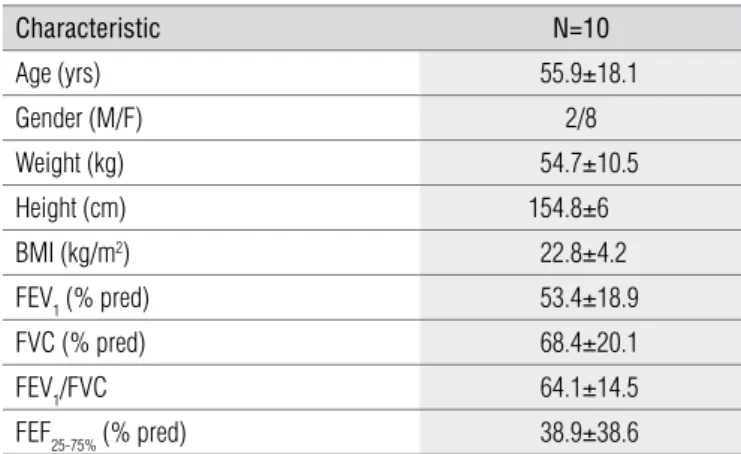
From April 2010 to November 2010, ten patients were re-cruited and evaluated. All individuals tolerated and completed the steps in this study. heir demographic and functional char-acteristics are presented in Table 1.
here were no statistically signiicant diferences between the results of spirometry and plethysmography at baseline be-tween control and interventions (Table 2).
Characteristic N=10
Age (yrs) 55.9±18.1
Gender (M/F) 2/8
Weight (kg) 54.7±10.5
Height (cm) 154.8±6
BMI (kg/m2) 22.8±4.2
FEV1 (% pred) 53.4±18.9
FVC (% pred) 68.4±20.1
FEV1/FVC 64.1±14.5
FEF25-75% (% pred) 38.9±38.6
Table 1. Functional and demographic characteristics of patients with bronchiectasis.
FEV1=forced expiratory volume in 1 second; FVC=forced vital capacity; FEF25-75=forced
ex-piratory flow between 25% and 75% of the forced vital capacity; BMI=body mass index.
CTRL ELTGOL FLUTTER p
FVC (L) 2±0.73 1.9±0.77 1.87±0.64 0.527
FEV1 (L) 1.24±0.55 1.25±0.62 1.19±0.47 0.452
FEV1/FVC 64±14.2 63.6±12.45 63.5±14.47 0.926
FEF25-75% (L/s) 1±1.06 0.92±1.05 0.85±1.04 0.358 IC (L) 1.23±0.44 1.29±0.54 1.32±0.52 0.171 VC (L) 1.84±0.73 1.81±0.82 1.79±0.73 0.838 TLC (L) 4.09±1.04 4.55±1.38 4.14±1.09 0.104 FRC (L) 2.94±0.96 3.25±0.96 3.09±1.35 0.273 RV (L) 2.25±0.85 2.11±0.61 2.41±0.76 0.298 RV/TLC (%) 54.4±13 56.8±15.05 56.2±14.04 0.273 IC/TLC 0.31±0.09 0.32±0.07 0.29±0.15 0.651
Table 2. Baseline conditions.
FEV1=forced expiratory volume in 1 second; FVC=forced vital capacity; FEF25-75=forced
ex-piratory flow between 25% and 75% of the vital capacity; IC=insex-piratory capacity; VC=vital capacity; TLC=total lung capacity; FRC=functional residual capacity; RV=residual volume.
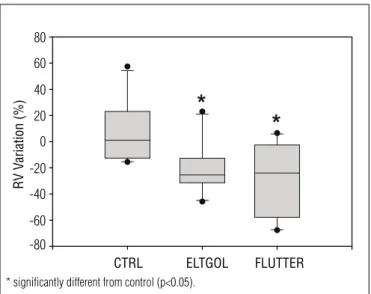
here were no diferences between the percentage varia-tions of FVC, FEV1, FEV1/FVC, FEF25-75%, VC, IC and RV/TLC between ELTGOL, FLUTTER and CTRL. he variables RV (Figure 1), FRC and TLC showed reduction in ELTGOL and FLUTTER when compared to CTRL (Table 3). here was a reduction in IC/TLC only in FLUTTER (Table 3).
Expectorated secretions were obtained from eight pa-tients. The dry weight of secretions was higher (p<0.05) for ELTGOL compared to FLUTTER and CTRL (median; min-max): [0.38; 2.63-0.06 g] vs [0.15; 1.3-0.05 g] vs [0.14; 0.65-0.02 g], respectively.
Discussion
his study showed that both ELTGOL and FLUTTER acutely reduced pulmonary hyperinlation, although ELTGOL was more efective in removing pulmonary secretions of pa-tients with bronchiectasis.
Bronchiectasis evolves with a pulmonary obstructive syndrome in which the RV is typically elevated by airway obstruction and loss of elastic retraction19. his elevation of the RV promotes an increased relationship RV/TLC19 that, in healthy young individuals, is between 0.20-0.25, with values increasing with age but not reaching a maximum of 0.4 in ages above 60 years20.
In our study, patients showed RV/TLC and FRC beyond the normally accepted upper limit, probably due to airway obstruc-tion, with consequent air retention and lung hyperinlation21,21. After the application of the FLUTTER, there was a reduction in FRC, RV and TLC, suggesting that the airway clearance was suicient to reduce pulmonary hyperinlation. his reduction is remarkable as the positive expiratory pressure performed during the evaluated protocols could increase the FRC, as noted by Jones et al.21. It is likely that the positive pressure per-formed during the Flutter intervention stabilized the airways during expiration, avoiding the dynamic collapse and favoring pulmonary delation23.
During the intervention with Flutter, there was no increase in the airway secretions removal when compared to CTRL. Perhaps the time required for the displacement of secretions with FLUTTER is higher than that observed with ELTGOL, causing movement of secretions, but without reaching central airways from where they could be eliminated through cough-ing. his hypothesis is reinforced by the fact the ELTGOL
Table 3. Spirometric and plethysmographic percentual variations in the different interventions.
CTRL ELTGOL FLUTTER
ΔFEV1 1.4 [(-6.3) - (13.3)] 2.2 [(-20.2) - (20.9)] 1.6 [(-6.8) - (21.4)]
ΔFVC 0.2 [(-35.3) - (7.5)] 0.96 [(-11.8) - (22.1)] 2.44 [(-3.9) - (8.1)]
ΔFEV1/FVC 0.8 [(-4) - (5.9)] 0 [(-8.6) - (10.6)] 0.7 [(-11.3) - (19.6)]
ΔFEF25-75 0.43 [(-36.9) - (40.4)] 6 [(-90.51) - (236)] 4.5 [(-21.4) - (160)]
ΔIC 5.70 [(-8.46) - (23.68)] 2.65 [(-15.65) - (27.66)] -3.49 [(-28.47) - (33.78)]
ΔVC -2.35 [(-8.12) - (18.42)] 5.01 [(-8.56) - (22.22)] -2.44 [(-20.76) - (7.33)]
ΔTLC 4.63 [(-7.45) - (12.63)] -9.66 [(-40.03) - (-1.96)]* -18.27 [(-42.83) - (-6.43)]*
ΔFRC 4.26 [(-18.87) - (22.43)] -14.48 [(-55.65) - (-3.60)]* -25.81 [(-52.02) - (-5.14)]*
ΔRV 2.89 [(-8.02) - (35.14)] -18.72 [(-71.85) - (-10.73)]* -29.55 [(-54.66) - (-8.86)]*
ΔRV/TLC 0.81 [(-6.00) - (20.69)] -8.48 [(-25.46) - (113.04)] -5.21 [(-22.81) - (27.59)]
ΔIC/TLC 6.73 [(-17.3) - (21.3)] 17.9 [(-10.2) - (57.8)] 22.8 [(-3.64) - (82.5)]*
∆=percentage difference between post and pre-intervention; FEV1=forced expiratory volume in 1 second; FVC=forced vital capacity; FEF25-75=forced expiratory flow between 25% and 75% of the vital capacity; IC=inspiratory capacity; VC=vital capacity; TLC=total lung capacity; FRC=functional residual capacity; RV=residual volume; *=different from CTRL (p<0.05). Values are median [min – max]. CTRL=control protocol; ELTGOL=ELTGOL intervention; FLUTTER=Flutter VRP1® intervention.
80
60
40
20
0
-20
RV V
ariation (%)
-40
-60
-80
CTRL ELTGOL FLUTTER
Figure 1. Residual volume (RV) percentage variation in control (CTRL), ELTGOL and FLUTTER, considering the pre and post-intervention values. The superior and inferior borders represent the quartiles (percentile 25 and 75, respectively). The internal line is the median, whilst the vertical lines represents the data amplitude/variation.
* significantly different from control (p<0.05).
promotes the narrowing of the airways and, consequently, the increase of gas-liquid interaction, favoring the dynamic drag of the secretions toward central airways7, while the Flutter has as main mechanism the change in secretions rheology, favoring the mucociliary clearance7. Since patients with bronchiectasis present deiciency in mucociliary system, it is possible that the secretions moved slower, even with a change in the rheological properties8. In addition to these factors, during the FLUTTER, bronchial secretions had to move against gravity, while, during the ELTGOL, the patient experienced the two lateral decubitus, which, in theory, could accelerate the mucociliary clearance, with more expressive results in the amount of secretion expec-torated immediately after the application of the technique.
Considering the physiological repercussions compatible with bronchial secretions removal observed in our study, it is likely that a larger sample size and the secretion collec-tion at 30 and 60 min after the intervencollec-tions would provide statistically significant results for the secretion elimination with FLUTTER.
As for spirometry, our findings are consistent with previ-ous studies in which they noted improvement in spirometric values after airway clearance techniques18,24,25. Similarly to our study, Bellone et al.8 did not find significant differences in FEV1 between Flutter®
and ELTGOL in patients with acute exacerbation of chronic bronchitis.8 According to van der Schans6, the use of pulmonary function tests in the short term is a limited method for assessing airway clearance techniques. The compressive effect of the forced maneuver, in addition to the possible presence of secretions in the in-termediate airways26, can justify the absence of significant differences in the spirometric variables observed in several studies. In contrast, the results of the study of Figueiredo, Zin and Guimarães27 demonstrated a reduction in total and peripheral respiratory system resistance after applying the Flutter®27 in patients with bronchiectasis. Additionally, Martins et al.9, found an increase in the peripheral airway clear-ance following the use of ELTGOL in patients with chronic bronchitis. These results could help explain the changes in
static lung volumes observed in our study. Corroborating this hypothesis, Regnis et al.12 found a positive association between mucociliary clearance assessed by radioactive marker and RV/TLC in patients with cystic fibrosis.
Regarding the lung volumes changes in FLUTTER, the decrease in TLC was mainly influenced by a reduction in FRC, with small reduction in IC. This combination promoted a significant reduction in the inspiratory fraction (IC/TLC), since there was a higher reduction in TLC than in IC (-18.27 vs -3.49%). When compared to ELTGOL, this result repre-sents a superiority of the FLUTTER in reducing pulmonary hyperinflation and improving the respiratory mechanics. After ELTGOL an increase in the inspiratory fraction (17.9%) was also noted, however, probably due to the small sample size, these results were not statistically significant.
The main limitations of the present study are: the small sample size, the collection of secretion in only eight of the ten patients and the lack of evaluation of the long term effects of the interventions. Nevertheless, considering the scarcity of studies related to the ELTGOL in the lit-erature, it is believed that our results signalize a possible application of this technique for the treatment of patients with bronchiectasis. The ELTGOL promoted greater se-cretion removal than the FLUTTER, in addition of being a technique of easy administration and low cost. Thus, although the Flutter is largely described and cited in the literature24,28,29, the ELTGOL might be an interesting al-ternative for the treatment of chronic patients requiring therapeutic procedures to increase the removal of lung secretions. However, further studies are needed in order to evaluate other clinically relevant outcomes such as the reduction of exacerbations and the improvement of lung function in the long term to validate the benefits of ELT-GOL in treating hypersecretive patients30.
In conclusion, ELTGOL and Flutter VRP1®
techniques acutely reduced lung hyperinflation, but only the ELTGOL increased the removal of pulmonary secretions from pa-tients with bronchiectasis..
References
1. Cohen M, Sahn SA. Bronchiectasis in systemic diseases. Chest. 1999;116(4):1063-74.
2. O’Donnell AE. Bronchiectasis. Chest. 2008;134(4):815-23.
3. Lopes AJ, Esberard D, Almeida LL, Capone D, Jansen JM. Bronquiectasias: diagnóstico e tratamento. Ars Cvrandi, Rio de Janeiro. 2002;35(5):28-32.
4. Murray MP, Pentland JL, Hill AT. A randomised crossover trial of chest physiotherapy in non-cystic fibrosis bronchiectasis. Eur Respir J. 2009;34(5):1086-92.
5. Wallis C, Prasad A. Who needs chest physiotherapy? Moving from anecdote to evidence. Arch Dis Child. 1999;80(4):393-7.
6. van der Schans CP. Forced expiratory manoeuvres to increase transport of bronchial mucus: a mechanistic approach. Monaldi Arch Chest Dis. 1997;52(4):367-70.
7. Ramos EMC, Ramos D, Yomasa DM, Moreira GL, Melegati KCT, Vanderlei LCM, et al. Influence that oscillating positive expiratory pressure using predetermined expiratory pressures has on the viscosity and transportability of sputum in patients with bronchiectasis. J Bras Pneumol. 2009;35(12):1190-7.
8. Bellone A, Lascioli R, Raschi S, Guzzi L, Adone R. Chest physical therapy in patients with acute exacerbation of chronic bronchitis: effectiveness of three methods. Arch Phys Med Rehabil. 2000;81(5):558-60.
9. Martins JA, de Andrade A, Britto RR, Lara R, Parreira VF. Effect of ELTGOL on mucus clearance in stable patients with chronic bronchitis. Respir Care. 2011. [Epub ahead of print].
10. Kodric M, Garuti G, Colomban M, Russi B, Porta RD, Lusuardi M, et al. The effectiveness of a bronchial drainage technique (ELTGOL) in COPD exacerbations. Respirology. 2009;14(3):424-8.
11. Postiaux G, Lens E, Alsteens G, Portelange P. Efficacité de l’expiration lente totale glotte ouverte en décubitus latéral (ELTGOL): sur la toilette en périphérie de l’arbre trachéobronchique. Ann Kinésithér. 1990;17(3):87-99.
12. Regnis JA, Robinson M, Bailey DL, Cook P, Hooper P, Chan HK, et al. Mucociliary clearance in patients with cystic fibrosis and in normal subjects. Am J Respir Crit Care Med. 1994;150(1):66-71.
13. Konstan MW, Stern RC, Doershuk CF. Efficacy of the Flutter device for airway mucus clearance in patients with cystic fibrosis. J Pediatr. 1994;124(5 Pt 1):689-93.
14. Fink JB, Mahlmeister MJ. High-frequency oscillation of the airway and chest wall. Respir Care. 2002;47(7):797-807.
15. Pereira CAC, Sato T, Rodrigues SC. Novos valores de referência para espirometria forçada em brasileiros adultos de raça branca. J Bras Pneumol. 2007;33(4):397-406.
16. Neder JA, Andreoni S, Castelo-Filho A, Nery LE. Reference values for lung function tests: I. Static volumes. Braz J Med Biol Res. 1999;32(6):703-17.
17. Sociedade Brasileira de Pneumologia e Tisiologia. Diretrizes para testes de função pulmonar. J Bras Pneumol. 2002;28(Supl 3):S1-238.
18. Placidi G, Cornacchia M, Polese G, Zanolla L, Assael BM, Braggion C. Chest physiotherapy with positive airway pressure: a pilot study of short-term effects on sputum clearance in patients with cystic fibrosis and severe airway obstruction. Respir Care. 2006;51(10):1145-53.
19. Janssens JP, Pache JC, Nicod LP. Physiological changes in respiratory function associated with ageing. Eur Respir J. 1999;13(1):197-205.
20. Cotes JE. Lung function in Disease. In: Cotes JE. Lung function: assessment and application in medicine. 5th ed. Oxford: Blackwell Scientific Publications; 1993. p. 514-609.
21. Nomenclature and definitions in respiratory physiology and clinical aspects of chronic lung diseases. Bull Physiopathol Respir (Nancy). 1975;11(6):937-59.
22. Jones A, Tse E, Cheung L, To C, Lo C. Restoration of lung volume using the Flutter VRP1 or breathing exercise. Aust J Physiother. 1997;43(3):183-9.
23. Calverley PM, Koulouris NG. Flow limitation and dynamic hyperinflation: key concepts in modern respiratory physiology. Eur Respir J. 2005;25(1):186-99.
24. McCool FD, Rosen MJ. Nonpharmacologic airway clearance therapies: ACCP evidence-based clinical practice guidelines. Chest. 2006;129(1 Suppl):250S-259S.
25. Osman LP, Roughton M, Hodson ME, Pryor JA. Short-term comparative study of high frequency chest wall oscillation and European airway clearance techniques in patients with cystic fibrosis. Thorax. 2010;65(3):196-200.
26. Cochrane GM, Webber BA, Clarke SW. Effects of sputum on pulmonary function. Br Med J. 1977;2(6096):1181-3.
27. Figueiredo PH, Zin WA, Guimarães FS. Flutter valve improves respiratory mechanics and sputum production in patients with bronchiectasis. Physiother Res Int. 2010. doi: 10.1002/pri.507. [Epub ahead of print].
28. Eaton T, Young P, Zeng I, Kolbe J. A randomized evaluation of the acute efficacy, acceptability and tolerability of Flutter and active cycle of breathing with and without postural drainage in non-cystic fibrosis bronchiectasis. Chron Respir Dis. 2007;4(1):23-30.
29. Swift GL, Rainer T, Saran R, Campbell IA, Prescott RJ. Use of flutter VRP1 in the management of patients with steroid-dependent asthma. Respiration. 1994;61(3):126-9.
30. Martínez-García MA, Soriano JB. Physiotherapy in bronchiectasis: we have more patients, we need more evidence. Eur Respir J. 2009;34(5):1011-2.