J. Braz. Chem. Soc., Vol. 18, No. 5, 1061-1067, 2007.
Printed in Brazil - ©2007 Sociedade Brasileira de Química 0103 - 5053 $6.00+0.00
Article
*e-mail: [email protected]
Microwave-Assisted Rapid and Regioselective Synthesis of
N
-(alkoxycarbonylmethyl)
Nucleobases in Water
Guirong Qu,* Zhiguang Zhang, Haiming Guo, Mingwei Geng and Ran Xia
College of Chemistry and Environmental Science, Henan Normal University, Xinxiang 453007, P. R. China
Foi desenvolvido um método fácil e ambientalmente benigno para a preparação de nucleobases N-(etioxicarbonilmetil) e N-(iso-propoxicarbonilmetil), importantes na construção
de blocos para Ácidos Nucleicos Peptídicos (ANP). Todas as nucleobases são regiosseletivamente alquiladas e os produtos desejados são obtidos com rendimentos moderados a altos, sob irradiação de microondas por 8 minutos em água como solvente e na presença de Et3N como base
A facile and eco-friendly approach has been developed for the preparation of N
-(ethyoxycarbonylmethyl) nucleobases and N-(iso-propoxycarbonylmethyl) nucleobases, which are important building blocks for Peptide Nucleic Acids (PNA). All the nucleobases are regioselectively alkylated and the desired products are obtained in moderate to high yields under microwave irradiation for 8 min in water as the solvent and in the presence of Et3N as the base.
Keywords: modified nucleoside, microwave irradiation, water
Introduction
In order to find out effective, selective, nontoxic antiviral and antitumor drugs, modified nucleosides have become of great interest in recent years, due to their intriguing chemical and pharmacological
properties.1 Carbocyclic nucleosides,2 acyclic
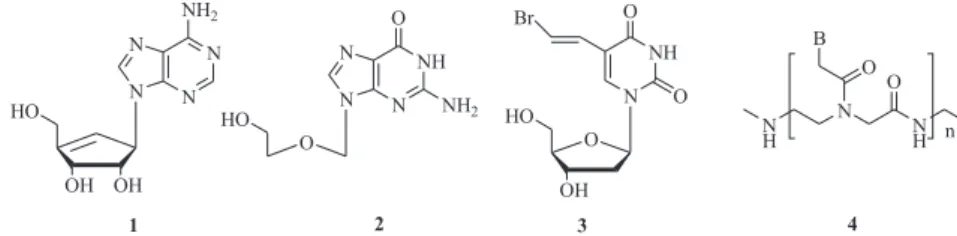
nucleosides,3 5-substituted pyrimidine nucleosides4 and others have been designed and prepared, such as Neplanocin A (1), Acyclovir (2), and BVDU (3) (Figure 1), which exhibited potential biological activities against Human Immunodeficiency Virus (HIV), Herpes Simplex Virus (HSV), Varicella Zoster Virus (VZV), Hepatitis B Virus (HBV) and so on. In 1991, Nielsen and coworkers reported a novel synthetic mimic of DNA in which the sugar-phosphate backbone of natural
nucleic acid was replaced with a polyamide backbone,
named Peptide Nucleic Acids (PNA, 4).5 PNA can
hybridize to complementary DNA, RNA, or PNA, and exhibit higher thermal stability and better sequence discrimination than DNA. Therefore, PNA has attracted wide attention in medicinal chemistry for the development of biosensors and gene therapeutic drugs, and a number of groups have developed several methods for the preparation of the monomers and submonomers of PNA, including ours.6 However, some drawbacks also exist in the reported methods. For example, low yields and poor regioselectivity are frequently encountered. What is more, long reaction time up to 24 h, inert gas atmosphere, harsh reaction conditions, and toxic solvents are usually required, which do not meet the requirement of green chemistry.7
Figure 1. Structures of some modified nucleosides.
1062 Microwave-assisted Rapid and Regioselective Synthesis of N-(alkoxycarbonylmethyl) J. Braz. Chem. Soc.
In order to expand our interest in the modification of nucleoside and obtain the submonomers in higher yields under milder reaction conditions in shorter reaction time, we turned our attention to microwave
irradiation (MWI).8 Microwave assisted organic
synthesis has been widely utilized in recent years for the formation of a variety of carbon and carbon-heteroatom bonds, which usually lead to a remarkable decrease in reaction time, enhancement in yields, easier workup, and better regioselectivity.9 However, only a few methods were reported to obtain these modified nucleoside analogues under MWI.10 Herein, we report a rapid, convenient, and green protocol for the synthesis of the N-(ethoxycarbonylmethyl) nucleobases and N -(iso-propoxycarbonylmethyl) nucleobases, building blocks for Peptide Nucleic Acids.
Results and Discussion
Initially, we selected uracil (5a) and ethyl
chloroacetate (6a) as a model system to investigate the
effect of solvents, bases, and irradiation time on the yield. DMF is an excellent solvent to absorb microwave energy and dissolve the nucleobase, for its high polarity. However, dark reaction mixture and poor yield were obtained, indicating side reactions had occurred (entry 1). Using CH3CN as solvent also did not give rise to high yield, in which uracil had poor solubility, so 52% yield was achieved, associated with N3-alkylated product (entry 2). To our surprise, uracil was exclusively alkylated at N1, and 7a was obtained in satisfactory yield by using
water as the solvent in the presence of K2CO3 as the
base (entry 3), suggesting this method was highly regioselective. Water is a promising medium to replace volatile organic solvent11 and a good absorber for microwave energy. Water, in combination with microwave irradiation, makes our procedure highly cost-effective and benign to the environment. More importantly, this strategy has been successfully applied to several kinds of reactions.12
The influence of base also played an important role in the yield. Lower yield was obtained by using NaOH as the base, maybe the strong base could speed up the hydrolysis of ethyl chloroacetate, especially in boiling water (entry 4). Therefore, weaker bases were employed subsequently. To our delight, obvious changes in yield were observed when DMAP (4-Dimethylaminopyridine) (entry 5), DABCO (1,4-Diazabicyclo[2.2.2]octane) (entry 6), NaHCO3 (entry 7) and TEA (Triethylamine) (entry 8) were evaluated. At last, TEA became the best of choice because it was very cheap and easily available. It is also worthy to mention that it is unnecessary to neutralise the excess TEA after reaction, since it can be easily removed in vacuum because of its low boiling point (88.8 oC), which could simplify the workup and present an additional synthetic advantage. Changing irradiation time had significant effect on the yield too (entries 8, 9). However, it seemed that the reaction reached the chemical equilibrium after irradiation for 8 min (entry 10), because only slight change in yield was detected when longer reaction time than 8 min was adopted (entry 11).
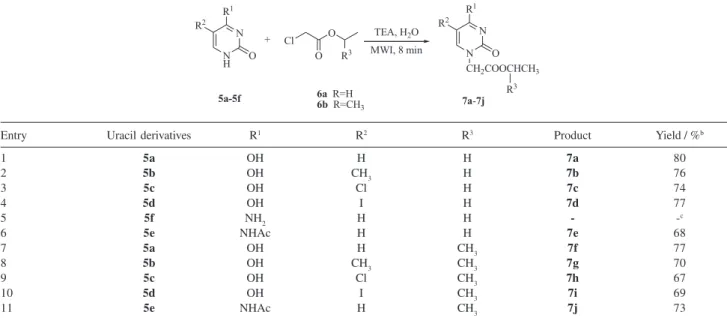
With this promising system in hand, we extended the substrate scope to other uracil derivatives, as outlined in Table 2.
Table 1. Optimization of reaction conditions under MWIa
NH N H O O Cl O O + Base MWI NH N O O CH2COOCH2CH3
5a 6a 7a
Entry Solvent Base Irradiation time / min Yield / %b
1 DMF K2CO3 4 30
2 CH3CN K2CO3 5 52
3 H2O K2CO3 5 60
4 H2O NaOH 5 47
5 H2O DMAP 5 65
6 H2O DABCO 5 67
7 H2O NaHCO3 5 61
8 H2O TEA 5 68
9 H2O TEA 7 74
10 H2O TEA 8 80
11 H2O TEA 9 79
1063 Qu et al.
Vol. 18, No. 5, 2007
To our delight, all the uracil derivatives were exclusively alkylated at N1, confirmed by HMBC spectra. Treatment of nucleobases with iso-propyl chloroacetate (6b) under the same conditions as ethyl chloroacetate (6a)
successfully afforded corresponding products in moderate yields. Substituting 5-H in 5a with Cl, CH3, or I had little
influence on the yield, indicating the substitutent-effect was not obvious (entries 1-4, 7-10).13 It was necessary to protect the exocyclic amino group of cytosine (5f, entry
5), because more than three new spots were detected by TLC. As a result, N4-acetyl cytosine (5e) was utilized as the precursor of cytosine in order to prevent side reactions,
Table 2. Microwave-assistted alkylation of uracil derivativesa
N N H R1 O R2 Cl O O R3
+ TEA, H2O N
N R1
O R2
CH2COOCHCH3 MWI, 8 min
R3
5a-5f 6aR=H
6b R=CH3 7a-7j
Entry Uracil derivatives R1 R2 R3 Product Yield / %b
1 5a OH H H 7a 80
2 5b OH CH3 H 7b 76
3 5c OH Cl H 7c 74
4 5d OH I H 7d 77
5 5f NH2 H H - -c
6 5e NHAc H H 7e 68
7 5a OH H CH3 7f 77
8 5b OH CH3 CH3 7g 70
9 5c OH Cl CH3 7h 67
10 5d OH I CH3 7i 69
11 5e NHAc H CH3 7j 73
Reaction conditions: 5a-5f (2 mmol), 6 (6 mmol), TEA (4 mmol), H2O (5 mL), aMWI 250 W (105 oC); bIsolated yield after silica gel column chromato-graphy; cThe desired product was not obtained.
and then alkylation of 5e as described above afforded 7e
and 7j in 68% and 73% yield (entries 6 and 11),
respectively.
Application of this procedure to a series of purine derivatives also proved to be successful. The desired products in moderate to high yields were also obtained, as described in Table 3. Gratifyingly, this method gave N9-alkylated products, uncontaminated with N7-alkylated products. Maybe N9 position has higher electron density than N7. As was expected, the replacement of 6a with 6b
resulted in minor changes in yields. It could be concluded that the alkyl side chains in chloroacetate could not
Table 3. Alkylation of purine derivatives in the presence of TEA under MWIa
N N N H N R1 R2 Cl O O R3
+ TEA, H2O
MWI, 8 min
N N N N R1 R2
CH2COOCHCH3
R3
8a-8d 6a6bR=HR=CH
3 9a-9g
Entry Purine derivatives R1 R2 R3 Product Yield / %b
1 8a Cl H H 9a 72
2 8b Cl Cl H 9b 70
3 8c NH2 H H 9c -c
4 8d benzylamino H H 9d 78
5 8a Cl H CH3 9e 69
6 8b Cl Cl CH3 9f 74
7 8d benzylamino H CH3 9g 81
aReaction conditions: 8a-8d (2 mmol), 6 (6 mmol), TEA (4 mmol), H
1064 Microwave-assisted Rapid and Regioselective Synthesis of N-(alkoxycarbonylmethyl) J. Braz. Chem. Soc.
influence their electrophilic reactivities. When 2-H in 8a
was substituted by Cl, only neglectable variations in yield were detected (entries 1, 2 and 5, 6). The exocyclic amino group of adenine was also necessary to protect (entry 3),14 because only trace amount of desired product was obtained. Treatment of 6-chloro purine with benzyl amine under the same conditions as we reported8 afforded N6-benzylamino purine (8d) in 86% yield. Then alkylation
of it as described above gave rise to 9d and 9g in 76% and
80% yields, respectively (entries 4 and 7).
Finally, the formation of 7a and 9a was conducted in
a pre-heated oil bath (105 °C) under the identical conditions as the microwave method in order to evaluate the effectiveness of our method in comparison with conventional heating method, as shown in Table 4. It had been found that the reaction proceeded with only 12% yield of 7a and 16% yield of 9a after 8 min, 52% and
56% after 6 h, demonstrating clearly that our method is superior to the conventional method.
Conclusions
In conclusion, we have developed a rapid, facile, and environmentally benign protocol for the preparation of N -(alkoxycarbonylmethyl) nucleobases, which are important building blocks for PNA. All the products are achieved in moderate to high yields, as well as high regioselectivity, assisted by MWI in water as the solvent. Our method has several advantages in terms of yields, mild reaction conditions, short reaction time, and lack of side products. Extension of this method to synthesize other submonomers of PNA is currently in progress in our laboratory.
Experimental
All reagents and solvents were purchased from commercial sources and used without further purification.
The nucleobases were a gift from Xinxiang Tuoxin
Biochemical Technology & Science Co. Ltd, P. R. China. Melting points were determined with an XRC-1 micro melting point apparatus and are uncorrected. 1H
and 13C NMR spectra were recorded in DMSO-d
6 solutions on a Bruker DPX-400 spectrometer (at 400 MHz and 100 MHz, respectively) using TMS as internal
standard. Chemical shifts (δ) were expressed in ppm and coupling constants (J) were given in Hz. Mass spectra were taken with a JEOL JMS-DX302 mass spectrometer. Elemental analyses were performed on an EA-1110 (CE Instruments) instrument. All reactions were performed in a commercially available single-mode microwave apparatus equipped with a high sensitivity IR sensor for temperature control and measurement (MAS-I, Sineo Microwave Chemical Technology Co. Ltd., Shanghai, P. R. China).
General procedure for the synthesis of 1-(ethoxycarbonyl-methyl) uracil (7a)
To a mixture of uracil (2 mmol, 0.224 g) and TEA (0.56 mL, 4 mmol) in neat water (5 mL), ethyl chloroacetate (0.65 mL, 6 mmol) was added. Then the mixture was irradiated under reflux at 250 W (105 °C) for 8 min. Subsequently, the reaction mixture was concentrated to dryness under reduced pressure and the residue was purified by column chromatography (EtOAc-EtOH 95:5) to afford 7a in 80% yield.
The preparation of N6-benzylamino purine (8d)
Benzylamine (12 mmol) was added to a stirred suspension of 6-chloropurine (5 mmol) in water (10 mL) in a 50 mL round-bottomed flask. After vibration, the flask was moved into microwave oven and irradiated at 200 W for 10 min. After the reaction completed, the solvent and excess benzylamine were removed in vacuum. The crude product was purified by column chromatography using ethyl acetate as eluent to afford 8d in 84% yield.
1-(Ethoxycarbonylmethyl) uracil (7a)
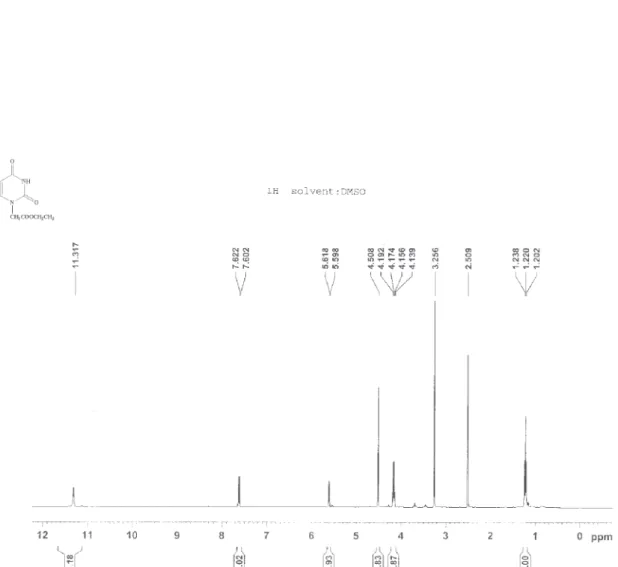
White crystals; mp 135-136 °C; 1H NMR: δ 1.22 (t, 3H, J 7.2, CH3), 4.165 (q, 2H, J 7.2, OCH2), 4.508 (s, 2H, NCH2), 5.608 (d, 1H, J 8, 5-H), 7.612 (d, 1H, J 8, 6-H), 11.317 (s, 1H, 3-H).
1-(Ethoxycarbonylmethyl) thymine (7b)
Colorless needle crystals; mp 170-171 °C; 1H NMR:
δ1.22 (t, 3H, J 7.2, CH2CH3), 1.771 (s, 3H, 5-CH3), 4.163 (q, 2H, J 7.2, OCH2), 4.465 (s, 2H, NCH2), 7.492 (s, 1H, 6-H), 11.31 (s, 1H, 3-H).
5-Chloro-1-(ethoxycarbonylmethyl) uracil (7c)
Pale yellow crystals; mp 168-170 °C; 1H NMR: δ 1.21 (t, 3H, J 7.2, CH3), 4.161 (q, 2H, J 7.2, OCH2), 4.508 (s, 2H, NCH2), 8.157 (s, 1H, 6-H), 11.985 (s, 1H, 3-H); 13C NMR: δ 14.16 (CH3), 48.89 (NCH2), 61.51 (OCH2),
Table 4. Yields of 7a and 9a, obtained by the conventional heating method
Product time / min Yield / %a time / h Yield / %a
7a 8 12 6 52
9a 8 16 6 56
1065 Qu et al.
Vol. 18, No. 5, 2007
106.45 (5-C), 143.27 (6-C), 150.23 (2-C), 159.58 (4-C), 167.97 (C=O); HR-MS calc. for C8H9ClN2O4 232.0251, found 232.0243; Anal. calc. for C8H9ClN2O4 forC 41.31, H 3.90, N 12.04; found C 41.26, H 3.78, N 12.12.
1-(Ethoxycarbonylmethyl)-5-iodo uracil (7d)
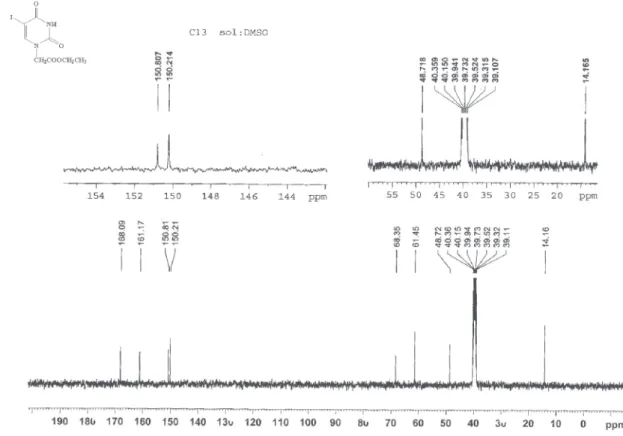
White powder; mp 158-160 °C; 1H NMR: δ1.207 (t, 3H, J 7.2, CH3), 4.154 (q, 2H, J 7.2, OCH2), 4.501 (s, 2H, NCH2), 8.204 (s, 1H, 6-H), 11.787 (s, 1H, 3-H).
N4-Acetyl-1-(ethoxycarbonylmethyl) cytosine (7e)
Colorless crystals; mp 190-191 °C; 1H-NMR:
δ1.217 (t, 3H, J 7.2, CH2CH3); 2.117 (s, 3H, COCH3), 4.161 (q, 2H, J 7.2, OCH2), 4.621 (s, 2H, NCH2), 7.189 (d, 1H, J 7.2, 5-H), 8.044 (d, 1H, J 7.2, 6-H), 10.816 (s, 1H, 3-H).
1-(Iso-propoxycarbonylmethyl) uracil (7f)
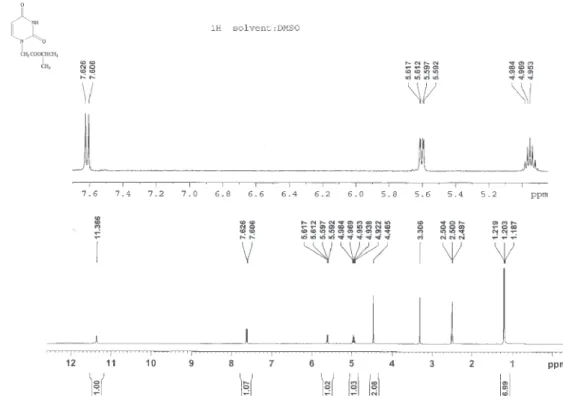
Colorless crystals; mp 134-135 °C; 1H NMR: δ 1.203 (t, 6H, J 7.2, CH3), 4.465 (s, 2H, NCH2), 4.953 (m, 1H, OCH), 5.608 (q, 1H, J 8 and 2, 5-H), 7.616 (d, 1H, J 8, 6-H), 11.366 (s, 1H, 3-H).
1-(Iso-propoxycarbonylmethyl) thymine (7g)
White powder; mp 159-160 °C; 1H NMR: δ 1.203 (t, 6H, J 7.2, CH(CH3)2), 1.757 (d, 3H, J 0.4, 5-CH3), 4.42 (s, 2H, NCH2), 4.949 (m, 1H, OCH), 7.497 (d, 1H, J 0.4, 6-H), 11.352 (s, 1H, 3-H); 13C NMR: δ 12.03 (5-CH
3), 21.67 (CH(CH3)2), 48.74 (NCH2), 69.06 (OCH), 108.65 (5-C), 141.78 (6-C), 151.09 (2-C), 164.47 (4-C), 167.88 (C=O); HR-MS calc. for C10H14N2O4: 226.0954, found: 226.0948; Anal. calc. for C10H14N2O4: C 53.09, H 6.24, N 12.38; found: C 52.98, H 6.19, N 12.31.
5-Chloro-1-(iso-propoxycarbonylmethyl) uracil (7h) Colorless column crystals; mp 176-177 °C; 1H NMR:
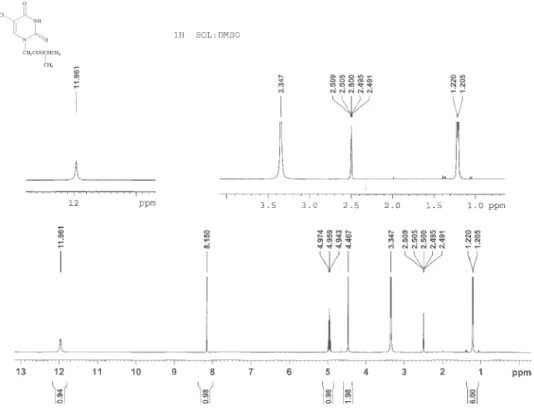
δ 1.212 (d, 6H, J 6, CH3), 4.467 (s, 2H, NCH2), 4.959 (t, 1H, J 6, OCH), 8.15 (s, 1H, 6-H), 11.961 (s, 1H, 3-H); 13C NMR: δ 21.64 (CH(CH3)2), 49.05 (NCH2), 69.36 (OCH), 106.42 (5-C), 143.3 (6-C), 150.23 (2-C), 159.6 (4-C), 167.46 (C=O); HR-MS calc. for C9H11ClN2O4: 246.0407, found: 246.0396; Anal. calc. for C9H11ClN2O4: C 43.83, H 4.50, N 11.36; found: C 43.70, H 4.45, N 11.30.
5-Iodo-1-(iso-propoxycarbonylmethyl) uracil (7i) Colorless column crystals; mp 220-221 °C; 1H NMR:
δ 1.212 (d, 6H, J 6.4, CH3), 4.463 (s, 2H, NCH2), 4.955 (m, 1H, OCH), 8.205 (s, 1H, 6-H), 11.77 (s, 1H, 3-H); 13C NMR: δ21.66 (CH(CH3)2), 48.87 (NCH2), 68.24 (OCH), 69.27 (5-C), 150.26 (6-C), 150.81 (2-C), 161.17 (4-C), 167.58 (C=O); HR-MS calc. for C9H11IN2O4: 337.9763,
found: 337.9755; Anal. calc. for C9H11IN2O4: C 31.97, H 3.28, N 8.29; found: C 31.89, H 3.20, N 8.25.
N4-acetyl-1-(iso-propoxycarbonylmethyl) cytosine (7j) Colorless column crystals; mp 176-178 °C; 1H NMR:
δ 1.207 (d, 6H, J 6.4, CH(CH3)2), 2.102 (s, 3H, COCH3), 4.579 (s, 2H, NCH2), 4.952 (m, 1H, OCH), 7.19 (d, 1H, J 7.2, 5-H), 8.045 (d, 1H, J 7.2, 6-H), 10.877 (s, 1H, NH); 13C NMR: δ 21.67 (CH(CH
3)2), 24.5 (COCH3), 50.96 (NCH2), 69.01 (OCH), 95.29 (5-C), 150.79 (6-C), 155.34 (2-C), 163.12 (4-C), 167.57 (C=O), 171.11 (CCH3); HR-MS calc. for C11H15N3O4: 253.1063, found: 253.1051; Anal. calc. for C11H15N3O4: C 52.17, H 5.97, N 16.59; found: C 52.11, H 5.91, N 16.64.
6-Chloro-9-(ethoxycarbonylmethyl) purine (9a)
Colorless sheet crystals; mp 97-98 °C; 1H NMR: δ1.215 (t, 3H, J 7.2, CH3), 4.189 (q, 2H, J 7.2, OCH2), 5.721 (s, 2H, NCH2), 8.683 (s, 1H, 2-H), 8.978 (s, 1H, 8-H).
2, 6-Dichloro-9-(ethoxycarbonylmethyl) purine (9b) White powder; mp 112-113 °C; 1H NMR: δ 1.235 (t, 3H, J 7.2, CH3), 4.214 (q, 2H, J 7.2, OCH2), 5.248 (s, 2H, NCH2), 8.706 (s, 1H, 8-H).
6-Benzylamino-9-(ethoxycarbonylmethyl) purine (9d) White powder; mp 182-183 °C; 1H NMR: δ 1.224 (t, 3H, J 7.2, CH3), 4.182 (q, 2H, J 7.2, OCH2), 4.77 (br s, 2H, PhCH2), 5.078 (s, 2H, NCH2), 7.197~7.375 (m, 5H, Ph), 8.137 (s, 1H, 8-H), 8.2 (s, 1H, 2-H), 8.251 (s, 1H, NH).
6-Chloro-9-(iso-propoxycarbonylmethyl) purine (9e) Colorless sheet crystals; mp 142-144 °C; 1H NMR:
δ1.216 (d, 6H, J 6, CH3), 4.983 (m, 1H, OCH), 5.234 (s, 2H, NCH2), 8.684 (s, 1H, 8-H), 8.792 (s, 1H, 2-H); 13C NMR: δ 21.61 (CH(CH3)2), 45 (NCH2), 69.76 (OCH), 130.65 (5-C), 148.08 (8-C), 149.33 (4-C), 152 (6-C), 152.33 (2-C), 166.97 (C=O); HR-MS calc. for C10H11ClN4O2: 254.0571, found: 254.0561; Anal. calc. for C10H11ClN4O2: C 47.16, H 4.35, N 22.00; found: C 47.08, H 4.29, N 22.08.
2,6-Dichloro-9-(iso-propoxycarbonylmethyl) purine (9f) Yellow powder; mp 109-110 °C; 1H NMR: δ1.227 (d, 6H, J 6, CH3), 4.997 (m, 1H, OCH), 5.207 (s, 2H, NCH2), 8.701 (s, 1H, 2-H); 13C NMR: δ21.6 (CH(CH
1066 Microwave-assisted Rapid and Regioselective Synthesis of N-(alkoxycarbonylmethyl) J. Braz. Chem. Soc.
N6-benzylamino-9-(iso-propoxycarbonylmethyl) purine (9g) Colorless sheet crystals; mp 179-180 °C; 1H NMR:
δ1.218 (d, 6H, J 6, CH3), 4.723 (br s, 2H, PhCH2), 4.969 (m, 1H, OCH), 5.037 (s, 2H, NCH2), 7.186~7.358 (m, 5H, Ph), 8.135 (s, 1H, 8-H), 8.191 (s, 1H, 2-H), 8.318 (s, 1H, NH); 13C NMR: δ21.66 (CH(CH
3)2), 42.83 (PhCH2), 44.26 (NCH2), 69.35 (OCH), 117.4 (5-C), 126.76 (Ph), 127.32 (Ph), 128.35 (Ph), 140.3 (8-C), 141.4 (4-C), 152.73 (2-C), 154.57 (6-C), 167.58 (C=O); HR-MS calc. for C17H19N5O2: 325.1539, found: 325.1525; Anal. calc. for C17H19N5O2: C 62.75, H 5.89, N 21.52; found: C 62.68, H 5.80, N 21.60.
Acknowledgments
We are grateful for financial support from the National Natural Science Foundation of China (No. 20372018).
Supplementary Information
General procedure, characterization of all compounds
and 1H NMR, 13C NMR of selected compounds, are
available free of charge at http://jbcs.sbq.org.br, as PDF file.
References
1. Bisacchi, G. S.; Singh, J.; Godfrey, J. D.; Kissick, T. P.; Mitt, T.; Malley, M. F.; Di Marco, J. D.; Gougoutas, J. Z.; Mueller, R. H.; Zahler, R.; J. Org. Chem.1995, 60, 2902; Ewing, D.;
Glacon, V.; Mackenzie, G.; Postel, D.; Len, C.; Tetrahedron Lett.2002, 43, 3503; Paoli, M. L.; Piccini, S.; Rodriquez,
M.; Sega, A.; J. Org. Chem.2004, 69, 2881; Boesen, T.;
Madsen, C.; Pedersen, D. S.; Nielsen, B. M.; Petersen, A. B.; Petersen, M. A.; Munck, M.; Henriksen, U.; Nielsen, C.; Dahl, O.; Org. Biomol. Chem.2004, 2, 1245; Robins,
M. J.; Hatfield, P. W.; Can. J. Chem. 1982, 60, 547;
Chiacchio, U.; Rescifina, A.; Iannazzo, D.; Romeo, G.; J. Org. Chem. 1999, 64, 28; Geen, G. R.; Kincey, P. M.; Tetrahedron Lett.1992, 33, 4609; Garg, R.; Gupta, S. P.;
Gao, H.; Babu, M. S.; Debnath, A. K.; Hansch, C.; Chem. Rev.1999, 99, 3525; Agrofoglio, L. A.; Gillaizeau, I.; Saito,
Y.; Chem. Rev.2003, 103, 1875.
2. Haines, D. R.; Tseng, C. K. H.; Marquez, V. E.; J. Med. Chem.
1987, 30, 943; Theil, F.; Ballschuh, S.; Flatau, S.;
Janta-Lipinski, M.; Matthes, E.; Bioorg. Med. Chem.1998, 6, 701;
Li, F.; Brogan, J. B.; Gage, J. L.; Zhang, D.; Miller, M. J.; J. Org. Chem.2004, 69, 4538.
3. Kumar, R.; Nath, M.; Tyrrell, D. L. J.; J. Med. Chem.2002,
45, 2032; Amblard, F.; Nolan, S. P.; Gillaizeau, I.; Agrofoglio,
L.A.; Tetrahedron Lett.2003, 44, 9177; Suwiñski, J.; Walczak,
K.; Synthesis2001, 225; Jeffery, A. L.; Kim, J.-H.; Wiemer,
D. F.; Tetrahedron2000, 56, 5077; Nguyen, C.; Ruda, G. F.;
Schipani, A.; Kasinathan, G.; Leal, I.; Musso-Buendia, A.; Kaiser, M.; Brun, R.; Ruiz-Perez, L. M.; Sahlberg, B.-L.; Johansson, N. G.; Gonzalez-Pacanowska, D.; Gilbert, I. H.;
J. Med. Chem.2006, 49, 4183.
4. Sajiki, H.; Yamada, A.; Yasunaga, K.; Tsunoda, T.; Amer, M. F. A.; Hirota, K.; Tetrahedron Lett.2003, 44, 2179; Petricci, E.;
Radi, M.; Corelli, F.; Botta, M.; Tetrahedron Lett.2003, 44,
9181; Larock, R. C.; Wang, Y.; Dong, X.; Yao, T.; Tetrahedron
2005, 61, 11427; Asakura, J.; Robins, M. J.; J. Org. Chem.
1990, 55, 4928; Ali, H.; Ahmed, N.; Tessier, G.; Lier, J. E.; Bioorg. Med. Chem. Lett.2006, 16, 317; De Clercq, E.;
Descamps, J.; Balzarini, J.; Giziewicz, J.; Barr, P. J.; Robins, M. J.; J. Med. Chem.1983, 26, 661.
5. Nielsen, P. E.; Egholm, M.; Berg, R. H.; Buchardt, O.; Science
1991, 254, 1497; Nielsen, P. E.; Acc. Chem. Res.1999, 32,
624; Hyrup, B.; Egholm, M.; Nielsen, P. E.; Wittung, P.; Norden, B.; Buchardt, O.; J. Am. Chem. Soc.1994, 116, 7964; Dueholm,
K. L.; Egholm, M.; Behrens, C.; Christensen, L.; Hansen, H. F.; Vulpius, T.; Petersen, K. H.; Berg, R. H.; Nielsen, P. E.; Buchardt, O.; J. Org. Chem.1994, 59, 5767; Egholm, M.;
Buchardt, O.; Nielsen, P. E.; Berg, R.H.; J. Am. Chem. Soc.
1992, 114, 1895.
6. Kosynkina, L.; Wang, W.; Liang, T.C.; Tetrahedron Lett.
1994, 35, 5173; Thomson, S. A.; Josey, J. A.; Cadilla, R.;
Gaul, M. D.; Hassman, C. F.; Luzzio, M. J.; Pipe, A. J.; Reed, K. L.; Ricca, D. J.; Wiethe, R. W.; Noble, S.A.; Tetrahedron
1995, 51, 6179; Hudson, R. H. E.; Viirre, R. D.; McCourt,
N.; Tse, J.; Nucleosides, Nucleotides, Nucleic Acids2003,
22, 1029; Sood, G.; Schwalbe, C. H.; Fraser, W.; Acta Crystallogr. 1998, 54, 1907; Hudson, R. H. E.; Li, G.; Tse,
J.; Tetrahedron Lett.2002, 43, 1381; Qu, G.-R.; Li, Y.; Han,
S.-H.; J. Chem. Res.2005, 167; Will, D. W.; Breipohl, G.; Langner, D.; Knolle, J.; Uhlmann, E.; Tetrahedron 1995,
51, 12069; Gasser, G.; Belousoff, M. J.; Bond, A. M.;
Spiccia, L.; J. Org. Chem. 2006, 71, 7565.
7. Anastas, P. T.; Warner, J. C.; Green Chemistry: Theory and Practice, Oxford University Press: Oxford, 1998.
8. Qu, G.-R.; Han, S.-H.; Zhang, Z.-G.; Geng, M.-W.; Xue, F.;
Can. J. Chem.2006, 84, 819; Qu, G.-R.; Geng, M.-W.; Han,
S.-H.; Zhang, Z.-G.; Xue, F.; Chin. Chem. Lett.2006, 17, 1149;
Qu, G.; Han, S.; Zhang, Z.; Geng, M.; Xue, F.; J. Braz. Chem. Soc.2006, 17, 915.
9. Khalafi-Nezhad, A.; Soltani Rad, M. N.; Hakimelahi, G. H.;
Helv. Chim. Acta2003, 86, 2396; Kappe, C.O.; Angew. Chem., Int. Ed.2004, 43, 6250; Varma, R.S.; Green Chem.1999, 1,
43; Loupy, A.; Microwaves in Organic Synthesis, Wiley-VCH:
Weinheim, 2002, p.147; Nuchter, M.; Ondruschka, B.; Bonrath, W.; Gumb, A.; Green Chem.2004, 6, 128; Cao, J.; Lai,
Y.-Y.; Cao, H.; Xing, X.-N.; Wang, X.; Xiao, W.-J.; Can. J. Chem.
1067 Qu et al.
Vol. 18, No. 5, 2007
10. Le, H. P.; Muller, C. E.; Bioorg. Med. Chem. Lett.2006, 16,
6139; Peyrottes, S.; Gallier, F.; Bejaud, J.; Perigaud, C.;
Tetrahedron Lett.2006, 47, 7719; Guezguez, R.; Bougrin,
K.; El Akri, K.; Benhida, R.; Tetrahedron Lett.2006, 47,
4807; Paolini, L.; Petricci, E.; Corelli, F.; Botta, M.;
Synthesis2003, 1039; Varma, R. S.; Lamture, J.B.; Varma,
M.; Tetrahedron Lett.1993, 34, 3029; Khalafi-Nezhad, A.;
Zarea, A.; Soltani Rad, M. N.; Mokhtari, B.; Parhami, A.;
Synthesis2005, 419; Lanver, A.; Schmalz H.-G.; Molecules
2005, 10, 508; Khalafi-Nezhad, A.; Soltani Rad, M.N.;
Khoshnood, A.; Synthesis2004, 583.
11. Kormos, C. M.; Leadbeater, N. E.; Synlett2006, 1663; Gellis,
A.; Boufatah, N.; Vanelle, P.; Green Chem.2006, 8, 483;
Miyazawa, A.; Saitou, K.; Tanaka, K.; Gadda, T. M.; Tashiro, M.; Prakashb, G. K. S.; Olah, G.A.; Tetrahedron Lett.2006,
47, 1437; Arvela, R. K.; Leadbeater, N. E.; Mack, T. L.;
Kormos, C.M.; Tetrahedron Lett.2006, 47, 217; Sharma,
A.; Kumar, V.; Sinha, A.K.; Adv. Synth. Catal. 2006, 348,
354; Ju, Y.; Kumar, D.; Varma, R.S.; J. Org. Chem.2006,
71, 6697; Paul, S.; Gupta, M.; Singh, P. P.; Gupta, R.; Loupy,
A.; Synth. Commun.2005, 35, 325.
12. Li, C. J.; Chan, T. H.; Organic Reactions in Aqueous Media,
John Wiley: New York, 1997; Ju, Y.; Varma, R. S.; Org. Lett.
2005, 7, 2409; Li, C.-J.; Chem. Rev.2005, 105, 3095;
Surendra, K.; Krishnaveni, N. S.; Sridhar, R.; Rao, K.R.; J. Org. Chem. 2006, 71, 5819; Yang, S.-C.; Hsu, Y.-C.; Gan,
K.-H.; Tetrahedron2006, 62, 3949; Barnard, T. M.; Vanier, G.
S.; Collins, M. J.; Org. Process Res. Dev. 2006, 10, 1233.
13. Khalafi-Nezhad, A.; Zare, A.; Parhami, A.; Soltani Rad, M. N.; Nejabat, G. R.; Can. J. Chem.2006, 84, 979.
14. Davies, R. G.; Gibson, V. C.; Hursthouse, M. B.; Light, M. E.; Marshall, E. L.; North, M.; Robson, D. A.; Thompson, I.; White, A. J. P.; Williams, D. J.; Williams, P. J.; J. Chem. Soc., Perkin Trans. 1,2001, 3365.
Received: January 24, 2007
J. Braz. Chem. Soc., Vol. 18, No. 5, S1-S14, 2007. Printed in Brazil - ©2007 Sociedade Brasileira de Química 0103 - 5053 $6.00+0.00
Supplementary Information
*e-mail: [email protected]
Microwave-assisted Rapid and Regioselective Synthesis of
N
-(alkoxycarbonylmethyl)
Nucleobases in Water
Guirong Qu,* Zhiguang Zhang, Haiming Guo, Mingwei Geng and Ran Xia
College of Chemistry and Environmental Science, Henan Normal University, Xinxiang 453007, P. R. China
S2 Microwave-assisted Rapid and Regioselective Synthesis of N-(alkoxycarbonylmethyl) J. Braz. Chem. Soc.
Figure S2.1H NMR spectrum of compound 7b (400 MHz, DMSO-d 6).
S3 Qu et al.
Vol. 18, No. 5, 2007
Figure S4.13C NMR spectrum of compound 7c (100 MHz, DMSO-d 6).
S4 Microwave-assisted Rapid and Regioselective Synthesis of N-(alkoxycarbonylmethyl) J. Braz. Chem. Soc.
Figure S6.13C NMR spectrum of compound 7d (100 MHz, DMSO-d 6).
S5 Qu et al.
Vol. 18, No. 5, 2007
Figure S8.1H NMR spectrum of compound 7f (400 MHz, DMSO-d 6).
S6 Microwave-assisted Rapid and Regioselective Synthesis of N-(alkoxycarbonylmethyl) J. Braz. Chem. Soc.
Figure S10.13C NMR spectrum of compound 7g (100 MHz, DMSO-d 6).
S7 Qu et al.
Vol. 18, No. 5, 2007
Figure S12.13C NMR spectrum of compound 7h (100 MHz, DMSO-d 6).
S8 Microwave-assisted Rapid and Regioselective Synthesis of N-(alkoxycarbonylmethyl) J. Braz. Chem. Soc.
Figure S14.1H NMR spectrum of compound 7i (400 MHz, DMSO-d 6).
S9 Qu et al.
Vol. 18, No. 5, 2007
Figure S16.1H NMR spectrum of compound 7j (400 MHz, DMSO-d 6).
S10 Microwave-assisted Rapid and Regioselective Synthesis of N-(alkoxycarbonylmethyl) J. Braz. Chem. Soc.
Figure S18.1H NMR spectrum of compound 9a (400 MHz, DMSO-d 6).
S11 Qu et al.
Vol. 18, No. 5, 2007
Figure S20.1H NMR spectrum of compound 9d (400 MHz, DMSO-d 6).
S12 Microwave-assisted Rapid and Regioselective Synthesis of N-(alkoxycarbonylmethyl) J. Braz. Chem. Soc.
Figure S22.13C NMR spectrum of compound 9e (100 MHz, DMSO-d 6).
S13 Qu et al.
Vol. 18, No. 5, 2007
Figure S24.13C NMR spectrum of compound 9f (100 MHz, DMSO-d 6).
S14 Microwave-assisted Rapid and Regioselective Synthesis of N-(alkoxycarbonylmethyl) J. Braz. Chem. Soc.