Licenciado sob uma Licença Creative Commons DOI: http://dx.doi.org.10.1590/0103-5150.028.001.AO06
[T]
Does the heel-rise test explain functional
capacity in venous insufficiency?
[I]
O teste da ponta do pé prediz capacidade
funcional na insuiciência venosa?
[A]
Danielle Aparecida Gomes Pereira[a], Ana Clara Ribeiro Lages[b], Marluce Lopes Basílio[c], Monize Cristine de Oliveira Pires[c], Débora Pantuso Monteiro[b], Túlio Pinho Navarro[d]* [a] Universidade Federal de Minas Gerais (UFMG), Departamento de Fisioterapia, Belo Horizonte, MG, Brazil [b] Universidade Federal de Minas Gerais (UFMG), Hospital das Clínicas, Belo Horizonte, MG, Brazil
[c] Universidade Federal de Minas Gerais (UFMG), Departamento de Fisioterapia, Programa de Pós-Graduação em Ciências da Reabilitação, Belo Horizonte, MG, Brazil
[d] Universidade Federal de Minas Gerais (UFMG), Escola de Medicina, Departamento de Cirurgia, Belo Horizonte, MG, Brazil
[R]
Abstract
Introduction: Individuals with chronic venous insufficiency (CVI) have muscle pump dysfunction and re
-duced functionality. However, studies are inconsistent in proving whether a particular test can assess mus
-cle functional capacity. Therefore, the aim of this study was to evaluate whether the heel-rise test (HRT) is able to explain functional capacity in patients with CVI. Materials and methods: Subjects with CVI aged
between 20 and 59 years old were selected for this study. All participants were classified by means of the Clinical Anatomy Etiology Pathophysiology Classification of Chronic Venous Disease (CEAP). The HRT and
* DAGP: PhD, e-mail: [email protected] ACRL: Grad., e-mail: [email protected] MLB: Grad., e-mail: [email protected]
MCOP: MSc candidate, e-mail: [email protected] DPM: MSc, e-mail: [email protected]
the shuttle walk test (SWT) were performed. Descriptive statistics, Spearman correlation, linear models and regression variance analysis (one-way ANOVA) were used for data analysis. Significance was set at alpha ≤ 5%. Results: 79 subjects were included in the study (38.79 ± 1.34 years). The HRT was able to explain func
-tional capacity only in individuals aged between 50-59 years (R2 = 0.60, p = 0.0001). The heel-rise test was not sensitive to detect differences between the CEAP classes analyzed (p > 0.05). Conclusion: The HRT was
able to explain functional capacity in individuals aged between 50-59 years, and it can be applied in clinical practice for the functional evaluation of patients with CVI with mild severity in this age range.
[P]
Keywords: Venous insufficiency. Physical examination. Varicose veins.
[B]
Resumo
Introdução: Indivíduos com insuficiência venosa crônica (IVC) podem apresentar disfunção da bomba muscu-lar e redução de sua funcionalidade. Porém, estudos são inconsistentes em afirmar se um teste específico mus-cular pode avaliar a capacidade funcional. Sendo assim, o objetivo do presente estudo é avaliar se o teste da ponta do pé (TPP) é capaz de predizer a capacidade funcional em indivíduos com IVC. Materiais e métodos: Foram selecionados para o estudo indivíduos com IVC com idade entre 20 e 59 anos. Os participantes foram classificados por meio da CEAP (Clinical Etiology Anatomy Pathophysiology Classification of Chronic Venous
Desease). Foram realizados o TPP e o teste do deslocamento bidirecional progressivo (TDBP). Estatísticas des-critivas, correlação de Spearman, modelos de regressão linear e análise de variância (ANOVA one-way) foram utilizados para a análise dos dados. Para significância estatística, foi usado alfa de 5%. Resultados: Foram incluídos 79 indivíduos (38,79 ± 1,34 anos) no estudo. O TPP foi capaz de predizer a capacidade funcional somente em indivíduos de 50 a 59 anos (R2 = 0,60; p = 0,0001). O TPP não foi sensível em detectar diferenças entre as classes CEAP analisadas (p > 0,05). Conclusão: O TPP foi capaz de explicar a capacidade funcional em indivíduos de 50 a 59 anos, podendo ser aplicado na prática clínica de forma válida para a avaliação funcional de pacientes com IVC de gravidade leve nessa faixa etária. [K]
Palavras-chave: Insuficiência venosa. Exame físico. Varizes.
Introduction
Chronic venous insufficiency (CVI) is a dysfunction
of the venous system due to venous valvular incompe
-tence, which may or may not occur associated with ve
-nous flow obstruction (1). Secondary to poor valvular functioning, the venous hypertension is settled, and it is often associated with muscle pump (1) dysfunction. Composed of the calf veins and surrounding tissue, the muscle pump works to drain venous blood during exercise, reducing venous stasis (1, 2, 3).
Symptoms and common structural changes result
-ing from CVI include pain and heaviness in the lower limbs, especially late in the day; hyperpigmentation;
lipodermatosclerosis; edema; varicose veins and ve
-nous ulcers (1, 2). For many patients, CVI represents a reduction of functional mobility and quality of life (1). CVI ulcers result in socioeconomic problems such as loss of work days and early retirement (4).
Early detection and treatment are important to prevent the disease progress and complications (5). One approach is the use of compressive stockings
that can minimize complications from venous hy
-pertension, aiding in blood return to the heart and promoting the relief of symptoms (6).
Another approach is to conduct physical therapy that can be performed by means of strength training and endurance of the muscle pump, with the goal of improving venous flow in the lower extremities, which can ensure greater functional performance
of individuals with CVI (3).According to Padberg et al.
(7), the function and strength of muscle pump im-proves after a six-month program of exercises to strengthen the calf muscle. The benefit of isotonic exercises has also been described by Kan and Delis
(8). This study showed an improvement in the ejec
-tion capacity of the muscle pump by increasing en
In order to prescribe physical therapy treatment, it is necessary to conduct a targeted assessment.
However, clinical examination does not always pro
-vide all the necessary information about the anoma
-lies reported by the individual and observed by the examiner (9). Thus, non-invasive tests have been used to further investigate these factors, mainly
related to the presence of muscle pump dysfunc
-tion (9). Air plethysmography is a noninvasive test that can detect hemodynamic changes in the venous system, by valvular insufficiency or by changes in
muscle pump (10). Although this examination pro
-vides useful data to evaluate muscle pump function,
it is expensive in terms of equipment, time and fi
-nancial cost.
Therefore, easy to perform and inexpensive tests, such as the heel-rise test (HRT), can be used to infer muscle pump function (11). This test is commonly used in clinical practice to evaluate the function of
the calf muscle by counting the number of repeti
-tions of plantar flexion until fatigue (12). In addition to assessing the function of concentric and eccentric mode of the muscle pump, this test also measures the mobility of the ankle joint (13). According to Van
Udenet al.(3), individuals with CVI commonly show
reduced resistance in the calf muscle, which shows the applicability of the HRT as a tool for evaluating the muscle pump function in CVI.
The weakness of calf muscles can cause distur
-bances in gait, since this muscle plays an important role during the terminal stance phase (14). The study
by Van Uden et al.(3) showed that patients with CVI
have reduced gait velocity, which is a determining factor in the functionality of the individual. Pieper
et al. (13) observed a positive correlation of per
-formance of plantar flexion with balance (r = 0.38 to 0.47) and gait (r = 0.38 to 0.45), and a negative correlation with walking time (r = -0.30 to -0.35). However, studies are still inconsistent in demonstrat-ing objectively whether the HRT, bedemonstrat-ing a specific test to evaluate muscle pump, can assess functional
ca-pacity. Therefore, the aim of this study was to evalu
-ate whether the HRT is able to explain functional capacity in individuals with CVI.
Materials and methods
This was a cross-sectional, exploratory and cor
-relational study, approved by the Research Ethics
Committee of the institution in which the study was conducted (CAAE – 0291.0.203.000-11).
Individuals with CVI between the ages of 20 and 59 years, regardless of sex and ethnicity, were selected for the study. Participants underwent clinical evaluation and were classified according to the Clinical Etiology Anatomy Pathophysiology Classification of Chronic Venous Disease (CEAP) (15), including individuals classified as C1 to C5. Individuals who had venous
ulcers (C6 according to CEAP), peripheral obstruc
-tive arterial disease, uncontrolled diabetes mellitus, uncontrolled hypertension, unstable angina, recent pulmonary embolism, acute cardiac events proven by electrocardiogram, heart failure and orthopedic or neuromuscular diseases that limited walking and/or plantar flexion in the standing position were excluded. The sample was recruited by convenience in the city of Belo Horizonte, in the Brazilian state of Minas Gerais.
The tests were performed in the cardiovascular rehabilitation sector of the institution in which the study was conducted. The HRT and the shuttle walk test (SWT), were applied by trained examiners. To conduct the HRT, the reliability of the intra- and
inter-examiner measurements was assessed. The repro
-ducibility of both the intra- and the inter-examiner was high (r > 0.9; p < 0.05). The order of application of the tests was randomized. A five-minute interval was provided between the tests.
The positioning of the individual in the HRT was
defined as proposed by Pereira et al.(16). The test
was performed with the subject standing barefoot, in bipodal support and with the dominant hand rest-ing in front of a wall for balance. First, the individual performed plantar flexion until the support over the metatarsal-phalangeal joints for the measurement of the maximum height of plantar flexion. This height was the reference point for all repetitions during the test and the marking was done by an equipment with a rod (16). The subject was instructed to perform the maximum number of complete and consecutive plantar flexions at the greatest possible speed. The examiners recorded the time in seconds and the max-imum number of repetitions. When the individual did not reach the maximum height for two consecutive
repetitions, the test was finished. The following vari
-ables were evaluated in this test: maximum number of repetitions, total time (seconds) and speed (num-ber of repetitions per second).
Results
Of the 79 subjects in the study, 75 were female, 50.6% practiced physical activities, 92.4% reported no functional limitations related to CVI, 96.2% were
non-smokers, 91.1% did not use compression stock
-ings, 32.9% were CEAP 1, 31.6% were CEAP 2 and 35.4% were CEAP 3. The subjects had a mean age of 38.79 ± 1.34, with 20 individuals being assessed in the age groups 20-29, 40-49 and 50-59 years, and 19 subjects aged 30-39 years. The mean duration of the disease was 11.40 ± 0.99 years.
In the HRT, the mean number of repetitions was 72.29 ± 5.91 (CI = 60.50 to 84.08), the mean time was 68.24 ± 6.25 (CI = 55.77 to 80.70) seconds, and the mean speed in repetitions per second was 1.17
± 0.49 (CI = 1.07 to 1.26). In the SWT, the mean dis
-tance traveled was 584.17 ± 11.64 (CI = 560.96 to 607.37) meters.
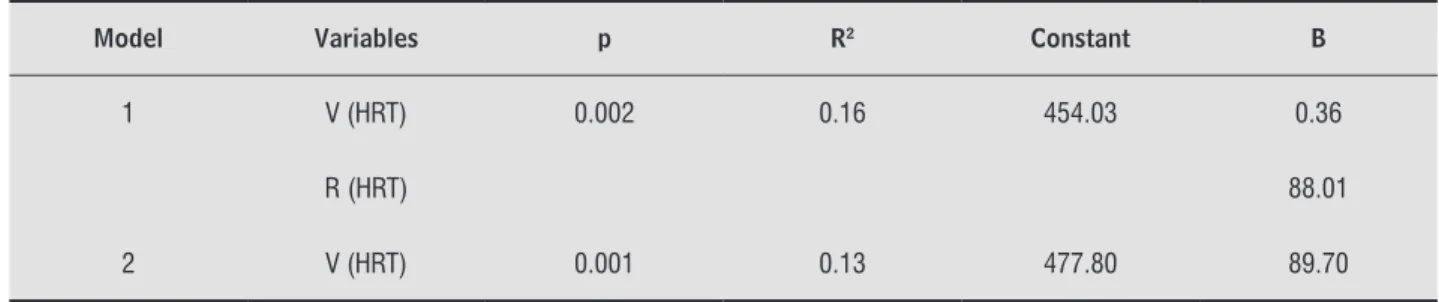
Two linear regression models were used for analy
-sis. In the first model, the number of repetitions and the speed in the HRT were entered as explanatory variables for the distance in the SWT. In the second model, only the speed in the HRT was entered as an explanatory variable. The results of these analyses are shown in Table 1.
The results of the linear regression analyses in different age groups were not significant for 20 to 29 years (p = 0.13), 30 to 39 years (p = 0.15) and 40
to 49 years (p = 0.45). The model showed statisti
-cal significance only for the age group from 50 to 59 years (Table 2).
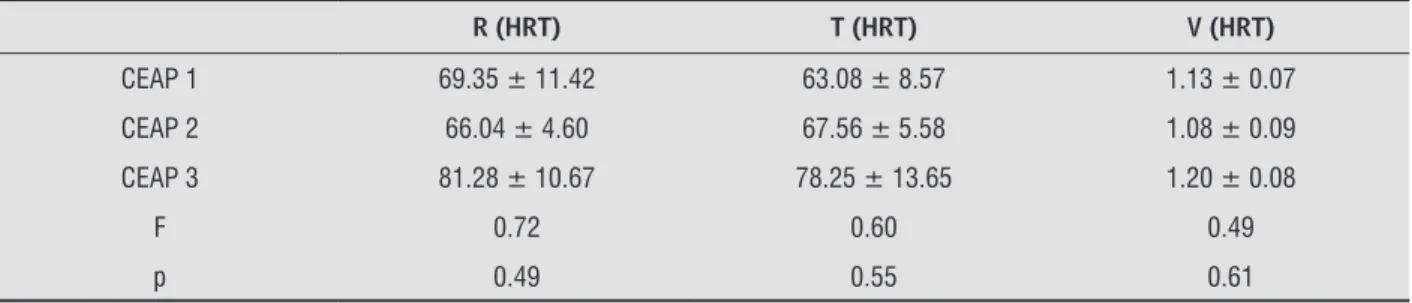
The results of the comparison between the differ
-ent classes of CEAP in relation to the HRT variables are shown in Table 3.
individuals with various health conditions (17,18, 19, 20, 21). The protocol for performing the SWT was the modified version developed by Singh et al. (17). Two cones are positioned at a distance of nine meters apart. The test requires the individual to walk from one cone to another, bypassing them. The beginning
of the test is marked by a first acoustic signal gener
-ated by portable stereo (19, 20). Then, signals are sent at regular intervals within which the individual must try to walk all the distance between the cones. At the end of each minute, the time interval between the sound signals decreases, resulting in increased speed. The test is discontinued if the participant does not reach the cone for two consecutive times within the interval between signals, or if their heart rate exceeds 90% of the maximum rate calculated by age.
The heart rate was monitored during the SWT us
-ing the Polar™ heart rate monitor (Polar Electro OY,
Finland). The variables analyzed in this test were the maximum distance (meters) and maximum speed attained (meters/minute).
Descriptive statistics were presented as mean ± standard deviation, with a confidence interval of 95%.
The Kolmogorov-Smirnov test was performed to eval
-uate data distribution. The correlation between the variables of the SWT and the HRT was assessed by Spearman coefficient. The linear regression model was applied to determine the association between the HRT and the SWT. Analyses were conducted with the total sample and with the sample stratified by age (20 to 29 years, 30 to 39 years, 40 to 49 years and 50 to 59 years). One-way analysis of variance (one-way ANOVA) was used for comparison of the HRT between the different classes of the CEAP. A significance level of 5% was considered.
Table 1 - Linear regression considering the total sample of participants
Model Variables p R2 Constant B
1 V (HRT) 0.002 0.16 454.03 0.36
R (HRT) 88.01
2 V (HRT) 0.001 0.13 477.80 89.70
Table 2 - Linear regression considering the total sample of participants between 50 and 59 years
Model Variables p R2 Constant B
1 V (HRT) 0.0001 0.60 378.57 -0.44
R (HRT) 164.44
2 V (HRT) 0.0001 0.58 347.27 163.22
Note: V (HRT) = speed in number of repetitions per second in the heel-rise test; R (HRT) = number of repetitions in the heel-rise test; p = level of signiicance; R2 = determination coeficient.
Table 3 - Comparison of different CEAP classes regarding the result of the HRT
R (HRT) T (HRT) V (HRT)
CEAP 1 69.35 ± 11.42 63.08 ± 8.57 1.13 ± 0.07
CEAP 2 66.04 ± 4.60 67.56 ± 5.58 1.08 ± 0.09
CEAP 3 81.28 ± 10.67 78.25 ± 13.65 1.20 ± 0.08
F 0.72 0.60 0.49
p 0.49 0.55 0.61
Note: R (TPP) = number of repetitions in the heel-rise test; T (HRT) = total time of the heel-rise test; V (HRT) = speed in number of repeti -tions per second in the heel-rise test; CEAP 1 = level 1 in the Clinical Etiology Anatomy Pathophysiology Classiication of Chronic Venous Disease (CEAP); CEAP 2 = level 2 in the CEAP classiication; CEAP 3 = level 3 in the CEAP classiication; F = one-way ANOVA; p = signiicance level.
Discussion
In this study, the HRT was able to explain func
-tional capacity in individuals aged 50-59 years; how
-ever, this result was not found in the entire sample. Furthermore, the HRT was not sensitive in detecting differences among classes 1, 2 and 3 of the CEAP.
The HRT is an instrument that assesses the func
-tion of the calf muscle, which is commonly affected
in patients with CVI (3). Because this muscle is criti
-cal to the good performance of an individual during walking (14), individuals with CVI may show deficits in functional mobility (1) evaluated in this study by means of the SWT.
Age is another factor associated with a reduction
in calf muscle function. The sharp decline of mus
-cle mass and strength associated with the reduced functional capacity that occurs with aging (22, 23) contributes to the increased prevalence and severity
of CVI in older age groups (1, 24). Studies evaluat
-ing muscle pump function at different ages by air
plethysmography showed that muscle pump effi
-ciency decreases with increased age (25, 26).
Labropouloset al.(27), in their evaluation of
pa-tients under 60 years of age who had CVI for less than 10 years and did not have a history of deep
vein thrombosis, concluded that the hemodynam
-ic changes of this population are more associated with the clinical severity of the disease, since the ejection ability of the calf muscle remained intact in these individuals.
Therefore, characteristics of the study popula
-tion, such as age less than 60 years and classifica
-tion at lower levels of the CEAP, only from 1 to 3, may have weakened correlations between the HRT and the SWT. It is important to emphasize the fact that the sample was constituted of non-elderly adults,
what may have been the cause of lower levels of im
Conclusion
The HRT was able to explain functional capacity in
individuals from 50 to 59 years of age, with speed be
-ing the variable that contributed the most to explain this result. Thus, the HRT can be applied in clinical practice in a valid manner for the functional evalu-ation of individuals with mild CVI in this age group.
References
1. França LHG, Tavares V. Insuficiência venosa crônica: uma atualização. J Vasc Bras. 2003;2(4):318-28. 2. Navarro TP, Nunes TA, Ribeiro AL, Castro-Silva M. Is
total abolishment of great saphenous reflux in the in
-vasive treatment of superficial chronic venous insuffi
-ciency always necessary? Int Angiol. 2009;28(1):4-11. 3. van Uden CJT, van der Vleuten CJM, Kooloos JGM, Hae
-nen JH, Wollersheim H. Gait and calf muscle endur
-ance in patients with chronic venous insufficiency. Clin Rehabil. 2005;19(3):339-44.
4. Aguiar ET, Pinto LJ, Figueiredo MA, Savino Neto S. Úlcera de insuficiência venosa crônica. J Vasc Br. 2005; 4(Supel. 2):S195-200.
5. Kecelj Leskovec N, Pavlović MD, Lunder T. A short re
-view of diagnosis and compression therapy of chron
-ic venous insuff-iciency. Acta Dermatovenerol Alp Pannonica Adriat. 2008;17(1):17-21.
6. Ibegbuna V, Delis KT, Nicolaides NA, Aina O. Effect of elastic compression stockings on venous hemody
-namics during walking. J Vasc Surg. 2003;37(2):420-5. 7. Padberg FT, Johnston MV, Sisto SA. Structured exer -cise improves calf muscle pump function in chronic
venous insufficiency: a randomized trial. J Vasc Surg. 2004;39(1):78-87.
8. Kan YM, Delis KT. Hemodynamic effects of supervised
calf muscle exercise in patients with venous leg
ul-ceration: a prospective controlled study. Arch Surg. 2001;136(12):1364-9.
9. Sacchi AA, Castro AA, Pitta GBB, Miranda Junior F.
Avaliação da bomba muscular da panturrilha em pacientes portadores de varizes primárias dos
membros inferiores através da pletismografia a ar. J Vasc Bras. 2007;6(1):25-34. doi: 10.1590/S1677- 54492007000100005.
individuals did not show deficits in function of the calf muscles enough to cause a significant reduction in functional capacity. In this study, the results found
in the isolated analysis of different age groups sup
-port this hypothesis, because the HRT was only able to explain functional capacity in the older age group (50-59 years).
A comparison between the different classes of the CEAP in relation to the variables of the HRT showed that this test was unable to detect differences
be-tween the three classes analyzed. As the clinical se
-verity of CVI may be related to deficits of the function of the calf muscle (1, 3), perhaps the test is sensitive in differentiating individuals classified at more severe levels of the CEAP.
A limitation of this study is the large discrepancy between the frequency of women (94.9%) and men
(5.1%) in the sample, which compromises the capac
-ity to generalize the data. However, the prevalence of CVI is higher in women (24). Epidemiological studies suggest the female sex as a risk factor for CVI (24, 28).
In this study, to carry out the HRT, the individual was asked to perform plantar flexions at the greatest possible speed until fatigue. Thus, the speed was not pre-determined, leading to greater variability in data. However, standardization of the speed of the HRT was not a clinically feasible choice since the test at lower speeds may result in a ceiling effect in participants with a higher level of physical performance. On the other hand, higher speeds can prevent the realization
of the test in people with a low level of physical per
-formance. Thus, the reason for adopting free speed was to reach the greatest number of people.
Through statistical analysis, it was observed that the choice of completing the HRT with free speed was positive, considering that speed was the variable that contributed the most to explaining functional capac-ity in the age group of 50-59 years. Given this fact, it can be suggested that in order to assess functional capacity in patients with CVI aged 50-59 years with mild CEAP classification, the HRT is not performed until fatigue, but with a pre-determined time, with the guidance that plantar flexions are performed as
quickly as possible. Such considerations can be gen
-eralized to a restricted age range.
Studies with samples of elderly individuals with greater clinical severity of CVI are necessary to verify
whether the HRT is able to explain functional capac
21. Morales FJ, Martínez A, Méndez M, Agarrado A, Ortega F, Fernández-Guerra J, et al. A shuttle walk test for assessment on functional capacity in chronic heart failure. Am Heart J. 1999; 138: 291-98.
22. Goldspink G. Age-related loss of muscle mass and strength. J Aging Res. 2012;2012:158279. doi: 10.1155/2012/158279.
23. Evans WJ, Campbell WW. Sarcopenia and age-related changes in body composition and functional capac
-ity. J Nutr. 1993;123(2 Suppl):465-8.
24. Staffa R. Chronic venous insufficiency – epidemiology. Bratisl Lek Listy. 2002;103(4-5):166-8.
25. Schina Jr. MJ, Neumyer MM, Healy DA, Atnip RG, Thiele BL. Influence of age on venous physiologic pa
-rameters. J Vasc Surg. 1993;18(5):749-52.
26. Engelhorn CA, Beffa CV, Bochi G, Pullig RC, Picheth FS, Cunha SS. Avaliação por pletismografia a ar da fun -ção da bomba muscular da panturrilha conforme a
idade. J Vasc Bras. 2003;2(1):13-6.
27. Labropoulos N, Giannoukas AD, Nicolaides AN, Veller M, Leon M, Volteas N. The role of venous reflux and calf
muscle pump function in nonthrombotic chronic
ve-nous insufficiency. Correlation with severity of signs and symptoms. Arch Surg. 1996;131(4):403-6. 28. Robertson L, Evans C, Fowkes FG. Epidemiology of
chronic venous disease. Phlebology. 2008;23(3):103-11. doi: 10.1258/phleb.2007.007061.
Received: 10/22/2013
Recebido: 22/10/2013
Approved: 04/28/2014
Aprovado: 28/04/2014
10. Engelhorn CA, Beffa CV, Bochi G, Pullig RC, Cassou MF, Cunha SS. A pletismografia a ar avalia a gravi
-dade da insuficiência venosa crônica? J Vasc Bras. 2004;3(4):311-6.
11. Haber M, Golan E, Azoulay L, Kahn SR, Shrier I. Reli
-ability of a device measuring triceps surae muscle fatigability. Br J Sports Med. 2004;38(2):163-7. 12. Österberg U, Svantesson U, Takahashi I, Grimby G.
Torque, work and EMG development in a heel-rise test. Clin Biomech (Bristol, Avon). 1998;13(4-5):344-50. 13. Pieper B, Templin TN, Birk TJ, Kirsner RS. The stand
-ing heel-rise test: relation to chronic venous disorders and balance, gait, and walk time in injection drug
us-ers. Ostomy Wound Manage. 2008;54(9):26-30. 14. Perry J. Análise de marcha: função normal e patológi
-ca. São Paulo: Manole; 2005.
15. Eklöf B, Rutherford RB, Bergan JJ, Carpentier PH, Gloviczki P, Kistner RL, et al. Revision of the CEAP classification for chronic venous disorders: consensus statement. J Vasc Surg. 2004;40(6):1248-52.
16. Pereira DAG, Oliveira KL, Cruz JO, Souza CG, Cunha Filho IT. Avaliação da reprodutibilidade de testes funcionais na doença arterial periférica. Fisioter Pesqui. 2008;15(3):228-34. doi: 10.1590/S1809- 29502008000300003.
17. Singh SJ, Morgan MDL, Scott S, Walters D, Hardman AE. Development of a shuttle walking test of disability in patients with chronic airways obstruction. Thorax. 1992;47(12):1019-24.
18. da Cunha Filho IT, Pereira DA, de Carvalho AM, Campe
-delli L, Soares M, de Sousa Freitas J. The reliability of walking tests in people with claudication.Am J Phys Med Rehabil. 2008;86(7):574-82.
19. Cunha Filho IT, Pereira DAG, Carvalho AMB, Campe
-delli L, Soares M, Freitas JS. Confiabilidade de testes
de caminhada em pacientes claudicantes: estudo
pi-loto. J Vasc Bras. 2008;7(2):106-11.