Use of Hearing Aids and Functional Capacity in
Middle-Aged and Elderly Individuals
Juliana Carioli
1Adriane Ribeiro Teixeira
21Specialization Course of Audiology, Universidade Federal do Rio Grande do Sul, Porto Alegre, Rio Grande do Sul, Brazil 2Department of Developmental Psychology and Personality,
Universidade Federal do Rio Grande do Sul, Porto Alegre, Rio Grande do Sul, Brazil
Int Arch Otorhinolaryngol 2014;18:249–254.
Address for correspondence Adriane Ribeiro Teixeira, PhD, Department of Developmental Psychology and Personality, Universidade Federal do Rio Grande do Sul, Rua Ramiro Barcelos, 2600–Instituto de Psicologia da UFRGS, Porto Alegre, Rio Grande do Sul 90035003, Brazil (e-mail: [email protected]).
Introduction
Advances in health care, such as the discovery of diagnostic techniques and therapeutic methods effective in curing or controlling disease, can lead to increasing life expectancy. With these advances, elderly people are expected to maintain their functional capacity so that they remain autonomous and independent as long as possible. For such, it is of great importance to introduce health programs aimed at the
pre-vention, early diagnosis, and treatment of chronic diseases and disabilities that arise over the years.1–6
As we age, there is a tendency toward chronic degenerative diseases that compromise the physical and mental functions of the individuals and ultimately lead to difficulties in daily activities or disability of the elderly to perform them.1–6
Currently it is said that health is measured through the ability of the individual to remain functionally independent and not due to the presence or absence of disease; the
Keywords
►
elderly
►
hearing loss
►
hearing aids
Abstract
Introduction
Hearing loss is among the sensory changes strongly associated with loss
of functional capacity.
Objective
It aims to determine whether the use of hearing aid contributes to the
improvement of instrumental activities of daily living (IADL) for middle aged and elderly
hearing-impaired individuals.
Methods
This is a descriptive, longitudinal, and interventional study. We evaluated 17
subjects, 13 (76.5%) female, aged between 58 and 96 years old (mean 77.1
10.4
years). All were new users of hearing aids. Evaluation included social history, pure tone
audiometry, and scale of IADL developed by Lawton and Brody. The subjects were
presented daily life situations and were expected to respond if they could do them
without assistance (3 points), partially assisted (2 points) or if they were unable to
perform them (1 point). IADL was applied before the use of hearing aids adaptation and
after a three- and six-month period of use.
Results
Data analysis revealed that before the use of hearing aids the average score
obtained by the subjects was 22.94
4.04 points. Three months after beginning the
use the average score was 23.29
4.12 and after six months the average score was
23.71
3.69 points. Statistical analysis revealed a signi
fi
cant difference between
scores obtained before the use of hearing aids and six months post-
fi
tting (p
¼
0.015
)
Conclusion
The use of hearing aids among the subjects evaluated promoted positive
changes in performing IADL, especially to using the telephone.
received
September 15, 2013
accepted
November 26, 2013
published online
February 28, 2014
DOI http://dx.doi.org/ 10.1055/s-0034-1368136.
ISSN 1809-9777.
Copyright © 2014 by Thieme Publicações Ltda, Rio de Janeiro, Brazil
constraints brought by disability can cause more significant problems than the disease itself, as it can make patients dependent on their family and caregivers and can compro-mise their well-being and quality of life.7–10
The concepts for functional capacity are very similar. It is related to the degree of preservation of the individual to perform activities of daily living (ADL) and instrumental activities of daily living (IADL), so they can live independently.11,12
Functional capacity is evaluated in two aspects: basic ADL (i.e., the individual’s ability to feed, bathe, and dress without help) and IADL, which evaluate more complex tasks, often related to individuals’ social engagement, such as shopping, answering the telephone, and using means of transportation.13 Hearing loss is one of the most frequent and disabling sensory changes, not only negatively affecting the elderly socially and emotionally but also affecting their quality of life.14–17It is believed that hearing loss is strongly associated with loss of functional capacity,18,19 which explains the importance of this study.
Thus, the present study aimed to examine whether the use of hearing aids improves functional capacity for IADL for hearing-impaired middle-aged and elderly individuals.
Methods
The research is a descriptive, longitudinal, and interventional study. The population comprised 17 individuals, of both genders, between 58 and 96 years old (mean 77.110.4 years).
Inclusion criteria were: individuals from 40 years old (which is considered the beginning of middle age),20 new users of hearing aids with bilateral hearing loss, and partici-pation in all phases of the research. Exclusion criteria were: not signing the informed consent form (ICF) and history of cognitive, neurologic, and/or psychiatric disorders. For par-ticipants who met the inclusion criteria, we presented the objectives of the research, and all participants signed ICF.
First, the individuals were submitted to audiological eval-uation, with pure tone audiometry performed in a sound-proof booth and with tone thresholds by air (from 250 to 8,000 Hz) and bone (500 to 4,000 Hz) measured using an Interacoustics audiometer model AD-229, Denmark.
To classify the degree of hearing loss, we used the average of the hearing thresholds by air at 500, 1,000, 2,000, and 4,000 Hz, according to the World Health Organization.21 Mean values between 10 dBHL (decibel hearing level) and 25 dBHL indicate that the person has normal hearing thresh-olds; between 26 and 40 dBHL, mild hearing loss; between 41 and 60 dBHL, moderate hearing loss; between 61 and 80 dBHL, severe hearing loss; above 81 dBHL, profound hearing loss. For this study we considered the mean of the better ear. This study was developed in three stages. In thefirst stage of evaluation, the procedures were as follows: we applied social history developed (anamnesis) especially for this study, containing demographic and hearing history. Furthermore, we used a questionnaire created by Lawton and Brody (1969),22 which measured the ability of the individual to develop IADL. Through this, we evaluated the functional capacity (i.e., the degree of independence of these individuals
in everyday activities, such as using the telephone, preparing meals, managingfinances, commuting by means of public transportation, cleaning the house, going shopping, among others).
These issues were assessed using nine items where the patient had three response options:“able without assistance” (score 3),“able with partial assistance”(score 2), and“unable” (score 1). The maximum achievable score in the evaluation was 27 points, which corresponds to maximum indepen-dence, and the minimum achievable score was 9 points, meaning maximum dependency.
After completing the questionnaire, hearing aid(s) indicat-ed for each subject were selectindicat-ed and testindicat-ed. All subjects were fitted with hearing aid(s) with digital technology, with non-linear amplification. Nine (52.9%) participants used bilateral hearing aids and 8 (47.1%) used a single one.
The second stage of the research was initiated 3 months after beginning usage of hearing aid(s); the patient was contacted by telephone and asked to attend a meeting reviewing their hearing aid(s). At the hearing center, the patient answered a questionnaire evaluating functional capacity.
In the third stage, which began 6 months after beginning usage of hearing aid(s), patients again answered the ques-tionnaire for assessing functional capacity.
The project was submitted to and approved by the Re-search and Ethics Committee of the institution (no. 212439). The rights regarding confidentiality, anonymity, and with-drawal of participation without prejudice to any treatments that were being performed were assured.
Data were both quantitative and descriptive statistically analyzed. To evaluate the performance of individuals for the task at each stage, descriptive statistical analysis was per-formed and then the nonparametric Friedman test was used. The total score was used to assess the overall performance of the individual (considering performance on all tasks). To compare the total score between steps and descriptive statis-tics, analysis of variance for repeated measures was performed.
Results
The sample consisted of 17 subjects, 13 women (76.5%) and 4 men (23.5%). Although the inclusion criteria defined that the minimum age would be 40 years, the sample consisted of subjects aged between 58 and 96 years (mean 77.110.4 years). The other characteristics are shown in►Table 1. With regard to education, most individuals had incomplete prima-ry education (76.5%). Of the population, 76.4% had moderate hearing loss, 11.8% presented mild hearing loss, and 11.8%, severe hearing loss. For this classification, we took into account the best ear. All subjects werefitted with hearing aids with digital technology, with nonlinear amplification. Nine (52.9%) participants use bilateral hearing aids and 8 (47.1%), monoaural aids.
Data on the ability of the elderly to perform IADL for the three stages of the research are described in►Table 2.
degree of independence of individuals was found comparing thefirst and third stages (p¼0.015).
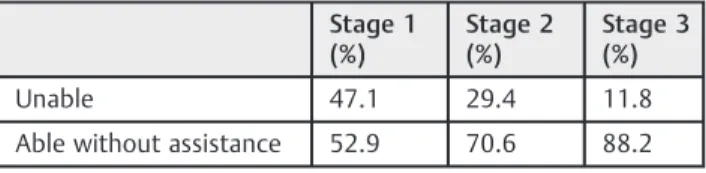
►Table 4shows the evolution in the use of the telephone in the three stages of the research. There was a significant difference (p¼0.011) between at least two of the three stages in the degree of independence in using the telephone. Although it was not possible to identify the difference in multiple comparison tests, the lowest observed p value (p¼0.123) indicates that this difference is probably between the level of independence of thefirst and third stage, with the third stage being the higher level of independence.
Discussion
We observed among the participants of the study a higher ratio of women (76.5%), which did not differ from other studies.6,23 Although the scientific literature shows that men are more affected by hearing loss,24data show that women seek more health services.25In addition, data from the 2010 population census in the country and the literature in the field of gerontology show that the majority of Brazilian individuals in the age range studied are women.26–28This fact is known as “feminization of aging”and is corroborated by previous stud-ies,6,23and it should be taken into consideration for appraisal, diagnosis, and treatment of hearing services, which should be prepared to meet, in most cases, female subjects with specific characteristics, needs, and requirements.
A low level of education was expected by the researchers because many participants were elderly. This population, according to the 2010 census, has low levels of education because it had no opportunity to attend school in the life stage considered appropriate.26,29,30 Furthermore, it should be stressed again that many of the sample were women. Thus,
until a few years ago, few women attended schools, and many who abandoned their studies as they finished the initial grades to devote themselves to learning housework.
The degree of hearing loss observed in most cases is compatible with that caused by aging. Previous studies indi-cate that the majority of the elderly had mild to moderate hearing loss, which corroborates the results of this research and was expected by researchers due to the age range of the sample components.31,32 Although all subjects presented bilateral hearing loss, approximately half of the individuals (47.1%) acquired only one hearing aid. This could be explained by the fact that the purchase was made by the subjects of research, using their ownfinancial resources. Thus, in many cases, although there was an indication of binauralfitting of hearing aids, financial issues, aesthetics, manual dexterity, auditory processing, or asymmetrical hearing loss led to monaural fitting.33 This is quite common when analyzing the purchase of hearing aids in private hearing centers, which has been reported in other studies.34,35
As previously described, the functional capacity is strongly related to the presence of some diseases and disabilities. Studies demonstrate that there is an association between hearing loss and the lack of autonomy of patients.1,10,36Thus, we expected a low autonomy of the individuals to perform IADL in the first stage of the study, an evolution occurring after fitting (steps 2 and 3). The analysis of data contained in►Table 2, however, showed that compared with the ability to carry out IADL between the three stages, the only task in which there was significant change was the ability to use the telephone (p¼0.011). The change was so evident that it was able to give a significant difference in scores between the three stages of the study (►Table 3).
Most individuals could perform adequately and effectively the investigated IADL, contrary to what was expected by the evaluators because most of the subjects had hearing loss and low levels of education. Thisfinding contradicts other studies, whose results indicated that the low level of education and hearing loss negatively influenced the autonomy of the elderly.1,6,10,37
Most of the subjects had hearing loss from mild to moder-ate in the better ear, which can make communication difficult through the use of the phone. To carry out the other activities, however, the individual may resort to communication strat-egies, such as lipreading and requesting repetition of phrases. In addition, some activities investigated by the instrument, such as shopping, ironing, controlling remedies andfinance, for example, are more closely related to cognitive and motor activity and may not be influenced by the presence of mild to moderate hearing loss.
Data in►Table 4confirm the change observed between the three evaluations with regard to the use of the phone. The analysis suggests that the change in the behavior of the subjects occurred between steps 1 and 3 of the research. The greater autonomy in the use of the telephone does not confirm previous studies that reported on new hearing aid users whose main complaint was difficulty using the telephone.38–40 The studies cited, however, are prior to 2010, before hearing aid resources facilitating the use of Table 1 Characteristics of the sample regarding demographic,
social, and audiological variables
Variables n %
Gender
Male 4 23.5
Female 13 76.5
Education
Illiterate 1 5.9
Primary school 2 11.8
Incomplete primary school 13 76.5
Higher education 1 5.9
Degree of hearing loss
Mild 2 11.8
Moderate 13 76.4
Severe 2 11.8
Hearing aidfitting
Monoaural 8 47.1
telephone were available. Moreover, it should be pointed out that in addition to these resources, all subjects in the research sample received specific guidelines from the pa-thologist responsible for selecting andfitting hearing aids. In thefitting process, individuals and their families should
be targeted, and the use of telephone and other auxiliary equipment should be one of the items addressed.41
Thus, considering the test scores (especially with regard to the use of the telephone) and the time of use of hearing aids by the subjects, it appears that there was a gradual improvement Table 2 Ability to perform instrumental activities of daily living during the three stages of the research
Task Stage 1 Stage 2 Stage 3 pvalue
n % n % n %
Use the telephone: 0.011
Unable 8 47.1 5 29.4 2 11.8
Able without assistance 9 52.9 12 70.6 15 88.2
Commute to distant sites: >0.999
Unable 3 17.6 3 17.6 3 17.6
Able with partial assistance 5 29.4 5 29.4 5 29.4
Able without assistance 9 52.9 9 52.9 9 52.9
Shop: >0.999
Able with partial assistance 4 23.5 4 23.5 4 23.5
Able without assistance 13 76.5 13 76.5 13 76.5
Prepare meals: >0.999
Unable 1 5.9 1 5.9 1 5.9
Able with partial assistance 1 5.9 1 5.9 1 5.9
Able without assistance 15 88.2 15 88.2 15 88.2
Clean the house: >0.999
Unable 2 11.8 2 11.8 2 11.8
Able without assistance 15 88.2 15 88.2 15 88.2
Handicraft: >0.999
Unable 4 23.5 4 23.5 4 23.5
Able with partial assistance 3 17.6 3 17.6 3 17.6
Able without assistance 10 58.8 10 58.8 10 58.8
Wash and iron clothes: >0.999
Unable 3 17.6 3 17.6 2 11.8
Able with partial assistance 1 5.9
Able without assistance 14 82.4 14 82.4 14 82.4
Take medicines: >0.999
Able with partial assistance 4 23.5 4 23.5 4 23.5
Able without assistance 13 76.5 13 76.5 13 76.5
Managefinances: >0.999
Able with partial assistance 10 58.8 10 58.8 10 58.8
Able without assistance 7 41.2 7 41.2 7 41.2
Table 3 Overall score per assessment stage
n Mean Standard deviation Median Minimum Maximum
Overall score (stage 1) 17 22.94 4.04 24 12 27
Overall score (stage 2) 17 23.29 4.12 25 12 27
Overall score (stage 3) 17 23.71 3.64 25 14 27
in auditory skills and speech recognition due to the new use of amplification.42Thesefindings corroborate other studies de-scribing the acclimatization period starting from week 6 of amplification.43,44 In 2002, 134 elderly in thefirst year of adjustment of hearing prosthesis showed more significant changes between thefirst and sixth months of use.44Thus, we can confirm the importance of the intervention with the use of hearing aids in middle-aged adults and seniors.
Conclusion
The analysis of the results showed that the use of hearing aid (s) improved functional capacity for IADL in the individuals evaluated, especially in using the telephone.
References
1 Rosa TEC, Benício MHDA, Latorre MR, Ramos LR. Determinant
factors of functional status among the elderly. Rev Saude Publica 2003;37(1):40–48
2 Guedes JM, Silveira RCR. Análise da capacidade funcional da
população geriátrica institucionalizada na cidade de Passo Fundo–RS. RBCEH 2004;1(37):10–21
3 Costa EC, Nakatani AYK, Bachion MM. Capacidade de idosos da
comunidade para desenvolver Atividades de Vida Diária e Ativi-dades Instrumentais de Vida Diária. Acta Paul Enferm 2006;19(1): 43–45
4 Alves LC, Quinet Leimann BC, López Vasconcelos ME, et al. The
effect of cronic diseases on functional status of the elderly living in the city of São Paulo, Brazil. Cad Saude Publica 2007;23(8): 1924–1930
5 Alves LC, Leite IC, Machado CJ. The concept and measurement of
functional disability in the elderly population: a literature review. Cienc Saude Coletiva 2008;13(4):1199–1207
6 Alves MJM, Ribeiro LC, Milane JL, Almeida AM. Perfil da Capacidade Funcional do Idoso. Annals of the XVI National Meeting of Population Studies; 2008. Available at http://www.abep.nepo.unicamp.br/en-contro2008/docspdf/ABEP2008_1534.pdf. Accessed on January 29, 2014
7 Bonardi G, Souza VBA, Moraes JFD. Incapacidade Funcional e
idosos. Sci. Med 2007;17(3):138–144
8 Lachs MS, Feinstein AR, Cooney LM Jr, et al. A simple procedure for
general screening for functional disability in elderly patients. Ann Intern Med 1990;112(9):699–706
9 Veras RP. País Jovem com Cabelos Brancos: a saúde do idoso no
Brasil. Rio de Janeiro, Brazil: Relume Dumará; 1994
10 Schneider RH, Marcolin D, Dalacorte RR. Avaliação funcional de
idosos. Sci. Med 2008;18(1):4–9
11 Ribeiro RCL, Silva AIO, Modena CM, Fonseca MC. Capacidade
Funcional e qualidade de vida de idosos. Estud Interdiscip Envel-hec 2002;4:85–96
12 Ramos LR. Determinant factors for healthy aging among senior
citizens in a large city: the Epidoso Project in São Paulo. Cad Saude Publica 2003;19(3):793–797
13 Espejo Espejo J, Martínez de la Iglesia J, Aranda Lara JM, et al.
Evaluative cycle of the process of a full geriatric assessment pro-gramme run by a Health Centre. Aten Primaria 1997;20(1):3–11
14 Russo ICP. Intervenção audiológica no idoso. In: Ferreira LP, ed.
Tratado de fonoaudiologia. São Paulo, Brazil: Roca; 2004:585–596
15 Mattos LC, Veras RP. A prevalência da perda auditiva em uma
população de idosos da cidade do Rio de Janeiro: um estudo seccional. Rev Bras Otorrinolaringol (Engl Ed) 2007;73(5): 654–659
16 Veras RP, Mattos LC. Audiology and aging: literature review and
current horizons. Braz J Otorhinolaryngol 2007;73(1):128–134
17 Ribeiro LCC, Alves PB, Meira EP. Percepção do idoso sobre as
alterações fisiológicas do envelhecimento. Ciênc Cuid Saúde 2009;8(2):220–227
18 Santos LD, Salmela LFT, Lelis FO, Lobo MB. Eficácia da Atividade Física na manutenção do desempenho funcional do idoso: revisão de literatura. Revista Fisioter Bras 2001;2(3):169–176
19 Ramos MP. Apoio Social e saúde entre idosos. Sociologias 2002;
4(7):156–175
20 Duarte CP, Santos CL, Gonçalves AK. A concepção de pessoas de
meia-idade sobre saúde, envelhecimento e atividade física como motivação para comportamentos ativos. Rev Bras Cienc Esporte 2002;23(3):35–48
21 Organização Mundial da Saúde. WHO/PDH/97.3 Geneva, Switzerland:
WHO; 1997
22 Lawton MP, Brody EM. Assessment of older people:
self-maintain-ing and instrumental activities of daily livself-maintain-ing. Gerontologist 1969; 9(3):179–186
23 Rogers RG, Rogers A, Belanger A. Active life among the elderly in
the United States: multistate life-table estimates and population projections. Milbank Q 1989;67(3–4):370–411
24 Mattos LC, Veras RP. The prevalence of hearing loss in na elderly
population in Rio de Janeiro: a cross sectional study. Braz J Otprhinolaryngol 2007;73(5):654–659
25 Gomes R, Nascimento EF, Araújo FC. Why do men use health
services less than women? Explanations by men with low versus higher education. Cad Saude Publica 2007;23(3):565–574
26 Instituto Brasileiro de Geografia e Estatística. Brasília (DF), Brazil; IBGE: 2010. Available at http://www.ibge.gov.br. Accessed Novem-ber 11, 2013
27 Salgado CDS. Mulher idosa: a feminização da velhice. Estud
Interdiscip Envelhec 2002;4:7–19
28 Nicodemo D, Godoi MP. Juventude dos anos 60–70 e
envelheci-mento: estudo de casos sobre feminização e direitos das mulheres idosas. Rev Ciênc Ext 2010;6(1):40–53
29 Souza MMC. O analfabetismo no Brasil sob o enfoque demográfico. Textos para discussão no. 639. Available at: http://www.ipea.gov.br/ portal/images/stories/PDFs/TDs/td_0639.pdf. Accessed November 11, 2013
30 Mafra SCT, Silva EP, Fonseca ES, Almeida AV, Freitas NC. O
envelhecimento nas diferentes regiões do Brasil: uma discussão a partir do censo demográfico de 2010. Anais do VI Workshop de
Análise Ergonômica do Trabalho, III Encontro mineiro de Estudos em Ergonomia e VIII simpósio do Programa de Educação Tutorial em Economia Doméstica—Envelhecimento: como pensar o tra-balho, a sociedade e as cidades? Available at: http://www.ded.ufv. br/workshop/docs/anais/2013/Simone%20Caldas%20Tavares% 20Mafra%20-%20%20%20%20%20%20Tem%C3%A1tica%20En-velhecimento.pdf. Accessed November 11, 2013
31 Gardner M, Slenkovich NG. Disacusia neurossensorial. In: Jafek
BW, Murrow BW, eds. Segredos em Otorrinolaringologia. Porto Alegre, Brazil: Artmed; 2006
32 Samelli AG, Negretti CA, Ueda KS, Moreira RR, Schochat E.
Com-paring audiological evaluation and screening: a study on presby-cusis. Braz J Otorhinolaryngol 2011;77(1):70–76
Table 4 Changes in use of the telephone in the three stages of the research Stage 1 (%) Stage 2 (%) Stage 3 (%)
Unable 47.1 29.4 11.8
Able without assistance 52.9 70.6 88.2
33 Almeida K, Iorio MCM. Próteses Auditivas: fundamentos teóricos e
aplicações clínicas. São Paulo, Brazil: Lovise; 2003
34 Moura LOS, Iorio MCM, Azevedo MF. The efficacy of hearing aids on diminishing or eliminating tinnitus. Braz J Otorhinolaryngol 2004; 70(5):624–631
35 Zandavalli MB, Christmann LS, Garcez VRC. Rotina de
procedi-mentos utilizados na seleção e adaptação de aparelhos de
ampli-ficação sonora individual em centros auditivos na cidade de Porto Alegre, Brasil–RS. Rev CEFAC 2009;11(Suppl 1):106–115
36 Gopinath B, Schneider J, McMahon CM, Teber E, Leeder SR,
Mitchell P. Severity of age-related hearing loss is associated with impaired activities of daily living. Age Ageing 2012;41(2): 195–200
37 Fiedler MM, Peres KG. Functional status and associated factors
among the elderly in a southern Brazilian city: a population-based study. Cad Saude Publica 2008;24(2):409–415
38 Magalhães FF, Mondelli MFCG. Assessment of hearing aids users’
satisfaction‐systematic review. Rev CEFAC 2011;13(3):552–558
39 Veiga LR, Merlo ARC, Mengue SS. Satisfação com a prótese auditiva
na vida diária em usuários do Sistema de Saúde do Exército. Rev Bras Otorrinolaringol (Engl Ed) 2005;71(1):67–73
40 Fialho IM, Bortoli D, Mendonça GG, Pagnosim DF, Scholze AS.
Percepção de idosos sobre o uso de AASI concedido pelo Sistema Único de Saúde. Rev CEFAC 2009;11(2):338–344
41 Geraldo T, Ferrari DV, Bastos BG. Orientação ao usuário de prótese
auditiva: retenção da informação. Arq Int Otorrinolaringol 2011; 15(4):410–417
42 Munro KJ, Lutman ME. The effect of speech presentation level on
measurement of auditory acclimatization to amplified speech. J Acoust Soc Am 2003;114(1):484–495
43 Almeida K. Avaliação dos resultados da intervenção. In: Almeida K,
Iório MCM, eds. Próteses Auditivas: fundamentos teóricos e apli-cações clínicas. 2nd ed. São Paulo, Brazil: Lovise; 2003:357–379
44 Humes LE, Wilson DL, Barlow NN, Garner C. Changes in hearing-aid
benefit following 1 or 2 years of hearing-aid use by older adults. J