The process of knowledge transference: a matter concerning of
teaching of psychiatric nursing
O processo de transferência de conhecimento: uma questão sobre o ensino de enfermagem
psiquiátrica
El proceso de transferencia de conocimiento: una cuestión acerca de la enseñanza de la enfermería
psiquiátrica
Laís de Mello Santos1
Rosane Mara Pontes de Oliveira1
Virgínia Faria Damásio Dutra1
Isaura Setenta Porto1
1. Federal University of Rio de Janeiro. Rio de Janeiro, RJ, Brazil.
Corresponding author:
Virgínia Faria Damásio Dutra. E-mail: [email protected]
Submited on 12/02/2016. Accepted on 02/03/2017.
DOI: 10.1590/2177-9465-EAN-2016-0356
A
bstrActObjectives: To identify the strategies used by teachers to share the contents of Psychiatric Nursing and Mental Health; to describe the stages of knowledge sharing in light of the knowledge transfer process. Method: Qualitative, descriptive-exploratory research of the case study type, carried out with six teachers and 23 students, data production was by semi-structured interview and focus group. For the data analysis, the SECI knowledge conversion model was used: socialization, externalization, combination and internalization. Results: Teachers made socialization and externalization, but did not make clear the assessment and
teaching-learning strategies. The combination was completed, but the internalization was uninished, despite suggesting an
attempt to reach it. Conclusion: The feasibility and applicability of the knowledge transfer process to the teaching of Psychiatric
Nursing were conirmed.
Keywords: Knowledge; Teaching; Mental Health; Psychiatry Nursing; Learning.
r
esumoObjetivos: Identiicar as estratégias utilizadas pelos docentes para compartilhar os conteúdos de Enfermagem Psiquiátrica e de Saúde Mental; descrever as etapas do compartilhamento de saberes à luz do processo de transferência do conhecimento. Método: Pesquisa qualitativa, descritivo-exploratório do tipo estudo de caso, realizado com seis docentes e 23 discentes, a produção dos dados se deu por entrevista semiestruturada e grupo focal. Para a análise dos dados foi utilizado o modelo
SECI de conversão do conhecimento: socialização, externalização, combinação e internalização. Resultados: Os docentes
efetuaram a socialização e a externalização, mas não deixam claro a avaliação e as estratégias de ensino-aprendizagem. A
combinação foi concretizada, mas a internalização demonstrou-se inacabada, apesar de sugerir uma tentativa de alcança-la.
Conclusão: A viabilidade e a aplicabilidade do processo de transferência de conhecimento para o ensino de Enfermagem Psiquiátrica foram comprovadas.
Palavras-chave: Conhecimento; Ensino; Saúde Mental; Enfermagem Psiquiátrica; Aprendizado.
r
esumenObjetivos: Identiicar las estrategias utilizadas por los maestros para compartir el contenido de Enfermería Psiquiátrica y Salud Mental; describir los pasos de la puesta en común de los conocimientos a la luz del proceso de transferencia de conocimientos. Método: Cualitativa, descriptiva y exploratorio, estudio de caso, realizado con seis profesores y 23 estudiantes, la producción de datos era por medio de entrevistas semi-estructuradas y grupos focales. Para el análisis de datos se utilizó el modelo SECI de conversión del conocimiento: la socialización, exteriorización, combinación e interiorización. Resultados: Los maestros efectúan la socialización y la externalización, pero no hacen las estrategias de evaluación y de enseñanza-aprendizaje claros. La combinación se terminó, pero la internalización demostró ser sin terminar, a pesar de sugerir un intento de llegar a él. Conclusión: Viabilidad
y la aplicabilidad del proceso de transferencia de conocimientos a la enseñanza de la enfermería psiquiátrica han sido probados.
INTRODUCTION
Nursing has, in its essence, the care as an instrument of work and study. The construction of the nursing knowledge body, as a science, guarantees the professional identity, autonomy, authority and responsibility of the profession. Nursing seeks to instrument care through the approximation of theoretical and practical knowledge, as a discipline with predominance in
the logic of scientiic, empirical and analytical rationality, while respecting the subjectivity of each user and the human creativity
of each professional.1
Knowledge is an inherent capacity to the human being, of tacit character, governed by action and based on rules, being individual and changeable. It is endowed with an individual content that is expressed through the skills, experiences,
judgments of value and social network. To be perceived,
knowledge has to be provided with meaning, because without it the process of knowledge transfer becomes inert and static, without real relevance in the generation of new knowledge,
concepts and deinitions, in search of its validation as truth.2
Knowledge can be derived in two ways:3 the explicit, which
is characterized as a fast and simple mean for internalization or
storing; and the tacit, that is a speciic form of knowledge which is held in the mind of the individual, that is, it is diicult to access.
However, it can still be shared, forming a collective knowledge that sometimes becomes explicit. This includes the SECI model of knowledge conversion, comprised by the steps of Socialization, Externalization, Combination and Internalization (SECI), which enable the process of knowledge transfer between individuals.
There are at least four ways of knowledge conversion: Socialization, which transforms tacit knowledge into tactical knowledge; Externalization, which transforms tacit knowledge into explicit knowledge; Combination, that transforms explicit knowledge into explicit knowledge and Internalization, which transforms explicit knowledge into tacit knowledge. Socialization comes from the sharing of experiences and technical skills in the daily experience of work. Externalization articulates and organizes
explicit tacit knowledge through dialogue and group relection of
a theme, and is constructed through written language, providing a symbolic mark to the creation of knowledge. The combination
is the reconiguration and categorization of explicit knowledge,
giving it the opportunity to generate new knowledge through information networks. Internalization is the process where the incorporation of explicit knowledge into tacit occurs, promoting change, enhancement and development of individual and collective practices.4
Over many years, Psychiatric Nursing has guided its teaching technologies in the discipline through the containment,
medicalization and exclusion of the subject. Nowadays, mental
health technologies are added to the creative and reciprocal knowledge used in teaching to approximate theory to practice
is learned in the academy, in order to assist the improvement of the process of taking care of the other.5
Changes in the scope of the quality of care provided to
people with mental disorders resulting from the Psychiatric Reform process led to the creation of several substitute devices to asylums with the purpose of reformulating the practice of mental healthcare by providing assistance to individual autonomy, freedom and means of social inclusion. Faced with
this context, there was a need for adequate knowledge, practice
and Mental health assistance. However, the attempt to break
with the hospital-centered model is complex, requiring the
Psychiatric Nursing to break the medicament paradigm, contain and monitor, giving way to the construction of new rehabilitative
care strategies and promote efective care, which demand the
generation of new knowledge.6,7
It requires new forms of teaching, building possibilities
for mental healthcare, such as: interpersonal relationship,
therapeutic project design, therapeutic residency, social
inclusion, psychosocial rehabilitation, interprofessional, territorial and intersectoral attention. Thus, the process of training nurses,
associated to the importance of integration and relection of
knowledge and practices, aims to train a professional with skills to act, according to the collective and social context, sustained in the new model of assistance, integral and humanized.5-8
With this, the study aimed to identify the strategies used by the teachers to share the contents of Psychiatric Nursing and Mental Health; to describe the steps of knowledge sharing in light of the knowledge transfer process.
METHOD
The study has a qualitative approach of the
descriptive-exploratory type, having as a research design the case study, since it aims to identify the process of knowledge transfer in Mental Health provided to undergraduate students. The research scenario was a public nursing school. The participants were students enrolled and attending the 7th period and teachers
who make up the core of Psychiatric/Mental Health Nursing, totaling six professors, of which three have permanent link with the institution and the other three are in the position of substitute teachers who have a contract of one year extendable by another one year with the institution.
Data collection took place in two stages: irst, observation
of classes and interviews with teachers; and second, a focus group with the students. For the observation, a systematic
behavioral technique and notes, a field diary, through the
non-participant observation of classes taught by teachers, with focus on knowledge transfer mechanisms used. For the
interview was used a verbal-linguistic technique, based on an
open-ended interview conducted according to a semi-structured
In the second step, data collection with the students, occurred through a focus group from a semi-structured script composed
of questions that come with the understanding and the views of
students in relation to lectures given by the teachers. The script of the focal group included the expectations, evaluation and learning of students.
The data collection period was from October 2014 to April
2015 and the distribution of the number of interviews conducted with each teacher was performed according to the number of
classes each one ministered. The data obtained from the irst
stage totaled 38 hours of non-participant observation and 12 interviews. The focus group had a duration of 60 minutes, with
the participation of 23 subjects randomly. The data were analyzed based on the Content Thematic Analysis, in order to obtain
indicators to generate inferences about the messages.9 The
research obeyed the ethical and legal precepts of Res. 466/12,
obtained approval in the EEAN/HESFA zip code, Number:
824,821 on 10/27/2014. The participants signed the Free and Informed Consent Term.
RESULTS
Based on the analysis of the data, emerged four categories, namely: Socialization as a sensation or as a teaching belief;
Strategies as a way of externalizing knowledge; Aggregating
knowledge: the use of the combination to apprehend Mental Health; and the Internalization of knowledge orienting future nurses.
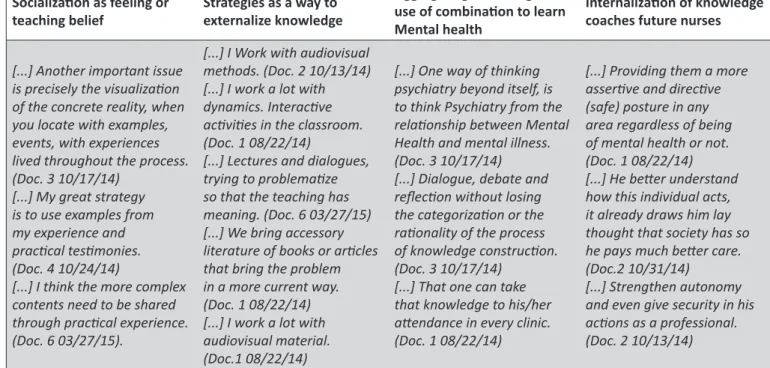
The teachers' statements (Table 1) expose the instruments used so that the students could not only absorb the content taught throughout the discipline, but also put it into practice in their care actions developed in all the clinics that involve the process of physical illness and/or mental health, where Nursing performs its task of caring.
The teacher, by ensuring to the student the instruments that allow the understanding of psychic illness process and its determining factors, are contributing greatly to the student
being able to understand the subject in the face of its complexity and subjectivity, since it is only possible to perform care when
someone can visualize the dimension and the degree of physical,
motor and social impairment imposed to the subject by the mental
disorder.
From the speeches of the students (Table 2) it is possible to
verify the change in the thinking of the students regarding the ield
of Mental Health, where the fear of the unknown and the stigma allow the discovery of what really happens with the individual in
psychic sufering. This situation was only possible by stimulating the association of the theoretical and practical ields, where students try
to associate the examples and contents provided in the classroom with the know-hows they have experienced in practice.
During the learning process, the student envisages achieving at the end of the discipline the greatest amount of knowledge to
be able to act facing customers in various ields and areas of nursing. However, it is worth mentioning that, quantity not always has quality, so it is important that students understand that for
that knowledge to be able to generate positive results in future employment, it must be worked, stimulated, enhanced, developed and apprehended.
In this process, the student needs to perform the function of
a "sculptor", which irst selects the raw material of his work, then
separates the material to be used in its construction, then molds
and develops the premise of the work with care and efort, and after the long day at work, his inal work for the sculptor's always uninished because everything is better with a few touch-ups
and dedication. Thus, it is the student who has a knowledge to
be acquired, he chooses the tools and strategies he will use to
apprehend it, after much study and development, he will be able to develop it in practice, however, it is always possible to learn more and more.
DISCUSSION
The category called socialization as sensation or teach-ing belief refers to the feeling experienced by teachers in the
process of socialization of knowledge. Along the production of
data, we are faced with the fragility in most answers given by teachers, who report having the desire and the pretension to
reach the objectives proposed in the classroom with the intention
of continuing the socialization stage. However, such expressions
characterize the implementation of the objectives of the lesson
and this category only in the ambit of thinking and believing.
It also concerns the irst stage of the knowledge transfer
process determined by the sharing of experiences and technical skills in the daily work experience. It is characterized by the knowledge propagated by the teacher in its breadth and diversity, not with the intention of transferring the knowledge to the students as mere repositories of information, but rather providing space for the development of care practices that corroborate with personal, intellectual and psychosocial enrichment of the student, so that they can become critical
subjects in relation to the theory and practice in Psychiatric
Nursing and Mental Health.
In order that the student can comprehend and, moreover, understand the meaning of the contents taught, teachers use as main tool the correlations and integrations between theory and practical experience, so that the student can visualize, being in
person in practical ield or only from the experiential account of
teaching that knowledge inserted and contextualized in a real situation of everyday life by providing subsidies to go into the
Table 1.
Consolidaion of teachers’ speeches with the emerging categories of the study.
Socializaion as feeling or
teaching belief
Strategies as a way to
externalize knowledge
Aggregaing knowledge: the
use of combinaion to learn
Mental health
Internalizaion of knowledge
coaches future nurses
[...] Another important issue
is precisely the visualizaion
of the concrete reality, when
you locate with examples,
events, with experiences
lived throughout the process.
(Doc. 3 10/17/14)
[...] My great strategy
is to use examples from
my experience and
pracical tesimonies.
(Doc. 4 10/24/14)
[...] I think the more complex
contents need to be shared
through pracical experience.
(Doc. 6 03/27/15).
[...] I Work with audiovisual
methods. (Doc. 2 10/13/14)
[...] I work a lot with
dynamics. Interacive
aciviies in the classroom.
(Doc. 1 08/22/14)
[...] Lectures and dialogues,
trying to problemaize
so that the teaching has
meaning. (Doc. 6 03/27/15)
[...] We bring accessory
literature of books or aricles
that bring the problem
in a more current way.
(Doc. 1 08/22/14)
[...] I work a lot with
audiovisual material.
(Doc.1 08/22/14)
[...] One way of thinking
psychiatry beyond itself, is
to think Psychiatry from the
relaionship between Mental
Health and mental illness.
(Doc. 3 10/17/14)
[...] Dialogue, debate and
relecion without losing
the categorizaion or the
raionality of the process
of knowledge construcion.
(Doc. 3 10/17/14)
[...] That one can take
that knowledge to his/her
atendance in every clinic.
(Doc. 1 08/22/14)
[...] Providing them a more
asserive and direcive
(safe) posture in any
area regardless of being
of mental health or not.
(Doc. 1 08/22/14)
[...] He beter understand
how this individual acts,
it already draws him lay
thought that society has so
he pays much beter care.
(Doc.2 10/31/14)
[...] Strengthen autonomy
and even give security in his
acions as a professional.
(Doc. 2 10/13/14)
Table 2.
Consolidaion of students’ speeches with the emerging categories of the study.
Socializaion as feeling or
teaching belief
Strategies as a way to
externalize knowledge
Aggregaing knowledge: the
use of combinaion to learn
Mental health
Internalizaion of knowledge
coaches future nurses
[...] The sigma that we bring
of the paient with mental
disorder is very strong, of the
aggressiveness, the violence,
of not knowing how to act
or dealing does not generate
interest in people, but we can
change in our head and our
relecion on the psychiatric
paient. (GF12/11/14)
[...] My expectaions were
posiive, I thought it was
going to be diicult, but I
never imagined meeing
people as similar to me as I
did, so this was posiive for
me. (GF12/11/14).
[...] I have turned to aricles
and group discussions to
absorb what everyone has
understood and what it
would be possible to apply in
pracice. (GF12/11/14)
[...] I researched at home
on aricles and books and
was very pleasurable to me.
It helped me deal with and
recognize, for my percepion
of these people has
increased over the period.
(GF12/11/14)
[...] We can put it into
pracice and think more and
reairm the content within
ourselves. GF12/11/14)
[...] In pracice the greatest
contribuion is in the
interpersonal relaionship
with the paient, to break the
sigmas and try to establish
the bonding relaionship.
(GF12/11/14)
[...] Deconstrucion of
preconcepions and
paradigms that we had
before towards the person
with mental disorders.
(GF12/11/14)
[...] I think it's important that
the nurse uses itself as a
therapeuic tool for the other.
(GF12/11/14)
[...] It is a very theoreical
content and diicult to
understand, to assimilate
and translate to the pracical
scenario. (GF12/11/14)
[...] The contents were very
extensive and taught in a not
very didacic way, making
the content uninteresing and
diicult to understand and to
be interesing. (GF12/11/14)
[...] The levels of classes
are totally diferent, there
are very good classes and
also classes that you do not
The teacher has a set of experiences and knowledge inter-twined in a metric of continuous learning. In order to make the knowledge more concrete for the student, the teacher expresses through examples and correlations all his experience lived along the professional practice. It is also necessary for this knowledge to be more easily absorbed and understood by the student that the teacher acts directly in the practice with him.
The dimension of practical experience is important for student learning, as it generates the valorization of the potential of users, territory and family. It is possible to observe that the experiences lived by the students contribute to the understanding of the
importance of the therapeutic bond, the afection as a resource
and the potential of the interpersonal relation, as a facilitator of the teaching-learning process.10
In the context of knowledge mobilization, for the attention in mental health to be based on the integrality of the care it is
necessary to equip the professional with a know-how and a
know-learn in nursing based on their theoretical and practical skills, on how to act and react, in decision-making, initiative,
skills acquired and improved over the course of the professional
practice.11
From the data collected, there was the concern of teachers in providing subsidies to students so that they could understand the care in Psychiatric Nursing and Mental Health in all its dimensions, as for in relation to the political context, treatment, diagnosis, the
process of illness, to assistance, the deconstruction of objectivity, theories based on the care and interaction between the subject receiver and the subject that promotes care.
The category called strategies as a way to externalize knowledge comprises the second stage of the knowledge transfer process called externalization, which is the sharing of
knowledge through dialogue, relection and written language,
in which it is possible from a dynamic articulation to provide a symbolic nature to knowledge. This category brings us to the understanding that many resources are needed to teach in order to overcome the barriers of understanding and apprehension of knowledge beyond the boundaries of the classroom. The
teacher requires strategies, resources and, above all, cognitive
and personal skills to reach the essence of the student and make him/her understand what really the care is for Psychiatric/
Mental Health Nursing making a diference in the lives of those
individuals.
In this category, the resources that the teachers use and believe to be facilitators of the process of understanding the content taught in the classroom by the student are presented. It is about how the transformation of the raw and dense knowledge (tacit) into something more tangible and easy (explicit) for the student's understanding occurs through teaching-learning strategies adopted by teachers.
A study5 identiied teaching-learning strategies that have
predominated in 20 nursing undergraduate courses in the area of Mental Health. The authors report the predominance of lecture and dialogue classes and point out: seminars; dynamics and work
groups; reading and discussion of texts; use of ilms to develop a
theme of mental health; search in databases in order to search for articles on mental health; construction of problem situations in the community; debates in plenary and groups; creation of artistic and educational material; theoretical and practical activities in health services and metal health/psychosocial care; workshops; individual and collective production of texts; discussion of clinical cases and directed studies.
One reflection that is important in relation to what was presented by the participant teachers of the study regarding the teaching-learning strategies is to highlight the fact that many of them use the words 'materials' and 'methods' to describe the strategies used in the classroom. It is noteworthy to point out that
there is an important conceptual diference between what means
resource and material and, mainly, strategy.
The strategies are seen as a work script, where the
profes-sional relects on the didactic sequence of the activities to be developed in the classroom according to the objectives proposed to be achieved during the lesson. Another important highlight is the diferentiation between resources and materials. The mate -rials include the class of tangible tools. The resources include the didactic tools that help the teacher to promote the learning
more efectively, so they are seen as strategies of reading, group
work, use of audios or videos, games (including virtual ones), simulations, through a certain dynamics, newspapers, books, magazines, CDs, CD-ROMs, websites, etc.12
A study13 about teaching practice used as base Didactic
Content Knowledge, which refers to the teacher as transformer of content in something teachable and comprehensible to the student through the selection of materials, analogies, examples, metaphors and explanations. For this, the teacher needs to
understand that it is not a didactic technique, nor a relective practice, nor a scientiic knowledge, but a metric composed of
all these elements.13
The implementation of the second stage of the teaching-learning process is characterized from the speech of the students,
but this efectiveness becomes impaired from the moment that the teacher cannot express efectively in the choices and nomen -clatures provided to the facilitating strategies and resources of the teaching-learning process.
The category named as aggregating knowledge: the use
of the combination to apprehend Mental Health emerged from the third stage of the process of knowledge transfer - combination, applied to the teaching-learning process in Psychiatric Nursing
and categorization of knowledge, in order to generate the oppor-tunity to expand knowledge through information networks. The information networks in this context are understood as the at-tempt to transpose the limits of the classroom, in order to broaden
the ield of understanding of the students. It is noteworthy that it is possible to airm that this stage was concluded, since the subjects express the need to group the knowledge to apprehend
Mental Health and to use it in all their professional life.
In the past, teacher was the only way to acquire knowledge,
but this scenario changed with the advent of information technology. Today, through the internet, the student can access various information that can contribute to their learning. In this new educational scenario, the teacher also has the role of guiding the student in the search and selection of information pertinent to their training process so that they can obtain and deepen the knowledge. These resources come with the intention of adding more value to the learning process and transforming the way of teaching and learning the knowledge.14
The teacher, faced with this revolutionary era of real-time digital communication, needs to become a mediator of the
information acquired by the student through such digital sources,
for which the teacher needs to incorporate such technologies into its teaching methodology rather than the convenience of the mere discursive classes. Which makes the teacher a guiding and transforming learning process beyond the four walls of the classroom, making the student think, stimulates their thinking, and solves problem situations, analyzes data, and builds solutions. "Teachers of the future should be seen as cognitive architects of knowledge. Someone who plans every day his way of teaching, which emphasizes research and mediation".15:100
In the exercise of learning, the student is seen as a main actor, because without him knowledge would be doomed to the end, because there would be no conditions for the propulsive spring of knowledge to penetrate new spaces and target audiences, because it is this global dimension that the
student gives the knowledge that makes it something ininite and uninished, always requiring an individual to develop and share with the world to make a diference in people's lives. For
this, knowledge must be shared, discussed and debated with as many individuals as possible so that by the end of the day it can be understood as inherent knowledge to all who feed on it. The category called internalization of knowledge coaches future nurses encompasses the last step in the process of knowledge transfer: the internalization. It is characterized as the incorporation of knowledge from the change, enhancement and enrichment of individual and collective practices. Such category
is seen as the inal step where the student can learn and put into practice all the knowledge acquired and take it for the rest of his
life. There is no way to say that this step was reached, because the students are still in the process of training, but you can see
the attempt by the teachers in taking them to relect and to build
of learning by the students that returns to the beginning of the cycle for the step known - socialization, as a new attempt to reach the internalization of knowledge.
The autonomy of the subject arises from a continuous critical relection on the professional practice, narrowing the distances
between what to say and what to do, that is, between theory and practice, making the professional safe from actions and making them have a good professional performance. Thus, the student should not become mere recipients of the process of transfer of knowledge made by the teacher, but rather, an analyzer of
these lavors that served as a basis for the construction of skills, perceiving themselves before the professional ield ethically
responsible for their actions.16
It is observed, in the teachers' speeches, the transversality that the knowledge of Mental Health and Psychiatric Nursing have in front of the other areas of health, in this way the teachers need to train students who can take this knowledge beyond the psychiatric clinic, applying it in any relationship of care. The emphasis given on the professional posture and autonomy exercised by the nurse is essential for the student to
be positioned in the face of the subject's problem, be it physical,
mental or social.
The quality of psychiatric nursing care comes from theoreti -cal and practi-cal knowledge, skills such as posture and ethics,
beliefs and values imputed to professional practice, to the subject
and his family. The knowledge, skills and experiences developed by nursing need continuous improvement and, for this, the
profes-sional needs to constantly relect and evaluate their profesprofes-sional
practice.17 They are contributing factors in the construction of
knowledge: experience, interpersonal relationship, basic knowl-edge, balance of theory with practice, exchanges of knowledge and applicability of knowledge in practice.18,19
Knowledge is taken as the raw material of progress of science of the today world, but the World Health Organization reports that there is a gap between the advances of science
and the practical application and difusion of knowledge. Thus, it becomes impracticable to airm that the process of knowledge transfer in nursing occurs in a safe and efective way, however,
to promote knowledge without transferring it generates a cycle of professional frustrations.20
It is observed the concern to provide subsidies to the student, so that it has a leadership position and is able to develop
efective, fast and precise decision-making in the moments when
it is necessary during its evaluation of the problem situations that arise along of daily work.
and in the 7th period, the short time of contact of the student with the subject and the rotation of the substitute teachers.
CONCLUSION
The data have provided subsidies to conclude that teachers
perform the irst three stages of the process of knowledge transfer,
called: Socialization, Externalization and Combination; however, in
the irst two steps, it is possible to observe failures in the process
as regards to not making the lesson plan and the lack of use of evaluation tools of learning of the student in each class, not
allowing, thus, the conirmation of the achievement of the objectives
of the classes and the other weakness found was in relation to the strategies used by the teachers to facilitate the understanding and
apprehension of knowledge, because they cannot deine exactly the diference between the use of resources, strategies or materials
during their application in classes.
The stage of Internalization, in which the student needs to
be able to efectively put into practice the valorization, change
and enrichment of knowledge, was not completed during the process of knowledge transfer, since it was a moment in which students should be more secure in the process of apprehension and development of the knowledge to act with the clientele, however, it was still possible to observe them apprehensive and insecure to deal with the clientele. Therefore, it cannot be said that the students reached the goals proposed by the teachers at the end of the course. However, one can observe the resumption of the cycle of transfer of knowledge by students as an attempt to reach the Internalization.
It is concluded that it is a time when students are in the process of training, development of learning and construction of the knowledge framework that will lead to professional life. It is possible to identify that it is not enough for the teacher to have the desire to teach the student to apprehend Mental Health, it must have theoretical, didactic and personal tools to develop this process. It can be concluded, however, that the research has
achieved its objectives, since the possibility and applicability of
the process of knowledge transfer to the teaching of Psychiatric Nursing and Mental Health were proven by the construction and appropriateness of the steps/categories with the data of the study.
REFERENCES
1. Oguiso T, Freitas GF. Care - The Essence of the Nursing Professional Identity. Rev Esc Enferm USP [Internet]. 2016 Apr; [cited 2017 Jan 19]; 50(2):188-193. Available from: http://www.scielo.br/scielo. php?script=sci_arttext&pid=S0080-62342016000200188&lng=en. http://dx.doi.org/10.1590/S0080-623420160000200001
2. Pacheco ASV, Rissi M, Ferreira JMC, Nakayama MK. Dimension -amento do Sistema de Transferência de conhecimento cientíico e tecnológico do Socius/ISEG, da Universidade Técnica de Lisboa. GUAL [Internet]. 2011 set/dec; [cited 2017 Jan 19]; 4(3): 103-125. Available from: https://periodicos.ufsc.br/index.php/gual/article/ view/1983-4535.2011v4n3p103/21982. http://dx.doi.org/10.5007/1983-4535.2011v4n3p103
3. Nonaka I, Takeuchi H. Criação de Conhecimento na empresa: como as empresas japonesas geram a dinâmica da inovação. 4ª ed. Rio de Janeiro: Campus; 1997. 358p.
4. Cunha AJM, Ferreira MAT. Transferência de conhecimento em empresas multinacionais estudo de caso na indústria de papel. Perspec Ciênc Inform [Internet]. 2011 abr; [cited 2017 Jan 19]; 16(4):95-118. Available from: http://www.scielo.br/pdf/pci/v16n4/v16n4a08. http://dx.doi. org/10.1590/S1413-99362011000400008
5. Rodrigues J, Pinho LB, Spricigo JS, Santos SMA. Uso da criatividade e da tecnologia no ensino da crise em enfermagem psiquiátrica e saúde mental. SMAD, Rev Eletrônica Saúde Mental Álcool Drog [Internet]. 2010 Jan; [cited 2017 Jan 19]; 6(1):1-19. Available from: http://www.revistas. usp.br/smad/article/view/38708/41559. http://dx.doi.org/10.11606/ issn.1806-6976.v6i1p1-19
6. Pereira EC, Costa-Rosa A. Problematizando a Reforma Psiquiátrica na atualidade: a saúde mental como campo da práxis. Saude Soc [Internet]. 2012 dez; [cited 2017 Jan 19]; 21(4):1035-43. Available from: http://www.scielo.br/scielo.php?script=sci_arttext&pid=S0104-12902012000400020&lng=en. http://dx.doi.org/10.1590/S0104-12902012000400020
7. Guimarães AN, Borba LO, Larocca LM, Maftum MA. Mental health treatment according to the asylum model (1960 to 2000): nursing pro-fessionals' statements. Texto Contexto - Enferm [Internet]. 2013 Jun; [cited 2017 Jan 19]; 22(2):361-9. Available from: http://www.scielo.br/sci -elo.php?script=sci_arttext&pid=S0104-07072013000200012&lng=en. http://dx.doi.org/10.1590/S0104-07072013000200012
8. Magnago C, Tavares CMM. O ensino de enfermagem psiquiátrica nas Universidades Públicas do Estado do Rio de Janeiro. Rev Eletr Enf [Internet]. 2012 jan/mar; [cited 2017 Jan 19]; 14(1):50-8. Available from: https://www.fen.ufg.br/fen_revista/v14/n1/pdf/v14n1a06.pdf. http:// dx.doi.org/10.5216/ree.v14i1.10626
9. Bardin L. Análise de conteúdo. São Paulo: Edições 70; 2011. 229p. 10. Cortes JM, Kantorski LP, Barros S, Antonacci MH, Chiavagatti FG,
Willrich JQ. Saberes e fazeres que integram o ensino de enfermagem psiquiátrica na perspectiva de enfermeiros docentes. Rev Portug Enferm Saúde Mental [Internet]. 2014 dez; [cited 2017 Jan 19]; (12):34-42. Available from: http://www.scielo.mec.pt/pdf/rpesm/n12/n12a05.pdf 11. Lucchese R, Castro P, Ba S, Rosalem V, Silva A, Andrade M, et al.
Professional knowledge in primary health care of the person/family in mental distress: Le Boterf perspective. Rev Esc Enferm USP [Internet]. 2014 Dec; [cited 2017 Jan 20]; 48(spe2):123-31. Available from: http://www.scielo.br/scielo.php?script=sci_arttext&pid=S0080-62342014000800123&lng=en. http://dx.doi.org/10.1590/S0080-623420140000800019
12. Mazzioni S. As estratégias utilizadas no processo de ensino-aprendizagem: concepções de alunos e professores de ciências contábeis. Rev Eletr Administr Turismo-ReaT [Internet]. 2013 Jan/Jun; [cited 2017 Jan 20]; 2(1):93-109. Available from: https://periodicos.ufpel. edu.br/ojs2/index.php/AT/article/view/1426/2338
13. Backes VMS, Moyá JLM, Prado ML. The construction process of pedagogical knowledge among nursing professors. Rev Latino-Am Enfermagem [Internet]. 2011 Apr; [cited 2017 Jan 20]; 19(2):421-8. Available from: http://www.scielo.br/scielo.php?script=sci_ arttext&pid=S0104-11692011000200026&lng=en. http://dx.doi. org/10.1590/S0104-11692011000200026
14. Barros S, Claro HG. The teaching-learning process in mental health: the student's perspective about psychosocial rehabilitation and citizenship. Rev Esc Enferm USP [Internet]. 2011 Dec; [cited 2016 Jul 30]; 45(3):698-707. Available from: http://www.scielo.br/scielo. php?script=sci_arttext&pid=S0080-62342011000300022&lng=en&nr m=iso. http://dx.doi.org/10.1590/S0080-62342011000300022 15. Viera MM. Educação e Novas Tecnologias: o papel do professor nesse
cenário de inovações. Rev Esp Acad [internet]. 2011; [cited 2016 Jul 30]; 11(129):95-102. Available from: http://ojs.uem.br/ojs/index.php/ EspacoAcademico/article/viewFile/14359/8641
17. Benito GAV, Tristão KM, Paula ACSF, Santos MA, Ataide LJ, Lima RCD. Desenvolvimento de competências gerais durante o estágio supervisionado. Rev Bras Enferm. [Internet]. 2012 fev; [cited 2017 Jan 20]; 65(1):172-8. Available from: http://www.scielo.br/scielo. php?script=sci_arttext&pid=S0034-71672012000100025&lng=en. http://dx.doi.org/10.1590/S0034-71672012000100025
18. Fuillerat NP. Enfermería Basada en Evidencia y Transferencia de Conocimiento. Index Enferm [Internet]. 2015 Jun; [cited 2016 Nov 20]; 24(1-2):5-6. Available from: http://www.scielo.cl/scielo.php?script=sci_ar ttext&pid=S0717-95532015000200012. http://dx.doi.org/10.4321/ S1132-12962015000100001
19. Lapeña-Moñux YR, Cibanal-Juan L, Orts-Cortés MI, Maciá-Soler ML, Palacios-Ceña D. Nurses' experiences working with nursing students in a hospital: a phenomenological enquiry. Rev Latino-Am Enfermagem [Internet]. 2016 Jul; [cited 2016 Aug 02]; 24:e2788. Available from: http://www.scielo.br/scielo.php?script=sci_arttext&pid=S0104-11692016000100352&lng=en. http://dx.doi.org/10.1590/1518-8345.1242.2788