Behavioral Alarm Treatment for Nocturnal Enuresis
Rodrigo F. Pereira, Edwiges F. M. Silvares, Paula F. Braga
Behavior Therapy Laboratory, Institute of Psychology, Universidade de Sao Paulo, Sao Paulo, SP,
Brazil
ABSTRACT
Purposes: To investigate the eficacy of alarm treatment in a sample of Brazilian children and adolescents with nocturnal
enuresis and relate treatment success to age and type of clinical support.
Materials and Methods: During 32 weeks, 84 children and adolescents received alarm treatment together with weekly
psychological support sessions for individual families or groups of 5 to 10 families.
Results: 71% of the participants achieved success, deined as 14 consecutive dry nights. The result was similar for children
and adolescents and for individual or group support. The time until success was shorter for participants missing fewer support sessions.
Conclusions: Alarm treatment was effective for the present sample, regardless of age or type of support. Missing a higher
number of support sessions, which may relect low motivation for treatment, increased the risk of failure.
Key words: enuresis; behavior therapy; child; adolescent; group therapy Int Braz J Urol. 2010; 36: 332-8
INTRODUCTION
According to the International Children Continence Society, nocturnal enuresis is deined as discrete incontinence episodes while an individual is asleep (1). Children must be at least ive years old to be diagnosed with enuresis. In addition to that, the DSM-IV criteria states that the involuntary voiding must occur at least twice a week for at least three months (2). Nocturnal enuresis is one of the most frequent problems of childhood, affecting up to 15% of children from 5 to 7 years of age and 1 to 2% of young adults (3-6). However, if DSM-IV criteria are employed, the prevalence of enuresis is around 2.6% (3). The variation in the criteria employed by different investigators to deine enuresis makes it dificult to establish a precise prevalence rate (5).
The etiology and underlying physiological mechanisms of nocturnal enuresis are heterogeneous
�oi: 10.1590/S1677-55382010000300010
(7). Nevertheless, there is consensus concerning the notion that nocturnal enuresis arises from a combi-nation of lack of vasopressin release during sleep or bladder hyperactivity and the inability to be aroused from sleep by bladder sensations (8). There clearly is a genetic basis at the origin of these phenomena (9), and the dificulty in waking up when the bladder is full is a sign of problems in the maturation of the central nervous system (10).
Some factors may affect the response to alarm treatment, especially those of a psychological nature, such as marital conlict, lack of motivation and parental punishment (13). The physiological aspects associated with a poor response to alarm treatment include the dificulty to wake up with the sound of the device (15). The literature concerning the impact of enuresis severity on the outcome of alarm treatment is contradictory, with both positive (13) and negative (16) impacts being reported.
There is a dearth of studies on the prevalence and severity of enuresis in the Brazilian population. A study carried out with a probabilistic sample in an urban center in southern Brazil (17) has revealed a 20.1% prevalence of nocturnal enuresis in boys and 15.1% in girls based on the criterion of one wetting episode per night. This lack of studies may lead to a low level of information about enuresis and other lower urinary tract diseases among professionals that deal with children, such as caregivers and school teachers (18).
The main objective of the present study was to determine the success rate of alarm treatment in a population of Brazilian children and adolescents with nocturnal enuresis. We also aimed at identifying the relationship between age, type of psychological sup-port and rate of success.
MATERIALS AND METHODS
The study sample included 84 children and adolescents from a university psychology clinic. Between 2002 and 2006, this group received care from four psychologists (graduate students at the university’s Clinical Psychology graduate program). The participants were classiied as children (6 to 10 years of age, n = 52) or adolescents (11 to 17 years of age, n = 32). Inclusion criteria were: age between 6 and 17 years, having wetting episodes at least twice a week for three consecutive months and absence of other disorders that could have caused the wetting episodes, such as diabetes or spina biida. The sample included 19 adolescents that participated in the study conducted by Rocha, Costa and Silvares in the same research center (19).
All patients received full-spectrum home training (12), which consisted in the use of a
bell-and-pad alarm during the night. Children and families were told to use the alarm daily in combination with cleanliness training and retention training as described by Houts (12). In addition, the families and patients were instructed to restrict luid intake before going to bed, to keep regular sleep hours and to keep a record of night wetting episodes. Treatments lasted up to 32 weeks.
Each family participated in a weekly fol-low-up/support session lasting about one hour at the clinic. They were irst screened for diagnosis and when there were about 20 families waiting for treatment, they were randomly assigned to partici-pate in individual sessions (n = 51) or group sessions including ive to ten families (n = 33). This procedure was undertaken about once or twice a year, and at each time a new randomization was made with the families previously screened. During the support sessions, the therapist reviewed the wetting record and made sure the procedures were being correctly followed. The children were accompanied by their parents or by caregivers in charge of monitoring the treatment at home.
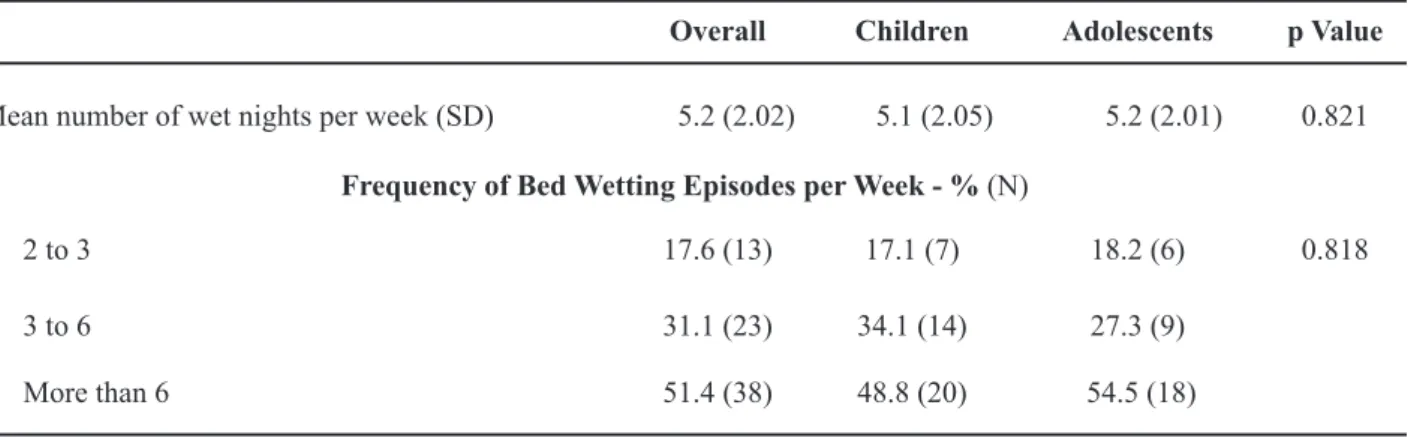
Table 1 – Frequency of enuresis episodes before treatment.
Overall Children Adolescents p Value
Mean number of wet nights per week (SD) 5.2 (2.02) 5.1 (2.05) 5.2 (2.01) 0.821
Frequency of Bed Wetting Episodes per Week - % (N)
2 to 3 17.6 (13) 17.1 (7) 18.2 (6) 0.818
3 to 6 31.1 (23) 34.1 (14) 27.3 (9)
More than 6 51.4 (38) 48.8 (20) 54.5 (18)
Unpaired t-test was used to compare the frequency of enuresis episodes before treatment. Fisher’s exact test was used to verify the relationship between success and the study variables (age and type of psychological support), and variance analysis was used to determine the time required to obtain success taking into consideration the study variables. ANOVA was used to analyze the variation in the time required to achieve success. Signiicance was established at p < 0.05.
RESULTS
To characterize the sample, the frequency of wetting episodes (severity of enuresis) in the sample was determined before the start of treatment. This information was not available for 10 participants, and thus 74 children and adolescents were considered (N = 74). Table-1 shows the distribution of the sample ac-cording to the frequency of night wetting episodes. Table-1 shows that more than half of the overall sample experienced bedwetting every night. This proportion was slightly larger in the group of adolescents, but the difference was not signiicant. Similarly, the mean number of weekly episodes for the overall sample (5.2) was similar to that for the two separate age groups.
The rate of severe enuresis in the sample is larger than that reported in prevalence studies (3). This is possibly due to the inclusion criteria used in this study and to the fact that the search for treatment may be more frequent when enuresis is more severe.
Table-2 shows the distribution of the two age groups and types of support in terms of treatment success and failure. Dropouts were included in the failure criteria.
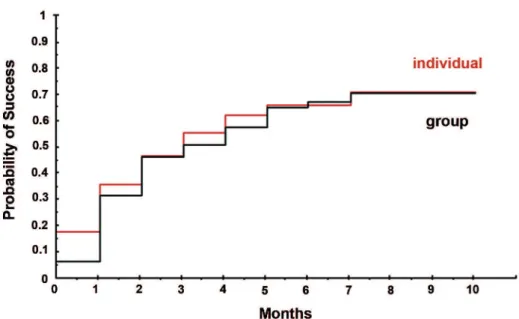
Success was achieved in 71% of the sample. The success rate among children (6 to 10 years of age) and adolescents (11 to 17 years of age) was not statistically signiicant. Similarly, there was no sta-tistical difference between the two types of support, although the failure rate was lower to participants receiving individual support (14% vs. 41% for group support) (Table-2). An analysis was also carried out to investigate if the onset of success differed in terms of age and session format. Figures 1 and 2 show the chance of obtaining success during treatment for these two variables.
Figure-1 shows that although success was achieved earlier in the group receiving individual support, the difference was not statistically signiicant. There was also no signiicant difference in time to achieve success according to age (Figure-2).
An analysis of time to achieve success related to session attendance is shown in Table-3.
Table 2 – Success rate of an alarm technique with individual or group support in a sample of children and adolescents with nocturnal enuresis.
Success - N (%) Failure - N (%) p Value
Overall
65 (71) 19 (29) Not applicable
Age
Children 41 (79) 11 (21)
0.79
Adolescents 24 (75) 8 (25)
Type of Support
Group 36 (59) 15 (41)
0.108
Individual 29 (86) 4 (14)
Table 3 – Time, in weeks, to achieve success (deined as 14 consecutive dry nights) according session attendance.
Mean Standard Deviation p Value
Number of missed sessions < 10% 7.3 5.17 0.007*
> 10% 13.3 8.20
COMMENTS
In the present study, the 71% success rate obtained by the participants is in accordance with previous results described in the literature - 65% on average (13). Considering more than half of our study participants had severe enuresis, the hypothesis that severity affects the results of treatment, either nega-tively or posinega-tively, may not be supported.
Age range has also been described as a pre-dictor of failure, since adolescent enuresis is usually more dificult to treat (20). We did not observe a sig-niicant difference between children and adolescents, with both presenting similar success rates. However, with a broader sample, the slight difference in time to obtain success could appear as a signiicant factor.
The type of psychological support provided was not related to treatment success, as previously reported (13). Participants from families receiving individual support had similar success rates than those receiving group support; however, those receiving group support missed more sessions, an aspect
associ-ated with greater dificulty in achieving success. The percentage of group format participants that missed more than 20% of the sessions was 39.6%, against 17.5% of the participants of individual format. It is possible that the individual support leads to a greater commitment by the families, expressed in a better attendance to the sessions. Participants that missed more than 10% of the sessions, regardless of session format, took, on average, 5 more weeks to achieve success than those who missed less than 10% of the sessions. There seems to be a relationship between session attendance and success (13). The number of missed support sessions may be interpreted as a relection of low adherence. It is likely that missing sessions in itself does not affect treatment, but rather, that it relects a dificulty in following the prescribed steps, leading to a higher failure rate or to a longer interval until success achievement.
Figure 1 – Probability of success according to session format.
Figure 2 – Probability of success according to age.
have been able to conirm the observed trend towards a better performance in participants receiving indi-vidual support, and to clarify the relationship between failure and missing support sessions. Therefore,
have exaggerated the success rate, since the cases of success may have resulted from spontaneous remis-sion of enuresis.
CONCLUSIONS
Treatment of nocturnal enuresis with an alarm technique was satisfactory in this Brazilian sample. The success rate was in accordance with that described in the literature. The results of treatment were similar for children and adolescents and for individual and group support. Failure to participate in support sessions was associated with a delay in success achievement. We believe that treatment with the alarm technique may be used in other Brazilian patient populations and that additional studies should be carried out to identify predictors of success and failure that are characteristic of this population.
ACKNOWLEDGEMENTS
This work received inancial support from Fundação de Amparo à Pesquisa do Estado de São Paulo (FAPESP) and Conselho Nacional de Desen-volvimento Cientíico e Tecnológico (CNPq).
CONFLICT OF INTEREST
None declared.
REFERENCES
1. Nevéus T, von Gontard A, Hoebeke P, Hjälmås K, Bauer S, Bower W, et al.: The standardization of termi-nology of lower urinary tract function in children and adolescents: report from the Standardisation Commit-tee of the International Children’s Continence Society. J Urol. 2006; 176: 314-24.
2. American Psychiatric Association: Diagnostic and Statistical Manual of Mental Disorders DSM-IV. Enuresis (Not Due to a General Medical Condition). Washington, DC. 1994; pp. 108-10.
3. Butler RJ, Golding J, Northstone K; ALSPAC Study Team: Nocturnal enuresis at 7.5 years old: prevalence
and analysis of clinical signs. BJU Int. 2005; 96: 404-10.
4. Lottmann H: Enuresis treatment in France. Scand J Urol Nephrol Suppl. 1999; 202: 66-9.
5. Butler RJ: Childhood nocturnal enuresis: developing a conceptual framework. Clin Psychol Rev. 2004; 24: 909-31.
6. Ozden C, Ozdal OL, Altinova S, Oguzulgen I, Urgan-cioglu G, Memis A: Prevalence and associated factors of enuresis in Turkish children. Int Braz J Urol. 2007; 33: 216-22.
7. Nevéus T: Diagnosis and management of nocturnal enuresis. Curr Opin Pediatr. 2009; 21: 199-202. 8. Hjalmas K, Arnold T, Bower W, Caione P, Chiozza
LM, von Gontard A, et al.: Nocturnal enuresis: an international evidence based management strategy. J Urol. 2004; 171: 2545-61.
9. Järvelin MR, Vikeväinen-Tervonen L, Moilanen I, Huttunen NP: Enuresis in seven-year-old children. Acta Paediatr Scand. 1988; 77: 148-53.
10. Baeyens D, Roeyers H, Naert S, Hoebeke P, Vande Walle J: The impact of maturation of brainstem inhibition on enuresis: a startle eye blink modiica-tion study with 2-year followup. J Urol. 2007; 178: 2621-5.
11. Moffatt ME, Harlos S, Kirshen AJ, Burd L: Desmo-pressin acetate and nocturnal enuresis: how much do we know? Pediatrics. 1993; 92: 420-5.
12. Houts AC. Behavioral treatment for enuresis. In: Kazdin AE, Weisz JR, (ed.), Evidence-based psycho-therapies for children and adolescents. New York, The Guilford Press. 2003; pp. 389-406.
13. Butler RJ, Gasson SL: Enuresis alarm treatment. Scand J Urol Nephrol. 2005; 39: 349-57.
14. Glazener CM, Evans JH, Peto RE: Alarm interventions for nocturnal enuresis in children. Cochrane Database Syst Rev. 2005; 18: CD002911.
15. Butler RJ, Robinson JC: Alarm treatment for child-hood nocturnal enuresis: an investigation of within-treatment variables. Scand J Urol Nephrol. 2002; 36: 268-72.
16. Kristensen G, Jensen IN: Meta-analyses of results of alarm treatment for nocturnal enuresis--reporting practice, criteria and frequency of bedwetting. Scand J Urol Nephrol. 2003; 37: 232-8.
17. Mota DM, Victora CG, Hallal PC. Investigation of voiding dysfunction in a population-based sample of children aged 3 to 9 years. J Pediatr (Rio J). 2005; 81: 225-32.
EDITORIAL COMMENT
The authors should be congratulated for per-forming a study evaluating the results with alarm for enuresis in Brazilian children and adolescents. The authors’ good results with this treatment demonstrate their high level of expertise in this ield and that Brazilian patients can be successfully treated by this method. However, a signiicant drawback of the alarm treatment is the high dropout rate (reference 13 and 14 in the article). An intention to treat analyses is the most accurate way to evaluate the inal success rate and it was not the case in this study. For instance, the alarm was indicated for 100 children and 30 discontinued the treatment (dropouts) even before patients could be entered into the study protocol. Suppose 45 (65%) out of those 70 had success with alarm. The rate of failure should be 55% (25 + 30 patients failed) not 35%. Unfortunately, the overall dropout rate was not stated. How many patients were not included in the protocol because they or the family was not adapted
to the method? Since we do not have this informa-tion, the results of this study can be interpreted as overestimated. Also, the lack of a control group, the limited number of patients and the absence of clear randomization criteria does not permit to draw any conclusions regarding the value of a psychological support for these types of patients. It is interesting to note that children have the same success rate as the adolescents showing that this treatment is successful even in younger age.
Dr. Ubirajara Barroso Jr.
Rua Alameda dos Antúrios, 212 / 602 Salvador, BA, 40280-620, Brazil E-mail: [email protected] children. What do pre-school teachers know about it?Int Braz J Urol. 2007; 33: 383-8; discussion 388. 19. Rocha MM, Costa NJ, Silvares EF: Changes in parents’
and self-reports of behavioral problems in Brazilian adolescents after behavioral treatment with urine alarm
for nocturnal enuresis. Int Braz J Urol. 2008; 34: 749-57; discussion 757.
20. Nappo S, Del Gado R, Chiozza ML, Biraghi M, Ferrara P, Caione P: Nocturnal enuresis in the adolescent: a neglected problem. BJU Int. 2002; 90: 912-7.
Accepted after revision:
January 18, 2010
Correspondence address: Dr. Rodrigo Fernando Pereira
Av. Prof. Mello Moraes, 1721 / Bloco F / Sala 30 Cidade Universitária