Epidemiology of AIDS and HIV Infection
in the Caribbean
JAI I? NARAIN,*
B.
HULL,*
C. J.
HOSPEDALES,~
S.
MAHABIR,~ &
D. C.
BASSETT~
A review
of
surveillance data on AIDS and HIV infection in the 18 English-speaking Caribbean countries and Suriname suggests that the epidemiologic pattern of AIDS in the Caribbean is evolving from an epidemic that began in 1983 among homosexual and bisexual males to one in which cases are increasingly resultingfrom heterosex- ual contact, with difierent countries at various stages of transition. Overall, there has been a decline in the male to female case ratio. Perinatal transmission is already a major problem in many countries-19% of cases in the Bahamas are among chil- dren under 15 years of age. Serosurveys conducted in Trinidad and Tobago, Jamaica, Antigua, St. Vincent and the Grenadines, and other countries show high HIV sero-prevalence among homosexuals (15-40%), prisoners @-loo%), prostitutes (up to 13%), and cocaine users (2%): at nresent, prevalence in the general population continues to be low. ., I
S
ince the first case was reported in the United States in 1981, cases of ac- quired immunodeficiency syndrome (AIDS) have been reported in increasing numbers from almost all parts of the world, including the Caribbean coun- tries. An estimated 5-10 million persons worldwide are likely to be infected with human immunodeficiency virus (HIV), the causative agent of AIDS (I). In the Americas, which reports the majority of the world’s AIDS cases, five countries- the United States of America, Brazil, Canada, Haiti, and Mexico-account for 95% of all reported cases (2). The data also demonstrate that the entire Carib- bean area has exceptionally high rates of AIDS. This paper describes the magni- tude of AIDS and HIV infection in 18 English-speaking Caribbean countries and Suriname, and discusses the implica- tions of the changing epidemiologic pat- tern of the disease in this area.BACKGROUND
‘Caribbean Epidemiology Center, P.O. Box 164, Port of Spain, Trinidad and Tobago.
Since its inception in 1975, the Carib- bean Epidemiology Center (CAREC) has collected and analyzed communicable- disease surveillance data from its 19 member countries: Anguilla, Antigua and Barbuda, Bahamas, Barbados, Be- lize, Bermuda, the British Virgin Islands, the Cayman Islands, Dominica, Gre- nada, Guyana, Jamaica, Montserrat, St. Kitts and Nevis, Saint Lucia, St. Vincent and the Grenadines, Suriname, Trinidad and Tobago, and the Turks and Caicos Islands. These countries have a com- bined population of 6.3 million people and share a similar colonial history and similar problems, especially in health.
AIDS surveillance in the area began in 1982; since 1985, the countries routinely have reported AIDS cases to CAREC, us- ing a standard PAHOlWHO form. HIV antibody testing began in the Caribbean in 1985, first in Trinidad and Tobago and subsequently in many other countries. As of August 1988, almost all the 19
countries and territories had already ac- quired HIV antibody testing equipment and supplies, and their technicians had been trained with CAREC assistance.
METHODS
We reviewed and analyzed data on AIDS cases from the 19 Caribbean coun- tries which have been reporting cases on a quarterly basis to CAREC in Port of Spain, Trinidad. A standard reporting form is used, and it provides information on distribution of cases according to age, sex, and transmission category.
The countries also report the number of HIV tests performed on donated blood and the number of tests performed for diagnostic purposes. Information on HIV
infection in specific population groups was gathered through various surveys and studies conducted in different coun- ties, most of which are still unpublished.
For the purpose of surveillance and for reporting to CAREC, a positive serologic
test is defined as a repeatedly reactive an- tibody test with ELISA, followed by a positive confirmation test with Western blot assay. The WHOPAHO AIDS case definition is used by all the reporting
countries.
RESULTS
The first confirmed case of AIDS in the Caribbean occurred in Jamaica in 1982. In Trinidad and Tobago, eight cases were re- ported in 1983-all in homosexual or bi- sexual males.
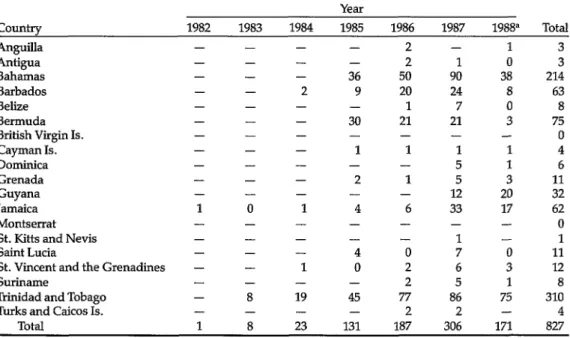
As of 30 June 1988, the CAREC mem- ber countries had reported 827 cases, 80% of which were reported since Janu- ary 1986 (Table 1). The number of re- ported cases was 187 for 1986 and 306 for 1987, representing an increase of 63%. Of the 827 total cases, 492 had died, giving an overall case fatality ratio of 59.4%.
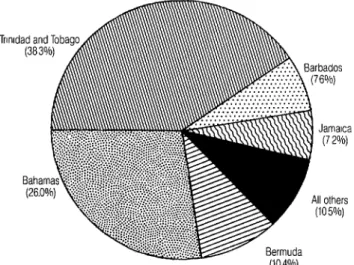
Nearly 90% of the cases were reported from five countries-Trinidad and To- bago, Bahamas, Bermuda, Barbados, and
Table 1. Reported cases by year and country as of 30 June 1988.
Year
Country 1982 1983 1984 1985 1986 1987 1988” Total
AnguiIIa - - - - 2 - 1 3
Antigua - - - - 2 1 cl 3
Bahamas - - - 36 50 90 38 214
Barbados - - 2 9 20 24 8 63
Belize - - - - 1 7 0 8
Bermuda - - - 30 21 21 3 75
British Virgin Is. - - - 0
Cayman Is. - - - 1 1 1 1 4
Dominica - - - 5 1 6
Grenada - - - 2 1 5 3 11
Guyana - - - 12 20 32
Jamaica 1 0 1 4 6 33 17 62
Montserrat - - - 0
St. Kitts and Nevis - - - 1 - 1
Saint Lucia - - - 4 0 7 0 11
St. Vincent and the Grenadines - - 1 0 2 6 3 12
Suriname - - - - 2 5 1 8
Trinidad and Tobago - 8 19 45 77 86 75 310
Turks and Caicos Is. - - - - 2 2 - 4
Total 1 8 23 131 187 306 171 827
*Data for first six months only.
Figure 1. Distribution by country of reported AIDS cases
among CAREC member countries, as of 30 June 1988. Jamaica; 75% were from the first three
countries (Figure 1).
The distribution of cumulative cases and of deaths in selected countries were as follows: Trinidad and Tobago, 310 cases and 200 deaths; Bahamas, 214 and 104; Bermuda, 75 and 58; Barbados, 63 and 43; and Jamaica, 62 and 38. In Guy- ana, the first 12 cases were reported in 1987; up to June in 1988, 20 additional cases had been reported. Similarly, Ja- maica reported six cases in 1986 and 33 in 1987. Montserrat and the British Virgin Islands are the only two territories in the Americas that have not reported any AIDS cases to date. The annual incidence rates of reported cases in some Caribbean
countries are among the highest in the world. During 1987, the rates per 100,000 population varied from 0 to 38.3, median 4.27. Countries with high rates were Ba- hamas (38.3), Bermuda (35.3), Barbados (9.4), and Trinidad and Tobago (7.0) (Ta- ble 2). Of the five countries with the ma- jority of reported cases, only Bermuda did not report an increase in case rates from 1986 to 1987. Overall, the 20-44 year age group had the most cases; the number of reported cases peaked among 25-34-year-olds (Table 3).
Of 737 adult cases (115 years old) re- ported up to June 1988, 564 (76.5%) were among males and 173 (23.5%) among fe- males; the male to female ratio was 3.3:1.
Table 2. Number of reported AIDS cases and case rate per 100,000 population in selected CAREC member countriesa in 1987, and cumulative case rate per 100,000 as of 30 June 1988.
Mid-year No. of cases 1987 case Cumulative population reported in rate per case rate per
Country in1987 1987 100,000 100,000
Bahamas 235,000 90 38.3 91.1
Barbados 256,000 24 9.4 24.6
Bermuda 59,400 21 35.3 126.3
Guyana 988,000 12 1.2 3.2
Jamaica 2,400,OOO 33 1.4 2.6
Trinidad and Tobago 1,230,OOO 86 7.0 25.2
Tomtries reporting fewer than 10 new cases in 1987 are not included.
The proportion of AIDS reported in fe- males has increased from year to year. While none of the 31 persons with AIDS reported up to 1984 were females, the proportion increased to 18.3%, 23.0%, 25.5%, and 28.9% in 1985, 1986, 1987, and 1988 (up to June), respectively.
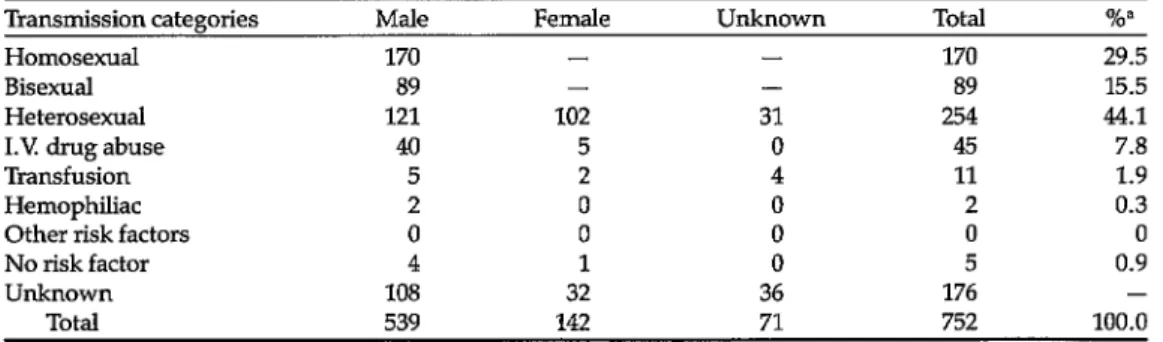
Table 4 shows the distribution of re- ported adult cases by transmission cate- gories: homosexual or bisexual males (45.0%), heterosexual males and females (44.1%), intravenous drug users (7.8%), blood transfusion recipients (1.9%), and hemophiliacs (0.3%). Overall, sexual HIV transmission was responsible for 89% of the total cases reported up to June 1988. Of 45 intravenous drug users with AIDS, 44 (98%) were from Bermuda.
Table 3. Age and sex distribution of cases reported as of 30 June 1988.
Age (ye4 Male Female Total %” <1 22 12 34 5.3
l-4 15 13 28 4.4
5-14 2 2 4 0.6
15-19 9 2 11 1.7
20-24 53 28 81 12.6 25-34 187 77 264 41.2 35-44 98 24 122 19.1 45-54 47 15 62 9.7 >55 27 7 34 5.3
IJllkllOWIl 143 20 163 -
Total 603 200 803b 100.0
Wzcentages based on total cases for whom age information was available.
bFor 24 cases, information on the sex was not available.
The first pediatric AIDS cases reported in the Caribbean were 11 cases in 1985, followed by 14 and 30 cases in 1986 and 1987, respectively. The male to female ra- tio of cumulative AIDS cases in children is 1.4:1. Of children under five years of age who have AIDS, all were born to HIV-positive mothers. The Bahamas re- ported the highest proportion of perina- tally transmitted AIDS; 19% of reported cases were in children, compared to an overall Caribbean percentage of 10.3.
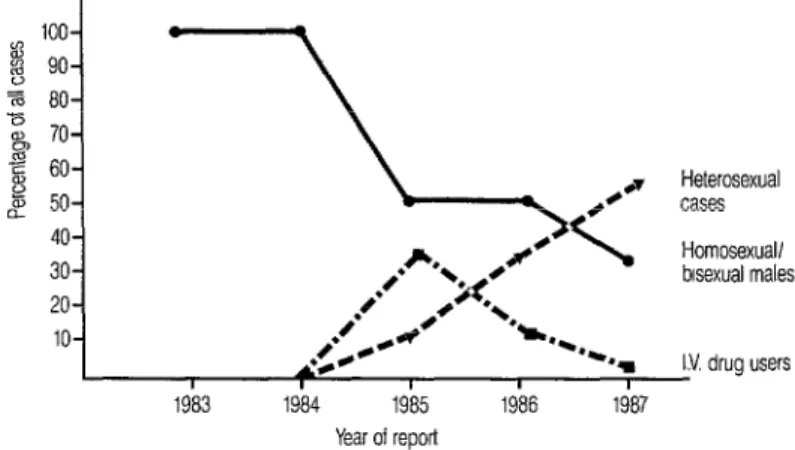
Comparison of risk behavior data over the last five years demonstrates a shift from the predominantly homosexual spread seen earlier in the epidemic to- ward the present pattern of predomi- nantly heterosexual transmission (Figure 2). The number of homosexuals and bi- sexuals with AIDS continues to increase, but the relative increase of those who ap- pear to have acquired AIDS heterosex- ually has been far greater.
As a result, the proportion of hetero- sexual persons with AIDS has steadily in- creased, while that among homosexuals and bisexuals has declined over the years. Of cases reported in 1986, 27% were heterosexual contact cases. This proportion increased to 56.2% in 1987 and to 61.1% of cases reported in 1988 up to June. In all countries reporting more than 60 cumulative cases, those cases as-
Table 4. Distribution of adult AIDS cases by major transmission categories, in CAREC member countries, 1982-June 1988.
Transmission categories Male Female Unknown Total
Homosexual 170 - - 170
Bisexual 89 - - 89
Heterosexual 121 102 31 254
1.V drug abuse 40 5 0 45
Transfusion 5 2 4 11
Hemophiliac 2 0 0 2
Other risk factors 0 0 0 0 No risk factor 4 1 0 5
Unknown 108 32 36 176
Total 539 142 71 752
‘Percentages were calculated with a denominator of 576, excluding cases with unknown risk factors.
%”
29.5 15.5 44.1 7.8 1.9 0.3
0
0.9 - 100.0
Heterosexual cases Homosexual/ bisexual males
IY drug users I I I I I
1983 1984 1985 1986 1987 Year of report
Figure 2. Proportion of reported cases by major risk categories in the Caribbeak, 1983-1987..
sociated with heterosexual contact have been increasing.
In Trinidad and Tobago, among per- sons with AIDS resulting from sexual transmission, the proportion attributable to heterosexual contact increased from none in 1983 and 1984, to 13%, 25%, and 47% during the middle of 1985,1986, and 1987, respectively. Data from Bermuda from 1985 to 1987 show an increase in heterosexual contact cases (from 6% to 24% of the total) and a decrease in re- ported cases among intravenous drug users.
HIV INFECTION
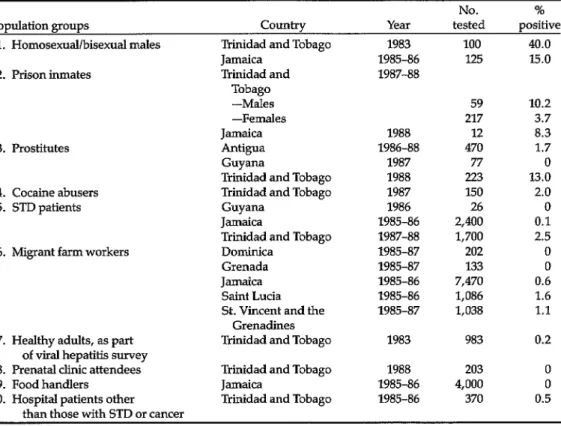
Some seroprevalence studies have been conducted in the Caribbean to as- sess the extent of HIV infection in specific population groups (Table 5).
One of the first serologic studies was conducted among homosexuals in Trini- dad and Tobago (3); subsequent serosur- veys and screenings have been con- ducted in persons from other identified high-risk groups, specifically prostitutes and persons seeking treatment at sexu- ally transmitted disease clinics. In sexu- ally active populations not at high risk, surveys have been conducted on women
46 PAHO Bulletin 23(2-Z), 1989
attending prenatal clinics and also on persons without known risk factors, such as blood donors. HIV seroprevalences range from 15-40% among homosexual and bisexual males, 4-10% among pris- oners, O-13% among prostitutes, 2% among cocaine users, and O-2.5% among individuals attending STD clinics.
As of July 1988, 15 Caribbean countries were testing donated blood for HIV anti- bodies. The prevalence of HIV infection in nine countries reporting data has ranged from 0.04% to 1.55%, with a me- dian of 0.26% (Table 6).
A 1982 outbreak of hepatitis B in Trini- dad and Tobago provided an opportunity to obtain serum samples from a represen- tative sample of 983 adults from the gen- eral population. Two of these persons (0.2%) had antibodies to HIV and both were from known risk groups. Among 4,000 food handlers tested in Jamaica during 1985-1986, none were found to have antibodies to HIV (4).
DISCUSSION
Table 5. Seroprevalence in several population groups, 1985-1988.
Population groups Country
No. tested
% positive 1. Homosexual/bisexual males
2. Prison inmates
3. Prostitutes
4. Cocaine abusers 5. STD patients
6. Migrant farm workers
7. Healthy adults, as part of viral hepatitis survey 8. Prenatal clinic attendees 9. Food handlers
10. Hospital patients other
Trinidad and Tobago Jamaica
Trinidad and
Tobago -Males -Females Jamaica Antigua Guyana
Trinidad and Tobago Trinidad and Tobago Guyana
Jamaica
Trinidad and Tobago Dominica
Grenada Jamaica Saint Lucia St. Vincent and the
Grenadines Trinidad and Tobago
1983 1985-86 1987-88
100 40.0 I.25 15.0
1988 1986-88 1987 1988 1987 1986 1985-86 1987-88 1985-87 1985-87 1985-86 1985-86 1985-87 1983
59 10.2 217 3.7 12 8.3 470 1.7
77 0
223 13.0 150 2.0
26 0
2,400 0.1 1,700 2.5
202 0
133 0
7,470 0.6 1,086 1.6 1,038 1.1
983 0.2
Trinidad and Tobago 1988 203 0 Jamaica 1985-86 4,000 0 Trinidad and Tobago 1985-86 370 0.5 than those with STD or cancer
are still more likely than females to have AIDS, the gap is narrowing. The propor-
tion of new cases attributable to hetero-
sexual transmission is increasing. Given the prevailing pattern of sexual behavior, the rapid spread of HIV from bisexuals (and possibly from intravenous drug abusers in some countries) to heterosex- ual persons, and the size of the hetero- sexual population, it is inevitable that sexual transmission will continue to oc- cur and to increase in the Caribbean. This will, in turn, directly and significantly af- fect perinatal transmission of HN, which is already a substantial problem in many countries of the area.
The World Health Organization’s Global Program on AIDS has described three distinct epidemiologic patterns of AIDS in the world. In general, the epide- miology in the Caribbean does not fit eas-
ily into any pattern. In the larger Carib- bean countries, the epidemic began among homosexuals (Pattern I) and then shifted rapidly towards Pattern II, in which heterosexual transmission is the predominant mode of spread. The male
Table 6. HIV seroprevalence (%) among
blood donors.a
counhy 1986 1987
Bahamas Barbados Bermuda Cayman Islandsb Grenadab Jamaica
St. Vincent and the
Grenadinesb Suriname
- 0.50 - 0.11 0.04 0.09 - 0.49 - 0.26 0.27 0.23
- 0.45 - 0.04 Trinidad and Tobago 1.5
aBased on quarterly reporting system. bBased on fewer than 500 donors tested.
1.55
to female case ratio in Trinidad and To- bago up to 1985 was 5.9:1, but has de- clined steadily since then.
The Caribbean countries have a serious AIDS problem with one of the highest annual incidence rates in the world. Since the virus was introduced in the late 197Os, primarily among the homosexual population by gay and bisexual men trav- eling between the Caribbean and North America, and considering that AIDS of- ten has a 7-8 year or longer incubation period, the yearly increase in heterosex- ual contact cases has been extremely rapid. In part, this could be explained by factors related to the sexual behavior of the population, such as a higher ratio of bisexual to homosexual males than in North America, the nature of sexual/ marital relationships, and perhaps the in- creasing level of STDs. It is generally be- lieved that most Caribbean homosexuals, unlike those in the United States, tend to be bisexual because homosexuality is not well tolerated in the area. Strong social and religious disapproval makes it diffi- cult to follow a homosexual lifestyle openly-many homosexuals are married, have children, and perhaps continue to engage in both homosexual and hetero- sexual activity. HIV probably was intro- duced into the heterosexual population when bisexual males had sexual contact with women. This hypothesis is sup- ported further by data from Trinidad and Tobago which show that, while initial cases resulting from heterosexual contact were women with bisexual partners, 72% of the heterosexual cases reported in 1987 were among males whose only risk activ- ity was frequent sexual contact with fe- males (5), indicating female-to-male transmission of HIV
Further spread of HIV in the commu- nity may have been facilitated by the fact that men and women tend to have multi- ple sexual partners (6). In many commu- nities, it seems, sex is not often linked to
monogamous relationships: serial con- sensual unions are common, and unin- terrupted and civilly sanctioned monoga- mous marriages are in the minority (S. Mintz, as quoted in 5). The fluidity of sex- ual relationships and the custom for men to have multiple partners have been doc- umented in several anthropological stud- ies (7, 8). In addition, risk factors such as teenagers engaging in unprotected sex (9) and the increasing levels of sexually transmitted diseases, particularly syphi- lis, have further contributed to rapid spread of HIV in the Caribbean.
This increase in heterosexual transmis- sion in the Caribbean has inevitably re- sulted in more HIV infection. Pediatric AIDS is already a substantial problem in many countries, where the proportion of children among reported AIDS cases is 10%. This figure is far greater than that from North America and Europe, where the proportion is less than 3% (10, 21). Some Caribbean countries are still at the initial stages of the epidemic (Guyana, for example, where the first cases were reported as recently as 1987), but given the general trend seen in most other Ca- ribbean countries, this is expected to change.
Faced with the increasing problem of AIDS and HIV infection, the govern- ments of all Caribbean countries have taken the problem very seriously: na- tional AIDS committees have been estab- lished, education of health care workers and the general public has been started, and almost all countries now screen do- nated blood. The majority of countries have started implementing short-term programs (one year) for AIDS prevention and control, and most have developed medium-term plans (three years) with as- sistance from the Pan American Health Organization, the World Health Organi- zation’s Global Program on AIDS, and CAREC.
Priorities and strategies for the
medium-term programs for AIDS control in the Caribbean are based on available epidemiologic evidence. These priorities include strengthening of epidemiologic surveillance through HIV serosurveys and serosurveillance studies, and pre- vention of sexual transmission and of perinatal transmission through informa- tion and education strategies aimed both at those engaged in high-risk behaviors and at the general population. To this end, it is important to conduct knowl- edge, attitude, and practice surveys, es- pecially of specific target groups, and to follow these studies with interventions. Such surveys have been carried out in some countries, including Grenada and Jamaica. It is also important to take steps to reduce the social and economic impact of HIV on individuals, groups, and soci- eties. In the absence of a vaccine or an effective therapy, the development and strengthening of AIDS education and in- formation campaigns and of counselling services in all countries of the Caribbean remain the most important strategies for containing the spread of the virus.
REFERENCES
1. World Health Organization, Global Pro- gram on AIDS. Update on AIDS, July 1988.
2. St. John, R., M. Clifford, and F. Zacarfas. Epidemiology of AIDS in the Americas. Paper presented at the IV International
3.
4.
5.
6.
7.
8.
9.
10.
11
Conference on AIDS, Stockholm, 12-16 June 1988.
Bartholomew, C., C. Saxinger, J. W. Clard, M. Gail, A. Dudgeen, B. Mahabir, B. Hull-Drysdale, F. Cleghorn, R. C. Gallo, and W. A. Blattner. Transmission of HTLV-1 and HIV among homosexual men in Trinidad. JAMA 257(19):2604-2608, 1987.
Murphy, E., l? Figueroa, W. N. Gibb, ef al. Retroviral epidemiology in Jamaica, West Indies: Introduction of HIV into an HTLV- 1 endemic island. Paper presented at the III International Conference on AIDS, Washington, D.C., l-5 June 1987. Cleghorn, F., et al. In: Proceedings of the London Conference on Global Impact of AIDS, March 1988, p. 55.
Bishop, J. Family life in the Caribbean- Sociocultural issues which affect AIDS prevention strategies. Presented at the CAREC Workshop on Prevention Coun- selling, July 1988.
Kerr, M. Personality and Conflicf in Jamaica. Collins, London, 1963.
Hodge, M. Young women and the devel- opment of stable family life in the Carib- bean. A Journal of the Caribbean Arfisfs Movement, 1977.
Jagdeo, T. l? Myths, misconceptions and mistakes: A study of Trinidad adoles- cents. The Family Planning Association of Trinidad & Tobago, 1986.
Centers for Disease Control. Reports on selected racial/ethnic groups. MMWR 37: l-3,1988.
Health Education Authority and Public Health Laboratory Service AIDS Centre, United Kingdom. A quarterly epidemio- logical briefing on AIDS/HIV in the United Kingdom. Issue 1, March 1988.