Preventable deaths in trauma patients associated
with non adherence to management guidelines
Mortes evitáveis em pacientes de trauma associadas a não adesão
às diretrizes de atendimento
INTRODUCTION
he care of trauma patients demands speciic attitudes and procedures. Due to the acute presentation and associated multiple organ dysfunction of trauma patients, patients’ injuries should be identiied as quickly as pos-sible, and therapeutic measures should be promptly initiated. (1) he
exist-ing evidence that some trauma victims die due to treatment-related errors rather than the severity of their injuries led to the concept of “preventable deaths”.(2) he rate of preventable deaths can be determined by medical
au-Antonio Cesar Marson1, Cintia
Magalhães Carvalho Grion2, Olavo
Franco Ferreira Filho2, João Carlos
homson1
1. MD, PhD, Physician of the Department of Surgery of the Universidade Estadual de Londrina – UEL – Londrina (PR), Brazil. 2. MD, PhD, Physician of the
Department of Internal Medicine of the Universidade Estadual de Londrina – UEL – Londrina (PR), Brazil.
ABSTRACT
Objectives: To evaluate patients treated for traumatic injuries and to identify adherence to guidelines rec-ommendations of treatment and as-sociation with death. The recommen-dations adopted were defined by the committee on trauma of the Ameri-can College of Surgeons in advanced trauma life support.
Methods: Retrospective cohort study conducted at a teaching hospi-tal. he study population was victims of trauma ≥ 12 years of age with injury severity scores ≥ 16 who were treated between January 1997 and December 2001. Data collection was divided into three phases: pre-hospital, in-hospital, and post-mortem. he data collected were analyzed using EPI INFO.
Results: We analyzed 207 pa-tients, 147 blunt trauma victims (71%) and 60 (29%) penetrating trauma victims. Trauma victims had a 40.1% mortality rate. We identi-fied 221 non adherence events that occurred in 137 patients. We found
a mean of 1.61 non adherence per pa-tient, and it occurred less frequently in survivors (1.4) than in non-survi-vors (1.9; p=0.033). According to the trauma score and injury severity score methodology, 54.2% of deaths were considered potentially preventable. Non adherence occurred 1.77 times more frequently in those considered potentially preventable deaths com-pared to other non-survivors (95% CI: 1.12–2.77; p=0.012), and 92.9% of the multiple non adherence oc-curred in the first group (p=0.029).
Conclusions: Non adherence oc-curred more frequently in patients with potentially preventable deaths. Non adherence to guidelines recom-mendations can be considered a con-tributing factor to death in trauma victims and can lead to an increase in the number of potentially preventable deaths.
Keywords: Trauma centers; Trauma severity indices; Mortality; Outcome assessment (Health Care); Cause of death; Risk factors
his study was developed at the Hospital Universitário da Universidade Estadual de Londrina - UEL - Londrina (PR), Brazil.
Financial disclosures: here are none to report.
Sources of support: here are none to report.
Submitted on July 19, 2010 Accepted on September 6, 2010
Author for correspondence:
Cintia Magalhães Carvalho Grion Avenida Robert Koch 60 - Divisão de Terapia Intensiva Adulto - Vila Operária Zip Code: 860380-350 - Londrina (PR), Brazil.
dits that are based on clinical and autopsy data or by the calculation of survival probability using the TRISS methodology.(3-14)
he mean rate of potentially preventable deaths in the United States is 19%.(6, 9,15) In Europe, the rates vary
from 25% to 33%.(7,8) Only a few articles have discussed
how treatment errors contribute to the occurrence of po-tentially preventable deaths.(2,7,16) hese errors may occur
due to a lack of professional training, a lack of equip-ment, or speciic factors associated with a patient’s trau-ma or accident. An analysis of the incidence of prevent-able deaths can be used to evaluate the quality of health care systems or to determine which treatment areas have associated errors and need to be improved.(17-19)
he objective of this study was to evaluate trauma-related deaths in patients who were treated at a teach-ing hospital and who were referred by the pre-hospital trauma care team to analyze adherence to guidelines recommendations during their treatment.
METHODS
his was a retrospective cohort study that was con-ducted at a teaching hospital and was approved by the local ethics committee. Informed consent was not re-quired.
he Hospital Universitário de Londrina is a public teaching hospital, which is part of Londrina State Uni-versity. It is a general hospital that provides health servic-es to the city of Londrina and the north region of Parana state. It is considered to be a regional trauma care center, which has speciic rooms to assist trauma patients within emergency department, access to computerized tomog-raphy and ultrasonogtomog-raphy in the hospital and prompt access to neurosurgery, vascular and thoracic surgery, and speciic rooms to orthopedic procedures.
he pre-hospital system is a public health service i-nanced by the government. It is composed of a central system of regulation and dispatch of human resources and ambulances equipped to assist trauma patients and perform the procedures necessary in the ield. he am-bulance staf includes nurses, paramedics and a motor-ist. Because in Brazil nurses are not allowed to perform all procedures in these patients, i.e., endotracheal intu-bation and thoracic drainage, a physician may be a part of the staf group in selected calls, depending on the an-ticipation of the need to perform medical procedures. he pre-hospital central dispatch receives the calls and decides what kind of staf group is going to the scene (with or without a physician) according to a triage
al-gorithm. hey also determine to which hospital to send the victim. here are three hospitals in Londrina that receive trauma patients assisted by the pre-hospital sys-tem: two of them are part of beneicent institutions and one of them is the University Hospital. he previous notiication of patient transfer to the hospital is made by the staf in the ambulance. here is no helicopter transportation available in the system.
Medical triage and treatment at the scene are pro-vided by health care professionals who are trained in pre-hospital trauma life support (PHTLS) and ATLS, and tertiary hospital care is provided by attending sur-geons trained in ATLS.
Patients in this study consisted of trauma victims aged >12 years who had an injury severity score (ISS)(20) of >16
and who were referred by the pre-hospital trauma care
team between January 1997 and December 2001to the
Hospital Universitário de Londrina. he exclusion criteria were as follows: 1) burn victims; 2) patients transferred from outside hospitals; 3) patients who were in cardiac arrest at the time of arrival to the emergency department who never experienced return of spontaneous circulation.
Data collection was divided into three phases: pre-hospital, during hospitalization and post-mortem. Pre-hospital data collection was carried out by analyzing the pre-hospital trauma care team’s records. he following variables were analyzed: 1) epidemiological data (i.e., sex, age, mechanism of injury, time at which the acci-dent occurred, and clinical descriptions of the patients’ injuries); 2) clinical data (i.e., diaphoresis, tachycardia, pallor, Glasgow coma scale (GCS) score, systolic arte-rial pressure, and respiratory rate), assessment of injury severity by anatomic site according to the abbreviated injury scale (AIS;1985 revision); and 3) patient man-agement data: (i.e., the use of oxygenation, the acquisi-tion of a deinitive airway, ventilaacquisi-tion assistance, tho-racentesis, pleural drainage, volume resuscitation, and injury stabilization).(21,22)
drain placement, urethral drain placement, fracture immobilization, laboratory data, and the types of spe-cialists that were consulted). From the operating room, we collected data regarding the length of surgery, the anatomic lesions that patients were found to have, the surgical procedures that were performed, and mortality. From the intensive care unit or loors, we collected data on admission time and mortality.
Collection of post-mortem data was carried out by compiling information provided by the Legal Medi-cine Institute, which is where all autopsies were per-formed. All patients who died during hospitalization due to trauma were submitted to an autopsy. We col-lected information regarding the time of the accident, the mechanism of injury, the time of death, anatomic lesion severity according to the AIS-85, and cause of death. Data from autopsy were used to identify missed diagnoses, and to calculate the AIS-85 and ISS scores.
Two trauma indices were calculated. he revised trauma score (RTS) was calculated using data ob-tained in the emergency department according to the formula: RTS=(0.9368 x GCS) + (0.7326 x SBP) + (0.2908 x RR), where SBP=systemic blood pressure and RR=respiratory rate.(23) he ISS was obtained based
on the anatomic lesions that were described in patients’ medical records during pre-hospital treatment, in the emergency department, in the operating room, and at the Legal Medical Institute and were classiied accord-ing to the AIS-85. he ISS was calculated by determin-ing the sum of squares of the three worst indices. How-ever, if one of the indices was assigned a score of 6, the patient was assigned an overall score of 75.
A potentially preventable death was deined as death that occurred in a trauma victim with a probability of survival greater than 0.5 according to their trauma score and injury severity score (TRISS) score.(24) Deaths
occurring in victims with a survival probability >50% and survival occurring in victims with a survival prob-ability <50% were deined as unexpected outcomes.
Adherence was evaluated according to advanced trauma life support (ATLS) recommendations.(25) Non
adherence to guidelines recommendations during man-agement of the trauma patient was classiied as follows, according to reviewers’ interpretation:
1) delay to hospital admission: more than one hour after the trauma;
2) airway management: failure to oxygenate properly or fail to intubate patient when indicated. he following conditions were considered indications for orotracheal intubation: GCS less than 8, severe maxillary or facial
fractures, bronchoaspiration risk, airway obstruction risk, apnea, and incapacity to maintain oxygenation;
3) ventilation management: failure to perform tho-racentesis or thoracic drainage when indicated (pneu-mothorax or he(pneu-mothorax); failure or delay to provide mechanical ventilation when necessary;
4) volume resuscitation: failure to compensate for signs of hypovolemia during volume resuscitation; in-adequate bleeding control; delay to perform surgical procedures to control bleeding;
5) neurological management: failure to oxygenate or ventilate properly; delay to neurosurgeon evalua-tion; delay to perform neurosurgical procedures; delay to ICU admission;
6) others: diagnostic or therapeutic decisions con-sidered inappropriate and not included in the previous items;
7) diagnostic procedures: failure to perform nostic procedures when necessary or unnecessary diag-nostic procedures resulting in delays of initial patient management;
8) diagnose: relevant injuries not identiied during initial evaluation; and
9) late injury diagnosis: injuries not diagnosed on time for optimal management.
Non adherence was determined based on the con-sensus agreement of three physicians with ATLS train-ing and ield experience who examined the clinical data of all the patients included in the study. Two of these physicians are authors of the present paper (homson, JC and Marson, AC) and another one was invited to participate as a consultant without authorship. None of them was involved in the treatment of the trauma patients included in this study.
Collected data were entered into an Excel® spreadsheet
ive. Comparison between the observed mortality rate and the mortality rate estimated by the major trauma outcome study (MTOS) was carried out using Z statistics calculus, as previously described.(26,27) he severity of the injuries
of the trauma victims in our study and the severity of the injuries observed in MTOS was compared using the M-statistic, as previously described.(24,26) Logistic regression
analysis using stepwise variable selection, with a variable exit threshold set at p < 0.05, was applied to identify fac-tors associated with mortality. All p-values <0.05 were considered to be statistically signiicant.
RESULTS
During the study period, the pre-hospital trauma care system treated 30,087 patients. Of those pa-tients, 27,508 (91.4%) were trauma victims and 5,766 (21.0%) were referred to the Londrina State Univer-sity Hospital. Of these, 207 (3.6%) patients met the inclusion criteria for our study. Reasons for exclusion were age less than 12 years-old (n=496), ISS less than 16 (n=5,189), burn victims (n=10), transference from outside hospitals (n=52), cardiac arrest at the time of arrival to the emergency department (n=19). he mean age of included patients was 34,0 ± 14.4 years, and the majority of patients were males (91.8%). he most common mechanisms of injury of the included trauma patients were motorcycle or bicycle accidents (n=68, 32.9%), stabbings or gunshot wounds (n=58, 28.0%) and traic accidents (n=57, 27.5%). hese resulted in 147 (71%) blunt trauma patients and 60 (29%) pen-etrating trauma patients. he description of the popu-lation characteristics is depicted in table 1.
Of the 207 patients included in the study, 83 (40.1%) died. he majority of deaths were due to trau-matic brain injury (51.8%), followed by hypovolemia (19.3%) and a combination of traumatic brain injury and hypovolemia (15.4%). A higher survival rate was observed in penetrating trauma victims than in blunt trauma victims (88.3% versus 48.3%; p<0.001). he mean ISS was lower among survivors than non-survi-vors (23.3 ± 6.5 versus 30.6 ± 11.4; p<0.001).
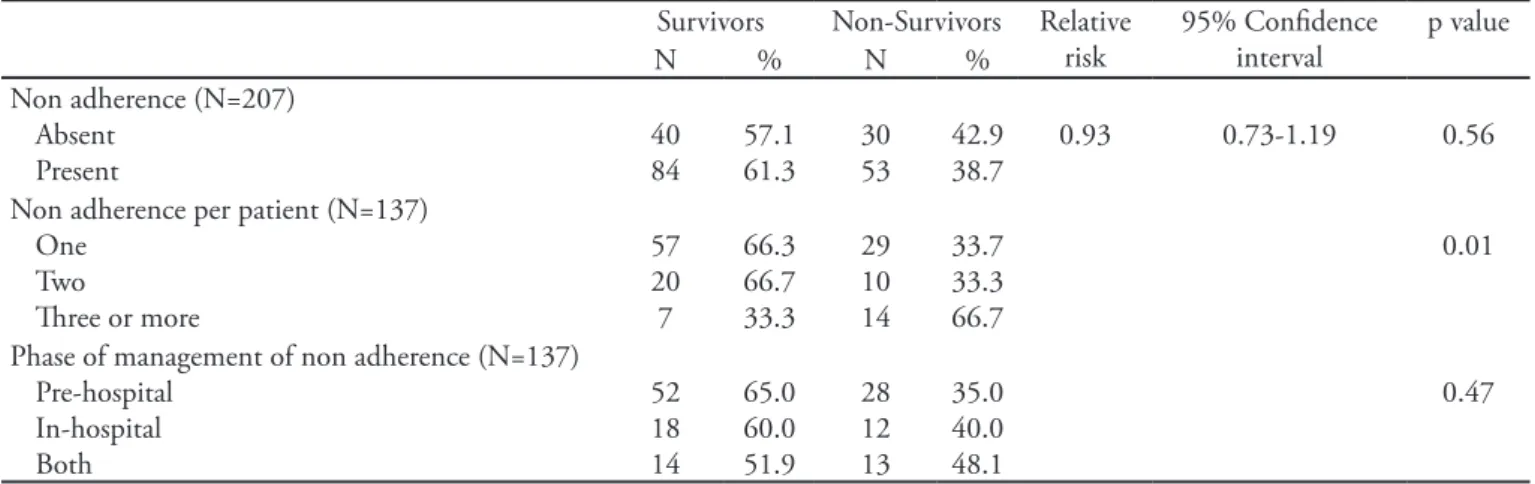
We identiied 221 non adherence events during man-agement of trauma patients, 135 (61.0%) of which oc-curred during the pre-hospital treatment phase and 86 (39.0%) of which occurred during the hospital treat-ment phase. Non adherence events occurred in the man-agement of 137 patients (66.2%) resulting in a mean of 1.61 non adherences per patient. here was no diference in the distribution of non adherences according to age or sex. Overall, more non adherences events occurred in the management of patients who survived, but there were more of these events per patient among non-survivors (Table 2). he mean number of non adherence events that occurred per patient was 1.4 among survivors and 1.9 among non-survivors (p=0.03). here were no difer-ences observed regarding the distribution of non adher-ence based on the mechanism of injury (p=0.16).
Most non adherence events occurred during the pre-hospital management phase and were mostly comprised of delays in referral (59.8%) and airway management (16.8%). he delay in hospital arrival could have been due to distance or diiculties in patient extrication. he most frequent types of in-hospital phase non adherence events that occurred were during resuscitation (13.9%) and management of brain injuries (13.9%). Non
ad-Table 1 – Baseline characteristics of patients
Patient characteristics Survivors (N=124)
Non-survivors (N= 83)
p value
Male sex 113 (91.1) 77 (92.8) 0.67
Age (years) 32.5 + 11.9 37.2 + 17.2 0.02
Blunt trauma 71(48.3) 76 (51.7) <0.001
Penetrating trauma 53 (88.3) 7(11.7) Mechanism of injury
<0.001 Motorcycle/bicycle accident 12 (75.0) 4 (25.0)
Stabbing/gunshot wounds 51 (87.9) 7 (12.1) Car/pedestrian accidents 13 (44.8) 16 (55.2) Automobile accidents 34 (42.5) 46 (57.5)
Falls 10 ( 62.5) 6 (37.5)
Aggressions 4 (50.0) 4 (50.0)
ISS 23.3 (6.5) 30.6 (11.4) >0.001
herence in the management of hypovolemia occurred frequently (21.2%) and were the most frequent non adherence event occurring in both phases of treatment in the same patient (2.2%) (Figure 1).
he mean length of hospital stay among survivors was 18.7 days, whereas it was 6.9 days among non-survivors. hus, patients who survived presented with longer length of stay, since most deaths occurred before the sixth day of hospitalization.
According to the TRISS methodology, 45 out of 83 deaths (54.2%) were considered potentially prevent-able. he mean probability of survival was 79.7% for patients classiied as potentially preventable deaths and 25.1% in the other non survivors patients (p<0.001). Patients classiied as preventable deaths presented with similar age and frequency of male gender, but had lon-ger mean length of stay (10.2 ± 21.4 days) compared to other non survivals (2.9 ± 6.3 days, p = 0.02). he
Table 2 - Analysis of non adherence events according to outcome
Survivors Non-Survivors Relative risk
95% Conidence interval
p value
N % N %
Non adherence (N=207) Absent
Present
40 84
57.1 61.3
30 53
42.9 38.7
0.93 0.73-1.19 0.56
Non adherence per patient (N=137) One
Two
hree or more
57 20 7
66.3 66.7 33.3
29 10 14
33.7 33.3 66.7
0.01
Phase of management of non adherence (N=137) Pre-hospital
In-hospital Both
52 18 14
65.0 60.0 51.9
28 12 13
35.0 40.0 48.1
0.47
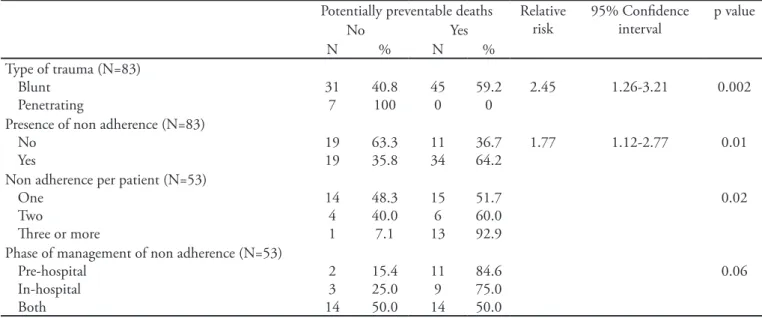
presence of non adherence was 1.77 times higher in patients with potentially preventable deaths compared to other non survivors (95% CI: 1.12 – 2.77; p=0.01), and 92.9% of multiple non adherence events (three or more) occurred in the group of patients classiied as po-tentially preventable deaths (p=0.02) (Table 3). Among patients with penetrating trauma, there were no poten-tially preventable deaths (p=0.002).
In the group of patients classiied as potentially preventable deaths, 20.0% patients died in the irst 24 hours, 42.2% patients died between the irst and third day of hospitalization, 8.9% patients died between the fourth and sixth day of hospitalization, and 28.9% pa-tients died after seven or more days of hospitalization. here was higher frequency of early deaths in the others non survivors patients; 52.6% of deaths occurred in the irst 24 hours, 26.3% occurred between the irst and third day of hospitalization, 5.3% occurred between the fourth and sixth day of hospitalization, and 15.8% occurred after seven or more days of hospitalization.
he logistic regression analysis included age, sex, type of trauma, number of non adherence events and severity relected by the probability of survival with the TRISS methodology. his analysis showed that pen-etrating trauma and number of non adherence events remained in the model as risk factors for death, and probability of survival > 0.5 by the TRISS methodol-ogy was a protective factor (Table 4).
In our study population, we observed a higher mor-tality rate than predicted by the MTOS (Z-statistic for death=6.69 and Z-statistic for survival=-6.69). Addi-tionally, the injury severity of the patients in our study was statistically diferent than that of patients included in the MTOS (M-statistic=0.44).
DISCUSSION
he current study evaluated trauma patients who were managed according to international guidelines during the pre-hospital phase until hospital discharge, and we looked for non adherence during management to correlate its presence with the occurrence of deaths.
We found that 54.2% of the deaths that occurred were potentially preventable and that they occurred more fre-quently in blunt trauma victims. Based on TRISS calcula-tions, 65% of patients had a higher than 50% probabil-ity of survival. Other authors have reported lower rates of preventable deaths and have found that these types of deaths occurred more frequently during the in-hospital phase of treatment.(28,29)
Our results revealed that a large proportion of patients (66.2%) had non adherence events during their treat-ment and that more non adherence per patient occurred
among non-survivors than survivors. Multiple non adher-ence events (i.e., >3 per patient) were more likely to occur in the non-survivor group. herefore, we concluded that the presence of multiple non adherence events could have increased the probability of death in this cohort. It can be speculated that because non-survivors presented with more severe injuries, they required complex treatments, which could possibly have led to a higher probability of the occurrence of non adherence to protocols guidelines. Regression analysis adjusted to severity and case mix dem-onstrated that non adherence independently contributed to death in our patients.
Among non-survivors, non adherence occurred more frequently in the group of patients classiied as potentially preventable deaths (64.2%). Additionally, the majority of patients with multiple non adherence events (92.9%) were also in this group. hese indings support the exist-ing evidence that non adherence to guidelines recommen-dations can be considered a risk factor for mortality in trauma patients and increase the number of potentially preventable deaths.(13,17-19)
he occurrence of non adherence was more frequent during the pre-hospital phase. During the in-hospital phase, non adherence occurred most frequently during resuscitation and management of brain injuries. We must consider two important aspects when interpreting these indings. First, 60% of non adherence that occurred in the pre-hospital phase was due to delays in patient referral. his likely impacted the survival rate of those patients be-cause the time that elapses between trauma and deinitive treatment has prognostic value.(30) It has been proven that
Table 3 - Distribution of potentially preventable deaths according to type of trauma and the occurrence of non adherence
Potentially preventable deaths Relative risk
95% Conidence interval
p value
No Yes
N % N %
Type of trauma (N=83) Blunt
Penetrating
31 7
40.8 100
45 0
59.2 0
2.45 1.26-3.21 0.002
Presence of non adherence (N=83) No
Yes
19 19
63.3 35.8
11 34
36.7 64.2
1.77 1.12-2.77 0.01
Non adherence per patient (N=53) One
Two
hree or more
14 4 1
48.3 40.0 7.1
15 6 13
51.7 60.0 92.9
0.02
Phase of management of non adherence (N=53) Pre-hospital
In-hospital Both
2 3 14
15.4 25.0 50.0
11 9 14
84.6 75.0 50.0
0.06
Table 4 - Regression analysis of contributing factors to death
Multivariate*
Variable OR CI 95% p value†
Trauma (penetrating) 10.36 3.62 – 29.66 < 0.001 Probabily of survival
> 0.5‡
0.04 0.01 – 0.13 < 0.001
Number of non adherence events
1.47 1.05 – 2.05 0.02
*Multiple Logistic regression. † Wald Chi-Square Test. ‡ Probability of
during wars, a delay in treatment inluences survival. Dur-ing World War II, the mortality rate of 5.8% was associ-ated with a transportation time between 12 and 15 hours. During the Korean War, the mortality rate was 2.4%, and the transportation time was between 4 and 6 hours. Dur-ing the Vietnam War, the mortality rate was 1.7%, and the transportation time was between 1 and 4 hours. hus, a clear pattern can be observed between transportation time and mortality rate.(31) he second aspect to be considered
is the fact that 14% of the in-hospital non adherence were due to management of brain injuries and that most of the deaths that occurred in our patients were caused by brain injuries.
It is important to be cautious when interpreting ind-ings regarding potentially preventable deaths. A high inci-dence of preventable deaths generally points to a low qual-ity of the health care system. However, to better verify the eiciency and eicacy of health care systems, additional data regarding survivors of severe injuries, the mechanism of injury of trauma patients, the location at which the traumatic event occurred, and intrinsic conditions of the trauma are necessary.(12)
By comparing our mortality indings with those of the MTOS using Z statistics, we found a signiicant diference between our mortality rate and that of the MTOS (Z-statistic=6.69). his result in Z statistics shows that the number of deaths found in our patients was higher than expected compared to the patients in the MTOS cohort. he value of Z-statistics can be af-fected by diferences in terms of injury severity between our patients and those from MTOS. he M-statistic can be used to evaluate similarities in the severity of injuries among groups. Values of M vary from zero to one. If the result of M statistics is one, it means that the severity of injury is identical in the two groups. herefore, closer a value of M is to one, more similar is the severity of injuries among groups. Values below 0.88 indicate sig-niicant diferences between groups.(24) In our study, the
M-statistic value was 0.44, indicating that there was a signiicant diference in injury severity in our patients compared to the patients in the MTOS cohort.(26)
Another aspect that must be considered when evaluat-ing the potential causes of our high mortality rate is the setting of the present study. Londrina State University Hospital is classiied as a teaching and general hospital, and it has been reported that trauma victims who are managed in general hospitals may have a worse prognosis than those that are treated in specialized centers.(5)
here are several limitations to the present study that must be considered. his is a retrospective study that was
performed as a baseline analysis while further studies in our trauma care system are still ongoing. We, therefore, applied the AIS-85 because it was in use during the obser-vation period of the present study. Due to the retrospec-tive design of the research, and because it depended on medical records, information about patient management may have been missed, and the non adherence events reported in this study may have been overestimated. To minimize this possibility, patients’ medical records were compared with nursing records and with the registries of other teams who also cared for the patients. he fact that two of the reviewer physicians that searched for adher-ence to guidelines recommendations are authors of this study may have introduced bias in their decisions. To minimize this possibility, we blinded the reviewers about information on death, TRISS and probability of survival. Furthermore, some of the non adherence criteria adopted, such as, delays in bleeding control, neurological evalua-tion, neurosurgical procedure and ICU admission, were judged according to reviewers’ opinions and this may have also introduced bias in the study. hese criteria are not objective in the literature, since the timing to perform these therapeutic procedures depends on the evaluation of each case by the emergency physician, taking into account many variables, such as severity of injuries, presence of comorbidities and age.
he adoption of the TRISS methodology to ind out the preventable deaths could also be seen as a limita-tion of this study, since there are alternative methods described in the literature, such as a clinical review of the patient’s chart and autopsy data, using judge review-ers to decide whether a death was preventable or not. hese alternative methods are not free from limitation either; notably, in the most severe cases where the com-plexity of injuries involving more than one organ has to be taken into account, the diference in the clinical expression of these injuries for diferent age groups and previous clinical condition of victims is problematic. All these variables make it diicult to analyze which deaths are supposed to be considered preventable, relecting the quality of the system where it occurred.
Furthermore, when adopting the TRISS methodology, we have to consider that our population has very severe injuries and does not perfectly match the major trauma outcome study (MTOS) population, as seen by the ind-ing of M statistics of 0.44. he positive Z statistics of our study may also imply that the TRISS methodology may have underestimated mortality for our patients.
ad-herence events must be addressed. he irst step we pro-pose is identiication of speciic categories of non adher-ence that is most common, as we could determine in the present study. he second step would be through techni-cal training, and ensuring that professionals performing the tasks are technically competent and appropriately credentialed. Attention to detail, checklists, and supervi-sion can be efective in reducing non adherence. Finally, implementing evidence-based institutional protocols is efective in reducing the possibility of deviations from recommendations. he ATLS protocols for early man-agement of severe trauma are an excellent example of ef-fective guidelines, and implemented as an institutional protocol that promotes changes in staing, training, equipment and supervision would afect performance and probably reduce mortality.
CONCLUSIONS
his study revealed that our trauma victims have severe injuries and do not match perfectly the MTOS popula-tion database. Our results showed that a higher number of deaths than expected occurred in this cohort as compared to the MTOS cohort.
Non adherence to guidelines recommendations was common during the management of trauma patients in the present study, and more frequently in the pre-hospital management phase. he presence of multiple non adher-ence events was most commonly identiied in the non-survivor group. Deaths were considered to be potentially preventable in approximately half of non-survivors pa-tients, and the number of non adherence events was inde-pendently associated with death.
RESUMO
Objetivos: Avaliar pacientes tratados por lesões traumáticas e identiicar a adesão às recomendações de diretrizes de tratamento e sua associação com óbito. As recomendações adotadas foram as de-inidas pelo comitê de Trauma do American College of Surgeons para suporte avançado de vida no trauma.
Métodos: Este foi um estudo de coorte retrospectivo realizado em um hospital de ensino. A população do estudo foi constituída por vítimas de traumatismo com idade igual ou superior a 12 anos e com escores de gravidade da lesão ≥ 16 tratados entre janeiro de 1997 e dezembro de 2001. A coleta de dados foi dividida em três fases: pré-hospitalar, intra-hospitalar e post-mortem. Os dados colhidos foram analisados com o software EPI INFO.
Resultados: Analisamos 207 pacientes, 147 vítimas de traumatis-mo fechado (71%) e 60 (29%) vítimas de traumatistraumatis-mo penetrante. As vítimas de traumatismo tiveram uma taxa de mortalidade de 40,1%. Identiicamos 221 eventos de não adesão que ocorreram em 137 pa-cientes. Identiicamos uma média de 1,61 ocorrências de não adesão por paciente, que ocorreu menos frequentemente entre os que sobrevi-veram (1,4) do que entre os que não sobrevisobrevi-veram (1,9; p=0,033). Se-gundo a metodologia de escore de gravidade da lesão, 54,2% dos óbi-tos foram considerados potencialmente evitáveis. A não adesão ocorreu 1,77 vezes mais frequentemente nos óbitos que foram considerados potencialmente evitáveis em comparação aos demais não-sobreviventes (IC 95%: 1,12 – 2,77; p=0,012) e 92,9% das ocorrências múltiplas de não adesão ocorreram no primeiro grupo (p=0,029).
Conclusões: A falta de adesão às diretrizes ocorreu com maior freqüência em pacientes com óbitos potencialmente evitáveis. O não cumprimento das recomendações das diretrizes pode ser considerado um fator contribuinte para a morte em vítimas de traumatismo, e pode levar a um maior número de mortes potencialmente evitáveis.
Descritores: Centros de traumatologia; Índices de gravidade do trauma; Mortalidade; Avaliação de resultados (Cuidados de Saúde); Causas de morte; Fatores de risco
REFERENCES
1. Collicott PE. Advanced Trauma Life Support (ATLS): past, present e future--16th Stone Lecture, American Trauma Society. J Trauma. 1992;33(5):749-53.
2. Stocchetti N, Pagliarini G, Gennari M, Baldi G, Banchini E, Campari M, et al. Trauma care in Italy: evidence of in-hospital preventable deaths. J Trauma. 1994;36(3):401-5. 3. McKoy C, Bell MJ. Preventable traumatic deaths in
children. J Pediatr Surg. 1983;18(4):505-8.
4. Spain DM, Fox RI, Marcus A. Evaluation of hospital care in one trauma care system. Am J Public Health. 1984;74(10):1122-5.
5. Baker CC, Degutis LC, DeSantis J, Baue AE. Impact of a trauma service on trauma care in a university hospital. Am J Surg. 1985;149(4):453-8.
6. Kreis DJ Jr, Plasencia G, Augenstein D, Davis JH, Echenique M, Vopal J, et al. Preventable trauma deaths: Dade County, Florida. J Trauma. 1986;26(7):649-54. 7. Draaisma JM, de Haan AF, Goris RJ. Preventable trauma
deaths in he Netherlands-- a prospective multicenter study. J Trauma. 1988;29(11):1552-7.
8. Hoyt DB, Hollingsworth-Fridlund P, Fortlage D, Davis JW, Mackersie RC. An evaluation of provider-related and disease-related morbidity in a level I university trauma service: directions for quality improvement. J Trauma. 1992;33(4):586-601.
9. Cales RH, Trunkey DD. Preventable trauma deaths. A review of trauma care systems development. JAMA. 1985;254(8):1059-63.
in England and Wales. Br Med J (Clin Res Ed). 1988;296(6632):1305-8.
11. McDermott FT, Cordner SM, Tremayne AB. Evaluation of the medical management and preventability of death in 137 road traic fatalities in Victoria, Australia: an overview. Consultative Committee on Road Traic Fatalities in Victoria. J Trauma. 1996;40(4):520-33; discussion 533-5. 12. Sauaia A, Moore FA, Moore EE, Moser KS, Brennan R,
Read RA, Pons PT. Epidemiology of trauma deaths: a reassessment. J Trauma. 1995;38(2):185-93.
13. Sugrue M, Caldwell E, D’Amours S, Crozier J, Wyllie P, Flabouris A, et al. Time for a change in injury and trauma care delivery: a trauma death review analysis. ANZ J Surg. 2008;78(11):949-54.
14. Sklar DP, Crandall CS, Loeliger E, Edmunds K, Paul I, Helitzer DL. Unanticipated death after discharge home from the emergency department. Ann Emerg Med. 2007;49(6):735-45.
15. Davis JW, Hoyt DB, McArdle MS, Mackersie RC, Eastman AB, Virgilio RW, et al. An analysis of errors causing morbidity and mortality in a trauma system: a guide for quality improvement. J Trauma. 1992;32(5):660-5; discussion 665-6.
16. Deane SA, Gaudry PL, Woods P, Cass D, Hollands MJ, Cook RJ, Read C. he management of injuries--a review of deaths in hospital. Aust NZ J Surg. 1988;58(6):463-9. 17. Gruen RL, Jurkovich GJ, McIntyre LK, Foy HM, Maier RV.
Patterns of errors contributing to trauma mortality: lessons learned from 2,594 deaths. Ann Surg. 2006;244(3):371-80.
18. Teixeira PG, Inaba K, Hadjizacharia P, Brown C, Salim A, Rhee P; et al. Preventable or potentially preventable mortality at a mature trauma center. J Trauma. 2007;63(6):1338-46; discussion 1346-7.
19. Chua WC, D’Amours SK, Sugrue M, Caldwell E, Brown K. Performance and consistency of care in admitted trauma patients: our next great opportunity in trauma care? ANZ J Surg. 2009;79(6):443-8.
20. Baker SP, O’Neil B, Haddon W Jr, Long WB. he
injury severity score: a method for describing patients with multiple injuries and evaluating emergency care. J Trauma. 1974;14(3):187-96.
21. Teasdale G, Jennett B. Assessment and prognosis of coma after head injury. Acta Neurochir (Wien). 1976;34(1-4):45-55.
22. Association for the Advancement of Automotive Medicine, Committee on Injury Scaling. he Abbreviated Injury Scale -1990 Revision (AIS-90). Des Plains, IL: Association for the Advancement of Automotive Medicine; 1990. 23. Champion HR, Sacco WJ, Copes WS, Gann DS,
Gennarelli TA, Flanagan ME. A revision of the Trauma Score. J Trauma. 1989;29(5):623-9.
24. Boyd CR, Tolson MA, Copes WS. Evaluating trauma care: the TRISS method. Trauma Score and the Injury Severity Score. J Trauma. 1987;27(4):370-8.
25. American College of Surgeons. Committee on Trauma. Advanced Trauma Life Support Manual. Chicago, Illinois: American College of Surgeons; 1997.
26. Champion HR, Copes WS, Sacco WJ, Lawnick MM, Keast SL, Bain LW Jr, et al. he Major Trauma Outcome Study: establishing national norms for trauma care. J Trauma. 1990;30(11):1356-65.
27. Flora JD Jr. A method for comparing survival of burn patients to a standard survival curve. J Trauma. 1978;18(10):701-5.
28. Zafarghandi MR, Modaghegh MH, Roudsari BS. Preventable trauma death in Tehran: an estimate of trauma care quality in teaching hospitals. J Trauma. 2003;55(3):459-65.
29. Esposito TJ, Sanddal TL, Reynolds SA, Sanddal ND. Efect of a voluntary trauma system on preventable death and inappropriate care in a rural state. J Trauma. 2003;54(4):663-9;discussion 669-70.
30. Marson AC, homson JC. he inluence of prehospital trauma care on motor vehicle crash mortality. J Trauma. 2001;50(5):917-20; discussion 920-1.