288
Rev Dor. São Paulo, 2015 oct-dec;16(4):288-90
ABSTRACT
BACKGROUND AND OBJECTIVES: Elderly people with de-mentia are impaired in the way they interpret and communicate pain, being important the use of speciic tools for accurate diag-nosis. his study aimed at summarizing literature data on tools for pain evaluation in hospitalized elderly patients with dementia.
CONTENTS: his is a literature review of the following data-bases: LILACS, Pubmed/Medline, CINAHL, SCOPUS, Co-chrane, Web of Science and Joanna-Briggs Institute. Eligibility criteria were established for studies selection. A speciic tool was used for critical evaluation. From 383 studies found, 4 were in-cluded in this review. Studies have evaluated the performance of 8 observational or self-report scales.
CONCLUSION: Our study results suggest that observational and self-report scales may be used to evaluate pain in hospital-ized elderly patients with dementia, provided the level of cog-nitive impairment is observed to select the scale, thus avoiding inadequate evaluations and consequently the undertreatment of pain.
Keywords: Dementia, Aged, Pain evaluation.
RESUMO
JUSTIFICATIVA E OBJETIVOS: Os idosos com demência apresentam comprometimento que afeta o modo como inter-pretam e comunicam a dor, sendo importante a utilização de in-strumentos especíicos para o diagnóstico adequado. O objetivo deste estudo foi sintetizar os dados da literatura sobre os instru-mentos utilizados para avaliação da dor em idosos com demência internados.
CONTEÚDO: Trata-se de revisão da literatura, utilizando as bases de dados: LILACS, Pubmed/Medline, CINAHL, SCO-PUS, Cochrane, Web of Science e Joanna Briggs-Institute. Critéri-os de elegibilidade foram estabelecidCritéri-os para seleção dCritéri-os estudCritéri-os. Utilizou-se instrumento especíico para avaliação crítica. Foram
Pain evaluation scales for elderly patients with dementia
Escalas de avaliação da dor em pacientes idosos com demência
Andressa Caio Eira da Custódia1, Flávia de Oliveira Motta Maia1, Rita de Cassia Gengo e Silva1
1. Universidade de São Paulo, Hospital de Clínicas, Departamento de Enfermagem, São Paulo, SP, Brasil.
Submitted in May 25, 2015.
Accepted for publication in September 17, 2015. Conlict of interests: none – Sponsoring sources: none.
Correspondence to: Andressa Caio Eira da Custódia Av. Dr. Enéas de Carvalho Aguiar, 419 05403-000 São Paulo, SP, Brasil. E-mail: [email protected]
© Sociedade Brasileira para o Estudo da Dor
localizados 383 estudos, dos quais 4 foram incluídos nesta re-visão. Os estudos avaliaram o desempenho de 8 escalas observa-cionais ou de autorrelato.
CONCLUSÃO: Os resultados deste estudo sugerem que escalas observacionais e de autorrelato podem ser utilizadas para avaliar a dor em idosos com demência em ambiente hospitalar, desde que seja observado o nível de comprometimento cognitivo para a escolha da escala, evitando-se assimavaliações inadequadas e consequentemente o subtratamento da dor.
Descritores: Avaliação da dor, Demência, Idoso.
INTRODUCTION
Pain is a sensory and unpleasant experience, resulting from real or potential injury to body tissues1. Painful sensation
ver-balization is the golden standard for its diagnosis2 and that is
why neurocognitive disorders may be a major challenge for health professionals when diagnosing and handling pain3,4.
Cognitive impairment, which is present in elderly people with dementia, may afect diferent aspects involved in pain manifestation. In other words, identifying pain goes beyond individuals’ ability to perceive and interpret the experience (judgment) and to manifest5 it verbally or by other means
(language)6. In addition, behavioral changes in patients with
advanced dementia may be interpreted as baseline disease symptoms, instead of manifestation of pain or discomfort. In this context, it is important to understand speciic tools to diagnose pain in this population, especially in the hospital. Having this information may contribute to support diagnos-tic decisions of health professionals.
his study aimed at summarizing literature data on tools be-ing used to evaluate pain in hospitalized elderly people with dementia.
CONTENTS
his is a literature review carried out from April to October 2014, in LILACS, Pubmed/Medline, CINAHL, SCOPUS, Cochrane, Web of Science and Joanna Briggs-Institute databas-es, which intended to answer the following research question: which are the available tools to evaluate pain in hospitalized elderly people with dementia?
Primary studies published in the last 10 years (2005 to 2014) in English, Spanish and Portuguese, aiming at using tools to evaluate pain in hospitalized elderly with dementia were in-cluded. Studies not available online in full and those with poor methodological quality were excluded.
REVIEW ARTICLE
289
Pain evaluation scales for elderly patients with dementia Rev Dor. São Paulo, 2015 oct-dec;16(4):288-90
Keywords were: elderly, elderly aged 80 years or above, de-mentia, pain measurement, pain evaluation tools and their correlates in each database.
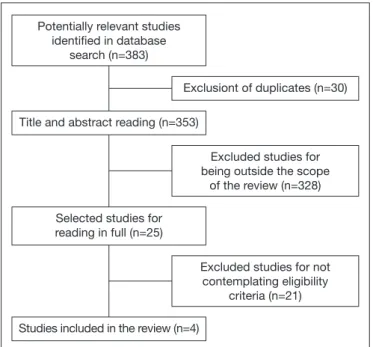
For pre-selection, titles and abstracts were initially read. Ar-ticles selected for full reading were independently evaluated by three researchers who, by means of consensus, decided for their maintenance or not in the inal review sample. Figure 1 shows the lowchart of selection of studies to be part of the sample.
Data collection and articles review
Data were collected by means of a structured tool and the methodological quality of included studies was evaluated according to Strengthening the Reporting of Observational Studies in Epidemiology (STROBE) criteria.
One systematic review evaluating pain in patients with de-mentia was found, however not speciically in a hospital, and so it was discarded from this review.
Due to the heterogeneity of selected studies, results were de-scriptively evaluated. he summary of articles included in this review is shown in table 1.
DISCUSSION
From 383 localized studies, four were included in the review. In all, participants mean age was above 80 years and most were females. he predominance of long-lived elderly in se-lected studies is compatible with the literature which shows direct relationship of dementia with advanced age7.
Pain evaluation scales were observational and self-report scales: Pain Assessment Advanced Dementia Scale (PAIN-AD), Verbal Rating Scale-5 (VRS5), Verbal Rating Scale-6 (VRS6), visual analog scale (VAS), facial pain scale (FPS), Behavioral Pain Assessment in the Elderly (DOLOPLUS-2), Red Wedge Scale (RWS) and McGill questionnaire.
PAINAD was developed to evaluate pain in individuals with advanced dementia and is made up of ive observation items: breathing, negative vocalization, facial expression, body lan-guage and consolability7. his scale has increased pain
detec-tion and the use of analgesics, as compared to numerical scale evaluation7.
Figure 1. Flowchart of selection stages of studies for systematic re-view structuring, São Paulo 2015
Potentially relevant studies identiied in database
search (n=383)
Title and abstract reading (n=353)
Exclusiont of duplicates (n=30)
Selected studies for reading in full (n=25)
Excluded studies for being outside the scope
of the review (n=328)
Excluded studies for not contemplating eligibility
criteria (n=21)
Studies included in the review (n=4)
Table 1. Summary of articles found. São Paulo, 2015
Authors Study objectives Pain evaluation Results
Hutchison et al.7
Check whether PAINAD improves the ability to detect pain in patients unable to report it
PAINAD vs NVS (0 to 10)
Score of pain intensity unawareness was mower for the PAI-NAD group. Patients evaluated with PAIPAI-NAD made more use of analgesics.
Pautex et al.8
Evaluate whether tools routinely used in the clinical practice and that do not re-quire long observation times are reliable to evaluate pain in patients with different cognitive impairment levels.
5-point VRS, VAS, RWS, FPS & Mc-Gill questionnaire
McGill questionnaire was better to evaluate pain intensity as compared to its quality; it was also better to estimate the affec-tive component of pain as compared to other scales. Patients with cognitive impairment had more dificulty to use RWS, VAS and FPS; patients with moderate to severe cognitive impair-ment were more skilled in using VRS.
Herr et al.9 Evaluate the performance of self-evalu-ation scales in hospitalized patients with severe dementia, and compare with ob-servational data.
6-point VRS, VAS, VPS, DOLOP-LUS-2
2/3 of patients were able to use self-evaluation pain scales. For patients with good understanding, reliability of self-evaluation scales was satisfactory. Correlation among self-evaluation scales has varied from moderate to strong (r=0.45 to 0.94, p<0.001), being the strongest correlation between VRS and FPS; DOLOPLUS-2 had moderate correlation with self-evalu-ation scales.
Pesonen10 Report psychometric properties and the performance of DOLOPLUS-2 observa-tional scale
D O L O P L U S - 2 , VAS
DOLOPLUS-2 and VAS scores had moderate correlation; it was observed that the correlation was stronger in patients without dementia (0.ç68) as compared to those with dementia (0.38). Internal consistency of DOLOPLUS-2 was higher when applied to patients without dementia as compared to those with de-mentia (Cronbach alpha = 0.835 and 0.667, respectively).
290
Custódia AC, Maia FO and Silva RC Rev Dor. São Paulo, 2015 oct-dec;16(4):288-90
DOLOPLUS-2 scale8 is characterized by the evaluation of
verbal complaints, facial expressions, protective body pos-tures, sleep pattern, behavioral problems, functional limita-tions, changes in communication and social life. Correlation and discriminating ability of DOLOPLUS-2 were lower for dementia patients as compared to VAS self-report scale. Al-though DOLOPLUS-2 and VAS are diferent tools in their composition, which could inluence correlation analysis, what calls the attention is their poorer performance in pa-tients with dementia as compared to papa-tients without demen-tia in the study itself8.
Self-report scales had diferent results with regard to variabil-ity in identifying pain, considering diferent levels of patients’ cognitive impairment. Scales used had diferent character-istics for pain self-report: VRS requires patients to describe pain with words, scoring its intensity; VAS may be represent-ed by a 10-cm ruler where each point represents current pain level; RWS is a variation of VAS using a red line to indicate pain intensity; and with FPS patients choose, in a row of six faces, the face that best represents their pain intensity9,10.
According to characteristics of each scale, it is observed that at evaluation time patients must have preserved cognition and be able to understand and judge what best expresses their pain. In this sense, study results show that the higher the Mental State Mini Exam (MSME) score11, the better the
reliability estimates of self-report scales12. It should also be
stressed that, among evaluated scales, VAS had better pain evaluation results in patients with moderate to severe cogni-tive impairment11.
Other studies substantiate such results, conirming the pos-sibility of pain diagnosis with the use of self-report scales in patients with dementia, as from their ability to interpret and translate into words their pain intensity. On the other hand, the use of facial pain scales may increase the possibility of confusion with feelings and impair the translation of reported pain9,10,13.
Limitations of this study were the choice of hospital environ-ment, which has limited the identiication of studies on the subject, and the heterogeneity of methodological procedures of selected studies, which has made diicult the analysis of data.
CONCLUSION
his study has contributed to stress the importance of pain evaluation systematization in hospitalized patients with
de-mentia, a diicult and extremely important task for the clini-cal practice.
Eight scales were identiied to be used in this speciic popula-tion with diferent cognitive impairment levels. Among ob-servational scales, PAINAD has shown increased pain detec-tion and improved treatment with the use of analgesics. Self-report scales were better for patients with less severe cog-nitive impairment and VRS has provided more consistent results for pain evaluation in the elderly with moderate to severe cognitive impairment.
Results of this review suggest that observational and self-re-port scales may be used to evaluate pain in hospitalized elderly with dementia, provided the level of cognitive impairment is taken into consideration when choosing the scale, thus avoid-ing inadequate evaluations and consequent undertreatment of pain.
REFERENCES
1. Merskey H, Bogduk N. International Association for the Study of Pain. Classiication of Chronic Pain. 2nd ed. IASP Task Force on Taxonomy. Seattle; 1994 [acesso 2014 Set
13]. Disponível em: http://www.iasp-pain.org/Education/Content.aspx?ItemNumber =1698&navItemNumber=576#Pain.
2. Ando C, Hishinuma M. Development of the Japonese DOLOPLUS-2: a pain assess-ment scale for the elderly with Alzheimr’s disease. Psychogeriatrics. 2010;10(3):131-7. 3. Lorenzet IC, Santos FC, Souza PM, Gambarro RC, Coelho S, Cendoroglo MS. Aval-iação da dor em idosos com demência: tradução e adaptação transcultural do instru-mento PACSLAC para a língua portuguesa. RBM. 2011;68(4):129-33.
4. Lautenbacher S, Niewelt BG, Kunz M. Decoding pain from the facial display of pa-tients with dementia: a comparison of professional and nonprofessional observers. Pain Med. 2013;14(4):469-77.
5. Scherder E, Oosterman J, Swaab D, Herr K, Ooms M, Ribbe M, et al. Recent devel-opments in pain in dementia. BMJ. 2005;330(7489):461-4.
6. Burlá C, Camarano AA, Kanso S, Fernandes D, Nunes R. [A perspective overview of dementia in Brazil: a demographic approach]. Cienc Saude Colet. 2013;18(10):2949-56. Portuguese.
7. Hutchison RW, Tucker WF Jr, Kim S, Gilder R. Evaluation of a behavioral assess-ment tool for the individual unable to self-report pain. Am J Hosp Palliat Care. 2006;23(4):328-31.
8. Pautex S, Herrmann FR, Michon A, Giannakopoulos P, Gold G. Psychometrics prop-erties of the Doloplus-2 observational pain assessment scale and comparison to self-assessment in hospitalized elderly. Clin J Pain. 2007;23(9):774-9.
9. Herr K, Bursch H, Ersek M, Miller LL, Swaford K. Use of pain-behavioral assessment tools in the nursing home: expert consensus recommendations for practice. J Gerontol Nurs. 2010;36(3):18-29.
10. Pesonen A. Pain measurement and management in the elderly patients: clinical studies in long term hospital care and after cardiac surgery [dissertação na Internet]. Helsinki, Finland: Department of Anaesthesiology and Intensive Care; 2011 [acesso em 2015 Fev 10]. Disponível em: http://www.jpsmjournal.com/article/S0885-3924(05)00611-1/pdf. 11. Pesonen A, Kauppila T, Tarkkila P, Sutela A, Niinistö L, Hosenberg PH. Evaluation
of easily applicable pain measurement tools for the assessment of pain in demented patients. Acta Anaesthesiol Scand. 2009;53(5):657-64.