UPDATE ARTICLE
Animal models of anxiety disorders and stress
Alline C. Campos,
1,2Manoela V. Fogac¸a,
3,4Daniele C. Aguiar,
5Francisco S. Guimara˜es
3,41Group of Neuroimmunology, Laboratory of Immunopharmacology, Institute of Biological Sciences, School of Medicine, Universidade Federal
de Minas Gerais (UFMG), Belo Horizonte, MG, Brazil.2Infectious Diseases and Tropical Medicine Program, School of Medicine, UFMG, Belo Horizonte, MG, Brazil.3Department of Pharmacology, Ribeira˜o Preto Medical School, Universidade de Sa˜o Paulo (USP), Ribeira˜o Preto, SP, Brazil.4Center for Interdisciplinary Research on Applied Neurosciences (NAPNA), USP, Sa˜o Paulo, Brazil.5Department of Pharmacology, Institute of Biological Sciences, UFMG, Belo Horizonte, MG, Brazil.
Anxiety and stress-related disorders are severe psychiatric conditions that affect performance in daily tasks and represent a high cost to public health. The initial observation of Charles Darwin that animals and human beings share similar characteristics in the expression of emotion raise the possibility of studying the mechanisms of psychiatric disorders in other mammals (mainly rodents). The development of animal models of anxiety and stress has helped to identify the pharmacological mechanisms and potential clinical effects of several drugs. Animal models of anxiety are based on conflict situations that can generate opposite motivational states induced by approach-avoidance situations. The present review revisited the main rodent models of anxiety and stress responses used worldwide. Here we defined as ‘‘ethological’’ the tests that assess unlearned/unpunished responses (such as the elevated plus maze, light-dark box, and open field), whereas models that involve learned/ punished responses are referred to as ‘‘conditioned operant conflict tests’’ (such as the Vogel conflict test). We also discussed models that involve mainly classical conditioning tests (fear conditioning). Finally, we addressed the main protocols used to induce stress responses in rodents, including psychosocial (social defeat and neonatal isolation stress), physical (restraint stress), and chronic unpredictable stress.
Keywords: Anxiety disorders; stress; animal models
Introduction
Anxiety and fear are normal emotions with great adaptive value that have been selected along the evolutionary process. While fear occurs in response to specific threats, the source of anxious behavior is usually undefined or unknown.1In contrast to normal/adaptive anxiety, anxiety
disorders affect the individual performance of daily life tasks,2representing a high cost for public health care all over the world.3-6
Experimental anxiety: animal models
The initial observation of Charles Darwin that the expression of emotion in humans and other mammals was phylogenetically preserved (‘‘... the young and the old of widely different races, both with man and animals, express the same state of mind by the same move-ments...,’’ Charles Darwin, 1872)7 brought the evolution
theory close to behavioral neuroscience. Based on this assumption, animal models of emotional disorders attempt to reproduce features of human psychiatric disorders in laboratory animals, correlating the
physiolo-gical and behavioral changes associated with specific emotional states (face validity), the etiology of diseases (construct validity), and responses to pharmacological treatments (predictive validity). Even if one considers that current animal models aim to reflect several factors (such as low cost, speed, and reproducibility) in addition to the dominant theoretical views related to the pathogenesis of specific disorders and the accepted action mechanism of psychotropic drugs, they have produced a significant contribution to the discovery of new drugs and the understanding of the neurobiology of psychiatric dis-eases.8
Despite the theoretical idea that a model should reproduce all features of the phenomenon under inves-tigation, this is rarely (if ever) achieved, reflecting the complex manifestations of psychiatric disorders and the huge cognitive differences between humans and labora-tory animals (mainly rodents, e.g., rats, mice, hamsters, gerbils, guinea pigs). Animal models of anxiety, therefore, do not intend to replicate all features and symptoms of a specific anxiety disorder but rather generate a state of anxiety that could be related to these disorders.9
In rodents, conflict situations can be generated by opposite motivational states induced by approach-avoid-ance situations. For example, approach behaviors can be observed in new environments, reflecting an uncondi-tioned general exploratory drive, or in seeking responses that have been previously conditioned. On the other hand, avoidance drives can also be unlearned, such as
Correspondence: Alline Cristina Campos, Institute of Biological Sciences, Universidade Federal de Minas Gerais, Av. Antoˆnio Carlos, 6627/901, bloco A3, sl 162, Pampulha, CEP 31270-901, Belo Horizonte, MG, Brazil.
E-mail: [email protected]
ß2013 Associac¸a˜o Brasileira de Psiquiatria
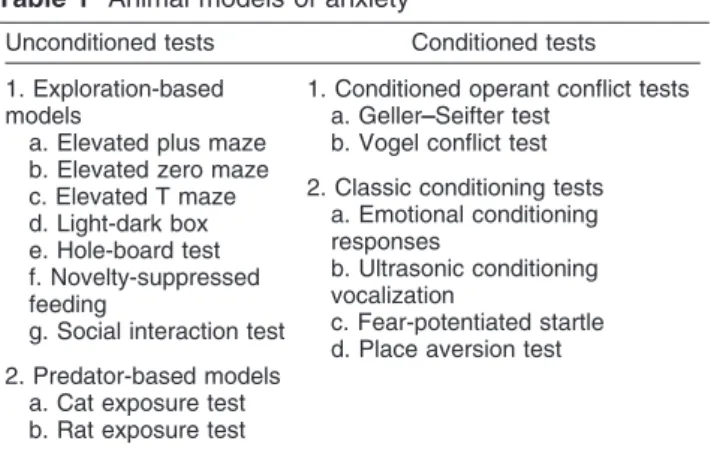
aversion to new, brightly lit, open and elevated places, or learned, including by punished responses such as electric shocks. In this review, animal models that measure unconditioned conflicts are defined as ethological (such as the elevated plus maze, light-dark box, open field, novelty suppressed feeding, and predator exposure tests), since they are all based on unlearned fear/ avoidance behavior, whereas models that involve learned/punished responses are referred to as condi-tioned operant conflict tests (such as the Vogel conflict test, VCT). Finally, models that involve mainly classical conditioning are discussed as classic conditioning tests. Table 1 summarizes the main animal models used to evaluate anxiety-like responses in rodents.
Ethological (unconditioned) behavioral-based models
The study of unconditioned/ethological responses to different forms of external threats is a logical extension and simulation, in laboratory conditions, of what occurs in nature (innate fear/avoidance). These models are pro-posed to have a high ethological validity, permitting a more detailed characterization of the behavioral changes induced by the tests.10 The basic premise of most of these models is the set of behavioral responses induced by exposure to a new environment, which simultaneously evokes fear and curiosity, creating a typical approach-avoidance conflict. The first study that investigated this phenomenon was done by Montgomery11 using a Y-shaped maze with one enclosed arm and two open arms. He observed that rats consistently show high levels of exploration and preference for the enclosed paths and concluded that, since the open and enclosed arms should evoke the same exploratory drive, the greater avoidance of the open arms was due to higher levels of fear/ avoidance evoked by open places.11However, as we will discuss latter, other factors can also interfere in explora-tory behavior of novel environments, such as the complexity of the situation, the degree of novelty (which changes from the beginning to the end of the experi-mental session), and the basal state of the animal.9,12-15
The elevated plus maze
The elevated plus maze (EPM), perhaps the most employed animal model of anxiety in current practice, was first proposed by Handley & Mithani16 and further validated by File et al.17 The apparatus is raised above floor level, and is composed of two enclosed arms opposed perpendicularly by two open arms. The test is based on the natural tendency of rodents to explore novel environments and their innate avoidance of unprotected, bright, and elevated places (represented by the open arms). Confinement to the open arms induces physiolo-gical signs of stress (increased defecation and corticos-terone levels),17whereas exposure to classical anxiolytic drugs, such as benzodiazepines, increases exploration of these arms.17
The basal activity of the animals in the EPM is affected by several factors, such as housing conditions, lighting levels, circadian cycle variations, prior handling or stress exposure, and familiarity with the maze. For instance, individual housing increases anxiety in rats but decreases it in mice, probably due to distinct social organization patterns between the species, while prior stress exposure (foot shock, social defeat, predator exposure) markedly increases anxiety. Moreover, re-exposure to the EPM results in marked reductions in open arm exploratory behavior and can totally abolish the anxiolytic effect of benzodiazepines.18-20 In addition, the presence of the experimenter in the same room can also interfere with the results. This caveat, however, has been overcome by videotaping the experimental session for later behavioral analysis (with or without the help of specialized software). Regarding the different variables that can be recorded in a 5-min EPM session, studies employing factor analysis suggested that the enclosed arm entries can be used as an uncontaminated measure of locomotor activity, while percentage of entries and time spent in the open arms constitute the primary anxiety index.21 Administration of anxiolytic drugs such as diazepam, at non-sedative doses, promotes an increase in the percen-tage/ratio of open arm exploration without affecting enclosed arm exploration.17,18 In addition to these classical measures, different groups have proposed the evaluation of other ethological variables, such as risk assessment of the open arms and head dipping in these arms, to increase the sensitivity of this model.22
The elevated zero maze
The elevated zero maze (EZM) is a modification of the EPM that incorporates both traditional and novel etholo-gical measures for the analysis of drug effects while eliminating the ambiguous interpretation of animal loca-tion in the center area of the EPM.23
The EZM is a circular runway elevated from the floor that alternates open, brightly lit areas with enclosed, dark paths. It is proposed that the uninterrupted nature of the open versus enclosed segments of the circular arena alleviates the problems concerning the center zone of the EPM. Similar to the behavioral measures scored in the EPM, the percent of time spent and the percentage of
Table 1 Animal models of anxiety
Unconditioned tests Conditioned tests 1. Exploration-based
models
a. Elevated plus maze b. Elevated zero maze c. Elevated T maze d. Light-dark box e. Hole-board test f. Novelty-suppressed feeding
g. Social interaction test 2. Predator-based models
a. Cat exposure test b. Rat exposure test
1. Conditioned operant conflict tests a. Geller––Seifter test
b. Vogel conflict test 2. Classic conditioning tests
a. Emotional conditioning responses
b. Ultrasonic conditioning vocalization
entries in the open areas of the EZM during the 5-min session are related to anxiety index. In this model, diazepam and chlordiazepoxide significantly increase the percentage of time spent in the open quadrants, as well as other ethological measures, such as frequency of head dips and reduced frequency of stretched attend postures in the enclosed towards the open quadrants.23 To
minimize environmental variables introduced by the presence of the investigator that may impact anxiety-like behaviors, videotaping of the session is also recom-mended.
Elevated T maze
The elevated T maze (ETM) was originally proposed by Graeff et al.24 It is based on the EPM and consists of three arms: one enclosed by a lateral wall standing perpendicular to two opposite open arms of equal dimension. The whole apparatus is elevated from the floor. This model allows measurement of two different behaviors in the same animal: the conditioned response represented by inhibitory avoidance of the open arms and the unconditioned response represented by escape behavior when the animal is placed in the extremity of these arms. These responses have been related to generalized anxiety and panic disorders, respectively. The ETM was developed in response to the inconsis-tencies found in other animal models of anxiety, particularly the EPM, regarding drugs that interfere directly with serotonergic neurotransmission.
On the day before the test, animals are exposed to one of the open arms of the T-maze for 30 min. This prior forced exposure to one of the open arms of the maze decreases the latency to leave this arm on a later trial. This result has been attributed to the habituation of behavioral reactions to novelty, which may interfere with one-way escape.25Twenty-four hours after pre-exposure to the open arm, the animals are tested in the ETM to measure inhibitory avoidance acquisition. To this end, each animal is placed at the distal end of the enclosed arm of the ETM facing the intersection of the arms. The time taken by the rat to leave this arm with all four paws is recorded (baseline latency). The same measurement is repeated in two subsequent trials (avoidance 1 and 2) at 30-s intervals. Following avoidance training (30 s), each rat is placed at the end of the same previously experienced open arm and the latency to leave this arm with all four paws is recorded for three consecutive trials (escape 1, 2 and 3) with 30-s intertrial intervals. A cut-off time of 300 s is usually established for the avoidance and escape latencies.
The light-dark box
The light-dark exploration test was developed before the EPM test by Crawley & Goodwin in the early 1980s.26 Similar to the EPM, this animal model is based on the innate aversion of rodents to places with bright light. During a 5-min session, animals are allowed to freely explore a novel environment composed of two different
compartments: protected (dark) and unprotected (lit). In rodents, this model generates an inherent conflict between their exploratory drive and their avoidance of the lit compartment.26,27Treatment with anxiolytic drugs
such as benzodiazepines increases the time spent in the lit compartment as well as the number of transitions between the two areas.26,27In this test, as in others that measure exploratory activity, particular attention should be given to drug- or genetic-induced changes in basal locomotor activity or novelty-seeking behavior (e.g., amphetamine treatment), since they could produce false positive results.
The hole-board test
The hole board consists of a square arena with a number of holes in the floor that the rodents can explore by poking their heads. The test is based on this latter behavior, named head dipping,28,29which has been validated as a measure of exploratory activity and anxiety.29 The number of head-dips is assumed to be inversely propor-tional to the anxiety state.30 Drug effects on this test, however, can be influenced by the familiarity of the animal with the test environment.31,32In mice naive to the testing apparatus, benzodiazepines exert a biphasic effect on exploratory head dipping, with lower doses increasing and higher doses decreasing this behavior.32 However, the doses of benzodiazepines that increase exploration in naive mice fail to do so in mice that have been previously exposed to the apparatus.32
The social interaction test
The social interaction test, developed by File & Hyde,33
was the first model of anxiety-like behavior based on ethologically relevant concepts. This test differs from the others because it involves the important component of eliminating the need to introduce aversive or appetitive conditions. In addition, it does not require previous animal training. Pairs of rodents (rats or mice) are allowed to freely interact in an arena while the time spent on social interaction is recorded. This interaction time for each of the rodents in the pair is directly impacted by the behavior of the partner animal. Therefore, the pair counts as one unit for data collection purposes. If the experimental design involves one rat receiving treatment while the other serves as a control, interaction time initiated by the former is used as the dependent measure. Anxiolytic-like behavior is inferred by an increase in social interaction time while general motor activity remains unaffected. Conversely, decreased time spent engaging in social behavior would indicate anxiogenic-like behavior.
Hyponeophagia-based model: novelty suppressed feeding test
Bodnoff et al.35validated the novelty suppressed feeding (NSF) test. In this model, animals deprived of food for 24 hours are exposed to a transparent box consisting of a sawdust-covered floor, a central platform holding a single pellet of chow, and focused lighting. The latency for the animal to reach the center of the box and initiate food intake is measured, being directly correlated with anxiety levels. Thus, this model creates a conflict between the natural tendency to feed after food-deprivation and the ethologic aversion of novel, brightly lit, and central places. In this test it is also important to control for any drug-induced changes in food intake, which is usually done by measuring this variable in the animals’ home cages.36
In the NSF, acute and chronic administration of diazepam induces an anxiolytic-like effect, represented by a decrease in the latency to onset of eating.37
Furthermore, in the case of antidepressants, the model exhibits good predictability, since it responds only to chronic treatment (minimum of 2 weeks), mimicking the time course required for the therapeutic effects of these drugs in humans. Due to this characteristic, the NSF is often employed after the chronic unpredictable stress procedure (where animals are exposed to daily different stressors for, at least, 14 days), which increases anxiety-like behaviors, to evaluate the anxiolytic and antidepres-sant properties of chronic treatments.35,37 Although it involves hunger, this test is well accepted since it does not require painful procedures or previous training.
Conditioned operant conflict tests
Operant behaviors relate to spontaneous responses emitted by the animal to an environmental change, known as reinforcement, which can be positive or negative. Positive reinforcement, also known as reward, occurs when the stimulus exposure increases the possibility of a future response in relation to this stimulus, such as progressive lever-pressing to obtain a pleasur-able food. On the other hand, negative reinforcement is seen when a trained animal executes a response to avoid an unpleasant stimulus, usually observed in punished paradigms, such as electric shocks. This latter procedure is used in the so-called conflict tests described below.
The Geller––Seifter and Vogel conflict tests
The operant conflict test was firstly developed by Geller & Seifter38and later modified by Vogel,39and shows a high predictive value for classical anxiolytic drugs. In the Geller––Seifter test, rats deprived of food for 24 hours are trained to press a lever and obtain a sugar-sweetened drink at variable intervals (the non-punished component). In the test session, a signaling stimulus (such as a tone or a light) is introduced, indicating now that the lever-press behavior will always yield a reward but, at the same time, will be punished by an electric shock, producing a conflict between drinking the palatable water and receiving the shocks. In the control condition, the animal’s tendency to
press the lever decreases, whereas anxiolytic drugs show an anti-conflict effect, increasing the probability of punished responses. This effect is not due to antinoci-ception, since is not observed after treatment with opioid agonists such as morphine. Psychostimulant drugs such as amphetamine also fail to produce this effect.40
Some years after the introduction of this model, Leaf & Muller41 reported that shocks suppress the licking behavior of water-deprived rats. However, these researchers did not test usual anxiolytic drugs, an experiment that was later performed by U.S. researcher John Vogel in 1971.39Vogel introduced a more simplified test, in which animals were deprived of water for 24 hours and briefly trained to find a bottle of water in an experimental box. On the next day (after another 24-hour period of water deprivation), the animals are re-exposed to the same box, which contains a stainless steel grid floor. The contact of the animal with the bottle spout and the grid floor closes an electrical circuit controlled by a sensor. After each 20 licks at the bottle of water, the animal receive a mild shock (0.5 mA).39In this model, anxiolytic drugs also show anti-conflict properties, inducing an increase in the number of punished licks. Similar to the Geller––Seifter procedure, control experiments to avoid any drug effect in nocicep-tion and thirst should be performed.
Even though both models described above have a good predictive value for benzodiazepines and barbitu-rates, the VCT also responds to some non-anxiolytic drugs, producing false-negative results.40 Moreover, antidepressants produce inconsistent results in these models. Chronic treatment with tricyclic antidepressants and monoamine oxidase inhibitors, such as imipramine and phenelzine respectively, increases punished responses, but the serotonin reuptake inhibitor (SSRI) fluoxetine does not.42,43 Chronic administration of the partial 5HT1A agonist buspirone also produces
anti-conflict effects in rats44,45but not in mice.46
In comparison to the Geller––Seifter test, the VCT has the advantage of avoiding a prolonged training period. However, despite good predictive value regarding classi-cal anxiolytics, these tests are susceptible to interference from several variables, such as hunger, thirst, pain, learning and memory, which can sometimes hinder interpretation of the results.
Classic conditioning tests
Pavlovian or classical conditioning experiments involve an associative learning process in which a neutral conditional stimulus (CS) is repeatedly paired with an unconditional stimulus (US). After the repeated pairings, the CS presentation alone will induce affective responses manifested as a conditional emotional response.47
Fear conditioning
such as an electric shock. Re-exposure to the CS will activate a conditioned fear response which resembles the responses that occur in the presence of danger.48,49 Conditioning learning can be elicited in several species, including humans.50The defensive responses elicited by
the CS in animals are characterized by freezing (com-plete immobility except as required for breathing), reflex expression (characterized by fear-potentiated startle), and autonomic (increase in heart rate and in the mean arterial pressure) and endocrine (stress-related hormone release) responses.50-53
Fear conditioning models involve the encoding of traumatic memories, representing a psychological stress without physical stimuli.51,54 They have been associated with a vulnerability to phobic fears and other anxiety-related disorders, such as panic disorder (PD), agoraphobia, and posttraumatic stress disorder (PTSD).55,56
In this model, administration of anxiolytic drugs immediately before the pairing of CS and US (during the memory acquisition process) affects the formation of conditioned learning. If administration occurs before the re-exposure to CS, it will affect fear and anxiety expression acquired during the conditioning. The drug could also affect extinction of the conditioned response, where a new learning process (that the CS no longer predicts the occurrence of the UCS) occurs after repeated exposure to a CS in the absence of the US.57
Systemic administration of benzodiazepines or SSRIs reduces the freezing behavior observed during the expression of conditioned fear.58-60This is in agreement with clinical findings indicating that they are effective for the treatment of anxiety disorders.57However, in contrast
to their clinical effects, SSRIs are effective after acute administration in this model.61,62 Li et al.,63 however, showed that chronic treatment with SSRIs induces a greater attenuation of conditioned emotional responses after repeated rather than acute administration.63 In addition, several other factors can influence the effects of SSRIs, including the timing of drug administration, the kind of CS stimulus, and the intervals between acquisition and expression of conditioned fear.54,64
Other animal models of anxiety
Predator encounter-based models
Defensive behaviors are observed in all mammalian species and occur in response to threatening cues, such as the presence of live predators and environmental hazards.22,65 Therefore, exposure to an ethological stimulus evokes defensive responses that resemble emotional states related to fear and anxiety.66,67 Accordingly, predator exposure constitutes an important animal model for identification of the impact of threatening situations on different brain regions and the relationship between defensive behaviors and fear-related disorders, such as panic attacks and PTSD.68-70
In rats, exposure to a live cat or to its odor elicits specific behaviors, such as fight, freezing, risk-assess-ment, and autonomic activation. These responses are
accompanied by a reduction in locomotor activity and in non-defensive behaviors, such as grooming and repro-duction.66,71,72 Although both stimuli elicit defensive responses, exposure to a live cat induces more robust responses than exposure to its odor, accompanied by freezing and ultrasonic vocalizations. Furthermore, live cat exposure is usually resistant to habituation, has a strong contextual conditioning component, and induces anxiogenic-like effects in animals that are subsequently exposed to other anxiety models, such as the EPM (see below).68,73,74
This model was pharmacologically validated with the observation that chronic administration of panicolytic drugs decreases the fight reactions induced by the presence of the predator, whereas benzodiazepines preferentially inhibit the avoidance behavior.75,76 These latter effects were also described in cat odor models, as pretreatment with chlordiazepoxide reduced the subse-quent anxiogenic-like behavior observed in the EPM and light-dark box. However, acute treatment with benzodia-zepines did not reduce the defensive behaviors elicited by odor itself.77 On the other hand, other studies showed that this treatment is able to reduce risk assessment behaviors and increase approach to the odor.70,78
Escape behavior induced by electrical/chemical
stimulation of dorsal portions of the periaqueductal grey matter (dPAG) as a model of panic disorder
PD is a chronic and disabling psychiatric disorder characterized by unexpected and recurrent panic attacks that affects about 5% of people worldwide.2PD patients experience psychosocial impairment and a high risk of psychiatric comorbidities and suicide.
The periaqueductal grey matter (PAG) is a midbrain structure that, among other functions, integrates defen-sive behavior. In humans, electrical stimulation of this structure evokes strong feelings of fear, impending death, non-localized pain, and marked autonomic changes.79 Given the striking similarities between the autonomic and behavioral effects of dPAG stimulation and symptoms of panic attacks, it has been suggested that this structure is involved in the genesis of PD in humans and that stimulation of this midbrain area in animals can model panic attacks.
The influence of stressful situations on anxiety-like behavior: animal models of stress
Several studies conducted on animals and volunteers have suggested that stressful experiences occurring throughout life may contribute crucially to the develop-ment and pathogenesis of several psychiatric disorders, including mood disorders, schizophrenia, and anxiety.81 Moreover, most of the symptoms of anxiety disorders are accompanied by activation of the hypothalamic-pituitary-adrenal (HPA) axis and changes in hormonal mediators and glucocorticoid biomarkers of stress responses.81-83 For instance, studies conducted by McEwen et al. at Rockefeller University in New York suggest that laboratory animals subjected to chronic stressors exhibit behavioral changes in models related to anxiety disorders.84
Several studies have reported the association between exposure to stressful situations and subsequent episodes of major depression.85-88 The same is true for anxiety disorders. For example, patients who apparently experi-enced some stressful situation in the course of their lives have more intense episodes of panic attacks89,90and are more vulnerable to the development of PTSD, a disorder that involves an individual overreaction to an initial exposure to traumatic event.91-94
It was only in the last three decades that the relation-ship between somatic and psychological consequences promoted by exposure to extreme stressors and the neurobiological substrate involved in these processes started to be better understood. This advance was made possible by the development of models that aim to evaluate behavioral changes induced by acute or chronic exposure to stressors (predators, shocks, movement restriction), which respond to clinically effective drugs. The main differences among these models relate to the duration (chronic vs. acute) and nature of stressor exposure.
Predator exposure-based models: PTSD
PTSD is a debilitating chronic condition that reflects emotional and physiological modifications following an initial reaction to a traumatic experience.2 Patients with PTSD exhibit persistent re-experience of traumatic memories (nightmares, intrusive thoughts) and increased avoidance of trauma-related stimuli (hypervigilance and hyperarousal) even though the traumatic event is no longer occurring.2
PTSD modeling in laboratory animals has been a particular challenge, since some of the symptoms of this disorder (nightmares, invasive thoughts) cannot be evaluated.95 Among proposed models for PTSD, those based on predator exposure have been widely used because they can mimic several symptoms of the disorder, such as hyperarousal and chronic generalized anxiety.96-98The anxiogenic effects of this procedure are
long-lasting, persisting for at least 3 weeks, and reflect the non-associative sensitized fearful manifestations that are observed in PTSD patients.95For example, in rats, a single cat exposure modifies the function of brain areas
(such as the amygdala, prefrontal cortex, and hippocam-pus) that have been associated with the genesis of PTSD symptoms in humans.99,100In this model, the animals are exposed to a live cat or its odor for 5-30 min and, after 7 to 21 days, are exposed to an animal model of anxiety such as the EPM, fear conditioning, or startle-potentiated responses.74,96,98
Psychological and physical stress models
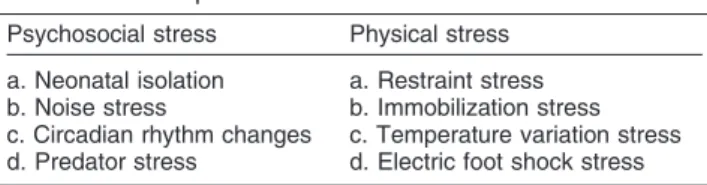
Essentially, these models induce stress by exposing the animals to psychological or physical challenges. These procedures may be used in acute or chronic studies depending on the objectives and parameter chosen by the experimenter to evaluate the impact of stress on anxiety. The main protocols used are presented in Table 2 and briefly described below.
Neonatal isolation stress
Early-life stressful experiences, such as maternal separa-tion or neonatal isolasepara-tion, promote long-lasting neural and behavioral effects and have profound consequences on subsequent quality of life.101During the neonatal separa-tion procedure, on the 2nd day after birth, the litter of the inbred strain is removed from the cage and placed in another cage for 1 hour (9 a.m./12 a.m.) in a room located apart from the animal facility. White noise is played in the background to mask the vocalizations of other pups. After the 1-hour period, the litters are placed back with their dams in their home cages.102,103 The separation proce-dure is repeated for 8 days. This model has been used extensively to demonstrate the effect of early lifetime stress on vulnerability to addiction and in the generation of anxiety-like behaviors, which are usually observed in the adult rodents subjected to the contextual fear conditioning, EPM, or social interaction tests.104-107
Stress induced by circadian rhythm changes
Alterations in circadian rhythm have a profound impact on the physical and psychological homeostasis of an individual.108Rodents subjected to unexpected changes in the day-night light cycle exhibit acute stress responses.104 Circadian rhythms are controlled by the pineal gland via melatonin secretion.109 The stress
procedure consists of lighting the home cage of the rodents during the dark phase of the cycle (e.g., lights on from 7 p.m. to 7 a.m.) and leaving it unlit in the light phase (lights off from 7 a.m. to 7 p.m.). Another possibility is to promote four or five cycles of dark-light phases (60-180 minutes) during the circadian cycle. This is a good
Table 2 Stress protocols
Psychosocial stress Physical stress a. Neonatal isolation
b. Noise stress
c. Circadian rhythm changes d. Predator stress
method for induction of short-term stress responses, but repeated exposure may lead to adaptation. Responses to this stressor can be evaluated by measuring biochemical parameters associated with stress response and using the previously described animal models of anxiety.110-112
Stress induced by a noisy stimulus
Humans are constantly exposed to potentially hazardous levels of noise in modern daily life. In model animals, noise stress can be induced by using loudspeakers (15 W) connected to a white noise generator (0-26 kHz) located 30 cm above the cage. The noise can be set at a certain level (e.g., 100 dB or higher) and the animals can be exposed to the noise protocol either acutely or repeatedly (4 hours/day/15 days).113,114 Like those of other protocols, the behavioral effects of noise stress can be observed in animal models of anxiety and depres-sion.115,116
Low temperature-induced stress
Changes in body temperature lead to stressful responses due to activation of the thermoregulatory center and, subsequently, of the HPA axis.117 Abrupt reductions in
temperature by using either cold water or freezer compartments have frequently been used to induce stress in laboratory animals. The most widely used protocols consist in the immersion of the animals in cold water (15-186C for 15-30 min) or placing the animals (in their home cages) in a cold, isolated environment (46C for 15-30 min). This procedure can be used in acute or chronic protocols (7-14 days).118
Restraint and immobilization stress
Restraint stress and immobilization protocols are one of the most commonly employed procedures to induce stress-related behavioral, biochemical and physiological changes in laboratory animals.119 Restraint stress is generally induced by keeping the animals in a cylindrical or semi-cylindrical tube with ventilation holes for 120-180 min.120,121 In an immobilization stress protocol, animals
are restrained by gentle wrapping of their upper and lower limbs with adhesive tape for 120 min.122,123 Head movement is restricted by a metal loop wound around the neck. The procedure can be used to induce either acute or chronic stress (7-21 days). Immobilization models produce an inescapable physical and mental stress with a low rate of adaptation.124After restraint or immobilization stress, animals exhibit higher levels of anxiety in the EPM and other tests of anxiety.120,121
Electric foot shock-induced stress
This protocol is very similar to the pre-test session described in fear conditioning-based models. Rodents are very susceptible to mild shocks, exhibiting a remark-able stress response after foot shock delivery. The protocol consists of placing rodents in a chamber with a
metal grid floor connect to a shock generator. After a habituation period, animals receive mild (05-2 mA), brief (1-2 s duration) foot shocks. Like other stress protocols, electric foot shocks can be combined with anxiety tests.125,126
Social defeat stress
The social defeat stress (SDS) model was initially proposed by Klaus Miczec.127The SDS protocol consists of the introduction of a single mouse (known as the intruder) in the home cage of a resident male mouse (known as the aggressor).127-131 During the test, beha-viors related to confrontation of the intruder mouse by the resident aggressor is recorded. The time spent by an intruder mouse in social defeat posture induced by the presence of an aggressor is computed throughout five trials by a blind observer. Defeat posture is identified by the followed criteria: immobility (four paws on ground, oriented toward the aggressor), escape (escaping from the aggressor), crouching (four paws on ground, not oriented toward aggressor), or defensive upright stance (standing erect with forepaws extended).127The proce-dure can be used in acute or chronic stress proto-cols.130,132
Chronic unpredictable stress
The chronic unpredictable stress (CUS) model has been widely used to induce persisting stress-related behavioral changes in rodents.133It consists of randomly presenting
different stressors to the rodents on a daily basis. This scheme prevents the stress adaptation process observed in other models of chronic stress.134 In this model, animals are exposed for 2 to 5 weeks to a wide range of stressors, including foot shocks, restraint stress, light-dark cycle reversal, unpleasant noises, changes in the home cage (removal of sawdust, replacement of sawdust with water, heating [376C] or cooling [46C] of the home cage). After several days of exposure to this regimen, the animals exhibit a gradually increased HPA axis sensitivity and a decrease in responses to pleasant stimuli, without, however, any change in exploratory activity.135
This protocol has good face validity and seems to represent the stressors faced by humans in everyday life more realistically. Moreover, it has excellent predictive validity, since repeated treatment with antidepressants (fluoxetine, desipramine, or imipramine) is able to reverse the behavioral effects induced by this model.36,136
Conclusions
of the model. Particular attention should be paid to procedures that can control for positive or false-negative results and bias induced by local laboratory conditions. Some of these aspects have been addressed in the current review. Despite their drawbacks, animal models are invaluable tools for investigation of the neurobiology of anxiety- and stress-related disorders.
Acknowledgements
This work was supported by grants from Conselho Nacional de Desenvolvimento Cientı´fico e Tecnolo´gico (CNPq), Coordenac¸a˜o de Aperfeic¸oamento de Pessoal de Nı´vel Superior (CAPES), Fundac¸a˜o de Amparo a` Pesquisa do Estado de Sa˜o Paulo (FAPESP), and Fundac¸a˜o de Amparo a` Pesquisa do Estado de Minas Gerais (FAPEMIG).
Disclosure
The authors report no conflicts of interest.
References
1 Graeff FG, Guimara˜es FS. Fundamentos de psicofarmacologia. 2nd ed. Sa˜o Paulo: Ateneu; 2012.
2 American Psychiatric Association. Diagnostic and statistical manual of mental disorders - DSM-IV-TRH. 4th ed. Arlington: American Psychiatric Publishing; 2000.
3 Kessler RC, Demler O, Frank RG, Olfson M, Pincus HA, Walters EE, et al. Prevalence and treatment of mental disorders, 1990 to 2003. N Engl J Med. 2005;352:2515-23.
4 Alonso J, Le´pine JP, ESEMeD/MHEDEA 2000 Scientific Committee. Overview of key data from the European Study of the Epidemiology of Mental Disorders (ESEMeD). J Clin Psychiatry. 2007;68:3-9.
5 Nutt DJ, Kessler RC, Alonso J, Benbow A, Lecrubier Y, Le´pine JP, et al. Consensus statement on the benefit to the community of ESEMeD (European Study of the Epidemiology of Mental Disorders) survey data on depression and anxiety. J Clin Psychiatry. 2007;68:42-8.
6 Merikangas KR, Zhang H, Avenevoli S, Acharyya S, Neuenschwander M, Angst J, et al. Longitudinal trajectories of depression and anxiety in a prospective community study: the Zurich Cohort Study. Arch Gen Psychiatry. 2003;60:993-1000. 7 Darwin C, Prodger P, Ekman P. The expression of the emotions in
man and animals. 3rd ed. London: Harper Collins; 1998. 8 Bourin M, Petit-Demoulie`re B, Dhonnchadha BN, Hasco¨et M.
Animal models of anxiety in mice. Fundam Clin Pharmacol. 2007;21:567-74.
9 Lister RG. Ethologically-based animal models of anxiety disorders. Pharmacol Ther. 1990;46:321-40.
10 Cole JC, Rodgers RJ. Ethological evaluation of the effects of acute and chronic buspirone treatment in the murine elevated plus-maze test: comparison with haloperidol. Psychopharmacology (Berl). 1994;114:288-96.
11 Montgomery KC. The relation between fear induced by novel stimulation and exploratory behavior. J Comp Physiol Psychol. 1955;48:254-60.
12 Berlyne DE. The arousal and satiation of perceptual curiosity in the rat. J Comp Physiol Psychol. 1955;48:238-46.
13 File SE, Day S. Effects of time of day and food deprivation on exploratory activity in the rat. Anim Behav. 1972;20:758-62. 14 Russell PA. Relationships between exploratory behaviour and fear:
a review. Br J Psychol. 1973;64:417-33.
15 Jacobs BL, Wise WD, Taylor KM. Differential behavioral and neurochemical effects following lesions of the dorsal or median raphe nuclei in rats. Brain Res. 1974;79:353-61.
16 Handley SL, Mithani S. Effects of alpha-adrenoceptor agonists and antagonists in a maze-exploration model of ‘fear’-motivated behaviour. Naunyn Schmiedebergs Arch Pharmacol. 1984;327:1-5. 17 Pellow S, File SE. Anxiolytic and anxiogenic drug effects on exploratory activity in an elevated plus-maze: a novel test of anxiety in the rat. Pharmacol Biochem Behav. 1986;24:525-9.
18 File SE, Mabbutt PS, Hitchcott PK. Characterisation of the phenomenon of ‘‘one-trial tolerance’’ to the anxiolytic effect of chlordiazepoxide in the elevated plus-maze. Psychopharmacology (Berl). 1990;102:98-101.
19 Lister RG. The use of a plus-maze to measure anxiety in the mouse. Psychopharmacology (Berl). 1987;92:180-5.
20 Rodgers RJ, Cole JC, Aboualfa K, Stephenson LH. Ethopharmacological analysis of the effects of putative ‘anxiogenic’ agents in the mouse elevated plus-maze. Pharmacol Biochem Behav. 1995;52:805-13.
21 File SE. Behavioural detection of anxiolytic action. In: Elliott JM, Heal DJ, Marsden CA, editors. Experimental approaches to anxiety and depression. New York: Wiley; 1992. p. 25-44.
22 Blanchard RJ, Blanchard DC. Attack and defense in rodents as ethoexperimental models for the study of emotion. Prog Neuropsychopharmacol Biol Psychiatry. 1989;13:S3-14.
23 Shepherd JK, Grewal SS, Fletcher A, Bill DJ, Dourish CT. Behavioural and pharmacological characterisation of the elevated ‘‘zero-maze’’ as an animal model of anxiety. Psychopharmacology (Berl). 1994;116:56-64.
24 Viana MB, Tomaz C, Graeff FG. The elevated T-maze: a new animal model of anxiety and memory. Pharmacol Biochem Behav. 1994;49:549-54.
25 Teixeira RC, Zangrossi H, Graeff FG. Behavioral effects of acute and chronic imipramine in the elevated T-maze model of anxiety. Pharmacol Biochem Behav. 2000;65:571-6.
26 Crawley J, Goodwin FK. Preliminary report of a simple animal behavior model for the anxiolytic effects of benzodiazepines. Pharmacol Biochem Behav. 1980;13:167-70.
27 Crawley JN, Marangos PJ, Paul SM, Skolnick P, Goodwin FK. Interaction between purine and benzodiazepine: Inosine reverses diazepam-induced stimulation of mouse exploratory behavior. Science. 1981;211:725-7.
28 Boissier JR, Simon P, Lwoff JM. [Use of a Particular Mouse Reaction (Hole Board Method) for the Study of Psychotropic Drugs]. Therapie. 1964;19:571-83.
29 File SE, Wardill AG. Validity of head-dipping as a measure of exploration in a modified hole-board. Psychopharmacologia. 1975;44:53-9.
30 Bilkei-Gorzo´ A, Gyertya´n I. Some doubts about the basic concept of hole-board test. Neurobiology (Bp). 1996;4:405-15.
31 File SE. Effects of chlorpromazine on exploration and habituation in the rat. Br J Pharmacol. 1973;49:303-10.
32 Nolan NA, Parkes MW. The effects of benzodiazepines on the behaviour of mice on a hole-board. Psychopharmacologia. 1973;29:277-86.
33 File SE, Hyde JR. Can social interaction be used to measure anxiety? Br J Pharmacol. 1978;62:19-24.
34 Cryan JF, Sweeney FF. The age of anxiety: role of animal models of anxiolytic action in drug discovery. Br J Pharmacol. 2011;164:1129-61.
35 Bodnoff SR, Suranyi-Cadotte B, Aitken DH, Quirion R, Meaney MJ. The effects of chronic antidepressant treatment in an animal model of anxiety. Psychopharmacology (Berl). 1988;95:298-302. 36 Santarelli L, Saxe M, Gross C, Surget A, Battaglia F, Dulawa S,
et al. Requirement of hippocampal neurogenesis for the behavioral effects of antidepressants. Science. 2003;301:805-9.
37 Bodnoff SR, Suranyi-Cadotte B, Quirion R, Meaney MJ. A comparison of the effects of diazepam versus several typical and atypical anti-depressant drugs in an animal model of anxiety. Psychopharmacology (Berl). 1989;97:277-9.
38 Geller I. The acquisition and extinction of conditioned suppression as a function of the base-line reinforcer. J Exp Anal Behav. 1960;3:235-40.
40 Millan MJ, Brocco M. The Vogel conflict test: procedural aspects, gamma-aminobutyric acid, glutamate and monoamines. Eur J Pharmacol. 2003;463:67-96.
41 Leaf RC, Muller SA. Simple method for CER conditioning and measurement. Psychol Rep. 1965;17:211-5.
42 Schefke DM, Fontana DJ, Commissaris RL. Anti-conflict efficacy of buspirone following acute versus chronic treatment. Psychopharmacology (Berl). 1989;99:427-9.
43 Fontana DJ, Commissaris RL. Effects of acute and chronic imipramine administration on conflict behavior in the rat: a potential ‘‘animal model’’ for the study of panic disorder? Psychopharmacology (Berl). 1988;95:147-50.
44 Amano M, Goto A, Sakai A, Achiha M, nee H, Takahashi N, et al. Comparison of the anticonflict effect of buspirone and its major metabolite 1-(2-pyrimidinyl)-piperazine (1-PP) in rats. Jpn J Pharmacol. 1993;61:311-7.
45 Schefke DM, Fontana DJ, Commissaris RL. Anti-conflict efficacy of buspirone following acute versus chronic treatment. Psychopharmacology (Berl). 1989;99:427-9.
46 Martin JR, Moreau JL, Jenck F, Cumin R. Acute and chronic administration of buspirone fails to yield anxiolytic-like effects in a mouse operant punishment paradigm. Pharmacol Biochem Behav. 1993;46:905-10.
47 Pearce JM, Hall G. A model for Pavlovian learning: variations in the effectiveness of conditioned but not of unconditioned stimuli. Psychol Rev. 1980;87:532-52.
48 Kim JJ, Jung MW. Neural circuits and mechanisms involved in Pavlovian fear conditioning: a critical review. Neurosci Biobehav Rev. 2006;30:188-202.
49 Maren S. Neurobiology of Pavlovian fear conditioning. Annu Rev Neurosci. 2001;24:897-931.
50 LeDoux JE. Emotion circuits in the brain. Annu Rev Neurosci. 2000;23:155-84.
51 Fanselow MS. Conditioned and unconditional components of post-shock freezing. Pavlov J Biol Sci. 1980;15:177-82.
52 Resstel LB, Correˆa FM. Medial prefrontal cortex NMDA receptors and nitric oxide modulate the parasympathetic component of the baroreflex. Eur J Neurosci. 2006;23:481-8.
53 Rudy JW, Huff NC, Matus-Amat P. Understanding contextual fear conditioning: insights from a two-process model. Neurosci Biobehav Rev. 2004;28:675-85.
54 Hashimoto S, Inoue T, Muraki I, Koyama T. Effects of acute citalopram on the expression of conditioned freezing in naive versus chronic citalopram-treated rats. Prog Neuropsychopharmacol Biol Psychiatry. 2009;33:113-7.
55 Johansen JP, Cain CK, Ostroff LE, LeDoux JE. Molecular mechanisms of fear learning and memory. Cell. 2011;147:509-24. 56 Mineka S, Oehlberg K. The relevance of recent developments in
classical conditioning to understanding the etiology and main-tenance of anxiety disorders. Acta Psychol (Amst). 2008;127:567-80.
57 Inoue T, Kitaichi Y, Koyama T. SSRIs and conditioned fear. Prog Neuropsychopharmacol Biol Psychiatry. 2011;35:1810-9. 58 Hashimoto S, Inoue T, Koyama T. Serotonin reuptake inhibitors
reduce conditioned fear stress-induced freezing behavior in rats. Psychopharmacology (Berl). 1996;123:182-6.
59 Hashimoto S, Inoue T, Koyama T. Effects of the co-administration of 5-HT1A receptor antagonists with an SSRI in conditioned fear stress-induced freezing behavior. Pharmacol Biochem Behav. 1997;58:471-5.
60 Inoue T, Hashimoto S, Tsuchiya K, Izumi T, Ohmori T, Koyama T. Effect of citalopram, a selective serotonin reuptake inhibitor, on the acquisition of conditioned freezing. Eur J Pharmacol. 1996;311:1-6. 61 Den Boer JA, Westenberg HG. Effect of a serotonin and noradrenaline uptake inhibitor in panic disorder; a double-blind comparative study with fluvoxamine and maprotiline. Int Clin Psychopharmacol. 1988;3:59-74.
62 Oehrberg S, Christiansen PE, Behnke K, Borup AL, Severin B, Soegaard J, et al. Paroxetine in the treatment of panic disorder. A randomised, double-blind, placebo-controlled study. Br J Psychiatry. 1995;167:374-9.
63 Li XB, Inoue T, Hashimoto S, Koyama T. Effect of chronic administration of flesinoxan and fluvoxamine on freezing behavior induced by conditioned fear. Eur J Pharmacol. 2001;425:43-50.
64 Luyten L, Vansteenwegen D, van Kuyck K, Gabre¨ls L, Nuttin B. Contextual conditioning in rats as an animal model for generalized anxiety disorder. Cogn Affect Behav Neurosci. 2011;11:228-44. 65 Blanchard RJ, Blanchard DC, Rodgers J, Weiss SM. The
characterization and modelling of antipredator defensive behavior. Neurosci Biobehav Rev. 1990;14:463-72.
66 Blanchard DC, Blanchard RJ. Ethoexperimental approaches to the biology of emotion. Annu Rev Psychol. 1988;39:43-68.
67 Hendrie CA, Weiss SM, Eilam D. Exploration and predation models of anxiety: evidence from laboratory and wild species. Pharmacol Biochem Behav. 1996;54:13-20.
68 Blanchard DC, Griebel G, Blanchard RJ. Conditioning and residual emotionality effects of predator stimuli: some reflections on stress and emotion. Prog Neuropsychopharmacol Biol Psychiatry. 2003;27:1177-85.
69 Kavaliers M, Choleris E. Antipredator responses and defensive behavior: ecological and ethological approaches for the neuros-ciences. Neurosci Biobehav Rev. 2001;25:577-86.
70 McGregor IS, Hargreaves GA, Apfelbach R, Hunt GE. Neural correlates of cat odor-induced anxiety in rats: region-specific effects of the benzodiazepine midazolam. J Neurosci. 2004;24:4134-44. 71 Apfelbach R, Blanchard CD, Blanchard RJ, Hayes RA, McGregor
IS. The effects of predator odors in mammalian prey species: a review of field and laboratory studies. Neurosci Biobehav Rev. 2005;29:1123-44.
72 McGregor IS, Schrama L, Ambermoon P, Dielenberg RA. Not all ‘predator odours’ are equal: cat odour but not 2,4,5 trimethylthiazo-line (TMT; fox odour) elicits specific defensive behaviours in rats. Behav Brain Res. 2002;129:1-16.
73 Adamec RE, Burton P, Shallow T, Budgell J. NMDA receptors mediate lasting increases in anxiety-like behavior produced by the stress of predator exposure--implications for anxiety associated with posttraumatic stress disorder. Physiol Behav. 1999;65:723-37. 74 Campos AC, Ferreira FR, da Silva WA, Jr., Guimara˜es FS. Predator threat stress promotes long lasting anxiety-like behaviors and modulates synaptophysin and CB1 receptors expression in brain areas associated with PTSD symptoms. Neurosci Lett. 2013;533:34-8.
75 Blanchard RJ, Griebel G, Henrie JA, Blanchard DC. Differentiation of anxiolytic and panicolytic drugs by effects on rat and mouse defense test batteries. Neurosci Biobehav Rev. 1997;21:783-9. 76 Griebel G, Blanchard DC, Jung A, Lee JC, Masuda CK, Blanchard
RJ. Further evidence that the mouse defense test battery is useful for screening anxiolytic and panicolytic drugs: effects of acute and chronic treatment with alprazolam. Neuropharmacology. 1995;34:1625-33.
77 Zangrossi H, Jr., File SE. Chlordiazepoxide reduces the general-ised anxiety, but not the direct responses, of rats exposed to cat odor. Pharmacol Biochem Behav. 1992;43:1195-200.
78 Dielenberg RA, Hunt GE, McGregor IS. ‘‘When a rat smells a cat’’: the distribution of Fos immunoreactivity in rat brain following exposure to a predatory odor. Neuroscience. 2001;104:1085-97. 79 Nashold BS, Jr., Wilson WP, Slaughter DG. Sensations evoked by
stimulation in the midbrain of man. J Neurosurg. 1969;30:14-24. 80 Soares Vde P, Campos AC, Bortoli VC, Zangrossi H, Jr.,
Guimara˜es FS, Zuardi AW. Intra-dorsal periaqueductal gray administration of cannabidiol blocks panic-like response by activat-ing 5-HT1A receptors. Behav Brain Res. 2010;213:225-9. 81 Heim C, Nemeroff CB. The impact of early adverse experiences on
brain systems involved in the pathophysiology of anxiety and affective disorders. Biol Psychiatry. 1999;46:1509-22.
82 Risbrough VB, Stein MB. Role of corticotropin releasing factor in anxiety disorders: a translational research perspective. Horm Behav. 2006;50:550-61.
83 Mathew SJ, Price RB, Charney DS. Recent advances in the neurobiology of anxiety disorders: implications for novel therapeu-tics. Am J Med Genet C Semin Med Genet. 2008;148C:89-98. 84 Magarin˜os AM, Deslandes A, McEwen BS. Effects of
antidepres-sants and benzodiazepine treatments on the dendritic structure of CA3 pyramidal neurons after chronic stress. Eur J Pharmacol. 1999;371:113-22.
86 Paykel ES, Rao BM, Taylor CN. Life stress and symptom pattern in out-patient depression. Psychol Med. 1984;14:559-68.
87 Bidzin´ska EJ. Stress factors in affective diseases. Br J Psychiatry. 1984;144:161-6.
88 Kandler K, Katz LC. Neuronal coupling and uncoupling in the developing nervous system. Curr Opin Neurobiol. 1995;5:98-105. 89 Savoia MG, Bernik M. Adverse life events and coping skills in panic
disorder. Rev Hosp Clin Fac Med Sao Paulo. 2004;59:337-40. 90 Batinic´ B, Trajkovic´ G, Duisin D, Nikolic´-Balkoski G. Life events and
social support in a 1-year preceding panic disorder. Psychiatr Danub. 2009;21:33-40.
91 Gilboa D, Friedman M, Tsur H. The burn as a continuous traumatic stress: implications for emotional treatment during hospitalization. J Burn Care Rehabil. 1994;15:86-91; discussion 91-4.
92 Sapolsky RM. Why stress is bad for your brain. Science. 1996;273:749-50.
93 Yehuda R, Teicher MH, Trestman RL, Levengood RA, Siever LJ. Cortisol regulation in posttraumatic stress disorder and major depression: a chronobiological analysis. Biol Psychiatry. 1996;40:79-88.
94 Dykman RA, Ackerman PT, Newton JE. Posttraumatic stress disorder: a sensitization reaction. Integr Physiol Behav Sci. 1997;32:9-18.
95 Pitman RK. Overview of biological themes in PTSD. Ann N Y Acad Sci. 1997;821:1-9.
96 Adamec RE, Shallow T. Lasting effects on rodent anxiety of a single exposure to a cat. Physiol Behav. 1993;54:101-9.
97 Adamec R. Transmitter systems involved in neural plasticity underlying increased anxiety and defense--implications for under-standing anxiety following traumatic stress. Neurosci Biobehav Rev. 1997;21:755-65.
98 Matar MA, Cohen H, Kaplan Z, Zohar J. The effect of early poststressor intervention with sertraline on behavioral responses in an animal model of post-traumatic stress disorder. Neuropsychopharmacology. 2006;31:2610-8.
99 Adamec R, Walling S, Burton P. Long-lasting, selective, anxiogenic effects of feline predator stress in mice. Physiol Behav. 2004;83:401-10.
100 Baisley SK, Cloninger CL, Bakshi VP. Fos expression following regimens of predator stress versus footshock that differentially affect prepulse inhibition in rats. Physiol Behav. 2011;104:796-803. 101 Francis DD, Meaney MJ. Maternal care and the development of
stress responses. Curr Opin Neurobiol. 1999;9:128-34.
102 Kosten TA, Miserendino MJ, Kehoe P. Enhanced acquisition of cocaine self-administration in adult rats with neonatal isolation stress experience. Brain Res. 2000;875:44-50.
103 Kosten TA, Ambrosio E. HPA axis function and drug addictive behaviors: insights from studies with Lewis and Fischer 344 inbred rats. Psychoneuroendocrinology. 2002;27:35-69.
104 Kosten TA, Kehoe P. Neonatal isolation is a relevant model for studying the contributions of early life stress to vulnerability to drug abuse: response to Marmendal et al. (2004). Dev Psychobiol. 2005;47:108-10.
105 Babygirija R, Cerjak D, Yoshimoto S, Gribovskaja-Rupp I, Bu¨lbu¨l M, Ludwig K, et al. Affiliative behavior attenuates stress responses of GI tract via up-regulating hypothalamic oxytocin expression. Auton Neurosci. 2012;169:28-33.
106 Maniam J, Morris MJ. Long-term postpartum anxiety and depres-sion-like behavior in mother rats subjected to maternal separation are ameliorated by palatable high fat diet. Behav Brain Res. 2010;208:72-9.
107 Lai MC, Yang SN, Huang LT. Neonatal isolation enhances anxiety-like behavior following early-life seizure in rats. Pediatr Neonatol. 2008;49:19-25.
108 Atcheson JB, Tyler FH. Circadian rhythm: man and animals. In: Greep RO, Astwood EB, editors. Handbook of physiology. Washington: American Physiological Society, 1975. p. 127-34. 109 Nicholson S, Lin JH, Mahmoud S, Campbell E, Gillham B, Jones M.
Diurnal variations in responsiveness of the hypothalamo-pituitary-adrenocortical axis of the rat. Neuroendocrinology. 1985;40:217-24.
110 Rai D, Bhatia G, Sen T, Palit G. Comparative study of perturbations of peripheral markers in different stressors in rats. Can J Physiol Pharmacol. 2003;81:1139-46.
111 Fonken LK, Finy MS, Walton JC, Weil ZM, Workman JL, Ross J, et al. Influence of light at night on murine anxiety- and depressive-like responses. Behav Brain Res. 2009;205:349-54.
112 Castro JP, Frussa-Filho R, Fukushiro DF, Chinen CC, Abı´lio VC, Silva RH. Effects of long-term continuous exposure to light on memory and anxiety in mice. Physiol Behav. 2005;86:218-23. 113 Ravindran R, Rathinasamy SD, Samson J, Senthilvelan M.
Noise-stress-induced brain neurotransmitter changes and the effect of Ocimum sanctum (Linn) treatment in albino rats. J Pharmacol Sci. 2005;98:354-60.
114 Manikandan S, Devi RS. Antioxidant property of alpha-asarone against noise-stress-induced changes in different regions of rat brain. Pharmacol Res. 2005;52:467-74.
115 File SE, Fernandes C. Noise stress and the development of benzodiazepine dependence in the rat. Anxiety. 1994;1:8-12. 116 Naqvi F, Haider S, Batool Z, Perveen T, Haleem DJ. Sub-chronic
exposure to noise affects locomotor activity and produces anxiogenic and depressive like behavior in rats. Pharmacol Rep. 2012;64:64-9.
117 Kvetn˜ansky´ R, Weise VK, Gewirtz GP, Kopin IJ. Synthesis of adrenal catecholamines in rats during and after immobilization stress. Endocrinology. 1971;89:46-9.
118 Jaggi AS, Bhatia N, Kumar N, Singh N, Anand P, Dhawan R. A review on animal models for screening potential anti-stress agents. Neurol Sci. 2011;32:993-1005.
119 Kvetnansky R, Mikulaj L. Adrenal and urinary catecholamines in rats during adaptation to repeated immobilization stress. Endocrinology. 1970;87:738-43.
120 Padovan CM, Guimara˜es FS. Restraint-induced hypoactivity in an elevated plus-maze. Braz J Med Biol Res. 2000;33:79-83. 121 Campos AC, Ferreira FR, Guimara˜es FS, Lemos JI. Facilitation of
endocannabinoid effects in the ventral hippocampus modulates anxiety-like behaviors depending on previous stress experience. Neuroscience. 2010;167:238-46.
122 Shansky RM, Hamo C, Hof PR, McEwen BS, Morrison JH. Stress-induced dendritic remodeling in the prefrontal cortex is circuit specific. Cereb Cortex. 2009;19:2479-84.
123 Hill MN, Hunter RG, McEwen BS. Chronic stress differentially regulates cannabinoid CB1 receptor binding in distinct hippocampal subfields. Eur J Pharmacol. 2009;614:66-9.
124 Kasuga S, Ushijima M, Morihara N, Itakura Y, Nakata Y. [Effect of aged garlic extract (AGE) on hyperglycemia induced by immobiliza-tion stress in mice]. Nihon Yakurigaku Zasshi. 1999;114:191-7. 125 Herrmann L, Ionescu IA, Henes K, Golub Y, Wang NX, Buell DR,
et al. Long-lasting hippocampal synaptic protein loss in a mouse model of posttraumatic stress disorder. PLoS One. 2012;7:e42603. 126 Golub Y, Mauch CP, Dahlhoff M, Wotjak CT. Consequences of extinction training on associative and non-associative fear in a mouse model of Posttraumatic Stress Disorder (PTSD). Behav Brain Res. 2009;205:544-9.
127 Miczek KA, O’Donnell JM. Intruder-evoked aggression in isolated and nonisolated mice: effects of psychomotor stimulants and L-dopa. Psychopharmacology (Berl). 1978;57:47-55.
128 Rodgers RJ, Randall JI. Resident’s scent: a critical factor in acute analgesic reaction to defeat experience in male mice. Physiol Behav. 1986;37:317-22.
129 Spina MG, Basso AM, Zorrilla EP, Heyser CJ, Rivier J, Vale W, et al. Behavioral effects of central administration of the novel CRF antagonist astressin in rats. Neuropsychopharmacology. 2000;22:230-9.
130 Kabbaj M, Norton CS, Kollack-Walker S, Watson SJ, Robinson TE, Akil H. Social defeat alters the acquisition of cocaine self-administration in rats: role of individual differences in cocaine-taking behavior. Psychopharmacology (Berl). 2001;158:382-7. 131 Nikulina EM, Covington HE, 3rd, Ganschow L, Hammer RP, Jr.,
Miczek KA. Long-term behavioral and neuronal cross-sensitization to amphetamine induced by repeated brief social defeat stress: Fos in the ventral tegmental area and amygdala. Neuroscience. 2004;123:857-65.
133 Mineur YS, Belzung C, Crusio WE. Effects of unpredictable chronic mild stress on anxiety and depression-like behavior in mice. Behav Brain Res. 2006;175:43-50.
134 Willner P. Validity, reliability and utility of the chronic mild stress model of depression: a 10-year review and evaluation. Psychopharmacology (Berl). 1997;134:319-29.