Screening of expression libraries using ELISA: identification of
immunogenic proteins from
Tityus bahiensis
and
Tityus serrulatus
venom
E. Kalapothakis
a,*, S. Jardim
a, A.C. Magalha˜es
a, T.M. Mendes
a, L. De Marco
a,
L.C.C. Afonso
b, C. Cha´vez-Olo´rtegui
caDivisa˜o de Biologia Celular, Departamento de Farmacologia, ICB, Universidade Federal de Minas Gerais, Av. Antoˆnio Carlos 6627 Belo
Horizonte, MG 31-270901, Brazil
bDepartamento de Cieˆncias Biolo´gicas, ICEB-NUPED, Universidade Federal de Ouro Preto, Ouro Preto, MG 35-400 000, Brazil cFundac¸a˜o Ezequiel Dias, Rua Conde Pereira Carneiro 80, Belo Horizonte, MG 30550-010, Brazil
Received 6 January 2000; accepted 20 June 2000
Abstract
The present report describes the use of ELISA with cDNA expression libraries in the identification of immunogenic proteins. The methodology described was applied using libraries constructed with mRNA isolated fromTityus serrulatusandTityus bahiensisvenom glands. In addition we describe for the first time the sequence of a neurotoxin fromTityus bahiensisvenom gland named TbTx5 whose amino acid sequencing showed 93% similarity with theTityus bahiensisTbTx IV-5 neurotoxin. The methodology described can be used for the generation of an immunogenic bank in order to contribute to genome and proteome projects.q2000 Elsevier Science Ltd. All rights reserved.
Keywords:Screening; Expression library; ELISA; Genome; Proteome;Tityus bahiensis;Tityus serrulatus
1. Introduction
The identification of antigenic proteins from a specific tissue or even from the whole organism is very important in areas such as toxinology and parasitology. To this end, specific antibodies have been successfully used to isolate genes from expression libraries (Young and Davis, 1983;
Sambrook et al., 1989). The protocol used involves antibo-dies that must be as pure as possible in terms of immuno-logical activity. However, a major problem with this technique is the cross-reactivity with proteins produced by different host cells leading to a difficult interpretation of the results obtained on nitrocellulose or nylon membranes. In addition, antibodies that do not react strongly with an anti-gen are normally difficult to use. In the present report we describe the use of an enzyme-linked immunosorbent assay — ELISA, (Engvall and Perlmann, 1971) to screen expres-sion libraries. The rationale behind this approach involves the specificity of ELISA and the possibility to quantify the immunological signal on ELISA microtitration plates. In addition, we have found that this methodology can generate a large amount of information within a short period of time and can contribute to genome and proteome projects by the identification of proteins and toxins important for the devel-opment of antivenoms for clinical use. The system has been established using Tityus bahiensis and Tityus serrulatus venom gland cDNA libraries.
0041-0101/00/$ - see front matterq2000 Elsevier Science Ltd. All rights reserved. PII: S 0 0 4 1 - 0 1 0 1 ( 0 0 ) 0 0 1 9 4 - X
www.elsevier.com/locate/toxicon
Abbreviations: Bp, base pair(s); Da, daltons; EDTA, ethylenedia-mine tetra acetic acid; Ig, immunoglobulin; IPTG, isopropyl-b-d
-thiogalactoside; Kb, kilobase(s); PBS, phosphate buffered saline; PCR, polymerase chain reaction; SDS, sodium dodecyl sulfate; TAE, tris-acetate-EDTA buffer; TBS, tris-buffered saline; Ts,Tityus serrulatusscorpion; Tb,Tityus bahiensisscorpion; TstFG50,Tityus serrulatustoxic fraction purified through Sephadex G50; Xgal, 5-bromo-4-chloro-3-indolyl-b-d-galactoside
* Corresponding author. Tel.: 155-31-4992713; fax: 1 55-31-4992695.
2. Materials and methods
2.1. General molecular biology
Standard recombinant DNA techniques (plasmid purifica-tion, phenol extracpurifica-tion, ethanol precipitapurifica-tion, electrophor-esis, etc.) were carried out as described by Sambrook et al. (1989).
2.1.1. Construction and analysis of the venom-gland cDNA library
Venom glands from 50Tityus bahiensisscorpions were removed 2 days after venom extraction. The glands were frozen immediately, pulverized with a mortar and pestle in liquid nitrogen and lysed in the presence of guanidinium thiocyanate according to the published procedures (Chomc-zynsky and Sacchi, 1987). Total RNA was passed through an oligo(dT)-cellulose column as described by Sambrook et al. (1989). Complementary DNA synthesis was performed using the ZAP-cDNA synthesis kit (Stratagene). The cDNA molecules were prepared from 5mg of Tityus bahiensis venom gland mRNA and inserted directionally into a Uni-Zape XR vector at the XhoI andEcoR I sites. The
vector was subsequently packaged into viable lambda ZAP phage particles using the Gigapack II Packaging Extracts Kit (Stratagene). The insert sizes were analyzed by PCR (Saiki et al., 1988) using the primers M13R (50
GGAAACAGCTATGACCATG 30) and M13U (50
GTAAAACGACGGCCAGT 30). PCR was carried out
using plasmids isolated from the total library. The Tityus serrulatusvenom gland cDNA library has been described by Guatimosim et al. (1999) and was also constructed as described above.
2.1.2. Animals and venoms
Adult female New Zealand white rabbits (2.0–2.5 kg) were used and maintained at the Fundac¸a˜o Ezequiel Dias (FUNED), Belo Horizonte, Brazil. All animals received water and food under controlled environmental conditions. T. serrulatus scorpions were collected near the town of Santa Ba´rbara, Minas Gerais, Brazil. T. bahiensis were collected in the Town of Ouro Preto, Minas Gerais, Brazil. The venom from mature animals was obtained by electric stimulation, pooled, lyophilized and stored at2208C in the dark before use.
2.1.3. Preparation of antibodies
The immunization protocol was carried out in rabbits as described by Cha´vez-Olo´rtegui et al. (1993) using 100mg of total venom (Tityus serrulatusorTityus bahiensis) or 20mg of purified toxins from the venom ofTityus serrulatus:a -type toxin tityustoxin (TsTx) (Gomez and Diniz, 1966; also called toxin IV-5 by Possani et al. (1981) or Ts IV by Martin-Eauclaire et al. (1994)), and theb-type toxin TsTx I (Toledo and Neves, 1976; also called Ts VII by Bechis et al. (1984) and toxin-g by Possani et al. (1985)). Booster
injections of 20mg of toxin in incomplete Freund’s adjuvant were made 1, 2, 3 and 4 weeks later. Immune sera were collected 10 days after the last injection and analysed by Western blotting and ELISA. Anti-TsTx and anti-TsTxI sera were further purified as described by Cha´vez-Olo´rtegui et al. (1994). The chromatographic profile obtained by reverse-phase high-performance liquid chromatography showed a single peak, suggesting that TsTx and TsTxI were homogeneous, in good agreement with the results of SDS-PAGE electrophoresis for basic proteins. The specific activity and titration of serum from rabbits immunized was carried out as described by Cha´vez-Olo´rtegui et al. (1997).
2.1.4. Western blotting
Eletrophoresis for basic proteins (Reisfeld et al., 1962) was performed using the BIO-RAD, Mini-Protean II system with 15% polyacrylamide gels and 30mg total protein per lane as determined by protein assay (Lowry et al., 1951). Gels were electrophoretically blotted as follows: nitrocellu-lose membranes (0.45mm, Schleicher and Schuell) containing the venom transferred from the polyacrylamide gels were blocked for 1 h in 0.3% Tween-20/PBS and then exposed to the first antibody diluted 1:100 in 0.05% Tween-20/PBS, for 1 h at 378C or overnight at 48C. After 6 washes in 0.05% Tween-20/PBS the membranes were incubated in 0.05% Tween-20/PBS containing anti-rabbit-IgG conju-gated for 1 h at room temperature. The membranes were washed 3 times in 0.05% Tween-20/PBS and twice in PBS and then stained using 1 mg DAB/ml (3,30diaminobenzidine, Sigma Chemical Co., St Louis,
MO, USA) in PBS with 0.04% H2O2and 8.3% methanol.
2.1.5. cDNA library screening using ELISA
378C and washing four times with 0.15 M NaCl and 0.05% Tween 20, the plates were incubated for 2 h at 378C with specific antibodies diluted 1:250 in incubation buffer (0.2% casein in PBS10.05% Tween 20). Antibo-dies against the whole venom of Tityus serrulatus and Tityus bahiensiswere used in the first round of screening. The plates were washed as described above and incubated for 1 h at 378C with peroxidase-coupled anti-rabbit IgG (Sigma) diluted 1:1000 in incubation buffer. The wells were washed and the assay was completed with citrate buffer (50 mM Na2HPO4, 24 mM citric acid, pH 5.0), 0.2 mg/ml of OPD (o-phenylenediamine) and 0.2ml/ml of H2O2. After incubation at 258C for 20 min in the dark the reaction was stopped by the addition of 20ml/ well of a 1:20 dilution of sulphuric acid. Absorbance values were determined at 492 nm with a Titertek Multi-scan plate spectrophotometer. Results were confirmed by a second round of ELISA, and the positive clones were grown with and without IPTG. Total venom of Tityus serrulatus and Tityus bahiensis (100 ng/well), purified TsTx and TsTxI toxins from Tityus serrulatus (50 ng/ well) were used as positive control. As an alternative to disrupted bacteria, we used glass beads (3 mm diameter) and vortexing at high speed for 30 s. We also found that
lysozyme (0.1 mg/ml for 2–5 min at 20–258C) can improve (10–20%) the result when used before the glass bead treatment. After cell disruption the supernatant was immediately used or stored at2808C in an ultra-low freezer before use.
2.1.6. DNA sequencing and computer analysis
Large scale plasmid isolations fromE. coliwere carried out according to the alkaline lysis SDS method and purified on CsCl–ethidium bromide gradients as described by Sambrook et al. (1989). DNA sequencing reactions were performed on both strands using the chain termination method of Sanger et al. (1977). All reactions were carried out using the Automated Laser Fluorescent ALF DNA Sequencer (Pharmacia, LKB Biotechnology Inc.). Nucleic acid sequences were analysed using the MacVectore5.0
program (Oxford Molecular Group PLC). After editing, the sequences were compared to sequences in the GenBanK databases (Altschul et al., 1997).
3. Results and discussion
Scorpion toxins form a family of structurally related proteins and it is expected that several of these proteins share common epitopes. In this work, the immunological cross-reactivity between Tityus serrulatus and Tityus bahiensis was demonstrated by Western blotting and also by ELISA and the results illustrated the possibility to use antibodies generated against the venom or purified toxins from one species of scorpions to isolate similar toxins in the venom of a second species (Fig. 1). In reality, toxins from both the species have shown high level of similarity at the amino acid and DNA levels (Becerril et al., 1996; Guatimosim et al., 1999).
We report here the results of a screening carried out using ELISA and expression libraries constructed with venom glands from the scorpionsTityus serrulatusandTityus bahiensis.The Tityus bahiensis cDNA library, containing approximately 1.1×10⁶independent recombinants showed the presence of cDNAs corresponding to molecules of approximately 350 to 1,100 bp (data not shown). TheTityus serrulatuscDNA library has been used by our group and contains 6.7×10⁶ recombi-nants and one major class of cDNA (300–650 bp). After an initial screening of 350 colonies we found approximately 10% positive clones that showed different levels of immunoreactiv-ity. In contrast, 90% of the clones did not show higher reactivity than the negative control (clones not induced by IPTG). The positive clones were used for further immunological character-ization using purified antibodies against the TsTx and TsTxI toxins. Since the best results were obtained using the specific anti-TsTx and anti-TsTxI antibodies, we also used a pool of antibodies in the first screening, followed by the use of indivi-dual antibodies on a second plate containing positive clones and a few negative clones. The sera from immunized rabbit displayed consistent immunoreactivity with the antigens E. Kalapothakis et al. / Toxicon 39 (2001) 679–685
Fig. 1. Western blotting analysis of (1)Tityus serrulatusfraction TsFG50, (2)Tityus serrulatuswhole venom and (3)Tityus bahiensis
coated on the microtitration plate, while sera from control mice did not react (data not shown).
We did not expect to detect all immunogenic proteins expressed in the venom gland since some proteins may be post-translationally modified and theE. colisystem used in the production of the recombinant protein may not be able to modify correctly the protein. In addition, the cDNA must be in frame with the fusion protein (b-galactosidase) and finally, the expression level is different from clone to clone and some clones could express very low levels of recombinant protein. However, several clones were identified as potential immunogenic proteins and the knowledge of these clones may be important to improve anti-serum production and quality (Table 1). This proce-dure does not allow to screen as many clones as membrane-lifting within a short period of time and good libraries and purified antibodies are recommended. However, this approach gives more quantitative results than the standard visual inspection of antibody signal and approximately 300 clones can be analysed by one person per week. In addition, it is specifically useful for cDNA libraries constructed with RNA isolated from tissues containing a limited number of specific clones such as venom glands. We found that the best time to
induce the cells varies from clone to clone, but 8–10 h yielded recombinant protein detectable by ELISA for most clones. A second round of ELISA was carried out to confirm the positive signal and approximately 90% of the positive clones showed the same result (positive or negative).
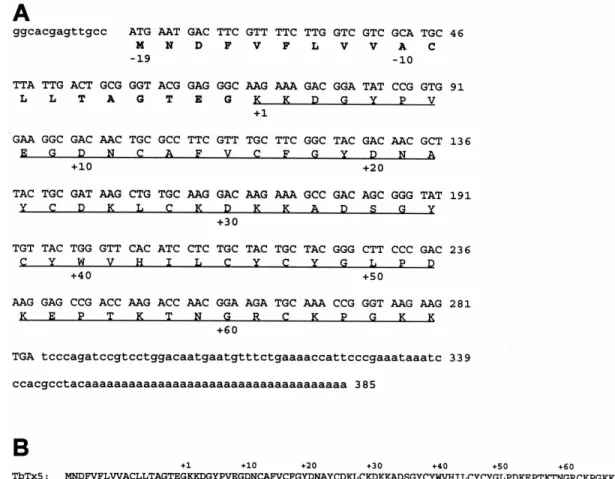
Isolated clones were characterized by DNA sequen-cing, and several were shown to code for previously described proteins, supporting the validity of the process described (see Table 1). To illustrate the methodology, we also showed the complete sequencing of one clone isolated from the Tityus bahiensis cDNA library. In reality, two independent clones encoding for the same toxin were isolated (clone 7.1 and 7.10). The toxin described in the present study has been designated TbTx5 (Tityus bahiensis Toxin 5) since Becerril et al. (1996) has already reported the sequence of four different toxins isolated from the venom ofTityus bahiensis scor-pion. The clones encode for a toxin very similar to TbTx IV-5 (93% identity at the amino acid level). Fig. 2 shows the nucleotide sequence of the cDNA encoding the precursor of TbTx5 and also the comparison of amino acid sequence among TbTx5, TbTxIV-5 and TsTx. Sequence analysis showed that the cDNA contained a E. Kalapothakis et al. / Toxicon 39 (2001) 679–685
Table 1
ELISA results. ELISA was carried out as described in Section 2. The absorbance of pre-immune serum (control) was subtracted. Clones for which no sequencing data is available or no significant similarity has been found using GenBanK databases and Fasta program are labelled nd or ns, respectively
Tityus bahiesiscDNA library ELISA results Toxin name
Anti-Tb venom Anti-TsTx Anti-TsTx I
Negative control 0.059 0.067 0.084 –
T. bahiensisvenom 2.275 0.950 2.497 –
Clone 7.1 0.128 0.647 0.387 TbTx5a
Clone 7.10 0.100 0.721 0.508 TbTx5a
7.19 0.103 0.570 0.395 nd
7.58 0.096 0.856 0.481 nd
7.75 0.143 0.541 0.348 nd
7.82 0.172 0.624 0.401 nd
24.2 0.369 0.411 0.304 ns
24.33 0.268 0.309 0.328 ns
Tityus sennulatuscDNA library Elisa results Toxin name
Anti-Ts venom Anti-TsTx Anti-TsTx I
Negative control 0.052 0.050 0.063 –
T. serrulatusvenom 1.292 0.482 1.560 –
Clone 13.33 0.783 0.572 0.757 TsNTxPb Clone13.49 0.319 0.319 0.303 TsTx Ic
Clone 13.52 0.156 0.223 0.221 ns
Clone 28 0.163 0.334 0.283 ns
Clone 64 0.121 0.353 0.348 c–TsTxKba
Clone 68 0.105 0.350 0.382 nd
a The present work.
b TsNTxP (Guatimosim et al., 1999).
short 50-untranslated region and an open reading frame
encoding a peptide of 86 amino acids. The sequence of nucleotides 14 to 70 encodes for a signal peptide of 19 amino acids containing an initiating Met and a series of highly hydrophobic amino acids residues (Fig. 2). TbTx5 and TbTx IV-5 differ by only four residues at positions 9 (G for A), 29 (K for G) 53 (K for N) and position 61 (R for K) and also showed 5 extra residues at the C-terminal peptide. TbTx5 also showed an important similarity with TsTx (also called toxin IV of Tityus serrulatus by Martin-Eauclaire et al. (1994)) showing 87% identity at the amino acid level.
Using the Tityus serrulatus cDNA library, clones containing the nucleotide sequence encoding for TsNTxP and TsTxI were found. TsNTxp is a protein
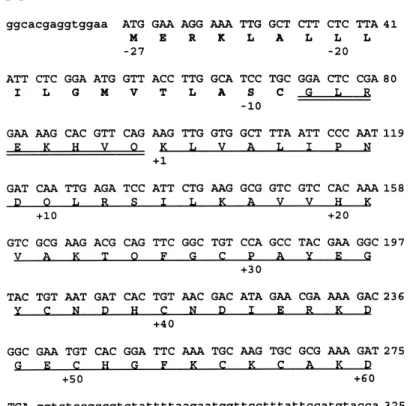
described by our group (Guatimosim et al., 1999) that proved to be highly immunogenic, and TsTx I is a neurotoxin active on sodium channel which has been described by several groups (Toledo and Neves, 1976; also called Ts VII by Bechis et al. (1984) and toxin-g by Possani et al. (1985)). Of interest is clone 64 called here cTsTx-Kb (cDNA of TsTx-Kb), whose deduced amino acid sequence (Fig. 3) showed 64% identity with the long chain potassium ion channel blocker BmTxKb2 isolated from the scorpion Buthus martensii (Zhu et al., 1999), approximately 91% with the toxin TsTx-Kb described by Rogowski et al. (1994) and its sequence is almost identical to the partial sequence of clones Ts-50Cl.14 and Ts-30Cl.3 published by Legros et
al. (1998). However, a deletion of a guanine base at E. Kalapothakis et al. / Toxicon 39 (2001) 679–685
Fig. 2. (A) Nucleotide sequence of cDNA encoding TbTx5. The coding region is shown in uppercase with the 50and 30untranslated regions in
position 102 of this clone was observed and the most likely conclusion is that this deletion is probably a clon-ing artefact. The toxin encoded by clone cTsTx-Kbalso showed 48% identity with a defensin isolated from the scorpion Leiurus quinquestriatus hebraeus (Cociancich
et al., 1988). Finally, no significant similarity was found for some other isolated clones after DNA sequence analy-sis using GenBanK databases and the Fasta program of Pearson and Lipman (1988).
In conclusion, we described the use of ELISA in the E. Kalapothakis et al. / Toxicon 39 (2001) 679–685
Fig. 3. (A) Nucleotide sequence of cDNA encoding cTsTxKb. The hydrophobic region (signal peptide) is indicated (bold), the putative propeptide is underlined twice and the segment that corresponds to the amino acid sequence of cTsTxKb is underlined. (B) Comparison of amino acid sequence of cTsTxKbwith BmTxKb2 (a putative potassium ion channel blocker fromButhus martensii, Zhu et al., 1999); TsTx-Kb(potassium ion channel blocker fromTitus serrulatus, Rogowski et al., 1994) and clones Ts50Cl.14 and
Ts30Cl.3 (Legros et al., 1998). Numbering corresponding to the signal peptide is negatively numbered. When there is no similarity the
screening of expression libraries. The methodology shows good potential for the identification of antigenic proteins and could be very useful for groups interested in information from a specific tissue or organism.
Acknowledgements
The work was supported by PADCT, FAPEMIG, CNPq and PRONEX.
References
Altschul, S.F., Madden, T.T.L., Scha¨ffer, A.A., Zhang, J., Zhang, Z., Miller, W., Lipman, D.J., 1997. Gapped BLAST and PSI-BLAST: a new generation of protein database search programs. Nucleic Acids Res. 25, 3389–3402.
Becerril, B., Corona, M., Coronas, F.I., Zamudio, F., Calderon-Aranda, E.S., Fletcher Jr., P., Martin, B.M., Possani, L.D., 1996. Toxic peptides and genes encoding toxin gamma of the Brazilian scorpions Tityus bahiensis and Tityus stigmurus. Biochem. J. 313, 753–760.
Bechis, G., Sampieri, F., Yuan, P.M., Brando, T., Martin, M.F., Diniz, C.R., Rochat, H., 1984. Amino acid sequence of Toxin VII, a beta-toxin from the venom of the scorpion Tityus serrulatus. Biochem. Biophys. Res. Commun. 122, 1146–1153. Cha´vez-Olo´rtegui, C., Lopes, C.S., Cordeiro, F.D., Granier, C., Diniz, C.R., 1993. An enzyme linked immusorbent assay (ELISA) that discriminates between Bothrops atrox and
Lachesis muta mutavenoms. Toxicon 32, 1649–1656. Chavez-Olortegui, C., Fonseca, S.C., Campolina, D., Amaral, C.F.,
Diniz, C.R., 1994. ELISA for the detection of toxic antigens in experimental and clinical envenoming by Tityus serrulatus
scorpion venom. Toxicon 32, 1649–1656.
Chavez-Olortegui, C., Kalapothakis, E., Ferreira, A.M., Ferreira, A.P., Diniz, C.R., 1997. Neutralizing capacity of antibodies elicited by a non-toxic protein purified from the venom of the scorpionTityus serrulatus. Toxicon 35, 213–221.
Chomczynski, P., Sacchi, N., 1987. Single-step method of RNA isolation by acid guanidinium thiocyanate–phenol–cholorofom extraction. Anal. Biochem. 162, 156–159.
Cociancich, S., Goyffon, M., Bontems, F., Bulet, P., Bouet, F., Menez, A., Hoffmann, J., 1993. Purification and characteriza-tion of a scorpion defensin, a 4 kDa antibacterial peptide presenting structural similarities with insect defensins and scorpion toxins. Biochem. Biophys. Res. Commun. 194, 17–22. Engvall, E., Perlmann, P., 1971. Enzyme-linked immunosorbent assay (ELISA): quantitative assay of immunoglobin G. Immunochemistry 8, 871–874.
Gomez, M.V., Diniz, C.R., 1966. Separation of toxic componennts from the Brazilian scorpionTityus serrulatusvenom. Mem. Inst. Butantan, Simp. Internac. 33, 899–902.
Guatimosim, S.C.F., Prado, V.F., Diniz, C.R., Cha´vez-Olo´rtegui, C., Kalapothakis, E., 1999. Molecular cloning and genomic analysis of TsNTxP: an immunogenic protein from Tityus serrulatusscorpion venom. Toxicon 37, 507–517.
Legros, C., Ceard, B., Bougis, P.E., Martin-Eauclaire, M.F., 1998. Evidence for a new class of scorpion toxins active against K1 channels. FEBS Lett. 431, 375–380.
Lowry, O.H., Rosebrowgh, N.J., Farr, A.L., Randall, R.J., 1951. Protein measurement with the Folin phenol reagent. J. Biol. Chem. 193, 265–275.
Martin-Eauclaire, M.F., Ce´ard, B., Ribeiro, A.M., Diniz, C.R., Rochat, H., Bougis, P.E., 1994. Biochemical, pharmacological and genomic characterisation of TsIV, an alpha-toxin from the venom of the south American scorpionTityus serrulatus. FEBS Lett. 342, 181–184.
Pearson, W.R., Lipman, D.J., 1988. Improved tools for biolo-gical sequence comparison. Proc. Natl. Acad. Sci. USA 85, 2444–2448.
Possani, L.D., Martin, B.M., Mochca-Morales, J., Svendsen, I., 1981. Purification and chemical characterization of the major toxins from the venom of the Brazilian scorpionTityus serrulatusLutz and Mello. Carlsberg Res. Commun. 46, 195–205.
Possani, L.D., Martin, B.M., Svendsen, I., Rode, G.S., Erickson, B.W., 1985. Scorpion toxins from Centruroides noxius and
Tityus serrulatus. Biochem. J. 229, 739–750.
Reisfeld, R.A., Lewis, U.J., Williams, D.E., 1962. Disk electrophoresis of basic proteins and peptides on polyacrylamide gels. Nature 195, 281–283.
Rogowski, R.S., Krueger, B.K., Collins, J.H., Blaustein, M.P., 1994. Tityustoxin K alpha blocks voltage-gated noninactivating K1 channels and unblocks inactivating K1 channels blocked by alpha-dendrotoxin in synapto-somes. Proc. Natl. Acad. Sci. USA 15, 1475–1479. Saiki, R.K., Gelfand, D.H., Stoffel, S., Scharf, S.J., Higuchi, R.,
Horn, G.T., Mullis, K.B., Erlich, H.A., 1988. Primer-directed enzymatic amplification of DNA with a thermostable DNA polymerase. Science 252, 1643–1651.
Sambrook, J., Fritsh, E.F., Maniats, T., 1989. Molecular Cloning: A Laboratory Manual, vols. 1–3, Cold Spring Harbor, New York. Sanger, F., Nicklen, S., Coulson, A.R., 1977. DNA sequencing with chain termination inhibitors. Proc. Natl. Acad. Sci. USA 74, 5463–5467.
Toledo, D., Neves, A.G.A., 1976. Purification and partial character-ization of a second toxin from the scorpionTityus serrulatus. Comp. Biochem. Physiol. 55, 249–253.
Young, R.A., Davis, R.W., 1983. Efficient isolation of genes by using antibody probes. Proc. Natl. Acad. Sci. USA 80, 1194– 1198.
Zhu, S., Li, W., Zeng, X., Jiang, D., Mao, X., Liu, H., 1999. Mole-cular cloning and sequencing of two ‘short chain’ and two ‘long chain’ K(1) channel-blocking peptides from the Chinese scorpionButhus martensii Karsch. FEBS Lett. 457, 509–514.