Dement Neuropsychol 2017 September;11(3):276-286
276
276 Motor learning in autism Moraes et al.
Original Article
Motor learning characterization in people
with autism spectrum disorder
A systematic review
Íbis Ariana Peña de Moraes1, Thais Massetti2, Tânia Brusque Crocetta3, Talita Dias da Silva4,
Lilian Del Ciello de Menezes2, Carlos Bandeira de Mello Monteiro2, Fernando Henrique Magalhães1
ABSTRACT. Autism Spectrum Disorder (ASD) is a neurodevelopmental disorder primarily characterized by deficits in social interaction, communication and implicit skill learning. Objective: To analyse the results of research on “motor learning” and the means used for measuring “autistic disorder”. Methods: A systematic literature search was done using Medline/ PubMed, Web of Science, BVS (virtual health library), and PsycINFO. We included articles that contained the keywords “autism” and “motor learning”. The variables considered were the methodological aspects; results presented, and the methodological quality of the studies. Results: A total of 42 studies were identified; 33 articles were excluded because they did not meet the inclusion criteria. Data were extracted from nine eligible studies and summarized. Conclusion: We concluded that although individuals with ASD showed performance difficulties in different memory and motor learning tasks, acquisition of skills still takes place in this population; however, this skill acquisition is related to heterogeneous events, occurring without the awareness of the individual.
Key words: motor learning, motor skill, motor control, performance.
CARACTERIZAÇÃO DA APRENDIZAGEM MOTORA EM PESSOAS COM TRANSTORNO DO ESPECTRO AUTISTA: UMA REVISÃO SISTEMÁTICA
RESUMO. O Transtorno do Espectro Autista (TEA) é uma desordem do desenvolvimento neurológico caracterizada principalmente por déficits na interação social, comunicação e aprendizagem de habilidades implícitas. Objetivo:
Analisar os resultados da pesquisa sobre “aprendizagem motora” e suas formas de mensurar na “desordem autista”.
Métodos: Uma pesquisa bibliográfica sistemática foi feita usando Medline/PubMed, Web of Science, BVS (biblioteca virtual de saúde) e PsycINFO. Incluímos artigos que mostraram as palavras-chave “autismo” e “aprendizagem motora”. As variáveis consideradas foram os aspectos metodológicos; os resultados apresentados e a qualidade metodológica dos estudos. Resultados: Um total de 42 artigos foram identificados; foram excluídos 33 artigos porque não atendiam aos critérios de inclusão. Os dados foram extraídos de nove estudos elegíveis e resumidos. Conclusão: Concluímos que, embora as pessoas com TEA tenham demonstrado dificuldades de desempenho em diferentes tarefas de aprendizagem motora de memória, a aquisição de habilidades ocorre nessa população; No entanto, essa aquisição de habilidades está relacionada a eventos heterogêneos, ocorrendo sem a consciência dos indivíduos.
Palavras-chave: aprendizagem motora, habilidade motora, controle motor, desempenho.
INTRODUCTION
A
utism spectrum disorder (ASD) is a het-erogeneous neurodevelopmental disorder of multifactorial origin, characterized by dei-cits in social interaction and communication;1however, motor coordination deicits are increasingly recognized as a prevalent feature of these conditions.2 Today, ASD is generally incurable, although it is treatable to a variable degree to prevent worse outcomes.3 herefore,
This study was conducted at the School of Arts, Sciences and Humanities – University of São Paulo, SP, Brazil.
1Post-graduate Program in Sciences of Physical Activity – School of Arts, Sciences and Humanities – University of São Paulo, São Paulo, SP, Brazil. 2 Post-graduate Program in Rehabilitation Sciences – Faculty of Medicine – University of São Paulo, São Paulo, SP, Brazil.3Department of Morphology and Physiology – Faculty of Medicine of ABC – Santo André, SP, Brazil. 4 Post-graduate Program in Cardiology – Federal University of São Paulo – Paulista School of Medicine – São Paulo, SP, Brazil.
Íbis Ariana Peña de Moraes. Rua Arlindo Béttio 1000 – 03828-000 São Paulo SP – Brazil. E-mail: [email protected] Disclosure: The authors report no conflicts of interest.
Received April 04, 2017. Accepted in final form June 29, 2017.
Dement Neuropsychol 2017 September;11(3):276-286
277
Moraes et al. Motor learning in autism
continued eforts should be made to promote the early identiication of children with ASD so that interventions can be started at the youngest possible age.
he diagnosis of ASD has systematically risen since Kanner’s description in 1943 and Asperger’s deini-tion in 1944. An increase in numbers has met with an increase in litigation regarding ASD and the Individu-als with Disabilities Education Improvement Act.4 he prevalence of 4-year-old ASD was 13.4 per 1,000, which was 30% lower than the prevalence of ASD at 8 years of age, suggesting a progression in reducing the age of the irst ASD assessment.5
he frequency of ASD diagnoses has been increasing for decades, but researchers cannot agree on whether the trend is a result of increased awareness, improved detection, expanding deinitions, an actual increase in incidence, a combination of these factors,6 or the com-plex nature of these overlapping disorders and changes in clinical deinitions over time.7
Predominantly, children with ASD have diiculty performing skilled movements8 and show a host of motor disorders including poor coordination, poor tool use, and delayed learning of complex motor skills.9
ASD, which has seen an alarming rise in prevalence, is a common condition that family physicians encounter in the clinical setting.10 he revision of diagnostic crite-ria for ASD has been widely anticipated and is expected to be an important contribution to the reinement of the deinition of ASD. In the upcoming DSM-V (Fifth Edition of the Diagnostic and Statistical Manual of Men-tal Disorders), several changes have been made com-pared with the previous diagnostic criteria.11 he new deinition has four diferent domains with sub-criteria for diagnosis. It uses one “umbrella” term of ASD with diferent levels of severity and no longer uses terms such as Asperger syndrome, classic autism, or pervasive development disorder. It has no emphasis on language delay and age of onset, only that ASD is deined as a neurodevelopmental disorder with symptoms in early childhood, although the disorder may be irst diagnosed later in life.10
he three areas of impairments in ASD have been reduced to two areas; namely, a social-communication domain and a behavioral domain, including ixated interests and repetitive behaviors. In addition, the clini-cal presentation of ASD is described in more detail in terms of clinical speciicity.11
Besides an adequate diagnosis, appropriate behav-ioral therapy and rehabilitation treatment signiicantly afect the prognoses and, thus, it is important to con-irm an early diagnosis and to treat the disorder at an
early stage. Treatment is more efective when persons can learn and properly perform the proposed task. Based on this evidence, some authors study the occur-rence of motor learning in ASD from their practice.12
In addition, parents and clinicians frequently observe children with ASD displaying a clumsy gait, poor muscle tone, imbalance, as well as poor manual dexter-ity and coordination. Considering the consistent clinical reports of impaired motor functioning in ASD, motor examination may provide a window into the underlying neurobiological substrate of the disorder. Motor signs may serve as markers for deicits in parallel or neigh-bouring brain systems important for the control of socialization and communication.13 Measures of motor function tend to be more overtly observable than mea-sures of more complex social and behavioral systems.8 heory suggests that one of the crucial steps in motor learning is the ability to form internal models: i.e., to predict the sensory consequences of motor com-mands and learn from errors to improve performance on the next attempt.9 Efective development of praxis involves connections between multiple brain regions. he angular and supramarginal gyri are thought to be the site of storage of learned time-space movement rep-resentations or “action sequences”. It is thought that these movement representations help to program the premotor cortex, which is involved in transcoding them into motor programs that, in turn, activate the motor cortex for execution.8
hus, the cerebellum appears to be an important site for the acquisition of internal models and, indeed, the development of the cerebellum is abnormal in children with ASD.9 In particular, numerous histopathological and magnetic resonance imaging studies have reported reduced volume in the fastigial nuclei and cerebellar vermis lobules VI–VII in children with ASD. his is a region supporting ocular motor function, verbal work-ing memory, and speech coordination.2
Another change commonly found in ASD is motor behavior, but the etiology remains unclear.14 Deicits in imitation have also been emphasized in the ASD litera-ture, as well as abnormalities in “self-other mapping” (thought to be associated with dysfunction within mir-ror neuron systems) and have been hypothesized as contributing to impaired development of empathy, joint attention, and theory of mind.8
Dement Neuropsychol 2017 September;11(3):276-286
278 Motor learning in autism Moraes et al.
may contribute to impaired development of social and communicative (in addition to motor) ability in ASD.15 Careful investigation of motor adaptation may therefore provide insight into the neurological mechanisms con-tributing to impaired motor function and skill acquisi-tion in these children.9
According to Larson et al.,9 more complex tasks which involve learning new tools for controlling or adapting the movements of the arm in response to a change of visual information can be diicult for persons with ASD. hese include some tasks in which distur-bances are purely visual, rather than mechanical, and the individuals tested have never experienced any of these uncommon disturbances.9
he studies of Jones et al.16 showed that children with ASD consistently experience diiculty learning an abstract rule from a discrete physical reward. Rule learn-ing is facilitated by the provision of more concrete rein-forcement, suggesting an underlying diiculty in form-ing conceptual connections. It is important to identify why persons with ASD might have diiculty in learning and applying rules. One possibility is a disruption of the ability to learn from particular types of rewards. Most rule-learning paradigms involve the provision of feed-back, either concrete and/or abstract.
he brain builds an association between action and sensory feedback to predict the sensory consequence of self-generated motor commands. his internal model of action is central to our ability to adapt movements and may also play a role in our ability to learn from observ-ing others.17 With regard to the motor diiculties in ASD, some systematic reviews were conducted to show important developments in research for clinical practice and knowledge of ASD about motor learning, such as the improvement that child’s play can have on executive function-related behaviors,18 the assessment of motor abilities in ASD using a computational context,14 or the identiication of ability and disability in ASD.19
However, motor learning trials in this population are required due to a large discrepancy in the information. Systematic reviews are needed to provide up-to-date information on ASD and motor learning. herefore, to support clinical need and bridge the knowledge gap, the aim of this study was to analyze the results of studies on motor learning in persons with ASD using a systematic review strategy.
METHODS
his review was based on a systematic search of published articles available through April 2016 and conducted according to the Preferred Reporting Items
for Systematic Reviews and Meta-Analyses guidelines.20 he study was recorded in the International prospective register of systematic reviews under number 46990.
Eligibility criteria. To increase conidence in the selec-tion of articles, all potentially relevant articles were reviewed independently by two researchers, who reached consensus to establish which articles fulilled the inclusion criteria.21
Abstracts of identiied articles were then screened for the following inclusion criteria: [1] population included had a diagnosis of ASD; and [2] motor learning was assessed in this population. here were no restric-tions on minimum sample size. Articles were excluded if they were: [1] not data-based (e.g., books, theoretical papers, or secondary reviews); [2] studies not published in English; [3] examined populations not explicitly iden-tiied as having a diagnosis of ASD; or [4] did not include motor learning information.
All identiied studies were grouped in EndNote Web (homson Reuters) and duplicates removed.
Information sources and search. he current systematic review was based on published articles available through April 2016. he search was conducted on the databases PubMed (http://www.ncbi.nlm.nih.gov/pubmed), Web of Science (https://isiknowledge.com), BVS (virtual health library; http://bvsalud.org), and PsycINFO (http://www.apa.org/pubs/databases/psycinfo/) which were searched concurrently for entries using the estab-lished keywords. We included articles that contained both the keywords “motor learning” AND “autistic disorder” OR “autism”.
he article search used the terms: “autistic disorder” OR “autism” AND “motor learning”, “autistic disorder” OR “autism” AND “motor control”, “autistic disorder” OR “autism” AND “performance”, “autistic disorder” OR “autism” AND “motor skill”; surveyed studies that contained this combination of words anywhere in the text were selected.
Dement Neuropsychol 2017 September;11(3):276-286
279
Moraes et al. Motor learning in autism
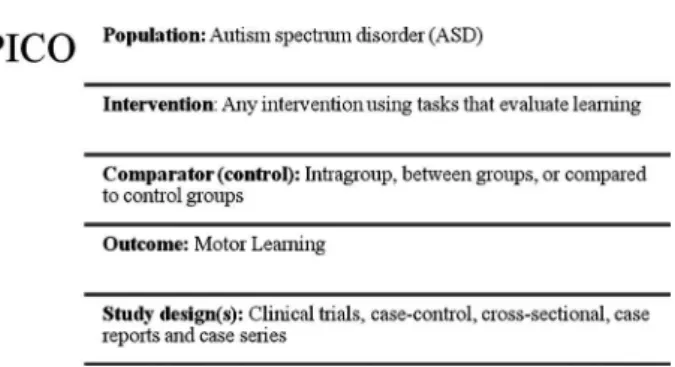
group (C), and outcome (O) and on several searches in the aforementioned databases.
We used 3 steps to select the articles. he irst step was to look for articles in databases and read their titles and abstracts. he second step was the exclusion of stud-ies by title, abstract, or our inclusion criteria. he third and inal step was to analyse the eligible studies.23
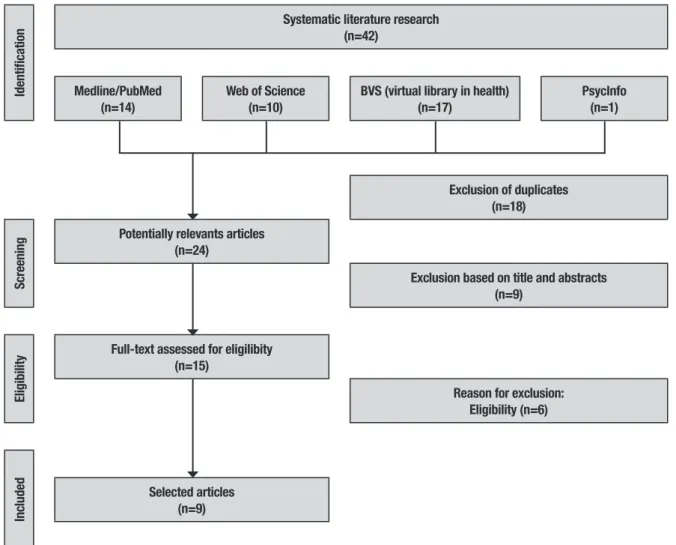
Study selection and data collection processes. After performing the initial literature searches, each study title and abstract was screened for eligibility by the irst author. Full texts of all potentially relevant studies were subsequently retrieved and further exam-ined for eligibility. he Preferred Reporting Items for Systematic Reviews and Meta-Analyses guidelines low diagram (Figure 1) provides more detailed information regarding the selection process of studies.
To increase conidence in the selection of articles, all potentially relevant articles were reviewed indepen-dently by two researchers. After reading all potential studies, the researchers reached consensus to establish which articles fulilled the inclusion criteria.21
Analysis. Motor learning is a phenomenon that refers to relatively permanent neuromotor changes, leading to the acquired ability to perform motor skills. Such changes ensure that the appropriate movement is achieved. hey are derived from experience and prac-tice, resulting in the acquisition, retention, and transfer of motor skills.24 However, motor learning can be measured by improvements in performance, which can be seen to increase and correct errors of execution and decrease duration of the task. In a developmental context, impaired performance of skilled gestures may be secondary to a fundamental problem with acquiring motor skills.9
Motor learning is the study of the acquisition of motor skills or the performance improvement of learned or highly practiced motor skills.25 However, this chang-ing capability in motor learnchang-ing is not directly measur-able, because the changes responsible for motor learn-ing are complex processes within the central nervous system. herefore, change can be inferred by sustained improved performance26 and also individual diferences in repetitive behaviours within the ASD may afect which areas of the brain are engaged during motor learning.27
Traditionally, therapists often use rational argu-ments, many verbal instructions, and available sensory feedback or feedback from an external source to engage patients in motor learning.28,29
Figure 1. Representation of the search strategy – according to the Popu-lation Intervention Comparison Outcome (PICO) strategy.
Acceptable performance of a motor skill within a sin-gle session (or series of sessions) does not demonstrate that the skill has been learned. A skill is not considered truly learned until retention and/or transfer of that par-ticular skill is demonstrated. hese skills are classiied by: [1] size of the movement – gross or ine motor skills; [2] beginning and end points – continuous rhythmicity; and [3] characterizing the stability of the environment in which the task is being performed – open or closed (temporal and spatial features of the environment where a task is performed.30
Practice which leads to optimal learning depends on the task being learned and the characteristics of the learner (e.g., age, stage of learning). he best practice design will not simply promote immediate performance efects, but, more importantly, will promote long-term learning.31
RESULTS
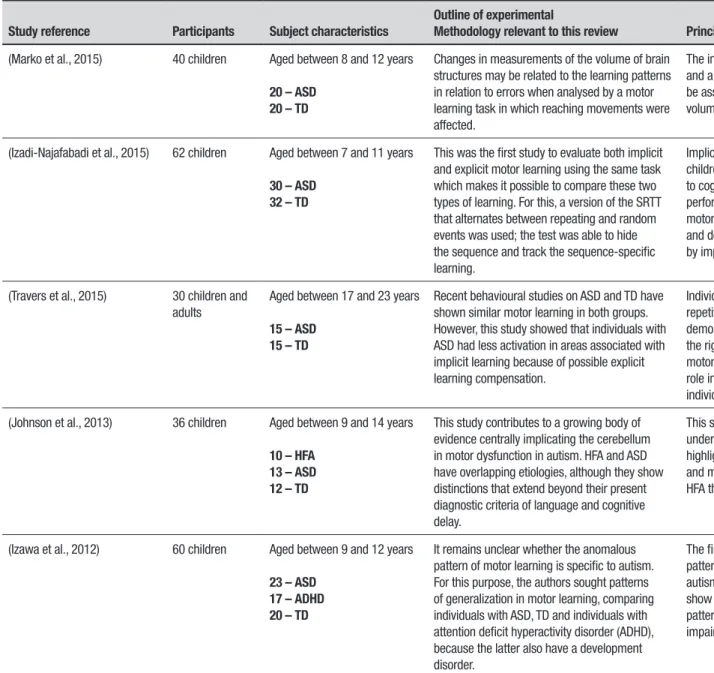
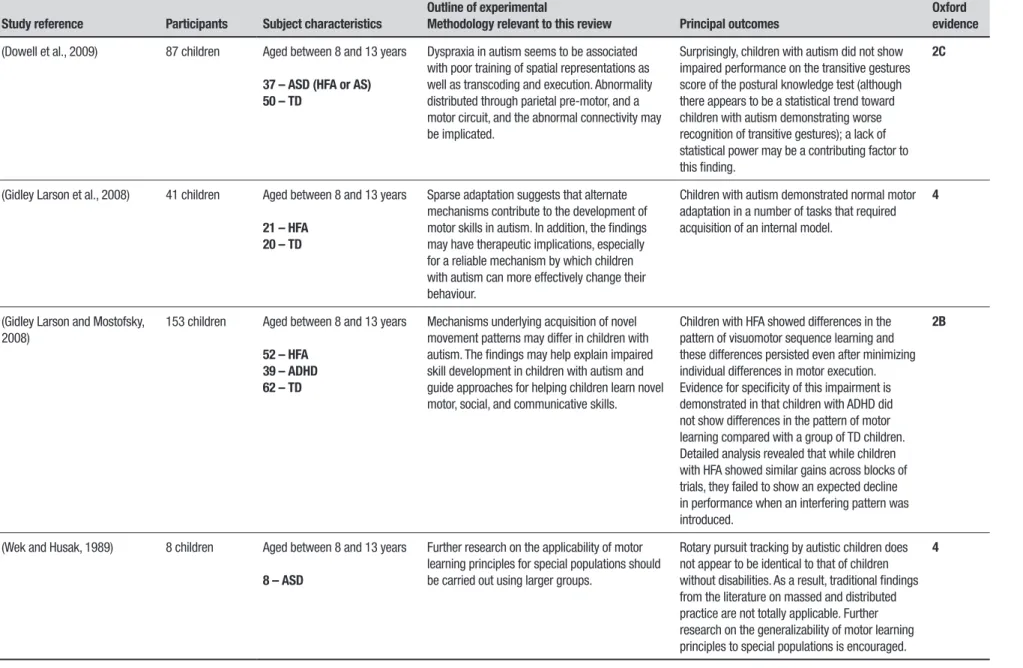
Nine articles met the inclusion criteria for this review. he overall results for the studies included in this review are briely presented below in Table 1.
Selection of studies. he databases searched were
Dement Neuropsychol 2017 September;11(3):276-286
280 Motor learning in autism Moraes et al.
Identification
Systematic literature research (n=42)
Medline/PubMed (n=14)
Web of Science (n=10)
BVS (virtual library in health) (n=17)
PsycInfo (n=1)
Exclusion of duplicates (n=18)
Screening
Potentially relevants articles (n=24)
Exclusion based on title and abstracts (n=9)
Eligibility
Full-text assessed for eligilibity (n=15)
Reason for exclusion: Eligibility (n=6)
Inc
luded Selected articles (n=9)
Figure 2. Flowchart of selected articles adapted from Moher et al. (2009).
Study characteristics. More information on the method-ological and general characteristics of all the analysed studies can be found in Table 1.
Countries in which the data was collected. he reviewed studies were carried out in Baltimore,8,9,17,32,33 Cali-fornia,34 and Alabama27 in the United States of America; Monash2 in Australia; and Najafab35 in Iran.
Participant characteristics. he nine reviewed studies included a total of 517 participants; of these selected studies, only six provided gender information, with 31 women participating and 256 men. he articles by Gidley Larson et al.,9 Gidley Larson & Mostofsky,32 and Johnson et al.2 do not distinguish the gender of their participants. Participants in the sample had a diagnosis of ASD, High Functioning Autism, Asperger’s syndrome, or were individuals with typical development, used as a control group.
he age of participants in the studies ranged from 7 to 23 years. In four of the included studies, the par-ticipants were individuals whose age ranged from 8 to 13 years old.8,9,32,34 In one study, the participants were individuals between 9 and 12 years of age;17 another study included individuals aged between 9 and 14 years;2 the study by Izadi-Najafabadi et al.35 featured individu-als aged between 7 and 11 years; those in the study by Marko et al.33 were aged between 8 and 12 years; and, in turn, the study with a sample of older individuals was that by Travers et al.27 with participants aged between 17 and 23 years.
he main limitations of these studies were the use, in certain studies, of cognitive justiication for the limita-tions encountered in the execution of motor learning, but not for the deicit in motor behavior.
Dement Neuropsyc
hol 2017 September;11(3):276-286
281
Moraes et al.
Motor lear
ning in autism
Table 1. Detailed representation of studies.
Study reference Participants Subject characteristics
Outline of experimental
Methodology relevant to this review Principal outcomes
Oxford evidence
(Marko et al., 2015) 40 children Aged between 8 and 12 years
20 – ASD 20 – TD
Changes in measurements of the volume of brain structures may be related to the learning patterns in relation to errors when analysed by a motor learning task in which reaching movements were affected.
The increased sensitivity to proprioceptive error and a decreased sensitivity to visual error may be associated with abnormalities in cerebellum volume.
2C
(Izadi-Najafabadi et al., 2015) 62 children Aged between 7 and 11 years
30 – ASD 32 – TD
This was the first study to evaluate both implicit and explicit motor learning using the same task which makes it possible to compare these two types of learning. For this, a version of the SRTT that alternates between repeating and random events was used; the test was able to hide the sequence and track the sequence-specific learning.
Implicit motor learning is not affected in these children. Applying the findings of this study to cognitive orientation to daily occupational performance approach, the impaired explicit motor learning through the global strategy ‘‘Plan’’ and domain specific strategies can be supported by implicit approaches.
3B
(Travers et al., 2015) 30 children and adults
Aged between 17 and 23 years
15 – ASD 15 – TD
Recent behavioural studies on ASD and TD have shown similar motor learning in both groups. However, this study showed that individuals with ASD had less activation in areas associated with implicit learning because of possible explicit learning compensation.
Individuals with ASD who had more severe repetitive behaviour/restricted interest symptoms demonstrated greater decreased activation in the right SPL and right precuneus regions during motor learning which can thus play an important role in motor learning and repetitive behaviour in individuals with ASD.
3B
(Johnson et al., 2013) 36 children Aged between 9 and 14 years
10 – HFA 13 – ASD 12 – TD
This study contributes to a growing body of evidence centrally implicating the cerebellum in motor dysfunction in autism. HFA and ASD have overlapping etiologies, although they show distinctions that extend beyond their present diagnostic criteria of language and cognitive delay.
This study makes an important contribution to our understanding of the nature of motor function, highlighting deficits in processing visual feedback and motor learning. These deficits were greater in HFA than in ASD.
3B
(Izawa et al., 2012) 60 children Aged between 9 and 12 years
23 – ASD 17 – ADHD 20 – TD
It remains unclear whether the anomalous pattern of motor learning is specific to autism. For this purpose, the authors sought patterns of generalization in motor learning, comparing individuals with ASD, TD and individuals with attention deficit hyperactivity disorder (ADHD), because the latter also have a development disorder.
The findings suggest that there is a specific pattern of altered motor learning associated with autism. This is because the children with ASD show a slower rate of learning and an altered pattern of generalization that is predictive of impaired motor, imitation, and social skills.
Dement Neuropsyc
hol 2017 September;11(3):276-286
282
Motor lear
ning in autism
Moraes et al.
Table 1. Continuation.
Study reference Participants Subject characteristics
Outline of experimental
Methodology relevant to this review Principal outcomes
Oxford evidence
(Dowell et al., 2009) 87 children Aged between 8 and 13 years
37 – ASD (HFA or AS) 50 – TD
Dyspraxia in autism seems to be associated with poor training of spatial representations as well as transcoding and execution. Abnormality distributed through parietal pre-motor, and a motor circuit, and the abnormal connectivity may be implicated.
Surprisingly, children with autism did not show impaired performance on the transitive gestures score of the postural knowledge test (although there appears to be a statistical trend toward children with autism demonstrating worse recognition of transitive gestures); a lack of statistical power may be a contributing factor to this finding.
2C
(Gidley Larson et al., 2008) 41 children Aged between 8 and 13 years
21 – HFA 20 – TD
Sparse adaptation suggests that alternate mechanisms contribute to the development of motor skills in autism. In addition, the findings may have therapeutic implications, especially for a reliable mechanism by which children with autism can more effectively change their behaviour.
Children with autism demonstrated normal motor adaptation in a number of tasks that required acquisition of an internal model.
4
(Gidley Larson and Mostofsky, 2008)
153 children Aged between 8 and 13 years
52 – HFA 39 – ADHD 62 – TD
Mechanisms underlying acquisition of novel movement patterns may differ in children with autism. The findings may help explain impaired skill development in children with autism and guide approaches for helping children learn novel motor, social, and communicative skills.
Children with HFA showed differences in the pattern of visuomotor sequence learning and these differences persisted even after minimizing individual differences in motor execution. Evidence for specificity of this impairment is demonstrated in that children with ADHD did not show differences in the pattern of motor learning compared with a group of TD children. Detailed analysis revealed that while children with HFA showed similar gains across blocks of trials, they failed to show an expected decline in performance when an interfering pattern was introduced.
2B
(Wek and Husak, 1989) 8 children Aged between 8 and 13 years
8 – ASD
Further research on the applicability of motor learning principles for special populations should be carried out using larger groups.
Rotary pursuit tracking by autistic children does not appear to be identical to that of children without disabilities. As a result, traditional findings from the literature on massed and distributed practice are not totally applicable. Further research on the generalizability of motor learning principles to special populations is encouraged.
4
Dement Neuropsychol 2017 September;11(3):276-286
283
Moraes et al. Motor learning in autism
results of motor learning analysis. he studies included in this review have speciic diiculties: small and het-erogeneous samples. Few articles were included and not all were randomized controlled trials, recommended for evaluating the highest degree of evidence in systematic reviews.
DISCUSSION
Motor deiciency in children with ASD has received increasing attention with abundant evidence clearly indicating the high prevalence of motor impairment. One of the major challenges in the management of motor skills in this population concerns the understanding of the task. However, before motor performance can be considered as a major feature of ASD, it is essential to establish a valid and reliable motor assessment for use in ASD children that incorporates appropriate adapta-tions to facilitate understanding of tasks and to ensure accurate assessment of motor performance.
ASD is a highly uncertain entity and little is stated about it with any degree of certainty. Understanding uncertainty and indeterminacy is important for an understanding of ASD and its heterogeneity.36 Over the past few years, awareness of motor problems in individ-uals with ASD has grown. hus, a common feature is a deiciency of motor control and motor learning, a conse-quence for the majority of children with the disability.37
Outcomes. he main objective of this study was to
analyse research indings about motor learning in persons with ASD. Having searched through diferent tests and tasks performed by subjects, the results show that there was a performance improvement during the stages of learning protocols.
Children with disabilities often have many disad-vantages that have long-term consequences and motor problems place an additional burden on child and can signiicantly afect daily life and social interactions. hus, determining the role that ine and gross motor skills can play in improving cognitive and social skills can help identify abilities that can be intervened early, which can reduce the impact of motor diiculties and may also help enable full potential.38
During tests aimed at analyzing motor learning from errors in visual feedback,2,9,33 it was noted that there is a major inluence of cerebellar integrity in driving motor activities efectively. he cerebellum has historically been ascribed a role in motor learning and coordina-tion and studies suggest that cerebellar changes may contribute to the range of cognitive, linguistic, social, and motor behaviours seen in ASD.39 In the study by
Johnson et al.,2 evidence is shown for the contribution of the cerebellum in motor dysfunction in ASD, high-lighting deicits in processing visual feedback and the learning engine. According to the author, these deicits were greater in High Functioning Autism than in ASD. Similar results were found in the study by Gidley Larson and Mostofsky32 comparing motor learning in ASD with attention deicit hyperactivity disorder patients through a constant and alternating speed task.
Other brain regions that showed decreased activity during the task were the right upper lobe and the right parietal precuneus. Activation in these areas is signii-cantly related to behavioural learning during serial reac-tion time tasks. he results of the research Travers et al.27 indicate the presence, albeit less robust, of motor-linked implicit learning in ASD compared to individuals with typical development, indicating possible diiculties with motor learning in ASD.
he indings suggest that there is a speciic pattern of altered motor learning associated with ASD; probably because people with ASD show a slower rate of learning and an altered pattern of generalization that is predic-tive of impaired motor, imitation, and social impair-ment.17 However, individuals with ASD demonstrated normal motor adaptation in a number of tasks that required acquisition of an internal model.9
Dement Neuropsychol 2017 September;11(3):276-286
284 Motor learning in autism Moraes et al.
his study makes an important contribution to our understanding of the nature of motor function in these populations, highlighting deicits in processing visual feedback and motor learning. herefore, it contributes to a growing body of evidence centrally implicating the cerebellum in ocular motor dysfunction in ASD. High Functioning Autism and ASD have overlapping eti-ologies, although both show distinctions that extend beyond their present diagnostic criteria of language and cognitive delay.2
he research of Dowell et al.8 used a questionnaire and motor tests and showed that children with ASD demonstrate marked impairments in praxis examina-tion, with deicits observed not only in the performance of gestures of imitation, but also gestures of command and gestures of actual tool use, showing that dyspraxia in ASD seems to be associated with poor training of spa-tial representations as well as transcoding and execut-ing. herefore, as the results of the study reported that dyspraxia in ASD cannot be entirely accounted for by impairments in basic motor skills, this suggests the presence of additional contributory factors.40,41
Gidley Larson et al.9 considered three well-studied motor adaptation protocols to test the ability of chil-dren with ASD to acquire internal models of action. Two experiments involved learning to control a novel tool (reach adaptation with a robotic arm), while the third involved learning to compensate for a transformation in the visual input. As evidenced by the after-efects of adaptation, the children with ASD improved their per-formances through the formation of internal predictive models, with rates of acquisition and forgetting that did not difer from typically developing children. his sug-gests that alternate mechanisms are contributing to the development of motor skills in ASD. In addition, the indings may have therapeutic implications, especially as a reliable mechanism by which children with ASD can more efectively change their behaviour.
A similar study performed by Marko et al.33 mea-sured learning from error as a function of the sensory modality of that error and found that children with ASD outperformed typically developing children when learn-ing from errors that were sensed through propriocep-tion, but underperformed typically developing children when learning from errors that were sensed through vision. Contradicting previous studies, the authors suggested that the abnormal patterns of motor learn-ing in children with ASD – showlearn-ing increased sensitiv-ity to proprioceptive error and decreased sensitivsensitiv-ity to visual error – may be associated with abnormalities in the cerebellum.
Another predictor of diiculties in motor learn-ing in ASD children was discussed in a study12 where perceptual and motor tasks measuring key aspects of motor behaviour were used to investigate whether visual processing speed or visually triggered or visually guided movement difers between ASD individuals with or without speech onset delay. hey concluded that ASD subjects with and without speech onset delay difer in visually guided and visually triggered behaviour and showed that early language skills are associated with slower movement in simple and complex motor tasks. It can be seen that these movement skill diferences become more obvious with increasing age, relecting the limited opportunities of children with ASD to practice and improve their movement skills.42
In the same context, the study by Gidley Larson and Mostofsky32 examined motor learning in children with ASD compared with both a Typical Development con-trol group and a clinical concon-trol group (Attention dei-cit hyperactivity disorder group). hey found that only children with ASD showed similar degrees of learning (i.e., similar rates of improvement in-time-on-target) across the circular blocks when compared with Typical Development children. In addition, children with Atten-tion deicit hyperactivity disorder did not show impaired learning on either task compared to TD children. his lack of diference suggests that children with ASD were able to learn the motor sequence. It suggests that mech-anisms underlying acquisition of novel movement pat-terns may difer in children with ASD. hese indings may help explain impaired skill development in children with autism and guide approaches for helping children learn novel motor, social, and communicative skills.
Wek and Husak34 performed a task during 10 con-secutive days and showed that for persons with normal development, massed practice conditions resulted in poorer performance when compared with distributed practice, largely because of fatigue and the inability to process cognitive information in the short rest inter-vals (e.g. massed practice characteristic). However, the results showed that, for the ASD sample, there were no signiicant diferences between the groups or across trials, since there was no efect on trials for the dis-tributed practice group, where the scores of this group were similar to those of the massed practice group. It can be hypothesized that ASD had diferent adaptation mechanisms to fatigue and to process cognitive infor-mation. he authors suggested that further research on the applicability of motor learning principles for special populations should be carried out using larger groups.
Dement Neuropsychol 2017 September;11(3):276-286
285
Moraes et al. Motor learning in autism
change in thinking from regarding ASD as a disorder of regional brain dysfunction to a model of ASD as a large-scale neural systems disorder with alterations in corti-cal systems connectivity. his is due to developmental alterations in white matter and their role in intrahemi-spheric connectivity. Corroborating this, Mostofsky et al.44 demonstrated an association between increasing radiate white matter volume and functional impairment in children with ASD, which presented as basic motor skill impairment.
Another practical study was conducted by Allen and Courchesne45 that, through an analysis of functional magnetic resonance imaging during a motor task, con-cluded that individuals with ASD showed signiicantly greater cerebellar motor activation and signiicantly less cerebellar attention activation, suggesting that develop-mental cerebellar abnormality has diferent functional implications for cognitive and motor systems. In the study of Lang and Bastian,46 who analysed the role of the cerebellum in adapting anticipatory muscle activity during a multi-jointed catching task, the authors con-cluded that the cerebellum is important in generating the appropriate anticipatory muscle activity across mul-tiple muscles and modifying it in response to changing demands though trial-and-error practice.
Corroborating these results, the study of Mostof-sky et al.44 stated that cerebellar components have been implicated in contributing to the pathophysiol-ogy of ASD, but the results indicated that the group with autism had signiicant impairments in procedural learning compared with the control group. he data suggested that deicits in procedural learning may con-tribute to the cognitive and behavioural phenotype of ASD; these deicits may be secondary to abnormalities in cerebellar-frontal circuits. According to Muller et al.,47 another region apparently altered in ASD individuals is the primary and secondary motor cortex. he
research-ers stated that, for relatively complex functions of visuomotor learning, ASD subjects apply more stimulus-driven strategies to the digit-sequence task, even at later learning stages.
Study limitations. his study provides a systematic review and important guidelines for future research on interven-tion with regard to ASD and motor learning. However, future studies should clarify certain aspects about the study design and methodology, outcome measures, follow-up investigations, and transfer efects of the practice. Another limitation of our study was the fact that heterogeneity and comorbidities that might inlu-ence motor learning in ASD were not included in the review, representing topics of interest for futures studies.
We conclude that although individuals with ASD showed deicits in diferent tasks of memory and motor learning, acquisition skills still take place in this popu-lation; however, this skill acquisition is related to het-erogeneous events, occurring without the awareness of the individual. Furthermore, the indings may have therapeutic implications through educational programs and more efective rehabilitation. hus, further research is necessary; with an emphasis on experimentally con-trolled, blinded and randomized study designs, to better address motor learning in the population.
Authors contributions. IAPM structured the script and directed the study; TM and TBC held the data collection and organized the data; TM held the data collection and organized the data; TDS structured the method and data analysis; CBMM structured the discussion and conclusion; LDCM and FHM performed the data analysis and prepared the results; TM and TDS adapted the study to the English language; CBMM and IAPM helped in the construction of the discussion; FHM reviewed and generally organized the manuscript.
REFERENCES
1. American Psychiatric Association. DSM-5: Manual diagnóstico e estatístico de transtornos mentais. Artmed Editora, 2013.
2. Johnson BP, Rinehart NJ, White O, Millist L, Fielding J. Saccade adap-tation in autism and Asperger’s disorder. Neuroscience. 2013;243: 76-87.
3. Bolte S. Is autism curable? Dev Med Child Neurol. 2014;56(10):927-31. 4. Hill DA, Kearley R. Autism litigation: outcomes for 2010, trends in deci-sion making and changes in diagnostic criteria. Res Dev Disabil. 2013; 34(5):843-8.
5. Christensen DL, Bilder DA, Zahorodny W, Pettygrove S, Durkin MS, Fitzgerald RT, et al. Prevalence and Characteristics of Autism Spectrum Disorder Among 4-Year-Old Children in the Autism and Devel-opmental Disabilities Monitoring Network. J Dev Behav Pediatr. 2016; 37:1-8.
6. Neggers YH. Increasing prevalence, changes in diagnostic criteria, and nutritional risk factors for autism spectrum disorders. ISRN Nutr. 2014; 2014:514026.
7. Durkin MS, Maenner MJ, Newschaffer CJ, Lee LC, Cunniff CM, Daniels JL, et al. Advanced parental age and the risk of autism spectrum disorder. Am J Epidemiol. 2008;168(11):1268-76.
8. Dowell LR, Mahone EM, Mostofsky SH. Associations of postural knowl-edge and basic motor skill with dyspraxia in autism: implication for abnormalities in distributed connectivity and motor learning. Neuropsy-chology. 2009;23:563-70.
9. Gidley Larson JC, Bastian AJ, Donchin O, Shadmehr R, Mostofsky SH. Acquisition of internal models of motor tasks in children with autism. Brain. 2008;131:2894-903.
Dement Neuropsychol 2017 September;11(3):276-286
286 Motor learning in autism Moraes et al.
Using the new DSM-V diagnostic criteria and the CanMEDS-FM frame-work. In: Can Fam Physician and Le Medecin de Famille: College of Family Physicians of Canada; 2015;61:421-4.
11. Lauritsen MB. Autism spectrum disorders. Eur Child Adolesc Psychiatry. 2013;22(1):37-42.
12. Barbeau EB, Meilleur AA, Zefiro TA, Mottron L. Comparing Motor Skills in Autism Spectrum Individuals With and Without Speech Delay. Autism Res. 2015;8(6):682-93.
13. Shillingsburg MA, Bowen CN, Peterman RK, Gayman MD. Effective-ness of the Direct Instruction Language for Learning Curriculum Among Children Diagnosed With Autism Spectrum Disorder. Focus Autism Other Develop Disabil. 2014;30(1):44-56.
14. Gowen E, Hamilton A. Motor abilities in autism: a review using a compu-tational context. J Autism Dev Disord. 2013;43:323-44.
15. Mostofsky SH, Ewen JB. Altered connectivity and action model forma-tion in autism is autism. Neuroscientist. 2011;17:437-48.
16. Jones EJ, Webb SJ, Estes A, Dawson G. Rule learning in autism: the role of reward type and social context. Dev Neuropsychol. 2013;38: 58-77.
17. Izawa J, Pekny SE, Marko MK, Haswell CC, Shadmehr R, Mostofsky SH. Motor learning relies on integrated sensory inputs in ADHD, but over-selectively on proprioception in autism spectrum conditions. Autism Res. 2012;5:124-36.
18. Shaheen S. How child’s play impacts executive function--related behav-iors. Appl Neuropsychol Child. 2014; 3(3):182-7.
19. De Schipper E, Lundequist A, Coghill D, de Vries PJ, Granlund M, Holt-mann M, Bolte S. Ability and Disability in Autism Spectrum Disorder: A Systematic Literature Review Employing the International Classiication of Functioning, Disability and Health-Children and Youth Version. Autism Res. 2015;8(6):782-94.
20. Hutton B, Salanti G, Caldwell DM, Chaimani A, Schmid CH, Cameron C, Moher D. The PRISMA Extension Statement for Reporting of Systematic Reviews Incorporating Network Meta-analyses of Health Care Interven-tions: Checklist and Explanations. Ann Intern Med. 2015;162(11):777-84. 21. Sampaio RF, Mancini MC. Estudos de revisão sistemática: um guia para
síntese criteriosa da evidência cientíica. Braz J Phys Ther. 2007;11:83-9. 22. Figoni SF. Exercise responses and quadriplegia. Med Sci Sports Exerc.
1993;25:433-41.
23. Massetti T, da Silva TD, Ribeiro DC, Malheiros SRP, Re AHN, Favero FM, de Mello Monteiro CB. Motor learning through virtual reality in cerebral palsy–a literature review. MedicalExpress. 2014;1:302-6.
24. Brownstone RM, Bui TV, Stifani N. Spinal circuits for motor learning. Curr Opin Neurobiol. 2015;33:166-73.
25. Magill RA, Anderson D. Motor learning and control: Concepts and appli-cations. New York. McGraw-Hill; 2007.
26. Sattelmayer M, Elsig S, Hiliker R, Baer G. A systematic review and meta-analysis of selected motor learning principles in physiotherapy and medical education. BMC Med Educ. 2016;16:15.
27. Travers BG, Kana RK, Klinger LG, Klein CL, Klinger MR. Motor learning in individuals with autism spectrum disorder: activation in superior pari-etal lobule related to learning and repetitive behaviors. Autism Res. 2015;8(1):38-51.
28. Boyd LA, Winstein CJ. Impact of explicit information on implicit motor-sequence learning following middle cerebral artery stroke. Phys Ther. 2003;83:976-89.
29. Tennant LK, Murray NP, Tennant LM. Effects of strategy use on
acquisi-tion of a motor task during various stages of learning. Percept Mot Skills. 2004;98:1337-44.
30. Hogan N, Sternad, D. On rhythmic and discrete movements: relec-tions, deinitions and implications for motor control. Exp Brain Res. 2007;181:13-30.
31. Muratori LM, Lamberg EM, Quinn L, Duff SV. Applying principles of motor learning and control to upper extremity rehabilitation. J Hand Ther. 2013;26:94-102.
32. Gidley Larson JC, Mostofsky SH. Evidence that the pattern of visuo-motor sequence learning is altered in children with autism. Autism Res. 2008;1:341-53.
33. Marko MK, Crocetti D, Hulst T, Donchin O, Shadmehr R, Mostofsky SH. Behavioural and neural basis of anomalous motor learning in children with autism. Brain. 2015;138:784-97.
34. Wek SR, Husak WS. Distributed and massed practice effects on motor performance and learning of autistic children. Percept Mot Skills. 1989;68:107-13.
35. Izadi-Najafabadi S, Mirzakhani-Araghi N, Miri-Lavasani N, Nejati V, Pashazadeh-Azari Z. Implicit and explicit motor learning: Application to children with Autism Spectrum Disorder (ASD). Res Dev Disabil. 2015;47:284-96.
36. Hollin G. Autistic Heterogeneity: Linking Uncertainties and Indetermina-cies. Sci Cult (Lond). 2017;26:209-31.
37. Piochon C, Kloth AD, Grasselli G, Titley HK, Nakayama H, Hashimoto K, et al. Cerebellar plasticity and motor learning deicits in a copy-number variation mouse model of autism. Nat Commun. 2014;5:5586. 38. Kim H, Carlson AG, Curby TW, Winsler A. Relations among motor, social,
and cognitive skills in pre-kindergarten children with developmental disabilities. Res Dev Disab. 2016;53:43-60.
39. Riva D, Giorgi C. The cerebellum contributes to higher functions during development: evidence from a series of children surgically treated for posterior fossa tumours. Brain. 2000;123:1051-61.
40. Dewey D, Cantell M, Crawford SG. Motor and gestural performance in children with autism spectrum disorders, developmental coordination disorder, and/or attention deicit hyperactivity disorder. J Int Neuropsy-chol Soc. 2007;13:246-56.
41. Dziuk MA, Gidley Larson JC, Apostu A, Mahone EM, Denckla MB, Mostofsky SH. Dyspraxia in autism: association with motor, social, and communicative deicits. Dev Med Child Neurol. 2007;49:734-9. 42. Staples KL, MacDonald M, Zimmer C. Assessment of motor behavior
among children and adolescents with autism spectrum disorder. Inter-national Rev Res Dev Disabil. 2012;42:179-214.
43. Minshew NJ, Williams DL. The new neurobiology of autism: cortex, connectivity, and neuronal organization. Arch Neurol. 2007;64:945-50. 44. Mostofsky SH, Goldberg MC, Landa RJ, Denckla MB. Evidence for a
deicit in procedural learning in children and adolescents with autism: implications for cerebellar contribution. J Int Neuropsychol Soc. 2000;6: 752-9.
45. Allen G, Courchesne E. Differential effects of developmental cerebellar abnormality on cognitive and motor functions in the cerebellum: an fMRI study of autism. Am J Psychiatry. 2003;160:262-73.
46. Lang CE, Bastian AJ. Cerebellar subjects show impaired adaptation of anticipatory EMG during catching. J Neurophysiol. 1999;82:2108-19. 47. Muller RA, Cauich C, Rubio MA, Mizuno A, Courchesne E. Abnormal