Cognitive impairment of patients with
chronic renal disease on hemodialysis and
its relationship with sociodemographic and
clinical characteristics
Gabriela Dutra Gesualdo1, Juliana Gomes Duarte2, Marisa Silvana Zazzetta3, Luciana Kusumota4, Karina Gramani Say3, Sofia Cristina Iost Pavarini3, Fabiana de Souza Orlandi3
ABSTRACT. Cognitive impairment and dementia commonly occur in individuals with chronic kidney disease, especially in advanced stages, but are still poorly diagnosed. Objective: To evaluate the cognitive ability of patients with chronic kidney disease on hemodialysis and its relationship with sociodemographic and clinical characteristics. Methods:
A cross-sectional study was carried out in a Renal Replacement Therapy Unit in the interior of the State of São Paulo involving 99 patients. The data were collected through an individual interview, using the Sociodemographic and Clinical Characterization questionnaires and the Addenbrooke’s Cognitive Examination – Revised (ACE-R) questionnaire. Results:
Participants were predominantly male, with a mean age of 54.68 years. The mean ACE-R score was 64.26 points, and 76.76% of patients had lower-than-expected scores, suggesting the presence of cognitive impairment. A moderate, negative correlation was found between total score on the ACE-R and age (r= –0.38, p≤0.001), a moderate positive correlation with years of education (r=0.52, p≤0.001), and a weak positive correlation of total score with hemodialysis time (r=0.26, p≤0.001). Conclusion: A relationship was found between cognitive ability and age, years of education and hemodialysis time, suggesting that individuals who were older, had less education and longer hemodialysis time presented greater cognitive impairment.
Key words: aged, renal dialysis, renal insufficiency chronic, cognition.
COMPROMETIMENTO COGNITIVO DE PACIENTES COM DOENÇA RENAL CRÔNICA EM HEMODIÁLISE E SUA RELAÇÃO COM OS ASPECTOS SOCIODEMOGRÁFICOS E CLÍNICOS
RESUMO. O comprometimento cognitivo e demência ocorrem comumente em indivíduos com doença renal crônica (DRC), principalmente em fase avançada, mas ainda são pouco diagnosticados. Objetivo: Avaliar a capacidade cognitiva de pacientes com doença renal crônica em hemodiálise e a sua relação com as características sociodemográficas e clínicas. Métodos: Trata-se de um estudo correlacional, de corte transversal, realizado em uma Unidade de Terapia Renal Substitutiva do interior do Estado de São Paulo, com 99 pacientes. Os dados foram coletados por entrevista individual, utilizando-se os questionários de Caracterização Sociodemográfica e Clínica e o Addenbrooke’s Cognitive Examination – Revised (ACE-R). Resultados: A maioria dos participantes era do gênero masculino, com idade média de 54,68 anos. A pontuação média do ACE-R foi de 64,26 pontos, sendo que 76,76% (n=76) apresentaram pontuação abaixo do esperando, sugerindo a presença de comprometimento cognitivo e verificou-se correlação negativa, de moderada magnitude, entre a pontuação total do ACE-R e a idade (r= –0,38; p-valor≤0,001), correlação positiva, de moderada magnitude, com os anos de escolaridade (r=0,52; p-valor≤0,001) e correlação positiva de fraca magnitude com o tempo de hemodiálise (r=0,26; p-valor≤0,001). Conclusão: Houve relação entre a capacidade cognitiva, a idade, os anos de escolaridade e tempo de hemodiálise sugerindo que as pessoas mais idosas, com menor escolaridade e maior tempo de hemodiálise apresentaram mais comprometimento cognitivo.
Palavras-chave: idoso, diálise renal, insuficiência renal crônica, cognição.
This study was conducted at the Departamento de Gerontologia da Universidade Federal de São Carlos, São Carlos, SP, Brazil.
1Doutoranda em Ciências da Saúde pelo Programa de Pós Graduação em Enfermagem Fundamental, Escola de Enfermagem de Ribeirão Preto, Universidade de São Paulo, Ribeirão Preto SP, Brasil. 2Discente do Curso de Graduação em Gerontologia, Departamento de Gerontologia, Universidade Federal de São Carlos, São Carlos SP, Brasil. 3Docente do Curso de Graduação em Gerontologia, Departamento de Gerontologia, Universidade Federal de São Carlos, São Carlos SP, Brasil. 4Docente da Escola de Enfermagem de Ribeirão Preto, Universidade de São Paulo, Ribeirão Preto SP, Brasil.
Fabiana de Souza Orlandi. Rodovia Washington Luis, km 235 – Bairro Monjolinho – 13565-905 São Carlos SP – Brazil. E-mail: fabi_ferreira @yahoo.com.br
Disclosure: The authors report no conflicts of interest.
Received January 8, 2017. Accepted in final form August 04, 2017.
INTRODUCTION
C
ognitive impairment and dementia commonly occur in individuals with chronic kidney disease (CKD), especially in advanced stages, but are still poorly diag-nosed.1 Dementia is a state of persistent and progressive cognitive dysfunction characterized by impairment in memory and in at least one other aspect, or domain, of cognitive function, such as language, orientation, rea-soning, attention, or executive functioning - the cogni-tive skill necessary for planning and sequencing tasks.2 he term cognitive impairment is used to describe a deicit beyond that associated with normal aging, but not characterized as dementia.However, individuals at any stage of the disease are susceptible to cognitive dysfunction, associated with increased risk of death, poor adherence to recommended treatments, increased progression of cerebrovascu-lar disease and longer hospitalizations.3-5 CKD maybe strongly associated with the incidence of dementia, especially Vascular Dementia,6,7 relative to the general population. he prevalence of cognitive impairment is higher in individuals with renal failure, especially those on dialysis.8 Mild cognitive impairment difers from the dementia syndrome and, unlike dementia, has no impact on individual daily activities.
he etiology of cognitive impairment is multifacto-rial, but the chronic and debilitating nature of CKD, cou-pled with an exhaustive routine of treatments, may be responsible for this change.9 he impairment in cognitive function is also attributed to the efect of uremic toxins.10
he risk of cognitive impairment and dementia in patients with CKD is due to the high prevalence of ischemic, symptomatic or asymptomatic cerebrovas-cular injuries.3 his vascular mechanism may explain the association between risk factors afecting both the brain and the kidneys and their potential exacerbation in renal disease.11
Oxidative stress, immune inlammatory processes, anemia, hyperhomocysteinemia, and vitamin B12 deiciency may be involved with this decline in neuro-cognitive performance. Patients who present CKD and undergo hemodialysis have more prothrombotic factors, such as endothelial dysfunction, abnormal vascular reac-tivity, atherosclerosis, and cardiovascular events.12-17
In a recent study comparing the cognitive perfor-mance of dialysis patients with that of the general pop-ulation found that respondents on dialysis had worse performance in tasks evaluating executive function, associated with vascular disease and risk factors.18
Individuals undergoing hemodialysis had worse per-formance on tests evaluating logical reasoning, verbal
learning, motor ability, verbal luency and visuospatial ability. Dialysis processes directly contribute to cognitive decline by inducing cerebral ischemia. Acute reduction in intravascular volume and luid changes that occur during sessions can cause edema and reduce cerebral perfusion.19
Despite evidence that early hemodialysis improves cognitive abilities in patients with CKD, a large pro-portion of hemodialysis patients present moderate to severe cognitive impairment, even if poorly diagnosed. In a review study, no diference in cognitive dysfunction was found among patients with CKD treated using dif-ferent dialysis modalities.20
Cognitive assessment in individuals with CKD is of the utmost importance. Due to the complexity of this condition, patients have to process and understand sig-niicant amounts of information in order to properly comply with the treatment. Early diagnosis and interven-tion help contain or mitigate the progress of cognitive impairment.20 hus, the objective of the present study was to evaluate the cognitive ability of patients with chronic renal disease on hemodialysis, and its relation-ship with sociodemographic and clinical characteristics.
METHODS
Participants. A cross-sectional study with a quantita-tive approach was conducted in a Renal Replacement herapy Unit situated in the interior of the State of São Paulo, Brazil. During the data collection period, 165 patients beneited from the Uniied Health System and agreements, covering the cities of the municipality of São Carlos. he sample was designed for convenience, with a total of 99 participants, who met the following eligibility criteria: age 20 years or older, medical diag-nosis of terminal stage CKD (category 5) and hemodi-alysis treatment for at least 6 months. Participants were excluded from the sample if: [A] younger than 20 years old; [B] treated by peritoneal dialysis; [C] on hemodi-alysis for less than 6 months; [D] patients exhibiting sequelae of stroke; [E] patients with severe visual or hearing impairment. After the invitation to partici-pants, the objective of the present study was explained and any queries answered. Having agreed to partici-pate in the study, all respondents signed the informed consent form. All ethical guidelines were respected and the project was approved by the Research Ethics Committee of the Federal University of São Carlos under permit nº. 799.212/2014.
aspects. he following sociodemographic variables were analyzed: age, gender and educational level. Clin-ical aspects were analyzed based on the following vari-ables: hemodialysis time, albumin, hematocrit, urea levels and health status.
Addenbrooke’s Cognitive Examination – Revised (ACE-R) questionnaire. his was developed in the United Kingdom in 2000 and reviewed by Mioshi et al. in 2006, to facili-tate its application and include new language issues. he ACE-R was adapted and validated for use in Brazil by Carvalho and Caramelli in 2007.21
he questionnaire contains ive subscores, each rep-resenting a cognitive domain. he general ACE-R score ranges from 0 to 100 points, distributed across ive domains: orientation/attention (18 points), memory (26 points), verbal luency (14 points), language (26 points) points and visuospatial abilities (16 points), all of which are evaluated individually. Cut-of scores indicating cognitive impairment have been established for the overall battery, as well as for each domain and the Mini-Mental State Examination (MMSE) included in the ACE-R. hese cut-of scores are: <78 points for total, 17 points for orientation/attention, <15 points for memory, <8 points for verbal luency, <22 points for language, <13 for visuospatial ability, and <25 for the MMSE included in the ACE-R.21
Statistical analysis. he data were keyed into a spread-sheet in Excel for Windows 7 and the descriptive anal-ysis was carried out using measures of position (mean, median, minimum and maximum) and dispersion (standard deviation) with the software SPSS (Statis-tical Package for the Social Sciences) version 22.0. he Shapiro-Wilk normality test was also performed, revealing non-normal distribution of data. Spear-man’s Correlation Coeicient was calculated between ACE-R (total and domain) scores and the sociodemo-graphic and clinical variables. In this study, the magni-tudes of the correlations were classiied according to Levin and Fox (2014): weak (<0.3); moderate (0.3 to 0.59), strong (0.6 to 0.9) and perfect (1.0). he level of signiicance adopted for the statistical tests was 5%, p-value≤0.05.
RESULTS
he majority of patients with CKD were male (67.67%, n=67), with a mean age of 54.68 (±15.19) years, ranging from 22 to 85 years. Mean years of education was 7.37 (±4.18) years, whereas mean hemodialysis time was 54.98 (±54.06) months. Regarding health status, the
majority (56.56%) of participants described their health as excellent, very good or good (Table 1).
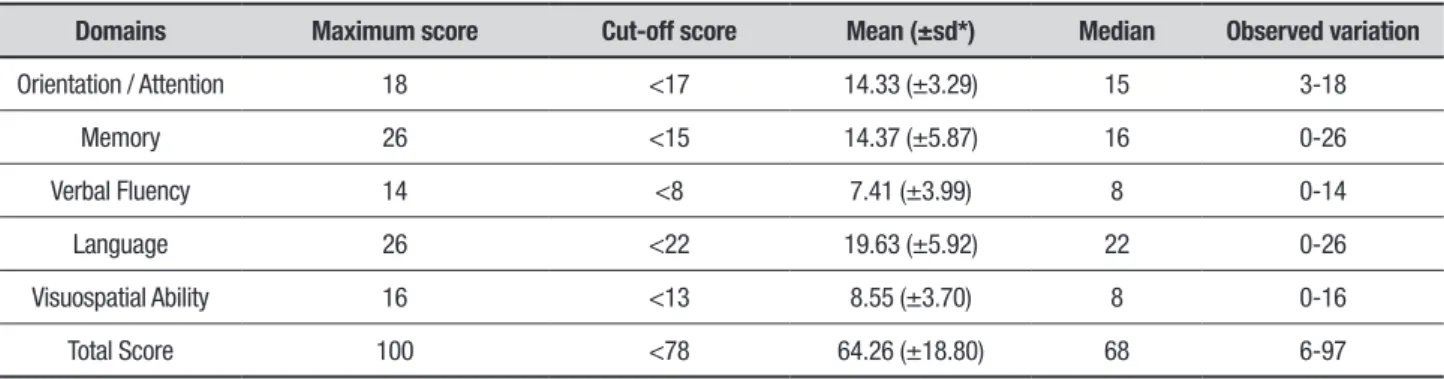
Regarding the cognitive performance of the CKD patients, mean score on the ACE-R was 64.26 (±18.80) points. he domain with the highest mean score was “Language” 19.63 (±5.92) while the domains exhibiting the greatest deicit compared to the cut-of scores were “Orientation/Attention” with a mean of 14.33 (±3.29) and “Visuospatial Ability” with a mean of 8.55 (±3.70) (Table 2). Regarding the cognitive evaluation, 76.76% (n=76) had lower-than-expected scores, suggesting the presence of some degree of deicit.
Concerning the relationship between cognition and sociodemographic and clinical variables, there was a moderate correlation between total ACE-R score and both age (r= –0.38, p≤0.001) and education (r=0.52, p≤0.001). he “Orientation/Attention” domain corre-lated positively with both years of education (r=0.40, p≤0.001) and hemodialysis time (r=0.26, p≤0.001). For the memory domain, there was a weak negative tion with age (r= –0.20, p=0.04) and a positive correla-tion with both years of educacorrela-tion (r=0.42, p≤0.001) and hemodialysis time (r=0.21, p=0.03) (Table 3)
DISCUSSION
he proile of the patients studied was similar to those found in similar studies involving participants with CKD on hemodialysis in Brazil and other countries.22,23 Previous studies suggest that the greater the severity of CKD, the greater the progression of cognitive decline.24 In a study of 1315 hemodialysis patients in the city of Singapore, decreasing estimated GFR and the presence of CKD in patients over 55 years of age were associ-ated with greater overall cognitive decline at four years of follow-up.25 Another investigation involving 7839 participants with CKD on hemodialysis failed to demon-strate that increased risk of cognitive impairment or dementia was associated with low estimated GFR.11
In a study investigating the association between level of physical activity and cognitive function on the MMSE of 102 patients with CKD on hemodialysis at the Clini-cas Hospital of the Medical School of Botucatu, 44.1% of participants presented mild to severe cognitive deicit and higher level of physical activity was associated with better cognitive function,26 similar indings to those of the present study.
Table 1. Distribution of patients with chronic renal disease according to sociodemographic and clinical characteristics.
Variable Mean (±sd*) Median Observed variation
Distribution
into categories n %
Gender – – – Male 67 67.67
Female 32 32.33
Age (years) 54.68 (±15.19) 57.00 22-85 22-31 6 6.06
32-41 15 15.15
42-51 19 19.19
52-61 23 23.23
62-71 19 19.19
72-81 15 15.15
82-91 2 2.03
Education (years) 7.37 (±4.18) 8.00 0-20 0-5 41 41.41
6-10 30 30.30
11-15 24 24.24
16-20 4 4.05
Hemodialysis time (months)
54.98 (±54.06) 41.00 6-264 6 Ⱶ 18 25 25.25
18 Ⱶ 30 17 17.17
30 Ⱶ 42 5 5.06
42 Ⱶ 54 11 11.11
54 Ⱶ 66 12 12.12
66 ├┤ 264 29 29.29
Health status – – – Excellent/Very Good/Good 56 56.56
Regular/Poor 40 40.40
Very poor 3 3.04
*standard deviation.
Table 2. Descriptive analysis of domains evaluated by ACE-R in patients with chronic kidney disease.
Domains Maximum score Cut-off score Mean (±sd*) Median Observed variation
Orientation / Attention 18 <17 14.33 (±3.29) 15 3-18
Memory 26 <15 14.37 (±5.87) 16 0-26
Verbal Fluency 14 <8 7.41 (±3.99) 8 0-14
Language 26 <22 19.63 (±5.92) 22 0-26
Visuospatial Ability 16 <13 8.55 (±3.70) 8 0-16
Total Score 100 <78 64.26 (±18.80) 68 6-97
or equal to that of the other participants.9,10 Similarly, an investigation that evaluated the cognitive ability of 75 chronic renal patients on hemodialysis using the MMSE found a mean score of 24.16 (±4.49) points, with a mini-mum of seven and maximini-mum of 30 points. In addition, the domain with the lowest score was “Attention” and “Calculation”,20 data corroborated by the present study.
In a recent study of 314 patients on dialysis at a Boston Dialysis Clinic, compared to the general popula-tion, patients had worse performance on tasks assessing executive function, associated with vascular disease and vascular risk factors.18 In the present study, hemodialy-sis subjects showed worse performance on tests evalu-ating logical reasoning, verbal learning, motor ability, verbal luency and visuospatial memory.
In an investigation of cognitive function, depression and quality of life of patients at diferent stages of CKD, in which 119 patients on hemodialysis, peritoneal dialy-sis and conservative treatment were evaluated using the MMSE as a tool for cognitive screening, the hemodi-alysis patients had worse performance on the cognitive evaluation tests when compared to the peritoneal dialy-sis and conservative treatment groups.9
A study evaluating the cognitive ability of individuals with CKD on hemodialysis using the MMSE as well as the relationship with the sociodemographic and clinical characteristics of these individuals, found a mean score of 24.16 points on the MMSE and no diference for causes of CKD.20 In the study, MMSE scores correlated
positively with years of education and income per capita and inversely with age.
CKD has been strongly correlated with vascular dementia in particular,7 relative to the general popu-lation, and the prevalence of cognitive impairment is higher in individuals with renal failure and even more signiicant in patients on dialysis. In qualitative terms, mild cognitive impairment is similar to dementia, although the impact of the condition on the perfor-mance of activities of daily living is not as signiicant as that caused by dementia.27
Dementia appears to complicate the management of patients with ESRD and has been correlated with poorer prognosis. Patients with dementia present deicits in at least two of the following cognitive functional areas: memory, executive function, attention, visuospatial abil-ities, speed of information processing, and language.27 Although evidence suggests that hemodialysis improves cognition in patients with CKD,5 a signiicant, yet under-estimated, portion of individuals on hemodialysis has moderate to severe cognitive impairment.27
Based on our results, it was concluded that there was a relationship between cognitive ability and age, years of education and hemodialysis time, where older individu-als with less education and more time on hemodialysis had lower cognitive performance.
he identiication of patients with cognitive disor-ders is important to improve quality of life and reduce the morbidity associated with this condition. he ideal Table 3. Spearman’s correlation coefficient between ACE-R and its domains and sociodemographic and clinical variables of patients with chronic kidney disease.
Age Years of education Hemodialysis time
ACE-R Spearman correlation –0.38 0.52 0.18
P ≤0.001 ≤0.001 0,07
Orientation and Attention Spearman correlation –0.13 0.40 0.26
P 0.17 ≤0.001 ≤0.001
Memory Spearman correlation –0.20 0.42 0.21
P 0.04 ≤0.001 0.03
Verbal Fluency Spearman correlation –0.07 0.31 0.04
P 0.48 ≤0.001 0.66
Language Spearman correlation –0.43 0.48 0.13
P ≤0.001 ≤0.001 0.19
Visuospatial Ability Spearman correlation –0.40 0.40 0.09
timing for the assessment of cognitive function and the instruments to be used for diagnostic screening depend on the clinical situation of the patient.
Finally, further research is needed to devise and eval-uate preventive strategies for these factors in chronic kidney disease patients in order to delay or avert cogni-tive deicit in these patients.
Author contribution. Gesualdo GD contributed with the execution of the research, planning, analysis and inter-pretation of the data, writing of the article and inal approval of the version to be published. Duarte JG,
Kusumota L, Zazzetta MS, Pavarini SCI and Say KG collaborated with the analysis and interpretation of the data, elaboration of the article, critical review relevant intellectual content, inal approval of the version to be published. Orlandi FS contributed with the project design, planning, analysis and interpretation of the data, elaboration of the article, relevant critical revision of the intellectual content, inal approval of the version to be published.
Support. he Coordenação de Aperfeiçoamento de Pessoal de Nível Superior (CAPES).
REFERENCES
1. Kurella Tamura M, Yaffe K. Dementia and cognitive impairment in ESRD:
diagnostic and therapeutic strategies. Kidney Int. 2011;79:14-22. 2. American Psychiatric Association. Task Force on DSM-IV. Diagnostic and
Statistical Manual of Mental Disorders: DSM-IV. 4. Vol. xxvii. American Psychiatric Association; Washington, DC: 1994:886.
3. Bugnicourt JM, Godefroy O, Chillon JM, Choukroun G, Massy ZA.
Cognitive disorders and dementia in CKD: the neglected kidney-brain axis. J Am Soc Nephrol. 2013;24:353-63.
4. McQuillan R, Jassal SV. Neuropsychiatric complications of chronic kidney disease. Nat Rev Nephrol. 2010;6:471-9.
5. Nasser Mel T, Shawki S, El Shahawy Y, Sany D. Assessment of
cogni-tive dysfunction in kidney disease. Saudi J Kidney Dis Transpl. 2012;23: 1208-14.
6. Cukor D, Coplan J, Brown C, Friedman S, Cromwell-Smith A, Peterson
RA, et al. Depression and anxiety in urban hemodialysis patients. Clin J Am Soc Nephrol. 2007;2:484-90.
7. Cheng KC, Chen YL, Lai SW, Mou CH, Tsai PY, Sung FC. Patients with
chronic kidney disease are at an elevated risk of dementia: a population-based cohort study in Taiwan. BMC Nephrol. 2012;13:129.
8. Gaxatte C, Daroux M, Bloch J, Puisieux F, Deramecourt V, Boulanger E.
Cognitive impairment and chronic kidney disease: which links? Nephrol Ther. 2011;7:10-7.
9. Condé SAL, Fernandes N, Santos FR, Chouab A, Mota MMEP, Bastos
MG. Declínio cognitivo, depressão e qualidade de vida em paci-entes de diferpaci-entes estágios da doença renal crônica. J Bras Nefrol. 2010;32:242-8.
10. Bossola M, Antocicco M, Di Stasio E, Ciciarelli C, Luciani G, TazzaL, et al. Mini Mental State Examination over time in chronic hemodialysis patients. J Psychosom Res. 2011;71:50-54.
11. Helmer C, Stengel B, Metzger M, Froissart M, Massy ZA, Tzourio C, et al. Chronic kidney disease, cognitive decline, and incident dementia: the 3C Study. Neurology 2011;77:2043-51.
12. Small DM, Coombes JS, Bennett N, Johnson DW, Gobe GC. Oxidative stress, anti-oxidant therapies and chronic kidney disease. Nephrology (Carlton) 2012;17:311-21.
13. Vianna HR, Soares CM, Tavares MS, Teixeira MM, Silva AC. Inflam-mation in chronic kidney disease: the role of cytokines. J Bras Nefrol. 2011;33:351-64.
14. Murray AM, Li SL, Collins AJ. Anemia as a risk factor for incident dementia in hemodialysis patients. J Am Soc Nephrol. 2002;13:628a 15. Singh NP, Sahni V, Wadhwa A, Garg S, Bajaj SK, Kohli R, et al. Effect of
improvement in anemia on electro neurophysiological markers (P300) of
cognitive dysfunction in chronic kidney disease. Hemodial Int. 2006;10: 267-73.
16. Troen AM, Scott TM, D’Anci KE, Moorthy D, Dobson B, Rogers G, et al.; FACT Study Investigators. Cognitive dysfunction and depression in adult kidney transplant recipients: baseline findings from the FAVORIT Ancillary Cognitive Trial (FACT). J Ren Nutr. 2012;22:268-76.
17. Recio-Mayoral A, Banerjee D, Streather C, Kaski JC. Endothelial dysfunction, inflammation and atherosclerosis in chronic kidney disease-a cross-sectiondisease-al study of predidisease-alysis, didisease-alysis disease-and kidney-trdisease-anspldisease-antdisease-ation patients. Atherosclerosis. 2011;216:446-51.
18. Sarnak MJ, Tighiouart H, Scott TM, Lou KV, Sorensen EP, Giang LM, et al. Frequency of and risk factors for poor in hemodialysis patients. Neurology. 2013;80:471-480.
19. Radić J, Ljutić D, Radić M, Kovaĉić V, Sain M, Curković KD. The possible impact of dialysis modality on cognitive function in chronic dialysis patients. Neth J Med. 2010;68:153-7.
20. Silva ST, Ribeiro RCL, Rosa COB, Cotta RMM. Capacidade cognitiva de indivíduos com doença renal crônica: relação com características sociodemográficas e clínicas. J Bras Nefrol. 2014;36(2):163-70. 21. Carvalho VA, Barbosa MT, Caramelli P. Brazilian version of
Adden-brooke’s Cognitive Examination in the diagnosis of mild Alzheimer Disease. Cog Behav Neurol. 2010;23(1):8-13.
22. Orlandi FS, Gesualdo GD. Avaliação do nível de fragilidade de idosos com doença renal crônica em tratamento hemodialítico. Acta Paul Enferm. 2014;27(1):29-34.
23. Silva GM, Gomes IC, Machado EL, Rocha FH, Andrade EIG, Acurcio FA, et al. Uma avaliação da satisfação de pacientes em hemodiálise crônica com o tratamento em serviços de diálise no Brasil. Physis. 2011;21(1):581-600.
24. Kurella MT, Chertow GM, Luan J, Yaffe K. Cognitive impair ment in
chronic kidney disease. J Am Geriatr Soc. 2004;52:1863-9. 25. Feng L, Yap KB, Yeoh LY, Ng TP. Kidney function and cognitive and
func-tional decline in elderly adults: findings from the Singapore longitudinal aging study. J Am Geriatr Soc. 2012;60:1208-14.
26. Stringueta-Belik F, Shiraishi FG, Silva VRO, Baretti P, Caramori JCT, Bôas PJFV et al. Maior nível de atividade física associada a melhor função cognitiva em renais crônicos em hemodiálise. J Bras Nefrol. 2012;34(4):378-86.