AR
TICLE
1 Pós-Graduação em Enfermagem, Centro de Ciências da Saúde, Universidade Estadual de Maringá. Av. Colombo 5790, Jardim Universitário. 87020-900 Maringá Paraná Brasil. aliny.lima.santos@ gmail.com
Microvascular complications in type 2 diabetes and associated
factors: a telephone survey of self-reported morbidity
Abstract The scope of this article is to estimate the prevalence of microvascular complications of self-reported type 2 diabetes and the association with sociodemographic characteristics, nutrition-al status, treatment given and time since diagno-sis. It involved a cross-sectional study with 318 people with type 2 diabetes living in Maringá in the State of Paraná. A telephone survey of self-re-ported morbidity was conducted in the months from January to June 2012. For the analysis de-scriptive statistics, univariate and multiple logis-tic regression were used. The prevalence of self-re-ported complications of diabetes was 53.8%, the most frequent being retinopathy (42.8%), followed by peripheral neuropathy (14.5%) and nephropathy (12.9%). The variables associated with the presence of complications were age (p = 0.008), overweight/obesity (p = 0.002), insulin (p < 0.001), insulin use linked to oral antidiabetic drug (p = 0.003) and time since diagnosis (p = 0.013). The prevalence of self-reported microvas-cular complications for people with diabetes was high, being more frequent among those of more advanced age, with inadequate nutritional status, a delay in diagnosis of the disease and those who were using insulin alone or in combination with oral antidiabetic agents.
Key words Diabetes mellitus, Complications of
diabetes, Cross-sectional studies, Prevalence
Aliny de Lima Santos 1
Hellen Pollyanna Mantelo Cecílio 1
Elen Ferraz Teston 1
Guilherme Oliveira de Arruda 1
Fabiana Magalhães Navarro Peternella 1
S
ant
Introduction
Type 2 diabetes mellitus (‘DM2’), like other chronic diseases, is considered to be a public health problem, not only in developed countries,
but also in developing countries1. It is a health
condition with high rates of occurrence of illness and mortality – currently affecting more than
20% of adults between the ages of 65 and 762.
It is estimated that by 2030, 366 million peo-ple in the world will have diabetes. In Brazil, the number of people suffering will increase from 4.5 million (in 2000) to 11.3 million, resulting in the country having, by that date, the eighth
high-est rate of occurrence of the disease worldwide3.
DM2 is the most common form of the disease – approximately 90% of cases – and its emergence has an intimate relationship with inappropriate lifestyle habits, which compromise the action and production of insulin, or cause a
predispo-sition to resistance to insulin4.
In initial stages, the illness can be oligosymp-tomatic or even asympoligosymp-tomatic. This can delay its diagnosis, increasing the risk of complications that can be acute – including hypoglycemia, di-abetic ketoacidosis and hyperosmolar coma – or chronic, such as micro- and microvascular
alter-ations5.
In relation to the chronic complications, there is the distinction between macrovascular and mi-crovascular. Examples of macrovascular compli-cations would include ischemic cardiomyopathy, cerebrovascular disease, and peripheral vascular disease, all frequently associated with the disease
and possibly leading to death5,6. Microvascular
complications are characterized by damage to vi-sion (retinopathy), kidney disease (nephropathy) and neurological lesions (neuropathy). These are the most common causes of irreversible blind-ness, chronic kidney disease and non-traumatic
leg amputations5,7,8.
The chronic complications of DM2 are some of the principal causes of illness and mortality, and a source of growing concern for health
au-thorities in developed countries5. It is thus
im-portant for health professionals to know the factors that predispose a person to occurrence of chronic microvascular complications. Among these factors, the literature highlights the impor-tance of (i) the type of treatment, (ii) the time elapsed since discovery of the diagnosis, and (iii)
the patient’s nutritional state9. Aware of the
so-cial-demographic characteristics commonly as-sociated with the appearance of complications is also important for choosing a direction for
im-plementation of actions with patients suffering from diabetes.
On this subject, Brazilian studies on the oc-currence of microvascular complications of dia-betes, and the social-demographic factors associ-ated with those complications, have been made
in various capital cities of Brazil’s states5,8,10,11, and
they have discovered differences in and relating to the complications affecting the population concerned. However, there is little information available about the percentage of occurrence, and factors associated with the microvascular complications of DM2, in the state of Paraná, in-dicating a need for investigation on the subject.
Telephone surveys can be an effective strat-egy for monitoring and control of risk factors for complications. Studies that use this strategy can serve to indicate percentage of occurrence of these risk factors, and also of the complications that are present in people with DM2. This type of contact also has the advantage of being via-ble in financial and logistical terms, and can have a positive influence on the self-care of a person with diabetes, especially in the ambit of primary
healthcare12. However, studies using this
meth-od are still rare in Brazil, and as far as is known non-existent in the state of Paraná.
It is considered that production of informa-tion on percentage of occurrence, and the factors associated with microvascular complications, in general and in specific regions, can broaden knowledge on the health profile of people with DM2, and can favor formulation of feasible pol-icies and strategies for prevention and treatment of the condition. With this in mind, the aim of this study has been to determine the levels of occurrence of self-reported microvascular com-plications from Type 2 diabetes mellitus, and as-certain the associations with social-demograph-ic characteristsocial-demograph-ics, nutritional status, treatment used, and time from diagnosis.
Method
This is a cross-sectional study carried out by telephone interview surveys, with people with diabetes registered in the Diabetics Association
of Maringá and Region (Associação dos
aúd
e C
ole
tiv
a,
20(3):761-770,
2015
individuals. An estimate was adopted with a con-fidence interval of 95% (IC95%), occurrence of the event of interest of 50% and maximum error of five percentage points in the level of occur-rence of any risk factor, with 10% added to the result for any losses. This resulted in a sample of 318 individuals.
These individuals were selected randomly from a list of active residential telephone lines, supplied by ADIM. Three attempts were made, on different days and at different times of day, aiming to avoid exclusion of a possible partici-pant on the first try due to his/her not being at home at the time of the call or the line being busy. If it was not possible to hold the interview, the researcher proceeded to the next telephone number in the list, up to three substitutions be-ing allowed.
The telephone interviews were held in Jan-uary through June 2012, by a team compris-ing nurses and one physiotherapist, previously trained. Their average duration was 20 minutes, and included presentation of: (i) the investigator, (ii) the objects of the study, (iii) the method (ap-proach by telephone) and (iv) verbal consent. Af-ter acceptance, the questions and the related reply alternatives were read, and answers recorded on a printed copy of the data collection instrument. Questions from participants about control of the disease were answered by the interviewers at an appropriate moment – in practice, only after the end of the interview.
For investigation of the chosen variables, a form was prepared containing questions from two instruments: (1) the questionnaire from the Vigitel survey – the ‘Program for Vigilance of Risk Factors and Protection for Chronic
Illness-es by Telephone Enquiry’ – of 201113; and (2) A
questionnaire to determine the factors associated with clinical and metabolic control of diabetes, comprising questions that aimed to obtain the information relating to social-demographic, anthropometric and clinical characteristics, and characteristics of the illness (time of diagnosis and presence/absence of complications) and of treatment.
The data was analyzed by the following cate-gories: social-demographic variables (age, in the ranges 18 to 39, 40 to 59, 60 to 79, and 80 or over; marital status, categorized as with or without a partner; and level of schooling – categorized into illiterate, primary, secondary and higher educa-tion); nutritional status – self-reported using the Body Mass Index (qualified as appropriate when eutrophic, and inappropriate when overweight
or obese – there were no participants classified as underweight); type of drug treatment (use of insulin, use of oral antidiabetics, or both); time from diagnosis, in years, as from the age (self-re-ported) at which the patient received the diagno-sis of diabetes – categorized as from 0 to 5 years, 6 to 10, 11 to 20 and over 20; and self-reported complications of diabetes (presence or not of kidney problems, difficulty in vision, and foot lesions that are slow to heal).
Defining complications, participants were asked to indicate complications for which a med-ical diagnosis which had been made that resulted from the diabetes.
For analysis, the data was first entered on Microsoft Office Excel 2010 spreadsheets, and subsequently transferred to the statistical
pro-gram IBM SPSS®, version 20, for compilation of
descriptive data, and association tests between the independent variables and the variables of in-terest (microvascular complications arising from diabetes, in general, and specifically: nephrop-athy, retinopathy and/or peripheral neuropa-thy) through univariate analysis (Pearson’s chi-squared test). Subsequently, the associations were tested and all the variables that showed a value of p < 0.20, by the step wise method, were inserted in a multiple logistic regression model. The Odds Ratio (OR) was used as a measure of association, with confidence interval of 95%, significance lev-el established when p < 0.05 for the tests carried out, and level of fit for the model verified using the Hosmer and Lemeshow test.
In relation to the ethical precepts of
Resolu-tion 196/9614, the Informed Consent Form was
read to the participants of the study by the in-vestigators, and the interviews were started only after verbal consent. The project was approved by the Permanent Committee for Ethics in Re-search on Human Beings of the State University of Maringá.
Results
The 318 interviewees had average age of 63.1 years ± 12.2 (minimum 22, maximum 89); more than half were female (54.1%), and had complet-ed primary complet-education (52.8%), and the majority had a partner (73.6%). In the nutritional state variable, the values were balanced: about half the
individuals (50.9%) had inappropriate BMI. All
S
ant
combined treatment. The average time from
di-agnosis of the illness was 13.9 years, ± 8.8
(max-imum 50 years, min(max-imum 1 year); and 37.1% re-ceived the diagnosis between 10 and 20 years ago. The occurrence of self-reported complications from diabetes was 53.8%, in the following order of frequency: retinopathy (42.8%), peripheral neuropathy (14.5%) and nephropathy (12.9%).
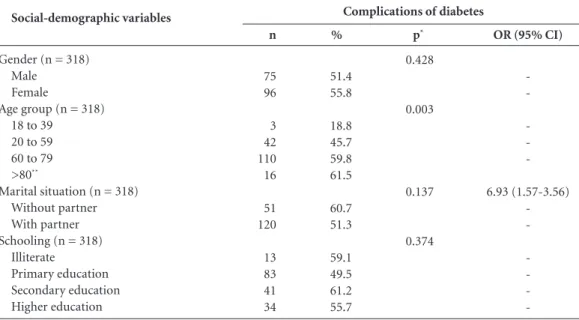
Univariate analysis of the social/demograph-ic variables indsocial/demograph-icated association of the presence of complications only with age group: people aged 80 or over were 6.93 (IC: 1.57-30.56) times more likely to have complications than the next age group (Table 1).
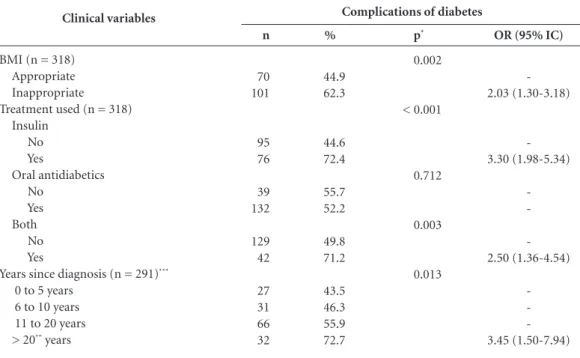
In relation to clinical variables, univariate analysis indicated association with (i) BMI, (ii) use of insulin, (iii) use of insulin associated with oral antidiabetics, and (iv) time of diagnosis. Peo-ple with inappropriate BMI (overweight/obese) had twice the probability of having complica-tions from diabetes than those with appropriate BMI. Similarly, individuals who used insulin, in isolation or in association with oral antidiabetics, more frequently reported complications from di-abetes. And individuals diagnosed more than 20 years ago had a higher than chance proportion of reporting complications (Table 2).
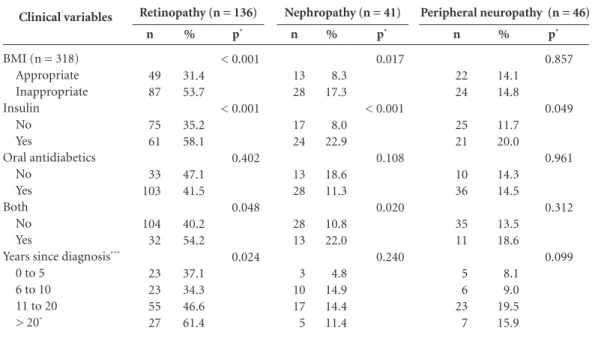
With regard to peripheral vascular compli-cations, reported as peripheral neuropathy, an association was found only with the treatment used: Users of insulin had more than twice the chance (OR = 1.88; IC95% = 1.00-3.52) of re-porting a complication (Table 2).
In relation to self-reported retinopathy, this factor showed association with the age range variable, intensifying with increasing age; the age range from 60 to 79 gave OR = 1.96, and IC95% = 1.21–3.28; and the range 80 or over gave OR = 2.54, and IC95% = 1.06–6.07. (Table 3).
There was strong association with self-re-ported retinopathy for inappropriate BMI (OR = 2.53; IC95% = 1.60-4.00); the treatment used, represented by the use of insulin (OR = 2.60; IC95% = 1.59-4.09); and insulin associated with oral antidiabetics (OR = 1.80; IC95% = 1.00-3.11).
Finally, a longer time since diagnosis was associated with a greater chance of an individ-ual reporting retinopathy (OR = 2.52; IC95% = 1.21-5.97) – it was more frequently reported by individuals diagnosed more than 20 years ago.
Vascular complications did not have associ-ation with demographic variables. The presence of neuropathy was associated with the marital situation “without partner” (OR = 2.00; IC95% = 1.00-1.87); inappropriate BMI (OR = 2.29; IC95% = 1.14-4.62); use of insulin in isolation (OR = 3.32; IC95% = 1.74-6.69); and insulin associated with oral antidiabetics (OR = 2.30; IC95% = 1.14-4.76). A highlight association was that individuals treated with insulin had three times the chance of reporting kidney complica-tions.
For peripheral vascular complications, re-ported as peripheral neuropathy, an association was found only with the type of treatment used:
Social-demographic variables
Gender (n = 318) Male
Female
Age group (n = 318) 18 to 39
20 to 59 60 to 79 >80**
Marital situation (n = 318) Without partner With partner Schooling (n = 318)
Illiterate
Primary education Secondary education Higher education
Table 1. Univariate analysis of the presence of complications, by social-demographic variable, Maringá, 2012.
%
51.4 55.8
18.8 45.7 59.8 61.5
60.7 51.3
59.1 49.5 61.2 55.7
n
75 96
3 42 110 16
51 120
13 83 41 34
p*
0.428
0.003
0.137
0.374
OR (95% CI)
-6.93 (1.57-3.56)
-* Pearson chi-squared test. ** p<0.05.
aúd e C ole tiv a, 20(3):761-770, 2015
People who used insulin in isolation were almost twice as likely (OR = 1.88; IC95% = 1.00-3.52) to report this type of complication (Table 4).
Table 5 shows the variables that continued to be associated with the general presence of
com-plications and the presence of retinopathy and nephropathy, in the multiple logistic regression, as well as the related adjustment variables.
A higher proportion of complications was found among individuals who used insulin, who
Clinical variables
BMI (n = 318) Appropriate Inappropriate Treatment used (n = 318)
Insulin No Yes Oral antidiabetics No Yes Both No Yes
Years since diagnosis (n = 291)***
0 to 5 years 6 to 10 years 11 to 20 years > 20** years
Table 2. Univariate analysis of the presence of complications by clinical variable, Maringá, 2012.
% 44.9 62.3 44.6 72.4 55.7 52.2 49.8 71.2 43.5 46.3 55.9 72.7 n 70 101 95 76 39 132 129 42 27 31 66 32 p* 0.002 < 0.001 0.712 0.003 0.013
OR (95% IC)
-2.03 (1.30-3.18) -3.30 (1.98-5.34) -2.50 (1.36-4.54) -3.45 (1.50-7.94)
* Chi-squared of Pearson; ** p<0.05; *** Did not remember/did not know: 27 respondents.
Complications of diabetes
Variables
Gender Male Female Age group
18 to 39 20 to 59 60 to 79**
>80** Marital situation Without partner With partner Schooling Illiterate Primary Secondary Higher education
Table 3. Frequency of self-reported retinopathy, nephropathy and neuropathy, by social-demographic variable, Maringá, 2012.
* Significance according to Pearson chi-squared test. ** p<0.05. % 38.4 46.5 6.2 35.9 47.8 53.8 42.3 44.0 45.5 36.9 47.8 52.5 n 56 80 1 33 88 14 37 99 10 62 32 32 p* 0.143 0.003 0.782 0.142
Retinopathy (n = 136)
% 11.0 14.5 12.5 12.0 13.6 11.5 19.0 10.7 22.7 10.7 16.4 11.5 n 16 25 2 11 25 3 16 25 5 18 11 7 p 0.343 0.978 0.050 0.327
Nephropathy (n = 41)
% 14.4 14.5 -11.1 16.3 15.4 13.1 15.0 18.2 18.5 10.4 6.6 n 21 25 -12 30 4 11 35 4 31 7 4 p 0.970 0.472 0.677 0.095
S
ant
had inappropriate BMI and who were in the age range 60 to 79; and these variables were not inde-pendent of: combined treatment of insulin with oral antidiabetics; nor of time from diagnosis; nor of marital situation.
Reporting of retinopathy was most frequent in individuals with inappropriate BMI and those between age 60 and 79, or 80 and above. Howev-er, these associations were not independent from
treatment with (a) insulin and (b) time since di-agnosis. Higher occurrence of nephropathy was found among individuals who used insulin, had inappropriate BMI and were without a partner, though we consider that the association of these variables was not independent from combined treatment with insulin and oral antidiabetics.
Finally, no associations with peripheral neu-ropathy were found in the multiple analysis.
Clinical variables
BMI (n = 318) Appropriate Inappropriate Insulin
No Yes
Oral antidiabetics No
Yes Both No Yes
Years since diagnosis***
0 to 5 6 to 10 11 to 20 > 20*
Table 4. Frequency of retinopathy, nephropathy and peripheral neuropathy by clinical variable, Maringá, 2012.
* Significance according to Person chi-squared test. ** p<0.05. *** Retinopathy (n = 128), nephropathy (n = 35), peripheral neuropathy (n = 41).
%
31.4 53.7
35.2 58.1
47.1 41.5
40.2 54.2
37.1 34.3 46.6 61.4
n
49 87
75 61
33 103
104 32
23 23 55 27
p*
< 0.001
< 0.001
0.402
0.048
0.024
Retinopathy (n = 136)
%
8.3 17.3
8.0 22.9
18.6 11.3
10.8 22.0
4.8 14.9 14.4 11.4
n
13 28
17 24
13 28
28 13
3 10 17 5
p*
0.017
< 0.001
0.108
0.020
0.240
Nephropathy (n = 41)
%
14.1 14.8
11.7 20.0
14.3 14.5
13.5 18.6
8.1 9.0 19.5 15.9
n
22 24
25 21
10 36
35 11
5 6 23 7
p*
0.857
0.049
0.961
0.312
0.099
Peripheral neuropathy (n = 46)
Independent variables
Presence of complications* Insulin (yes)
BMI (inappropriate) Age range (60 to 79) Retinopathy**
BMI (inappropriate) Age range (60 to 79) Age range (80 and over) Nephropathy***
Insulin (Yes) BMI (inappropriate)
Marital situation (without partner)
Table 5. Factors associated with complications of diabetes (presence, retinopathy and nephropathy), according to multiple logistic regression models: people with diabetes answering survey by telephone, Maringá, Parana, Brazil, 2013.
OR (95% CI)
2.64 (1.20-5.78) 2.30 (1.36-3.86) 7.00 (1.39-35.28)
2.82 (1.68-4.73) 9.97 (1.18-83.95) 12.42 (1.26-121.85)
3.65 (1.54-8.63) 2.50 (1.19-5.23) 2.28 (1.10-4.73)
Value p
0.016 0.002 0.018
< 0.001 0.034 0.031
0.003 0.015 0.026
* Model adjusted for the variables ‘Treatment with insulin and oral and oral antidiabetics’, ‘Time since diagnosis’ and ‘Marital situation’. ** Model adjusted for the variables ‘use of insulin’ and ‘time since diagnosis’. *** Model adjusted for the variable ‘treatment with insulin and oral antidiabetics’.
aúd
e C
ole
tiv
a,
20(3):761-770,
2015
Discussion
The chronic complications of DM2 have become increasingly common as more people, gradually,
have developed this metabolic disorder15. The
oc-currence of microvascular complications found in this study is high (53.8%), compared to that identified in a prospective study (57 months) made with 471 patients with diabetes and age and gender similar to those of this present study, in which it was found that 41.6% developed
microvascular complications16. The higher
oc-currence found in this present study, thus, may be related to the fact that the individuals of the other study were monitored through an outpa-tient facility, whereas in this study, (1) a peculiar method of data collection (telephone interview) having been adopted, which does not guarantee precision of data (since the data received depends on memory, or may be the result of misunder-standing of information received from health professionals, or might be affected by a degree of willingness to reveal complete information), and (2) the respondents came from a registry of an Association, without any information relating to the monitoring of their health.
Looking at the complications in isolation, it stands out that the occurrence found for diabetic retinopathy (42.8%) was higher than that found in a study carried out on 168 patients with DM2 in the western population of India, which showed
occurrence of 33.9%16; on the other hand it was
lower than the level found in a study carried out in Porto Alegre, Brazil, with people with average age of 53 (48.6%) – that is to say, younger than
those interviewed in this present study17. The
as-sociation identified between retinopathy and time since diagnosis corroborates the finding of the study carried out in India, in which retinopathy
was found to arise 11 years after diagnosis18. The
same is true of people with Type 1 diabetes mel-litus – a study in the United Kingdom reported that after 11 years from diagnosis the occurrence of some degree of retinopathy is around 66.6%,
rising to approximately 100% after 20 years19.
Indeed, time of progression of DM2 can de-termine a greater risk for development of micro-vascular complications in general. A study of a retrospective cohort made in Australia, for exam-ple, compared the repercussions of early start of diabetes and found that Type 2 is the phenotype that represents greater concern, due to the asso-ciation with micro- and macrovascular compli-cations, cardiovascular illnesses and early death
from cardiovascular causes20.
In the present study, diabetic nephropathy was in third place in terms of frequency of oc-currence, which differed from the study made
in Porto Alegre10 where it was the second most
frequent, representing 34.5% of microvascu-lar complications. However, a study made with adults attended in the endocrinology outpatients area of a General Hospital of the Brazilian state
of Ceará5 found the most frequent complication
to be peripheral neuropathy (41.1%), followed by nephropathy (28.2%) and retinopathy (16.4%). The differences found may be attributed to the way in which the data were collected, since in the studies referred to, the information was obtained from medical records, whereas self-reported in-formation was used in this present study.
Also, it is important to take into account that cultural differences can also be reflected in the oc-currence of complications found in different lo-cations. For example, a survey made in four large Chinese cities with 1,524 adult patients with
dia-betes found complications in 34.7%21, in the same
order as in this present study, but with different values: 14.8% for retinopathy, 10.7% for periph-eral neuropathy and 0.8% for nephropathy.
Retinopathy, also, was the complication most reported in two studies made in the municipal-ities of Campinas and Botucatu, cmunicipal-ities in the state of São Paulo, Brazil, in which retinopathy was found in 29%, and 40%, of the cases of
di-abetes, respectively12. It should be pointed out
that although nephropathy is the least frequent complication, it is one of the principal causes of increases of dialysis and mortality in people with
DM213,22, representing, in many countries, one of
the principal causes of the final stage of kidney
disease23.
Thus, considering the complexity of diabetic nephropathy, its prevention and treatment re-quire multifactorial intervention, involving the control of high blood pressure, hypoglycemia, dyslipidemia, use of tobacco, nephrotoxins, and the use of nephroprotection agents and changes in lifestyle, contributing to retarding the progress of a kidney lesion and reducing the risk of car-diovascular disease and/or death from
cardiovas-cular events22.
From the clinical point of view the diagnosis of DM2, by itself, already confers an increase in the risk of developing circulatory events, leading, in some cases, to peripheral neuropathy, which is the most important factor related to the devel-opment of ulcers. It is already present in 8% of patients at the time of diagnosis, in 15% after 10
compli-S
ant
cation that constitutes the cause of between 50% and 70% of non-traumatic amputations, and
50% of hospital admissions for diabetes24.
The association that was found between the presence of complications and the higher age groups corroborates findings of
popula-tion-based surveys8,25. This association is certainly
related to the greater occurrence of the pathology in older individuals, according to a study made in Ceará, which found predominance of the disease
in people over the age of 6026. Also,
physiopatho-logical processes inherent in aging such as, for example, atherosclerosis, hyperopia, immunolog-ical alterations, may compromise the capacity for scar healing, which can increase the occurrence of
complications27. Older people, thus, have
proba-bly been aware of the diagnosis of the disease for a longer time and, consequently, are more exposed to its complications, since, although the factor ‘time from diagnosis’ was not shown by this study to be associated with complications, it participat-ed in the multiple models found in the study as an adjustment factor, indicating the relationship of dependency with the associated variables.
In the present study, the only risk factor that was modifiable was the altered body mass index. Recent WHO data show that being overweight, and obese, are among the five principal risk fac-tors for DM2, with an important impact on the global occurrence of the disease. Thus, frequent-ly the reduction and control of weight is one of the principal strategies for non-pharmacological
treatment of the illness28. Thus, loss of between
5% and 10% of body weight is already able to reduce glycemic levels, retarding the progression of the disease, reducing the risk of complications and even leading to suspension of
pharmacolog-ical treatment12. In view of this, it is necessary to
emphasize the need for multi-professional in-terventions that aim for diet re-education, dai-ly practice of physical activity, prevention with a view to control of weight, and acquisition of
healthy life habits29.
In relation to pharmacological treatment, a significant association was found between the use of insulin and the occurrence of microvas-cular complications of DM2, and it was also the only variable associated with neuropathy. This association needs to be considered, since the use of insulin has been related to better glyce-mic control which, in turn, has been associated with lower frequency of complication from the disease, but the need for introduction of exog-enous insulin constitutes an indication that the organism is not succeeding in maintaining
gly-cemic control, resulting in a constant increase in
intracellular glucose30.
Continuation of this lack of glycemic con-trol leads to oxidative stress and endothelial dysfunction – events that are precursors of tis-sue damage, and are determinant for the devel-opment of micro and macrovascular complica-tions. Both are common denominators through which hyperglycemia, arterial hypertension and dyslipidemia act in the generation of these com-plications. Thus, the persistence of these alter-ations can be responsible for the mechanism of metabolic memory, related to the emergence of complications, even in individuals who use
exog-enous insulin30.
Also, it needs to be noted that insulin-de-pendent individuals are more predisposed to the occurrence of microalbuminuria, which precedes
the emergence of diabetic nephropathy31. It can
also be one of the markers for endothelial dys-function, characteristic of the presence of oxida-tive stress and future tissue lesion. It also needs to be considered that individuals can use insulin improperly, that is to say, without following the medical prescription, or even use it to
compen-sate for sporadic dietary extravagances32.
In relation to time since diagnosis, studies have shown its influence on the occurrence of
complications associated with diabetes5,11, as also
identified in this study. Taking only retinopathy as an example, it is estimated that after 15 years from diagnosis of DM2, 80% of patients have
some degree of lesion in the retina33, and after 20
years it can be present in 60% of cases34.
It can also be noted that, often, people neglect to take the proper care of the disease, especially those who tend not to recognize its seriousness. This can happen due to lack of motivation, due to disbelief in the seriousness of the disease, or in the benefits that certain actions can provide for its control. Also, the patient’s motivation and attitudes as to the treatment are not stable, and much less, indeed, crystalized, but subject to a pre-disposition toward adoption of self-treat-ment actions, influenced by cognitive, motiva-tional and emomotiva-tional components – and they may, also, be stimulated by health
profession-als32,35. Periods of greater or lesser adherence to
the care are part of the process of confronting the illness. In view of this, studies have empha-sized the need for health professionals constantly to evaluate the risk for complications and their presence and, through educational and motiva-tional activities, to improve self-treatment and
aúd
e C
ole
tiv
a,
20(3):761-770,
2015
As an overall conclusion, the risk factors for complications identified in this study were: age above 80; time since diagnosis of the disease; use of insulin; and altered body mass index – the first three not being modifiable, and only the last being subject to modification as a result of the activity of health professionals. Health pro-fessionals, in turn, need to find means for their activity to result in effective changes in lifestyle, and, more strongly, in the control and reduction of weight in people with DM2.
The offer of educational interventions by the health services, and the participation of people with diabetes in groups that deal with informa-tion about the disease, types of conduct for loss of body weight, and healthy life habits, can favor the awareness and development of skills for
dai-ly self-care that the disease demands12. Thus, to
improve the care for people with DM2, it is es-sential to combine the actions of prevention with those of control and treatment of the
complica-tions, with a view to diminishing the disease, and mortality resulting from it, since this group has three times higher mortality than the population
in general36.
It can be emphasized that one of the meth-odological limitations of this present study is the use of self-reported data, and, above all, the fact that it was carried out on individuals registered in a single association of people with diabetes, which makes it impossible to generalize from the data, or to make possible inferences for other scenarios, such as, for example, the public health services.
However, in view of its economic and tech-nical feasibility, use of telephone interviews is recommended, not only as a method for data collection in surveys, but also as a strategy for monitoring the health conditions of individuals with DM2 in the public health services, especially those who have risk of complications, or, indeed, when these complications already exist.
Contributors
AL Santos, HPM Cecílio, EF Teston, GO Arruda, FMN Paternela and SS Marcon contributed to the conception and development of the survey, analysis and interpretation of the data, signifi-cant critical review of the intellectual content, and approval of the final version to be published.
References
Karino MA, Pace AE. Risco para complicações em pés de trabalhadores portadores de diabetes mellitus. Cien
Cuid Saude 2012; 11(Supl.):183-190.
Oliveira PPl. Análise comparativa do risco de quedas entre pacientes com e sem diabetes melittus tipo 2. Rev
Assoc Med Bras 2012; 58(2):234-239.
Freitas LRS, Garcia LP. Evolution of prevalence of dia-betes and associated hypertension in Brazil: analysis of National Household Sample Survey, 1998, 2003 and 2008. Epidemiol Serv Saúde 2012; 21(1):7-19.
Mazzini MCR, Blumer MG, HoehneEL, Guimarães KRLSLQ, Caramelli B, Fornari L, Malheiros SVP. Ras-treamento do risco de desenvolvimento de diabetes mellitusem pais de estudantes de uma escola privada na cidade de Jundiaí, São Paulo. Rev Assoc Med Bras 2013; 59(2):136-142.
Queiroz PC, Aguiar DC, Pinheiro RP, Moraes CC, Pi-mentel IRS, Ferraz CLH, Ferraz TMBL. Prevalência das complicações micro e macrovasculares e de seus fatores de risco em pacientes com diabetes mellitus e síndrome metabólica. Rev Soc Bras Clin Med 2011; 9(4):254-258. 1.
2.
3.
4.
S
ant
Cenci DR, Silva MD, Gomes EB, Pinheiro HA. Análi-se do equilíbrio em pacientes diabéticos por meio do sistema F-Scan e da Escala de Equilíbrio de Berg. Fisiot Mov 2013; 26(1):55-61.
Oliveira AF, Valente JG, Leite IC, Schramm JMA, Aze-vedo AR, Gadelha AMJ. Global Burden oh disease attributable to diabetes mellitus in Brazil. Cad Saude
Publica 2009; 25(6):1234-1244.
Santos JC, Moreira TMM. Fatores de risco e compli-cações em hipertensos/diabéticos de uma regional sanitária do nordeste brasileiro. Rev Esc Enferm 2012, 46(5):1125-1132.
Caiafa JS, Castro AA, Fidelis C, Santos VP, Silva ES, Si-trângulo CJ. Atenção integral ao portador de Pé Diabé-tico. J Vasc Bras 2011; 10(4):11-32.
Rodrigues TC, Pecis M, Canani LH, Schreiner L, Kra-mer CK, Biavatti K, Macedo B, Esteves JF, Azevedo MJ. Caracterização de pacientes com diabetes mellitus tipo 1 do sul do Brasil: complicações crônicas e fatores asso-ciados. Rev Assoc Med Bras 2010; 56(1):67-73. Rodrigues DF, Brito GEG, Sousa NM, Rufino TMS, Carvalho TD. Prevalência de Fatores de Risco e Com-plicações do Diabetes Mellitus Tipo 2 em Usuários de uma Unidade de Saúde da Família. Rev Bras Cien Saúde 2011; 15(3):277-228.
Torres HC, Reis IA, Roque C, Faria P. Monitoramento telefônico como estratégia educativa para o autocui-dado das pessoas com diabetes na Atenção Primária.
Cienc y Enferm 2013, 19(1):95-105.
Brasil. Ministério da Saúde (MS). Secretaria de Vigilân-cia em Saúde. Secretaria de Gestão Estratégica e Parti-cipativa. Vigitel Brasil 2011: vigilância de fatores de risco
e proteção para doenças crônicas por inquérito telefônico.
Brasília: MS; 2012.
Brasil. Ministério da Saúde (MS). Conselho Nacional de Saúde. Resolução nº 196 de 10 de outubro de 1996. Diretrizes e Normas Regulamentadoras de Pesquisas Envolvendo Seres Humanos. Diário Oficial da União 1996; 16 out.
Francisco PMSB, Belon AP, Barros MBA, Carandina L, Alves MCGP, Goldbaum M, César CLG. Diabetes auto-referido em idosos: prevalência, fatores associa-dos e práticas de controle. Cad Saude Publica 2012; 26(1):175-184.
Cardoso CR, Salles GF. Predictors of development and progression of microvascular complications in a cohort of Brazilian type 2 diabetic patients. J Diabetes
Compli-cations 2008; 22(3):164-170.
Mielczarski RG, Costa JSD, Olinto MTA. Epidemiolo-gia e organização de serviços de saúde: diabetes melli-tus numa comunidade de Porto Alegre. Cien Saude
Colet 2012; 17(1):71-78.
Ramavat PR, Ramavat MR, Ghugare BW, Vaishnav RG, Joshi MU. Prevalence of Diabetic Retinopathy in Wes-tern Indian Type 2 Diabetic Population: A Hospital - based Cross - Sectional Study. J Clin Diagn Res 2013; 7(7):1387-1390.
Bryden KS, Dunger DB, Mayou RA, Peveler RC, Neil HA. Poor Prognosis of young adults with type 1 Diabe-tes. Diabetes Care 2003; 26(4):1052-1057.
Constantino MI. Long-term complications and morta-lity in Young-onset diabetes: type 2 diabetes is more he-zardous and lethal than type 1 diabetes. Diabetes Care 2013. 36(12):3863-3869.
Liu Z, Fu C, Wang W, Xu P. Prevalence of chronic com-plications of type 2 diabetes mellitus in outpatients - a cross-sectional hospital based survey in urban China.
Health and Quality of Life Outcomes 2010; 8:62.
6.
7.
8.
9.
10.
11.
12.
13.
14.
15.
16.
17.
18.
19.
20.
21.
Viana MR, Rodriguez TT. Complicações cardiovascu-lares e renais no diabetes mellitus. Rev Cien Med Biol 2011; 13(3):290-296.
Wolf G, Busch M, Müller N, Müller UA. Association between socioeconomic status and renal function in a population of German patients with diabetic nephro-pathy treated at a tertiary centre. Nephrol Dial
Trans-plant 2011; 26(12):4017-4023.
Araujo MM, Alencar AMPG. Pés de risco para o desen-volvimento de ulcerações e amputações em diabéticos.
Rev Rene 2009; 10(2):19-28.
Demakakos P, Hamer M, Stamatakis E, Steptoe A. Low -intensity physical activity is associated with reduced risk of incident type 2 diabetes in older adults: evidence from the English Longitudinal Study of Ageing.
Diabe-tologia 2010; 53(9):1877-1885.
Araújo MFM, Gonçalves TC, Damasceno MMC, Cae-tano JA, Aderência de diabéticos ao tratamento medi-camentoso com hipoglicemiantes orais. Rev Anna Nery 2010; 14(2):361-367.
Meireles AE, Pereira LMS, Oliveira TG, Christofoletti G, Fonseca Al. Alterações neurológicas fisiológicas ao envelhecimento afetam o sistema mantenedor do equi-líbrio. Rev Neurocienc 2010; 18(1):103-108.
World Health Organization (WHO). Global health risks: mortality and burden of disease attributable to
se-lected major risks. Genebra: WHO; 2009.
Azevedo ECC, Dias FMRS, Diniz AS, Cabaral PC. Con-sumo alimentar de risco e proteção para as doenças crônicas não transmissíveis e sua associação com a gordura corporal: um estudo com funcionários da área de saúde de uma universidade pública de Recife (PE), Brasil. Cien Saude Colet 2014; 19(5):1613-1622. Oliveira JEP, Vencio S, organizadores. Diretrizes da
So-ciedade Brasileira de Diabetes: 2013-2014. São Paulo:
AC Farmacêutica; 2014.
Al-Agha AE, Ocheltree A, Hakeem A. Occurrence of microalbuminuria among children and adolescents with insulin-dependent diabetes mellitus. Saudi J
Kid-ney Dis Transpl 2013; 24(6):1180-1188.
Santos AL, Marcon SS. How people with diabetes evaluate participation of their family in their health care?Invest Educ Enferm 2014; 32(2):260-269. Dias AFG, Vieira MF, Rezende MP, Oshima A, Muller MEW, Santos MEX, Serracarbassa PD. Perfil epidemio-lógico e nível de conhecimento de pacientes diabéticos sobre diabetes e retinopatia diabética. Arq Bras Oftal-mol 2010; 73(5):414-418.
Carpena MP, Rados DV, Sortica DA, Souza BM, Reis AF, Canani LH, Crispim D. Genetics of diabetic nephropa-thy. Arq Bras Endocrinol Metab 2010; 54(3):253-261. Rodrigues FFL, Santos MA, Teixeira CRS, Gonela JT, Zanetti ML. Relationship between knowledge, attitude, education and duration of disease in individuals with diabetes mellitus. Acta Paul Enferm 2012; 25(2):284-290.
Milioli R, Vargas MAO, Leal SMS, Montiel AA. Qua-lidade de vida em pacientes submetidos a amputação.
Rev Enferm UFSM 2012; 2(2):311-319.
Article submitted on 20/08/2014 Approved on 24/08/2014
Final version submitted on 26/08/2014 22.
23.
24.
25.
26.
27.
28.
29.
30.
31.
32.
33.
34.
35.