Analysis of a case series of behavioral
variant frontotemporal dementia
Emphasis on diagnostic delay
Henrique Cerqueira Guimarães1, Thiago Cardoso Vale1, Victor Pimentel2, Nayara Carvalho de Sá2, Rogério Gomes Beato2, Paulo Caramelli3
ABSTRACT. Introduction: Despite many advances in the characterization of the behavioral variant of frontotemporal dementia (bvFTD), the diagnosis of this syndrome poses a significant challenge, while delays or diagnostic mistakes may impact the proper clinical management of these patients. Objective: To describe the clinical profile at first evaluation of a sample of patients with bvFTD from a specialized outpatient neurological unit, with emphasis on the analysis of the delay between the onset of symptoms and diagnosis. Methods: We selected 31 patients that fulfilled international consensus criteria for possible or probable bvFTD. Patients’ medical admission sheets were thoroughly reviewed. Results: Patients’ mean age was 67.9±8.2 years; 16 (51.6%) were men. Mean number of years of formal education was 7.7±4.0 years. Mean age at onset was 62.2±7.7 years, indicating a mean of 5.8 years of diagnostic delay. Thirteen patients (41.9%) presented with initial behavioral complaints only, eleven patients (35.5%) had mixed behavioral and memory complaints, five patients (16.1%) presented with memory complaints only, and two patient (6.4%) had behavioral and speech problems. Nine patients (29%) were admitted with alternative diagnoses. Mean and standard deviation scores for the mini-mental state examination, animal category fluency and memory test for drawings (five-minute delayed recall) were 19.3±6.3, 8.3±4.1 and 3.7±2.7, respectively. Conclusion: Most patients from this sample were evaluated almost six years after the onset of symptoms and performed poorly on both cognitive screening tests and functional evaluation measures.
Key words: frontotemporal dementia, Alzheimer’s disease, dementia, diagnosis.
ANÁLISE DE UMA SÉRIE DE CASOS DE VARIANTE COMPORTAMENTAL DA DEMÊNCIA FRONTOTEMPORAL: ÊNFASE NO ATRASO DIAGNÓSTICO
RESUMO. Introdução: Apesar dos avanços na caracterização da variante comportamental da demência frontotemporal (vcDFT), o diagnóstico da síndrome apresenta-se desafiador e atrasos ou erros diagnósticos podem prejudicar o tratamento adequado aos pacientes. Objetivo: Descrever o perfil clínico à primeira avaliação de pacientes com vcDFT de uma unidade neurológica ambulatorial especializada, com ênfase na análise do atraso entre o início dos sintomas e diagnóstico. Métodos: Selecionamos 31 pacientes que preencheram os critérios internacionais para vcDFT possível ou provável. As fichas de admissão foram minuciosamente revisadas. Resultados: A média de idade dos pacientes foi 67,9±8,2 anos; 16 (51,6%) eram homens. A média de anos de escolaridade foi de 7,7±4,0 anos. A média de idade de início dos sintomas foi 62,2±7,7 anos, indicando um atraso diagnóstico médio de 5,8 anos. Treze pacientes (41,9%) apresentaram-se com apenas queixas comportamentais, onze pacientes (35,5%) tinham queixas amnésticas e comportamentais, cinco pacientes (16,1%) apresentaram-se apenas com queixas de perda de memória, e dois pacientes (6,4%) com problemas de fala e comportamentais. Nove pacientes (29%) foram admitidos com diagnósticos alternativos. A média e desvio-padrão dos escores do mini-exame do estado mental, fluência verbal de animais e teste de memória de figuras (evocação em cinco minutos) foram 19,3±6,3, 8,3±4,1 e 3,7±2,7, respectivamente. Conclusão: A maioria dos pacientes da amostra foi avaliada após uma média de quase seis anos de início dos sintomas e apresentaram baixo desempenho nos testes cognitivos e nas medidas de avaliação funcional.
Palavras-chave: demência frontotemporal, doença de Alzheimer, demência, diagnóstico.
1Cognitive and Behavioral Neurology Unit, Neurology Service, Hospital das Clínicas of the Federal University of Minas Gerais, Belo Horizonte MG, Brazil. 2
Depart-ment of Internal Medicine, Faculty of Medicine, Federal University of Minas Gerais, Belo Horizonte MG, Brazil. 3Cognitive and Behavioral Neurology Unit, Neurology
Service, Hospital das Clínicas of the Federal University of Minas Gerais, Belo Horizonte MG, Brazil. Department of Internal Medicine, Faculty of Medicine, Federal University of Minas Gerais, Belo Horizonte MG, Brazil.
Paulo Caramelli. Departamento de Clínica Médica / Faculdade de Medicina da UFMG – Avenida Professor Alfredo Balena, 190 / sala 24 – 630130-100 Belo Horizonte MG – Brasil. E-mail: [email protected]
Disclosure: The authors report no conflicts of interest.
INTRODUCTION
T
he behavioral variant of frontotemporal dementia (bvFTD) is the most frequent presenting phenotype from a wide spectrum of neurodegenerative diseases collectively named Frontotemporal Lobar Degenera-tion (FTLD). his miscellaneous entity also includes the language-impaired subtypes, Progressive Non-luent Aphasia (PNFA) and Semantic Dementia (SD); extra-pyramidal-predominant clinical phenotypes such as Progressive Supranuclear Palsy (PSP) and Corticobasal Syndrome (CBS); and inally, the bvFTD associated with motor neuron disease.1 It remains intriguing as to howa handful of implicated genes can determine two major groups of pathological landmarks i.e. tau pathology and ubiquitin inclusions, albeit so many heterogeneous and overlapping phenotypes.2 Indeed, even among subjects
with the same genetic mutation, the clinical picture can difer dramatically.3
he bvFTD seems to equally afect both sexes, al-though some series have reported a male predomi-nance.4 he mean age of onset is in the sixth decade and
a positive family history is found in up to 40% of cases. he degenerative process targets preferentially cortical regions that involve the anterior cingulate, insular and orbitofrontal cortex, and anterior temporal pole, which are essential to value-guided decision-making, motiva-tion, social cognimotiva-tion, emotion identiicamotiva-tion, emphatic concern, and appropriate personal conduct, with rela-tive preservation of episodic memory.5 At disease onset,
patients may manifest psychiatric symptoms such as maniform states, compulsive behavior, apathy and even psychotic features6 that might be misconstrued as
de-pression or a primary psychiatric disorder, delaying the proper evaluation and clinical management. Moreover, there is a growing body of evidence7 that a signiicant
proportion of bvFTD patients can present with severe amnestic symptoms, exhibiting a performance on clas-sical neuropsychological tests that is indistinguishable from that observed in Alzheimer’s disease (AD).8,9 In
contrast, pathologically-conirmed AD patients can be misdiagnosed as bvFTD if behavioral presentation is more salient at onset.10
Despite major advances in the characterization of bvFTD,1 the diagnosis of this syndrome remains a
chal-lenge, and delays or diagnostic mistakes may occur in many patients. hese diiculties may be even greater in developing countries where several resources, such as functional neuroimaging, e.g., positron emission to-mography (PET) or single photon emission toto-mography (SPECT) scans, genetic testing, and trained profession-als are still scarce.
To our knowledge, scant studies have discussed the issue of diagnostic delay in bvFTD.11-13 Nonetheless, it
was the Brazilian study13 that reported the longest time
delay between disease onset and proper diagnosis. How-ever, all of these reports included PNFA and SD patients, in whom the salient language impairment might have facilitated early referral for specialized assessment. In this regard, the primary aim of this study was to provide a summarized clinical picture from a sample of bvFTD patients upon irst arrival for evaluation at a cognitive and behavioral neurology outpatient unit, and also to investigate the possible variables associated with delay in specialized assessment.
METHODS
hirty-one patients were consecutively selected after medical chart review. Subjects that, on follow-up, ful-illed international consensus criteria for probable or possible bvFTD had their medical admission sheets thoroughly reviewed. Only patients that had their bvFTD diagnosis irst ascertained at our unit were in-cluded. he study was approved by the Ethics Commit-tee of the Federal University of Minas Gerais, in Belo Horizonte, Brazil.
We collected data on major demographic and clini-cal features, along with basic neuroimaging data. Sa-lient clinical symptoms at disease onset were obtained through caregiver reports. he irst behavioral core di-agnostic disorder was used to deine the age at onset. All patients were evaluated with a brief cognitive screening battery consisting of the mini-mental state examination (MMSE), semantic category luency for animals, and a picture drawing episodic memory test.14 hey were also
evaluated by means of the Functional Activities Ques-tionnaire (FAQ)15 and Katz’s Index of independence in
activities of daily living.16
According to consensus diagnostic criteria17, delayed
evaluation was deined as those participants in whom it took more than three years from symptoms onset to diagnosis. Statistics consisted of a descriptive analysis (means±standard deviation), emphasizing the demo-graphic and clinical proile of these patients at irst evaluation. We also estimated potential variables that might have been associated with delayed admission, by performing a stepwise logistic regression analysis. Med-calc version 11.6 was used for statistical analysis.
RESULTS
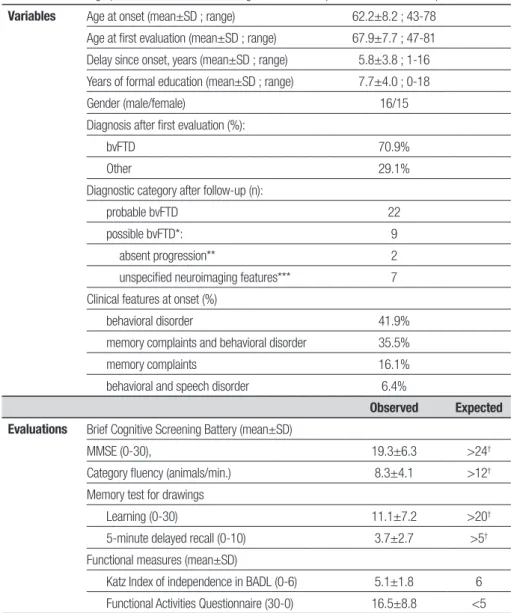
Table 1. Main demographic and clinical features along with evaluation performance of the sample.
Variables Age at onset (mean±SD ; range) 62.2±8.2 ; 43-78
Age at first evaluation (mean±SD ; range) 67.9±7.7 ; 47-81 Delay since onset, years (mean±SD ; range) 5.8±3.8 ; 1-16 Years of formal education (mean±SD ; range) 7.7±4.0 ; 0-18 Gender (male/female) 16/15 Diagnosis after first evaluation (%):
bvFTD 70.9%
Other 29.1%
Diagnostic category after follow-up (n):
probable bvFTD 22 possible bvFTD*: 9 absent progression** 2 unspecified neuroimaging features*** 7 Clinical features at onset (%)
behavioral disorder 41.9% memory complaints and behavioral disorder 35.5% memory complaints 16.1% behavioral and speech disorder 6.4%
Observed Expected
Evaluations Brief Cognitive Screening Battery (mean±SD)
MMSE (0-30), 19.3±6.3 >24†
Category fluency (animals/min.) 8.3±4.1 >12†
Memory test for drawings
Learning (0-30) 11.1±7.2 >20†
5-minute delayed recall (0-10) 3.7±2.7 >5†
Functional measures (mean±SD)
Katz Index of independence in BADL (0-6) 5.1±1.8 6 Functional Activities Questionnaire (30-0) 16.5±8.8 <5
*Six patients had only structural neuroimaging data. **both patients also have unspecified neuroimaging features. ***including abnormal SPECT findings in three patients. BADL: Basic Activities of Daily Living; Numbers between brackets mean range of possible scores from the worst to best performance. †Weighted average according to 5 levels of schooling ( 0, 1-3, 4-7, 8-11, >11 years).
age of 67.9±8.2 years at the time of evaluation in our specialized unit. Subjects had 7.7±4.0 mean years of formal education, and 16 (51.6%) were men. Patients’ clinical history suggested that the onset of disease was on average at 62.2±7.7 mean years of age. his data re-vealed a mean delay of 5.8±3.8 years until evaluation at our unit.
Almost 30% of the participants had a diagnosis other than bvFTD at the irst round of evaluations in the unit, meeting consensus diagnostic criteria only on follow-up visits: four had unspeciied psychiatric diagnosis and ive supposedly had AD. Regarding clinical presentation at onset, 13 patients (41.9%) displayed only behavioral disorders, 11 (35.5%) had mixed behavioral disorders
and memory complaints, ive (16.1%) had only memory complaints, and two (6.4%) participants presented with behavioral disorder and motor speech problems without aphasia (both developed features consistent with PSP-spectrum on follow-up).
neuro-imaging data. All of these cases had mostly difuse brain atrophy without a typical frontotemporal pattern. Un-fortunately, six of these patients had just structural neu-roimaging indings, precluding additional conclusions that might have been achieved with PET or SPECT scans.
Data given in Table 1 show that, at irst evaluation in the unit, average performance of the participants was unequivocally impaired on all the brief cognitive screen-ing tests, includscreen-ing the episodic memory test. he lower right-hand side column shows the expected scores ac-cording to control-reference performance,18
weight-ad-justed for ive levels of formal education. Functional im-pairment was also salient, with moderate imim-pairment in instrumental activities of daily living (FAQ: 16.5±8.8 points), and mild dependence in self-care (Katz Index: 5.1±1.8 points).
Using a stepwise logistic regression model, we tested which clinical variables might have contributed to the delay (>3 years) from onset of symptoms to irst evalua-tion at our specialized unit. he best model (AUC=0.734; 95% CI: 0.545-0.876), considering gender, schooling and age at onset, showed only memory complaints at presentation as a signiicant variable associated (OR: 0.12; 95% CI: 0.020-0.714) with delayed evaluation.
DISCUSSION
Most patients in this case series were evaluated in a spe-cialized unit after almost six years from symptom onset and performed poorly on both cognitive screening tests and functional evaluation measures. Even in this spe-cialized unit, almost 30% of the reported patients did not receive accurate diagnosis during the irst round of evaluations. In these cases, bvFTD was only ascertained at follow-up visits. Regarding the characteristics of bvFTD, memory complaints were present in almost half of the sample, isolated or associated with behavioral disorders. he presence of memory issues, according to caregiver reports, was a strong predictor of an earlier as-sessment at the unit.
Previous studies from developed countries that sought to evaluate early manifestations of bvFTD found, on average, around two years of delay from onset to proper diagnosis.11,12 In a Spanish case series of 42
mixed FTLD patients, the reported delay was 3.5 years
on average. According to Bahia et al.,13 in a cohort of
FTLD patients from Brazil, almost 75% of the sample received an AD or psychiatric diagnosis prior to a spe-cialized evaluation, and the delay from onset to proper diagnosis was around four years.
It seems quite reasonable that the bvFTD heteroge-neous genetic and pathological background potentially gives rise to very complex and variable clinical presen-tations. In turn, these issues inevitably increase the efort for an accurate and early diagnosis of this syn-drome, especially when technological resources are not available. It was only recently, after the new proposed diagnostic criteria,17 that most of the research groups
became more comfortable to deine a bvFTD diagnosis in patients with an amnestic presentation. he inding that memory complaints might have contributed to an early assessment at our unit suggests that the appro-priate characterization of psychiatric symptoms, which dominate the clinical picture in the early stages of the disease, may still be a major obstacle to correct identii-cation and treatment of these patients.19
Regarding limitations, we should emphasize that the small sample size and the study’s retrospective design preclude any generalizations of our indings, although the results were in accordance with a previous report in Brazil. We chose to include nine patients that only met possible bvFTD consensus criteria. hese subjects had no better explanation for their clinical presentation. Ad-ditionally, except for one subject who had a strong fam-ily history of FTLD, these patients did not match the current deinition of FTD phenocopy, since they had ei-ther progressive deterioration or abnormal neuroimag-ing indneuroimag-ings, even if non-speciic. A common limitation of research based on clinical settings is the lack of au-topsy-conirmed diagnosis. his caveat could have been reduced in our series by using pathophysiological bio-markers either in cerebrospinal luid (CSF) or position emission tomography.20 It has been previously
demon-strated that CSF markers help discriminate bvFTD from AD with high sensitivity and speciicity.21 he selection
of patients according to their CSF biomarkers proile would increase the speciicity of our clinical diagnosis,10
avoiding the inclusion of AD patients with frontal pre-sentation.
REFERENCES
1. Van Lagenhove T, van der Zee J, Gijselinck I, et al. Distinct Clinical Char-acteristics of C9orf72 Expansion Carriers Compared With GRN, MAPT, and Nonmutation Carriers in a Flanders-Belgian FTLD Cohort. JAMA Neurol 2013;1:1-9.
2. Galimberti D, Scarpini E. Genetics of frontotemporal lobar degenera-tion. Front Neur 2012;3:52.
3. Benussi L, Guidoni R, Pegoiani E, Moretti DV, Zanetti O, Binetti G. Pro-granulin Leu271LeufsX10 is one of the most commom FTLD and CBS associated mutations worldwide. Neurobiol Dis 2009;33:379-385. 4. Seelaar H, Rohrer JD, Pijnenburg YA, Fox NC, van Swieten JC. Clinical,
5. Neary D, Snowden J, Mann D. Frontotemporal dementia. Lancet Neurol 2005;4:771-780.
6. Snowden JS, Rollinson S, Thompson JC, et al. Distinct clinical and pathological characteristics of frontotemporal dementia associated with C9orf72 mutations. Brain 2012;135:693-708.
7. Hornberger M, Piguet O. Episodic memory in frontotemporal dementia: a critical review. Brain 2012;135:678-692.
8. Hornberger M, Piguet O, Grahan AJ, Nestor PJ, Hodges JR. How pre-served is episodic memory in behavioral variant frontotemporal demen-tia? Neurology 2010;74:472-479.
9. Liscic RM, Storandt M, Cairns NJ, Morris JC. Clinical and psychometri-cal distinction of frontotemporal and Alzheimer frontotemporal demen-tias. Arch Neurol 2007;64:535-540.
10. Mendez MF, Joshi A, Tassniyom K, et al. Clinicopathologic differencess among patients with behavioral variant frontotemporal dementia. Neu-rology 2013;80;561-568.
11. Hallam BJ, Silverberg ND, LaMarre AK, Mackenzie IR, Feldman HH. Clinical presentation of prodromal frontotemporal dementia. Am J Alzheimer Dis Other Demen 2008;22:456-467.
12. Pijnenburg AL, Gillissen F, Jonker C, Scheltens P. Initial complaints in frontotemporal lobar degeneration. Dement Geriatr Cogn Disord 2004; 17:302-306.
13. Bahia VS. Underdiagnosis of frontotemporal lobar degeneration in Bra-zil. Dement Neuropsychol 2007;1:361-365.
14. Nitrini R, Lefèvre BH, Mathias SC, et al. Brief and easy-to-administer neuropsychological tests in the diagnosis of dementia. Arq Neurop-siquiatr 1994;52:457-465.
15. Pfeffer RI, Kurosaki TT, Harrah CH, et al. Measurement of func-tional activities in older adults in the community. J Gerontol 1982;37: 323-329.
16. Katz S, Downs TD, Cash HR, Grotz RC. Progress in the development of the index of ADL. Gerontologist 1970;10:20-30.
17. Rascovsky K, Hodges JR, Knopman D, et al. Sensitivity of revised di-agnostic criteria for the behavioural variant of frontotemporal dementia. Brain 2011;134:2456-2477.
18. Machado TH, Guimarães HC, Barbosa MT, et al. Cognitive descriptive analysis of control subjects in an epidemiologic study: The Pietà Study. Dement & Neuropsychol 2009:3(Suppl 1):17.
19. Manes F. Psychiatric conditions that can mimic early behavioral variant frontotemporal dementia: the importance of the new diagnostic criteria. Curr Psychiatry Rep 2012;14:450-452.
20. Rabinovici GD, Rosen HJ, Alkalay A, Kornak J, Furst AJ, et al. Amyloid vs FDG-PET in the differential diagnosis of AD and FTLD. Neurology 2011;77:2034-2042.