From the Retina and Vitreous Service, University of São Paulo Medical School - São Paulo - SP - Brazil, and São Rafael Hospital - Monte Tabor Foundation - Salva-dor (BA) - Brazil.
1Vitreoretinal Specialist at the Department of Ophthal-mology, São Rafael Hospital, Monte Tabor Foundation, Salvador (BA) - Brazil.
2Head of the Vitreoretinal Service, Department of Ophthalmology, University of São Paulo Medical School -São Paulo (SP) - Brazil.
3Assistant Professor at the Department of Ophthalmolo-gy, University of São Paulo Medical School - São Paulo (SP) - Brazil.
Corresponding Author: Otacílio O. Maia Jr. Serviço de Retina e Vítreo, Departamento de Oftalmologia -Hospital São Rafael, Fundação Monte Tabor. Av. São Rafael, 2.142 - São Marcos - Salvador (BA) CEP 41253-190
E-mail: [email protected]
Recebido para publicação em 26.04.2007 Última versão recebida em 19.06.2007 Aprovação em 25.06.2007
The authors declare to have no financial interest in this study.
Nota Editorial: Depois de concluída a análise do artigo sob sigilo editorial e com a anuência do Dr. Ayrton Ro-berto Branco Ramos sobre a divulgação de seu nome como revisor, agradecemos sua participação neste processo.
Otacílio de Oliveira Maia Júnior1 Walter Yukihiko Takahashi2 John Helal Júnior3
Keywords: Vitreous body/surgery; Vitrectomy/methods; Macula lútea; Triamcinolone;
Pos-toperative complications; Tomography, optical coherence; Visual acuity
Purpose: To evaluate the efficacy of triamcinolone as an aid in vitreous visualization during 3D-vitrectomy for the treatment of diabetic vitreo-macular traction. Methods: Prospective interventional study in patients with symptomatic vitreomacular traction. Pre- and postoperative assess-ments included visual acuity, retinography, intraocular pressure and optical coherence tomography. All patients were operated by the same surgeon (OOMJ). Triamcinolone was used as a visual enhancer during surgery. The parameters of the vitreophage (Accurus 800CS, Alcon) were set to the 3D- system (dual dynamic drive), contact lenses (plain and wide angle) being used for visualization. Peripheral 360º vitreous circumcision at high cut rate was performed, carefully releasing the vitreomacular adhesion at the posterior pole by means of an appropriate pic or vitreore-tinal forceps. Results: The sample consisted of five consecutive patients (five eyes), three female and two male, with symptomatic vitreomacular traction. Their age ranged from 54 to 71 years (mean 62.6 ± 6.3 years). During the surgical procedure, the areas with vitreomacular traction were properly visualized and identified after the application of triamcinolone. No complications were recorded during or after surgery. There was a statistically significant improvement in visual acuity after the surgical procedure (p=0.0313). Conclusion: Triamcinolone facilitates the surgical treatment of vitreomacular traction by improving visibility of both the vitreous humor and the vitreous-retina interface. Triamcinolone-assisted 3D vitrectomy proved to be an effective procedure in these cases.
ABSTRACT
INTRODUCTION
The incomplete detachment of the posterior vitreous may affect the vitreous-retina interface and induce structural and functional changes of the retina secondary to the centripetal traction force exerted by the vi-treous(1-2). The macular region may become distorted and a minor traction
detachment of the retina may occur(2-3). Even though the separation of the
posterior vitreous from the retina, in the area of abnormal adhesion, may occur spontaneously(4-5), vitrectomy should be considered in cases of
sym-ptomatic vitreomacular traction with reduced visual acuity or metamorpho-psia(6-7). Optical coherence tomography (OCT) shows the vitreous-retinal
interface in detail, and may reveal structural alterations of the retina resulting from vitreomacular traction, thus helping in the diagnosis choo-sing an appropriate approach(8).
Despite advances in surgical instrumentation and techni-ques, the vitrectomy procedure continues to demand both skill and experience. The removal of the vitreous is a particularly challenging procedure, partly because of its transparency(9). To
assist in the visualization of the vitreous during vitrectomy, intraoperative triamcinolone acetonide was used. The triam-cinolone acetonide-assisted pars plana vitrectomy technique has been previously described(10-11), although not in
vitreoma-cular traction; we consider its use in this indication as a useful tool for the success of the surgery and to decrease iatrogenic risks. The objective of this study is to evaluate the effective-ness of triamcinolone as an aid in vitreous visualization during vitrectomy for diabetic vitreomacular traction.
METHODS
Interventional case series of patients with symptomatic vitreomacular traction from the Department of
Ophthalmolo-gy, University of São Paulo Medical School General Hospital, were submitted to a 20- or 25-gauge vitrectomy and prospec-tively evaluated for a minimum period of 3 months. Exclusion criteria were: cataract, corneal opacity, glaucoma, vitreous hemorrhage and loss of follow-up.
Pre- and postoperative assessments included visual acui-ty (Snellen), retinography, Goldmann applanation tonometry and OCT. The images obtained with the Stratus OCT version 4.0 (Carl Zeiss Meditec) were taken at the macular thickness program with the cursor placed manually in the center of the fovea, whenever the foveal depression was visible.
All patients were submitted to vitrectomy performed by the same surgeon (OOMJ), between January and July 2006. During surgery, prior core vitrectomy was performed, and triamci-nolone (Kenalog®, Bristol-Myers Squibb Company) was then
injected through a soft cannula, in a sufficient amount to stain the vitreous humor. The parameters of the vitreophage (Ac-curus 800CS, Alcon) were set to the 3D system (dual dynamic drive), and contact lenses (plain and wide angle) were used for Figure 1 - Preoperative: patient 1, 54-year-old, female, with diabetic retinopathy previously treated with panphotocoagulation by argon laser, with vitreomacular traction. Retinography of the left eye shows laser scars and a lamellar hole (A). Stratus OCT evidenced a lamellar hole with vitreomacular traction on the edge (yellow arrow) (B), incomplete vitreous detachment around the optic nerve (white arrow) (C) and an area of
subretinal hyporeflectivity (red arrow) indicating a shallow tractional retinal detachment (D).
A B
C D
Table 1. Characteristics of patients with diabetic vitreomacular traction submitted to triamcinolone-guided 3D vitrectomy at the University of São Paulo Medical School General Hospital, São Paulo, Brazil - 2006
Patients Age* Sex Panphotocoagulation Preoperative VA Vitrectomy Follow-up Postoperative VA
1 54 Female 18 20/60 20-Gauge 9 20/20
2 63 Male 24 20/100 25-Gauge 6 20/25
3 65 Female - 20/80 20-Gauge 3 20/30
4 71 Female 14 20/200 25-Gauge 3 20/30
5 60 Male 18 20/100 25-Gauge 6 20/30
visualization. Initially, a 360° vitreous circumcision at high cut rate was performed to avoid increasing macular traction by the adherent vitreous. After this initial approach, the vitreomacular adhesion was carefully released with a pic. Tighter adhesions were then removed with an appropriate vitreoretinal forceps. Upon removal of the vitreomacular tractions, a detailed inspec-tion of both the posterior pole and the periphery was performed, in order to detect preexisting or iatrogenic ruptures. Air-gas ex-change was performed as required.
Each variable was analyzed through descriptive statistics. For quantitative variables, this analysis included minimum and maximum values, mean and standard deviation. For qualitative variables, absolute and relative frequencies were calculated. The visual acuity measurement was converted to logMAR and analyzed through a non-parametric sign test. The level of signi-ficance used for the test was 5%. The study was approved by the Institutional Review Board/ Research Ethics Committee of
the University of São Paulo Medical School General Hospital and all the patients signed an Informed Consent Form.
RESULTS
The sample consisted of five consecutive patients (five eyes) with symptomatic vitreomacular traction. Three patients (60%) were female and two (40%), male. The age ranged from 54 to 71 years (mean 62.6 ± 6.3 years). All patients had type 2 diabetes mellitus, and 80% had diabetic retinopathy and had under-gone panphotocoagulation with argon laser at least one year ago (Table 1).
Preoperative visual acuity ranged from 20/200 to 20/60 (logMAR, 1.00 to 0.50 - mean 0.70 ± 0.18). On OCT, all patients presented hyperreflective structures, marginal to the optical nerve and in the macular region, both sites corresponding to areas of vitreomacular traction.
A B
C D
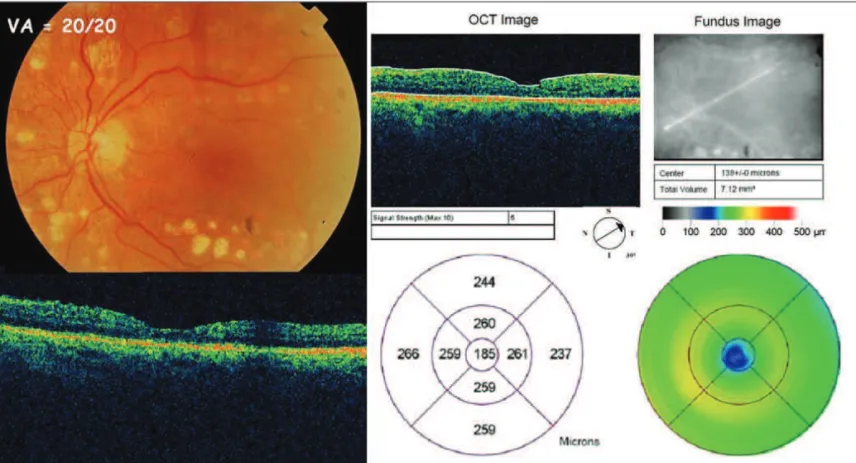
Figure 3 - Postoperative: patient showing visual acuity improvement 9 months after the surgical procedure. Stratus OCT evidenced macular structure recovery. Normal foveal thickness (185µm).
Two patients underwent a 20-gauge vitrectomy and three, 25-gauge. During the surgical procedure, the areas with vi-treomacular traction were properly visualized and identified after the application of triamcinolone. Air-gas exchange was not required in any of the patients. No complications were observed during or after surgery. Intraocular pressure increase was not detected throughout the follow-up period. There was a significant improvement in visual acuity (p=0.0313) with measurements ranging, on the last follow-up visit, from 20/30 to 20/20 (logMAR 0.20 to 0.00 - mean 0.14 ± 0.09). The follow-up period ranged from 3 to 9 months (mean 5.4 ± 2.5 months). One case was selected to illustrate the sur-gical procedure and the outcome (Figures 1, 2 and 3).
DISCUSSION
Triamcinolone acetonide-assisted visualization of the vi-treous has been reported as a helpful tool for surgeons perfor-ming procedures such as internal limiting membrane peeling or posterior vitreous separation(9-16). However, this is the first
study to describe the use of triamcinolone-guided 3D vitrecto-my in the treatment of diabetic vitreomacular traction.
Anomalous posterior vitreous detachment results when the extent of vitreous liquefaction exceeds the degree of wea-kening of vitreoretinal adherence and traction is exerted at this interface. There are various causes for this imbalance between the degree of gel liquefaction and weakening of vitreoretinal
adhesion(17). Systemic conditions, such as diabetes, induce
biochemical and structural alterations in the vitreous(18). In
this study, all patients had diabetes mellitus and most of them had been previously treated with panphotocoagulation with argon laser. In addition to the underlying systemic disease, laser therapy may have played some role in the etiology of vitreomacular traction in these patients.
During vitrectomy for vitreomacular traction, the traction may increase in the areas with established vitreoretinal adhe-sion, worsening the visual prognosis. However, no intraope-rative complications were observed during triamcinolone-gui-ded 3D vitrectomy. The 3D technology provides flow control of the removed vitreous, adjusted both to the cutting speed and to the vacuum produced by a customized treadle. In addi-tion, triamcinolone acted as a facilitator of the surgical pro-cedure, by improving visibility of both the vitreous humor and the vitreous-retina interface. Therefore, triamcinolone-guided 3D vitrectomy proved effective in these cases. These findings warrant further studies to evaluate the long-term effects on retinal structure and retinal function.
RESUMO
vi-treomacular sintomática. Na avaliação pré e pós-operatória foram realizadas a medida da acuidade visual, retinografia, pressão intra-ocular e tomografia de coerência óptica. Todos pacientes foram submetidos à vitrectomia pelo mesmo cirur-gião (OOMJ). No intra-operatório, utilizou-se triancinolona como marcador vítreo. Os parâmetros do vitreófago (Accurus 800CS, Alcon) foram programados no sistema 3D (dual dyna-mic drive), sendo utilizadas lentes de contato (grande angular e plana) para visibilização. Realizou-se circuncisão vítrea pe-riférica 360° com alto corte, desfazendo cuidadosamente as ade-sões vitreomaculares no pólo posterior por meio de gancho ou pinças vítreo-retinianas adequadas. Resultados: A amostra foi composta por cinco pacientes (cinco olhos) consecutivos com tração vitreomacular sintomática. Três eram do sexo fe-minino e dois, do masculino. A idade variou de 54 a 71 anos (média de 62,6 ± 6,3 anos). Durante o procedimento cirúrgico, os locais de tração vitreomacular foram identificados com boa visibilidade após aplicação da triancinolona. Não foram obser-vadas intercorrências tanto no intra quanto no pós-operatório. Houve melhora estatisticamente significante na acuidade vi-sual após procedimento cirúrgico (p=0,0313). Conclusão: A triancinolona tem ação facilitadora no tratamento cirúrgico da tração vitreomacular, por melhorar visibilização tanto do hu-mor vítreo quanto da interface vítreo-retina. A cirurgia de vitrectomia 3D, guiada por triancinolona, mostrou-se ser um procedimento eficiente nesses casos.
Descritores: Corpo vítreo/cirurgia; Vitrectomia/métodos; Ma-cula lútea; Triancinolona; Complicações pós-operatórias; To-mografia de coerência óptica; Acuidade visual
REFERENCES
1. Hikichi T, Yoshida A, Trempe CL. Course of vitreomacular traction syndrome. Am J Ophtalmol. 1995;119(1):55-61.
2. Smiddy WE, Green WR, Michels RG, de la Cruz Z. Ultrastructural studies of vitreomacular traction syndrome. Am J Ophthalmol. 1989;107(2):177-85.
3. Yamada M, Kishi S. Tomographic features and surgical outcomes of vitreo-macular traction syndrome. Am J Ophthalmol. 2005;139(1):112-7. Comment in: Am J Ophthalmol. 2005;140(4):765-6; author reply 766.
4. Kusaka S, Saito Y, Okada AA, Sasamoto M, Hayashi A, Ohji M, et al. Optical coherence tomography in spontaneously resolving vitreomacular trac-tion syndrome. Ophthalmologica. 2001;215(2):139-41.
5. Carpineto P, Ciancaglini M, Aharrh-Gnama A, Agnifili L, Mastropasqua L. Optical coherence tomography and retinal thickness analyser features of spon-taneous resolution of vitreomacular traction syndrome: a case report. Eur J Ophthalmol. 2004;14(1):67-70.
6. McDonald HR, Johnson RN, Schatz H. Surgical results in the vitreomacular traction syndrome. Ophthalmology. 1994;101(8):1397-402; discussion 1403. 7. Primiano Júnior HP, Nakashima AF, Maia Júnior OO, Bonanomi MT, Naka-shima Y. Estudo da síndrome de tração macular vítreo-retiniana idiopática por meio da tomografia de coerência óptica: relato de casos. Arq Bras Oftalmol. 2007;70(1):143-7.
8. Larsson J. Vitrectomy in vitreomacular traction syndrome evaluated by ocular coherence tomography (OCT) retinal mapping. Acta Ophthalmol Scand. 2004;82(6):691-4.
9. Yamakiri K, Sakamoto T, Noda Y, Nakahara M, Ogino N, Kubota T, et al. Reduced incidence of intraoperative complications in a multicenter controlled clinical trial of triamcinolone in vitrectomy. Ophthalmology. 2007;114(2): 289-96.
10. Peyman GA, Cheema R, Conway MD, Fang T. Triamcinolone acetonide as an aid to visualization of the vitreous and the posterior hyaloid during pars plana vitrectomy. Retina. 2000;20(5):554-5.
11. Sakamoto T, Miyazaki M, Hisatomi T, Nakamura T, Ueno A, Itaya K, et al. Triamcinolone-assisted pars plana vitrectomy improves the surgical procedures and decreases the postoperative blood-ocular barrier breakdown. Graefes Arch Clin Exp Ophthalmol. 2002;240(6):423-9.
12. Doi N, Uemura A, Nakao K, Sakamoto T. Vitreomacular adhesion and the defect in posterior vitreous cortex visualized by triamcinolone-assisted vitrec-tomy. Retina. 2005;25(6):742-5.
13. Enaida H, Hata Y, Ueno A, Ishibashi T, Torii H, Sakamoto T. Visualization of the Cloquet canal during triamcinolone-assisted vitrectomy. Arch ophthal-mol. 2004;122(10):1564-5.
14. Enaida H, Hata Y, Ueno A, Nakamura T, Hisatomi T, Miyazaki M, et al. Possible benefits of triamcinolone-assisted pars plana vitrectomy for retinal diseases. Retina. 2003;23(6):764-70.
15. Sonoda KH, Enaida H, Ueno A, Nakamura T, Kawano YI, Kubota T, et al. Pars plana vitrectomy assisted by triamcinolone acetonide for refractory uvei-tis: a case series study. Br J Ophthalmol. 2003;87(8):1010-4.
16. Furino C, Micelli Ferrari T, Boscia F, Cardascia N, Recchimurzo N, Sborgia C. Triamcinolone-assisted pars plana vitrectomy for proliferative vitreoretino-pathy. Retina. 2003;23(6):771-6.