Bo1m Inst. oceanogr. S Paulo, 20 (2): 79-104, 1971
A HYBRID ALGORITHM -FOR THE RAPID FOURIER TRANSFORM OF EXTENSIVE SERIES OF DATA
(Received 7/6/1971)
A. S. FRANCO
&N.
J.ROCK
Instituto Oceanogra fico da Universidade de sdo Paulo
SYNOPSIS
A technique is described for the rapid Fourier transform of large series of numbers. The technique takes advantage of the fact that most digital series are highly factorizable by the number 2, which permits
the use of the F.F.T. algorithm.
Using two magnetic tape units, or alternatively magnetic disk fa-cilities, very large series can be transformed efficiently with only modest computer facilities.
For the transformation of odd-valued series the Thomas Prime-Factor and Gentleman and Sande algorithms are treated in detail .
1 - GENERAL SURVEY ON FOURIER ANALYSIS
The Fourier transform has long been known to scientists for its useful-ness in representing a variety of periodic phenomena.
the tran sf orm pair may be written:
For continous signals
(la)
(l b )
for a frequency
f
and time t without finite limitations (i.e. -00 <t <00, et~.).In the particular example cited above the Fourier transform permits the representation of a function of time (g(t» by a function in the frequency domain (G(f» and vice-versa; hence the name of transformo It serves equally
to transform other domains such as wave-number and horizontal space.
For earth scientists the obtention of continuous signals in machine-processable form is usually prohibitively expensive and, for the majority of applications, unnecessary. Consequently the continuous signal is usually sampled at equal intervals of space or time, in which case a different form of the Fourier transform is used, that is applicable to the discrete values obtained by sampling. Called the Discrete Fourier Transform, or D.F.T., the transformpair may be written, for N-valued series:
X(k)
c (n)
N-l
(1/N) n~O c n e ( ) -i2nkn/N
N-1
k~O
X(k)ei2nnk/N(k=0,1,2, ... N-l)
(n=O,1,2, ... N-l)
(1 C?)
(1d)
An examination of the indexing shows that the numb er of mathematical operations required to evaluate the D.F.T. of an N-v.alued series is propor-tional to N2 . Consequently, for very large series the time and expense to evaluate a D.F.T. become prohibitive. This, coupled with the fact that by itself the D.F.T. has litt1e significance in representing the signal of a random "noise", caused the method to be overshadowed by other analytical techn i ques with better
analysis) .
computational speeds (e. g. convolution and spectral
The D.F.T. had alI the making of a mathematical dinosaur, when Cooley and Tukey (1965) showed that a remarkable increase in computational speed can be achieved if N is a high1y factorizab1e number. Thus if N=rm, the D.F.T. can be broken down into r separate D.F.T. 's of size r m- 2 etc.. Finally, one arrives at an m-step algorithm, each step of which requires N.r operations.
It can be seen that the number of operations has been reduced stantially by a factor of r.m/N (viz: N2 versus N.r.m).
Franco (1970) h as shown the process of the sub-division of the D.F.T. 's into smaller ones for the case where N=2 m.
sub-larger
For binary digital computers the case where N=2 m has important advantage over ot he r factors of r, both for
Accordingly the algorithms derived
multiplication economy and for N=2 m both by Cooley
in addressing. and Tukey, and Cooley and Sande,
F. F.T.
have acquired the name of the Fast Fourier Transform or
The high computational speed of the F.F.T., has made it not only feasible but also economically attractive, in terms of computer costs, to calculate energy spectra and correlation functions via the F.F.T.
for
Franco and Rock (1971) have demonstrated the suitability of the F.F.T. 13
the harmonic analysis of tides, where N=2 =8192 hourly observations of tida1 heights, or nearly a years data. By the use of matrices, tidal com-ponents centred at frequencies other than exact harmonics of the fundamental frequency were successfully extracted.
tidal and the residual energy spectrum.
Further filtering produced both the
However the fact that the analysis is tied to a power of 2 is a serious
drawback for many people. Few scientists are willing to neglect available data
and frequently better conditioned matrices,and better rejection of interferirig
comp\?nents may be obtained by an astute choice of N.
Fortunately, if we
are
willing to sacrifice computational speed,a more generalized form of the F.F.T.
may be derived.
2 -
THE GENTLEMAN AND SANDE ALGORITHM
Let us consider the simplified case where N has a factor
p,
and having
obtained the D.F.T. 's of
pseparate series each of N/p numbarl, we now raquira
the algorithm to combine
p
sets of N/p Fourier coefficientl.
We may write the original
~.F.T.ai:
N-l
c(n) -
k~O
X(k)a-
2'ITnk/N
or using the notation:
W
-2'1Ti/N
N -
e
N-l
nk
c(n) -
k~OX(k)WN
Now let
k
take the form k-(bp+j)
and l.t
ntake the form n-(a+m(N/p»
(n-0,l,2, ••• N-l)
(n -O , 1 , 2 , ••• N -1 )
{ j-O,l,2, ••• p-l
b -O , 1 • 2 , ••• (N / p ) -1{
m-O ,1.2 , ••• p-1
a-O,l ,2 , ••• (N /p)
-1We may now rewrite
(2a)
in terms of two separate lummationl:
p-l
c(a+m(N/p»
•
J..
LO
(N/p)-l
b~OX(bp+J)WN
.
(bp+j) (a+m(N/p»
(2a)
(2b)
(20)
(2d)
Note that if we write the original series X(k) as a two dimensional
p~N/p)array,the rearrangement of the data in equation
(2d)corr.spondl to a row-wise
indexing instead of the column-wise indexing normally uI.d in digital computera.
w(
':' ng equation
(2d)through, we get:
p-1
c(a+m(N/p»
-
j~Op-1
• j ~O
but, according to
(2b),and
Thus rearranging
(N /p)-1
b~O
X(bP+j)WN(bPa+j(a+m(N/p»+mbN)
(N/p)-l
/
mbN
b~O
X(bP+j)W~pa.w~(a+m(N
p»'WN
wP
-2'ITi/(N/p)W
N - • (N /p)
p;l wj(a+m(N/p»
(N/p)-l
b
c(a+m(N/p»
-
j~O
N
b*O
X(bP+j)WNip
Bolm Inst. oceanogr. S Paulo,
20 (2) I 79-104, 1971(2')
Cross-referring between the above equation and equation (2a) it can be seen that the innermost summation is already in the form of an N/p valued D.F.T.
Le t
(N/p)-l Bj(a)
=
b~O
X(bP+j)W~ip
By reverting the indexing to the column-wise form, we create series, each of p Fourier coefficients, and
p-l
c(a+m(N/p) = .I: . B (J' )wj(a+m(N/p»
J =0 a N
The complex multiplier of equation (2 e ) is more easily written:
since according to (2 b ) :
wj (a+m(N/p»
N
w
p
from which it can be seen that the normal multiplier of the D.F.T.
(2f)
(viz: Wmj ) p is multiplied
factor" by it:s
by an additional corrective factor Waj
N ' called the "twiddle
ori gi nat ors Gentleman and Sande (1966), which serves to shift the complex coefficients cyclically so that N/p and p may b e identical or
factorizable one by the another. When p=2 and N=2y successive repetitions of the algorithm make it formally similar to the F.F.T ..
3 - THOMAS PRlME-FACTOR ALGORlTHM FOR TWO FACTORS
lf N can be expressed b y
N
=
pq (3a)where p and q are prime with respect to one another, we can use this property to eli mi nate the "twiddle factor" by means of a suitable sequence.
As before we write:
•
and put:
k (j p + mq ) Mo d N
c(n) N-l
k~O
X(k)W~k
I
j =0 , 1 ,2 . .. q -1m =0 , 1 ,2 • •• p -1
which defines the remainder of the interger division of (j p+mq) possible to prove that k takes alI the values in the interval
O~k.:s:N-l
Bolm Inst. oceanogr. S Paulo, 20 (2): 79-104, 197 1
(3b)
(3a)
by N. l t is
(3d)
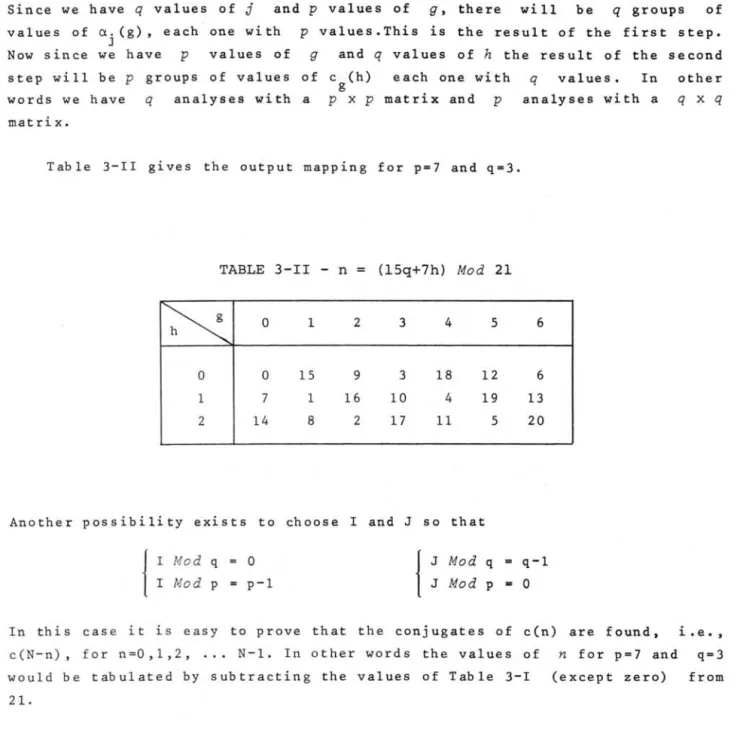
The input data can thus be arranged as p sequences of q ' numbers. For p-7 and q=3 an examp1e of the two dimensional mapping of 21 numbers appears as in Tab1e 3-1.
TABLE 3-1 - k = (7p+3q) Mod 21
~
O 1 2 3 4 5 6O O 3 6 9 12 15 18
1 7 10 13 16 19 1 4
2 14 17 20 2 5 8 11
SimiIar1y we wi11 suppose that output data sequence is represented in the form:
n = (gl+hJ) Mod
N
{g =0 ,1 ,2 , . •. p-1 h=0,1,2, .•• q-1 where l and J are to be determined at our convenience.
(3e)
Before rep1acing convenient to derive of the operator Mod.
k an d n l.n . Wnk N ' b Y expressions (30) and (3e) it is
a general expression lf L is any integer
for w~, according to the definition so that
L
=
KM +S
where K is the quotient of the integer division of
L
by M, and S is the remainder of that division, we have according to (2b) :Consequently
and from (3c) and (3e)
-i21T(KM+S)/M e
-i21TK -i21TS/M
= e e =
wnk W(nk) Mod N
N N
wL Mod M
M
wnk = W [(jp+mq) Mod N (gl+hJ Mod N] Mod N
N N
or, according to Appendix l, formula
(d):
w(jp+mq) (gI+hJ)
N
=
W(jgpl+jhpJ+mgqI+mhqJ)N
Bolrn Inst. oceanogr. S Paulo, 20 (2): 79-104, 1971
(3 f)
But, from (2b) and (3a) we have:
wP -i2TIp/pq w
N .. e • q
and
-i2TIq/pq w
- e - p
thus .
(3g)
Since we can choose I and J at our convenience, these factors may be chosen to satisfy the following relationships:
wI q
..
wI q Mod q _ wO qW
J '" wJ Mod q .. wq q q
wI p
'"
wI p Mod p '" w PwJ p wJ p Mod p wO P
which means th at I and J mus t be given by
j
I Mod q..
°
j
~
Mod q '" 1 I Mod p 1 Mod p..
O th us , according to (3h) , expression (3g) reduces to:Consequent1y, by using (3c), (3b), (3 e ) and (3j) we can change
c
I
(gI+hJ) Mod NJ
or
c
r
(gI+hJ) Mo dNI
q-1
.LO
J '"
p-1
m~O
Xr
(j p+mq) ModN]
w~
hw;gq -1 p-1
L wjh L Xr(J·p+mq) Mod
N]
wmpgj =0 q m"'O L
(3h)
(3i)
(3j)
(3b) into:
This expression can be sp1it into two, by using a more suitab1e matrix notation:
/Iwmg
ll
{x. (m)}P J
and
Bolmlnst. oceanog r. S Paulo, 20 (2) : 79-104, 1971
{a.(g)}
J
Since we have
q
values of j and p values ofg,
there will beq
groups of values of ct. (g), each one with p values.This is the resu1t of the first step.J
Now since we have p values of g and q values of h the result of the second step will be p groups of values of c (h) g each one with q values. In other words we have q ana1yses with a p x p matrix and p analyses with a q x q
matrix.
Table 3-11 gives the output mapping for p=7 and q=3.
TABLE 3-II - n = (15q+7h) Mod 21
~
O 1 2 3 4 5 6O O 15 9 3 18 12 6
1 7 1 16 10 4 19 13
2 14 8 2 17 11 5 20
Another possibility exists to choose I and J so that
j
I Mod qI Mod p .. p-l
O Mod q .. q-1
Mod p • O
In this case it i s easy to prove that the conjugates of c(n) are found, i.e., c(N-n), for n=0,1,2, ... N-l. In other words the va1ues of n for p=7 and q=3 would be tabulated by subtracting the va1ues of Tab1e 3-1 (except zero) from
21.
4 -
THOMAS PRIME-FACTOR ALGORITHM FOR THREE FACTORSIf it is possible to split pinto two mutually prime factors r and s, so that
p rs (4a)
we have
N = rsq (4b)
and a new step can be added to the ana1ysis. In fact we can make:
m (ar+bs) Mod p
Bolro Inst. oceanogr. S Paulo, 20 (2): 79-104, 1971
l
a =0 , 1 ,2 , . • • s -1b=O,1,2, .•. r-l
(4c)
and
n = (g1+hJ+ l L)
Mod
N1
g=0,1,2, ..• r-1 h =0 , 1 ,2 , • • • s-l l =0,1,2, ..• q-1 where I, J and L may be chosen at our convenience.
We have from (3 c ) and .(4 c ):
k = (jp+mq)
Mo d
N = {jp + [Car+bs)Mod
p]q}Mo d
N(4d)
After some
Mod
operator a1gebra (see Appendix I) this e xpression may be changed into:k = [j(rs) + a(rq) + b(sq)]
Mod
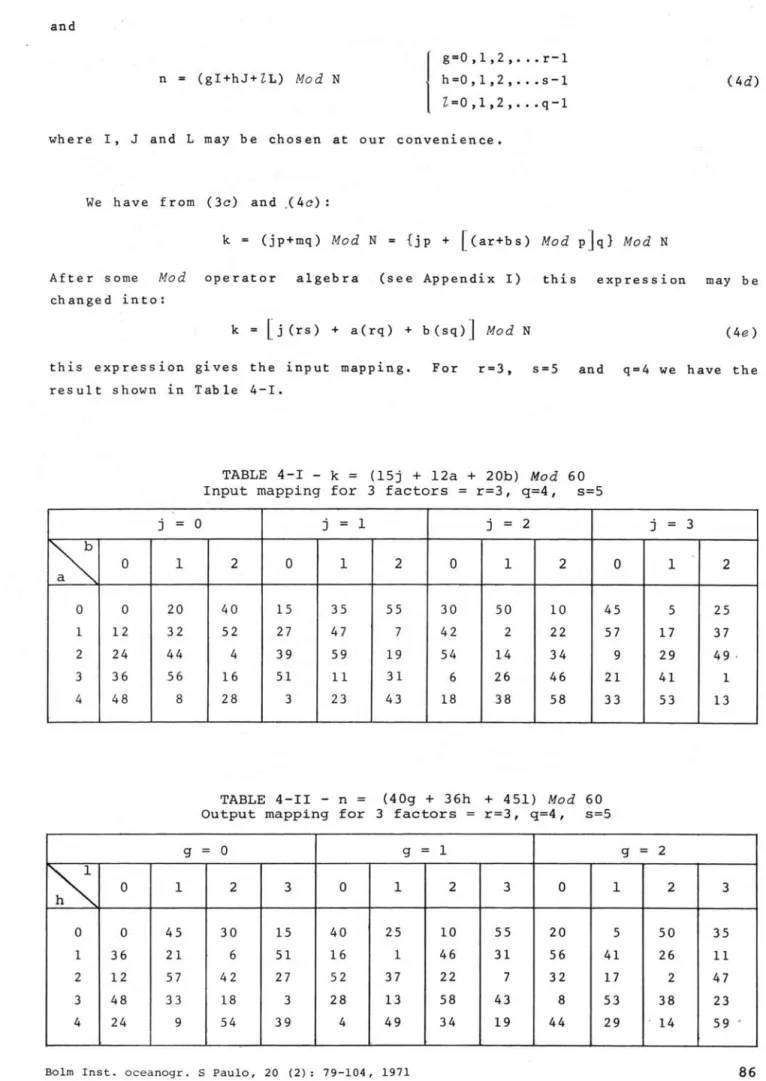
N (4 e ) this expression gives the input mapping. For r=3, s=5 and q=4 we have the resu1t s hown in Tab1e 4-1.j = O
~
O 1O O 20
1 12 32 2 24 44 3 36 56
4 48 8
g
~
O 1O O 45
1 36 21 2 12 57 3 48 3 3
4 24 9
TABLE 4-1 - k = (15j + 12a + 20b)
Mo d 60
1nput mapping for 3 factors = r=3, q=4, s=5
j = 1 j = 2
2 O 1 2 O 1 2
4 0 15 35 55 30 50 10
52 27 47 7 42 2 22
4 39 59 19 54 14 34
16 51 11 31 6 26 46
28 3 23 43 18 38 58
O 45 57 9 21 33
TABLE 4-II - n = (40g
+
36h+
451)Mod 60
Output mapping for 3 factors = r=3, q=4, s=5
= O g = 1
2 3 O 1 2 3 O 1
30 15 40 25 10 55 20 5
6 51 16 1 46 31 56 41
42 27 52 37 22 7 32 17
18 3 28 13 58 43 8 53
54 39 4 49 34 19 44 29
Bo lm In s t . o c ea nogr. S Paulo , 20 (2) : 79-104, 1971
j = 3
.
1 2
5 25 17 37 29 49 . 41 1 53 13
g = 2
2 3
50 35 26 11
2 47 38 23 14 59
Now from (4d) and (4e) we can obtain:
But we have from (2b) a'nd (4b):
thus
-i27Trs/rsq W
• e =
q
e-i27Trq/rsq=w s
e-i27Tsq/rsq=w
r
Since we can choose I,J and L so that
Mod q
Mod s
Mod r
~
I
=
1
I Mod qs
o
I
J Mod q ..O~
J Mod r
J Mod s
i t f o 11 ow 5 t h a t
I
L Mod sL Mod r
L Mod q
o
l
=
L Mod rs= O
J
1
thus from (3 b) , (4d), (4 e) and (4h) we obtain:
o
( 4f)
_ J Mod qr .. O
(4g)
(4h)
cl
(gl+hJ+lL) ModNI
q-1 s-l r-I
.í:O í:
b~-O
X{[- j (rs) + a(rq) + b(sq)] Mod N}WjZWahwbgJ = a=O q s r
or, by using a more suitab1e notation,
By using matrix notation this expression can be split into the following formulae:
II
Wb g1/
{X. (b)} = {ex. ( g) }r J a J a
II
w
ah/I
{ex. (a)}s J g {y. J g (h)}
(4i)
If one of the factors is a power of 2, then the respective summation can be treated by the F.F.T ..
It may be noted that X. (b) represents the values of X(k) arranged
accord-Ja
ing to expression (4e) as input data; whereas c gh (l) are the va1ues of c(n)
4-1 appearing in the output according to the order given by
(4d).
(See Tables and 4-11 for a three dimensional mapping of input and 6utput).5 - APPLICATION TO TIDAL SPAN
The main objection to the method of tida1 analysis via F.F.T. is that the number of samples must be a power of 2. In fact Cartwright (personal
communi-cation) says that the inter-tida1 bands are contaminated by tidal side bands which make it difficult to obtain the noise leveI without comp1icated
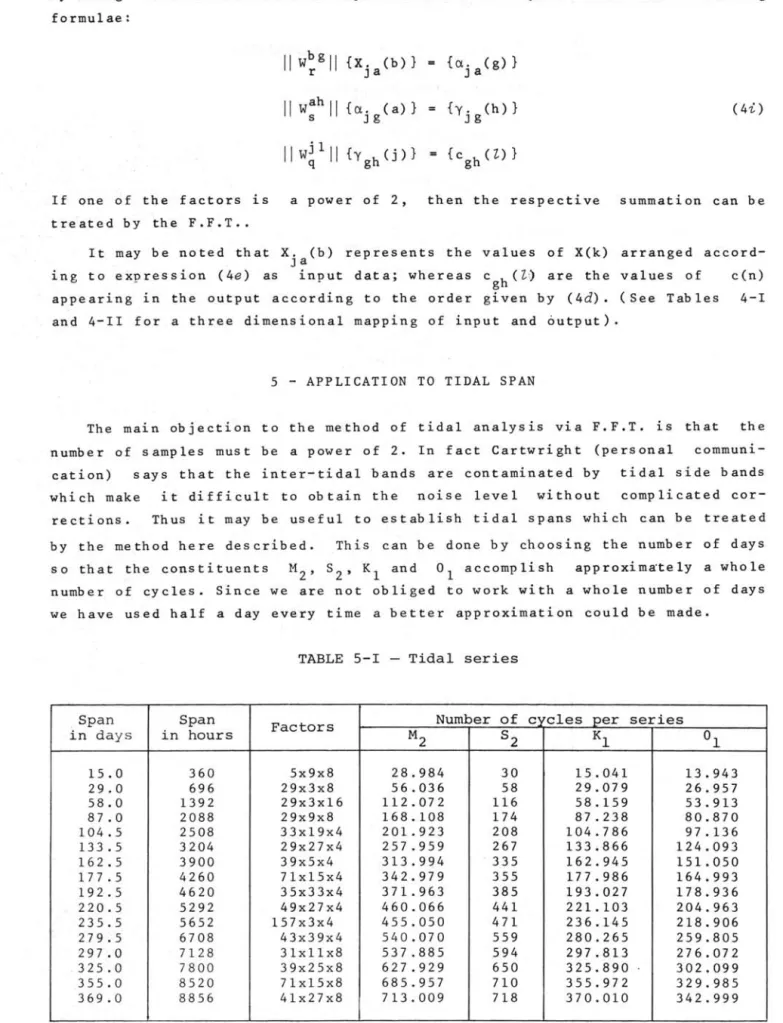
cor-rections. Thus it may be useful to estab1ish tidal spans which can be treated by the method here described. This can be done by choosing the number of days so that the constituents M2' S2' K1 and 01 accomp1ish approxim.te1y a whole number of cyc1es. Since we are not ob1iged to work with a who1e number of days we have used half a day every time a better approximation cou1d be made.
TABLE 5-1 - Tidal series
8pan 8pan Factors Number of c~cles per series
in day s in hours M2 8 2 Kl 01
15.0 360 5x9x8 28.984 30 15.041 13.943
29.0 696 29x3x8 56.036 58 29.079 26.957
58.0 1392 29x3x16 112.072 116 58.159 53.913
87. O 2088 29x9x8 168.108 174 87.238 80.870
104.5 2508 33x19x4 201.923 208 104.786 97.136
133.5 3204 29x27x4 257.959 267 133.866 124.093
162.5 3900 39x5x4 313.994 335 162.945 151.050
177 .5 4260 71x15x4 342.979 355 177.986 164.993
192.5 4620 35x33x4 371.963 385 193.027 178.936
220.5 5292 49x27x4 460.066 441 221.103 204.963
235.5 5652 157x3x4 455.050 471 236.145 218.906
279.5 6708 43x39x4 540.070 559 280.265 259.805
297. O 7128 31x11x8 537.885 594 297.813 276.072
325.0 7800 39x25x8 627.929 650 325.890 302.099
355.0 8520 71x15x8 685.957 710 355.972 329.985
369.0 8856 41x27x8 713.009 718 370.010 342.999
Table 5-1 shows the figures in days and hours. The hours have been factor-ized and the result is shown in the third column. Note that the last factor is always a power of 2 which means that one of the steps can be worked out by the Cooley-Tukey algorithm.
6 - NOTES ON COMPUTATION
In both the Thomas prime-factor and the Gentleman and Sande algorithm. the smallest blocks of D.F.T. 's are formed using a very efficient algorithm due to Watt (1959). The algorithm is a recurrence formula that requires only one sine
and cosine to evaluate a pair of Fourier coefficients.
Briefly for an argument 8 = 2nn/N (n=0.1.2 .... N-l).where N of the series. the recurrence formula is
i s the extent
(6a)
Y(k) being a real-valued series sampled at equidistant intervals
(k =0 • 1 • 2 , ••• N - 1) •
Putting XN=O and XN+I=O, the formula is iterated N times and the n th har-monic Fourier coefficients found from
b n (Xl sin 8)2/N
A fuller treatment of the method may be found in Cartwright and Catton (1963) .
The chief advantage of the Thomas prime-factor algorithm is the com-putational speed gained by avoiding the use of the "twiddle-factor" of the Gentleman and Sande algorithm. It suffers in being restricted to only mutually prime factors. being messy and bulky to program, and the need for extra memory space to sort the output.
There exist at least two distinctive ways of programming the "twiddle factor" into the Gentleman and Sande algorithm. In equation (2t) for each of the N/p
f act or
series Wja
N.
J
is
B (j) = (a=0,1,2, ... (N/p-l) a the argnment equivalent to a phase-shifting of the
a of the " tw iddle complex multiplier
wjm = wjmN / p which necessitates a recalculation of the multiplier wNj(a+m(N/p»
p N
for each series. However the method is extremely compact to program pendix 11) and, by sacrificing some of the speed of the calculation.
(see Ap-can be programmed so that the Fourier coefficients are calculated "in-place", or in other words only one array is needed to store the data at any phase
computation.
On the other hand. to avoid continuous recalculation of the
of the
" tw iddle factor", i f se ve r aIs e t s of data will use the algorithm on the same computer pass, the complex array wja can be calculated at the start of the program, stored, and multiplied directly with the coefficients B (j). a
r.
B~h (O)
Bgh (4)
B9h (2)
Bgh (6)
B 9 h (1)
B~ h (5 )
Bgh (7 )
FIG. 1 - Signal flow - diagram for the F.F.T. treatrnent of
q=2 ~blocks
ofD.F.T.
5size r x
8.The Watt sub-algorithm has been used- as the basic building block of both the Gentleman and Sande and the Thomas prime-factor algorithm. But the F.F.T., by a series of linear combinations, avoids the use of the sub-algorithm, and can substitute the Watt algorithm with greater computational efficiency. More-over, most series have a factor that is a power of 2 (especially time-series due to the natural divisions of days, hours, minutes and seconds), which suggests that a general purpose algorithm should take advantage of the F.F.T • • The use of the Thomas prime-factor algorithm in connection with the F.F.T. is indicated; since with one factor even and the others -of necessity-odd, there is a good possibility of finding at least three mutually prime factors. An examination of equation
(4i)
shows that if q_2 m the D.F.T. consists of8 X q separate calculations of an r-size D. F. T., r x q calculations
signal flow diagram (C o ch r an e
t
a Z., 1967). Since the F.F.T. only requires two blocks of data in the memory core at one time, the blocks of data for each stage of thetape.
calculation can be stored either on magnetic disk or magnetic
The reader is referred to Cochran
et
alo (1967) and Franco (1970) for a fuI ler discussion of the F.F.T. algorithm.For re as ons of convenience in the manipulation of magnetic tape, a par-ticular form of the F. F. T. was selected, where the data enters in "b i t- re-versed"* order and the Fourier coe ffi cients exit in natural order. A very
si mp 1 e technique for calculating bit-reversed numbers is presented in Tab le 6-1 (E. Bergamini, 1968, p e rs on a 1 communication) .
TABLE 6-1 - Generation of bit-reversed series
O 1 2 3 4 5 6 7 8 9 10
il
12 13 14 15 21 4- O 1
4-22 4- O 2 1 3
4-23 4- O 4 2 6 1 5 3 7
4-2" 4- O 8 4 12 2 10 6 14 1 9 55 13 3 11 7 15
NOTE: Each suceSS1ve line is generated by doubling the sequence of the line above. The odd sequence to the right of the dotted separator is formed by adding one to the even sequence to the left of the separator.
1nstead of arranging the blocks of data on magnetic tape in complete bit-reversed order, the odd numbers are interposed with the even numbers of sequence (viz: for a normal bit-reversed sequence 0,4,2,6,1,5,3,7, the order becomes 0,1,4,5,2,3,6,7). 1nitially, every other block (i.e. even numbered) is read from the first tape to form pairs for combination. The resulting pair of b10cks after combination are written in sequence onto a second tape. On completion of the first ha1f of the pass, the tape being read is rewound and the process continued reading and combining those data blocks
skipped on the then rewound,
first ha1f of the pass (i. e. odd numb ers) . Both their rô1es reversed and the process repeated for p as s . For r=2 m the process has m such iterative stages.
7 - CONCLUSION
that were tapes are the second
A very 1arge data series that is highly factorizable by 2 can thus be Fourier transformed very efficiently using very little computer memory core.
* By a bit-reversed number, one understands a number that when represented in binary notation has its binary bits arranged in reverse sequence to that of its natural equivalent.
Prob1ems arise 1rom the . bit-reversing of the data at the input and sorting the out-put, both of which need additiona1 memory core. Notwithstanding, these prob1ems ;an be
over~ome
either by the use of separate subprograms, or the extensive use of magnetic disk. The optimum solution depends on the com-puter configuration.A~though it appears feasib1e to program a1so the Gent1eman and Sande
a1gorithm in conjunction with the F.F.T., there are no distinct advantages in doing so and on1y in exceptiona1
be justifiab1e.
circunstances might programming effort
RESUMO
Apresenta-se neste trabalho uma técnica de transformação rápida de Fourier aplicada a uma longa série de valores numéricos. A t;cnica tira partido do fato de que a grande maioria das séries digitalizadas é, em geral, suscetível de fatoração onde aparece frequentemente o fator 2, o que permite o emprego do a1gorítmo da transformação rápida de Fourier (F.F.T.).
Com o emprego de duas fitas magnéticas ou discos, pode ser efetuada efi-cientemente a transformação de longas séries
ri a.
em computadores de modesta
memõ-O a1gorítmo de fatores primos de Thomas e o de Gent1eman e respectiva~ente, tratados em detalhe, na transformação
impar de valores.
ACKNOWLEDGEMENTS
de séries
-Sande sao, com numeFO
The authors gratefu11y wish to acknow1edge the assistance of the Instituto de Física da Universidade de são Paulo in permitting extensive
360/44 computer.
us e of the IBM
The research was carried out whi1st the junior author was a visiting professor to the Instituto Oceanográfico with the assistance of the "Conselho Nacional de Pesquisas" and the "Fundação de Amparo
ã
Pesquisa do Estado de são Paulo".REFERENCES
CARTWRIGHT, D. E.
&
CATTON, D. B. 1963. On the Fourier ana1ysis of tida1 observations. Int. hydrogr. Rev., vo1. 40, no. 1, p. 113-125.COCHRAN, W. T., COOLEY, J. W. et alo. 1967. What is the Fast Fourier Transform? I.E.E.E. Trans. Audio E1ectroacoustics, vo1. AU-15, p. 45-55. COOLEY, J. W.
&
TUKEY, J. W.of comp1ex Fourier series. 1965. An a1gorithm for the machine ca1cu1ation DOODSON, A. T. 1928.
Soc., Ser. A, vo1.
Maths Comput., vo1. 19, p. 297-301. The ana1ysis of tida1 observations.
227, p. 223-279. Phil. Trans. R.
FRANCO, A. S.
1970.
Fundamentals of power spectrum analysis as applied to discrete observations. Int. hydrogr. Rev., vol.47,
no.1,
p.91-112.
& ROCK, N. J.
1971.
to tidal oscillations. p.
155-199.
The Fast Fourier Transform and its application Bolm Inst. oceanogr. S Paulo, volo
20,
fasc~1,
GENTLEMAN, W. M. & SANDE, G.
1966.
Fast Fourier Transform for fun and volo29.
profit. Fall Joint Computer Conference,
1966.
AFIPS Proc. t WATT,J.M.
1959.
A note on the evaluation ofComputo J.,
1.4,
p.162
Apud CARTWRIGHT, D. E.&
the Fourier analysis of tidal observations. Int. no. 1, p. 113.125.
trigronometric series. CATTON,
D. B. 1963.
On hydrogr. Rev., vol. XL,APPENDIX I
It is necessar y to derive some general expression involving the operator
" Mo d"
in order to simplify expression (4f) .From the definition itself of A
Mo d
N, it fol1ows that««A
Mo d
N)Mo d
N)Mo d
N ••• » )=
AMod
N(a)
Now, if a and B are the remainders of the division of integers A and B,
res~ect i vel y , b y N , we can write:
A IN + a a A
Mod
N(b)
B JN + i3 i3 B
Mod
Nth u s
AB = INJN + a JN + i3 IN + a8
b ut, i f K 15 th e quotient of the integer division of 0.8 by N then
aB = KN + Y Y
( a8 )
Mod
Nand
AB (INJ + aJ + SI + K) N + Y
th us
(AB)
Mo d
N y (aS) Hod N(c)
or, according to ( b )
(AB)
Mo d
Nt
(AMod
N) (B!t od
N)1
Mod
N(d)
From
( b)
A + B
=
(I + J) N + ( a + 8)but, if M and a are the quotient and the remainder, respectively of the division of a + 8 by N, it follows that
a
+8
MN + ó - - - + Ó .. (a +B) Mo d
Nthus
A
+B • (I
+ J +M) N
+6
6 • (A + B)Mod
Ncons eq uen t 1y
(A + B)
Mod
N • (a +a)
Mod
N (e)or, according to (b)
(A
+B)
Mod
N • (A
Mod
N
+B
Mod
N)
Mod
N
(f)Finally, if
P<N
(g)
P
Mod
N .. PExpressions
(a),
(4),
(f) and(g)
are alI we need to effect alI the deve1opments.A P P E N D I X 11
FLOW DIAGRAMS and COMPUTER PROGRAMS
f.b..Q.W
DIAGRAM-I
THOMAS PRIME FACTOR ALGORITHM
CALCULArE SORTING FACTORS
GENERATE SORTING SEQUENCE
RxS NUHBERS
GENERATE
(R + 1) /2 S I NESI COSINES
CENERATE (5+ 1) /2 5 INES
•
COSINES
FOR THREE FACTORS UTILlSING
THE F. F. T.
Bolm Inst. oceanogr. S Paulo, 20 (2) 79-104, 1971
...
OBTAIN "5" FOURIER CO E FFS. VIA
WATT ' s PROCESS
OBTAIN "R " FOURIER COEFFS. FROH
REAL PAftT
OBTAIN "R" COEFFS. FROH IHAGINARY
PART
" S "
WATT ' S PROCESS IN
TWO PARTS
CALCULA TE
COMPLEX
MUL TIPLIERS
FOR F.F . T.
REALLOCATE
TAP~ LABELS. REWIND TAPES
A
SELECT
COMPLEX HULTIPLIEa
COMBINE
THE TWQ
BL OCKS
Bolm Inst. oceanogr. S Paulo, 20 (2)
FLOW DIAGRAM-I
(CONTINUED)H. STACE PROCESS
Q • 2M
79-104, 1971
END NO
DF DAr A
SOU OUTP UT IN PAIaS or BLOCKS
WRITE
FOURIER
COEFFS
FLOW
DIAGRAM 2
GENTLEMAN B ~ANDE ALGORITHM
NO
GENER ATE
Q SINE • COS I NE
TA BLE
SE,LECT . VALUES ROW-\HS E
CA L CULATE FOURIER COEFFS B Y
WATT ' S PROCESS
SUBSTI T UTE FOR COMPLEX
CONJUGATE
CALCULATE D
D. F. T . • S CALC o
Bolro Ins t . o ceanogr. S Paulo, 20 (2 ): 79-104, 1971
ADVA'NCE CO L UMN ARGU-HENT OF TWIDDLE
FACTOR
ADVANCE IWW ARGUMENT
OF
TWIDDLE FACTOR
COM B INE RESU L T T O FORM PAIR
AP P LY WATT ' S PR,OCESS SEPARA
-TE LY TO EACH FOU RI ER/COEFF.
COEFFS CA L C o
SER I ES OF D . F.T. ' S
CALCo
YES
WRITE FOURIER
NO
NO
IMPlICIT COMPlEX(V,W'
INTEGER*2Y(8856"BETA(8"INV(4',G~MA
tNTEGER*2 KTAB(llOl'
DIMENSION SINQ(21',COSQ(21',SINPl14"COSP(14),Y(41',WBETA(4"
lRA(41),RB(4l)
DIMENSION VV(4528,
COMMON VA(1107"WA(1107"A(110S"3(110S,,YY(1107),OUMMY'5133'
E QUI V A L E NC E 'V A l
1) ,Y
( l ) , ,l Y V
( l ) ,A ( 1 , )
DATA BETA/O,I,4,S,2,3,6,7/
DATA INV/O,2,1,3/
C
FAST FOURIER ANAlYSIS OF TIOES ON
~AGNETICTAPE
C
USING THE THOMAS PRIME ÁlGORITHM IN CONJUNCTION WITH THE FFT
READl5,500'NFFT,NDAYS,IQ,IP
C
DATA= NO. OF FFT'S =2**M,
NO OF OAtS IN SEQUENCE,FACTORS OF DFT'S
C WHICH SHOUlD SE 000
C
ARRAY lINV) IS BIT-REVERSED SEQUENC= FOR 2**'M-l' NUMBERS
C
ARRAY (BETA) IS INTERPOSEO
Bll-REVE~SEOSEQUENCE FOR 2*.M NUMBERS
SOO FORMAT( 4141
IPQ=IP*IQ
LGRUP=O
GAMA=3
NT=IPQ*NFFT
N=NDAYS*24
IF{N.NE.NTIGOTO 299
RN=2./N
REWIND 2
REWIND
3IE=O
C
DATA SERIES READ AS AN INTEGER ARRAt
REAOlS,SOl'(Y(I),I=I,NI
501
FORMAT (24131
lSUM=O
DO 12 1=I,N
12 ISUM=Y'I'&ISUM
YSUM=ISUM
YSUM=YSUM/N
DO 14 II=I,NFFT
KK=SETA'II'*IPQ-NFFT&1
C STATEMENT TO HAlF-BIT REVERSE SERIES
DO
13 l=I,IPQ
KK=KK&NFFT
IF(KK.GT.N,KK=KK-N
13 All)=Y'KK,-YSUM
14 WRITE(2'(All',1=1,IPQ,
C DATA STORED ON TAPE FOR SUCCESSIVE P\SSES OF lHOMAS PRIME AlGORITHM
REWIND 2
FAe T=6. 28318IIPQ
IPQ1=IPQ-l
IQ2=IQ&2
IP2=IP&2
101= IQ-1
l J> ...
=IP-l
C
GENERATE SINE ANO eOSINE TABlES
ARG=FACT*IP
ANG=O.
I
HQ= l 1
QU ) /2DO 10 J=l,IHQ
SINQlJ)=SIN(ANG)
COSQ(J)=COS(ANG)
10 ANG=ANG&ARG
ARG=FACT*IQ
ANG=O.
I HP
= (I P ta l
1200
20 J=I,IHP
SINPlJl=SINlANGl
COSP(J)=COS(ANG'
20 ANG"'ANG&ARG
C
CALCULATE TRIPLE SORTING FACTORS
NP=NFFT*IP
NQ=NFFT*IQ
IMPa&!
6
IMP=IMP&IP
IF(MOD(IMP,NQ).NE.OlGdT06
IMQ=&l
1
IMQ=IMQUQ
IFlHOD(IHQ,NP).NE.O)GOTO
1INFT=&l
8
INFT=INFT&NFFT
IFlMOOlINFT,IPQ,.NE.O)GOTO 8
C
INFT IS DEFINED BY MOOflNFT,NFFTl=l ANO AlSO MOOllNFT,IP*IQ)·O
ETC.MM=-IMQ
KK=O
C
CONSTRUCT SORTING TABLE FOR EACH BLlCK
DO 24 J=I,IQ
MM=MM&IMQ
IF(MM.GE.NlMM=MM-N
M=MM
DO 24 I=l,IP
KK=KK&1
IFlM.GE.N'M=M-N
KTABlKKl=M
24 M=M&IMP
C APPLICATION OF THOMAS PRIME SUCCESSI/ELY
25 REAOl2'lYYlll,I=I,IPQ,
M=O
DO 350 11=1,IPQ,IQ
K=lI-IP
DO
110L=I, IQ
K=K&IP
IFlK.GT.IPQ'K=K-IPQ
11 0 XlLl=YY(Kl*RN
C
DATA SORTEO ON ENTRY FOLLOWING Y(I,K)-XlIQ*M&IP*PllM=O,IP-1SP=O,IQ- , )
JQ=M&IQ2
DO 125 JJ=I,IHQ
SINFI=SINQlJJ)
COSFI=COSQlJJ)
COSTH=COSFI&COSFI
C
THE NUMBER OF FACTORS TO BE
EVALU~TEOMUST BE 000
U2=0.
Ul=X(IQl
1=IQl
120 UO=Xll'&Ul*COSTH-UZ
U2=Ul
Ul=UO
1=1-1
IFlI-l'121,121,120
121 M=M&l
AlM)=Xll)&COSFI*UI-U2
BlM)=SINFI*Ul
C
SUBSTITUTING THE COMPlEX CONJUGATES
JQ=JQ-l
AlJQ,=AlM)
125 B(JQ)=-B(M)
C
RESETTING M
M=M&IHC-l
350 CONTINUE
C
END OF FIRST BLOCK. NOW WATT'S
FOR~UlAIS APPLIEO TO COMPLEX COEFFI CIENTS
MM=1
DO 450 1I=I,IQ
M=MM
ML=M&IP
L=O
DO 360 K=II,IPQ,IQ
L=L&l
RA(L)=A(K)
360 RB(L) .. B(K)
JJ=1
DO 395 JJ=I,IHP
SINFI=SINP(JJ)
COSFI=COSP(JJ)
COSTH=COSFI&COSFI
U2=0.
Q2=O.
Ul=RA(IPI
Ql=RB(IPI
I=IPl
390 QO=RB(II&Ql*COSTH-Q2
UO=RA(I)&COSTH*Ul -U2
U2=Ul
Q2=Ql
Ul=UO
Ql=QO
1=1-1
IFll-11391,391,390
391 AR=RAlll&COSFI*Ul-U2
BR=RBlll&COSFI*Ql-Q2
AI=SINFI*Ul
BI=SINFI*Ql
C
COMBINING THE REAL ANO IMAGINARY
PA~TSWAlMI=CMPLXlAR-BI,BR&AII
IFlJJ.NE.IIWAlMlI=CMPLX(AR&BI,BR-~II
C
STATEMENT TO SORT THE COMPLEX CONJU;ATE
ML=ML-l
395 M=M&1
450 MM=MM&IP
lGRUP=LGRUP&l
WRITEl3I(WA(II,I=l,IPQ)
C STORING THE FOURIER
CO~FFICIENTS FRO~THE SUCCESSIVE PASSES OH TAPE
IF(lGRUP.lT.NFFT) GOTO 25
NFT4=NFFT/4
NFT2=NFT4&NFT4
NSTOP=N/2&1
INF4=MOOlINFT*NFT2,NI
M ~ 1
FACT=6.28318/NFFT
C
GENERATION OF COMPLEX MULTIPLIERS cOR F.F.T.
00 151 I=1,NFT2
ARG=FACT*INV(II
151 WBETA(II=CMPLX(-COS(ARG),-SIN(ARGI)
C
NOTE THE CHANGE OF SIGN IN THE COHPLEX HUlTIPlIER TO FACILITATE THE
C
COMPUTATION
ITAPE=3
JTAPE=2
NSTEP=NFTZ
lPASS=O
C INTIAlISE TAPE lABElS
691 lPASS=lPASS&l
REWINO ITAPE
REWINO JTAPE
lBlOC·O
K=O
GOTO 700
695 REAO( ITAPE)
100 REAO(ITAPE)(VA(I),1-1.IPQI
REAO ( IT APE )
REAO(ITAPE)(WAlII,I·l,IPQ)
lBlOC=lBLOC &1
IF(LBLOC.EQ.NFT4)REWINO ITAPE
K=K&1
WBK=WBETA(K)
IF(K.EQ.NSTEP)K=Q
C
BlOCK FOR OETERMINING THE COMPlEX MJlTIPLIER
C COMBINING BLOCKS VIA
F.F.T.AlGORITH~815 DO
8Z01=1,IPQ
Vl=VA(I)
VA(II=WA(II&Vl
820 WA(I)=(WA(II-V11*WBK
C
THE FORMULA IS CHANGEo SLIGHlLV WITi THE SIGN STOREO IN lHE COMPlEX
C
MULTIPLlER
IF(LPASS.EQ.GAMAIGOTO 120
WRIlE(JTAPE)(VA(I),I=l,IPQI
WRITE(JTAPE)(WA(I),1=1,IPQ)
IF(lBlOC.NE.NFT2IGOTO 695
JFT=ITAPE
ITAPE=JTAPE
JTAP E= JFT
NSTEP-NSTEP/2
GOTa 691
72 0 KK=(lBLOC-1)*INFT&1
C OUTPUT SORTEo ACCOROING TO
K.INFT*M~& IMQ.II &IMP.JJ
C
MM=0,1,2 •••• NFFT-l),III=0,1,2 •••••• I J -ll.(JJ·0,1,2 •••••••• IP-ll
KK=MOO(KK,N)
DO 830 l=l,IPQ
II=KTAB( I I&KK
IF( I1.GT.N)II=II-N
IF(II.lE.NSTOPIVV(III=VA(11
JJ=II&INF4
IF(JJ.GT.NIJJ=JJ-N
830 IF(JJ.lE.NSTOPIVV(JJI=WAlII
IFllBLOC.NE.NFT2IGOTO 695
REWINo 2
WRITE(ZI(VV(II,I=1,NSTOPI
GOTO 301
299 WRIT El6,6001
bO O
r URMAT('
P&
Q FACTORS ARE NOT CJRRECT')
301 CALL EXIT
END
IMPLICIT COMPLEX(W)
INTEGER*2VI695'
OIMENSION WA(696',SINQ(10',COSQ(lJ',XI139',RA(5"X8f5'
C
METHOO-- ALGORITHM OF GENTLEMAN .ANO. SANOE USING THE OIFFERENCE MElHO D
C OF WATT FOR REAL VAlUEO FOURIER SERI:S
REAO(5,500'N,IP,IQ
C
OATA--N=NUMBER OF VALUES TO SE REAO.OUTPUT IS OF N/2 &1 FOURIER COEFFICIENTS
C IP,IQ ARE THE FACTORS OF N, WHICH
CA~SE EVEN OR IOENTICAL
500 FORMATI314,
IPQ=IP*IQ
FACT=6.2831B/IPQ
IQ2=IO&2
IP2=IP&2
IPl=IP-l
101=10-1
IHP=( IP&l)!2
1 HQ = ( I O & 1) /2
IFIN.NE.IPQ,GOTO 299
REAO(5,501'(V(I',I=l,N'
501
FOR~AT(24I3'ARG=FACT*IP
ANG=O.
DO 10 J=l,IHO
SINO(J,=SIN(ANG'
COSO(J'=COS(ANG'
10 ANG=ANG&ARG
C
END OF INITALISING THE SINE TASLES
RN=2./N
M=O
C DATA SORTED ON ENTRV TO LOOP ANO WATI 'S PROCESS APPLIEO
DO 350 11
=
I, 1 P
L=O
DO 110 K=II,IPQ,lP
L""L&1
110 X(L,=V,K,*RN
JQ=M&lQ2
DO 125 JJ=l,IHQ
COSFI=COSO'JJ'
COSTH=COSFI&COSFI
U2=0.
Ul=X(IO'
1=101
120 UO=X(I'&COSTH*UI-U2
U2=Ul
U1=UO
1=1-1
IF(I.NE.l'GOTO 120
M=M&1
WA(M)=CMPlX(X(l'&COSFI*U1-U2,SINQ(JJ)*UL)
JO=JQ-l
125 W4( JO'=CONJG(WA(M"
35v
~ 1. M &IHO-1C
END OF FIRST BlOCK. NOW WATT'S
FOR~ULAIS APPLIEO TO COMPlEX COEFFI CIENTS
MM=1
C
INTIAlISING COlUMN ARGUEMENT DF TWI)OlE FACTOR
ARGP=FACT*IO
ARG=O.
00