Abstract
Objective: To describe the procedures followed for the validation and reliability analysis of the Portuguese version of the Needs of Parents Questionnaire in the context of pediatric hospitalization in Portugal.
Methods: This is a descriptive study based on procedures for the cultural and linguistic adaptation of health measurement tools. The validation was performed on a sample of 870 parents of hospitalized children in pediatrics departments from four hospitals in Portugal, with ages ranging from 2 days to 18 years. Content validity was assured by two cognitive debrieing meetings, separately organized with parents and staff. The reliability of the Portuguese version was assessed through reproducibility tests and internal consistency computation.
Results: Using Cronbach’s alpha, results from the cognitive debrieing and internal consistency scores were similar to those obtained by the authors of the original version and good for the three subscales, allowing us to state that the questionnaire has the adequate psychometric properties to measure parents’ needs. It was well accepted by parents, who valued all needs, especially the need to trust the care provided to their child when they are not present, as well as the need to be trusted and the need for information.
Conclusions: The questionnaire proved to be a valid and reliable measurement instrument to assess the needs of parents during their pediatric hospitalizations. The Portuguese version of the Needs of Parents Questionnaire has been validated.
J Pediatr (Rio J). 2010;86(3):221-227: Child, parents, hospitalization.
O
RiginAlA
RtiCleCopyright © 2010 by Sociedade Brasileira de Pediatria
221 introduction
Pediatric hospitalization can be a stressful experience, often leading to suffering for both child and family, associated with separation anxiety, loss of control, and fear of bodily harm and pain.1-3 Diagnosis and hospitalization unleash
feelings of insecurity, fear and anxiety, triggering an emotional crisis in the family and affecting all members in one way or another. At the onset of disease, reactions of parents and family members to an adverse situation depend on factors ranging from the integrity of family bonds to the transmission of values, considering the culture and society of which they are a part.3,4
Thus, understanding the responses of children and families to hospitalization and the experience of disease is key to improve quality of care in pediatrics, facilitating adaptation to the new context. The needs that emerge during pediatric hospitalization deserve attention from health care professionals so they can provide increasing
beneits and interaction to children. Recent studies show
that parents’ physical needs tend to be undervalued, compared to emotional ones,5,6 underscore the inancial
impact felt by the family,7 namely caused by changes to
work routines,8 and emphasize the importance of proper
Validation and reliability analysis of the Portuguese language
version of needs of Parents Questionnaire
Pedro l. Ferreira,1 elsa Melo,2 gina Reis,3 Débora F. Mello41. Professor associado, Agregação, Faculdade de Economia, Universidade de Coimbra (UC), Coimbra, Portugal. Diretor, Centro de Estudos e Investigação em Saúde, UC, Coimbra, Portugal.
2. Doutoranda, Ciências da Saúde. Professora adjunta, Escola Superior de Saúde, Universidade de Aveiro (UA), Aveiro, Portugal.
3. Mestre, Ciências de Enfermagem. Enfermeira especialista, Saúde Infantil e Pediátrica, Hospital Pediátrico de Coimbra, Coimbra, Portugal.
4. Professora associada, Departamento de Enfermagem Materno Infantil e Saúde Pública, Escola de Enfermagem, Universidade de São Paulo (USP), Ribeirão Preto, SP, Brazil.
No conflicts of interest declared concerning the publication of this article.
Suggested citation: Ferreira PL, Melo E, Reis G, Mello DF. Validation and reliability analysis of the Portuguese language version of Needs of Parents Questionnaire. J Pediatr (Rio J). 2010;86(3):221-227.
information and communication.7-13 Likewise, for parents,
the negotiation of care, taking their needs into consideration, contributes to adaptation or to the opportunity of playing parental roles, preparing them for care during their child’s hospitalization.14,15
The needs of parents of hospitalized children are considered by the Needs of Parents Questionnaire (NPQ), developed by Icelander Gudrún Kristjánsdóttir to assess how parents perceive needs emerging from the hospitalization of a child, as well as the importance of those needs and how well they are met.6,16 The questionnaire is an important
tool, enabling more advanced practices on the part of health care professionals, focused on the child and their families, based on effective participation of parents in health care processes. The conceptual structure of the questionnaire was based on an extensive literature review and interviews with parents and health care professionals about worries, needs, reactions and sentiments felt during the hospitalization of a child. The current version consists of 51 needs, divided into the following categories: need to trust; need to feel they are trusted; need for information; need for support and guidance; need for physical and human resources; needs of the child and other family members. The needs are analyzed from three points of views: importance of needs,
fulillment of needs, and independence from hospital.
The objective of this study was to describe the procedures followed for the validation and reliability analysis of the Portuguese version of the NPQ in the context of pediatric hospitalization in Portugal.
Method
Procedures for the cultural and linguistic adaptation of health measurement tools were followed to validate and analyze the accuracy of the Portuguese version of
NPQ.11,12 The process began by requesting authorization
from the authors of NPQ to translate the scales, as well as
for clariication regarding methodological procedures. After
receiving formal authorization from Gudrún Kristjánsdóttir for the questionnaire for parents, and from Linda Shields for the questionnaire for professionals, the original English language version began to be translated into Portuguese. The classic successive forward-backward translation method was used until there was consensus among the translators about pre-versions.
Two independent professional translators provided the translations, both native speakers of Portuguese with in-depth knowledge of the English language. The two translations were merged into a single document, later back-translated to the original language by two translators
who are native speakers of English. The two inal English
versions were later compared to each other and to the original version to ascertain their equivalence and the consensus among translators.
Face validity was checked through two panels, one consisting of laypersons (six parents of hospitalized children) and another of experts (six health care professionals). For
both panels, cognitive debrieing was used to assess clarity,
understanding, cultural relevance, inclusion of all concepts, and redundancy of items used. After beginning the session, both panels followed the same method, though it should be clear that the structure of the questionnaire (items and answer options) would not change, and only descriptions of needs would be subject to possible changes. Questionnaires were handed out, and panel members were reminded that the researchers were more interested in how the questions were phrased than in their answers.
To ensure the internal coherence of the questionnaire,
Cronbach’s alpha coeficient was used for the importance, fulillment and independence subscales. Though the
independence subscale allowed for dichotomous answers, we chose to follow the steps of other authors who worked
with the instrument and use Cronbach’s alpha coeficient
for all three subscales.
A sequential random sample comprised of 870 parents of children hospitalized in pediatrics services of four Portuguese hospitals, two children’s hospitals (Hospital Pediátrico de Coimbra, Coimbra; Hospital de Maria Pia, Porto) and two district hospitals with pediatrics services (Hospital Infante D. Pedro, Aveiro; Hospital de São Sebastião, Santa Maria da Feira). Face validation and comprehensibility testing were complemented by asking questions to a subset of the sample.
Data collection followed recommended ethical procedures, including authorization from the Boards of
Directors and Research Ethics Committees of all hospitals
and the free informed consent of all participants.
Contact with parents was customized, performed by two researchers. Parents were included in the sample if they were present and accompanying a hospitalized child, if the child had been hospitalized for 48 hours or more, and if parents could read and write in Portuguese. Parents were excluded if their children were terminal or if, according to the previous assessment of the nurses responsible for the services, they were not emotionally in condition to answer the questionnaire.
Results
Panels of experts (professionals) and laypersons
(parents of hospitalized children) began by illing out the
questionnaires, a process which took between 15 and 30 minutes. Overall, sentences were considered easy to understand, with clear semantic structures, and the
questionnaire easy to ill out. Later, the questionnaire was
To complement the testing, 210 parents were also questioned about their understanding of the questions
and how they relected the way they felt, their needs and their fulillment. Over 90.0 percent of parents answered
they had understood all or most questions, that sentences
identiied well or very well the needs they perceived while
their children were hospitalized, and that their own answers
relected their expectations regarding the hospital and their satisfaction with hospital services. No signiicant differences
were found among the opinions of adults accompanying hospitalized children.
Cronbach alpha coeficients found for internal coherence were high, ranging from 0.911 for the importance scale to 0.947 and 0.952, respectively, for the fulillment
and independence scales. Test-retest for a group of 30 parents, performed by requesting that the questionnaire
be illed out at two separate points in time, with intervals
ranging from 8 to 20 days, found the following values:
0.782 for importance, 0.876 for fulillment, and 0.901
for independence.
The sample comprised 870 parents of hospitalized children, with a response rate of 66 percent, above the 55 percent found by the authors.9 Table 1 presents the distribution of elements by the four hospitals participating in this study, by inpatient service, and by sociodemographic
characteristics.
The data shows caregivers were most often female (85.0%), especially mothers (84.2%), similar to other studies of the kind.2,9,17 On average, adults accompanying children were 33.2 years old, most (87.2%) were married or in stable relationships, 21.2 percent had not completed primary school and 15.5 percent had a college degree. As for socioeconomic status, 43.5 percent were of average
level, 49.6 were of very good or good level, and only 6.9
percent were of poor or bad level.
On average, children were 4 years old; 50.4% percent were younger than 2 years old and 8.6 percent were older than 11. As for gender, male children were found slightly more often. Mean length of hospitalization was 4.5 days.
Parents perceived 34.5 percent of children as having average health and 6.5 percent having poor health. Most children (70.8%) lived within 50 km of the hospital.
Analysis of importance items
Mean importance values ranged from 48.1 to 96.5 in a
scale from 0 to 100. The items considered least important corresponded to the need for a separate location where parents can be alone and the need for planned meetings with other parents to share and discuss the experience of hospitalization. On other end of the scale, the most important needs were for accurate information about the child’s health status; being able to trust that, even when absent, the best medical and nursing care would be provided
to their children; and the possibility of staying with the child 24 hours a day.
Ninety two percent of items were considered important
or very important by adults accompanying children, 90
percent for mothers and 88 percent for parents. Comparing the answers of these two categories of parents, we found that there is not much difference between them. However, mothers rate the following as slightly more important:
being able to care for their children (p < 0.05); lexibility
for the needs of parents (p < 0.05); feeling they are needed (p < 0.007); feeling less anxiety (p < 0.003); having health care professionals understand their feelings (p < 0.04); being able to contact the hospital after discharge (p < 0.01); having a social worker provide information on
inancial aid (p < 0.01); being able to explain aspects of
the hospitalization to family members, friends and others (p < 0.007); and receiving the aid and support they need to become aware of their own needs.
Mothers also claim as slightly more important that bathrooms be provided to adults accompanying children (p < 0.03); that teachers, educators or cultural entertainers be available to help motivate their children and maintain their development and learning (p < 0.01); and that a staff member be assigned exclusively to caring for their child’s needs (p < 0.003). Finally, mothers rate as slightly more important that they not be considered responsible for their child’s illness (p < 0.03), and that same professionals treat their children most of the time (p < 0.007).
Analysis of fulillment items
On a scale from 0 to 100, mean fulillment of needs and occurrence of situations ranged from 21.0 to 93.6. The
least frequent situations were planned meetings with other parents to share and discuss the experience of the child’s hospitalization, meeting other parents who went through similar experiences, knowing a nurse would accompany the child after discharge, being able to contact a social worker
regarding inancial aid, and knowing the child would have
extra classes and activities so they would not fall behind on their studies and development. On the other hand, the most frequent situations were being able to stay with the child 24 hours a day, if desired; being able to care for them and sleep in the same room; being able to trust that the child would receive the best medical and nursing care available even in their absence; feeling they are important and contribute to the well-being of the child; and feeling that health care professionals trusted them to care for their child in the hospital as well.
Interestingly, 11 out of the 51 needs listed in NPQ had
fulillment greater than 80 percent, and only four featured statistically signiicant different opinions between mothers
Variables n (%)
Hospital
Infante D. Pedro, Aveiro 174 (20.0)
Maria Pia, Porto 260 (29.9)
Pediátrico, Coimbra 210 (24.1)
São Sebastião, Feira 226 (26.0)
Service
Medicine 499 (57.4)
Surgery 177 (20.3)
Medical specialties 18 (2.1)
Surgical specialties 61 (7.0)
Intensive care unit 30 (3.4)
Neonatology 85 (9.8)
Gender of adult accompanying child
Female 737 (85.0)
Male 130 (15.0)
Age of adult accompanying child
From 16 to 20 years old 25 (2.9)
From 21 to 30 years old 271 (31.9)
From 31 to 40 years old 441 (51.9)
Over 40 years old 113 (13.3)
Mean ± standard deviation 33.2±6.7
Relationship to child
Mother 731 (84.2)
Father 130 (15.0)
Other 7 (0.8)
Family status of adult accompanying child
Married/stable relationship 751 (87.2)
Single 55 (6.4)
Widowed 6 (0.7)
Divorced/separated 49 (5.7)
Educational level of adult accompanying child
Incomplete primary school 181 (21.2)
Complete primary school 269 (31.5)
High school 271 (31.8)
College 87 (15.5)
Socioeconomic level of adult accompanying child (Graffar scale)
Very good 64 (10.9)
Good 227 (38.7)
Reasonable 255 (43.5)
Diminished 39 (6.7)
Bad 1 (0.2)
Gender of child
Female 272 (41.5)
Male 384 (58.5)
Age of child
2 years old or less 428 (50.4)
3 to 6 years old 181 (21.3)
7 to 11 years old 167 (19.7)
12 to 16 years old 73 (8.6)
Mean ± standard deviation (years) 4.0±4.2
Parents’ perception of child’s health
Poor 42 (6.5)
Average 224 (34.5)
Good 244 (37.5)
Very good 89 (13.7)
Excellent 51 (7.8)
Length of hospitalization
2 days to 1 week 678 (78.2)
1 week to 15 days 101 (11.7)
More than 15 days 88 (10.1)
Mean (days) 4.5
Distance from hospital
≤ 50 km 566 (70.8)
> 51 km 234 (29;2)
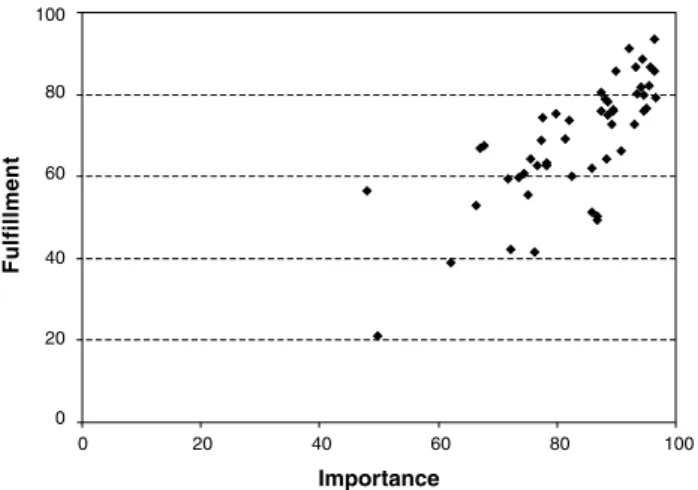
Figure 1 - Relationship between importance and fulillment of needs
Comparing mean importance values to the occurrence
and fulillment of various needs, we ind that needs rated
by parents as most important are also the most frequent,
and therefore those most fulilled for parents of hospitalized
children. The graph in Figure 1 shows this relationship, with needs represented as dots; coordinates represent mean
importance and fulillment of need.
Joint analysis of both distributions, of importance and
fulillment of needs, shows that six of the ten needs rated as
most important always occurred during hospitalization. They were: being able to trust that, even when absent, the child would receive the best medical and nursing care available; being able to stay with the child 24 hours a day; remaining informed about every treatment the child receives; being to sleep in the child’s room; and having hope about the child’s health status. These are, perhaps, the needs that best justify parents’ general satisfaction with their child’s hospitalization. We should also stress that no aspect rated
as very important by parents goes unfulilled.
Analysis of independence items
The percentage of afirmative answers regarding the role
of the hospital in providing support to the needs of parents
ranged from 69.2 to 95.9 percent. Parents felt the hospital
should not have the initiative in planning meetings with other parents to share and discuss the experience of pediatric hospitalization or provide a location at the service where parents can be alone. On the other hand, the hospital was considered fully responsible for providing information about possible prognoses, counseling while the child is prepared to be discharged and about special care to be provided to the child, information about their health status and how the disease and the treatment will impact their growth and development, among others.
Overall, mothers and fathers do not differ much regarding the responsibility they attribute to the hospital for helping them meet their needs. Exceptions are planning for discharge (p < 0.02), the presence of a teacher, educator or cultural entertainer (p < 0.04), for which mothers attribute more responsibility to the hospital than fathers. They also rate the hospital’s role in maintaining their hope about their child’s health status (p < 0.03), trusting in parents to care for the children at the hospital as well (p < 0.02), making them feel they are needed (p < 0.007), not blaming them for their child’s disease (p < 0.04), and being able to trust that, even when absent, their children would receive the best care available (p < 0.006).
Analysis of grouped items
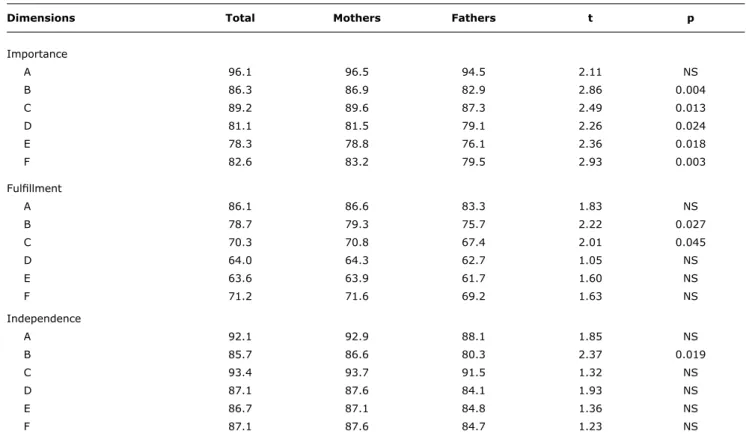
When importance items are aggregated, it becomes clear fathers and mothers of hospitalized children attribute high levels of importance to the need for trust, the need for information, and the need to be trusted. In terms of
how well those needs are met, we ind the aspects listed
above are indeed met. Finally, in terms of independence and the role of the hospital in meeting those needs, the need for information stands out. Mean values are presented
in Table 2.
This table allows us to conclude that, in relation to importance items, parents’ perceptions are positively correlated with the how their needs are met as well as to request that hospitals help meet those needs.
Discussion
Using Cronbach’s alpha, results from the cognitive
debrieing and internal consistency scores were similar to
those obtained by the authors of the original version6,16 and
good for the three subscales, allowing us to state that the questionnaire has the adequate psychometric properties to measure parents’ needs. We should also stress that the questionnaire has been used in other studies and other countries: in Iceland,6,18 Canada (both in English and in
French),9 Sweden,5,10 England,9 and Greece.2
Overall, parents valued all needs, especially the need to trust the care provided to their child when they are not present, as well as the need to be trusted and the need for information.
Dimensions total Mothers Fathers t p
Importance
A 96.1 96.5 94.5 2.11 NS
B 86.3 86.9 82.9 2.86 0.004
C 89.2 89.6 87.3 2.49 0.013
D 81.1 81.5 79.1 2.26 0.024
E 78.3 78.8 76.1 2.36 0.018
F 82.6 83.2 79.5 2.93 0.003
Fulillment
A 86.1 86.6 83.3 1.83 NS
B 78.7 79.3 75.7 2.22 0.027
C 70.3 70.8 67.4 2.01 0.045
D 64.0 64.3 62.7 1.05 NS
E 63.6 63.9 61.7 1.60 NS
F 71.2 71.6 69.2 1.63 NS
Independence
A 92.1 92.9 88.1 1.85 NS
B 85.7 86.6 80.3 2.37 0.019
C 93.4 93.7 91.5 1.32 NS
D 87.1 87.6 84.1 1.93 NS
E 86.7 87.1 84.8 1.36 NS
F 87.1 87.6 84.7 1.23 NS
table 2 - Mean aggregate values (total sample and by sex of adult accompanying child)
A = need to trust; B = need to feel they are trusted; C = need for information; D = need for support and guidance; E = need for physical and human resources; F = needs of the sick child and other family members; NS = not significant.
References
1. Algren C. Cuidado centrado na família da criança durante a doença e a hospitalização. In. Hockernberry M J. Wong: fundamentos de enfermagem pediátrica. Mosby: Rio de Janeiro; 2006. p. 637-705.
2. Kyritsi H, Matziou V, Perdikaris P, Evagelou H. Parent’s needs during their child’s hospitalization. Nursing Gr. 2005;23:1-9. 3. Vessey J. Children´s psychological responses to hospitalization.
In: Fitzpatrick J J. Annual review of nursing research. New York: Springer Publishing Company; 2003. p. 173-201.
4. Jorge A. Família e hospitalização da criança: (re)pensar o cuidar em enfermagem. Loures: Lusociência; 2004.
5. Shields L, Kristensson-Hallström I, O’callaghan M. An examination of the needs of parents of hospitalised children: Comparing parents’ and staff’s perceptions. Scand J Caring Sci. 2003;17:176-84. 6. Kristjánsdóttir G. Perceived importance of needs expressed by
parents of hospitalized 2 to 6 year olds. Scand J Caring Sci. 1995;9:95-103.
7. Callery P. Paying to participate: inancial, social and personal costs
to parents of involvement in their children’s care in hospital. J Adv Nurs. 1997;25:746-52.
8. Shields L. A review of the literature from developed and developing countries relating to the effects of hospitalization on children and parents. Int Nurs Review. 2001;48:29-37.
9. Shields L, Hunter J, Hall J. Parents’ and staff’s perceptions of parental needs during a child’s admission to hospital: an English perspective. J Child Health Care. 2004;8:9-33.
Parents also place high value on the information provided by health care professionals about their child’s health status, diagnostic examinations, treatment, and prognosis. This
matches the indings of other researchers, who consider the
information provided by health care professionals to parents as critical to lower their anxiety and insecurity, contributing to the well-being of the child and better performance of parental roles.5,15-17
Globally, parents say their needs are met during their child’s hospitalization, though they attribute to hospitals the role of helping them meet those needs.
Conclusion
In conclusion, the questionnaire proved to be a valid and reliable measurement instrument to assess the needs of parents during their pediatric hospitalizations.
10. Shields L, Kristensson-Hallstrom I. We have needs too: parental needs during a child´s hospitalization. Online Braz J Nurs. 2004;3: e. http://www.uff.br/nepae/siteantigo/objn303shieldsetal.htm. Access: 30/04/2006.
11. Dunckley M, Hugles R, Addington H J, Higginson I J. Language translation of outcome measurements tools: views of health professionals. Int J Palliat Nurs. 2003;9:49-55.
12. Hunt SM. Cross cultural comparability of measures and other issues related to multicountry studies. Br J Med Economics. 1993;6:27-34.
13. Ferreira P, Marques F. Avaliação psicométrica e adaptação cultural e linguística de instrumentos de medição em saúde: princípios metodológicos gerais. Coimbra: Centro de Estudos e Investigação em Saúde da Faculdade de Economia da Universidade de Coimbra; 1998.
14. Subtil C, Fonte A, Relvas A. Impacto na família da doença grave/ crônica em crianças: inventário de respostas à doença dos ilhos. Psiquiatr Clin. 1995;16:241-50.
15. Reis G. Expectativas dos pais durante a hospitalização da criança [dissertação]. Porto: Universidade do Porto; 2007.
16. Kristjánsdóttir G. A study of the needs of parents of hospitalized 2 to 6 year old children. Issues Compr Pediatr Nurs. 1991;14:49-64.
Correspondence: Pedro L. Ferreira Tel.: +351 239 790507 E-mail: [email protected]
17. Sabatés A, Borba R. As informações recebidas pelos pais
durante a hospitalização do ilho. Rev Latino Am Enfermagem. 2005;13:968-73.
18. Bragadottir H. A descriptive study of the extent to which self-perceived needs of parents are met in pediatric units in Iceland.
Scand J Caring Sci. 1999;13:201-7.
19. Hallstron I, Runeson I, Elander G. Observed parental needs during their child’s hospitalization. J Pediatr Nurs. 2002;17:141-8. 20. Melnyk B, Alpert-Gilles L, Feinstein N, Crean H. Creating
opportunities for parent empowerment: program effects on the mental health/coping outcomes of critically iII young children and their mothers. Pediatrics. 2004;113:597-607.
21. Brown J, Ritchie J. Nurses’ perceptions of parent and nurse roles in caring for hospitalized children. Children Health Care. 1999;19:28-36.