Instituto do Coração do Hospital das Clínicas - FMUSP
Mailing address: Fernando Antibas Atik Av. Chibarás, 626/101 04076003 -São Paulo-SP, Brazil
English version by Stela Maris C. e Gandour
Objective - To determine the risk factors for mortality related to myocardial revascularization when performed in association with coronary endarterectomy.
Methods - We assessed retrospectively 353 patients who underwent 373 coronary endarterectomies between January ’89 and November ’98, representing 3.73% of the myocardial revascularizations in this period of time. The ar-teries involved were as follows: right coronary artery in 218 patients (58.45%); left anterior descending in 102 patients (27.35%); circumflex artery in 39 patients (10.46%); and diagonal artery in 14 patients (3.74%). We used 320 (85.-79%) venous grafts and 53 (14.21%) arterial grafts.
Results - In-hospital mortality among our patients was 9.3% as compared with 5.7% in patients with myo-cardial revascularizations without endarterectomy (p=0.003). Cause of death was related to acute myocar-dial infarction in 18 (54.55%) patients. The most signifi-cant risk factors for mortality identified were as follows: diabetes mellitus (p=0.001; odds ratio =7.168), left main disease (<0.001; 9.283), female sex (0.01; 3.111), acute myocardial infarction (0.02; 3.546), ejection fraction <35% (<0.001; 5.89), and previous myocardial revascu-larization (<0.001; 4.295).
Conclusion – Coronary endarterectomy is related to higher mortality, and the risk factors involved are impor-tant elements of a poor outcome.
Key words - coronary endarterectomy, myocardial revas-cularization, atherosclerosis
Arq Bras Cardiol, volume 75 (nº 4), 275-280, 2000
Fernando Antibas Atik, Luís Alberto O liveira Dallan, Sérgio Almeida de O liveira, Luiz Augusto Ferreira Lisboa, Fernando Platania, Richard Halti Cabral, Adib Domingos Jatene
São Paulo, SP - Brazil
Myocardial Revascularization with Coronary
Endarterectomy. Stratification of Risk Factors for Early
Mortality
Coronary endarterectomy as proposed by Bailey et al 1 has been used since 1957 as a form of myocardial revascula-rization. Currently, marked technological developments have changed cardiac surgery and have reduced the unsuc-cessful indices of myocardial revascularization discarding coronary endarterectomy as a possible treatment for coro-nary heart disease for some decades, because of its high morbidity and mortality.
On the other hand, a great increase in surgical indica-tions has occurred for individuals of more advanced ages with diffuse coronary heart disease, whose lesions were frequently considered inoperable through conventional methods. The need for complete myocardial revasculariza-tion in these patients has justified the resurgence of corona-ry endarterectomy 2.
Because of the difficulty in defining precisely the ide-al patients to undergo coronary endarterectomy, which re-sults in a variability of indications and occasionally in its indiscriminate use, coronary endarterectomy has been cha-racterized as a risk factor of mortality associated with myo-cardial revascularization 3, mainly related to perioperative acute myocardial infarction. Therefore, the use of coronary endarterectomy is still a matter of controversy and its re-sults are highly variable due to lack of uniformity.
The objective of this study is to assess the in-hospital evolution of patients undergoing this procedure and to de-termine the risk factors related to its morbidity and mortality.
Methods
period. Ages of the patients ranged from 29 to 84 years (mean of 59.8 years), and 276 (78.19%) patients were males. Of all patients, 171 (48.44%) had 3 or more risk factors for coronary heart disease and 138 (39.09%) were diabetic patients. Surgical indication resulted from unstable angina in 190 (53.82%) patients, and 197 (55.81%) patients were in functional class III or IV of the Canadian Cardiovascular Society. Fifty-seven (16.15%) patients were operated on during the acute phase of acute myocardial infarction.
Twenty-four (6.8%) patients were operated upon on an emergency basis. Previous acute myocardial infarction and myocardial revascularization occurred, respectively, in 179 (50.71%) and 27 (7.6%) patients. Triple vessel involvement occurred in 323 (91.5%) patients, and 47 (13.31%) patients had left main disease. Ventricular function was significantly impaired (ejection fraction < 35%) in 51 (14.45%) patients.
All patients underwent surgery with extracorporeal circulation. The methods of cardiac protection used were intermittent aortic clamping with mild hypothermia in 204 (57.8%) patients and cold blood cardioplegia in the remai-ning patients. The manual technique of endarterectomy was adopted through a wide arteriotomy and removal of thrombi proximal and distal to the opening. In cases of arteriotomies larger than 3 cm, reconstruction was performed through wide venous anastomoses or through arterioplasty with the saphenous vein followed by an anastomosis with arterial graft at the center of the venous fragment.
We performed 373 endarterectomies, and the procedu-re was performed twice in 20 patients. The arteries operated upon were the following: right coronary artery in 218 (58.45%) patients; left anterior descending artery in 102 (27.35%) patients; circumflex artery and its branches in 39 (10.46%) patients; and diagonal artery in 14 (3.74%) patients. We used the saphenous vein graft in 320 (85.79%) patients, the left internal thoracic artery graft in 39 (10.46%) patients, the right internal thoracic artery graft in 11 (2.95%) patients, the right gastroepiploic artery graft in 2 (0.55%) patients, and the radial artery graft in one (0.26%) patient.
We performed a mean of 3.32 anastomoses per patient. The mean durations of extracorporeal circulation and ano-xia were, respectively, 116.27 and 71.95 minutes.
The most frequently associated procedure was left ventricular aneurysmectomy in 21 patients, and we added thrombectomy in 11 patients. The other procedures asso-ciated were left ventricular thrombectomy in 9 patients, mi-tral valvoplasty in 5 patients, aortic valve replacement in 4 patients, mitral valve replacement in 3 patients, carotid en-darterectomy in 2 patients, replacement of the ascending aorta in 2 patients, correction of a fistula between the right coronary artery and the pulmonary artery in one patient, and pulmonary lobectomy in one patient.
In the postoperative period, characterization of acute myocardial infarction followed basically electrocardiogra-phic criteria, such as new Q waves, persistent intraventri-cular conduction defects, and poor of progression of the R wave in precordial leads. In addition, changes in regional contraction on the two-dimensional echocardiogram that
did not exist in the preoperative period were also conside-red. Measurement of MB fraction of the creatine phospho-kinase, even though a routine procedure in the immediate postoperative period, did not constitute an absolute crite-rion for acute myocardial infarction, acting as a guide for this diagnosis when its value was 10% greater than that of total creatine kinase.
From the first postoperative day on, all patients recei-ved 200mg/day of acetylsalicylic acid until hospital dis-charge. Patients receiving arterial grafts were treated with calcium channel blockers (diltiazem – 180mg/day) from the first postoperative day on.
We tried to study the possible predictive factors of in-hospital death initially through a univariate analysis using the following tests: chi-square test, Pearson's test, Fisher's exact test, Student's t test, and Wilcoxon test. To estimate the probability of in-hospital death considering the varia-bles selected in the univariate analysis, through a multiva-riate model, we used the logistic regression technique. The significance level established was 0.05.
Results
In-hospital mortality was 9.35% (33 patients) as com-pared with 5.66% of the remaining myocardial revascula-rizations (p=0.003). The cause of death was related to perio-perative acute myocardial infarction with cardiogenic shock in 18 (54.55%) patients. Intraaortic balloon was used in 46 (13.03%) patients. Acute myocardial infarction and arrhyth-mias in the postoperative period occurred in 48 (13.6%) and 100 (28.33%) patients, respectively. Twenty-three (6.52%) patients had to be reoperated upon and the causes were as follows: mediastinal bleeding in 15 patients, 9 of whom also had associated cardiac tamponade; acute myocardial infarc-tion in 3 patients; cardiopulmonary arrest in 2 patients; and mediastinitis in the 3 remaining patients.
To define the risk factors for mortality, the patients were divided into 2 groups as follows: group 1 - comprising 320 patients who survived the surgical procedure and were discharged from the hospital; group 2 - comprising 33 patients who evolved to in-hospital death.
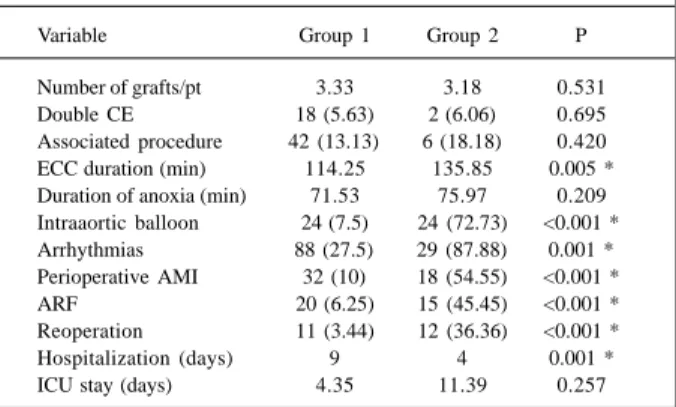
proce-dures, duration of anoxia, and duration of the intensive care unit stay were also studied in the univariate analysis, but they did not reach statistical significance (Table II).
To select the most important variables for assessing the probability of death, we used multivariate analysis, whi-ch identified the following preoperative risk factors (Table III): female gender, diabetes mellitus, disease left main, pati-ents undergoing surgery in the acute phase of myocardial infarction, previous myocardial revascularization, and ejec-tion fracejec-tion <35%.
No statistically significant relation was found between the artery undergoing endarterectomy and the use of the in-traaortic balloon pump the presence of arrhythmias, perio-perative acute myocardial infarction, and death (Table IV). We also found no relation between the type of graft used in the artery undergoing endarterectomy and the above-cited variables (Table V).
Discussion
The era of direct operations on coronary arteries for the treatment of coronary heart disease4 started in 1957 with the performance of direct endarterectomy by Bailey et al 1. With the appearance of extracorporeal circulation and spread of myocardial revascularization through venous grafts, the technique of direct endarterectomy remained out of use for several years.
The concept of complete myocardial revascularization gained strength in cardiology because of the higher inci-dence of late deaths, recurrence of angina, myocardial in-farction, and reoperations in patients treated incompletely 5,6. Improvement in the results of myocardial revascularization caused by a larger experience, by the development of me-thods of myocardial protection, and by the use of the inter-nal thoracic artery has allowed its application in patients Table I – Risk factors for preoperative mortality related to coronary
endarterectomy through univariate analysis
Variable Group 1 Group 2 P
N 320 33 ——
Age (years) 59.75 60.7 0.587
Female sex 64 (20) 13 (39.39) 0.010 * Diabetes mellitus 116 (36.25) 22 (66.67) 0.001 * Risk factors ** 151 (47.19) 20 (60.61) 0.142 Previous AMI 156 (48.75) 23 (69.7) 0.022 * Previous MR 20 (6.25) 7 (21.21) <0.001 * AMI 47 (14.69) 10 (30.3) 0.020 * Triple vessel 259 (80.94) 27 (81.82) 0.902 LM 37 (11.56) 10 (30.3) <0.001 * EF < 35% 37 (11.56) 14 (42.42) <0.001 * Emergency 21 (6.56) 3 (9.1) 0.583
Data between parentheses are percentages; * - statistically significant data; ** - three or more risk factors for coronary heart disease; AMI-acute myocardial infarction; MR- myocardial revascularization; LM left main disease; EF- ejection fraction.
Table II – Operative and postoperative risk factors for mortality related to coronary endarterectomy through univariate analysis
Variable Group 1 Group 2 P
Number of grafts/pt 3.33 3.18 0.531 Double CE 18 (5.63) 2 (6.06) 0.695 Associated procedure 42 (13.13) 6 (18.18) 0.420 ECC duration (min) 114.25 135.85 0.005 * Duration of anoxia (min) 71.53 75.97 0.209 Intraaortic balloon 24 (7.5) 24 (72.73) <0.001 * Arrhythmias 88 (27.5) 29 (87.88) 0.001 * Perioperative AMI 32 (10) 18 (54.55) <0.001 * ARF 20 (6.25) 15 (45.45) <0.001 * Reoperation 11 (3.44) 12 (36.36) <0.001 * Hospitalization (days) 9 4 0.001 * ICU stay (days) 4.35 11.39 0.257
Data between parentheses are percentages; * - statistically significant data; pt- patient; CE- coronary endarterectomy; ECC- extracorporeal circulation; AMI- acute myocardial infarction; ARF- acute renal failure; ICU- intensive care unit.
Table III - Risk factors for mortality related to coronary endarterectomy through multivariate analysis with estimation of
odds ratio
Variables Odds ratio
Female sex 3.111
Diabetes mellitus 3.482
Left main disease 3.767
Acute myocardial infarction 3.546 Previous revascularization 4.295
Ejection fraction 35% 5.890
Table IV- Relation between the site of endarterectomy and morbidity and mortality
Arteries RC AIVB Cx Di p
IAoB 22 (11) 13 (14.61) 8 (23.53) 3 (27.27) 0.092 Arrhythmia 57 (28.5) 31 (34.83) 17 (50) 5 (45.45) 0.066 AMI 27 (13.5) 12 (13.48) 7 (20.59) 1 (9.09) 0.715 Death 18 (9) 7 (7.87) 5 (14.71) 1 (9.09) 0.631
Total 200 89 34 11
-Data between parentheses are percentages; RC- right coronary artery; AIVB- anterior interventricular branch of the left coronary artery; Cx-circumflex artery; Di- diagonal artery; IaoB- intraaortic balloon; AMI-perioperative acute myocardial infarction.
Table V – Relation between the type of graft used in myocardial revascularization associated with coronary endarterectomy and
morbidity and mortality
Graft Venous Arterial p
IAoB 43 (14.93) 4 (8.33) 0.222
Arrhythmia 98 (34.03) 13 (27.08) 0.344
AMI 41 (14.24) 6 (12.5) 0.748
Death 30 (10.42) 1 (2.08) 0.100
Total 288 48
with diffuse coronary heart disease, which was earlier con-sidered a surgical contraindication. In addition, technolo-gical development has contributed to delay in operative indication because of pharmacological or percutaneous treatment, or both. Therefore, the presence of patients with advanced atherosclerotic disease with a still viable myocar-dium is increasingly more frequent, in whom the only way of effectively preserving function is through removal of the atheromatous plaque, followed by revascularization with venous or arterial grafts, or both.
The use of coronary endarterectomy, however, is still con-troversial mainly because of lack of uniformity in its indications and controversial results, according to studies in the literature, most of which are retrospective. A first issue to be approached is the definition of the ideal patient and the concept of diffuse atherosclerotic disease of coronary arteries. Livesay et al3 have considered necessary the presence of occluded arteries with multiple stenoses and diffuse distal involvement. Christakis et al 7 have added the presence of arteries perfusing viable myocar-dium with reversible ischemia, documented by scintigraphy with thallium or analysis of regional contraction on echocardiogram, or both. The contraindications for the procedure consisted of arteries with diameter smaller than 1mm irrigating myocardial areas of fibrosis secondary to previous infarcts and extremely calcified vessels 8,9. Souza et al 10 divide the indications of coronary endarterectomies into planned, when the procedure may be planned through preoperative coronary angiography, and necessary, when during operation the surgeon finds a previously attractive artery for myocardial revascularization but only coronary endarterectomy makes the procedure feasible.
The frequency of coronary endarterectomy varies with the medical center. Some groups perform it in a liberal manner without a careful analysis of each case, where it may represent up to 42% of the myocardial revasculariza-tions performed 11. Our incidence of 3.73% reflects our con-servative trend in regard to the procedure.
Another relevant issue is the importance of cardiac risk factors for the disease that affects millions of people in the entire world, but in this case it seems to manifest in a much more intense manner with significant repercussions when clinically or surgically treated 12. When comparing conventional myocardial revascularization with that asso-ciated with coronary endarterectomy, Livesay et al 3 identi-fied in the latter group a higher incidence of male patients, of patients with diabetes mellitus, with ventricular dysfunc-tion, and a higher number of arteries undergoing revascula-rization per patient. The higher incidence of postoperative acute myocardial infarction was related to incomplete obs-truction (stenosis <90%) of the coronary artery undergoing endarterectomy 13.
Brenowitz et al 12 have defined the following as risk factors for multiple endarterectomy: age >70 years, reopera-tion, insulin-dependent diabetes mellitus, female sex, and severe ventricular dysfunction. They also established a re-lation between the higher number of these factors and mor-tality. In patients undergoing multiple coronary endarterec-tomy and in the presence of 2 or more of these factors, the
index was 26.9%, and in those with no risk factor it was 1.7%. The application of this index was reproduced by Salerno et al 8, but not by other authors 14.
Therefore, determination of the risk factors related to mortality of myocardial revascularization associated with coronary endarterectomy is extremely important to establi-sh the most favorable cases. In our study, we identified as risk factors for in-hospital mortality the following: female gender, diabetes mellitus, left main disease, acute myocar-dial infarction, previous myocarmyocar-dial revascularization, and ejection fraction <35%. We found a relation between a hi-gher number of these risk factors and the chance of in-hos-pital death.
From the technical point of view, endarterectomy may be manual or with the aid of carbon dioxide to detach the atheromatous plaque, but the latter has been currently aban-doned. The procedure should be complete, and therefore it is more difficult to perform in the left coronary artery becau-se of its great number of branches and becaubecau-se of its smal-ler diameter. Arteriotomy size varies according to the facility of plaque detachment and may extend distally. Serial inci-sions may be performed to avoid blind tractions and intimal lesions. Therefore, because of the difficulty in accessing the branches of the left coronary artery, the resulting arterioto-my may be very long 14.
The methods of reconstruction of the wide arterioto-my comprise the following: primary suture, wide anastomo-sis with venous grafts, and arterioplasty with fragments of the saphenous vein isolated or followed by myocardial re-vascularization with arterial grafts 15,16.
More frequently, coronary endarterectomy is perfor-med in a single manner, but some authors 17 report its perfor-mance in two, three, and even seven arteries. Other authors believe a relation exists between the number of endarterec-tomies and the greatest morbidity and mortality, but this could not be reproduced in our study nor in others 7,13,17.
The procedure usually requires a greater period of ex-tracorporeal circulation and anoxia 7. Therefore, myocardial protection is mandatory. The method to be employed is, however, another point of controversy. Most authors prefer blood cardioplegia 2.
The site of endarterectomy, morbidity, and mortality is a controversial point. The right coronary artery was the first and is still the most frequently used artery because of the greater technical simplicity of the procedure in this artery and the relatively low risk. Brenowitz et al 12 introduced the use in the left arterior descending artery, but they reported a higher immediate mortality, as did others 3,11,13. These data could not be reproduced by Minale et al 18 or by us, where a similar incidence was shown. We believe that the risk factors and performance of complete myocardial revascularization are more important than sim ply the site where coronary en-darterectomy is performed.
found in the latter group lower mortality and incidence of acute myocardial infarction, a higher permeability of grafts at short- and long-term follow-up, and a higher symptoma-tic relief in the late follow-up. In our experience, despite the predominant use of venous grafts, we did not find signifi-cant differences between the type of graft used and imme-diate morbidity and mortality.
The main cause of failure in the postoperative period of coronary endarterectomy is acute myocardial infarction, which is directly related to thrombosis in the site of endarte-rectomy. This is the reason why some groups have routi-nely used platelet antiaggregating agents and anticoagu-lants, with significant changes in the prognosis 21. Other causes of early occlusion of grafts are the incomplete remo-val of atheromatous plaques, intimal flap obstructing tribu-tary vessels, conditions of low cardiac output, technical blems of the anastomosis, and inadequate myocardial pro-tection. Postoperative frequency of acute myocardial in-farction has ranged from 5 to 25%, with an associated mortality ranging from 0 to 15%. In our experience, these values were 13.6% and 5%, respectively.
The short-term results of coronary endarterectomy vary according to the study, reflecting variability in indica-tions and operative techniques, as more recent studies 7,13,17 have shown a significant improvement in results. Most studies, however, show a higher incidence of acute myocardial infarction, immediate mortality 8, and a lower patency of the grafts performed in arteries undergoing endarterectomy, in relation to those where this resource was not used. The study by Livesay et al 3 has analyzed the early and late evolution of 3,369 patients undergoing coronary endarterectomy, as compared with another group of 27,095 patients, in whom myocardial revascularization was not associated with coronary endarterectomy, during a period of 14 years. These authors have found a higher mortality (4.4%), a higher incidence of postoperative acute myocardial infarction (5.4%), and a higher incidence of cardiac arrest (3.5%) in the group undergoing coronary endarterectomy as compared with that undergoing only myocardial revascularization.
Some authors 7,14,17,22-24, however, report in-hospital mortality and patency of venous grafts similar for both groups. Larock et al 22, with some differences in group ho-mogeneity, have found a higher incidence of perioperative acute myocardial infarction, including impairment of the segmentary contractility assessed by myocardial scinti-graphy with thallium. Christakis et al 7, adopting strict criteria for indication, have prospectively studied 317 pa-tients undergoing coronary endarterectomy as compared with 911 patients undergoing conventional myocardial revascularization with documented homogeneity between both groups. They have found a similar incidence of in-hospital deaths (3.2% and 3.8%), acute myocardial infarc-tion (6% and 5.5%), low cardiac output syndrome (15.1% and 12.6%), and use of intraaortic balloon (4.5% and 6%). The authors have attributed these results to the strict
se-lection of patients and the large experience with the tech-nique.
Late survival ranges from 71% 13,17 to 90% after 5 years 7, being comparable to that of the group undergoing conven-tional myocardial revascularization. Higher late mortality was observed in patients with acute myocardial infarction prior to surgery 13, and also with advanced age and ventricu-lar dysfunction 12, reflecting the more aggressive nature of the disease.
Sequential anatomicopathological studies have de-monstrated that, in cases of failure after endarterectomy, an accelerated process of myointimal proliferation occurs fol-lowed by atherosclerosis in a second plane 25,26.
Livesay et al 3 have found a small increase in the risk of mortality (2.9% per year) and in late complications in the long-term. The clinical evolution and prognosis, however, were similar to those of patients undergoing only myocardial revascularization. Patency of the grafts did not differ from that of coronary endarterectomy, being around 75% in 29 months. These data were reproduced by Goldstein et al 9, who have found late permeability of 64% in 19 months.
On the other hand, Minale et al 18 found different results when studying patency and changes in segmentary contrac-tility after performing 728 coronary endarterectomies. Paten-cy of the arteries undergoing endarterectomy was much lo-wer than that of the arteries where this procedure was not used (45% versus 73.8%). These data agreed with mainte-nance of anginal symptoms and worsening in functional class. Segmentary contractility improved in 35% to 45% of the previously hypokinetic and akinetic areas, and worsening of segmentary contractility happened in 24% of the normal areas, reflecting a greater risk of contractile deterioration and a certain degree of subclinical perioperative acute myocardial infarction. Therefore, they postulate that this procedure should be limited to patients with unstable, critical, irrespon-sive clinical findings, limited to arteries that irrigate the left ventricular posterior wall with mild ventricular dysfunction. In conclusion, resurgence of coronary endarterectomy as an adjunctive of myocardial revascularization is a strong concept that has gained impetus through the technological development related to cardiac surgery, providing a signifi-cant improvement in its results, comparable to those of conventional myocardial revascularization. When perfor-med in an indiscriminate manner in diffuse atherosclerotic disease, a higher in-hospital mortality occurs, related to perioperative acute myocardial infarction. The risk factors identified in this study are important components related to a poorer evolution and should be considered in surgical in-dication. Coronary endarterectomy should be used whene-ver possible in selected patients in a programmed manner to promote myocardial revascularization.
Acknowledgments
1. Bailey CP, May A, Lemmon WM. Survival after coronary endarterectomy in man. JAMA 1957; 164: 641-6.
2. Loop FD. Resurgence of coronary artery endarterectomy. J Am Coll Cardiol 1988; 11: 712-3.
3. Livesay JL, Cooley DA, Hallman GL, et al. Early and late results of coronary en-darterectomy. Analysis of 3,369 patients. J Thorac Cardiovasc Surg 1986; 92: 649-60.
4. Mueller RL, Rosengart TK, Isom OW. The history of surgery for ischemic heart disease. Ann Thorac Surg 1997; 63: 869-78.
5. Lawrie GM, Morris GC, Silvers A. The influence of residual disease after coro-nary bypass on the 5 year survival rate of 1274 men with corocoro-nary artery disease. Circulation 1982; 66: 717-23.
6. Jones EL, Craver JM, Guyton RA, et al. Importance of complete revascularization in performance of the coronary bypass operation. Am J Cardiol 1983; 51: 7-12. 7. Christakis GT, Rao V, Fremes SE, Chen E, Naylor D, Goldman BS. Does coronary
endarterectomy adversely affect the results of bypass surgery? J Card Surg 1993; 8: 72-8.
8. Salerno PR, Dinkhuysen JJ, Chacur P, et al. Técnica e resultados da endarterecto-mia de artéria coronária. Rev Bras Cir Cardiovasc 1994; 9: 152-8.
9. Goldstein J, Cooper E, Saltups A, Boxall J. Angiographic assessment of graft pa-tency after coronary endarterectomy. J Thorac Cardiovasc Surg 1991; 102: 539-45.
10. Souza LCB, Paulista PP, Sousa JEMR, et al. Endarteriectomia eletiva e revascu-larização do miocárdio. Arq Bras Cardiol 1983; 41: 327-34.
11. Qureshi SA, Halim MA, Pillai R, Smith P, Yacoub MH. Endarterectomy of the left coronary system. Analysis of a 10 year experience. J Thorac Cardiovasc Surg 1985; 89: 852-9.
12. Brenowitz JB, Kayser KL, Johnson D. Results of coronary artery endarterectomy and reconstruction. J Thorac Cardiovasc Surg 1988; 95: 1-10.
13. Djalilian AR, Shumway SJ. Adjunctive coronary endarterectomy: improved sa-fety in modern cardiac surgery. Ann Thorac Surg 1995; 60: 1749-54. 14. Sommerhaug RG, Wolfe SF, Reid DA, Lindsey DE. Early clinical results of long
References
coronary arteriotomy, endarterectomy and reconstruction combined with multi-ple bypass grafting for severe coronary artery disease. Am J Cardiol 1990; 66: 651-9.
15. Ladowski JS, Schatzlein MH, Underhill DJ, Peterson AC. Endarterectomy, vein patch, and mammary bypass of the anterior descending artery. Ann Thorac Surg 1991; 52: 1187-9.
16. Aranki SF. A modified reconstruction technique after extended anterior descen-ding artery endarterectomy. J Card Surg 1993; 8: 476-82.
17. Brenowitz JB, Kayser KL, Johnson WD. Triple vessel coronary artery endarte-rectomy and reconstruction. Results in 144 patients. J Am Coll Cardiol 1988; 11: 706-11.
18. Minale C, Nikol S, Zander M, Uebis R, Effert S, Messmer BJ. Controversial aspects of coronary endarterectomy. Ann Thorac Surg 1989; 48: 235-41.
19. Gill IS, Beanlands DS, Boyd D, Finlay S, Keon WJ. Left anterior descending en-darterectomy and internal thoracic artery bypass for diffuse coronary disease. Ann Thorac Surg 1998; 65: 659-62.
20. Beretta L, Lemma M, Vanelli P, et al. Coronary open endarterectomy and recons-truction: short and long-term results of the revascularization with saphenous vein versus IMA-graft. Eur J Cardiothorac Surg 1992; 6: 382-7.
21. Cheseboro JH. Effect of dipyridamole and aspirin on late vein-graft patency after coronary bypass operations. N Engl J Med 1984; 310: 209-14.
22. Larock MP, Burguet W, Grenade T, et al. Usefulness of thromboendarterectomy in association with coronary artery bypass grafting. Am J Cardiol 1987; 60: 1025-9.
23. Kamath ML, Schmidt DH, Pedraza PM, et al. Patency and flow response in endar-terectomized coronary arteries. Ann Thorac Surg 1981; 31: 28-35.
24. Asimakopoulos G, Taylor KM, Ratnatunga CP. Outcome of coronary endarterec-tomy: a case-control study. Ann Thorac Surg 1999; 67: 989-93.
25. Walley VM, Byard RW, Keon WJ. A study of the sequential morphologic changes after manual coronary endarterectomy. J Thorac Cardiovasc Surg 1991; 102: 890-4. 26. Kragel AH, McItosh CM, Roberts WC. Morphologic changes in coronary artery