Extensional collapse in the Neoproterozoic Arac¸uaı´ orogen, eastern
Brazil: a setting for reactivation of asymmetric crenulation cleavage
Stephen Marshak
a,*, Fernando F. Alkmim
b, Alan Whittington
c,
Antoˆnio Carlos Pedrosa-Soares
daDepartment of Geology, University of Illinois, Urbana, IL 61801, USA
bDepartamento de Geologia, Universidade Federal de Ouro Preto, Ouro Preto, MG 35400, Brazil cDepartment of Geology, University of Missouri, Columbia, MO 65211, USA
dCPMTC-Instituto de Geocieˆncias, Universidade Federal de Minas Gerais, Belo Horizonte, MG 31279, Brazil
Received 16 July 2004; received in revised form 19 July 2005; accepted 21 September 2005 Available online 4 November 2005
Abstract
The Arac¸uaı´ orogen of eastern Brazil is one of many Brasiliano/Pan African orogens formed during the Neoproterozoic assembly of Gondwana. Its western edge, bordering the Sa˜o Francisco craton, is the Serra do Espinhac¸o fold-thrust belt, in which top-up-to-the-west (reverse-sense) faults, west-verging folds (F1), and east-dipping spaced to phyllitic cleavage (S1) developed. We have found that the
kinematics of deformation changes markedly at the hinterland margin of this fold-thrust belt. Here, beneath a plateau known as the Chapada Acaua˜, metadiamictite and fine-grained pelitic schist comprise an east-dipping belt that contains an assemblage of structures indicative of top-down-to-the-east (normal-sense) shear. This assemblage includes a cascade of F2folds that refold F1folds and verge down the dip of the
belt’s enveloping surfaces, vertical tension gashes, and top-down-to-the-east rotated clasts. Based on the presence of these structures, we propose that the plateau exposes a regional-scale normal-sense shear zone, here called the Chapada Acaua˜ shear zone (CASZ). Because F2
folds refold F1folds, normal-sense shear in the CASZ occurred subsequent to initial west-verging thrusting. Considering this timing of
motion in the CASZ, we suggest that the zone accommodated displacement of the internal zone of the Arac¸uaı´ orogen down, relative to its foreland fold-thrust belt, and thus played a role in extensional collapse of the orogen. The CASZ trends parallel to preserved thrusts to the west, and thus may represent an inverted thrust fault. Notably, throughout the CASZ, S1schistosity has been overprinted by a pervasive,
west-dipping asymmetric crenulation cleavage (S2). The sigmoid shape of S1surfaces in S2microlithons require that slip on each S2surface
was top-down-to-the-west. S2cleavage is axial-planar to the down-dip verging F2folds. Based on its geometry, we suggest that S2cleavage
initiated either as an antithetic extensional crenulation cleavage during reverse-sense shear, or as a near vertical asymmetric crenulation cleavage formed during east–west shortening of a preexisting east-dipping schistosity. Subsequent normal-sense shear in the CASZ reactivated this cleavage, causing clockwise rotation of S2domains (as viewed looking along-strike to the north), in a manner similar to that
of rotational ‘bookshelf faults’. Such movement could have accommodated concomitant vertical flattening of the CASZ during extensional collapse.
q2005 Elsevier Ltd. All rights reserved.
Keywords:Arac¸uaı´ orogen; Crenulation cleavage; Brasiliano orogeny; Orogenic collapse; Shear zone; Crustal extension; Neoproterozoic; Extensional crenulation cleavage; Espinhac¸o fold-thrust belt; Macau´bas basin
1. Introduction
When continental crust thickens during convergent or collisional orogeny, gravitational loading may trigger
extensional collapse (or ‘orogenic collapse’) above a normal-sense shear zone (or ‘extensional detachment’). Extensional collapse has been linked to the rise of post-tectonic granites and to the growth of late- to post-post-tectonic
sedimentary basins in the interior of orogens (Dewey, 1977;
Burchfiel and Royden, 1985; Norton, 1986; Me´nard and Molnar, 1988; Platt and Vissers, 1989; Malavieille et al., 1990; Malavieille and Taboada, 1991; Burchfiel et al., 1992;
Malavieille, 1993; Rey et al., 2001). Work by
Pedrosa-Soares et al. (2001), among others, demonstrates that the
Journal of Structural Geology 28 (2006) 129–147
www.elsevier.com/locate/jsg
0191-8141/$ - see front matterq2005 Elsevier Ltd. All rights reserved. doi:10.1016/j.jsg.2005.09.006
* Corresponding author.
interior of the Neoproterozoic-age Arac¸uaı´ orogen of eastern Brazil contains both late- to post-tectonic granites as well as post-tectonic sedimentary accumulations. The presence of these features hints that the orogen endured a phase of extensional collapse. To test this concept, we carried out structural analysis across the foreland/hinterland boundary of the Arac¸uaı´ orogen, with the goal of
determining whether the region contains a structural record of extensional deformation. Our results point to the existence of a previously unrecognized regional-scale normal-sense shear zone, here called the Chapada Acaua˜ shear zone (CASZ), which developed along the hinterland edge of the orogen’s fold-thrust belt. This shear zone dips east, parallel to faults in the fold-thrust belt to the west.
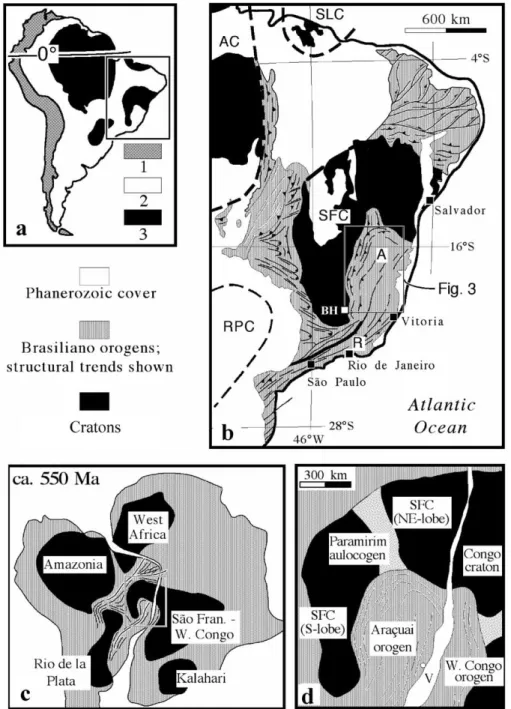
Fig. 1. (a) A location map of South America, showing the distribution of cratons and younger tectonic elements. On this map: 1Zregions involved in the
Andean orogeny; 2Zregions underlain by Brasiliano (Neoproterozoic) or younger (Paleozoic) orogenic belts; 3Zregions underlain by cratons, meaning
relatively stable crustal blocks that were not affected by the Brasiliano or younger orogenies. (b) A regional map of eastern Brazil. The heavy dashed lines outline the cratons, and white areas represent Phanerozoic cover. SFCZSa˜o Francisco craton, ACZAmazon craton, RPCZRio de la Plata craton; SLCZSa˜o
Luis craton; AZArac¸uaı´ Orogen; RZRibeira Belt. Note that the Arac¸uaı´ Orogen consists of rocks in the region between the coast and the Sa˜o Francisco
Considering its position and its kinematics, we suggest that the CASZ represents an inverted thrust, and that it served as a detachment accommodating extensional collapse of the Arac¸uaı´ orogen’s internal zone relative to its foreland fold-thrust belt. Significantly, exposures of the CASZ do not contain mylonite, in contrast with other examples of regional extensional detachments. Rather, schist in the CASZ displays a pervasive asymmetric crenulation clea-vage. This cleavage dips west, and thus is antithetic to the enveloping surfaces of the CASZ.
The purpose of this paper is two-fold. First, we present evidence for the existence of the CASZ and for the kinematics of displacement across it. Then, we describe the crenulation cleavage within the shear zone and discuss a model for the evolution this cleavage. We suggest that the cleavage initiated during thrusting, and was reactivated during normal-sense displacement of the CASZ. To set the stage for our discussion of the CASZ, and the crenulation cleavage that it contains, we begin by outlining the geologic setting of the Arac¸uaı´ orogen.
2. Geologic setting
The continental crust of Brazil consists of four major cratons (relatively stable blocks of Archean and Paleopro-terozoic crust) stitched together by NeoproPaleopro-terozoic-age
Brasiliano (ZPan African) orogens. One of these cratons,
the Sa˜o Francisco craton, underlies part of eastern Brazil. This craton’s map-view shape resembles the profile of a
horse’s head (Fig. 1). According to tectonic reconstructions
of West Gondwana (Dalziel, 1997), the northeast arm of the
Sa˜o Francisco craton connected to the Congo craton of Africa, prior to opening of the South Atlantic Ocean. This combination, a single coherent crustal block called the Sa˜o Francisco-Congo craton, lay in the center of West Gondwana and had the shape of a lopsided, upside-down ‘U’. A Neoproterozoic orogen, called the Arac¸uaı´-West Congo orogen, developed in the tongue-shaped enclave that
occupied the interior of the upside-down ‘U’ (Fig. 1d;
Porada, 1989; Brito-Neves and Cordani, 1991; Pedrosa-Soares et al., 1992, 1998, 2001; Trompette, 1997; Uhlein et al., 1998; Cunningham et al., 1998; Brito-Neves et al., 1999; Alkmim et al., 2001; Martins-Neto et al., 2001; Tack et al., 2001). When the South Atlantic Ocean opened in the Mesozoic, the Arac¸uaı´-West Congo orogen split in two, along its length, stranding the Arac¸uaı´ orogen and the Sa˜o Francisco craton in Brazil, while the West Congo orogen and the Congo craton remained in Africa. In this context, the Arac¸uaı´ orogen is defined as the Neoproterozoic orogenic domain that lies between the eastern edge of the Sa˜o Francisco craton and east coast of Brazil, between latitudes
158S and 218S (Pedrosa-Soares et al., 2001).
Current tectonic models (Pedrosa-Soares et al., 1992,
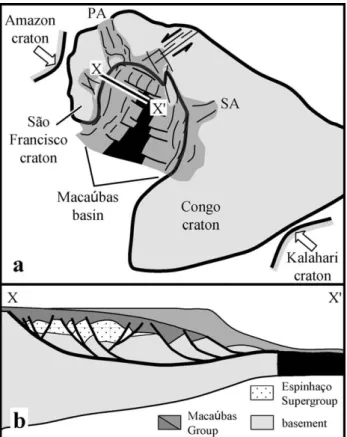
1998, 2001; Uhlein et al., 1998) suggest that the Arac¸uaı´ orogen developed in response to closure of a composite sedimentary basin. Basin formation began at about 1.75 Ga, with the development of the unsuccessful Espinhac¸o rift (named for the stratigraphic unit, the Espinhac¸o Super-group, which filled it). Remnants of the Espinhac¸o rift can be traced northwards along the eastern edge of the Sa˜o Francisco craton into a trough, called the Paramirim aulacogen, that defines the border between the northeast
and southern lobes of the craton (Fig. 1d). A second rifting
event, commencing at about 0.95 Ga, generated a broader basin that is superimposed on, and extends eastwards from,
the Espinhac¸o rift (Pedrosa-Soares et al., 1992, 1998, 2001;
Uhlein et al., 1998). This second basin is named the
Macau´bas basin, after the stratigraphic unit (the Macau´bas
Group) that filled it (Fig. 2a and b). To the south of latitude
178S, the Macau´bas basin opened sufficiently to produce
oceanic crust, but to the north of this latitude, the basin was
ensialic (Pedrosa-Soares et al., 1998, 2001). In other words,
the Macau´bas basin tapered from a narrow ocean basin to the south into an ensialic rift to the north. In this regard, it resembled the present-day Red Sea, which tapers to the north into the Gulf of Suez. Thus, the Macau´bas Group
Fig. 2. (a) This model portrays the Macau´bas basin at around 800 Ma as a Red Sea-type ocean formed between the Sa˜o Francisco and Congo arms of the continent. This ocean tapered northwards into two aulocogens. PAZ
Paramirim aulacogen; SAZSangha aulacogen. (b) A simplified
cross-section of the eastern margin of the Sa˜o Francisco craton at about 800 Ma, showing an interpretation of the Macau´bas Group depositional setting. The unit buries the Espinhac¸o Supergroup rift fill, and grades from proximal facies (darker pattern) on the west to distal facies (lighter pattern) on the east. The line of section is shown on the map of ‘a‘.
represents a passive-margin basin fill roughly to the south of
178300S, and an ensialic basin fill to the north.
Available radiometric dates indicate that formation of the Arac¸uaı´ orogen by closure of the Macau´bas and Espinhac¸o basins took place at the end of the Neoproterozoic (ca. 625–
560 Ma;Pedrosa-Soares et al., 2001). Development of this
orogen involved subduction of the oceanic parts of the Macau´bas basin, and inversion of its ensialic domains. Relicts of the Espinhac¸o rift bordering the Macau´bas basin
were also inverted at this time (Marshak and Alkmim, 1989;
Dussin and Dussin, 1995; Uhlein et al., 1998). Closure
produced a fold-thrust belt, the Espinhac¸o fold-thrust belt, along the eastern edge of the Sa˜o Francisco craton, and a magmatic province called the Mucuri granite province, in the interior of the orogen. Plutons of the Mucuri province intruded strata of the Macau´bas basin during pre-, syn-, and
post-collisional stages. Campos Neto (2000) and Alkmim
et al. (2001) suggest that the compressional stress driving crustal shortening during development of the Arac¸uaı´ orogen resulted from collision of the Amazon craton with the western margin of the Sa˜o Francisco craton and collision
of the Kalahari craton with the eastern margin of the Congo
craton (Fig. 2a).
The specific study area that we discuss in this paper comprises the western portion of the Arac¸uaı´ orogen, specifically the region between the eastern edge of the Sa˜o Francisco craton and the western edge of the Mucuri granite
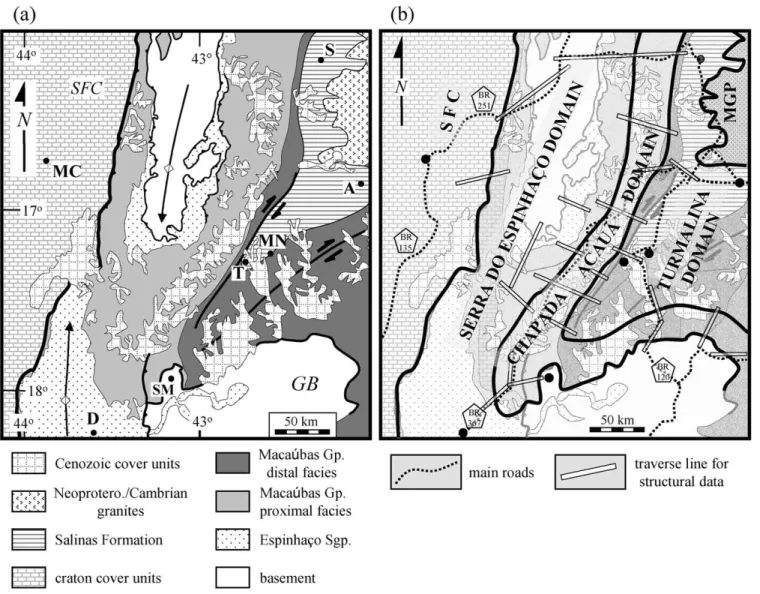
province (Figs. 3 and 4a). For purposes of discussion, we
group the various rock units involved in the Arac¸uaı´ orogen
into five tectonostratigraphic assemblages (Table 1),
com-binations of which comprise three tectonic domains (named, from west to east: the Serra do Espinhac¸o domain, the Chapada Acaua˜ domain, and the Turmalina domain;
Fig. 4b).
The Serra do Espinhac¸o domain comprises the broad Serra do Espinhac¸o fold-thrust belt, and is manifested topographically by a 60-km-wide terrain of ridges that reach elevations of 2000 m. In this domain, strata of the Espinhac¸o Supergroup and the Macau´bas Group, as well as slices of Archean basement, moved westward on east-dipping thrusts
up onto the edge of the Sa˜o Francisco craton (Uhlein et al.,
1986, 1998; Almeida-Abreu and Pflug, 1994; Dussin and
Fig. 4. (a) A simplified geologic map of our study area, delineating exposures of major stratigraphic units. The heavy black line indicates the eastern edge of the Sa˜o Francisco craton. Cities: MCZMontes Claros;
DZDiamantina; SMZSenador Modestino; TZTurmalina; MNZMinas Novas; AZArac¸uaı´; SZSalinas. GBZGuanha˜es basement block. (b) Distribution of the three structural domains (Serra do Espinhac¸o,
Chapada Acaua˜, Turmalina), as defined in the text. Part (a) serves as the base for this map. Note that the eastern edge of the Turmalina domain is the western intrusive contact of post-collisional plutons of the Mucuri granite province (MGP). The traverse lines shown on the map indicate the locations at which we collected structural data.
S.
Marshak
et
al.
/
Journal
of
Structural
Geology
28
(2006)
129–147
Dussin, 1995). The western topographic front of the range partially coincides with a major emergent ramp. To the west of this ramp, on the foreland side of our study area, a thin-skinned detachment propagated westward, beneath platform
strata of the Sa˜o Francisco craton (Marshak and Alkmim,
1989).
The Chapada Acaua˜ domain, which is the principal focus of this paper, is a 15–45-km-wide plateau (‘chapada’ is the Portuguese word for a relatively high plain), whose surface lies at an average elevation of 1000 m. This plateau has been dissected by river valleys, some of which cut down to elevations of as low as 500 m. The Chapada Acaua˜ domain contains an ESE-dipping package of Macau´bas pelitic schist, metadiamictite and quartzite.
The Turmalina domain encompasses the valley of the Arac¸uaı´ River. Here, bedrock consists of exposures of the Macau´bas Group and Salinas Formation. Strata of the Salinas Formation are notably lower in metamorphic grade than those of the Chapada Acaua˜ domain to the west, and do not display the structural assemblage found in the older Macau´bas Group. At its eastern edge, rocks of the Turmalina domain are cut by intrusives of the Mucuri granite province. The intrusives have been eroded to form a landscape of spectacular sugarloaf mountains. Plutons in the Mucuri granite province a range in age from about 625 to
490 Ma.Pedrosa-Soares and Wiedemann-Leonardos (2000)
recognize five phases of intrusion. Earlier phases, which are calk-alkaline and related to a magmatic arc formed on an active continental margin, occur only south of latitude
178300S. The termination of arc and the occurrence of
Neoproterozoic oceanic slivers at this latitude led
Pedro-sa-Soares at al. (2001)to consider 178300S to be the northern limit of ocean floor beneath the Macau´bas Basin. Some of the later phases of intrusion in the Mucuri granite province appear to be a consequence of decompression melting
(Pedrosa-Soares and Wiedemann-Leonardos, 2000).
Macau´bas Group correlative units reach amphibolite facies adjacent to and within the Mucuri granite province.
Table 1
Principal tectonostratigraphic units of the Arac¸uaı´ orogen
Mucuri granite province. This is a north–south-trending belt of granitic rocks that bisects the Arac¸uaı´ orogen. This province, which is over 350 km long and 100 km wide, includes numerous distinct Neoproterozoic and Cambrian plutons formed during at least five phases of intrusion between 625 and 490 Ma (Pedrosa-Soares and Wiedeman-Leonardos, 2000). Later phases are post-collisional intrusions, free of the regional ductile foliation.
Salinas Formation. This unit consists of graywacke, pelite, and
conglomerate, deposited as deep-water turbidites between 568 and 500 Ma, and metamorphosed to greenschist facies conditions (Lima et al., 2002). These sediments, derived from the magmatic arc of the orogen, occur in intramontane basins formed subsequently to deformation that affects underlying units but prior to the last phase(s) of intrusion.
Macau´bas Group and correlative units. These strata were deposited over and to the east of deposits of the Espinhac¸o Supergroup, during and subsequent to rifting that began about 0.95–0.88 Ga. The basal (rift-stage) units of the Macau´bas Group, exposed on the eastern side of the Macau´bas basin, include strata deposited during a Neoproterozoic glacial episode, and are now represented by outcrops of metadiamictite, quartzite and pelitic schist (Uhlein et al., 1999; Martins-Neto et al., 2001). These strata grade eastwards into upper (passive-margin stage) units that include both deep-marine turbidites now represented by outcrops of pelitic schist and metasandstone, and slivers of an ocean-floor assemblage now represented by outcrops of mica schist, metachert, banded iron formation, and orthoamphibolites. The ocean-floor assemblage comprises the Ribeira˜o da Folha Formation (Pedrosa-Soares et al., 2001; Lima et al., 2002). Higher-grade correlatives to the Macau´bas Group include the Dom Silve´rio Group (biotite–garnet schist, quartzite, mafic and locally ultramafic rocks, banded iron formation, and manganese-rich rocks, also representing a deep-ocean sedimentary assemblage) and the Rio Doce Group (amphibolite–facies pelitic schist and banded gneisses), both of which crop out to the south of our study area. The Macau´bas Group may also correlate with protoliths of high-grade paragneiss complexes that lie to the north and east of the Mucuri granite province.
Espinhac¸o Supergroup. These strata were deposited in a rift basin that formed along the eastern margin of the Sa˜o Francisco craton beginning at ca. 1.75 Ga (Dussin and Dussin, 1995; Uhlein et al., 1998). They were metamorphosed to low grade during the Brasiliano Orogeny, and now consist of quartzite, meta-conglomerate, and phyllite. Intercalations of bimodal meta-volcanic rocks occur in basal units of the Supergroup.
Basement. This unit consists of all rocks of the study area that are older than 1.8 Ga. In the Arac¸uaı´ orogen, basement includes Archean and
Paleoproterozoic metamorphic complexes and intrusives, as well as pre-1. 8 Ga supracrustal sequences.
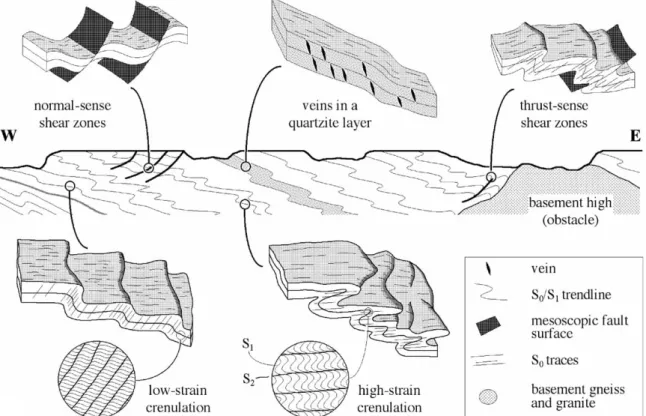
Fig. 5. This composite structure section across the western Arac¸uaı´ orogen shows three structural domains. The approximate location of this section is shown on
3. Observations
In order to understand the kinematics of deformation in the western Arac¸uaı´ orogen, we undertook detailed structural analysis at about 250 stations distributed across the portion of the Serra do Espinhac¸o, Chapada Acaua˜, and
Turmalina domains that lies between latitudes 168S and
188S. This study area, therefore, traverses the orogen from
the western front of the Serra do Espinhac¸o to the western edge of the Mucuri granite province. Our measurement stations concentrate along transect lines that follow access
routes provided by roads and stream valleys (Fig. 4b). We
combine our results in a single composite structure section,
representative of an east–west cross-section roughly at
latitude 178200S (Fig. 5). In the following description, we
characterize each structural domain separately, in order from west to east. For each domain, we describe the structural assemblages that it contains and infer the kinematic significance of this assemblage. We will discuss the assemblage of the Chapada Acaua˜ in the most detail.
3.1. Structures of the Serra do Espinhac¸o domain
The Serra do Espinhac¸o domain is the internal portion of
a west-verging fold-thrust belt (Uhlein et al., 1986, 1998;
Almeida-Abreu and Pflug, 1994; Dussin and Dussin, 1995).
Thus, this domain contains west-verging folds, east-dipping thrust ramps, detachment faults, and local duplexes
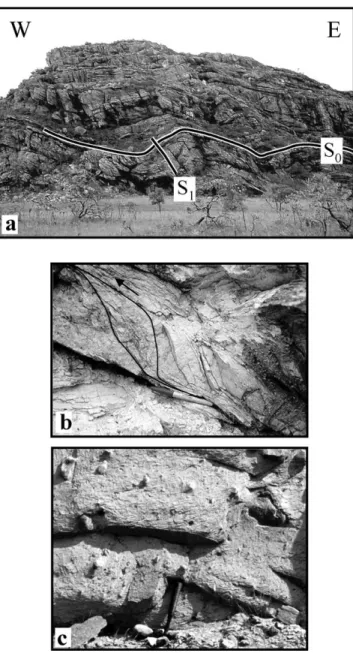
contain-ing east-dippcontain-ing ramps (Fig. 6a and b). Fault surfaces are
defined by mylonites in which C–S fabrics and porphyr-oclast tails indicate top-up-to-the-west movement. Slip lineations, defined by streaks of microscopic mica flakes, quartz fibers, and stretched grains, plunge east, down the dip of foliation. Most outcrops within the Serra do Espinhac¸o domain expose thick-bedded fluvial and eolian quartzites,
interbedded with pelitic horizons (Uhlein et al., 1986;
Dussin and Dussin, 1995; Grossi-Sad et al., 1997). The
quartzites acted as mechanical struts that buckled into large
open to tight west-verging inclined folds (F1) containing a
steep axial-planar cleavage (S1) that dips east (Fig. 6a).
Thin-bedded pelitic intervals locally buckled to form tight mesoscopic west-verging folds containing an east-dipping axial-planar phyllitic cleavage.
At the east-dipping unconformity between older Espin-hac¸o quartzites and younger Macau´bas metadiamictites, near the eastern margin of the domain, metadiamictites
contain an east-dipping phyllitic schistosity (S1) that
intersects relict bedding (S0) at an acute angle—S0at this
contact dips slightly less steeply than does S1. A down-dip
mineral lineation, defined by stretched quartz grains and by mica streaks, decorates the surface of foliation planes in the contact zone. Softer pebbles within Macau´bas metadiamic-tite layers have been stretched in the plane of shear to an
aspect ratio of about 5:1 (Fig. 6c), with their long axis
parallel to the mineral lineation. In shear zones, pressure-shadow tails on these clasts indicate top-up-to-the west sense of slip. Quartzite layers that occur within the metadiamictites above the contact have buckled into folds that verge up-dip (i.e. west). The limbs of these folds have been stretched and boudined. Taken together, structures along the Espinhac¸o/Macau´bas contact indicates that this unconformity was employed as a thrust-sense shear zone during the Brasiliano orogeny.
3.2. Structures of the Chapada Acaua˜ domain
The central portion of our study area is an approximately 15–45-km-wide plateau, here called the Chapada Acaua˜
domain (Figs. 4b and 5). Bedrock of the Chapada Acaua˜
Fig. 6. (a) Photo of west-verging folds in the Serra do Espinhac¸o fold-thrust belt. This structure involves quartzite containing spaced cleavage. The outcrop face is about 100 m from side to side. (b) Photo showing foliation sigmoids of a thrust shear zone in the Serra do Espinhac¸o domain. (c) Photo of stretched clasts of a Macau´bas metadiamictite in the Serra do Espinhac¸o domain. The attitude of the stretching lineation is 095/40.
domain consists of metamorphosed pelite, metadiamictite, quartzite and subordinate volcanics of the Macau´bas Group. These rocks occur in an overall east-dipping belt, meaning that the domain is bounded on the top and bottom by
enveloping surfaces that dip, on average, 358 east.
Metamorphic grade increases progressively from lower-greenschist in the west (manifested by occurrence of phyllitic metadiamictite and phyllite), to high greenschist in the east (manifested by occurrence of fine-grained garnet– mica schist). The appearance of staurolite in garnet–mica schist in the eastern border of the domain records the transition to the lower amphibolite facies.
Within the Chapada Acaua˜ domain, rocks retain an S1
schistosity that is axial-planar to west-verging
(top-up-to-the-west) F1folds (Fig. 7a–d). But the S1of the Chapada
Acaua˜ domain, in contrast to that of the Serra do Espinhac¸o
domain, has been transposed almost into parallelism with S0
everywhere except in the relict hinges of F1folds and in
quartzite beds. F1folds of the Chapada Acaua˜ domain are, in
general, tight to isoclinal, and thus differ in character from
those of the Serra do Espinhac¸o domain. Overall, S1
schistosity in the Chapada Acaua˜ domain dips east, subparallel to the domain’s enveloping surfaces. Through-out the domain, 5–25-cm-thick milky white quartz veins
developed parallel to S1foliation. Also, a prominent east–
west-trending mineral lineation, defined by stretched pebbles, tails on quartz grains, and streaks of mica (and in higher-grade schists, by aligned kyanite) developed on the
surface of the S1foliation in phyllites and schists (Fig. 7e
and f). This lineation is also manifested by stretched quartz
grains, which are visible on the surface of the S1-parallel
quartz veins.
In addition to the F1west-verging folds described above,
outcrops in the Chapada Acaua˜ domain contained inclined asymmetric folds that verge east and down dip, relative to
the domain’s enveloping surfaces. Isoclinal F1folds have
been bent around the hinges of the east-verging folds, and
thus we consider the east-verging set to be F2folds. The
Fig. 7. Equal-area plots of indicated attitudes of S0, S1, and L1structural elements in the Chapada Acaua˜ domain. (a) Poles to bedding. (b) Contoured equal-area plot of poles to bedding.bdefines the regional fold hinge trend (NNE). (c) Poles to S1schistosity. (d) Contoured equal-area plot illustrating that S1schistosity dips predominantly eastward, slightly more steeply than S0. (e) L1mineral-stretching lineation. (f) Contoured equal-area plot of the L1 lineations, which are dominantly down-dip in respect to the S1 schistosity.
shape of F2folds is defined by traces of S0/S1foliation in
pelitic schists, by traces of the quartz veins that parallel S1,
and locally, by traces of relict quartzite beds (Fig. 8a). F2
folds occur in cascading trains whose enveloping surfaces parallel the enveloping surfaces of the domain as a whole. They are asymmetric and vary in profile from open, in which the short limb is upright, to tight, in which the short limb is vertical, to nearly isoclinal, in which the short limb is
overturned. In general, hinges of F2 folds trend along the
strike of the Chapada Acaua˜ domain. But locally, F2fold
hinges display a pronounced curvature in map view, bowing down regional dip in the direction of vergence. We found a
few examples of F2fold hinges that curve through almost
1808; folds and such hinge shapes can be considered to be
sheath folds. The axis of symmetry of sheath folds in the Chapada Acaua˜ domain trends east, down the regional dip (Fig. 8b).
The orientation and geometry of F2folds indicates that
they formed in a top-down-to-the-east (i.e. normal-sense) shear couple. Quartzite beds locally occur interlayered with metadiamictites and phyllites of the Chapada Acaua˜ domain, and these beds preserve sedimentary structures.
We observed that, on the long limbs of F2 folds, cross
lamination in quartzite indicates that the beds are
right-side-up. Therefore, the F2folds of the Chapada Acaua˜ domain
are not parasitic folds formed from the overturned limb of a regional-scale nappe.
The most striking difference between the fabric of the Serra do Espinhac¸o domain and that of the Chapada Acaua˜ domain is that the latter includes a pervasive asymmetric
crenulation cleavage (Uhlein et al., 1986; Uhlein, 1991; Del
Rey-Silva et al., 1995; Grossi Sad et al., 1997;Fig. 9a–c). The crenulation cleavage of the Chapada Acaua˜ domain is
superimposed on, and results in bending of, S1schistosity.
Thus, we consider it to be the S2 fabric of the domain
(Fig. 11b and c). Significantly, S2crenulation is axial-planar
to the east-verging F2folds, so S2planes dip west, antithetic
to the dip of the Chapada Acaua˜ domain’s enveloping
surfaces (Fig. 10a and b). A lineation defined by the crests of
crenulations parallels the overall structural grain of the
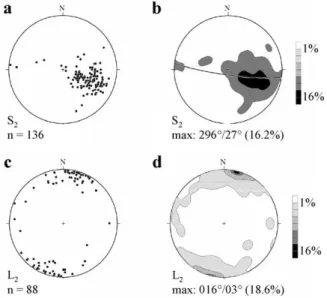
domain (Fig. 10c and d).
Fig. 9. Photographs of S2crenulation cleavage. (a) Closely spaced domains with moderate dip. (b) Steeply dipping domains in which S1has an open sigmoid shape. (c) Widely spaced domains with a shallow dip and tight sigmoid shape.
Fig. 10. Equal-area plots of indicated attitudes of S2 and L2 structural elements in the Chapada Acaua˜ domain. (a) Poles to S2 asymmetric crenulation cleavage. (b) Contoured equal-area plot illustrating that S2dips predominantly to the west, at a range of dips. (c) L2crenulation lineations. (d) Contoured equal-area plot illustrating that the L2crenulation lineations trend parallel to the local structural traces of the Arac¸uaı´ Orogen.
In detail, S2 cleavage surfaces consist of narrow (1–5-mm-thick) bands in which mica has completely transposed
into parallelism with the S2plane. The S2domains bound
5 mm- to 10 cm-wide microlithons, in which S1 foliation
remains visible but has been folded into a sigmoid shape in profile. Sigmoid shapes in microlithons vary. In locations
with steeply dipping S2 crenulation, sigmoids are open
(Fig. 9b), whereas in locations with gently dipping
crenulation, the sigmoids are tight, with relict S1 planes
overturning, relative to their original dip, in the center of
each microlithon (Fig. 9c). This relation suggests that, as
strain increases, the S2cleavage rotates to a shallower dip
and the S1sigmoids in microlithons become flattened. The
sigmoid shape of S1 traces in microlithons suggests that
shear occurred along S2 cleavage planes (Twiss and
Moores, 1992). Correlation of marker layers (quartzite
streaks in the S0/S1 foliation plane) across S2 domains
indicates that shear displacements on S2domain surfaces
range from 1 mm to 20 cm. With few exceptions (discussed later), the geometry of sigmoids within the microlithons indicates a top-down-to-the-west sense of shear on individual domain surfaces.
Crenulation cleavage similar in character to the S2fabric
of the Chapada Acaua˜ domain has been found in other locations worldwide, and has been discussed by numerous
researchers. Because of the shape of relict S1 cleavage in
microlithons, the S2cleavage of the Chapada Acaua˜ domain
can be called an ‘asymmetric crenulation cleavage’ (Twiss
and Moores, 1992). Because S1 remains visible within
microlithons of S2 crenulation, and because complete
redistribution of elements did not occur during the
development of S2(with some exceptions discussed later),
the cleavage can also be called a ‘zonal crenulation
cleavage’, following the terminology of Gray (1977a,b,
1979a,b) (see also Rickard, 1961; Gray and Durney,
1979a,b; Marlow and Etheridge, 1977).
Development of the S2crenulation in the Chapada Acaua˜
domain affected the geometry of stretched and flattened pebbles and cobbles in Macau´bas metadiamictites. Specifi-cally, clasts of weaker rock types, along with their tails, have been contorted into sigmoidal shapes that mimic the
profile of S1 foliation within S2 microlithons. Resistant
quartzite and gneiss clasts in the Chapada Acaua˜ domain, however, are not flattened significantly. Disruption of the matrix fabric around resistant clasts suggests that these
clasts rolled during formation of S2, in a
top-down-to-the-east shear couple (Fig. 11).
At several localities within the Chapada Acaua˜ domain, we observed west-dipping normal-sense shear zones (Fig. 12a). These shear zones roughly parallel the S2 foli-ation, suggesting that they are kinematically related, but they
Fig. 11. Photo of rotated clasts in the Macau´bas Group of the Chapada Acaua˜ domain. The clast, together with its pressure-shadow tails, defines a sigmoid shape, indicating top-down-to-the-east shear. The geometry of relict S1cleavage in a pelitic lens S0, supports this proposal.
are marked by 10–15-cm-wide bands of a micro-brecciated rock, and they accommodate significantly more
displace-ment (up to 5 m) than do individual S2cleavage domains.
Shear-zone dips vary—the amount of displacement across the shear zones increases as the dip of the shear zone decreases. Locally, these shear zones are spaced at intervals of 2–20 m. Outcrops in the Chapada Acaua˜ domain also expose a generation of non-bedding-parallel quartz veins
cuts the quartzite beds (Fig. 12b). These veins taper to their
tips, and occur in an en e´chelon configuration, suggesting that they originated as tension gashes in a shear couple associated with top-down-to-the east movement. Their dip
ranges from 608W to vertical. In places, the veins have been
cut by mesoscopic east-dipping bed-parallel shear surfaces. Offset across these surfaces indicates top-down-to-the-east displacement.
As noted above, the S2crenulation of the Chapada Acaua˜
domain generally dips westward and displays top-down-to-the-west shear on individual cleavage-domain surfaces.
However, we observed that S2cleavage attitude, as well as
the sense of shear on S2 domains, as indicated by the
sigmoid geometry of S1 in microlithons, is different in
locations where meta-sediments of the domain lie in proximity to basement contacts that do not dip east. Field relations at two localities along the northern margin of the Guanha˜es block, a 100-km-wide basement high at the
southern end of our study area, illustrate this point (Fig. 4a).
First, near the town of Senador Modestino (locality SM on
Fig. 4a), a local north–south-trending basement high occurs. Here, the surface of the Archean granitoid rises to a shallower depth. Roadcuts and field exposures provide outcrops of Macau´bas Group schist just above the basement–schist contact. On the west side of the basement high, where the
basement–cover contact dips west, S2cleavage in the schist
maintains its westward dip, but the asymmetry in
microli-thons changes (Fig. 13) such that the sigmoid shape indicates
top-up-to-the-east (i.e. reverse-sense) shear. Further, in some
exposures, S1in microlithons does not have the profile shape
of a sigmoid but rather resembles a simple arch or trough, and
S2 cleavage is axial planar to east-verging F2 fold trains
contained within west-dipping enveloping surfaces. The geometry of these folds and faults suggests that the presence of the Senador Modestino basement high localized a frontal thrust system on which rocks moved up and to the east. We envision this situation to resemble that which occurs at the base of a valley glacier that flows downslope overall, but locally must ride up and over a substrate high.
Farther to the northeast along the northern margin of the Guanha˜es block, the basement-cover contact dips
north-west. Here, S2cleavage rotates to a northeast strike, parallel
to the margin of the complex, and becomes more intense, meaning that cleavage domains are more closely spaced than elsewhere. In fact, adjacent to the basement–cover contact, the cleavage evolves into a ‘domainal crenulation
cleavage’ (terminology ofGray (1977a,b)) subparallel to the
contact—cleavage domains here have evolved into nearly pure bands of mica, microlithons have evolved into nearly
pure bands of quartz, and S1has been totally transposed into
S2. Where this occurs, F2 folds are isoclinal, with
subhorizontal axial planes and steep plunges to the
northwest. In these folds, S2 locally becomes overprinted
by an S3crenulation that is axial planar to F3folds whose
hinges have a bearing of 3308. Mineral lineations within this
region have attitudes of about 0758/208. These observations
indicate that at the southern end of our study area, the Chapada Acaua˜ domain curves eastward and follows the basement–cover contact defining the northern margin of the Guanha˜es block. Along this contact, Macau´bas rocks of the domain moved parallel to the basement–cover contact, relative to the basement below.
3.3. Structures of the Turmalina domain
The Turmalina domain, named for a town within it, encompasses the entire region between the Chapada Acaua˜ domain and the Mucuri granite province. It consists of three parts:
(1) High-grade Schist. The western part of the Turmalina domain, adjacent to the Chapada Acaua˜ domain, consists of amphibolite-grade schists derived from the Macau´bas
Group (Fig. 4a). These schists, which are
medium-grained, contain muscovite, biotite, garnet, and quartzG
kyanite and staurolite, have a strong schistosity, which dips eastward, and display a strong mineral-stretching
lineation, which plunges eastwards. Relict S0surfaces,
represented by compositional contrasts between layers, outline west-verging tight to isoclinal, inclined folds in the schists. The asymmetry of these folds indicates top-up-to-the-west (reverse-sense) displacement. Schistos-ity in this domain is axial-planar to these folds in their
hinges, where it cross cuts S0, but it lies parallel to S0on
fold limbs.
(2) Salinas Basin. The eastern part of the Turmalina domain exposes the relict of a basin in which the Salinas Formation, a sequence of sandy turbidites intercalated
Fig. 13. Outcrop sketch illustrating the top-up-to-the-east (reverse-sense) shear indicated by the geometry of S1foliation within S2microlithons at the Senador Modestino locality. The darker shaded band is a marker layer.
with conglomerates, was deposited. Salinas strata have been metamorphosed only to lower greenschist grade, and thus are significantly lower grade than rocks in the western part of the Turmalina domain. Also, they have not been as intensely deformed as the schist in the western part of the domain— they occur in homoclinally E-dipping panels and display only a weak spaced cleavage.
(3) Minas Novas Corridor. In the southern portion of the Turmalina domain, near the town of Minas Novas,
Pedrosa-Soares (1995) identified a northeast-trending
belt of Macau´bas Group strata in which bedding has a northeast strike and a steep dip. An oblique mineral lineation that plunges gently to the northeast can be seen
on S1and S0surfaces (Fig. 4a). Here, S0is folded around
plunging asymmetric folds. The geometry of these folds, along with the shallow rake of mineral lineations, indicates that overall movement in this belt was reverse-dextral. To emphasize its distinctive kinematics,
Pedrosa-Soares (1995)named this belt the ‘Minas Novas Corridor’.
Along its eastern border, rocks of the Turmalina domain have been intruded by plutons of the Mucuri granite province. Foliation trends in wall rocks near plutons have been deflected into parallelism with pluton borders, and thus no longer retain regional patterns. The kinematics of deformation within the Mucuri granite province remains
largely unknown. Of note, rocks throughout the Turmalina domain, both within and outside of the Minas Novas Corridor, do not contain the previously described
west-dipping S2crenulation or F2folds.
4. Discussion and interpretation
The Arac¸uaı´ orogen of eastern Brazil formed in Late Neoproterozoic/Early Paleozoic time, due to convergence between the Sa˜o Francisco and Congo cratons. We divide
the western portion of the Arac¸uaı´ orogen, between 168S
and 188S, into three north–south-trending structural
domains (named, from west to east: the Serra do Espinhac¸o domain, the Chapada Acaua˜ domain, and the Turmalina domain). Field studies indicate that the sense of shear recorded by structures in the Chapada Acaua˜ domain differs from that of the other domains. Also, the Chapada Acaua˜ domain contains a pervasive asymmetric crenulation cleavage not found in the other domains. Below, we present a kinematic and tectonic interpretation of the Chapada Acaua˜ domain, and discuss the role that crenulation cleavage played during its evolution.
4.1. Kinematics of deformation in the western Arac¸uaı´ orogen: existence of the CASZ
The Serra do Espinhac¸o domain of the Arac¸uaı´ orogen is a fold-thrust belt in which top-up-to-the-west (i.e.
sense) displacement occurred on east-dipping faults. Folds
(F1) in the Serra do Espinhac¸o domain verge west, and strata
in these folds contain an east-dipping phyllitic cleavage (S1).
The Chapada Acaua˜ domain, which lies on the hinterland side of the Serra do Espinhac¸o domain, is an east-dipping belt of pelitic schist, quartzite, and metadiamictite. Pelitic schist and metadiamicton in the Chapada Acaua˜ domain display the consequences of a second deformation event
(D2), not found in the Serra do Espinhac¸o domain. This
second deformation event produced a suite of structures that
includes (Fig. 14): a cascade of top-down-to-the-east folds
(F2); vertical en e´chelon tension gashes within east-dipping
enveloping surfaces; rotated clasts with a sense of rotation compatible with top-down-to-the-east (i.e. normal-sense) shear; and mesoscopic normal-sense shear zones. Based on the existence of these features, we propose that the Chapada Acaua˜ domain is a regional-scale normal-sense shear zone, which we henceforth refer to as the Chapada Acaua˜ shear zone (CASZ).
Could the CASZ have formed to accommodate shear in the overturned limb of a regional-scale west-verging nappe?
We discount this hypothesis because we found no evidence for regional-scale repetition of stratigraphic units in the domain, and no evidence for regional-scale fold closure. Further, stratigraphic facing indicators preserved in quartzite indicate that, overall, beds in the CASZ are right-side-up.
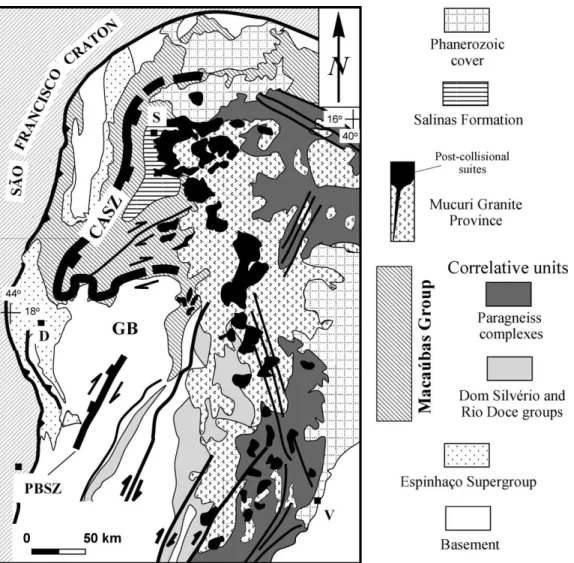
We have traced the CASZ along the hinterland margin of
the Espinhac¸o fold-thrust belt (Fig. 15). At its north end, the
CASZ merges with a northwest-trending strike-slip shear
zone. From this intersection southwards, to 188S, the CASZ
was a frontal ramp during normal-sense shear, for in this portion schists and metadiamictites display a pervasive
down-dip lineation. At 188S, the CASZ curves and trends
easterly along the north end of the Guanha˜es basement high, and the schist contains north-plunging folds and a northeast-plunging lineation. These relations imply that, at its southern end, the CASZ becomes a lateral ramp that fringes the northern margin of the Guanha˜es basement high.
We have not mapped the CASZ south of 188S. But
studies by others along the eastern and southeastern margin of the Guanha˜es basement high, studies within the Guanha˜es
Fig. 15. Regional map illustration of the location of the Chapada Acaua˜ Shear Zone (CASZ) relative to other structural elements of the Arac¸uaı´ orogen. GBZ
Guanha˜es basement block; PBSZZPedra Branca shear zone. Cities: SZSalinas; DZDiamantina; VZVito´ria.
block, indicate that normal-sense shear zones do occur south
of 188S (Cunningham et al., 1996; Peres et al., 2004).
Examples include the Pedra Branca shear zone and a series of emerald-bearing shear zones in the Guanha˜es block (Fig. 15). Significantly, radiometric dates from the emerald-bearing shear zones suggest that they were active at about
500 Ma, near the end of the Brasiliano orogeny (Peres et al.,
2004).
4.2. Tectonic role of the CASZ: an extensional detachment during orogenic collapse
Based on the location of the CASZ, and the kinematics of shear within it, we conclude that the CASZ is a regional-scale normal-sense shear zone (extensional detachment) that accommodated displacement of the internal portion of the Arac¸uaı´ orogen relative to its foreland. Down-dip-verging
F2folds within the CASZ refold up-dip-verging F1folds, so
the normal-sense shear is syn- to post-Brasiliano thrusting.
Indeed, since the CASZ is parallel to thrusts in the Espinhac¸o fold-thrust belt, the structure could represent
inversion of a preexisting thrust. The CASZ cannot be
associated with Cretaceous or younger South Atlantic rifting, because faults associated with these events only occur far to the east of the CASZ, and such faults are defined by zones of brittle fault breccia whose existence is not compatible with the level of exposure of the CASZ. Thus, we conclude that the CASZ was active during the late stage of the Brasiliano orogeny. This conclusion is compatible with dates of 500 Ma from normal-sense shear zones along strike to the south.
The existence of late-Brasiliano extensional detachment (the CASZ) in the Arac¸uaı´ orogen is compatible with a tectonic model in which the final stage of the orogen’s evolution involved extensional collapse. During collapse, displacement on the CASZ could have contributed to the exhumation of mid-crustal rocks in the interior of the orogen, and possibly to ‘channel flow’ of mid-crustal rocks
toward the foreland (Fig. 16a and b; cf. Beaumont et al., 2001).
In some cases, an extensional detachment dips toward the hinterland, and thus is ‘synthetic’ relative to thrusts on its foreland side, whereas in other cases, it dips toward the foreland, and thus is ‘antithetic’ relative to the thrusts
on its foreland side (cf. Collettini and Barchi, 2002;
Vanderhaeghe et al., 2003). Considering its geometry, we
suggest that the CASZ is a synthetic extensional detach-ment, and thus resembles the South Tibet Detachment. Notably, the CASZ differs from the South Tibet detachment in that it is not mylonitic, but rather contains low-grade, crenulated schists. Thus, the CASZ may serve as an example of what an extensional detachment looks like at shallower crustal levels than are currently exposed along the
South Tibet detachment (cf.Zheng et al., 2004).
The proposal that a phase of orogenic collapse occurred at the end of the Brasiliano orogeny could explain three enigmatic features of the Arac¸uaı´ orogen:
(1) Origin of the Salinas basin. Deposits of the Salinas Formation filled a basin in the Turmalina domain, west
of the Mucuri granite province (Fig. 16). These deposits
do not contain the metamorphic or deformational signatures of other units in the Arac¸uaı´ orogen, and they were deposited unconformably above deformed and metamorphosed units. Such characteristics typify deposits of intramontane basins formed during exten-sional collapse. The Salinas basin could have formed in this manner.
(2) Late-phase melting. Pedrosa-Soares and Wiedemann-Leonardos (2000)proposed that a late phase of intrusion occurred in the Mucuri granite province at 520 – 490 Ma. They relate this phase of post-collisional intrusion to decompression. Extensional collapse of the Arac¸uaı´ orogen could have caused the decompres-sion that triggered production of late granitic melts. (3) Core-complex characteristics of the Guanha˜es block.
The Guanha˜es block is a basement high composed of Archean and Paleoproterozoic granite and high-grade gneiss, which is surrounded by younger rocks. Our structural analysis suggests that the CASZ is a detachment that separates younger schist of the hanging wall from older basement rocks of the footwall. Thus, normal-sense shear on the CASZ could have contributed to exhumation of the Guanha˜es block. In this context, the block may be viewed as a ‘metamorphic core complex’, if we define a core complex simply as an exposure of a regional-scale extensional detachment and of the footwall beneath it. We emphasize that, by
using the term ‘core complex’, we do not imply that
structures at the surface of the Guanha˜es block resemble those of classic metamorphic core complexes of the
southwestern United States (Compton, 1980; Coney
and Harms, 1984; Spencer, 1984; Davis et al., 1986;
Malavieille, 1987). For example, the Guanha˜es block
does not have a carapace of mylonite overlain by chlorite breccia zone and by tilted fault blocks bounded by brittle normal faults. Notably, however, rocks of the Guanha˜es block underwent migmatization between 530
and 500 Ma (Machado et al., 1989; Silva et al., 2002;
Noce et al., 2003), i.e. during the post-collisional stage of the Brasiliano orogeny in the Arac¸uaı´ orogen. Similar migmatization has happened in other core complex
examples (e.g. the Shuswap terrane of Canada;Whitney
et al., 2004).
4.3. Interpretation of asymmetric extensional crenulation cleavage in the CASZ
Rocks in the Chapada Acaua˜ domain contain a pervasive
asymmetric extensional crenulation cleavage (S2) that is
axial planar to F2folds. In cases where outcrop faces are
oblique to strike, interpretation of such cleavage can be
misleading (Bell and Rubenach, 1983; Behrmann, 1987;
Bell and Johnson, 1992; Lexa et al., 2004). However,
because the S2cleavage of the CASZ is so widespread and
we have seen it on outcrop faces of many orientations, we are confident that we are not basing our interpretations on
oblique sections. As noted earlier, S2dips westward, and
thus is antithetic to the east-dipping enveloping surfaces of the CASZ. (Similar geometries of cleavage may occur in the
Appalachians; cf.De Roo and Van Staal, 1994.) Further, the
sigmoid shapes defined by the trace of relict S1schistosity in
S2microlithons indicate top-down-to-the-west slip on each
S2domain plane. When did this cleavage form, and what
role, if any, did it play during motion on the CASZ? To answer this question, we first examine ways in which asymmetric crenulation cleavage can form, in general
(Cosgrove, 1976; Platt, 1979, 1984; Bell and Rubenach,
1980; Platt and Vissers, 1980; Bell, 1981; White et al., 1981; Dennis and Secor, 1987; Passchier, 1991; Twiss and
Moores, 1992; Passchier and Trouw, 1996):
(1) Oblique shortening. Crenulation cleavage can develop due to shortening of a previously foliated rock when the shortening direction trends at an angle to the preexisting foliation. If this mechanism applies to our study area, it would imply that asymmetric crenulation developed during the progressive regional shortening of the Arac¸uaı´ orogen that accompanied development of the Espinhac¸o fold-thrust belt.
(2) Rotation of symmetric crenulation. Crenulation clea-vage can develop by rotation of a preexisting symmetric crenulation cleavage, so that shear occurs on crenula-tion domains after they first formed. This may happen when the rock layer containing the crenulation under-goes shear.
domain. If cleavage development accommodates layer-parallel shortening of the layer in which it forms, the cleavage is a ‘contractional crenulation cleavage’, or CCC, whereas if development results in extension of the layer in which it forms, then the cleavage is an
‘extensional crenulation cleavage’, or ECC (Platt,
1979,; 1984; Platt and Vissers, 1980). Both CCC and
ECC can occur in conjugate sets. ECC has been identified in shear zones at many localities, where it typically crenulates a mylonitic foliation and lies at an angle to the enveloping surfaces of the shear zone. If the acute angle between ECC domains and the enveloping surface of the shear zone opens in the direction of shear, then the cleavage is a ‘synthetic ECC’, whereas if the acute angle opens opposite to the direction of shear, it is an ‘antithetic ECC’; synthetic ECC tends to be more
common (Zheng et al., 2004). Determination of the
amount of shear across a shear-band cleavage can be
difficult, because if volume loss occurs due to pressure solution in the cleavage domain, oblique shortening
across a domain may produce an apparent offset (Gray
and Durney, 1979a,b; Worley et al., 1997). Once
formed, crenulation cleavage domains act as material planes in a rock, and thus can become active again
during a later phase of deformation (Bell, 1986; Davis,
1995; Ham and Bell, 2004).
We propose that the S2asymmetric crenulation cleavage
in the CASZ can be interpreted in three ways. First, the S2
cleavage is entirely a synthetic extensional crenulation cleavage (ECC) related to top-up-to-the-west shear. If this were the case, then the cleavage formed completely during the phase of regional shortening that yielded the west-verging Espinhac¸o fold-thrust belt, and was not affected by normal-sense shear reactivation of the CASZ. Second, the
S2 cleavage initiated as a west-dipping ECC (associated
with top-up-to-the-west shear), but during normal-sense shear in the CASZ, the cleavage reactivated, and crenulation domains rotated clockwise, as viewed looking along-strike
to the north, and became axial planar to F2folds as the folds
developed (Fig. 17a–c). Third, the S2cleavage initiated as a
near-vertical asymmetric crenulation associated with east– west shortening of a preexisting east-dipping schistosity. During normal-sense reactivation of the CASZ, the cleavage rotated clockwise, as viewed looking north, and became
axial planar to F2folds as the folds developed (Fig. 17d–f).
If either the second or third interpretation is correct, then the cleavage domains behaved like a mesoscopic bookshelf array of rotational normal faults when the CASZ was active
(Fig. 17g). As such, evolution of the cleavage domains
helped to accommodate both shear in the CASZ, and
concomitant vertical shortening of the orogen (Bell et al.,
2003).
Considering the range of present dips of S2cleavage, its
pervasiveness, and the fact that it is axial-planar to a generation of folds, we think that the third interpretation, in
which S2 cleavage initiated as a steep fabric, and then
rotated into its present orientation during normal-sense shear in the CASZ, is the most likely to be correct. We do not think that the fabric is simply an ECC fabric (the first alternative interpretation), because such fabrics are gener-ally not pervasive and are not axial-planar to a set of folds
(Platt and Vissers, 1980)—we observed that the S2
crenulation cleavage of the CASZ is pervasive and is
axial-planar to a generation of folds (F2). Since
cleavage-domain dips range fromO458to!158, we do not think that
the second interpretation could apply, as we would expect the cleavage to have a shallower angle with respect to the CASZ than we observed.
Acknowledgements
This research was supported by NSF EAR 99-02730. F.F. Alkmim and A.C. Pedrosa-Soares received additional financial support from CNPq (Conselho Nacional de Desenvolvimento Cientı´fico e Tecnolo´gico). We are very grateful for insightful reviews by Alain Chauvet and Tim Bell, and for helpful discussions with Tim Bell, Don Wise, and Christian Teyssier. Comments provided by Darrel Cowan, Jon Spencer and Brian Wernicke on an earlier version of the manuscript are also much appreciated. Joa˜o Hippert provided very useful editorial input.
References
Alkmim, F.F., Marshak, S., Fonseca, M.A., 2001. Assembling West Gondwana in the Neoproterozoic: clues from the Sa˜o Francisco Craton region, Brazil. Geology 29, 319–322.
Almeida-Abreu, P.A., Pflug, R., 1994. The geodynamic evolution of the southern Serra do Espinhac¸o, Minas Gerais, Brazil. Zentralblatt fu¨r Geologie und Pala¨ontologie 1/2, 21–44.
Beaumont, C., Jamieson, R.A., Nguyen, M.H., Lee, B., 2001. Himalayan tectonics explained by extrusion of a low-viscosity crustal channel coupled to focused surface denudation. Nature 414, 738–742. Behrmann, J.H., 1987. A precautionary note on shear bands as kinematic
indicators. Journal of Structural Geology 9, 659–666.
Bell, T.H., 1981. Foliation development: the contribution, geometry and significance of progressive bulk inhomogeneous shortening. Tectono-physics 75, 273–296.
Bell, T.H., 1986. Foliation development and refraction in metamorphic rocks; reactivation of earlier foliations and decrenulation due to shifting patterns of deformation partitioning. Journal of Metamorphic Geology 4, 421–444.
Bell, T.H., Johnson, S.E., 1992. Shear sense; a new approach that resolves conflicts between criteria in metamorphic rocks. Journal of Meta-morphic Geology 10, 99–124.
Bell, T.H., Rubenach, M.J., 1980. Crenulation cleavage development— evidence for progressive bulk inhomogeneous shortening from millipede microstructures in the Robertson River Metamorphics. Tectonophysics 68, 9–15.
Bell, T.H., Rubenach, M.J., 1983. Sequential porphyroblast growth and crenulation cleavage develpoment during progressive deformation. Tectonophysics 92, 171–194.
Bell, T.H., Ham, A.P., Hickey, K.A., 2003. Early formed regional antiforms and synforms that fold younger matrix schistosities: their effect on sites of mineral growth. Tectonophysics 367, 253–278.
Brito-Neves, B.B., Cordani, V.G., 1991. Tectonic evolution of South America during the Late Proterozoic. Precambrian Research 53, 23–40. Brito-Neves, B.B., Campos-Neto, M.C., Fuck, R.A., 1999. From Rodinia to Western Gondwana: an approach to the Brasiliano–Pan African cycle and orogenic collage. Episodes 22, 155–166.
Burchfiel, B.C., Royden, L.H., 1985. North–south extension within the convergent Himalayan region. Geology 13, 679–682.
Burchfiel, B.C., Zhiliang, C., Hodges, K.V., Yuping, L., Royden, L.H., Changrong, D., Jiene, X., 1992. The South Tibetan detachment system, Himalayan orogen: extension contemporaneous with and parallel to shortening in a collisional mountain belt. Geological Society of America Special Paper 269. 41pp.
Campos-Neto, M.C., 2000. Orogenic systems from southwestern Gond-wana. An approach to Brasiliano—PanAfrican Cycle and orogenic collage in south eastern Brazil. In: Cordani, U.G., Milani, E.J., Thomaz-filho, A., Campos, D.A. (Eds.), Tectonic Evolution of South America 31st International Geological Congress, Rio de Janeiro, pp. 335–365. Collettini, C., Barchi, M.R., 2002. A low-angle normal fault in the Umbria
region (Central Italy): a mechanical model for the related micro-seismicity. Tectonophysics 359, 97–115.
Compton, R.R., 1980. Fabrics and strains in quartzites of a metamorphic core complex. Geological Society of America Memoir 153, 271–279. Coney, P.J., Harms, T.A., 1984. Cordilleran metamorphic core complexes:
Cenozoic extensional relics of Mesozoic compression. Geology 12, 550–554.
Cosgrove, J.W., 1976. The formation of crenulation cleavage. Journal of the Geological Society of London 131, 155–178.
Cunningham, W.D., Marshak, S., Alkmim, F.F., 1996. Structural style of basin inversion at mid-crustal levels: two transects in the internal zone of the Brasiliano Arac¸uaı´ Belt, Minas Gerais Brazil. Precambrian Research 77, 1–15.
Cunningham, W.D., Alkmim, F.F., Marshak, S., 1998. A structural transect across the coastal mobile belt in the Brazilian Highlands (latitude 208S): the roots of a Precambrian transpressional orogen. Precambrian Research 92, 251–275.
Dalziel, I.W.D., 1997. Neoproterozoic–Paleozoic geography and tectonics: review, hypothesis, environmental speculation. Geological Society of America Bulletin 109, 16–42.
Davis, B.K., 1995. Regional-scale foliation reactivation and re-use
during formation of a macroscopic fold in the Robertson River Metamorphics, North Queensland, Australia. Tectonophysics 242, 293– 311.
Davis, G.A., Lister, G.S., Reynolds, S.J., 1986. Structural evolution of the Whipple and South Mountains shear zones, southwestern United States. Geology 14, 7–10.
De Roo, J.A., Van Staal, C.R., 1994. Transpression and extensional collapse: steep belts and flat belts in the Appalachian Central Mobile Belt, northern Brunswick, Canada. Geological Society of America Bulletin 106, 541–552.
Del-Rey Silva, L.H., Pedrosa-Soares, A.C., Fuck, R.A., 1995. Kinematic analysis in the Neoproterozoic Arac¸uaı´ belt, SE Brazil: tectonic implications for Gondwana assembly. Sociedade Brasileira de Geologia Nu´cleo de Minas Gerais, Boletim 13, 61–63.
Dennis, A.J., Secor, D.T., 1987. A model for the development of crenulations in shear zones with applications from the Southern Appalachian Piedmont. Journal of Structural Geology 9, 809–817.
Dewey, J.F., 1977. Extensional collapse of orogens. Tectonics 7, 1123–1139.
Dussin, I.A., Dussin, T.M., 1995. Supergrupo Espinhac¸o: Modelos de Evoluc¸a˜o geodinaˆmica. Geonomos 3, 9–26.
Gray, D.R., 1977a. Morphologic classification of crenulation cleavage. Journal of Geology 85, 229–235.
Gray, D.R., 1977b. Differentiation associated with discrete crenulation cleavages. Lithos 10, 89–101.
Gray, D.R., 1979a. Geometry of crenulation folds and their relationship to crenulation cleavage. Journal of Structural Geology 1, 187–205. Gray, D.R., 1979b. Microstructure of crenulation cleavages: an indicator of
cleavage origin. American Journal of Science 279, 97–128.
Gray, D.R., Durney, D.W., 1979a. Investigations on the mechanical significance of crenulation cleavage. Tectonophysics 58, 35–80. Gray, D.R., Durney, D.W., 1979b. Crenulation cleavage differentiation:
implications of the solution–redeposition process. Journal of Structural Geology 1, 73–80.
Grossi-Sad, J.H., Lobato, L.M., Pedrosa-Soares, A.C., Soares-Filho, B.S. (Eds.), 1997. Projeto Espinhac¸o em CD-ROM Belo Horizonte, Brazil, Companhia Mineradora de Minas Gerais Belo Horizonte, Brazil, Companhia Mineradora de Minas Gerais, vol. 2. 693pp.
Ham, A.P., Bell, T.H., 2004. Recycling of foliations during folding. Journal of Structural Geology 26, 1989–2010.
Lexa, O., Cosgrove, J., Schulmann, K., 2004. Apparent shear-band geometry resulting from oblique fold sections. Journal of Structural Geology 26, 155–161.
Lima, S.A.A., Martins-Neto, M.A., Pedrosa-Soares, A.C., Cordani, U.G., Nutman, A., 2002. A Formac¸a˜o Salinas na a´rea-tipo, NE de Minas Gerais: Uma proposta de revisa˜o da estratigrafia da Faixa Arac¸uaı´ com base em evideˆncias sedimentares, metamo´rficas e idades U–Pb SHRIMP. Revista Brasileira de Geocieˆncias 32, 491–500.
Machado, N., Schrank, A., Abreu, F.R., Knauer, L.G., Almeida-Abreu, P.A., 1989. Resultados preliminaries da geocronologia U–Pb na Serra do Espinhac¸o Meridional. Sociedade Brasileira de Geologia, Nu´cleo Minas Gerais, Boletim 10, 171–174.
Malavieille, J., 1987. Kinematic of compressional and extensional ductile shearing deformation in a metamorphic core complex of the northeastern Basin and Range. Journal of Structural Geology 9, 541– 554.
Malavieille, J., 1993. Late Orogenic extension in mountain belts: insights from the Basin and Range and the Late Paleozoic Variscan Belt. Tectonics 12, 1115–1130.
Malavieille, J., Taboada, A., 1991. Kinematic model for postorogenic Basin and Range extension. Geology 19, 555–558.
Malavieille, J., Guihot, P., Costa, S., Lardeaux, J.M., Gardien, V., 1990. Collapse of the thickened Variscan crust in the French Massif Central: Mont Pilat extensional shear zone and St. Etienne Late Carboniferous Basin. Tectonophysics 177, 139–149.
Marlow, P.C., Etheridge, M.A., 1977. Development of a layered
crenulation cleavage in mica schists of the Kanmantoo Group near Macclesfield, South Australia. Geological Society of America Bulletin 88, 873–882.
Marshak, S., Alkmim, F.F., 1989. Proterozoic contraction/extension tectonics of the southern Sa˜o Francisco region, Minas Gerais, Brazil. Tectonics 8, 555–571.
Martins-Neto, M.A., Pedrosa-Soares, A.C., Lima, S.A.A., 2001. Tectono-sedimentary evolution of Tectono-sedimentary basins from Late Paleoproter-ozoic to Late NeoproterPaleoproter-ozoic in the Sa˜o Francisco craton and Arac¸uaı´ fold belt, eastern Brazil. Sedimentary Geology 141–142, 343–370. Me´nard, G., Molnar, P., 1988. Collapse of a Hercynian Tibetan Plateau into
a Late Paleozoic European Basin and Range Province. Nature 334, 235–237.
Noce, C.M., Silva, L.C., Pedrosa-Soares, A.C., Alkmim, F.F., Peres, G.G., 2003. O embasamento da faixa Arac¸uaı´ no bloco Guanha˜es: Dados geocronolo´gicos e evoluc¸a˜o: XII Simpo´sio de Geologia de Minas Gerais, Ouro Preto. Sociedade Brasileira de Geologia, Nu´cleo Minas Gerais, CD-ROM, 90.
Norton, M.G., 1986. Late Caledonide extension in Western Norway: a response to extreme crustal thickening. Tectonics 5, 195–204. Passchier, C.W., 1991. Geometric constraints on the development of shear
bands in rocks. Geologie en Mijnbouw 70, 203–211.
Passchier, C.W., Trouw, R.A.J., 1996. Microtectonics. Springer, Berlin. 289pp.
Pedrosa-Soares, A.C., 1995. Potencial Aurı´fero do Vale do Arac¸uaı´, Minas Gerais: Histo´ria da explorac¸a˜o, geologia e controle tectono-metamo´-fico. Dr. Thesis, Intituto de Geocieˆncias da Universidade de Brası´lia, Brası´lia, 177pp.
Pedrosa-Soares, A.C., Wiedemann-Leonardos, C.M., 2000. Evolution of the Arac¸uaı´ Belt and its connection to the Ribeira Belt, Eastern Brazil. 31st International Geological Congress, Rio de Janeiro, 265–285. Pedrosa-Soares, A.C., Noce, C.M., Vidal, P., Monteiro, R.L.B.P.,
Leonardos, O.H., 1992. Toward a new tectonic model for the Late Proterozoic Arac¸uaı´ (SE Brazil)—West Congolian (SW Africa) belt. Journal of South American Earth Science 6, 33–47.
Pedrosa-Soares, A.C., Vidal, P., Leonardos, O.H., Brito-Neves, B.B., 1998. Neoproterozoic oceanic remnants in Eastern Brazil: further evidence and refutation of an exclusively ensialic evolution for the Arac¸uaı´–West Congo Orogen. Geology 26, 519–522.
Pedrosa-Soares, A.C., Noce, C.M., Wiedemann, C., Pinto, C.P., 2001. The Arac¸uaı´-West Congo Orogen in Brazil: an overview of a confined orogen formed during Gondwanaland Assembly. Precambrian Research 110, 307–323.
Peres, G.G., Alkmim, F.F., Jordt-Evangelista, H., 2004. The southern Arac¸uaı´ belt and the Dom Silve´rio Group: geologic architecture and tectonic significance. Annals of the Brazilian Academy of Sciences 76 (4), 771–790.
Platt, J.P., 1979. Extensional crenulation cleavage. Journal of Structural Geology 1, 95.
Platt, J.P., 1984. Secondary cleavages in ductile shear zones. Journal of Structural Geology 6, 439–442.
Platt, J.P., Vissers, R.L.M., 1980. Extensional structures in anisotropic rocks. Journal of Structural Geology 2, 397–410.
Platt, J.P., Vissers, R.L.M., 1989. Extensional collapse of thickened continental lithosphere: a working hypothesis for the Alboran Sea and Gibraltar arc. Geology 17, 540–543.
Porada, H., 1989. Pan African rifting and orogenesis in southern to Equatorial Africa, and Eastern Brazil. Precambrian Research 44, 103–136.
Rey, P., Vanderhaeghe, O., Teyssier, C., 2001. Gravitational collapse of the continental crust: definition, regimes and modes. Tectonophysics 342, 435–449.
Rickard, M.J., 1961. A note on cleavages in crenulated rocks. Geological Magazine 98, 324–332.
terrenos pre´-cambrianos brasileiros com base em novos dados U–Pb SHRIMP, Parte II: Oro´geno Arac¸uaı´ Cintura˜o Mineiro e Cra´ton Sa˜o Francisco Meridional. Revista Brasileira de Geocieˆncias 32, 513–528.
Spencer, J.E., 1984. Role of tectonic denudation in warping and uplift of low-angle normal faults. Geology 12, 95–98.
Tack, L., Wingate, M.T.D., Lie´geois, J.-P., Fernandez-Alonso, M., Deblond, A., 2001. Early Neoproterozoic magmatism (1000–910 Ma) of the Zadinian and Mayumbian Groups (Bas-Congo): onset of Rodinia rifting at the western edge of the Congo craton. Precambrian Research 110, 277–306.
Trompette, R., 1997. Neoproterozoic (w600 Ma) aggregation of
Western Gondwana: a tentative scenario. Precambrian Research 82, 101–112.
Twiss, R.J., Moores, E.M., 1992. Structural Geology. W.H. Freeman & Company, New York. 532pp.
Uhlein, A., 1991. Transic¸a˜o cra´ton—faixa dobrada: um exemplo do cra´ton Sa˜o Francisco e da Faixa Arac¸uaı´ (ciclo Brasiliano) no Estado de Minas Gerais. Dr. thesis, Instituto de Geoscieˆncias, Universidade de Sa˜o Paulo, Sa˜o Paulo, 295pp.
Uhlein, A., Trompette, R., Egydio da Silva, M., 1986. Estruturac¸a˜o tectoˆnica do Supergrupo Espinhac¸o no regia˜o de Diamantina (M.G.). Revista Brasileira de Geocieˆncias 16, 212–216.
Uhlein, A., Trompette, R., Egydio-Silva, M., 1998. Proterozoic rifting and closure, SE border of the Sa˜o Francisco Craton, Brazil. Journal of South American Earth Sciences 11, 179–189.
Uhlein, A., Trompette, R., Alvarenga, C.J.S., 1999. Neoproterozoic glacial and gravitacional sedimentation on a continental rifted margin: the Jequitaı´-Macau´bas sequence (Minas Gerais, Brazil). Journal of South American Earth Sciences 12, 435–451.
Vanderhaeghe, O., Teyssier, C., McDougall, I., Dunlap, W.J., 2003. Cooling and exhumation of the Shuswap metamorphic core complex constrained by 40Ar/39Ar thermochronology. Geological Society of America Bulletin 115, 200–216.
White, S.H., Burrows, S.E., Carreras, J., Shaw, N.D., Humphreys, F.J., 1980. On mylonites in ductile shear zones. Journal of Structural Geology 2, 175–187.
Whitney, D.L., Teyssier, C., Vanderhaeghe, O., 2004. Gneiss domes and crustal flow. Geological Society of America Special Paper 380, 15–33. Worley, B., Powell, R., Wilson, C.J.L., 1997. Crenulation cleavage formation: evolving diffusion, deformation and equilibration mechan-isms with increasing metamorphic grade. Journal of Structural Geology 19, 1121–1135.
Zheng, Y., Wang, T., Ma, M., Davis, G.A., 2004. Maximum effective moment criterion and the origin of low-angle faults. Journal of Structural Geology 26, 271–285.