Sucrose synthase molecular marker associated with sugar content in elite
sugarcane progeny
Jorge A. da Silva
1and Jose A. Bressiani
2 1Texas A&M University, Soil and Crop Sciences Department, Weslaco, TX, USA.
2Centro de Tecnologia Copersucar, Fazenda S. Antonio, Piracicaba,SP, Brazil.
Abstract
We describe the development and application of an expressed sequence tag (EST)-derived restriction fragment length polymorphism (RFLP) marker for sugarcane elite genotypes which can be used for quantitative trait loci (QTL) tagging for sugar content. EST-derived RFLP markers for proteins involved in sucrose metabolism have been used in Southern analysis for mapping and gene tagging in elite sugarcane clones. A single dose marker, obtained from a sucrose synthase EST associated with sugar content at theα= 0.01 probability level, is presented for sugarcane
breeding. Utilization of EST homologues to known genes for generation of molecular markers accelerated the identification of a QTL controlling an important trait-sugar content. Sugarcane bacterial artificial chromosome (BAC) clones hybridizing to the sucrose synthase EST were identified.
Key words:sucrose, synthase, expressed, sequence, tag. Received: April 13, 2004; Accepted: October 14, 2004.
Sugarcane (Saccharumsp.) is probably the world’s most valuable crop, valued at approximately US$143 bil-lion per year. About 75% of world sucrose production co-mes from sugarcane which is grown in more than 100 countries (http://www.illovo.co.za/worldofsugar). Sugar-cane breeding has become the cornerstone of all advanced sugarcane industries and it is now important that such breeding is integrated with biotechnology so that maximum advantage can be taken of new opportunities and that the current level of production is sustained (Hogarth et al., 1997). The high ploidy level and the cytogenetic complex-ity of sugarcane cultivars, involving varying chromosome sets and complex recombinational events, imposes difficul-ties in breeding this crop (Vettoreet al., 2001). Two factors make sugarcane breeding difficult, one factor is that
Saccharumspecies are some of the most genetically com-plex plants because they are polyploid and have relatively large genomes with a DNA content of about six pg (Arumuganathan and Earle, 1991), six times larger than the rice genome. The other factor is that commercial varieties are aneuploid because they have been developed from a se-ries of inter-specific crosses and backcrosses toSaccharum officinarumand are polyploid with a high number of chro-mosomes,S. officinarum having a chromosome comple-ment of 2n = 80 while the auto-octoploid Saccharum
spontaneum,(da Silvaet al., 1993) has a complement of 2n = 64 to 120.
In conventional sugarcane variety improvement pro-grams one cycle takes, on average, 12 years from hybrid-ization to the release of cultivars. Molecular markers represent a valuable tool for the breeder because techniques that would increase the efficiency of indirect and early se-lection in sugarcane would exert a great impact on breeding for high sugar content and could increase the selection pre-cision for early sugar content. In this study we describe an expressed sequence tag (EST)-derived restriction fragment length polymorphism (RFLP) marker associated with sugar content in the progeny of a cross between commercial sug-arcane genotypes.
The highly technological agriculture practiced today is based on genetic breeding techniques which use statistics to detect the underlying genes that govern the inheritance of quantitative traits. Compared with traditional methods, mapping with molecular markers is more efficient in genet-ically dissecting complex traits and has more impact on breeding techniques. The importance of gene mapping was first shown in humans (Botsteinet al., 1980), although the first genetic maps were actually made in plants (Tanksleyet al., 1989).
Molecular markers have great potential for improving the efficiency of the breeding process, not only by targeting more traits to be selected in one generation but also by the precision with which genotypes can be selected. Informa-www.sbg.org.br
Send correspondence to Jorge A. da Silva. Texas A&M University, Soil and Crop Sciences Department, Weslaco, 2415, E. Highway 83, 78.596-8399 TX, USA. E-mail: [email protected].
tion obtained with these markers has contributed to a better understanding of evolution and genetics of both diploids and polyploids (Soltis and Soltis, 1993).
Marker assisted selection (MAS) may be of great im-portance for sugarcane breeding in that it could increase se-lection efficiency. The suitability of the genetic markers used in MAS depends on their repeatability, map positions and linkage to other economically important qualitative and quantitative traits (Staubet al., 1996). The EST tech-nique has been used for the annotation of complete genome sequences in mammals (Vettore et al., 2001) and as a source of molecular markers for gene mapping in plants (Scottet al., 2000; da Silva and Ulian, 2001; da Silvaet al., 2001; da Silva, 2001).
Restriction fragment length polymorphisms (RFLPs) are generated by the restriction digestion of genomic DNA which is immobilized onto nylon membranes and hybrid-ized with genomic or cDNA probes (Southern, 1975). If the cDNA probe corresponds to the EST of a known gene it may increase the chance of tagging the quantitative trait loci (QTL) and allow the indirect but accurate selection of desirable genotypes. The development of EST-derived RFLP markers in sugarcane commercial genotypes for mapping and QTL tagging has been described by da Silva
et al. (2001) and QTLs have been tagged in the progeny re-sulting from a wild sugarcane cross (Minget al., 1998), but no QTL has been detected in the progenies of crosses in-volving commercial varieties. The present paper describes the tagging of a possible QTL for sugar content with an EST-derived RFLP marker using progenies of a cross be-tween two elite commercial sugarcane genotypes.
In 1996 a cross was made at the Copersucar experi-ment station in Camamu (Bahia, Brazil) between the elite
Saccharum spp.genotypes SP80-180 (the female line giv-ing a high yield of cane with low sugar content) and SP80-4966 (the male line giving a low yield of cane with high sugar content). In September 1997 the 500 progenies resulting from the SP80-180 x SP80-4966 cross were planted in plots of 1 row, 3 m long, at the Copersucar exper-iment station in Piracicaba (Sao Paulo, Brazil) to provide a source of seed cane for a field trial which was planted at the same experiment station in April 1999 in 6-m long dou-ble-row plots. The statistical design was laid out as a com-plete block with two replications using the varieties RB72454, SP80-1816 and SP80-1842 as common checks. The trial was harvested in July 2000 and the sugar-content determined by calculating the apparent sucrose content by polarization (Pol value; grams of sucrose per kg per 100 g of fresh cane). In order to accelerate the identification of QTLs for sugar content, the results of this trial were used to identify 10 progenies with extremely high or low Pol val-ues. These plants were then genotyped with EST-derived RFLP markers showing polymorphism between the SP80-180 and SP80-4966 parents.
For genomic DNA extraction and membrane prepara-tion young leaves were collected from the SP80-180 and SP80-4966 clones,frozen in liquid nitrogen and ground with dry ice. Genomic DNA was extracted using the method utilized by Brasileiro and Carneiro, 1998. Good quality DNA samples were digested with restriction en-zymes (EcoRI, EcoRV,DraI andXbaI), separated by elec-trophoresis and transferred to nylon membranes as described by da Silvaet al. (1993).
We obtained cDNA clones representing ESTs for sugar metabolism from the South African Sugar Associa-tion Experiment StaAssocia-tion (SASEX; 10 clones) (Carsonet al., 2001) and from the Sugarcane EST project (SUCEST; 19 clones) (Vettoreet al., 2001). The clones were grown in liq-uid media for plasmid DNA extraction and the DNA inserts amplified using the polymerase chain reaction (PCR) and M13 primers, the PCR products being labeled with32P us-ing the RediPrime (Amersham Pharmacia) accordus-ing to the manufacturer’s instructions. Hybridized membranes were laid onto X-ray films for one to seven days at -80 ºC, de-pending on the signal intensity.
The association of EST-derived RFLP markers with QTL was investigated using linear regression analysis of phenotype against genotype, which corresponds to Analy-sis of Variance (ANOVA) for a single factor model. This approach compares the phenotypic means of progeny pre-senting a marker with those of progeny without the same marker. For QTL tagging, the phenotypic means for those progeny containing the sugar associated marker and those where it was absent were compared, this method being equivalent to the linear regression of sugar content with re-spect to genotype (i.e.presence/absence of the marker) and is a special case of the maximum likelihood method (Lander and Botstein, 1989).
The cDNA clones carrying ESTs for proteins in-volved in carbohydrate metabolism (Table 1) used in com-bination with the four restriction enzymes yielded 176 polymorphic fragments in one or other of the parents (da Silvaet al, 2001). Nine of the EST clones were used as DNA probes with the restricted digested DNA of a random sample of 108 F1progeny plants and generated 16
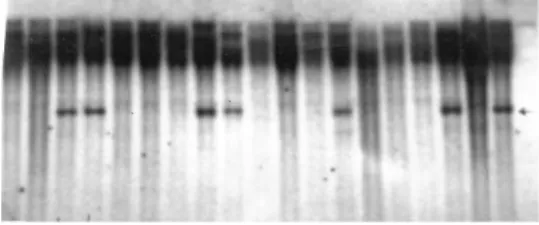
polymor-phic fragments. The pA35 clone plus theEcoRV restriction enzyme yielded a restriction fragment of about 4 Kb (Fig-ure 1) which was inversely associated (R2= 0.24,α= 0.01)
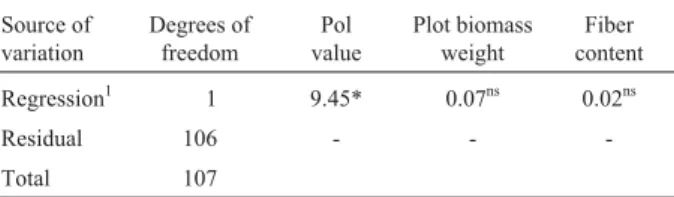
with Pol values (Table 2), indicating that plants without this marker would have a higher Pol value than plants with the marker and that this difference would be significant at the 99% probability level.
transgressive genotypes of the progeny. This suggests that SP80-4966 carries other alleles for high Pol, that compen-sate for the negative allele associated with the pA35 marker. The data are indicative of transgressive segregation (the occurrence of progeny with phenotypes outside the range determined by the parents) which is usually attribut-able to polygenic segregation (King and Stanfield, 1997).
The observed presence:absence segregation ratio (1:1, withχ2= 0.04 and p 0.9) in a random sample of the
mapping population suggests that the pA35 fragment is present in a single dose in the SP80-4966 genotype (da
Silva and Sorrells, 1996). No association was found between the pA35 fragment and other traits, such as the ton-nage of cane per hectare or fiber content (Table 2).
Results obtained with the EST pA35, which corre-sponds to the sucrose synthase gene, suggests that the polymorphic fragment is located near an allele coding for an isoform of the sucrose synthase enzyme. This transferase is part of the starch and sucrose metabolic pathway and takes part in the conversion of sucrose to starch (KEGG: Kyoto Encyclopedia of Genes and Genomes - http://www.genome.ad.jp/keg/). A putative al-lele coding for an active enzyme would explain the nega-tive association found between the pA35 marker and the Pol value. The cDNA clone from which the pA35 EST was obtained was32P-hybridized to a set of nitrocellulose membranes representing the sugarcane bacterial artificial chromosome (BAC) Library (Tompkinset al., 1999) for the identification of the BAC clones carrying the sucrose synthase gene. The cDNA clone hybridized to the clones present in well P17 of library plate number (LPN) 30, and well C3 of LPN 35, information which may be used for the physical mapping and map-based cloning of this sucrose synthase allele.
The presence of a negative allele in the high sugar parent may be explained by the quantitative nature (con-trolled by numerous loci) of the sugar content trait. This fact also explains the occurrence of transgressive plants, re-sulting from genetic recombination between this major gene, controlling sugar content, and other favorable alleles. It also illustrates the importance of pyramiding favorable alleles in elite sugarcane genotypes. A marker-assisted se-lection (MAS) using this marker would have allowed the identification of 16 out of 22 transgressive progenies for low Pol values and 19 out of 42 transgressive progenies for high Pol values. The difference between the mean Pol val-ues of plants without the marker and plants with the marker was -0.84, representing 5.9% of the progeny mean (14.05) or nearly 6 times greater than the 1% gain from selection for the same trait obtained in the last 10 years in the Copersucar breeding program without MAS. Because there was no as-sociation of the pA35 marker with other yield components (data not shown) we recommend the use of this marker for MAS aimed at increasing sugarcane Pol values.
Table 1- List of cDNA clones, representing expresses sequence tags, used as restriction fragment length polymorphism (RFLP) marker probes.
Expressed sequence tag Annotation
pA35 Sucrose synthase
pA47 Olygodendrocyte-specific proline-rich protein 2
pA65 Trypsin inhibitor
A84 Sucrose synthase
B63 Sucrose synthase
C17 Hypothetical protein similar to beta-1,3 glucanase
C48 Pyruvate dehydrogenase E1 component,
alpha subunit
C81 Sucrose synthase
E15 Pyrophosphatase-fructose 6-phosphate 1-phosphotransferase (PFP)
E46 2-oxoglutarate/malate translocator
SCCCCL1001F02.g Starch synthase homolog T9A21.90
SCCCCL2001A05.b Malate dehydrogenase
SCCCCL3001E04.g Malate oxidoreductase, chloroplast
SCCCCL3001F05.g Rubb_pea rubisco subunit binding-protein beta subunit precursor
SCCCCL3001F10.g Ubiquitin-carboxyl extension
SCCCCL3001H01.g Aldehyde oxidase-2
SCCCCL3003D01.g Aldehyde oxidase-2
SCCCCL3003F11.b Citrate Synthase, glyoxysomal precursor
SCCCCL3120A08.b NADPH dependent mannose 6-phosphate reductase
SCCCCL3120C01.b Malate oxidoreductase
SCCCCL3120C10.g Pgky_ wheat phosphoglycerate kinase, cytosolic
SCCCLR1001A05.g Sucrose synthase-1
SCCCLR1024D02.g Similar to ATP-citrate-lyase
SCCCLR1C01B09.g Malate dehydrogenase
SCCCLR1C01G07.g Glyceraldehyde 3-phosphate dehydrogenase, cytosolic 1
SCCCRZ1004A10.g Hypothetical protein T4L20.60
SCCCRZ2002B05.g Putative hydroxymethylglutaryl-CoA lyase
SCCCRZ2C02E02.g Wall-associated protein kinase
SCCCRZ2C03E11.g Putative ripening-related protein
Lingle and Irvine (1994) correlated high levels of su-crose synthase activity with an increase in susu-crose accumu-lation rate and plant ripening. However, results from other authors (Zhuet al., 1997; Botha, 2000) indicate no correla-tion between sucrose synthase activity and sucrose accu-mulation. These contrasting results could be due to an effect of genotypic differences between different varieties. An allele coding for an active enzyme reducing sucrose content would explain the negative association found be-tween the pA35 marker and the Pol value.
The narrow range of Pol values existing between the two parent clones, appears to have been a consequence of using a cross between commercial parents as mapping pop-ulation because varieties/clones with a low sugar content are normally discarded during the first selection stages of a breeding program. To be useful for MAS, this putative QTL needs to be validated in other crosses by investigating the same association with sugar content. Since sugarcane is the result of inter-specific hybridization, if this association is confirmed the origin of the QTL should be investigated,
i.e.it should be ascertained whether the sucrose synthase allele causing the lower sucrose content is coming from
Saccharum officinarumorS. spontaneum. Southern analy-sis performed using the sucrose synthase marker on S. spontaneum genotypes shows a high degree of polymor-phism among the 11 genotypes investigated (data not shown). The mapping of this fragment on a commercial progeny would increase the efficiency of introgression pro-grams, allowing the inclusion of new positive alleles from wild germplasm and reducing the normally associated ge-netic drag.
Another practical application of these findings in commercial sugarcane breeding would be the planning of crosses. The use of a single dose marker associated with a major QTL in a polymorphic cross for marker-assisted se-lection in sugarcane will allow more accurate sese-lection be-cause identification of high sugar genotypes would not involve environmental effects.
Acknowledgments
The RFLP analyses were conducted at the Copersucar Technology Center. The cDNA clones carrying the SASEX ESTs
were kindly provided by Barbara Hucket and Deborah Carson. FAPESP EST clones resulting from the SUCEST project were kindly provided by Andre Vettore and Paulo Arruda, from the Universidade Estadual de Campinas (UNICAMP). We would also like to thank James Irvine for fruitful discussion and suggestions.
References
Arumuganathan K and Earl ED (1991) Nuclear DNA content of some important plant species. Plant Mol Biol Rep 9:208-218.
Botha FC (2000) Sucrose phosphate synthase and sucrose synthase activity during maturation of internodal tissue in sugarcane. Aust J of Plant Physiol 27:81-85.
Botstein D, White RL, Skolnick M and Davis RW (1980) Con-struction of a genetic map in man using restriction fragment length polymorphism. An J Hum Genet 32:314-331. Brasileiro ACM and Carneiro VTC (1998) Manual de
Trans-formacao de Plantas. Embrapa-SPI/Embrapa-Cenargen, Brasíilia, 309 pp.
Carson D, Huckett B and Botha F (2001) Genomic research at SASEX: Perspectives from a small-scale program. Proc Int Soc Sugar Cane Technol 24:539-541.
da Silva JA (2001) Preliminary analysis of microsatellite markers derived from sugarcane ESTs. Genet Mol Biol 24:155-159. da Silva JA, Ulian E and Barsalobres CF (2001) Development of EST-derived RFLP markers for sugarcane breeding. Proc Int Soc Sugar Cane Technol 24:318-322.
da Silva JA and Sorrells ME (1996) Linkage analysis in polyploids using molecular markers. In: Jauhar P (ed) Methods of Genome Analysis in Plants. CRC Press, Boca Raton, Florida, pp 211-228.
da Silva JA, Sorrells ME, Burnquist WL and Tanksley SD (1993) RFLP linkage map of Saccharum spontaneum. Genome 36:782-791.
Hogarth DM, Cox MC and Bull JK (1977) Sugarcane improve-ment: Past achievements and future prospects. In: Manjit SK (ed) Crop Improvement for the 21st. Century. Louisiana State University, Louisiana, pp 29-55.
King, R and Stanfield W (1997) A Dictionary of Genetics. Oxford University Press, New York, 439 pp.
Lander ES and Botstein D (1989) Mapping mendelian factors un-derlying quantitative traits using RFLP linkage maps. Ge-netics 121:185-199.
Lingle SE and Irvine JE (1994) Sucrose synthase and natural rip-ening in sugarcane. Crop Sci 34:1279-1283.
Ming R, Liu SC, Lin YR, da Silva J, Wilson W, Braga D, van Deyze A, Weslaff TF, Wu KK, Moore PH, Burnquist W, Sorrells ME, Irvine, JE and Paterson, AH (1998) Detail alignment ofSaccharumandSorghumchromosomes: Com-parative organization of closely related diploid and polyploid genomes. Genetics 150:1663-1682.
Scott KD, Eggler P, Seaton G, Rossetto M, Ablet EM, Lee LS and Henry RJ (2000) Analysis of SSRs derived from grape ESTs. Theor Appl Genet 100:723-726.
Soltis DE and Soltis PS (1993) Molecular data and the dynamic nature of polyploidy. Critical Reviews in Plant Sciences 12:243.
Southern EM (1975) Detection of specific sequences among DNA fragments separated by gel eletrophoresis. J Mol Biol 98:503-517.
Table 2 - F-test values from the linear regression analysis of the pA37-EcoRV marker as a binary independent variable for the apparent sucrose content by polarization (Pol value; grams of sucrose per kg per 100 g of fresh cane), plot biomass weight (tonnage of cane per hectare) and fiber content (%) of 108 progenies of the SP80-180 x SP80-4966 cross.
Source of variation
Degrees of freedom
Pol value
Plot biomass weight
Fiber content
Regression1 1 9.45* 0.07ns 0.02ns
Residual 106 - -
-Total 107
1
Staub JE, Serquen FC and Gupta M (1996) Genetic markers, map construction and their application in plant breeding. Hortscience 31:729-741.
Tanksley SD, Young ND, Paterson AH and Bonierbale MW (1989) RFLP mapping in plant breeding: New tools for an old science. Biotechnology 7:257-264.
Tompkins JP, Yu Y, Miller-Smith H, Frisch DA, Woo SS and Wing RA (1999) A bacterial artificial chromosome library for sugarcane. Theor Appl Genet 99:419-424.
Vettore AL, da Silva FR, Kemper EL and Arruda P (2001) The Li-braries that made SUCEST. Genet Molec Biol 24:1-7. Zhu YJ, Komor E and Moore PH (1997) Sucrose accumulation in
the sugarcane stem is regulated by the difference between the activities of soluble acid invertase and sucrose phosphate synthase. Plant Physiology 115:609-616.