w ww . e l s e v i e r . c o m / l o c a t e / b j p
Original
Article
Reproductive
effects
of
the
psychoactive
beverage
ayahuasca
in
male
Wistar
rats
after
chronic
exposure
Alana
de
Fátima
Andrade
Santos
a,
Ana
Luiza
Sarkis
Vieira
b,
Aline
Pic-Taylor
c,
Eloisa
Dutra
Caldas
a,∗aLaboratóriodeToxicologia,DepartamentodeFarmácia,UniversidadedeBrasília,Brasília,DF,Brazil bCentrodeCirurgiaExperimental,FaculdadedeMedicina,UniversidadedeBrasília,Brasília,DF,Brazil cDepartamentodeGenéticaeMorfologia,InstitutodeBiologia,UniversidadedeBrasília,Brasília,DF,Brazil
a
r
t
i
c
l
e
i
n
f
o
Articlehistory:Received15November2016 Accepted9January2017 Availableonline9March2017
Keywords: Ayahuasca
N,N-dimethyltryptamine -Carbolinesalkaloids Malereproductivetoxicity Wistarrats
Testosterone
a
b
s
t
r
a
c
t
Ayahuascaisapsychoactive beverageused ancestrallybyindigenousAmazonian tribesand,more recently,byChristianreligionsinBrazilandothercountries.Thisstudyaimedtoinvestigatethe repro-ductiveeffectsofthisbeverageinmaleWistarratsafterchronicexposure.Theratsweretreatedby gavageeveryotherdayfor70daysat0(control),1×,2×,4×and8×thedoseusedinareligiousritual
(12animalspergroup),andanimalseuthanizedonthe71stday.Comparedtocontrols,therewasa
sig-nificantdecreaseinfoodconsumptionandbodyweightgaininratsfromthe4×and8×groups,anda
significantincreaseinthebrainandstomachrelativeweightatthe8×group.Therewasasignificant
increaseintotalserumtestosterone,andadecreaseinspermatictransittimeandspermaticreserves intheepididymiscaudaeinthe4×group,butnotinthehighestdosegroup.Nosignificantchanges
werefoundintheotherreproductiveendpoints(spermatozoidmotilityandmorphology,total sperma-tozoidcountanddailyspermproduction),andhistologyoftestisandepididymis.Thisstudyidentifieda no-observed-adverse-effect-levelforchronicandreproductiveeffectsofayahuascainmaleWistarrats at2×theritualisticdose,whichcorrespondsinthisstudyto0.62mg/kgbwN,N-dimethyltryptamine, 6.6mg/kgbwharmineand0.52mg/kgbwharmaline.Apotentialtoxiceffectofayahuascainmalerats wasobservedatthe4×dose,withanon-monotonicdose–response.Studiesinvestigatingtheroleof
ayahuascacomponentsinregulatingtestosteronelevelsareneededtobetterunderstandthisaction. ©2017SociedadeBrasileiradeFarmacognosia.PublishedbyElsevierEditoraLtda.Thisisanopen accessarticleundertheCCBY-NC-NDlicense(http://creativecommons.org/licenses/by-nc-nd/4.0/).
Introduction
Ayahuasca,which in Quechua means“wine ofthe souls”,is
a hallucinogenic plant concoction used ancestrally by Amazon
indigenousgroupsinxamanicritualsfordiagnosis,healing,and
spiritualdevelopment(Grobetal.,1996;McKenna,2004;Tupper,
2008).Sincethe1930s,Christianreligiouscommunitieshavealso usedthisconcoctionintheirrituals,includingSantoDaime,
Bar-quinhaandUniãodoVegetal(UDV)(Macrae,2004;Tupper,2008),
andthisuseislegalinBrazil(CONAD,2004).Theayahuasca reli-gionsalsohavecentersinothercountriesinSouthAmerica,Europe,
AsianandNorthAmerica(Halpern,2004;Tupper,2008;Labateand
Feeney,2012).Itsuse,however,goesbeyondreligiousrituals,being
alsousedforrecreationalpurposesby peopleseekingits
hallu-cinogeniceffects,withapotentialriskofintoxication(DosSantos,
2013;Winstocketal.,2014).Ontheotherhand,variousstudies
∗ Correspondingauthor.
E-mail:[email protected](E.D.Caldas).
havesuggestedthetherapeuticactionofayahuasca,includingfor
drugaddiction,anxietyanddepression(Pic-Tayloretal.,2015;Dos
Santosetal.,2016a;Domínguez-Clavéetal.,2016).
Ayahuascais generally produced withPsychotria viridisRuiz
& Pav., Rubiaceae, bush leavesand Banisteriopsiscaapi (Spruce
ex Griseb.) Morton, Malpighiaceae, vine, both native from the
Amazon. The B. caapi stem contains the -carbolinesalkaloids
harmine,harmalineandtetrahydro-harmine,whicharereversible
inhibitorsofmitochondrialmonoamineoxidase(MAO)enzymes
(McKennaet al.,1984; Harvey et al.,1998)responsible for the
oxidationofneurotransmitters,suchasserotonin,dopamineand
noradrenalin. P.viridis contains N,N-dimethyltryptamine (DMT),
whichisalsofoundinotherplantsandanimals,includinghumans
(Callawayetal.,1996).Duetoitsstructuralsimilaritytoserotonin
(5-hydroxytryptamina,5HT),DMTbindswithserotonergic
recep-tors,mainlythe5-HT2Atype,producingitshallucinogeniceffects
(Smithetal.,1998;Halberstadt,2015).StudiesshowthatDMTalso
actsasasubstratefortheserotonintransporter(SERT)andforthe vesicularmonoaminetransporter(Nagaietal.,2007;Cozzietal.,
2009;Halberstadt,2015).
http://dx.doi.org/10.1016/j.bjp.2017.01.006
Whenadministeredorally,DMTisrapidlydegradedbytheMAO
present inthe liverand intestine. However, in thepresence of
-carbolines, it can reachthebrain and becomes orally active.
Therefore,thehallucinogeniceffectsofayahuascaconsumptionare
producedbythesynergicactionoftheactivecompoundspresent
intheplantspeciesusedinitspreparation(BuckholtzandBoggan,
1977;Callawayetal.,1996,1999).Theeffectsincludealterationsin
affectiveandemotionalstates,thoughts,memoryandbody
sensa-tions,synesthesiaandhallucinationwithalterationsinthevisual,
olfactoryand auditorysenses (Shanon,2003; Pireset al.,2010;
DosSantos et al., 2016b). Somaticeffects may include nausea,
vomiting,diarrhea,tremors,dizziness,tachycardia,mydriasisand hypertension(CallawayandGrob,1998;Ribaetal.,2003;Vivesand
García-albea,2012).
A studyconducted by this research group in female Wistar
ratsfoundthattheacutelethaloraldoseofanayahuasca
infu-sionpreparedbytheUDVwasover50×theritualdose.Thissame
studyidentifiedgreaterneuronalactivityinregionsofthebrain
richinserotoninergicreceptors,suchastheamygdala,theraphe
nucleusandthehippocampus,inanimalsexposedtoasingledose
ofayahuasca,equivalentto30×theritualdose(Pic-Tayloretal.,
2015).AstudyconductedbyMotta(2013)showedthatfemalerats
exposeddailytoayahuascaduringpregnancyatdoseshigherthan
2×theritualdosehadreductioninreproductionrates,increase
inreabsortions,lowerbodyweightandlowerrelativefetusorgan
weights and fetus visceral malformations. Similarresults were
foundinapreviousstudyconductedbyOliveiraetal.(2010).
Several studies have addressed the relation between
psy-choactivedrugsandmaleinfertility.Testsonanimalsshowthat
substancessuchastetra-hydrocanabinol,foundin plantspecies
ofthegenusCannabis,reducetestosteronelevels,affectingsperm
productionandmotility,andconsequentlymalefertility(Morgan
etal.,2011;Onyije,2012).Drugssuchasalcohol,tobacco,cocaine,
andandrogenicanabolicsteroidsamong othersarealso
consid-eredpotentialinfertilityagents(Onyije,2012;Vigneraetal.,2013;
Kulkarnietal.,2014).Furthermore,Alvarengaetal.(2014)found
that a single dose of ayahuasca significantly decreased sexual
performanceofmalerats,buthigherperformancewasobserved
in sleep deprived rats treated at the lowest dose(250g/ml).
However,studiesevaluatingtoxicityaspectsregardingmale
repro-duction in animals exposed chronically to ayahuasca are still
needed.
Theaimofthisstudyistoinvestigatethepotentialtoxicological effectofanayahuascainfusiononreproductioninWistarrats,after
chronictreatment.
Materialsandmethods
Ayahuascamaterial
The ayahuasca used in this study was prepared in April,
2011 by the Núcleo Luz do Oriente of the UDV, Federal
Dis-trict,Brazil,andstoredina −20◦Cfreezerbeforelyophilization.
Theinfusion wasprepared with Banisteriopsiscaapi (Spruce ex
Griseb.)Morton,Malpighiaceae,collectedinÁguasLindasdeGoiás (15◦46′17′′S, 48◦14′56′′W) and the leaves of Psychotria viridis Ruiz&Pav.,Rubiaceae,collectedin Sobradinho, FederalDistrict (15◦75′23′′S,47◦72′92′′W).Samplesofbothspeciesweredeposited
in the University of Brasilia Herbarium under the references
AzevedoEP149880BrahmsandTrietoB149879Brahms,
respec-tively.ThelevelsofDMT,harmalineandharminepresentinthe
ayahuascainfusion,determined prior totheexperiment bygas
chromatography-tandemmass spectrometry(GC–MS/MS; Trace
UltracoupledwithaTSQQuantumXLSTripleQuadrupole;Thermo
Scientific),were0.146mg/mlofDMT,0.12mg/mlofharmaline,and
100 RT: 18.00 - 28.00
21.21 21.21
DMT
21.31
25.83
25.96
26.24 Harmaline
Harmine 25.54 26.22
26.23 26.26
26.24 NL: 2.70E8 TIC MS AYAL
NL: 6.71E4 TIC F: + c EI SRM ms2 130 000 [76 999-77 001] MS AYAL
NL: 1.69E6 TIC F: + c EI SM ms2 213 000 [169 999-170 001] MS AYAL
NL: 2.70E8 TIC F: + c EI SRM ms2 212 000 [168 999-169 001, 211 999-212 001] MS AYAL
26.27 26.29
50
0 100
50
0 100
50
0 100
50
0
18 20 22 24
Time (min)
Relativ
e ab
undance
26 28
Fig.1. GC–MS/MStotalionchromatogram(TIC)oftheayahuascasample,and theextractedionchromatogramsinselectedreactionmonitoring(SRM)modeof DMT(m/z130→77;RT=21.3min),harmaline(m/z213→170;RT=25.8min)and harmine(m/z212→169;RT=26.2min).
1.56mg/mlofharmine(Pic-Tayloretal.,2015).Fig.1showsthe
GC–MS/MStotalionchromatogramoftheayahuascaprovidedby
theUDV.Onlytheharminepeakcanbeseen,asitispresentata
concentrationovertentimeshigherthanDMTandharmaline.Fig.1
alsoshowsthechromatograms,inselectedreaction monitoring
mode, ofthe threeayahuasca components(abundance
normal-izedto100%ineachcase).Tetrahydroharminewasnotanalyzed
inthisstudy.Thelyophilizedmaterialwasappropriatelyweighed
accordingtothedosesselectedbeforetreatment,consideringbody weight,anddilutedinfilteredwater,maintainingafinalvolumeof 2ml.
Experimentalprotocol
Thestudywasconductedwith60maleratsofthespecies
Rat-tusnovergicus,Wistarlineage,providedbyGranjaRG(SãoPaulo,
Brazil)aged4weeks,andofuniformweight(210±10g).The ani-malswerekeptattheFacultyofHealthSciencesoftheUniversity ofBrasilia(UnB)animalhouseinAlesco®
polypropylenezincbar
cagesinventilatedshelves.Theyunderwenta15-day
acclimatiza-tionperiodbeforethetreatmentwasinitiated,weremaintained
undercontrolledtemperatureconditions(23±2◦C)anddark/light
cyclesof12h/12hduringtheexperiment,andweregiven
commer-cialrodentfeed(Purina®
)andfilteredwateradlibitum.Thisproject
wasapprovedbytheAnimalUseEthicsCommissionoftheUnB(n◦
107766/2010).
Clinicalassessment oftheanimalswasperformeddaily,and
bodyweightandfeedconsumptionverifiedevery3days.Onthe
71stday,theanimalswereeuthanizedbyexposuretoCO2anda
4mlbloodsamplewasimmediatelycollectedbycardiacpuncture
andsubjectedtocentrifugationtocollecttheserum.Thestudywas
carriedoutaccordingtoprotocolEPA/630/R-96/009/1996
(Guide-linesforReproductiveToxicityRiskAssessment).
Experimentaldoses
Theselecteddosesusedinthestudyweredeterminedaccording
tothe ritualdoseconsumed during a UDVceremony,
approxi-mately150ml for anindividual weighing 70kg(1×). Based on
thelevelsfoundintheinfusionbyGC–MS/MS,the1×dose
cor-respondsto3.3mg/kgbwofharmine,0.26mg/kgbwofharmaline
and0.31mg/kgbwofDMT.Theanimalswererandomlydistributed
waterandfourtreatedgroupsthatreceived1×,2×,4×and 8×
theusualdosefor70days,bygavage.Thesedosescoincidewith
thoseusedin thefemalereproductivetoxicitystudyconducted
previously(Motta,2013)thatdemonstratedthatthedaily inges-tionofayahuascaatdosesequalorgreaterto4×theusualdoseis lethalforfemalepregnantratsafterthe5thdayofadministration,
withanimalspresentingsigns ofpiloerection,convulsion,
chro-modacryorrhea,lordosisandcyanosis.Similarresultswerefound
inapre-testconductedaspartofthepresentstudywithmalerats
administereddailywith4×dosesofayahuasca.Thus,inorderto
ensurethesurvivaloftheanimalsduringthetreatment,thepresent
studywasconductedwithadministrationtakingplaceon
alternat-ingdays.
Bloodandorgananalysis
Twomlofserumofeachanimalwasstoredat−20◦Cforlater serologicdosageoftotaltestosterone,luteinizing(LH)andfollicle
stimulating(FSH)hormones,andbiochemicalanalyseswere
per-formedtoassesspancreatic(amylaseandlipase),hepatic(total,
direct,andindirectbilirubin),renal(creatinineandurea),
hepa-tobiliary,andpancreatic(glutamicoxaloacetictransaminase,and
glutamicpiruvictransaminase)functions,andtriacylglyceridesto assess lipidmetabolization. Spleen, liver,stomach, brain,heart, kidneys,testicles,epididymis,prostrateandseminalbladderwere
removedandwashedwithNaCl0.9%salinesolution,then
submit-tedtomacroscopicevaluationandweighing.
Reproductiveparameters
During the necropsy, the content of the deferent duct was
extractedbydiffusionin1mlofDulbecco’sModifiedEagleMedium (GIBCOTM)previouslyheatedat34◦Cforspermmotilityanalysis, withoutsurpassingthe10-minperiodaftereuthanasia.The
result-ingsolution(100l)wereinsertedinahemacytometer(Neubauer
chamber)andreadingsweretakenwithanopticmicroscope(Leica
GalenIII),andmagnifiedto400×.Fiftyspermatozoidswere
ana-lyzedperanimal, andthenumber ofprogressive(rapidorslow
progression)andnon-progressive(noprogressionormotionless)
counted(Seedetal.,1996).
Therighttestisofeach animal wasperforatedat oneofthe
extremitiestoremovethetunicaalbuginea,andtheparenchyma
washomogenizedfor1mininUltra-Turrax(IKA®
T10basic) in
10mlof0.05%TritonX-100todeterminetotalspermatozoidcount
(no.×106),dailyspermproduction,andspermtransitperiod(days). TherightepididymistailofeachanimalwascutupinaPetridish
andhomogenizedtodeterminethespermaticreserve.
Two samples of each testis and epididymis homogenates
(100l)wereanalyzedintheNeubauerchamberusinganoptic
microscope(ZeissPrimoStar;400×).Thespermatids(testis)and
spermatozoids(testisandepididymis)resistanttohomogenization
werecountedinfivechamberfieldsandthemeanofthetotalcount reportedforeachanimal(Straderetal.,1996).
Inrats,maturespermatozoidsinstages17–19represent48%
of seminiferous epithelium cycle length, which has a duration
periodof 12.75days(Robbet al.,1978).Hence,6.1days isthe
periodintheseminiferouscycleduringwhichmature
spermato-zoidsarepresent(Kempinasetal.,1998).Dailyspermproduction
wasobtaineddividingthenumberofresistantspermatozoidsin
thetesticleby6.1days(Robbetal.,1978;Blazaketal.,1985).The
spermtransittimewasobtaineddividingthenumberof
spermato-zoidsinthetailoftheepididymisbythedailyproductionofsperm
(Amannetal.,1976;Robbetal.,1978).
ThetailoftheleftepididymisofeachanimalwascutupinaPetri dishcontaining2mlofaphosphate-salinebuffersolution(PBS;7.4 pH)tocollectthespermatozoids.Theresultingsolutionwasdiluted
in5mlofPBSandstoredunderrefrigerationforupto10daysfor furtheranalysis.Twoslidesperanimalwerepreparedbysmearand
allowedtodryatroomtemperature,thenfixedwithmethanol(PA
grade)for10minandstainedwith1%eosinefor45min(Wyrobek
andBruce,1975).
Two hundred spermatozoids of each animal were analyzed
under microscopeand the percentage ofnormal and abnormal
spermatozoids(head, tailandmultiple) quantified(IRDG,2000;
SharmaandSingh,2010).
Testisandepididymishistology
ThelefttestisofeachanimalwaspreviouslyfixedinBouin solu-tionfor 3hat4◦C, cuttransversallyin halfandmaintainedfor anadditional4hatthesametemperatureandsolution.Afterthis period,theorganswerewashedin50%ethanol(proanalysisgrade)
overnightatroomtemperaturetoremovetheexcessofBouin,and
maintainedin70% ethanoluntil thehistologicalprocedurewas
performedusingclassicaltechniques(dehydration,diaphanization
andinclusioninparaffin).Non-consecutive5mthicksliceswere
obtainedusingmicrotome(Leica),thenstainedwithhematoxiline
andeosin(H&E).Threeslidesofeachanimalwereanalyzedunder
microscope.Ineachslide,tenseminiferoustubuleswereanalyzed
forthepresenceofcompletespermatogenesis,byJohnsen’s
Tubu-larBiopsyScore(JTBS)(Johnsen’s,1970).Foreachanimal,thefinal scorewasthemeanscoreobservedin10tubulesofthethreeslides (n=30)(MJTBS).
Thehead/bodysegmentsoftheepididymisofeachanimalwere
fixedinBouinfor7hat4◦C,followingthesamehistological proce-duredescribedabove.Longitudinalsectionsoftheepididymiswere
analyzedtodeterminethespermdensity,andclassifiedas
mod-eratehypospermia(+++),discretehypospermia(++),andnormal
spermdensity(+).Thepresenceofalterationsintheepididymis
andtesticle suchasexfoliationofgermcells, tubular
vacuoliza-tion,inflammatoryinfiltrates,granulomas, necrosis,edemasand
tubulesofreduceddiameter,andcellulardisorganizationwerealso investigated(Lanningetal.,2002).
Statisticalanalysis
Thestatisticalanalysisofthespermmorphologyandmotility
wasconductedbytheKruskal–Wallistest,andtheother
parame-terswereevaluatedusingone-wayanalysisofvariance(ANOVA),
withposthoccomparisonsbetweengroupsusingTukeyorDunnett
(homogeneous variance)or DunnettT3 (non-homogenous
vari-ance).TheanalyseswereperformedusingIBMSPSSStatisticsV.20
software,andthedifferenceswereconsideredstatistically signifi-cantatp≤0.05.
Results
Feedconsumption,bodyandorganweightandbiochemical
evaluations
Theanimalstreatedwithayahuascaat1×,2×and4×dosesdid
notshowadverseclinicalsignsduringtreatment.However,
ani-malstreated with8×dosesshowedevidentsigns ofstressand
constantvocalizationduringthegavageprocedure,and
piloerec-tionandtremorsafterayahuascaadministration.Twoanimalsof
the8×groupdiedduringtheexperiment,thefirstonthe16thday
oftreatmentwithsignsoftremorsandconvulsionminutesafter
gavage,andthesecondonthe37thdayduetofaultyadministration,
withalltheadministeredmaterialbeingfoundinthelung.
Table1showstheaveragefeedconsumption,measuredevery
Table1
Totalweightgain,feedconsumptionandbodyweight(g)attheendofthetreatmentofthecontrolandayahuascatreatedanimals(mean±standarderror).
Variable Control (n=12)
1× (n=12)
2× (n=12)
4× (n=12)
8× (n=10) Feedconsumption 72.1±0.7* 70.9±1.4* 74.6±1.1* 66.9±0.7# 64.2±1.0# Finalbodyweigh 405.4±11.9* 401.1±13.7*# 409.7±11.4* 381.1±12.3*# 355.3±10.5# Totalweightgain 204.1±7.9* 194.8±7.6* 197.5±8.9* 167.3±9.2# 158.5±7.5# Differentsymbolsbetweengroupsindicatesignificanceatp<0.05;ANOVAfollowedbyTukeyorDunnett.
treatmentforthecontrolandayahuascatreatedgroups.A signifi-cantdropinfeedconsumptionwasobservedinanimalstreatedat 4×and8×doses,whichhadasignificantimpactonthefinalbody weightforthe8×groupandonthetotalbodyweightgainforboth groups.
Table2showstherelative(%)weightsoftheanimalorgansin
thecontrolandtreatedgroups,andtheabsoluteweightsforthe
brainandreproductiveorgans.Animalsofthe8×groupshowedan
increaseintherelativeweightofthebrainandstomachin
rela-tiontothecontrol,however nodifferencewasobserved inthe
absolutebrainweights.Asignificantdecreaseintherelative
epi-didymisweightwasobservedinthe8×groupcomparedwiththe
4×group,aswellasasignificantincreaseintherelativeseminal vesicleweightcomparedwiththe2×group.Theabsoluteweightof thetesticleswassignificantlylowerfortheanimalsofthe8×group
incomparisonwiththeothergroups.Nomacroscopicalterations
wereobservedintheevaluatedorgans.
Thebiochemicalevaluationsconductedtoassessthehepatic,
pancreatic,renalandlipidmetabolizingfunctionsdidnotindicate
significantdifferencesamongthegroups(datanotshown).
Reproductiveendpoints
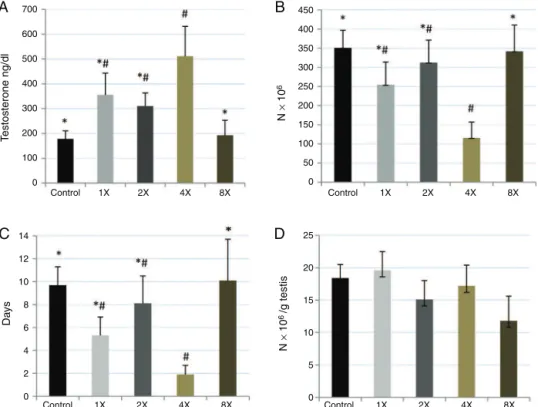
Asignificantincreasewasobservedintotaltestosteroneofthe
animalstreatedwith4×dosesofayahuascacomparedwiththe
controlgroupandwiththe8×group(Fig.2A).Therewereno
sig-nificantdifferencesinLHandFSHlevelsbetweenthetreatedand
controlgroups(datanotshown).
Thepercentagesofprogressive(spermmotility)and
morpho-logicallynormal (spermnormality)spermatozoidsareshown in
Fig.3.Onaverage,morethan75%ofthespermatozoidspresented
normalmotility(progressive),withnosignificantdifferenceamong
the groups of the study (Fig. 3A). Although all treated groups
showedlowerpercentagesofmorphologicallynormal
spermato-zoidsthanthecontrol,downto46.9%inthe4×group,thisreduction wasnotstatisticallysignificant(p=0.29)(Fig.3B).
Table3showsthepercentageofabnormalspermatozoidsfound
in the animals of the experimental groups. The percentage of
spermatozoidswithheadlesstailswasrelativelyhigheveninthe
animalsof thecontrol group,possibly asa consequence ofthe
smearingprocesswhenpreparingtheslides.Therewasanincrease
inthepercentageofspermatozoidswithaflattenedheadinthe ani-malsinthe8×groupinrelationtothe2×group,whichisprobably alsoanartifactduetothecellosmolaritychangesduringthe refrig-eratedstorageperiod,whichoccurredforupto10days.Therewas anincreaseinthepercentageofspermatozoidswithabenttailin thegroupstreatedwith2×and4×dosesinrelationtothe1×group.
Overall,nosignificantdifferencesinthetotalnumberof
abnor-malitieswerefoundbetweenthecontrolandtreatedanimals.A
significantreductionwasobservedinthespermreserveinthe
epi-didymistailandinthespermtransittimeoftheanimalstreated
withthe4×doseinrelationtothecontrolgroupandthe8×group (Fig.2Band2C).Nosignificantdifferenceswereobservedinthe totaldailyspermcountsinthetesticleamongthegroups(p=0.55),
althoughthecountwaslowerforthe8×doseincomparisonwith
thecontrolandtheothertreatedgroups(Fig.2D).
NosignificantdifferenceswereobservedinthemeanJTBSscore
(MJTBS)among thegroups, which ranged from9.43±0.12 (2×
group)to9.5±0.10(control).Allanimalspresentedscore of10
forat leastoneof thethirtytubulesanalyzed. Furthermore,no
morphologicalchangeswereobservedinthetestisofcontroland
treatedanimals.Smallnumberoflymphocytesandmacrophages
wereseenintheinterstitialtissueofepididymisheadsegmentsof
someanimalsfromallexperimentalgroups.
Discussion
Thisstudyshowedthatmaleratstreatedwithayahuascaat4×
and8×dosesevery2daysfor70dayshadlowerbodyweightgain
andlowerfeedconsumptionattheendofthetreatmentcompared
withtheothergroups,withsignificantlylowerfinalbodyweight
observedonlyinthehighestdosegroup.Therelativeweightsofthe
stomachandbrainweregreaterinthehighestdosegroupin
rela-tiontothecontrolgroup.Theseresultssuggestchronictoxicityof ayahuascainmaleratsathigherdoses.AstudyconductedbyMotta
(2013)demonstratedthatayahuascaadministereddailybetween
the6thand21stdayofgestationinducedtoxicity,withasignificant reductioninfeedconsumptionat1×,4×and8×doses,increases intherelativeweightsofthestomachofthe1×,2×and8×groups, anddilationofthestomachsandintestinesoftheanimalsofthe8× group.
Therewerenosignificantdifferencesobservedbetweenthe
rel-ative weights of thereproductiveorgans ofthe animals inthe
treatedgroupsand thoseofthecontrolgroup,buttheabsolute
weightofthetestisofthe8×groupwassignificantlylowerthan thecontrol.Nosignificantmorphologicalchangeswereobservedin thetestisorepididymisoftreatedanimals.Exposuretoayahuasca didnotleadtosignificantchangesinspermmotilityand
morphol-ogy,norinthenumberofabnormalspermatozoids,andtherewere
nosignificantalterationsindailyspermproduction,althoughthe
8×grouppresentedareductioninthisparameter.
Inthetestis,theMJTBSscorewasusedtoevaluate spermatoge-nesisaccordingtothepresenceorabsenceofdifferentcelltypesin theseminiferousepithelium(Johnsen,1970).Thisstudyidentified anaveragescorehigherthan9(outof10)forallgroups,
indicat-ingthatthespermatogenesiswascompleted,andthatayahuasca
didnotaffectspermproduction.Inadditiontospermatozoids,cells
fromall stages of spermatogenesis (spermatogonias,
spermato-cytes,roundandlatespermatids)werepresentinthetestis.
Thespermdensitiesintheepididymisheadandbodyregions
wereassessedduringthehistologicalanalysisinasemi-qualitative
manner, and no significant differences were found among the
groups.However,thespermcountinthetailoftheepididymisof
animalsfromthe4×groupwassignificantlylowerthanthecontrol andthe8×group.Indeed,KempinasandKlinefelter(2014)pointed outthatthetoxiceffectsonspermquantityandqualitymayoccur
intheabsenceofhistopathologicalalterationsintheepididymis
Table2
Relative(%)andabsolute(g)organweightsofthecontrolandayahuascatreatedanimals(mean±standarderror).
Control (n=12)
1× (n=12)
2× (n=12)
4× (n=12)
8× (n=10) Liver,% 3.56±0.33 3.47±0.20 3.43±0.25 3.49±0.20 3.52±0.26 Spleen,% 0.20±0.04 0.19±0.01 0.18±0.03 0.18±0.02 0.18±0.03 Rightkidney,% 0.35±0.02 0.34±0.02 0.36±0.04 0.35±0.01 0.37±0.04 Leftkidney,% 0.34±0.02 0.32±0.02 0.34±0.03 0.34±0.02 0.35±0.04 Stomach,% 0.46±0.06* 0.50±0.02*# 0.48±0.03*# 0.51±0.02*# 0.52±0.04# Heart,% 0.32±0.03 0.32±0.04 0.31±0.02 0.33±0.02 0.33±0.03 Brain,% 0.52±0.06* 0.53±0.06*# 0.51±0.06a 0.55±0.04*# 0.59±0.05# Brain,g 2.10±0.03 2.10±0.02 2.08±0.06 2.08±0.03 2.07±0.03 Testis,% 0.48±0.06 0.47±0.03 0.47±0.04 0.51±0.04 0.49±0.04 Testis,g 1.93±0.07* 1.86±0.04*# 1.93±0.04* 1.93±0.05* 1.73±0.05# Epididymis,% 0.20±0.04*# 0.21±0.05*# 0.22±0.07*# 0.25±0.05* 0.18±0.05# Epididymis,g 0.82±0.05*# 0.85±0.05*# 0.92±0.09* 0.93±0.05* 0.65±0.05# Prostate,% 0.20±0.09 0.23±0.06 0.20±0.06 0.23±0.07 0.17±0.03 Prostate,g 0.80±0.11*# 0.92±0.09* 0.82±0.07*# 0.87±0.07*# 0.59±0.04# Seminalvesicle,% 0.37±0.06* 0.34±0.08*# 0.29±0.05# 0.34±0.05*# 0.40±0.09* Seminalvesicle,g 1.48±0.06* 1.32±0.07*# 1.19±0.05# 1.30±0.05*# 1.42±0.07*# Differentsymbolsbetweengroupsindicatesignificanceatp<0.05;ANOVAfollowedbyTukeyorDunnett.
700
A
B
D
C
450
400
350
300
250
200
150
100
50
0
25
20
15
10
5
0 600
500
400
300
200
100
0
14
12
10
8
6
4
2
0 Control
T
estosterone ng/dl
N
×
10
6
N
×
10
6 /g testis
Da
ys
1X 2X 4X 8X
Control 1X 2X 4X 8X
Control 1X 2X 4X 8X
Control 1X 2X 4X 8X
Fig.2.Totaltestosterone(A);spermaticreserveintheepididymistail(B);spermatictransittime(C);dailyspermaticproduction(D)ofthecontrolandtreatedgroups(n=12 foreachgroup,exceptforthe8×,n=10)(mean±standarderror).Differentsymbolsbetweengroupsindicatesignificanceatp<0.05;ANOVAfollowedbyTukeyorDunnett.
85 65
60
55
50
45
40
35
30
25
20 80
A
B
75
70
65
60
55
50
Control 1X 2X 4X 8X Control
%
%
1X 2X 4X 8X
Table3
Percentageofabnormalspermatozoidsofthecontrolandayahuascatreatedanimals(mean±standarderror).
Parameter Control (n=12)
1× (n=12)
2× (n=12)
4× (n=12)
8× (n=10) Headlesstail 18.2±3.7 28.7±7.6 14.3±2.3 17.2±4.2 17.3±1.7 Flattenedhead 0.3±0.1*# 0.3±0.1*# 0.1±0.1* 0.3±0.1*# 0.9±0.4# Pinhead 1.4±0.5 0.7±0.2 0.7±0.3 1.3±0.2 1.2±0.5 Bentneck 1.4±0.3 2.1±0.7 2.0±0.8 0.8±0.3 0.9±0.3 Benttail 18.7±3.6*# 14.6±2.8* 27.3±3.4# 29.1±3.7# 24.2±4.3*# Coiltail 0.2±0.1 0.7±0.3 0.7±0.2 0.7±0.3 0.7±0.4 Multiplesabnormalities 0.0±0.0 0.2±0.2 0.2±0.1 0.4±0.2 0.2±0.1 Total 41.9±3.0 49.9±6.6 48.1±3.1 53.1±5.8 47.7±4.7 Differentsymbolsbetweengroupsindicatesignificanceatp<0.05;Kruskal–Wallistest.
2weeksbeforetheirarrivalinthatregion,whilethosefoundinthe headwerereleasedbythetesticlejustafewdaysprior(Lanning
etal.,2002).
Studieshave shown that delays in sperm transport time in
theepididymisdo notalter thefertilityofthegametes(Billups
et al., 1990; Kempinas et al., 1998), but a lower transit time
mayaffectspermdevelopment,maturityandfertility(Klinefelter,
2002;Fernandezetal.,2008).Meistrich(1975)demonstratedthat
treatmentofWistarratswithestradiolderivativestogetherwith
testosterone didnot affecttesticular functions,but accelerated
spermtransporttimeandconsequentlyreducedthespermreserve
intheepididymis,similartowhatwasfoundinthisstudywith
ayahuasca.However,other authorshave reportedtheaction of
toxicagentsonspermreservesinthetailoftheepididymis,but
nochangesinspermproduction(Goyaletal.,2001;Klinefelterand
Suarez,1997;Bellentanietal.,2011).
Themostrelevantresultfoundinthisstudywasthesignificant increaseintotaltestosteronelevelsinanimalstreatedchronically
withayahuascaatthe4×doseincomparisonwiththe8×group
andthecontrol,whichwasinparallelwithasignificantdecrease inspermreserveoftheepididymistailandinspermtransittime. Theseresultsindicatedthattheeffectsobservedat4×dosewasnot
aleatory,andreflectsanon-monotonicdose–response.Alvarenga
etal.(2014)didnotfindanyeffectontestosteronelevelsofmale
ratsafterasingleayahuascadose,butadecreaseinsexual
perfor-mancewasobservedatalldoses(250–1000g/ml).Theincrease
intestosteroneinthe4×groupmaybeassociatedtoanincrease
intheabsoluteweightsoftheepididymisofthisgroup,sinceitis
anandrogynous-dependentorgan.Fernandezetal.(2008)founda
potentialrelationbetweenlowerreproductiveorganweightsand
lowertestosteroneplasmalevelsinmaleWistarratstreatedwith
diethylstilbestrol.
DMTbindsstronglytothe5-HT2Atypeserotonergicreceptors,
andactsasasubstratefortheSERT,thusinhibiting neurotransmit-terreuptake,whichremainlongerinthesynapticcleft(Smithetal.,
1998;Nagaietal.,2007;Cozzietal.,2009;Halberstadt,2015).
Addi-tionally,the-carbolinealkaloidspresentintheayahuascainfusion mayalsoinhibitthisreuptake(Callawayetal.,1999;Cozzietal.,
2009).McKenna(2004)statedthattheregularuseofayahuasca
apparentlyproducesserotonergicalterationsincreasingSERT
den-sityinthebrain,withanimpactonthepositivechangesinbehavior reportedbyayahuascausers(Callawayetal.,1994).
Theincreases in testosterone levels in animalstreated with
ayahuascaat the4× dosesuggests anendocrine compensation
mechanism,whichmayberespondingtotheincreasesin
sero-toninlevelsinthesynapticcleftsandinserotonergicactivitydue toDMT.Thisincreasewasnotobservedatthe8×dose,indicating
anon-monotonicdose–response,whichiscommonforendocrine
disruptors(Lagardeetal.,2015).Thisobservationmaybeexplained
bytheinvolvementoftestosteroneinthenegativefeedback
mech-anism,inhibiting thereleaseof GnRHinthehypothalamus and
consequentlyinhibitingthereleaseofgonadotropins(LHandFSH)
bythepituitarygland(SpritzeranddosReis,2008),althoughno
changesinthesehormoneswereobservedinayahuascatreated
animalsinthepresentstudy.Anotherhypothesisisthatthegreater
serotonergicactivity at the 8× dose due to higher DMT levels
(Pic-Tayloretal.,2015)maybedesensitizingreceptorsand
con-sequentlyreducing the SERTdensity. The 5HT2B receptors play
aregulatoryroleinthehomeostasisofsynapticserotoninlevels,
possiblyparticipatinginthecontrolofSERTintheraphenuclei
neuronswhich,onceactivated,inhibittheextracellular accumula-tionofserotonininducedbyselectiveserotoninreuptakeinhibitors (SSRI)(Diazetal.,2012).Furthermore,Kranzetal.(2015)showed
adirectrelationbetweenincreasesinplasmatestosteronelevels
inducedbytreatmentintranssexualsandincreasesinthedensityof serotoninreuptakesitesinvariousbrainregions.Studieswith
ani-malshaveshownthattreatmentwithtestosteroneincreasedthe
densityof5-HT2Areceptorsincertainareasofthebrain(Sumner
andFink,1998;Mcqueenetal.,1999;Herrera-Pérezetal.,2013;
Kranzetal.,2015).
Thisstudyallowedtheestablishmentofa
no-observed-adverse-effect-levelofayahuascaformaleWistarratstreatedevery2days for70days,at2×thedoseusedataUDVritual,whichcorresponds
to0.62mg/kgbwofDMT,6.6mg/kgbwofharmine,and0.52mg/kg
bw of harmaline. The effects observed at higher doses include
decreasesinfeedconsumptionandbodyweightgains,andincrease
ofrelative stomachand brainweights.A potentialreproductive
toxiceffectwasobservedatthe4×dose,withanon-monotonic
dose–response.Studiesinvestigatingtheroleofayahuasca
com-ponentsinregulatingtestosteronelevels,aswellasofSERTinthe brainsofmaleratsareneededtobetterunderstandthistoxicaction. Thisisthefirsttimethatthepotentialeffectofayahuascaon
maleanimalreproductionparametersafterchronicexposurewas
investigated.Theresultsofthisstudyareimportantasthe
world-wideuseofthisbeveragehasincreasedsubstantiallyinthelast
decades.Additionally,asthetherapeuticuseofayahuascahasbeen considered,thesafetyofitsuseneedstobestablished.
Ethicaldisclosures
Protectionofhumanandanimalsubjects. Theauthorsdeclare
thattheproceduresfollowedwereinaccordancewiththe
regula-tionsoftheresponsibleClinicalResearchEthicsCommitteeandin
accordancewiththoseoftheWorldMedicalAssociationandthe
HelsinkiDeclaration.
Confidentialityofdata. Theauthorsdeclarethatnopatientdata appearsinthisarticle.
Righttoprivacyandinformedconsent. Theauthorsdeclarethat
Authors’contributions
AFASconductedtheexperimentsandanalyzedmostofthedata,
performedthestatisticsandpreparedthedraftmanuscript.ALSV
performedthehistologyanalysis.APTandEDCconceived,designed
andcoordinatedthestudy.Allauthorsreadandapprovedthefinal manuscript.
Conflictsofinterest
Theauthorsdeclarenoconflictsofinterest.
Acknowledgments
TheauthorsthankLucianaNolli,Karina Castro,JulianaAlves
deMorais,NágelavonZuben,CamilaFerreiraandStefanyAlves
for helping during the different phases of theexperiment. We
alsothanktheSabin Laboratoryforperformingthebiochemical
and hormone analyses. This work received the financial
sup-portof theFederal DistrictResearchFoundation (FAP-DF;grant
193000358/2010).AFASantoswasgrantedaMasterscholarship
byCAPES.
References
Alvarenga,T.A.,Polesel,D.N.,Matos,G.,Garcia,V.A.,Costa,J.L.,Tufik,S.,Andersen, M.L.,2014.Canayahuascaandsleeplosschangesexualperformanceinmale rats?Behav.Process.108,110–116.
Amann,R.P.,Johnson,L.,ThompsonJR.,D.L.,Pickett,B.W.,1976.Dailyspermatozoal production,epididymalspermatozoalreservesandtransittimeofspermatozoa throughtheepididymisoftherhesusmonkey.Biol.Reprod.15,586–592. Bellentani,F.F.,Fernandes,G.S.A.,Perobelli,J.E.,Pacini,E.S.A.,Kiguti,L.R.A.,Pupo,
A.S.,Kempinas,W.D.G.,2011.Accelerationofspermtransittimeandreduction ofspermreservesintheepididymisofratsexposedtosibutramine.J.Androl. 32,718–724.
Billups,K.L.,Tillman,S.,Chang,T.S.,1990.Ablationoftheinferiormesentericplexus intherat:alterationofspermstorageintheepididymisandvasdeferens.J.Urol. 143,625–629.
Blazak,W.F.,Ernst,T.L.,Stewart,B.E.,1985.Potentialindicatorsofreproductive tox-icity:testicularspermproductionandepididymalspermnumber,transittime, andmotilityinfischer344rats.Fundam.Appl.Toxicol.5,1097–1103. Buckholtz,N.S.,Boggan,W.O.,1977.Monoamineoxidaseinhibitioninbrainand
liverproducedby-carbolines:structure–activityrelationshipsandsubstrate specificity.Biochem.Pharmacol.26,1991–1996.
Callaway,J.C.,Grob,C.S.,1998.Ayahuascapreparationsandserotoninreuptake inhibitors:apotentialcombinationforsevereadverseinteractions.J.Psychoact. Drugs30,367–369.
Callaway,J.C.,Airaksinen,M.M.,Mckenna,D.J.,Brito,G.S.,Grob,C.S.,1994.Platelet serotoninuptakesitesincreasedindrinkersofayahuasca.Psychopharmacology (Berl.)116,385–387.
Callaway,J.C.,Raymon,L.P.,Hearn,W.L.,Mckenna,D.J.,Grob,C.S.,Brito,G.S.,Mash, D.C.,1996.QuantitationofN,N-dimethyltryptamineandharmalaalkaloidsin humanplasmaafteroraldosingwithayahuasca.J.Anal.Toxicol.20,492–497. Callaway,J.,McKenna,D.,Grob,C.,Brito,G.,Raymon,L.,Poland,R.,Mash,D.,1999.
PharmacokineticsofHoascaalkaloidsinhealthyhumans.J.Ethnopharmacol.65, 243–256.
CONAD,2004.ConselhoNacionaldePolíticassobreDrogas,ftp://ftp.saude.sp.gov. br/ftpsessp/bibliote/informeeletronico/2010/iels.jan.10/iels16/URS-CONAD-1 250110.pdf.
Cozzi,N.V.,Gopalakrishnan,A.,Anderson,L.L.,Feih,J.T.,Shulgin,A.T.,Daley,P.F., Ruoho,A.E.,2009.Dimethyltryptamineandotherhallucinogenictryptamines exhibitsubstratebehaviorattheserotoninuptaketransporterandthevesicle monoaminetransporter.J.Neural.Transm.(Vienna)116,1591–1599. Diaz,S.L.,Doly,S.,Narboux-Nême,N.,Fernandez,S.,Mazot,P.,Banas,S.M.,
Bou-tourlinsky,K.,Moutikine,I.,Belmer,A.,Roumier,A.,Maroteaux,L.,2012.5-HT2B receptorsarerequiredforserotonin-selectiveantidepressantactions.Mol. Psy-chiatry17,154–163.
Domínguez-Clavé,E.,Soler, J.,Elices, M.,Pascual, J.C.,Álvarez,E.,delaFuente Revenga,M.,Friedlander,P.,Feilding,A.,Riba,J.,2016.Ayahuasca: pharmacol-ogy,neuroscienceandtherapeuticpotential.BrainRes.Bull.126,89–101. DosSantos,R.G.,2013.Acriticalevaluationofreportsassociatingayahuascawith
life-threateningadversereactions.J.Psychoact.Drugs45,179–188.
DosSantos,R.G.,Osório,F.L.,Crippa,J.A.,Hallak,J.E.,2016a.Antidepressiveand anx-iolyticeffectsofayahuasca:asystematicliteraturereviewofanimalandhuman studies.Rev.Bras.Psiquiatr.38,65–72.
DosSantos,R.G.,Balthazar,F.M.,Bouso,J.C.,Hallak,J.E.,2016b.Thecurrentstate ofresearchonayahuasca:asystematicreview ofhumanstudiesassessing
psychiatricsymptoms,neuropsychologicalfunctioning,andneuroimaging.J. Psychopharmacol.30,1230–1247.
EPA, 1996. Guidelines for Reproductive Toxicity Risk Assessment 61., pp. 56274–56322.
Fernandez,C.D.B.,Porto,E.M.,Arena,A.C.,Kempinas,W.D.G.,2008.Effectsofaltered epididymalspermtransittimeonspermquality.Int.J.Androl.31,427–437. Goyal,H.O.,Braden,T.D.,Mansour,M.,Williams,C.S.,Kamaleldin,A.,Srivastava,
K.K.,2001.Diethylstilbestrol-treatedadultratswithalteredepididymalsperm numbersandspermmotilityparameters,butwithoutalterationsinsperm pro-ductionandspermmorphology.Biol.Reprod.64,927–934.
Grob,C.S.,McKenna,D.J.,Callaway,J.C.,Brito,G.S.,Neves,E.S.,Oberlaender,G.,Boone, K.B.,1996.Humanpsychopharmacologyofhoasca,aplanthallucinogenusedin ritualcontextinBrazil.J.Nerv.Ment.Dis.184,86–94.
Halberstadt,A.L.,2015.Recentadvancesintheneuropsychopharmacologyof sero-tonergichallucinogens.Behav.BrainRes.277,99–120.
Halpern,J.H.,2004.Hallucinogensanddissociativeagentsnaturallygrowinginthe UnitedStates.Pharmacol.Ther.102,131–138.
Harvey,R.,Champe,P.C.,Mycek,M.J.,1998.Lippincott’sIllustratedReviews Phar-macology.Artimed,PortoAlegre.
Herrera-Pérez,J.J.,Fernández-Guasti,A.,Martínez-Mota,L.,2013.BrainSERT expres-sionofmaleratsisreducedbyagingandincreasedbytestosteronerestitution. Neurosci.J.,http://dx.doi.org/10.1155/2013/201909.
IRDG,2000.ComputerAssistedSpermAnalysis(CASA)Group,RatSperm Mor-phologicalAssessment,1sted.IndustrialReproductiveToxicologyDiscussion Group,InvereskResearch,HuntingdonLifeSciences,Sequani,GlaxoWellcome (conts.),pp.8–13.
Johnsen,S.G.,1970.Testicularbiopsyscorecount–amethodforregistrationof spermatogenesisinhumantestes:normalvaluesandresultsin335hypogonadal Males.Hormones1,2–25.
Kempinas,W.D.G.,Klinefelter,G.R.,2014.Interpretinghistopathologyinthe epi-didymis.Spermatogenesis4,1–12.
Kempinas,W.D.G.,Suarez,J.D.,Roberts,N.L.,Strader,L.,Ferrell,J.,Goldman,J.M., Klinefelter,G.R.,1998.Ratepididymalspermquantity,quality,andtransittime afterguanethidine.Biol.Reprod.59,890–896.
Klinefelter,G.R.,2002.Actionsoftoxicantsonthestructureandfunctionofthe epi-didymis.In:Robaire,B.,Hinton,B.T.(Eds.),TheEpididymis–FromMolecules toClinicalPractice.KluwerAcademic/PlenumPublisher,NewYork,pp.353– 369.
Klinefelter,G.R.,Suarez,J.D.,1997.Toxicant-inducedaccelerationofepididymal spermtransit:androgen-dependentproteinsmaybeinvolved.Reprod.Toxicol. 11,511–519.
Kranz,G.S.,Wadsak,W.,Kaufmann,U.,Savli,M.,Baldinger,P.,Gryglewski,G., Haeusler,D.,Spies,M.,Mitterhauser,M.,Kasper,S.,Lanzenberger,R.,2015. High-dosetestosteronetreatmentincreasesserotonintransporterbindingin transgenderpeople.Biol.Psychiatry78,525–533.
Kulkarni,M.,Hayden,C.,Kayes,O.,Hayden,C.,2014.Recreationaldrugsandmale fertility.Trends.Urol.MensHealth5,19–23.
Labate,B.C.,Feeney,K.,2012.AyahuascaandtheprocessofregulationinBraziland internationally:implicationsandchallenges.Int.J.DrugPolicy23,154–161. Lagarde, F., Beausoleil, C., Belcher, S.M., Belzunces, L.P.,Emond, C., Guerbet,
M., Rousselle, C., 2015. Non-monotonic dose–response relationships and endocrinedisruptors:aqualitativemethodofassessment.Environ.Health 14:13,http://dx.doi.org/10.1186/1476-069X-14-13.
Lanning,L.L.,Creasy,D.M.,Chapin,R.E.,Mann,P.C.,Barlow,N.J.,Regan,K.S., Good-man,D.G.,2002.Recommendedapproachesfortheevaluationoftesticularand epididymaltoxicity.Toxicol.Pathol.30,507–520.
Macrae,E., 2004.Theritualuseofayahuascaby threeBrazilian religions.In: Coomber,R.,South,N.(Eds.),DrugUseandCulturalContextsBeyondetheWest. FreeAssociationBooks,London,pp.27–45.
McKenna, D.J., 2004. Clinical investigations of the therapeutic potential of ayahuasca:rationaleandregulatorychallenges.Pharmacol.Ther.102,111–129. McKenna,D.J.,Towers,G.H.N.,Abbott, F.,1984. Monoamineoxidaseinhibitors insouthAmericanhallucinogenicplants:tryptamineand-carboline con-stituentesofayahuasca.J.Ethnopharmacol.10,195–223.
Mcqueen,J.K.,Wilson,H.,Sumner,B.E.H.,Fink,G.,1999.Serotonintransporter(SERT) mRNAandbindingsitedensitiesinmaleratbrainaffectedbysexsteroids.Brain Res.Mol.BrainRes.63,241–247.
Meistrich,M.L.,1975.Alterationofepididymalspermtransportandmaturationin micebyoestrogenandtestosterona.Nature258,145–147.
Morgan, D.J., Muller,C.H., Murataeva, N.A., Davis, B.J., Mackie, K.,2011. 9-Tetrahydrocannabinol(9-THC)attenuatesmousespermmotilityandmale fecundity.Br.J.Pharmacol.165,2575–2583.
Motta,L.S.G.,(Dissertac¸ãodeMestrado)2013.Toxicidadeaguda,neurotoxicidade, toxicidadereprodutivaeembriotoxicidadedocháayahuasca(Banisteriopsis caapiePsychotriaviridis)emratasWistar.ProgramadePós-graduac¸ãoem Ciên-ciasdaSaúde,UniversidadedeBrasília,Brasília,pp.82.
Nagai,F.,Nonaka,R.,Satoh,H.K.K.,2007.Theeffectsofnon-medicallyused psychoac-tivedrugsonmonoamineneurotransmissioninratbrain.Eur.J.Pharmacol.559, 132–137.
Oliveira,C.D.R.,Moreira,C.Q.,deSá,L.R.M.,deSouza,S.H.,Yonamine,M.,2010. MaternalanddevelopmentaltoxicityofayahuascainWistarrats.BirthDefects Res.B:Dev.Reprod.Toxicol.89,207–212.
Onyije,F.M.,2012.Drug:amajorcauseofinfertilityinmale.AsianJ.Med.Pharm. Res.2,30–37.
effectsofayahuascainfusion(BanisteriopsiscaapiandPsychotriaviridis)infemale Wistarrat.Behav.Process.118,102–110.
Pires,A.P.S.,Oliveira,C.D.R.,Yonamine,M.,2010.Ayahuasca:umarevisãodos aspéc-tosfarmacológicosetoxicológicos.Rev.Cienc.Farm.BásicaApl.31,15–23. Riba,J.,Valle,M.,Urbano,G.,Yritia,M.,Morte,A.,Barbanoj,M.J.,2003.Human
pharmacologyofayahuasca:subjectiveandcardiovasculareffects,monoamine metaboliteexcretion,andpharmacokinetics.J.Pharmacol.Exp.Ther.306,73–83. Robb,G.W.,Amann,R.P.,Killian,G.J.,1978.Dailyspermproductionandepididymal
spermreservesofpubertalandadultrats.J.Reprod.Fertil.54,103–107. Seed,J.,Chapin,E.,Clegg,E.D.,Dostal,L.A.,Foote,H.,Hurtt,M.E.,Klinefelter,G.R.,
Makris,S.L.,Perreault,S.D.,Schrader,S.,Seyler,D.,Sprando,R.,Treinen,K.A., Veeramachaneni,D.N.,Wise,L.D.,1996.Methodsforassessingspermmotilit, morphology,andcountsintherat,rabbit,anddog:aconsensusreport.Reprod. Toxicol.10,237–244.
Shanon,B.,2003.Osconteúdosdasvisõesdaayahuasca.Mana9,109–152. Sharma,P.,Singh,R.,2010.Protectiveroleofcurcuminonlindaneinduced
repro-ductivetoxicityinmaleWistarrats.Bull.Environ.Contam.Toxicol.84,378–384. Smith,R.L.,Canton,H.,Barrett,R.J.,Sanders-Bush,E.,1998.Agonistpropertiesof N,N-dimethyltryptamineatserotonin5-HT2Aand5-HT2Creceptors.Pharmacol. Biochem.Behav.61,323–330.
Spritzer,P.M.,dosReis,F.M.,2008.Gonads.In:Aires,M.M.(Ed.),Physiology. Guan-abaraKoogan,RiodeJaneiro,pp.1115–1119.
Strader,L.F.,Linder,R.E.,Perrbault,S.D.,1996.Comparisonofratepididymalsperm countsbyivosHTM-IDENTandhemacytometer.Reprod.Toxicol.10,529–533. Sumner,B.E.H.,Fink,G.,1998.Testosteroneaswellasestrogenincreasesserotonin 2AreceptormRNAandbindingsitedensitiesinthemaleratbrain.BrainRes. Mol.BrainRes.59,205–214.
Tupper,K.W.,2008.Theglobalizationofayahuasca:harmreductionorbenefit max-imization?Int.J.DrugPolicy19,297–303.
Vignera,S.L.,Condorelli,R.A.,Barlecia,G.,Vicari,E.,Calogero,A.E.,2013.Doesalcohol haveanyeffectonmalereproductivefunction?Areviewofliterature.AsianJ. Androl.15,221–225.
Vives,S.G.,García-albea,J.,2012.Exceptionalstatesofconsciousnessand psy-chotropicsubstanceconsumption.ActasEsp.Psiquiatr.40,96–103.
Winstock,A.R.,Kaar,S.,Borschmann,R.,2014.Dimethyltryptamine(DMT): preva-lence,usercharacteristics and abuseliability in a largeglobal sample. J. Psychopharmacol.28,49–54.